


Sales reps famously spend just 30% of their time selling. Everything else goes into the work that keeps a deal moving forward, such as scoring leads and prepping for calls. How much revenue a team closes each quarter often comes down to how much of the rep’s day survives contact with that admin work. monday agents take on this operational work autonomously, around the clock, so reps spend more of their day in front of prospects instead of behind a keyboard.
The guide walks through how sales teams use monday agents across their pipeline, which workflows to automate first, and how agents and reps split the work.
Try monday agentsKey takeaways
- Each pipeline stage gets its own dedicated agent: Prospecting and deal-record accuracy already have agents built for them, rather than one general-purpose assistant covering everything loosely.
- Lead qualification and prospecting are the safest starting point: Scoring criteria and outreach volume are easy to verify, so a mistake is easy to catch and correct.
- Reps keep the negotiation, agents keep the busywork: Pricing exceptions and account strategy stay with reps, while data entry and follow-up sequencing move to agents.
- Ready-made agents cover common workflows, and the builder covers the rest: A team can describe anything the pre-built agents don’t handle in plain language, then deploy it without code.
- monday AI Workspace ties agent decisions to data across departments: A sales agent scoring a lead sees marketing engagement alongside deal data, all in the same workspace.
What are monday agents for sales teams?
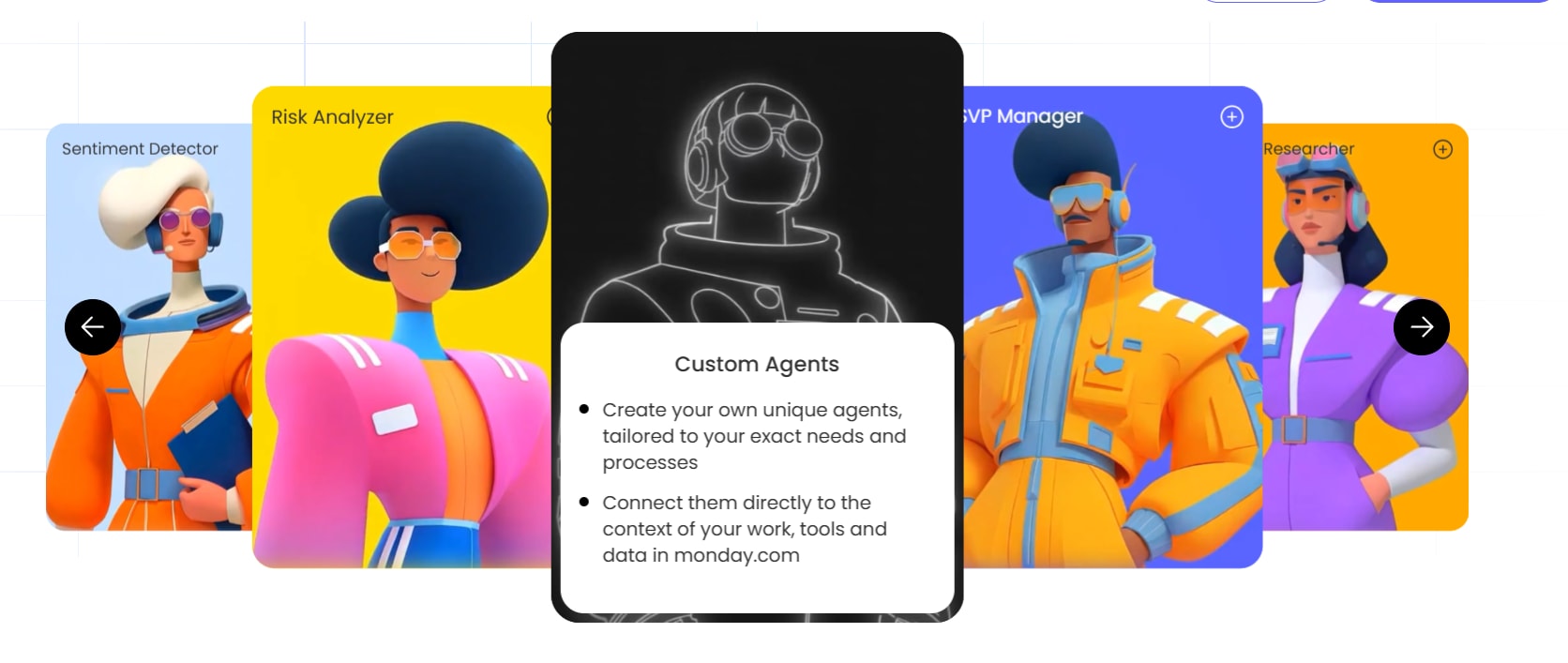
Sales teams use monday agents to qualify prospects and flag deals that need attention. The agents work inside monday AI Workspace, running continuously alongside reps without needing a prompt.
A monday agent is an autonomous teammate that reads the sales data already on the board and acts on it directly. Where a rule-based automation follows fixed logic, an agent interprets the situation and decides what to do next. Unlike a chatbot that answers questions or a copilot that suggests options, an agent takes the action itself.
Ready-made agents cover the most common sales workflows, and the no-code agent builder handles anything more specific to a team’s own process.
How sales teams use monday agents across the pipeline
Each stage of the pipeline presents an opportunity for an agent to take on repetitive work. Every agent below is ready to activate as-is, and teams can tune each further through the no-code builder as needs change. The sections below cover where they make the biggest impact, from first inbound lead to closed deal.
Prospecting and outreach
A rep opens their pipeline and finds dozens of new leads, many missing company details and contact info. The Outbound Prospector researches target prospects and drafts personalized, ready-to-send outreach, so reps open a board that’s already enriched and ready to contact. A lead that might have sat untouched for a day gets a first message the same afternoon instead.
For ongoing sequences, the Outbound Sequencing Agent sends personalized messages and follows up automatically until a lead replies.

Most teams call this an AI SDR: an agent that takes over the volume of first-touch and follow-up messages, while qualification stays with the Lead Qualifier and call prep stays with the rep.
For messages outside a formal sequence, AI Blocks like the Writing Assistant can draft a contextual email from existing board data, and Autofill with AI applies that same drafting directly to board columns as new leads arrive. None of this requires a rep to open a separate tool or copy information between systems.
Lead qualification
Without consistent scoring, high-value prospects sit ignored while reps chase lower-priority contacts. The Lead Qualifier scores and prioritizes leads against the criteria a team cares about, whether a lead shows intent by downloading a pricing guide or replying to outreach. A rep working the same list by hand might reach the top prospect by the end of the day; the agent has already flagged it before lunch. The scoring runs continuously, so high-value leads never sit unreviewed overnight.

Demo scheduling and follow-up
Demo scheduling logistics pull a rep’s attention away from other deals in the pipeline, from scheduling the call to following up after. The Sales Demo Manager books demos and handles the prep materials and follow-up that come with them, so reps show up prepared and move straight to the next conversation once it wraps. Nobody has to double-check whether a confirmation email went out or which version of the deck they sent.

Keeping records accurate
Records in monday AI Workspace drift out of date fast, especially once an account record falls out of step with the system it’s supposed to mirror. The Account Sync Agent keeps a Salesforce account record synced with the tracking board every week for a given product or service line, so reps and sales ops work from the same numbers. A rep pulling a report on Friday can trust the number in front of them instead of checking it against the system it’s meant to reflect.

Deal tracking and pipeline forecasting
Deals flowing off track is one of the biggest threats to quarterly targets, but spotting them early requires constant monitoring most sales leaders don’t have time for. The Pipeline Guardian watches the pipeline and flags deals that are stalling or at risk, recommending the next best action before they slip. The agent flags a deal gone quiet for two weeks the day it crosses that threshold, instead of waiting until next month’s forecast review.
Most teams start with the Lead Qualifier and one outreach agent, then add the others as a specific bottleneck becomes clear, rather than turning every workflow on at once. Each of these runs on the AI credits already included with a paid plan, with more available if usage grows.
Try monday agentsBenefits of using AI agents for sales workflows
Each agent above solves one specific workflow problem, but the value compounds across a full pipeline. The list below breaks down what that adds up to in measurable terms:
- Faster lead management: Agents score and enrich leads before a rep opens them, so first contact happens within minutes of a lead coming in.
- More selling time per rep: Agents absorb data entry and research, freeing hours each week for calls and negotiations.
- Consistent qualification at any hour: The agent evaluates every lead against the same criteria, whether it arrives at 2 p.m. or 2 a.m.
- Personalized outreach without the manual research: Agents draft messages from existing board data, so outreach feels specific to each prospect rather than templated.
- More reliable forecasts: Continuously updated deal stages and synced records keep the pipeline numbers reps present to leadership current.
- Same team, bigger pipeline: Agents absorb volume work that would otherwise mean hiring more SDRs or ops staff just to keep pace.
- Lower cost per qualified opportunity: Research and qualification happen without added headcount, cutting the cost of moving a lead from inbound to qualified.

How agents and reps work together
Knowledge workers spend 60% of the day in emails, chats, and meetings, according to Microsoft’s Work Trend Index. For a sales rep, that squeeze falls hardest on the calls and the negotiating only a person can do. Agents exist to take the rest off a rep’s plate, absorbing the volume work that doesn’t need a person’s judgment call.
Buyers reinforce the case for speed. A lead who fills out a form at 11 p.m. expects a reply before 9 a.m., and by then, they’ve often moved on to a competitor. An agent can qualify and route that lead before a rep even opens their inbox the next morning. Gartner forecasts that 40% of enterprises will have AI agents embedded into their workflows by the end of this year, and sales is one of the functions moving fastest, since qualification and outreach are naturally rules-adjacent work an agent can pick up early.
Agents don’t replace the rep here. The safest place to start is wherever the volume is highest and a mistake is easiest to catch:
| Agents handle | Reps keep |
|---|---|
| Data entry and record accuracy, catching and fixing small errors across many records at once. | Relationship building, built through repeated contact with the buying group. |
| Lead scoring and deal monitoring, flagging a stalled deal or a hot lead before a rep would otherwise notice. | Complex, multi-stakeholder negotiations, where tone and history matter most. |
| Outreach and follow-up sequencing, where a message that needs adjusting is a low-stakes fix, not a lost deal. | Strategic account planning and pricing exceptions, where the implications extend beyond a single deal. |
| Demo logistics, from booking through post-call follow-up, none of which needs judgment to get right. | Sensitive customer escalations, where empathy has to come from a person. |
Agents also handle common objections and qualification questions well on their own. When a prospect raises a concern about pricing or contract terms, the agent escalates to a rep with full context attached, so the conversation starts from a position of strength instead of a cold read. The handoff itself makes the case for the partnership: agents take on the volume and the routine calls, reps keep the ones that decide whether a deal closes.
Teams typically build trust with agents on the highest-volume, lowest-risk work first, like lead qualification and prospecting, then expand the scope as confidence grows.
How to build and deploy agents in monday AI Workspace
Agents don’t require technical expertise to deploy. The following steps get one running:
- Describe the role and triggers. Define what the agent should do and what should set it off, in plain language. For example: “When a new lead lands on the Inbound Leads board, score it based on company size and engagement history, and assign it to the enterprise rep if the score is above 80.”
- Connect knowledge sources. Point the agent to pricing sheets and existing deal records, so it has the same context a prepared rep would. The more relevant context it has, the more accurate its decisions become.
- Test in simulation mode. Watch the agent process a batch of test leads and review its reasoning before it goes live, then activate it once you’re confident in its decisions.
Multiple agents can run at once across different boards without conflict, and any board a rep already has access to can have an agent deployed on it.
How cross-department data improves agent decisions
Because monday AI Workspace connects marketing and support data with the sales pipeline, a sales agent scoring a lead factors in real behavioral signals, such as content downloads or webinar attendance, alongside firmographic fit. A prospect with open support tickets or pending invoices shows up in the same view, giving agents a fuller picture than a system built from disconnected tools could provide.
In a standalone CRM, that context usually lives in a separate system a rep has to check manually. Inside monday AI Workspace, an agent already has it, so the score or the flag it produces reflects the full account rather than just the fields sitting on a sales board. A support ticket opened last week can shift how the agent prioritizes a renewal this week, without a rep connecting the two manually.

Guardrails and compliance
Every agent runs inside guardrails teams control directly. Simulation mode previews what an agent would do before it goes live, and audit trails log every action it takes. High-impact actions, like changing a deal stage or sending an outbound message, need human approval before they run.
Simulation mode also lets teams preview agent behavior on customer-facing workflows before anything reaches a prospect, catching issues ahead of time rather than after. Admins set exactly what each agent can read and change, and disclosure settings control whether a prospect is told they’re interacting with AI. If a decision looks wrong after the fact, the audit trail shows exactly what the agent saw and why it acted, so the fix is a configuration change rather than a guessing game.
The platform holds SOC 2 Type II, ISO/IEC 27001, and ISO/IEC 27701 certifications, and supports GDPR and HIPAA compliance. Customer data is never used to train AI models.
Measuring agent performance
Thirty days after deployment, these metrics show whether agents are delivering value:
- Speed-to-lead: time between lead submission and first meaningful engagement.
- Lead-to-opportunity conversion rate: percentage of scored leads that become qualified opportunities.
- Rep selling time: hours per week on revenue-generating activity versus administrative work.
- Pipeline accuracy: variance between forecasted and actual deal outcomes.
- Cost per qualified opportunity: total sales cost divided by qualified opportunities generated.
Agent-driven outcomes, like leads scored and demos booked, can sit on the same monday AI Workspace dashboards reps already check daily, next to rep-driven outcomes like deals closed and revenue generated. The side-by-side view makes it easier to see which agents are pulling their weight and which need adjusting.
Start automating sales busywork with monday agents
Sales teams using monday agents offload the work that keeps reps from selling: prospecting and pipeline monitoring, while keeping full control through audit trails and simulation mode.
Start with one or two high-impact workflows, like lead qualification or prospecting, using the ready-made agents. Track results in your pipeline within weeks.
Try monday agentsFAQs
How is a monday agent different from an automation?
An automation follows a fixed rule (when X happens, do Y), while a monday agent interprets context and decides what action to take next, without a predefined trigger for every scenario.
Do AI agents replace SDRs or sales reps?
No. Agents handle operational work like lead scoring and data entry so that SDRs and reps can spend more time on relationship building and closing deals.
How long does it take to set up an AI agent?
Ready-made agents like the Lead Qualifier or Pipeline Guardian activate immediately. The no-code builder lets a team describe and test a custom agent in simulation mode before deployment, all within minutes.
Can multiple agents run on the same board?
Yes, each agent operates within its own defined scope and permissions, so a Lead Qualifier and a Pipeline Guardian can run on the same pipeline without stepping on each other's work.
Can I customize a ready-made agent instead of building from scratch?
Yes. The same no-code builder used for custom agents lets a team adjust any ready-made agent, starting from the Lead Qualifier's default criteria and tuning it to match their own scoring model.
What happens if an agent makes a mistake?
The audit trail logs every action, so a rep or admin can see what the agent saw and why it acted, then adjust the agent's instructions or reverse the specific action.
Is my sales data secure when using AI agents?
Yes. Agents operate within enterprise-grade security infrastructure, including SOC 2 Type II and ISO 27001 certifications, GDPR compliance, HIPAA support, granular permissions, and a policy that customer data is never used to train AI models.
How much do monday agents cost?
Every monday.com account receives free AI credits monthly to explore AI capabilities. monday.com offers a free signup with no credit card required, so teams can start exploring before committing to a paid plan.

 Get started