


Your sales team closes deals, but the CRM feels like it’s working against them. Healthcare reps spend 20 minutes scrolling through patient interaction histories before calls. Manufacturing teams manually enter technical specs from RFPs into generic contact fields that weren’t built for equipment serial numbers. Financial advisors juggle compliance requirements across three different systems because their CRM treats audit trails as an afterthought. Most platforms were built as one-size-fits-all solutions for businesses that operate nothing alike.
AI is transforming CRM from passive databases into active business intelligence platforms across major industries. In this guide, you’ll see the shift from generic to industry-specific solutions, learn how to evaluate which approach fits your business, and discover how monday CRM’s flexible platform can be configured to your exact needs.
Key takeaways
- Choose a CRM that speaks your industry’s language: Industry-aligned platforms deliver faster setup and higher adoption.
- Set realistic ROI expectations by sector: Retail sees results in 3-6 months, while manufacturing needs 12-18 months due to complex B2B cycles.
- AI transforms CRM from filing cabinet to business intelligence: Modern systems analyze data, predict outcomes, and recommend actions.
- Leverage monday CRM’s AI to eliminate manual work: Extract Info pulls data from documents, Timeline Summary creates instant context, and Assign Person matches work to the right team members.
- Evaluate platforms against three requirement layers: Universal needs, industry workflows, and company differentiators determine which CRM works long-term.
What are CRM industries and why do they matter now?
CRM industries are the specific business sectors that rely on customer relationship management software configured for their unique operational needs, compliance requirements, and customer engagement patterns. Manufacturing, healthcare, financial services, retail, and professional services each operate with fundamentally different workflows. A manufacturing company tracking equipment sales operates nothing like a healthcare provider managing patient communications or a financial services firm navigating regulatory requirements.
Organizations using CRM systems that understand their sector’s workflows report faster implementation timelines, higher user adoption rates, and measurable improvements in customer retention.
When a CRM speaks the language of your industry, whether that’s policy numbers in insurance, patient records in healthcare, or SKUs in retail, teams spend less time adapting the system and more time using it.
How to choose the right CRM for your industry
Choosing a CRM that fits your industry isn’t about checking feature boxes. It’s about understanding how your sector operates, what regulations you face, and which systems you need to connect. Follow these three steps to evaluate whether a platform will actually work for your business.
Understand the shift from generic to industry-specific solutions
Early CRM systems were designed as horizontal platforms. One system meant to serve any business, regardless of sector. Sales teams across manufacturing, healthcare, and retail all used the same contact fields, the same pipeline stages, and the same reporting structures.
This approach made sense when CRM was primarily a digital rolodex, but it doesn’t cut it anymore. Three factors drive the need for industry-specific solutions, and they’ll help you figure out whether your current CRM software actually fits how you work.
| Aspect | Generic CRM | Industry-specific CRM |
|---|---|---|
| Data fields | Standard contact and company fields | Pre-configured for industry terminology (patient records, policy numbers, SKUs, equipment serial numbers) |
| Workflows | Manual configuration required for every process | Industry processes built-in (claims processing, patient intake, quote-to-cash, referral management) |
| Compliance | Third-party add-ons needed, creating integration gaps | Native compliance features (HIPAA, SOC 2, GDPR, audit trails) |
| Integrations | Generic API connections | Pre-built connectors to industry-specific systems (EHR, ERP, e-commerce platforms) |
Here’s where it matters most:
- Industry-specific workflows: B2B manufacturers need technical specs, multi-stakeholder coordination, and months-long negotiations. Retail runs on high-volume transactions. Generic CRM forces both into the same template, creating friction.
- Compliance requirements: Healthcare needs HIPAA-compliant data handling in every workflow. Financial services require audit trails tracking every client interaction.
- Data structures: Wealth management firms track household relationships and investment preferences. Manufacturers track equipment serial numbers and warranty terms.
Identify your industry’s unique requirements
Every industry has three layers of CRM requirements that determine whether a system will actually get used or collect dust. Know these layers, and you’ll spot solutions that fit your business instead of forcing you into generic templates.
The first layer covers universal needs that every business shares: contact management, pipeline management, basic reporting, and communication logging. Layer two gets specific: the workflows and requirements that define how your sector actually operates. Layer three? What sets you apart from competitors.
Compliance requirements shape everything, from data storage to who can access what:
- Financial services organizations need SOC 2 compliance and comprehensive audit trails tracking every client interaction and data modification
- Healthcare requires HIPAA-compliant data storage, transmission, and access controls
- Manufacturing serving government contracts may need specific security certifications
Sales cycle characteristics shape how CRM must function. Retail operates on days with high transaction volume and quick decisions. Professional services run on weeks to months with relationship building and proposal development. Manufacturing and enterprise software can extend to years with multiple stakeholders and technical evaluations.
Evaluate industry-specific CRM integrations
Integration ecosystem requirements define which systems the CRM must connect with seamlessly. The table below outlines critical integrations by industry and why they matter for revenue operations:
| Industry | Critical integrations | Why it matters |
|---|---|---|
| Retail | E-commerce platforms, marketing automation, inventory systems | Real-time customer data across all purchase channels |
| Manufacturing | ERP systems, PLM tools, supply chain platforms | Quote accuracy, inventory visibility, order fulfillment coordination |
| Healthcare | Electronic health records, billing systems, telehealth platforms | Patient data synchronization, care coordination, compliance |
| Financial services | Portfolio management systems, compliance monitoring, document management | Client financial picture, regulatory adherence, audit trails |
| Professional services | Project management, time tracking, billing systems | Resource utilization, project profitability, accurate invoicing |
Set realistic ROI expectations by sector
ROI timelines and metrics look different across industries because sales cycles, customer lifetime value, and operational complexity all vary. Set realistic expectations for your sector, and you’ll avoid disappointment while making a stronger case to leadership.
- Fast ROI industries (3-6 months): Retail and e-commerce see quick returns through conversion rate improvement, customer retention gains, reduced cart abandonment, and personalized marketing efficiency. Professional services achieve similar timelines by improving resource utilization rates, project profitability, proposal win rates, and billing accuracy.
- Medium ROI industries (6-12 months): Financial services require more time due to compliance complexity, showing gradual gains in client acquisition cost reduction, compliance efficiency, and cross-selling success. Healthcare operates on similar timelines, focusing on patient engagement scores, appointment no-show reduction, and care coordination improvements.
- Longer ROI industries (12-18 months): Manufacturing needs extended timelines due to complex B2B sales cycles, multiple stakeholders, and extensive ERP integration requirements. Primary metrics include shortened sales cycles and improved quote accuracy, with secondary benefits in enhanced customer communication and pipeline visibility.
AI is changing CRM from a passive database into an active intelligence system. It analyzes data, spots patterns, predicts outcomes, and tells you what to do next. This transformation affects all industries, but how it shows up depends on workflow complexity, data volume, and how customers interact with you.
How AI is transforming CRM across all industries
AI is changing CRM from a passive database into an active intelligence system. It analyzes data, spots patterns, predicts outcomes, and tells you what to do next. This transformation affects all industries, but how it shows up depends on workflow complexity, data volume, and how customers interact with you.
From systems of record to AI-driven intelligence
Traditional CRM systems function as sophisticated filing cabinets. They store contacts, log interactions, and track deals. Every insight requires human analysis.
AI-powered CRM systems operate differently. They analyze data, spot patterns you’d miss, predict what’s coming, and recommend actions. The system does work instead of just recording it.
Organizations using monday CRM’s AI Timeline Summary get instant context before customer calls through short summaries of all communication events, including emails, calls, meetings, and notes. Sales and support teams save valuable time instead of scrolling through lengthy histories.
Digital workers and industry-specific AI agents
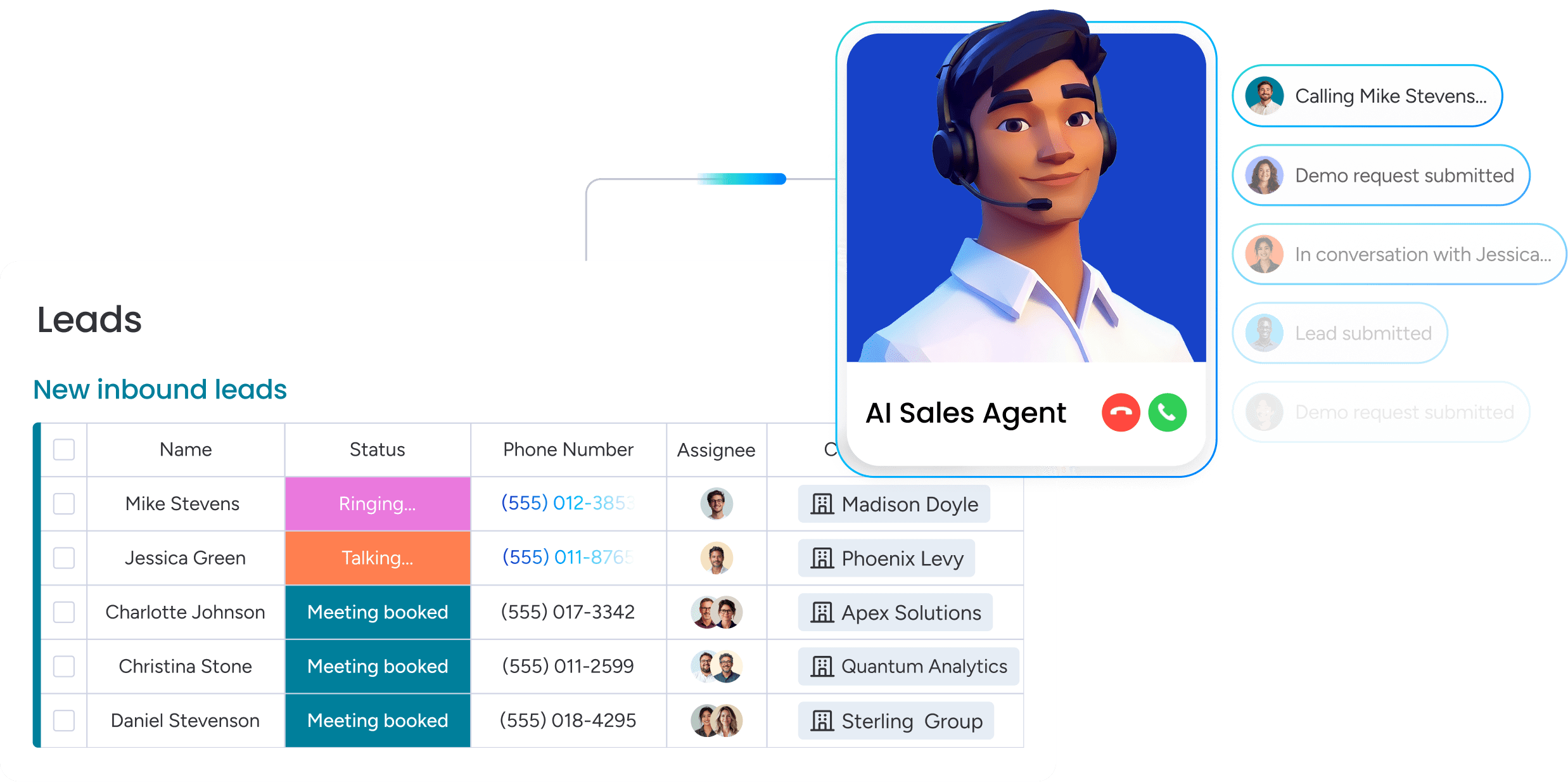
Digital workers are AI specialists that handle specific tasks nonstop, learn as they go, and get better over time. Unlike chatbots that just answer questions, digital workers do real work: they monitor data, analyze patterns, recommend actions, and execute tasks within set boundaries.
Try monday CRMMeasurable business impact of CRM AI integration

AI’s impact depends on what work it automates or improves in your industry. Revenue teams using monday CRM’s Extract Info AI action automatically extract and organize key information from files like invoices, resumes, or contracts as part of comprehensive sales automation. Specific details appear directly in board columns, eliminating manual input.
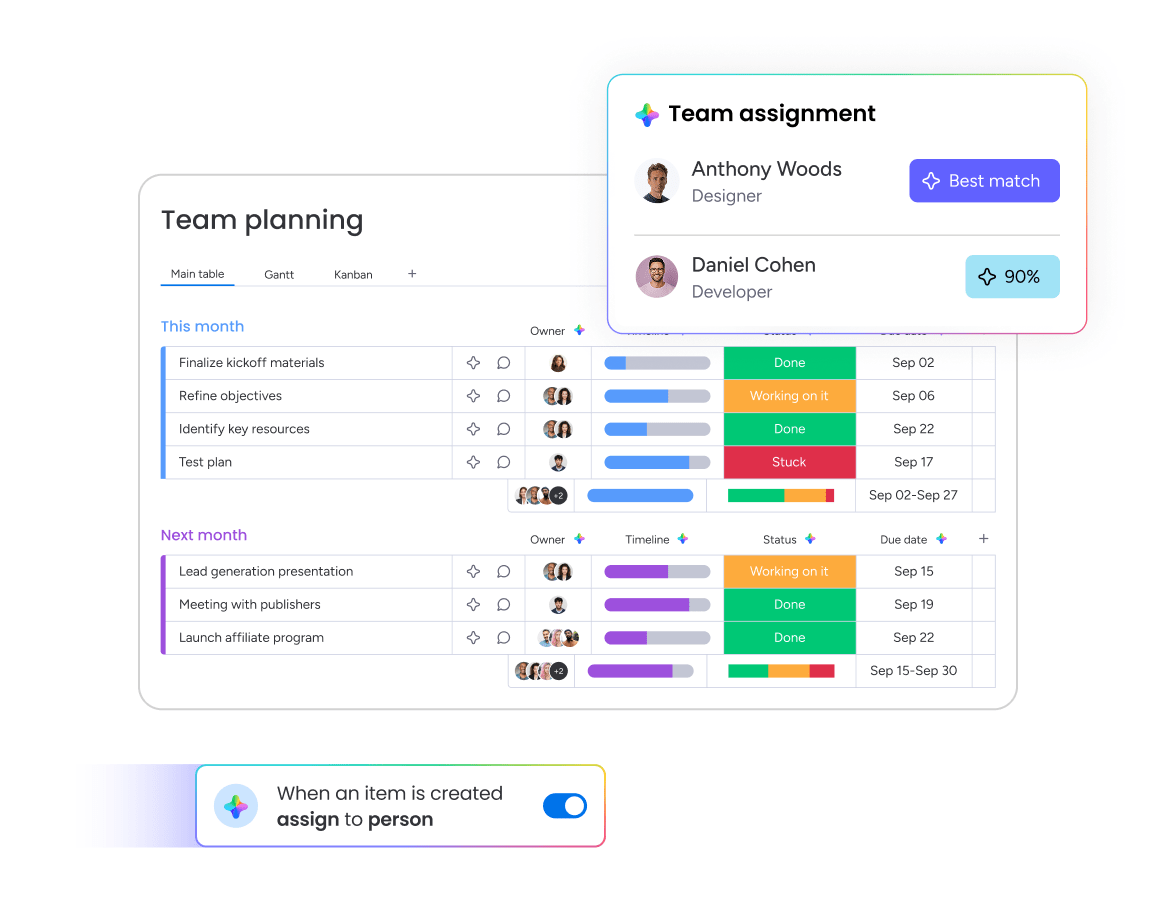
The Assign Label action analyzes text and automatically categorizes items, while the Assign Person action matches work to the right team members based on defined roles and skills. Organizations using AI-powered CRM handle significantly increased volume without adding staff proportionally, maintaining consistent communication quality at scale through tools like monday CRM’s Writing Assistant.
How monday CRM helps organizations meet industry requirements
The CRM market splits into two camps: platforms built for specific industries and flexible platforms that adapt to any sector. This distinction affects implementation complexity, ongoing maintenance, and long-term flexibility. Industry-specific platforms give you deep functionality for your sector, but can box you in as your business evolves. Flexible platforms need more setup work upfront, but they grow with you.
Financial services and insurance
Financial services and insurance organizations face heavy regulation, decades-long client relationships, specialized system integrations, and the constant tension between compliance and client experience.
Compliance and security requirements are non-negotiable foundations:
- SOC 2 certification and enterprise-grade data encryption form the baseline
- Audit trail functionality must track every client interaction and data modification
- Role-based access controls limit data visibility based on regulatory requirements and client confidentiality
Client relationship management must handle complexity beyond basic contacts:
- Household and entity relationship mapping tracks families, trusts, businesses, and their interconnections
- Integration with wealth management and portfolio systems ensures advisors see complete client financial pictures
Organizations in financial services gain value from a platform like monday CRM through compliance-ready infrastructure with SOC 2 certification, customizable workflows for different service models, and AI capabilities that enhance advisor productivity. The AI Timeline Summary helps advisors quickly understand client history before conversations, while Extract Info can pull data from loan applications and compliance documents directly into board columns.
Manufacturing and distribution

Manufacturing CRM must handle long sales cycles, complex B2B relationships, technical specs, and deep integration with ERP systems. This requires a platform built with the flexibility to manage such specific demands.
Complex sales process management addresses multi-stakeholder deals through:
- Deal tracking across multiple contacts with different roles
- Quote configuration for products with multiple specifications
- Proposal management with version control and approval workflows
Technical product information must be accessible during sales conversations:
- Product catalog integration with specifications
- Equipment serial number tracking for warranty management
- Configuration tools ensuring quotes include compatible components
Manufacturing teams benefit from monday CRM through deep integration capabilities connecting to major ERP systems, customizable workflows for complex sales processes, and AI-powered features that streamline technical sales. The Assign Person action automatically matches complex deals to team members with the right technical expertise and product knowledge, ensuring quotes reach engineers who understand specific equipment configurations and industry requirements.
Healthcare and life sciences
Healthcare CRM operates under strict HIPAA rules, manages complex patient and provider relationships, integrates with electronic health records, and balances clinical work with business development.
Compliance and security form foundational requirements:
- HIPAA-compliant data storage and transmission with encryption at rest and in transit
- Patient consent management and documentation
- Audit trails for all patient data access and modifications
Patient engagement and communication must be coordinated across the organization:
- Appointment scheduling with automated reminders
- Care coordination workflows ensuring patients complete recommended follow-ups
- Post-visit follow-up workflows requiring specialized configuration
Healthcare organizations benefit from monday CRM through HIPAA-compliant infrastructure, customizable patient engagement workflows, and AI capabilities that reduce administrative burden. The AI Timeline Summary provides clinical staff with instant patient interaction history before appointments, while the Assign Label action automatically categorizes patient inquiries by type and urgency, ensuring timely routing to the appropriate department or specialist.
Retail and e-commerce
Retail CRM handles high transaction volumes, omnichannel interactions across online, mobile, and physical stores, real-time personalization, and integration with e-commerce and marketing platforms. Speed and scale set retail apart.
Omnichannel customer data creates unified profiles through:
- Single customer view combining online browsing, mobile app usage, in-store purchases, and customer service interactions
- Real-time synchronization across all touchpoints, ensuring customers receive consistent information regardless of channel
Marketing automation and personalization drive revenue:
- AI-powered product recommendations analyze browsing behavior and purchase history
- Retail teams using monday CRM’s mass email capabilities with tracking for opens and link clicks help scale personalized outreach while measuring effectiveness
Retail teams benefit from monday CRM through flexible integration capabilities connecting to major e-commerce platforms, customizable workflows for omnichannel customer journeys, and AI-powered features that scale personalization.
Try monday CRMProfessional services
Professional services CRM manages project-based revenue, resource allocation, time tracking, billing, and the handoff from sales to delivery. Everything revolves around projects, which creates specific workflow needs.
Opportunity and proposal management supports business development:
- RFP and proposal tracking with collaboration features
- Scope definition and pricing tools
- Win/loss analysis identifying patterns in successful proposals
Resource planning and allocation optimizes team utilization:
- Skills-based resource matching
- Availability tracking across team members
- Utilization rate monitoring identifying under- and over-allocated staff
Professional services firms benefit from monday CRM by connecting business development, resource planning, and project delivery in unified workflows. The platform supports client projects for calculating billable hours, sending quotes, and collaborating with stakeholders across teams.
All industries are adopting CRM, but certain sectors are fundamentally changing how they use it. This transformation goes beyond new features. It’s a shift in what CRM does: from record-keeping to active business intelligence.
5 industries seeing massive CRM transformation
All industries are adopting CRM, but certain sectors are fundamentally changing how they use it. This transformation goes beyond new features. It’s a shift in what CRM does: from record-keeping to active business intelligence.
1. Manufacturing shows revenue growth through CRM optimization
Manufacturers are moving beyond basic contact management and using CRM for revenue intelligence. They’re shifting from reactive sales to predictive, AI-driven approaches that spot opportunities and risks early.
- AI analyzes historical deal patterns to identify which opportunities are likely to close and which need intervention
- Predictive analytics forecast customer reorder timing based on equipment lifecycles and usage patterns
- Pulls technical specifications from RFPs and automatically populates quote configurations, reducing hours of manual data entry to minutes of verification
2. Financial services enhances the customer experience with AI
Financial services CRM is moving from compliance-focused record-keeping to AI-powered relationship management. Advisors can serve more clients without sacrificing personalization.
- AI monitors client portfolios and life events to trigger timely, relevant outreach
- Sentiment analysis of client communications flags concerns for immediate advisor attention
- Detect sentiment to categorizes text as positive, negative, or neutral, helping advisors identify clients who may need proactive outreach before they express dissatisfaction directly
3. Healthcare streamlines patient journey management
Healthcare CRM is moving beyond appointment scheduling to manage the entire patient journey. Patient outcomes improve while clinical staff spend less time on admin work.
- Unified patient communication across departments ensures consistent messaging
- Care coordination workflows ensure patients complete recommended follow-ups and screenings
- AI categorizes patient inquiries and routes to appropriate staff based on urgency and expertise needed
4. Retail creates unified commerce experiences
Retail CRM is moving from channel-specific systems to unified platforms that recognize customers no matter how they shop. Customers get real omnichannel experiences, and lifetime value goes up.
- Single customer view combines online browsing, mobile app usage, in-store purchases, and customer service interactions into one profile
- AI-powered product recommendations analyze browsing behavior, purchase history, and similar customer patterns
- Email campaigns with performance tracking let retail teams send individual and mass emails using dynamic fields and templates, then track open rates and link clicks
5. Professional services achieves resource optimization
Professional services CRM is moving from opportunity tracking to full resource and profitability optimization. Firms can take on more projects without hiring proportionally more people.
- Seamless handoff from sales to delivery teams transfers full context
- Skills-based resource matching analyzes project requirements against team capabilities
- Account management tracks client onboarding progress and manages renewals
- Client projects calculate billable hours and enable collaboration with stakeholders
- Collection tracking monitors payment status across the client portfolio
Industry-specific CRM success starts with understanding your unique needs
The shift from generic to industry-specific CRM affects how your team works, how quickly you see results, and how well your system adapts. Teams that choose CRM aligned with their industry’s workflows, compliance needs, and integrations get faster implementation, higher adoption, and real revenue impact.
AI accelerates this shift by making CRM systems do work instead of just keeping records. Whether you’re in manufacturing, financial services, or healthcare, AI configured for your industry delivers immediate value. Success comes down to understanding your industry’s three requirement layers: universal business needs, sector-specific workflows, and what makes your company different.
Try monday CRMFAQs
What is a CRM for service businesses?
A CRM for service businesses is a platform that manages project-based revenue, tracks billable hours, handles resource allocation, and connects business development to project delivery in unified workflows. Service businesses need CRM capabilities that go beyond basic contact management to include project tracking, time management, and profitability analysis.
Why do financial institutions need a CRM?
Financial institutions need a CRM to maintain compliance audit trails, manage complex household and entity relationships, track all client interactions across channels, and enable advisors to serve more clients through automation and AI assistance. The platform must balance strict regulatory requirements with the need to deliver personalized client experiences.
What CRM features do you need for a service business?
Service businesses need project-deal linkage for seamless handoffs, time tracking integration, resource allocation visibility, profitability views by project and client, and proposal management with collaboration features. These capabilities ensure teams can track revenue from initial opportunity through project delivery and final invoicing.
Can small businesses afford a CRM?
Small businesses can afford CRM platforms with flexible pricing that scales with team size. The cost of not having a CRM often exceeds the investment through lost deals, manual errors, and time waste on administrative work that could be automated.
What should small business owners look for in a CRM?
The best CRM for small business owners combines an intuitive interface that feels familiar, no-code setup that doesn't require IT help, fast time-to-value measured in days rather than months, and the ability to scale as the business grows. Small businesses need platforms that deliver immediate value without extensive configuration.
How is AI changing CRM workflows across industries in 2026?
AI is transforming CRM from passive databases into active business intelligence systems that extract data from documents, summarize customer histories, route work to the right people, and compose communications. These capabilities are configured for industry-specific workflows and compliance requirements, making AI practical for real business use rather than a theoretical promise.
