


As teams grow and projects span more departments, the friction of scattered tools, missed deadlines, and duplicated work becomes impossible to ignore. What used to be manageable with spreadsheets and email threads now demands something more structured, especially when dozens of stakeholders need real-time visibility into progress. Project management software solves this by centralizing tasks, timelines, resources, and communication in one place.
Below, you’ll find 15 platforms built for different team sizes and work styles, along with evaluation criteria, essential features, and the trends shaping how organizations manage projects today. We’ll also explore how monday.com’s AI Work Platform’s AI-powered capabilities are setting new standards for intelligent project management.
Key takeaways
- Real-time visibility reduces friction: The right project management software reduces missed deadlines, duplicated work, and status-meeting overload by giving every team member real-time visibility into tasks, timelines, and resources.
- AI is now essential: AI-powered features like autonomous agents, sentiment analysis, and risk detection are now table stakes for modern platforms.
- monday.com’s AI Work Platform automates intelligently: monday.com’s AI Work Platform combines AI Blocks, purpose-built agents, and a no-code app builder to help teams automate routine work and focus on strategic priorities.
- Thorough evaluation prevents costly switches: Evaluating platforms across pricing, integrations, security, and ease of adoption prevents costly tool switches down the road.
- Phased rollouts drive adoption: A phased rollout with a pilot team, defined success metrics, and targeted training dramatically improves adoption rates.
15 tools to streamline projects and portfolios
Finding the right project management software tools can transform how your team works together. Each platform offers unique strengths for different organizational needs and work styles.
Before diving into each platform, here’s a quick comparison of all 15 tools to help you narrow down your shortlist based on pricing, strengths, and plan availability.
| Platform | Best for | Starting price | Free plan | Key differentiator |
|---|---|---|---|---|
| monday.com's AI Work Platform | Cross-departmental teams | Contact sales | Yes (up to 2 seats) | AI agents, no-code app builder, 200+ integrations |
| Asana | Marketing and creative teams | $10.99/user/mo | Yes | Timeline view and workload management |
| Trello | Small teams and startups | $5/user/mo | Yes | Kanban-first simplicity |
| Smartsheet | Data-driven teams | $7/user/mo | Yes | Spreadsheet-like interface with PM features |
| Wrike | Complex approval workflows | $9.80/user/mo | Yes | Proofing and review for creative work |
| ClickUp | Teams wanting flexibility | $7/user/mo | Yes | Multiple views and deep customization |
| Airtable | Interconnected data management | $10/user/mo | Yes | Relational database meets project management |
| Basecamp | Small businesses and agencies | $15/user/mo | No | Flat-rate pricing for unlimited users |
| Jira | Software development teams | $7.75/user/mo | Yes | Agile-native with sprint management |
| Notion | Knowledge + project management | $8/user/mo | Yes | All-in-one workspace for docs, tasks, wikis |
| Zoho Projects | Zoho ecosystem users | $5/user/mo | Yes | Deep integration with Zoho suite |
| Hive | Marketing and creative agencies | $12/user/mo | Yes | Native chat and proofing workflows |
| GanttPRO | Gantt chart-focused planning | $7.99/user/mo | No | Interactive Gantt charts with cost tracking |
| Microsoft Project | Enterprise portfolios | $10/user/mo | No | Microsoft 365 integration and advanced scheduling |
| Teamwork | Client-facing service teams | $10/user/mo | Yes | Client portal and billable hour tracking |
1. monday.com’s AI Work Platform
Best for: Cross-departmental teams needing a unified work platform that scales from small projects to enterprise-wide initiatives.
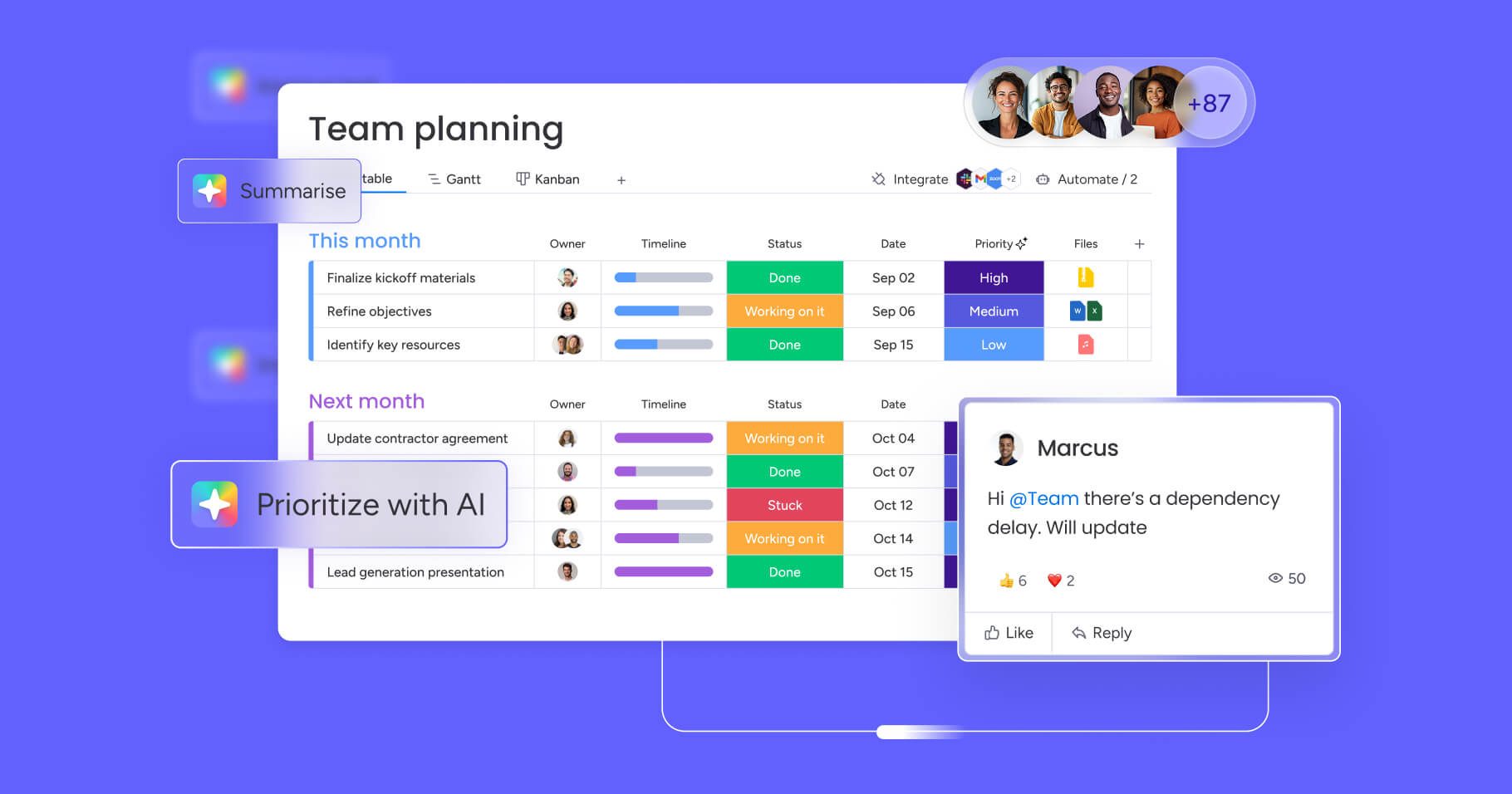
monday.com’s AI Work Platform stands out with its intuitive visual interface, powerful customization options, and AI-first approach. The platform’s flexible building blocks let teams create workflows for any business process without coding knowledge, while AI agents and automation handle routine work intelligently.
- Customizable dashboards for real-time visibility
- 200+ integrations with popular tools
- No-code automation engine with 250+ templates
- Enterprise-grade security with SOC 2 Type II, GDPR, and ISO 27001 compliance
- Interactive reports and dynamic data visualization
AI capabilities
- AI Blocks: AI Blocks automate content generation, sentiment analysis, and data extraction
- monday agents: Purpose-built AI agents like Project Analyzer that monitor projects and flag bottlenecks in real-time
- monday vibe: AI-powered no-code app builder that turns prompts into working business applications
- monday MCP: Connects external AI assistants (Claude, ChatGPT, Cursor) directly to your workspace
- monday sidekick: Context-aware AI assistant that generates content, analyzes data, and executes actions within workflows
Pricing
Starts at $9/user/month for the Basic plan, with Standard ($12/user/month), Pro ($19/user/month), and Enterprise (custom pricing) options available. Free plan available (up to 2 seats).
Considerations
- Rich feature set may require dedicated onboarding time for full adoption
- Advanced AI capabilities and enterprise features available on higher-tier plans
- Customization flexibility means initial setup investment pays off long-term
Pros: No-code customization for any workflow; AI agents (Project Analyzer) that flag bottlenecks automatically; 200+ integrations; enterprise-grade security (SOC 2, GDPR, ISO 27001); generous free plan
Cons: Rich feature set can require dedicated onboarding time; best AI and enterprise features sit behind higher tiers; initial setup takes investment to configure well
2. Asana
Best for: Marketing teams, creative departments, and organizations focused on task-based workflows.
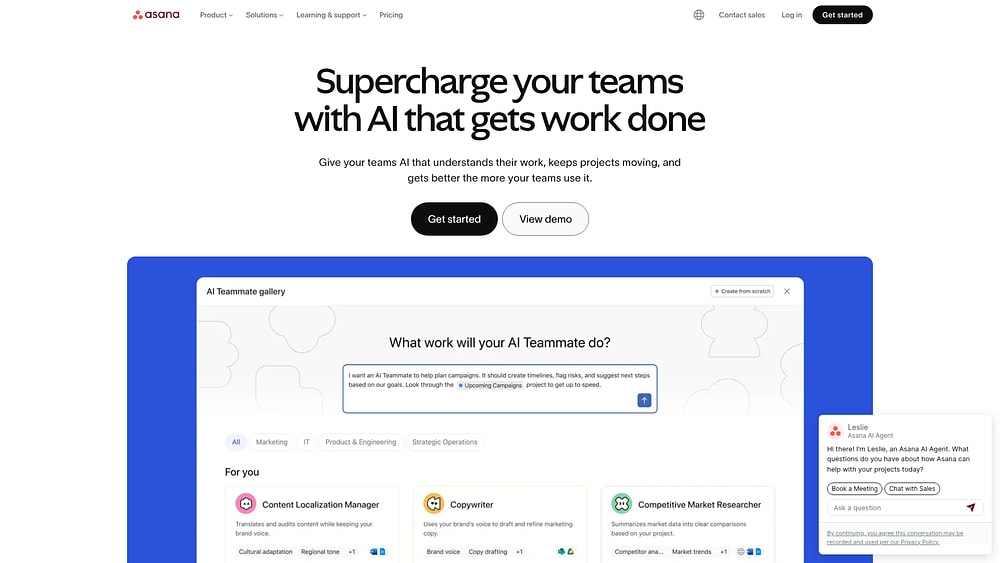
Asana excels at task management with an intuitive interface that makes it easy to organize and track work across teams.Its timeline and workload views help marketing and creative teams visualize project schedules and balance capacity without overwhelming team members.
Key features
- Timeline view for visualizing schedules
- Workload management and capacity planning
- Custom fields and forms for capturing details
- Reporting tools to track progress
Pricing
Starts at $10.99/user/month for the Premium plan, with Business ($24.99/user/month) and Enterprise options available for organizations requiring advanced features and controls.
Considerations
- Limited functionality in free version may necessitate upgrading for growing teams
- Learning curve for complex project setups and dependencies
- Some users report challenges with the mobile experience compared to desktop
Pros: Intuitive task management; strong Timeline and Workload views for capacity planning; custom fields/forms for detail capture
Cons: Free tier is limited, pushing growing teams to upgrade; learning curve for complex dependencies; mobile experience trails desktop
3. Trello
Best for: Small teams, startups, and visual project tracking.
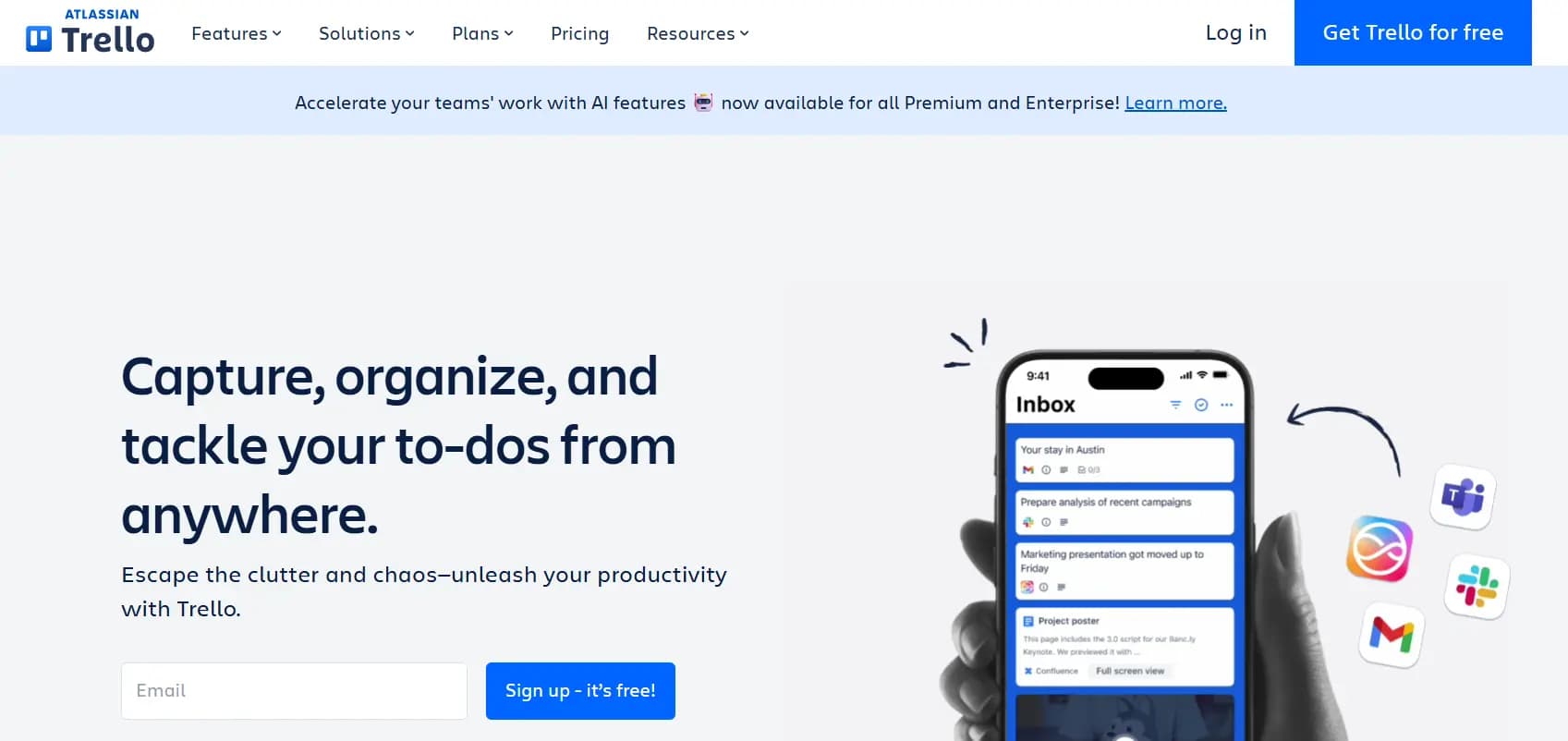
Trello uses a card-based Kanban approach that makes it ideal for visual thinkers and teams that prefer flexibility over structure.
Key features
- Drag-and-drop cards for intuitive management
- Power-Ups that extend functionality
- Checklists and due dates for tracking
- Simple permission settings for collaboration
Pricing
Starts at $5/user/month for the Standard plan, with Premium ($10/user/month) and Enterprise options available for teams requiring advanced automation and admin features.
Considerations
- Limited reporting capabilities compared to more robust platforms
- Can become unwieldy for complex projects with many dependencies
- Free version restrictions may necessitate upgrading for growing teams
Pros: Simple, visual Kanban boards; drag-and-drop ease of use; Power-Ups extend functionality; flexible permissions
Cons: Weak reporting compared to fuller platforms; gets unwieldy on complex, dependency-heavy projects; free plan is restrictive as teams grow
4. Smartsheet
Best for: Data-driven teams and organizations transitioning from spreadsheets.
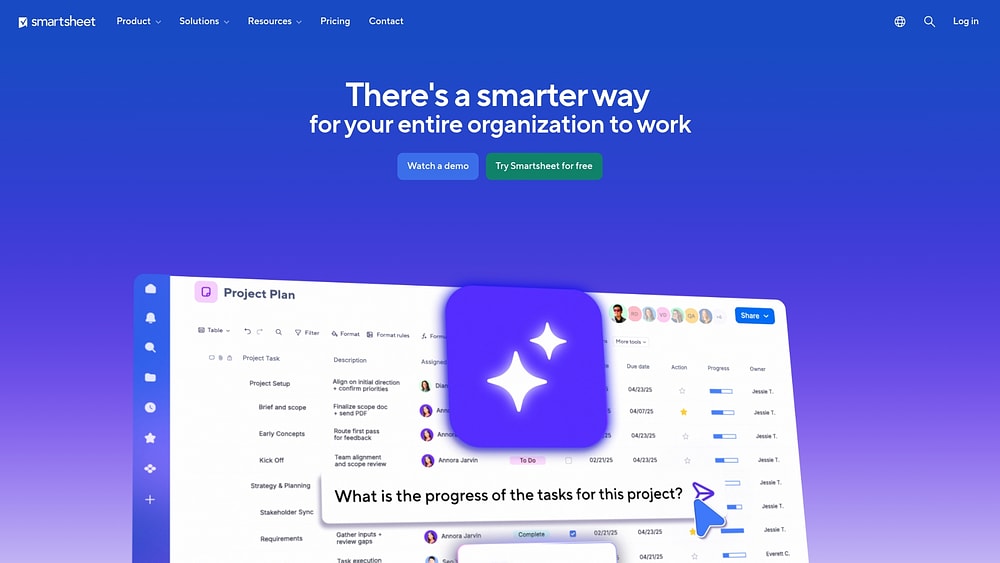
Smartsheet combines the familiarity of spreadsheets with powerful project management applications for a smooth learning curve. Teams comfortable with Excel or Google Sheets can transition quickly while gaining access to advanced features like automated workflows and resource management.
Key features
- Spreadsheet-like interface with project functionality
- Automated workflows and approval processes
- Resource management for team allocation
- Enterprise-level reporting and analytics
Pricing
Starts at $7/user/month for the Pro plan, with Business ($25/user/month) and Enterprise options available for organizations requiring advanced automation and administrative features.
Considerations
- Learning curve may be steeper for users without spreadsheet experience
- Advanced features limited to higher-tier subscriptions
- Complex formulas and dependencies require careful setup
Pros: Familiar spreadsheet-style interface eases onboarding; automated workflows/approvals; solid resource management and enterprise reporting
Cons: Steeper learning curve for non-spreadsheet users; advanced features locked to higher tiers; complex formulas/dependencies need careful setup
5. Wrike
Best for: Mid-size to enterprise organizations with complex approval processes.
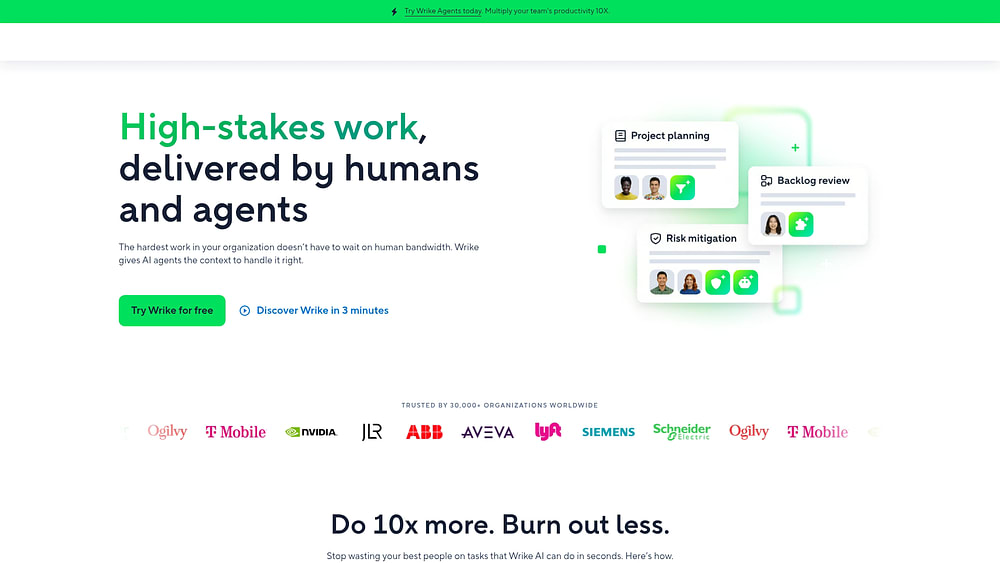
Wrike offers robust customization for complex workflows and approval processes across departments. Its powerful proofing and review capabilities make it particularly valuable for teams managing creative work that requires multiple rounds of stakeholder feedback.
Key features
- Custom request forms and automated approvals
- Time tracking and resource management
- Proofing and review tools for creative work
- Advanced security controls and audit reports
Pricing
Starts at $9.80/user/month for the Team plan, with Business ($24.80/user/month) and Enterprise options available for organizations requiring advanced security and customization features.
Considerations
- Complex interface may require dedicated training for team adoption
- Advanced features limited to higher-tier subscriptions
- Setup time can be significant for customized workflows
Pros: Deep customization for complex approval workflows; strong proofing/review tools for creative work; advanced security and audit controls
Cons: Complex interface needs dedicated training; advanced features gated to pricier plans; significant setup time for custom workflows
6. ClickUp
Best for: Teams seeking flexibility in how they visualize and manage work.
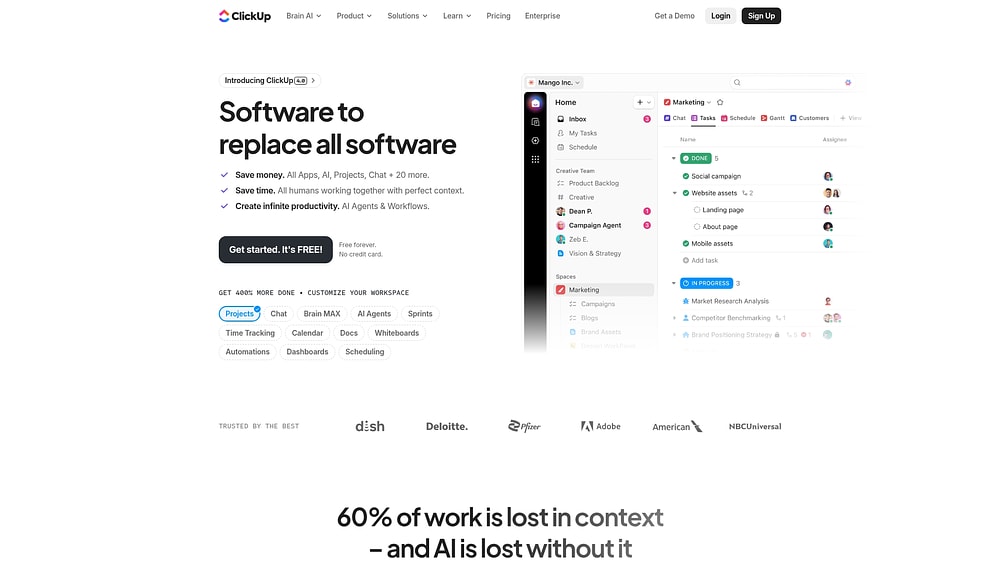
ClickUp provides extensive customization options with multiple ways to view and organize work. Its all-in-one approach combines project management, document creation, and knowledge management in a single platform that adapts to diverse team workflows.
Key features
- Multiple views including list, board, and Gantt
- Document creation and knowledge management
- Custom fields and statuses for workflows
- Time tracking and reporting tools
Pricing
Starts at $7/user/month for the Unlimited plan, with Business ($12/user/month) and Enterprise options available for teams requiring advanced customization and security features.
Considerations
- Feature-rich interface may overwhelm new users initially
- Some advanced functionality requires higher-tier subscriptions
- Performance can slow with very complex workspace structures
Pros: Extremely flexible with many views (list, board, Gantt); combines PM, docs, and knowledge management; strong customization of fields/statuses
Cons: Feature-dense interface can overwhelm new users; some functionality requires higher tiers; performance can lag in complex workspaces
7. Airtable
Best for: Teams managing complex, interconnected data alongside projects.
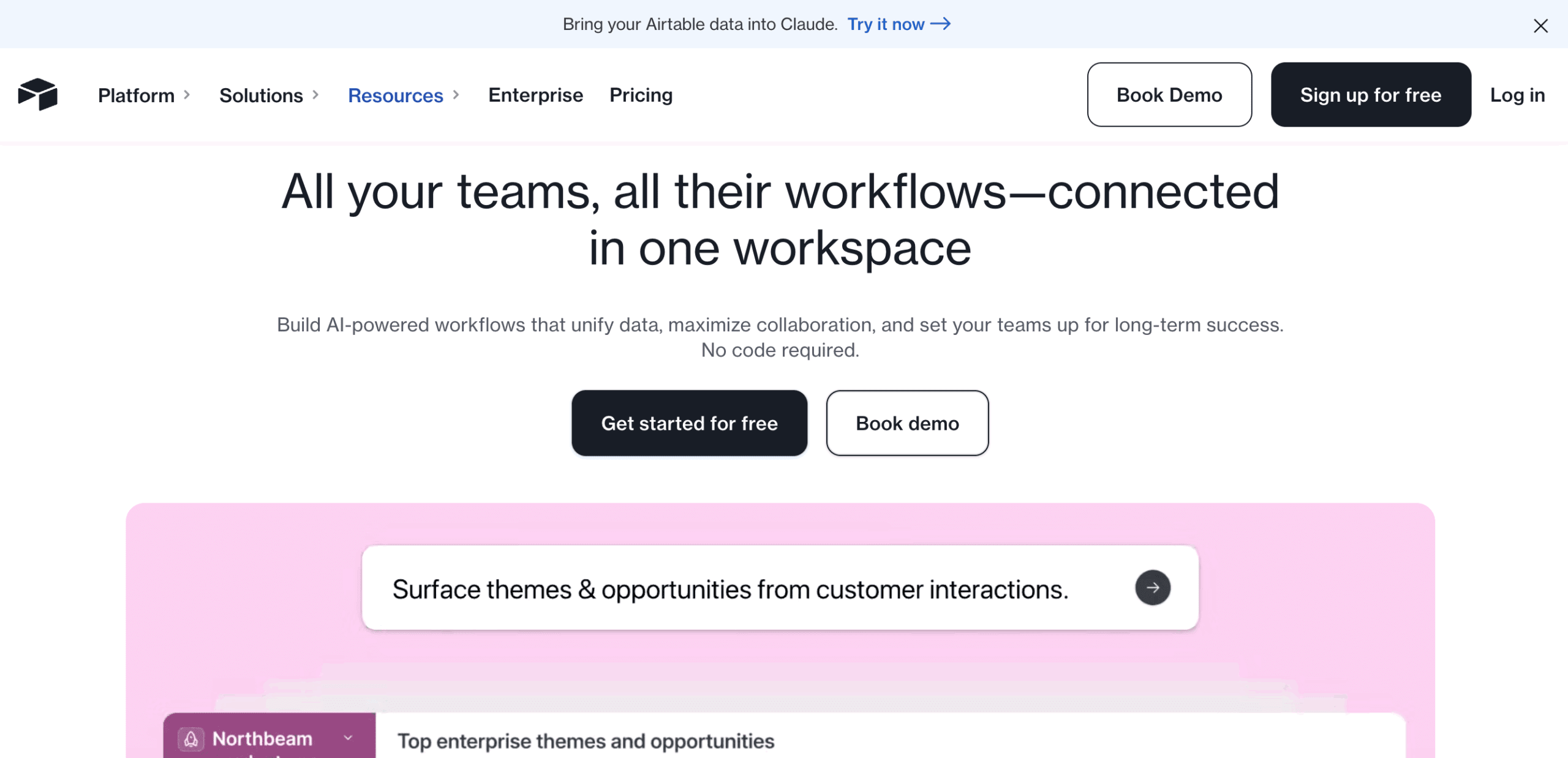
Airtable combines database functionality with project management and notes software for a unique approach to organizing information. Its relational database structure allows teams to connect information across multiple projects and workflows in ways traditional project management tools cannot.
Key features
- Relational database structure for connected information
- Multiple views including grid, calendar, and Kanban
- Custom forms for data collection
- Automation for routine tasks
Pricing
Starts at $10/user/month for the Plus plan, with Pro ($20/user/month) and Enterprise options available for teams requiring advanced features and controls.
Considerations
- Learning curve can be steep for users unfamiliar with database concepts
- Complex formulas and relationships may require technical expertise
- Free plan limitations may necessitate upgrading for growing teams
Pros: Relational database structure connects data across projects; multiple views (grid, calendar, Kanban); good automation for routine tasks
Cons: Steep learning curve for database concepts; complex formulas/relationships may need technical skill; free plan limits growth
8. Basecamp
Best for: Small businesses and agencies looking for straightforward solutions.
Basecamp focuses on simplicity with an all-in-one approach to team communication and project management. Its flat-rate pricing model makes it particularly attractive for growing teams that want predictable costs without per-user scaling.
Key features
- Message boards for team discussions
- To-do lists for task management
- File storage and sharing
- Client access options
Pricing
Flat rate of $15/user/month or $299/month for unlimited users, making it cost-effective for growing teams with no per-user cost scaling.
Considerations
- Limited customization options compared to more flexible platforms
- Lacks advanced project management features like Gantt charts
- All-or-nothing permission structure may be restrictive for complex teams
Pros: Simple all-in-one communication and PM tool; flat-rate pricing (no per-user scaling cost); client access built in
Cons: Limited customization; lacks advanced features like Gantt charts; all-or-nothing permissions can be restrictive for complex teams
9. Jira
Best for: Software development teams and IT departments.
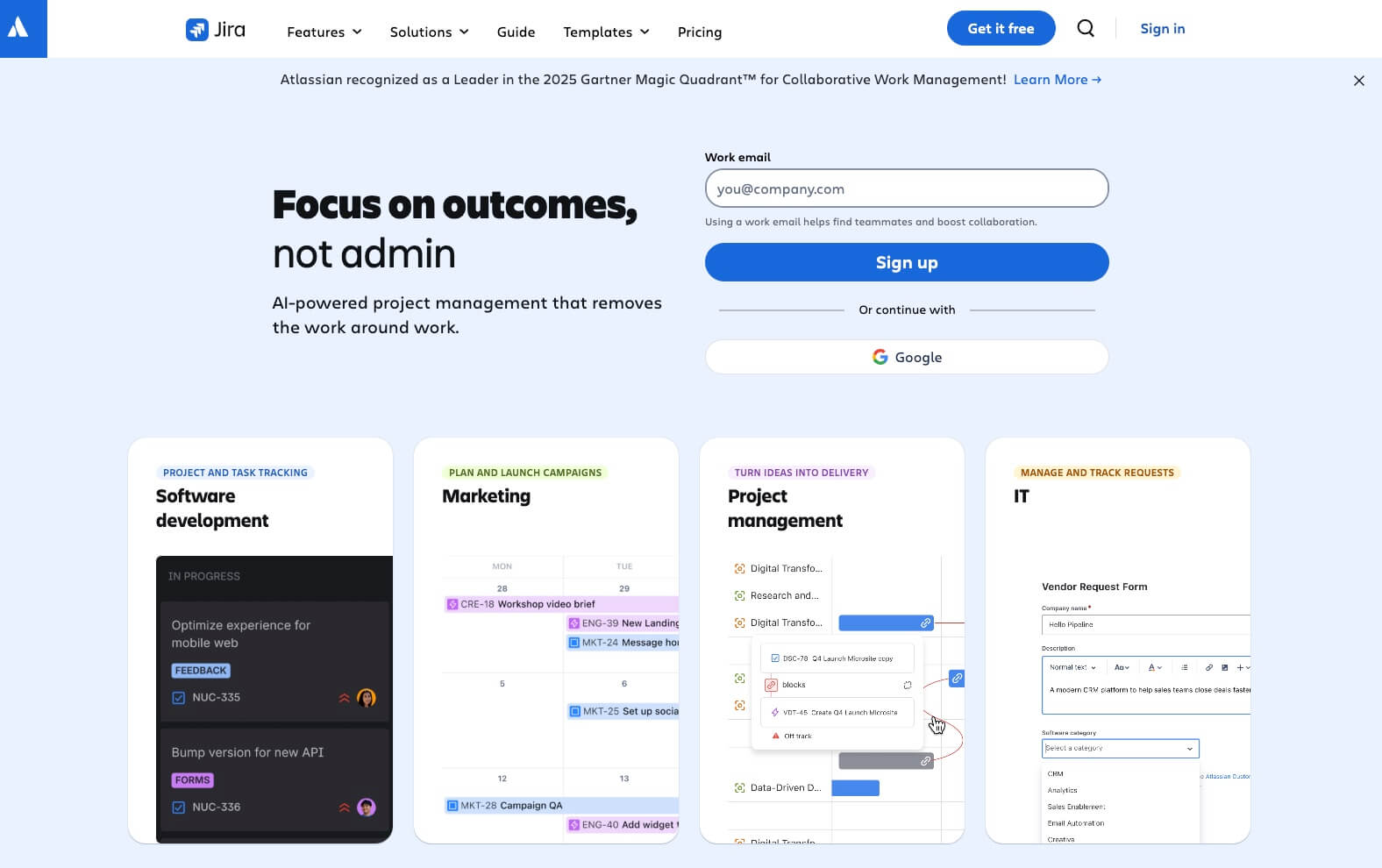
Jira is designed specifically for software development teams using agile methodologies. Its deep integration with development tools and native support for Scrum and Kanban workflows make it the standard choice for engineering organizations.
Key features
- Scrum and Kanban boards for agile workflows
- Issue tracking and bug management
- Release planning and sprint management
- Integration with development tools
Pricing
Starts at $7.75/user/month for the Standard plan, with Premium ($15.25/user/month) and Enterprise options available for organizations requiring advanced features and support.
Considerations
- Steep learning curve for non-technical team members
- Can become complex when customized extensively
- More focused on development than general project management
Pros: Purpose-built for agile/software teams; strong Scrum/Kanban boards, issue tracking, and sprint planning; deep dev-tool integrations
Cons: Steep learning curve for non-technical users; can get complicated with heavy customization; less suited to general (non-dev) project management
10. Notion
Best for: Teams that need to combine project management with knowledge management.
Notion combines notes, tasks, wikis, and databases in a flexible workspace that adapts to various team needs. Its all-in-one approach eliminates the need for separate documentation and project management tools.
Key features
- All-in-one workspace for notes, tasks, and knowledge
- Customizable templates for different workflows
- Database functionality for organizing information
- Wiki-style documentation
Pricing
Starts at $8/user/month for the Team plan, with Free Personal, Plus ($10/user/month), and Enterprise options available for different team sizes and requirements.
Considerations
- Learning curve can be steep for users unfamiliar with flexible workspace concepts
- Limited advanced project management features compared to dedicated platforms
- Performance can slow with very large databases or complex pages
Pros: All-in-one workspace for notes, tasks, and docs; highly customizable templates; database functionality for flexible organization
Cons: Steep learning curve for its flexible/blank-slate style; lighter on advanced PM features than dedicated platforms; can slow down with large databases
11. Zoho Projects
Best for: Organizations already using Zoho applications.
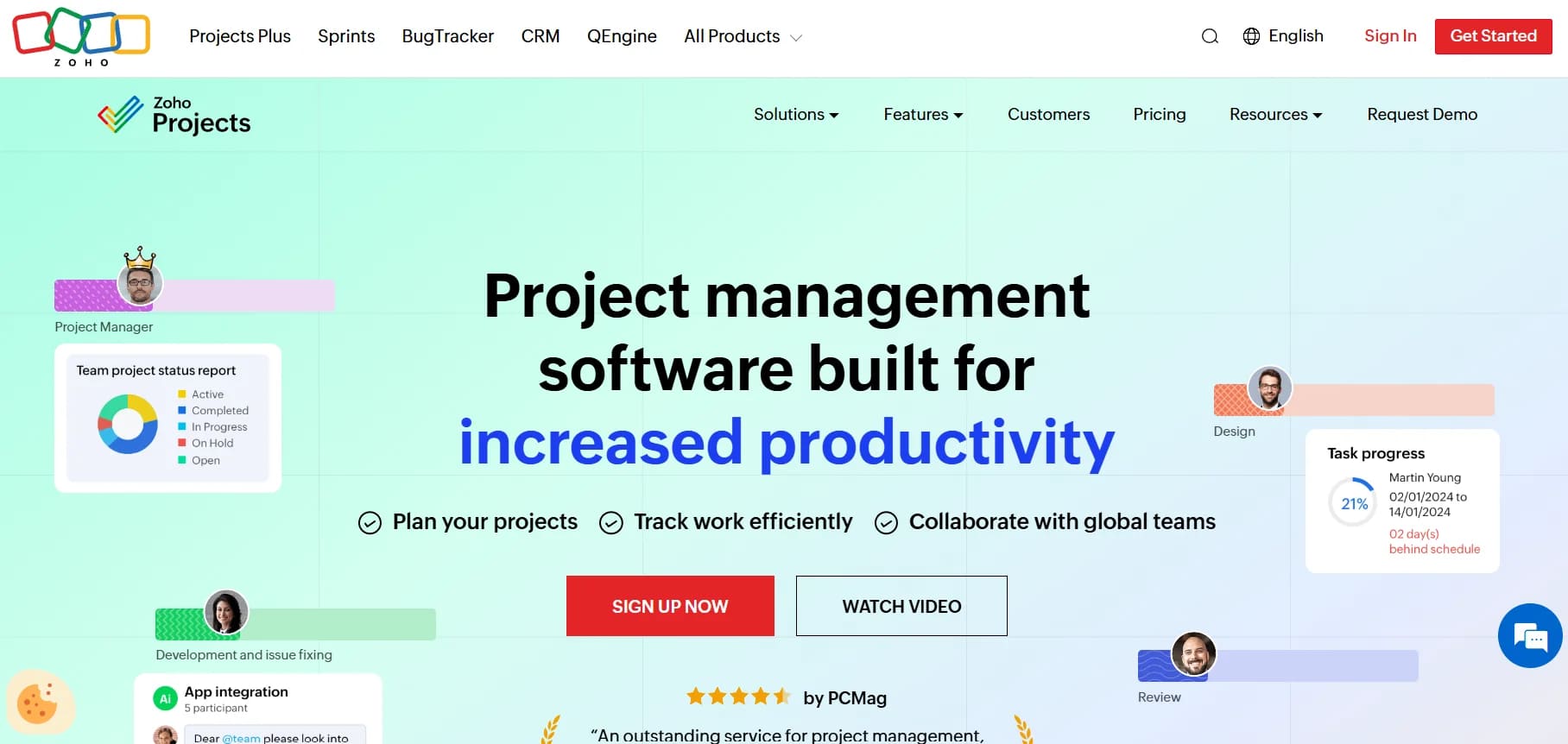
Zoho Projects integrates seamlessly with other Zoho applications for a comprehensive business solution. Teams already invested in the Zoho ecosystem will find it provides the most value through native connections with CRM, finance, and communication tools.
Key features
- Task management and time tracking
- Document management and collaboration
- Issue tracking and bug fixing
- Integration with Zoho ecosystem
Pricing
Starts at $5/user/month for the Premium plan, with Enterprise ($10/user/month) and higher tiers available for larger teams requiring advanced features.
Considerations
- Most valuable when used within the broader Zoho ecosystem
- Limited customization options compared to dedicated project platforms
- Learning curve can be challenging for teams new to Zoho’s interface
Pros: Native integration with the broader Zoho suite (CRM, finance, etc.); solid task management, time tracking, and issue tracking
Cons: Value is highest only if you’re already in the Zoho ecosystem; less customizable than dedicated PM platforms; learning curve for Zoho’s interface
12. Hive
Best for: Marketing teams and creative agencies managing collaborative projects.
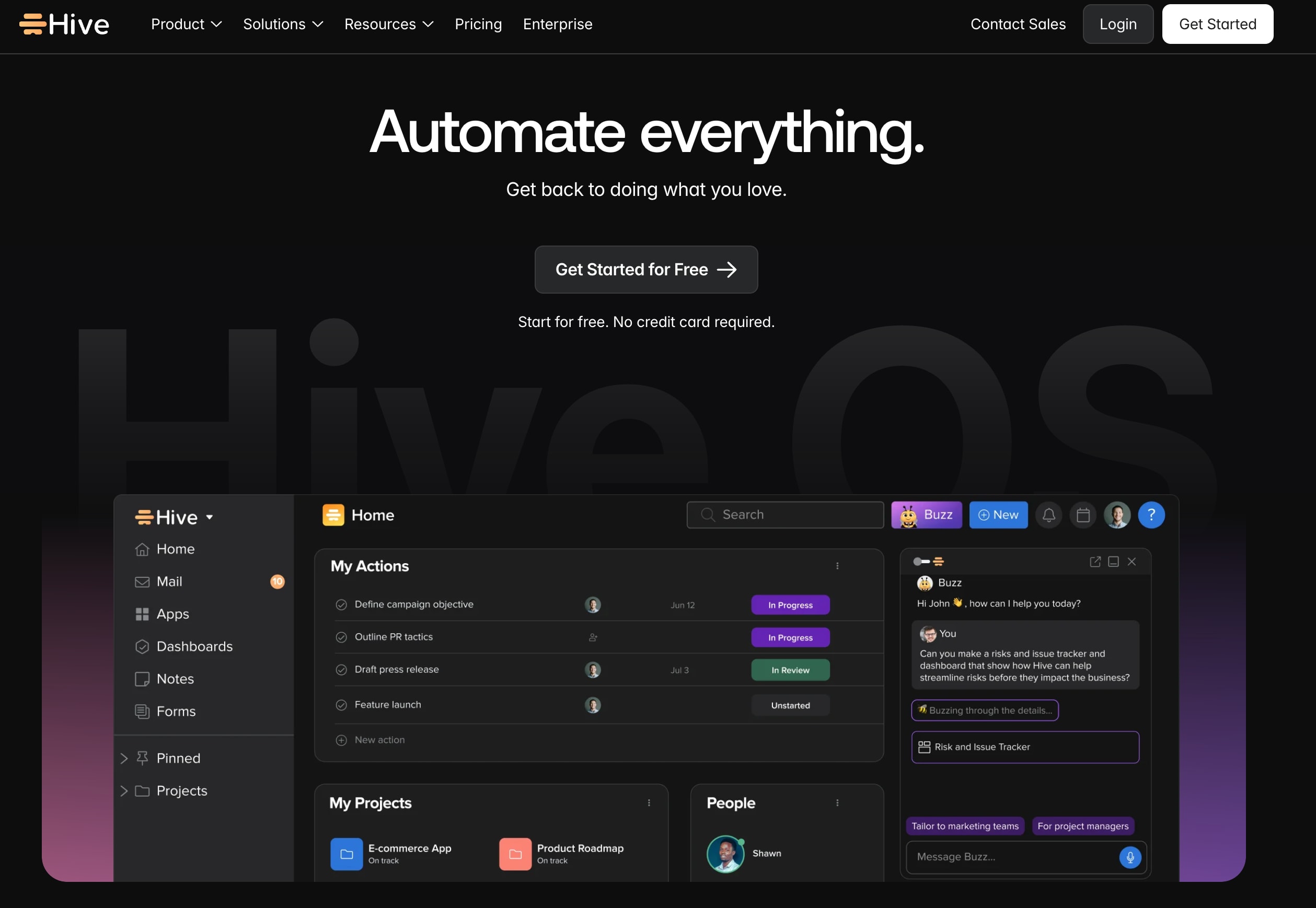
Hive combines project management with team collaboration features for a unified work experience. Its native chat and proofing workflows eliminate the need for separate communication and review tools.
Key features
- Multiple project views including Gantt and Kanban
- Time tracking and resource management
- Proofing and approval workflows
- Native chat and email integration
Pricing
Starts at $12/user/month for the Teams plan, with Enterprise options available for larger organizations requiring advanced security and support.
Considerations
- Learning curve may be steeper for team members new to collaborative platforms
- Some advanced features require higher-tier subscriptions
- Mobile experience less robust than desktop version
Pros: Multiple views (Gantt, Kanban); native chat and proofing eliminate need for separate tools; solid time tracking/resource management
Cons: Learning curve for new users; advanced features require higher tiers; mobile experience weaker than desktop
13. GanttPRO
Best for: Project managers who rely heavily on Gantt charts for planning.
GanttPRO specializes in timeline visualization with powerful Gantt chart functionality. Its interactive charts and cost tracking capabilities make it ideal for teams that prioritize timeline-based planning and budget management.
Key features
- Interactive Gantt charts for planning
- Resource workload management
- Cost tracking and budget management
- Team collaboration tools
Pricing
Starts at $7.99/user/month for the Basic plan, with Pro ($12.99/user/month) and Business ($19.99/user/month) tiers available for advanced features.
Considerations
- Focused primarily on Gantt visualization—may lack depth in other views
- Learning curve for team members unfamiliar with Gantt methodology
- Limited customization compared to more comprehensive platforms
Pros: Strong interactive Gantt charts; built-in cost tracking and budget management; good resource workload visualization
Cons: Narrow focus on Gantt view limits depth elsewhere; learning curve for teams unfamiliar with Gantt methodology; less customizable overall
14. Microsoft Project
Best for: Enterprise organizations with complex project portfolios.
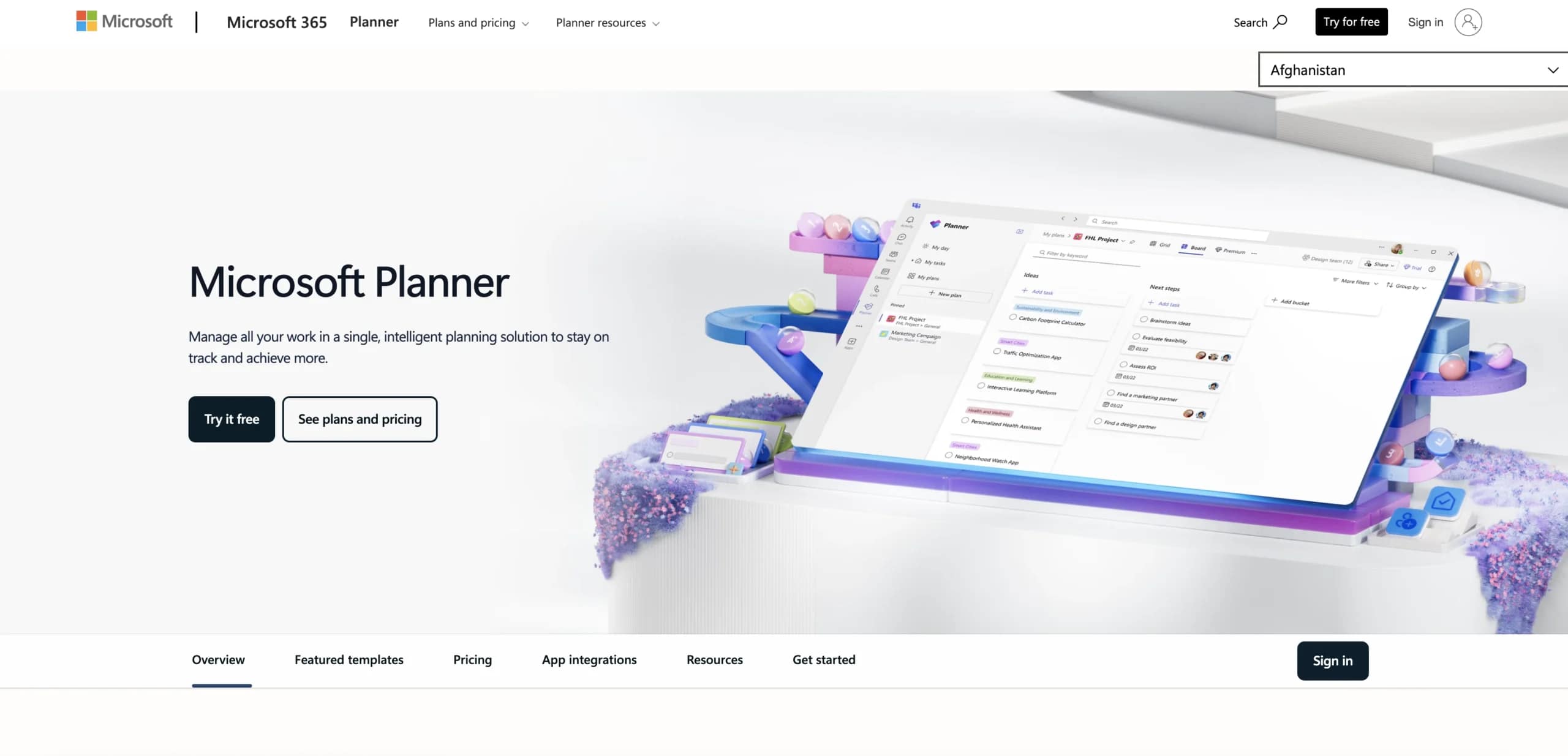
Microsoft Project offers comprehensive program management software capabilities with deep integration into the Microsoft ecosystem. Its advanced scheduling engine and portfolio management features make it the choice for large organizations managing multiple interconnected projects.
Key features
- Advanced scheduling and resource management
- Portfolio management for enterprise visibility
- Detailed reporting and analytics
- Integration with Microsoft 365
Pricing
Starts at $10/user/month for Project Plan 1, with Project Plan 3 ($30/user/month) and Project Plan 5 ($55/user/month) available for more advanced features.
Considerations
- Steep learning curve requires dedicated training investment
- Premium pricing may be prohibitive for smaller organizations
- Powerful but potentially overwhelming for simple project needs
Pros: Advanced scheduling engine; strong portfolio management for enterprise visibility; deep Microsoft 365 integration
Cons: Steep learning curve requiring real training investment; premium pricing may be too costly for smaller orgs; can be overkill for simple projects
Compare more: MS Project alternatives
15. Teamwork
Best for: Client-facing teams and service-based businesses.
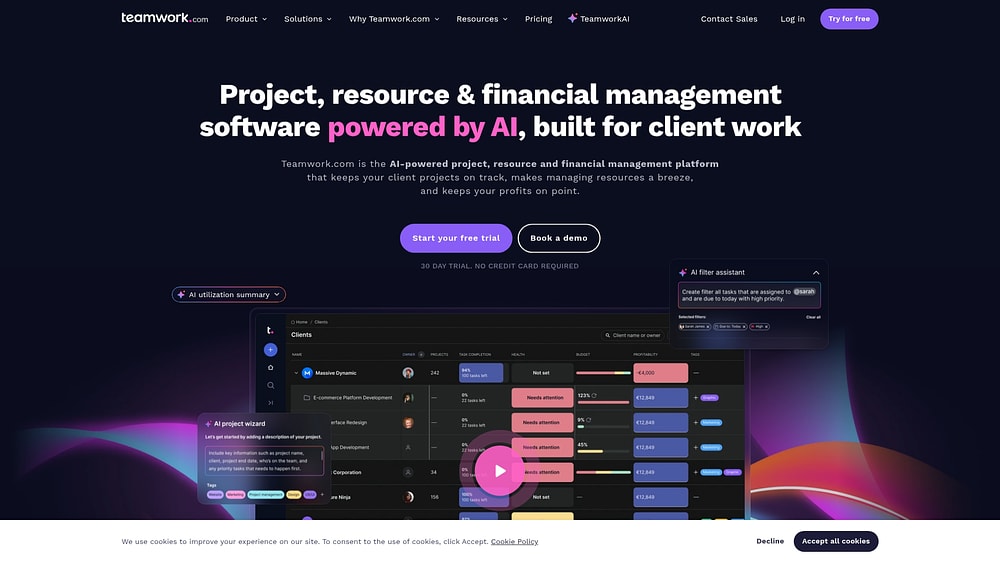
Teamwork is designed specifically for client service businesses like agencies and consultancies. Its client portal and billable hour tracking make it particularly valuable for teams that need to manage external stakeholder collaboration and project profitability.
Key features
- Client portal for stakeholder collaboration
- Time tracking and billable hours
- Task management and team collaboration
- Resource scheduling and workload management
Pricing
Starts at $10/user/month for the Deliver plan, with Free Forever, Grow ($13/user/month), and Scale ($25/user/month) options available to match different business needs.
Considerations
- Steep learning curve despite strong client management features
- May lack depth for complex workflows—evaluate against your specific needs
- Requires thorough testing before full implementation to ensure proper fit
Pros: Purpose-built for client-facing/service businesses; client portal plus billable-hours tracking; solid resource scheduling
Cons: Steep learning curve despite strong client features; may lack depth for very complex workflows; benefits from thorough testing before full rollout
How to evaluate and compare project management platforms
Selecting the right project management platforms requires understanding your team’s specific needs. What factors should you consider to make the right choice?
1. Pricing and scalability
Consider both immediate costs and long-term value as your organization grows. Look beyond the monthly subscription price to understand the total cost of ownership.
Key considerations when evaluating pricing models include:
- Per-user vs. flat-rate: How pricing changes as your team expands
- Feature limitations: What functionality is available at different tiers
- Hidden costs: Additional fees for support, training, or storage
- Growth accommodation: How the platform scales with increasing complexity
2. Integrations and customization
The best project management tools should connect seamlessly with your existing tech stack and adapt to your unique workflows.
When assessing integration capabilities, focus on:
- Native connections: Pre-built integrations with your essential tools
- API availability: Options for custom connections with other systems
- Customization depth: Ability to tailor fields, workflows, and processes
- Template library: Ready-made solutions for common examples
3. AI and automation capabilities
Modern project tracking management software leverages AI and automation to reduce manual work and provide intelligent insights.
The AI Work Platform’s AI Blocks transform how teams work by automating repetitive tasks and providing data-driven insights, letting team members focus on high-value activities.
4. Data security
Ensure the platform meets your organization’s security requirements, especially for sensitive projects or regulated industries.
Key security features to evaluate include:
- Compliance certifications: SOC 2, GDPR, HIPAA, etc.
- Data protection: Encryption standards and data handling
- Access controls: Permission settings and role-based access
- Audit capabilities: Activity logs and security reporting
5. User-friendliness
Even the most powerful software project management tools won’t deliver results if your team struggles to adopt it. Prioritize intuitive interfaces and comprehensive onboarding resources.
While Excel can handle basic task tracking for very small teams, it lacks the real-time collaboration, automation, and visibility that dedicated project management platforms provide. If your team has outgrown spreadsheets, that’s usually a sign you’re ready for purpose-built software.
Key features for modern project management applications
Today’s collaborative work environment demands certain essential capabilities to keep teams aligned and productive. What features should you prioritize?
1. Project tracking tools
Effective project tracking tools provide visibility into project status, deadlines, and potential issues before they become problems.
Essential tracking capabilities that enhance team performance include:
- Real-time updates: Instant visibility into project progress
- Milestone tracking: Markers for key achievements
- Dependency management: Understanding relationships between tasks
- Automated reporting: Regular status updates without manual work
2. Flexible work views
Different team members prefer different ways to visualize work. Modern project management apps offer multiple views of the same data.
The most versatile platforms provide various visualization options:
- Kanban boards: Visual workflow management
- Gantt charts: Timeline and dependency visualization
- Calendar views: Date-based scheduling perspective
- List views: Straightforward task organization
- Dashboard views: High-level metrics and reporting
3. Automations and AI blocks
Automation reduces manual work and ensures consistency across projects and teams. How can AI transform your project management approach?
monday.com’s AI Work Platform’s Digital Workforce concept takes automation further with AI-powered digital workers that proactively monitor projects, identify risks, and suggest improvements.
4. Resource allocation and program management
Effective PMO resource management prevents burnout and ensures optimal team utilization across projects. The best project planning software includes robust resource management capabilities.
5. Collaboration and communication
Centralized communication reduces email overload and keeps project discussions connected to relevant work items.
Tips for rolling out software project management tools
Implementing new project management tools requires careful planning to ensure successful adoption. How can you make the transition as smooth as possible?
1. Start small with a pilot team
Begin with a limited implementation to test the platform and gather feedback before rolling out company-wide.
A strategic pilot approach should include:
- Team selection: Choose motivated early adopters
- Scope definition: Start with a specific project type
- Documentation: Capture lessons learned and best practices
- Champion development: Build internal expertise for wider rollout
2. Set goals and success metrics
Define what success looks like for your implementation to measure progress and demonstrate value.
3. Train users on key features
Provide targeted training that focuses on the most valuable features for each team’s specific needs.
Effective training strategies for mastering project management tools include:
- Role-based approach: Customize training to different user needs
- Format variety: Offer live sessions, videos, and documentation
- Knowledge base: Create self-service learning resources
- Support network: Identify power users who can help others
4. Sync with existing processes
Align the new software with your current workflows to minimize disruption during the transition.
5. Measure progress and gather feedback
Continuously evaluate adoption and gather user feedback to refine your implementation approach.
Research consistently shows that internal issues like missed deadlines and insufficient resources are the primary drivers of project failure. Implementing the right project management software and tools addresses these challenges directly.
Trends shaping project management in 2026
The project management landscape continues to evolve rapidly. What emerging trends will impact how teams work in the coming years?
AI-driven risk and resource management
Artificial intelligence is transforming project management by automatically identifying potential risks before they impact timelines and deliverables. AI risk management allows managers to intervene earlier, allocate resources more effectively, and maintain project momentum even when faced with unexpected challenges.
monday.com’s AI Work Platform’s AI Blocks automate complex tasks like sentiment analysis, intelligent data categorization, and information extraction from unstructured content. These AI-powered features save teams an average of 4-6 hours weekly on routine work while improving decision-making quality by surfacing insights that might otherwise remain hidden in project data.
Consolidated platforms over point solutions
Organizations are increasingly recognizing the productivity drain and data fragmentation that occurs when teams must constantly switch between specialized applications for different aspects of project management. Forward-thinking companies are now prioritizing platforms that can handle everything from initial planning and task management to resource allocation, document collaboration, and performance analytics within a single ecosystem.
monday.com’s AI Work Platform exemplifies this consolidated approach by providing a flexible platform where teams can manage any type of work process without sacrificing depth of functionality. This unified approach reduces the technical overhead of managing multiple software subscriptions, eliminates integration headaches, and creates a single source of truth that improves visibility and decision-making at all levelsof the organization.
Greater emphasis on security and compliance
As project data increasingly contains sensitive business information and personal data, security has evolved from an IT concern to a central project management consideration. Organizations now evaluate project managementplatforms not just on features and usability, but on their ability to protect intellectual property, maintain regulatory compliance, and prevent unauthorized access.
monday.com’s AI Work Platform addresses these concerns with enterprise-grade security features including SOC 2 Type II compliance, GDPR adherence, and ISO 27001 certification. The platform’s comprehensive approach includes end-to-end encryption, customizable permission structures, and detailed audit logs that help security teams monitor platform usage.
Rise of digital workforces
The concept of digital workers (AI-powered assistants that handle routine tasks autonomously) is transforming how project teams allocate human resources. Organizations implementing digital workforces report significant improvements in productivity as team members spend less time on administrative tasks like status updates, data entry, and basic reporting, and more time on strategic thinking and creative problem-solving.
monday.com’s AI Work Platform is pioneering this approach with its comprehensive suite of AI-powered capabilities that function as virtual team members rather than just tools. The AI Work Platform’s AI can automatically categorize incoming requests, route them to appropriate team members, extract key information from emails and documents, and generate status reports without human intervention.
Real-time collaboration across remote teams
The permanent shift toward distributed and hybrid work models has fundamentally changed how project teams collaborate, making real-time digital collaboration capabilities essential rather than optional. Teams now require platforms that not only store project information butactively facilitate synchronous and asynchronous collaboration across different locations, time zones, and devices.
monday.com’s AI Work Platform addresses these distributed collaboration challenges through features specifically designed for remote and hybrid teams. The platform’s real-time updates ensure all team members see the latest project status regardless of location, while integrated communication tools keep discussions connected directly to relevant work itemsrather than scattered across email and messaging apps.
AI agents and autonomous workflows
The emergence of purpose-built AI agents represents the most significant shift in project management since the move to cloud-based platforms. According to PMI research, 91% of project managers say AI will have at least a moderate impact on their work, with 58% predicting “major” or “transformative” changes to how projects are delivered.
The project management software market is valued at $11.27 billion in 2026, and is expected to grow to $23.09 billion by 2031. The AI-in-project-management segment alone is worth $4.14 billion. The question for organizations isn’t whether to adopt AI-powered project management but how quickly they can integrate these capabilities into existing workflows. The AI Work Platform’s Agent Builder addresses this by letting teams create custom AI agents from a simple prompt. For example, The Project Analyzer agent continuously monitors active projects and surfaces risks before they escalate.
How monday.com's AI Work Platform transforms project management
The AI Work Platform reimagines project management by combining intelligent automation, real-time collaboration, and adaptive workflows in a single unified system. Built for teams that need both flexibility and enterprise-grade control, the platform serves more than 225,000 organizations worldwide, evolving from a visual work management tool into a comprehensive AI-powered work operating system that adapts to any team structure or workflow complexity.
What sets the AI Work Platform apart is its AI-first approach to project execution. Rather than treating AI as an add-on feature, the platform embeds intelligence throughout the entire project lifecycle, from initial planning and resource allocation to risk detection and performance optimization. This means teams spend less time on administrative overhead and more time delivering strategic value.
AI agents that work autonomously

monday agents are purpose-built AI workers that execute tasks without human intervention. The Project Analyzer continuously monitors active projects, identifies bottlenecks before they escalate, and recommends corrective actions based on historical patterns and current workload. Teams can also use the Custom Agent Builder to create specialized agents tailored to specific workflows, whether that’s a Research Assistant that gathers competitive intelligence, a Campaign Manager that tracks marketing initiatives, or an Onboarding Helper that guides new team members through processes.
AI Blocks for intelligent automation
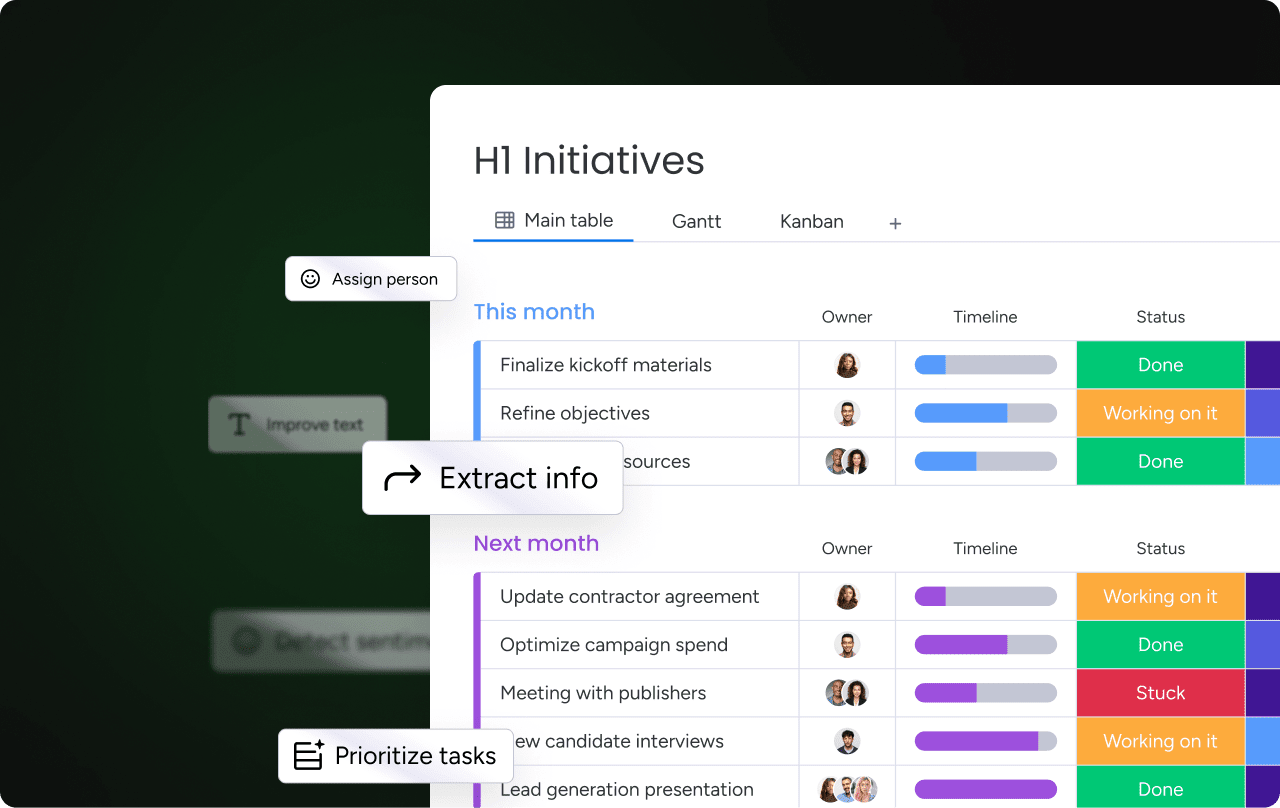
AI Blocks are pre-built AI functions that automate data-heavy tasks across your projects. They categorize incoming requests, summarize lengthy documents, detect sentiment in stakeholder feedback, and extract key information from unstructured content. Unlike traditional automation that requires complex setup, AI Blocks work immediately without technical configuration or third-party AI subscriptions, making advanced capabilities accessible to every team member.
No-code app building with monday vibe
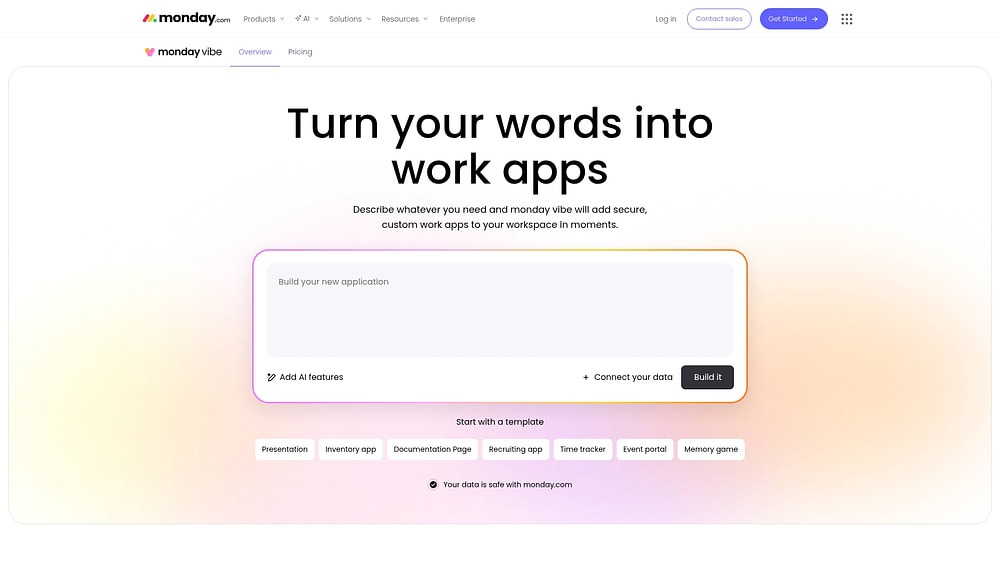
monday vibe transforms how teams build custom solutions by turning natural language prompts into working business applications in minutes. Describe what you need, and the AI generates a fully functional app complete with workflows, automations, and data structures. It’s enterprise-grade, permission-aware, and designed for non-technical users who want to solve operational challenges without waiting for IT resources or learning to code.
Connected AI ecosystem with monday MCP
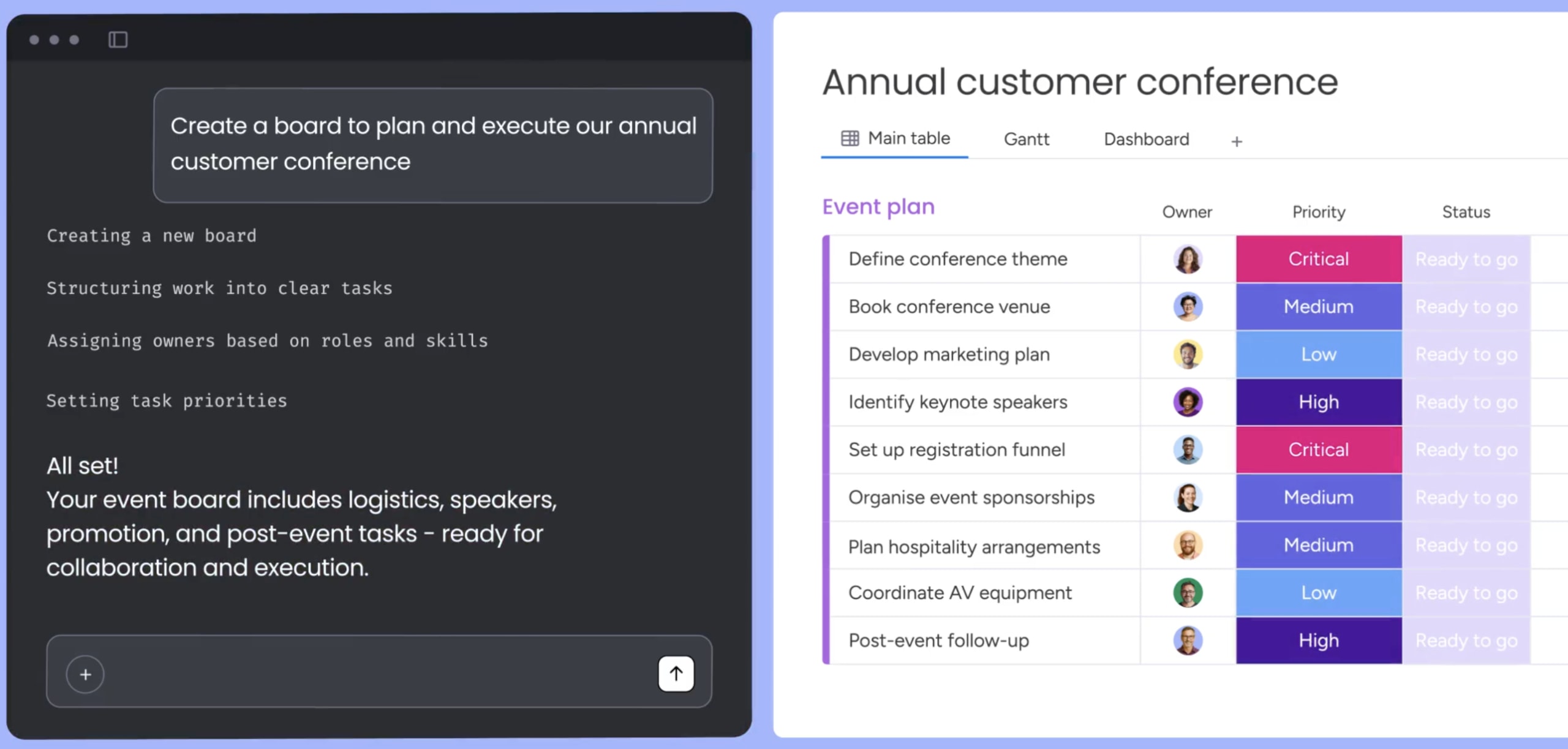
monday MCP (Model Context Protocol) connects external AI assistants like Claude, ChatGPT, Cursor, and Copilot directly to your workspace through secure OAuth authentication. This means you can generate project reports, manage tasks intelligently, and access cross-team visibility from whichever AI tool your team already uses, creating a seamless bridge between your preferred AI assistant and your project data.
How the AI Work Platform compares
To help you evaluate how monday.com’s AI Work Platform stacks up against other leading platforms, we’ve compared key capabilities across AI features, customization, integrations, and security. This side-by-side view highlights where each platform excels and where the AI Work Platform’s unique strengths set it apart.
| Capability | monday.com's AI Work Platform | Asana | ClickUp | Smartsheet |
|---|---|---|---|---|
| AI agents | Purpose-built agents with custom builder | AI teammate (limited) | ClickUp Brain | AI formulas only |
| No-code app builder | monday vibe (prompt-to-app) | No | No | No |
| AI assistant protocol | MCP (Claude, ChatGPT, Cursor) | No | No | No |
| Views | 15+ (Kanban, Gantt, timeline, calendar, dashboard, etc.) | 8+ | 10+ | 7+ |
| Integrations | 200+ | 200+ | 100+ | 100+ |
| Enterprise security | SOC 2 Type II, GDPR, ISO 27001, HIPAA | SOC 2, GDPR | SOC 2, GDPR | SOC 2, GDPR, HIPAA |
| Free plan | Yes (up to 2 seats) | Yes | Yes | Yes |
Independent research validates the platform’s impact. A Forrester Total Economic Impact study found that organizations using monday.com achieved a 346% ROI over three years and saved an average of $250,000 annually through improved efficiency. monday.com was also recognized as a Leader in the 2025 Gartner Magic Quadrant for both Adaptive Project Management & Reporting and Collaborative Work Management.

“monday.com has been a life-changer. It gives us transparency, accountability, and a centralized place to manage projects across the globe".
Kendra Seier | Project Manager
“monday.com is the link that holds our business together — connecting our support office and stores with the visibility to move fast, stay consistent, and understand the impact on revenue.”
Duncan McHugh | Chief Operations OfficerPlan work efficiently with the right project management software
Selecting the right project management software is a strategic decision that impacts how efficiently your team delivers results. The right platform depends on your specific needs, team structure, and work processes, but the best solutions improve collaboration, reduce manual work, and help organizations execute their most important strategic initiatives more consistently.
monday.com’s AI Work Platform offers a comprehensive solution that adapts to any workflow, from simple task tracking to complex cross-departmental programs. With its intuitive interface, powerful automation capabilities, and AI-driven insights, the AI Work Platform helps teams work smarter, not harder.
FAQs
What is project management software?
Project management software is a digital platform that helps teams collaborate, plan, organize, and execute projects from start to finish. It centralizes tasks, timelines, resources, and communication in one accessible location.
What are the 3 types of project management software?
The three main types of project management software are desktop applications (installed locally), web-based platforms (accessed through browsers), and mobile apps (optimized for smartphones and tablets), each offering different accessibility and functionality benefits.
What is the easiest project management tool for beginners?
Trello and the AI Work Platform are widely considered the easiest project management tools for beginners due to their intuitive interfaces, visual workflows, and minimal learning curves.
How much does project management software typically cost?
Project management software typically costs between $0 (free plans with limited features) to $25+ per user per month for premium plans, with enterprise solutions offering custom pricing based on specific organizational needs.
Can project management software integrate with other business applications?
Modern project management tools offer extensive integration capabilities with business applications like CRM systems, email platforms, file storage services, and communication tools to create a seamless workflow ecosystem.
How does AI improve project management software?
AI enhances project management software by automating routine tasks like status updates and task assignments, identifying risks before they impact timelines, optimizing resource allocation based on team capacity, and generating data-driven insights for faster decision-making. Platforms like monday.com's AI Work Platform use AI agents that monitor projects in real-time and flag bottlenecks proactively.
What makes monday.com's AI Work Platform different from other project management platforms?
The AI Work Platform differentiates through its AI-first approach with purpose-built AI agents, monday vibe (an AI app builder that turns prompts into custom business apps), and monday MCP (connecting external AI assistants directly to your workspace). Combined with 200+ integrations, enterprise-grade security, and an intuitive no-code interface, it's built for organizations that want both flexibility and control.

 Get started