


Most companies are rich in ambition but stretched thin on execution. Leaders set bold goals, yet the work to reach them often stalls somewhere between the plan and the day-to-day. Strategic initiatives are the coordinated plans that move an organization from a broad vision to real, measurable progress, breaking ambitious goals into focused work that teams can deliver.
This guide walks you through what strategic initiatives are, how they differ from strategy and projects, the main types with examples, and a step-by-step approach to building and measuring them. You’ll also learn the most common reasons initiatives fail, how to track them with KPIs, and how the right platform helps you keep strategy on course.
Key takeaways
- A strategic initiative is a coordinated plan of projects and milestones that moves an organization toward a high-level goal.
- Initiatives sit between strategy and projects: strategy sets direction, an initiative coordinates the work, and a project delivers one time-bound piece of it.
- The 7 main types range from corporate and business level to corrective, constructive, innovative, and defensive initiatives, each suited to a different stage of growth.
- Most initiatives fail from poor planning, weak communication, insufficient monitoring, or misaligned resources, all of which are avoidable with clear KPIs and a steady review cadence.
- monday AI Workspace helps teams plan, execute, and measure strategic initiatives in one place, with automations, dashboards, and agents that keep progress visible.
What is a strategic initiative?
A strategic initiative is a plan of action that helps an organization or team make progress toward its high-level goals. Strategic initiatives include tangible steps organizations take to help achieve specific outcomes.
Essentially, a strategic initiative is a bridge between a company’s overall goal and the daily activities employed to move the organization closer to the vision and business growth.
To clarify the relationship: a goal defines the broad direction your organization is heading and an objective is a specific, measurable milestone toward that goal. A strategic initiative is a coordinated plan to achieve one or more objectives.
Multiple teams have a hand in executing strategic initiatives, but business leaders often lead them with defined outcomes in mind. A single initiative might include a variety of projects and smaller milestones, so it’s important for leaders to establish a set of key performance indicators (KPIs) to monitor progress.
While strategic initiatives can vary widely in scope and objectives, they usually include specific characteristics, such as:
- Clear goals
- Budgets
- Timelines
- Steps to move initiatives toward the goal
- KPIs to measure progress
A strategic initiative isn’t meant to get you all the way to the ultimate goal; the point is simply to move closer. It’s important to keep that idea in mind as you consider the purpose of each initiative.
What is the purpose of strategic initiatives?
The purpose of strategic initiatives is to identify and execute practical actions that move an organization toward its high-level goals. Each initiative breaks down big-picture objectives into smaller, more achievable projects, reducing overwhelm and providing teams with clear direction. By turning strategy into focused execution, strategic initiatives bridge the gap between planning and results.
The outcome of strategic initiatives will vary from team to team and from one initiative to another. Some may drive revenue growth, while others improve internal efficiency or customer satisfaction. But business leaders need to be intentional and proactive when defining and managing these initiatives. Well-executed strategic initiatives not only accelerate progress but can also become the key differentiators that set companies apart from their competitors.
Strategic initiative vs. strategy vs. project
Strategy defines where the organization is going and how it will compete, and each strategic initiative turns part of that direction into coordinated work.
Projects sit one level below initiatives: an initiative groups several projects, and each project delivers one time-bound piece of the work. Knowing where each level begins and ends helps leaders assign the right owner and timeline to each piece, and the table below compares all three side by side.
| Strategy | Strategic initiative | Project | |
|---|---|---|---|
| Definition | The high-level plan for where the company is going and how it competes | A coordinated plan of projects and milestones that carries out part of the strategy | A single deliverable with a defined start and end |
| Scope | Broad, covering the whole organization | Focused on one objective, spanning multiple projects | Narrow, covering one output |
| Time horizon | Long term | Short to medium term | Fixed start and end dates |
| Owner | Executives and senior leadership | Cross-functional teams, often with a leader as sponsor | A project manager and their team |
| Example | Lead the mid-market segment | Increase revenue from mid-market customers | Redesign the pricing page |
7 types of strategic initiatives with examples
There’s more than one type of strategic initiative a company can explore. Each one serves a different purpose and can be implemented at different stages of a company’s lifecycle. Here’s a look at the different types of strategic initiatives, along with some examples of how they can be implemented.
Corporate level
Corporate-level strategic initiatives focus on the overall direction and long-term goals of an entire organization. These initiatives often involve major decisions such as mergers, acquisitions, diversification, or entering new markets.
Example: A conglomerate expands into the renewable energy sector to align with global sustainability trends.
Business level
Business level refers to how a specific business competes and succeeds in its market. These strategies focus on gaining a competitive advantage through pricing, product differentiation, or customer focus.
Example: A consumer electronics division launches a premium product line to capture high-end market share.
Functional level
Functional-level initiatives are strategies developed within specific departments like marketing, operations, or HR to support broader business or corporate strategies. These strategies are aimed at improving specific departmental processes to enhance business strategies.
Example: An operations team implements a new inventory management system as part of an operations strategy to reduce waste and improve supply chain efficiency.
Corrective
Corrective initiatives are used to fix existing problems, underperformance, or inefficiencies within the organization. They are often short-term since they’re reactionary but necessary to maintain stability.
Example: A manufacturing company restructures its supply chain after persistent delays and cost overruns.
Constructive or expansive
These initiatives aim to grow or expand the business’s capabilities and reach by improving processes, entering new markets, or increasing capacity. They are typically proactive and growth-oriented.
Example: A software company launches operations in a new international market to tap into global demand.
Innovative or disruptive
Innovative or disruptive initiatives introduce new technologies, business models, or approaches that can significantly alter the company’s position or the industry landscape.
Example: An automotive company invests in building autonomous vehicles to lead the shift toward self-driving cars.
Defensive
Defensive strategic initiatives are designed to protect the company from threats, such as market shifts, competitive pressures, or regulatory changes. They help sustain the company’s position and protect its assets.
Example: A local newspaper launches a digital subscription model in response to declining print revenue and online competition.

6 steps for building a successful strategic initiative
A strategic initiative is a significant undertaking that requires both time and resources. To get the most from your investment, take the time to analyze your needs and plan the process. Most organizations will have more than one strategic initiative on their radar, so before jumping into the steps below, make sure to adopt an approach to strategic portfolio management to keep all initiatives streamlined and prioritized.
1. Identify an objective
Analyze the vision and goals in your company’s strategic plan, and choose an objective to pursue. Before you select one, consider both company priorities and your current ability to make progress toward a specific goal.
2. Define an outcome
Identify an outcome that relates directly to your chosen objective. Let’s say that one of your company’s major goals is to be the dominant social media presence in the industry, but your competitors’ current follower counts are twice the size of yours.
Using SMART goals, a strategic initiative might include creating a plan, including a social media campaign focused on brand awareness and customer engagement to increase your following by 25% over one quarter before reassessing strategies for future growth.
3. Establish milestones
Work backward from your desired outcome to lay out project milestones you’ll need to meet along the way. To keep your team motivated, choose milestones that are achievable. Think of them like stepping stones: employees should be able to see how to get to the next milestone, even when the end of the path is out of sight.
4. Create a plan of action
Now that you have a set of milestones, it’s time to create a strategy to achieve each goal.
Identify the people involved, the steps they need to take, and the tactics they can use. It’s helpful to involve team leaders and project managers in this process since they have valuable insight that makes it easier to refine the plan. When the strategy is complete, you can allocate resources based on the scope of each phase.
5. Set KPIs
Before embarking on strategic initiatives, identify the metrics that will help you measure progress toward individual milestones and the final goal. The KPIs you choose should be tailored to specific goals.
If a large company’s initiative is to increase revenue, for example, you could track enterprise KPIs such as average deal size, sales cycle length, and quota attainment. One of your smaller milestones might be to boost sales calls by 30%, so to monitor progress, you can use metrics such as the average length of each call, the number of calls per day, and the number of new leads coming in per day.
6. Analyze and adapt
In business, things rarely go exactly to plan. Unexpected information, discoveries, and other roadblocks can arise at any time. To keep your team on track, get into a habit of regularly monitoring KPIs.
Using the right platform, like monday AI Workspace, can help you analyze KPIs through reports and dashboards to measure against your timeline and budget and make adjustments as necessary. KPI tracking helps your team spot inefficiencies during a strategic initiative and adapt quickly to keep projects on course.

Benefits of using strategic initiatives in project management
Strategic initiatives are the engines that drive meaningful change within an organization. By turning big-picture goals into focused efforts, they have the power to align teams, allocate resources effectively, and generate measurable impact. Here are some of the key benefits of well-crafted strategic initiatives:
- Clear direction: Break down high-level strategy into small, actionable steps, helping teams focus and understand exactly what needs to be done and why.
- Improved alignment: Ensure that departments and teams are working toward shared objectives, reducing siloed workflows and boosting collaboration.
- Speed up innovation: Provide a structured path to move from strategy to action, accelerating progress and reducing delays.
- Resource alignment: Prioritize and allocate resources, whether it’s time, people, or budgets, more efficiently.
- Risk mitigation: Identify potential obstacles early and take corrective action before small issues grow into larger problems.
- Competitive advantage: Support innovation, efficiency, and responsiveness to make your business stand out in a crowded market.
Practical examples of strategic initiatives
Whether you’re creating strategic initiatives for the entire company or a single team, it’s helpful to consider what you want to achieve. The type of initiative you choose will determine the end goal, milestones, strategies, and KPIs. Below, we’ll look at a few examples of strategic initiatives from different industries. Each outlines a core business objective and the strategic initiatives that support it.
SaaS company
Goal: Improve long-term customer satisfaction and reduce churn
Objective: Increase customer retention by 15% over the next 12 months
Type of initiative: Functional/corrective
Strategic initiatives:
- Launch a customer success program to provide onboarding support, training, and regular check-ins for new users.
- Implement a feedback loop using surveys and in-app analytics to identify friction points and areas for improvement.
- Develop loyalty features such as usage-based rewards or milestone achievements to incentivize continued use.
E-commerce business
Goal: Expand global footprint and diversify revenue streams
Objective: Launch in 3 new European markets and generate 20% of revenue from international sales by year-end
Type of initiative: Business level/constructive
Strategic initiatives:
- Localize the website for key regions, including language translation, currency conversion, and regional SEO optimization.
- Partner with international logistics providers to streamline shipping, returns, and delivery times.
- Launch regional marketing campaigns tailored to local consumer behaviors and preferences to build a region-specific customer experience.
Manufacturing company
Goal: Reduce operating expenses while maintaining product quality and output
Objective: Reduce operational costs by 10% while maintaining customer satisfaction scores above 90%
Type of initiative: Corporate level/defensive
Strategic initiatives:
- Invest in predictive maintenance technology to minimize unplanned downtime and extend equipment lifespan.
- Optimize supply chain processes by digitizing inventory management and improving vendor coordination.
- Implement lean manufacturing practices to eliminate waste and improve production efficiency.

6 reasons strategic initiatives fail and how to avoid them
Even well-designed strategic initiatives can fall short without the right execution. An AchieveIt survey found that 77% of leaders report silos hinder strategy execution and innovation, a reminder that most failures trace back to coordination and follow-through rather than the plan itself. Here are some common pitfalls and a look at what you can do to avoid them.
1. Inadequate planning
When initiatives begin without a solid plan, it’s easy for them to lose direction or stall, especially without clearly defined goals. Taking time to build a clear roadmap with strategic planning that includes defined steps, milestones, objectives, and contingencies can set the foundation for success.
2. Lack of communication
Poor communication creates confusion, misalignment, and misunderstandings across teams. Establish consistent, transparent messaging and open feedback loops on a unified work and collaboration platform to keep everyone informed and involved.
3. Insufficient monitoring
Without regularly tracking progress and KPIs, problems can go unnoticed until it’s too late to fix. Setting clear KPIs, check-in points, and automating reports on the AI Workspace ensures timely adjustments and steady progress.
4. Uncommitted leadership
When leaders aren’t visibly engaged and transparent, initiatives may lack the momentum and support they need to progress. Buy-in from both leadership and stakeholders is crucial since active involvement builds confidence across teams. An AchieveIt survey found that 81% of organizations experience delays when accountability is unclear, which makes visible ownership essential.
5. Resistance to change
Change can trigger uncertainty, leading teams to resist new initiatives. Proactively address concerns, communicate value, remain open to feedback, and offer ongoing training and support to ease transitions and encourage adoption.
6. Poor resource allocation
Initiatives often fail when teams lack the time, talent, or tools to execute plans effectively. Make sure your resources are aligned with your priorities and stay on top of evolving needs through predictive analytics and forecasting on the AI Workspace.
How to measure strategic initiatives with KPIs
To measure strategic initiatives, tie a small set of KPIs to each milestone and to the overall objective, then review them on a regular cadence so you can act before progress stalls. Strong measurement combines leading indicators, which predict where results are heading, with lagging indicators, which confirm what has already happened.
Start by choosing two or three metrics per initiative. Leading KPIs might include the number of sales calls booked or features shipped, while lagging KPIs track outcomes like revenue, retention, or cost savings. Connect each metric to a specific milestone so a slipping number points to a specific part of the plan rather than the whole initiative.
Set a review rhythm that matches the initiative’s pace, whether that is weekly for fast-moving work or monthly for long-horizon goals. Consistent check-ins turn KPIs into a decision-making habit instead of a year-end report.
The most common mistake is having no reliable way to track progress at all. An AchieveIt survey found that 49% of organizations lack the proper tools to measure their plans, while 63% of those using technology to track execution reported better alignment across teams. Real-time dashboards on the AI Workspace bring these metrics into one view, so leaders see progress across every initiative without chasing status updates.
Turn strategy into action with monday AI Workspace
One of the best ways to keep strategic initiatives on track is to plan, execute, and monitor every step in one place, from organizing goals to watching progress in real time. When work lives across spreadsheets and disconnected apps, updates go stale and leaders lose visibility. monday AI Workspace brings people and agents together so teams can work toward initiative objectives without that friction.
On monday AI Workspace, no-code workflows cut manual updates, dashboards display KPIs in real time, and agents flag risks before they derail progress.
Work smarter with AI-powered workflows and automation
Using custom no-code automation and workflows, you can remove time-consuming manual updates. Whether it’s sending notifications, assigning tasks, summarizing meetings, or updating statuses, monday workflows trigger automatically based on rules you define. Once set, Workflows keep execution moving so teams spend time on the initiative instead of admin.
With features like AI Blocks, teams build modular, reusable AI steps into those workflows to find insights, analyze data, and speed decisions, all with no code required. Workflows can also trigger monday agents, so a status change can kick off an agent that drafts a report or updates stakeholders while people stay focused on the work that needs judgment.
Jump straight into planning with strategic initiative templates
A library of ready-made templates makes it faster to start planning your strategic initiatives. You’ll find templates for project roadmaps, goal tracking, business strategy, organizational strategies and plans, and more. Each comes with columns, automations, and dashboards already built in, so teams skip setup and move straight into execution while still tailoring everything to their unique workflows.
Monitor KPIs with AI dashboards and analytics
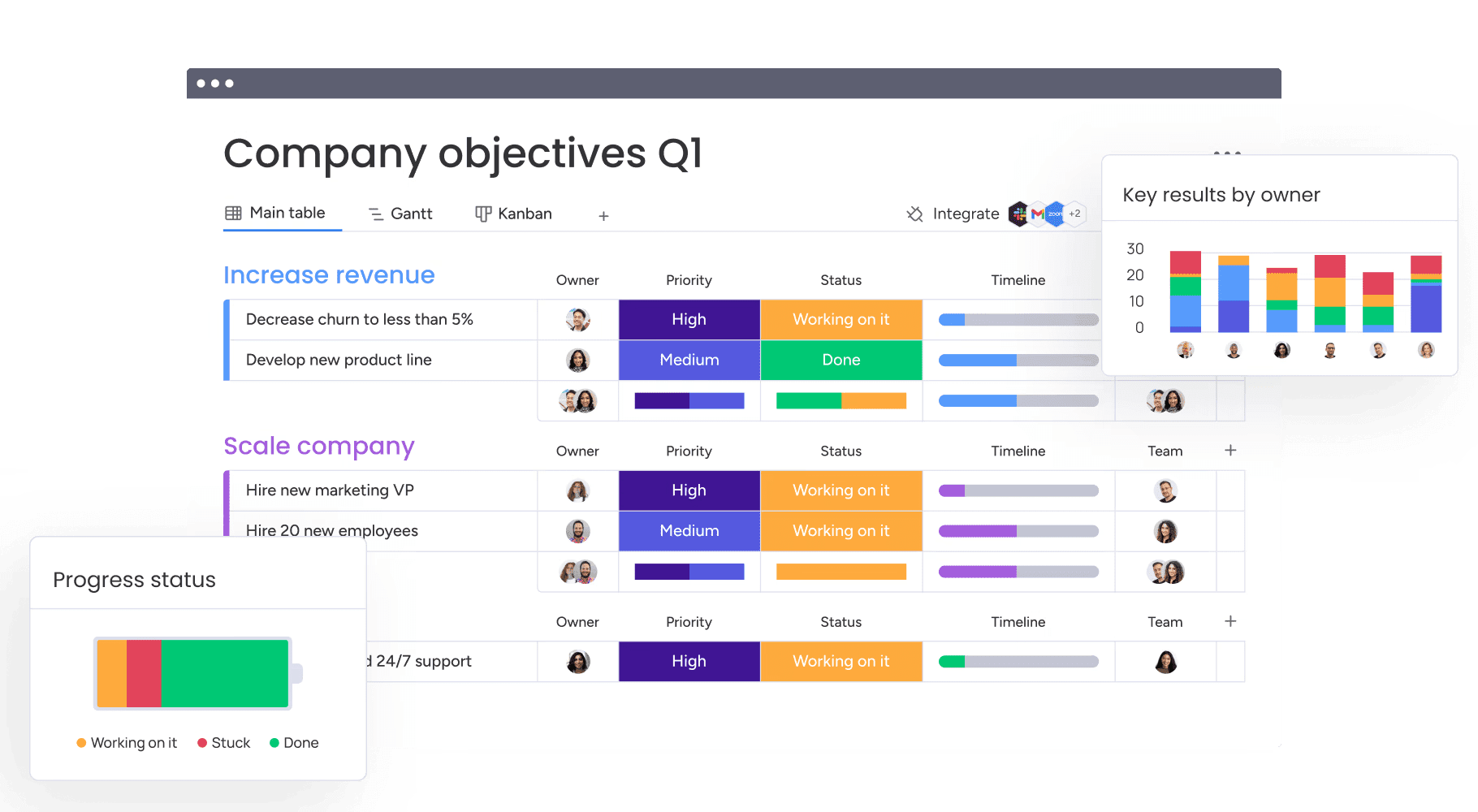
Strategic initiatives need continuous oversight. With real-time dashboards, you can track key metrics across teams and projects using visual widgets like charts, numbers, timelines, and progress battery views. Portfolio and executive summary reports roll several initiatives into one view for leaders, while AI risk alerts and AI-generated summaries highlight what needs attention. Ready-made agents such as OKR Tracker and Risk Analyzer keep a close eye on KPIs and surface progress at regular intervals, working alongside your team rather than in place of it.
Collaborate across teams with multiple work views
Coordinating complex initiatives across teams gets easier with flexible visual planning and a drag-and-drop interface. Each team and department can choose the view that fits how they work. With the Gantt Chart view, you can map out phases, set dependencies, and manage shifting timelines. The Timeline view gives every team member a clear sense of what’s next and how their work fits into the bigger picture. When you need something more tailored, monday vibe can build a custom app like an OKR monitor or executive overview from a plain-language description, and monday MCP connects your existing AI tools so the wider stack stays in sync.
Strong strategic initiatives start with strong planning
Successful strategic initiatives require exceptional organization. With strong advanced planning as the foundation of your strategic initiatives, you risk running into roadblocks, misallocating resources, and fumbling communication. With a flexible, reliable, and scalable platform like monday.com, teams can easily plan projects within an initiative while using advanced AI to work smarter by automating repetitive tasks.
The strongest strategic initiatives pair disciplined planning with the right execution layer. When people and AI agents work together on one platform, teams can track KPIs, catch risks early, and keep every initiative moving from strategy to measurable impact.
FAQs
What are strategic initiatives?
Strategic initiatives are comprehensive action plans that outline the steps an organization takes to move toward a high-level vision or objective. Each initiative bundles smaller goals, projects, and milestones that help teams reach a defined outcome and track progress along the way.
How do you develop strategic initiatives?
You develop strategic initiatives by first identifying high-priority objectives, then setting goals that move you toward them. Turn each goal into an initiative by breaking it into achievable milestones, building a plan to reach them, and choosing KPIs to monitor, assess, and improve as you go.
What are the key elements of a strategic initiative?
The key elements of a strategic initiative include a clearly defined objective, measurable outcomes or KPIs, a timeline, allocated resources, and a plan of action. These initiatives align with broader strategic goals and rely on cross-functional collaboration to succeed.
What's the difference between a strategic plan and a strategic initiative?
A strategic plan outlines an organization's long-term vision, goals, and priorities. A strategic initiative is a specific action or project that executes one or more parts of that plan. The plan sets direction, while initiatives turn that direction into focused, measurable work.
How does the AI Workspace manage strategic initiatives?
The AI Workspace helps manage strategic initiatives by bringing planning, execution, and measurement into one place. No-code workflows automate routine updates, real-time dashboards track KPIs across teams, and agents flag risks early, so people and agents keep each initiative moving toward its objective.

 Get started