


Business leaders are embracing AI with growing confidence. According to new research commissioned by monday.com and conducted by Nielsen, 94% of senior leaders are excited about opportunities to optimize work with AI, while 83% feel confident identifying where it can add value. The findings come from a survey of 1,701 directors and senior managers across seven countries.
But confidence in AI doesn’t necessarily mean organizations are prepared for the changes it brings. As agents take on more responsibility, managers face new questions about employee performance, accountability, and oversight. Our 2026 AI report, Squinting in the Sun, examines the bright light created by AI for senior leaders and the challenges that make the wider picture harder to see.
Download monday’s AI report 2026Key takeaways
- Confidence in AI runs high. 96% of leaders use AI at work, and 83% feel confident about where it adds value.
- Few organizations have fully integrated AI. Only 29% have AI fully integrated into a central operating system, while 57% report using more software tools since adopting AI.
- Contribution is harder to judge. 53% of leaders find it harder to evaluate an employee’s original work, while 78% have changed their approach to evaluating their teams.
- Agents are set to outnumber direct reports. 58% expect to manage more agents than people within 12 months, with data access a top concern (52%).
- AI oversight is a growing concern. 46% of leaders worry about losing control over agents’ actions, highlighting the need for clear permissions and approval processes.
AI adoption in 2026: what the research reveals
AI has become a regular part of working life for business leaders. According to monday.com’s 2026 AI report, 96% use AI at work, and 73% of those users rely on it daily. Satisfaction is high, too, with 82% reporting positive experiences using AI in their roles.

Leaders are increasingly focused on where AI can deliver the greatest value. But deciding which opportunities deserve effort isn’t always straightforward. Nearly half (48%) report decision fatigue from repeatedly determining where to use AI, while 63% feel greater pressure to act when they see what other companies are doing with AI.
With 68% of leaders saying their organizations place high importance on measuring AI return on investment (ROI), leaders also face expectations to demonstrate meaningful results. General optimism about AI doesn’t necessarily make those decisions any easier.
AI adoption doesn’t guarantee organizational readiness
Although 61% of leaders report having AI embedded in common workflows, only 29% say it’s fully integrated into a central operating system. Meanwhile, 57% report using more software tools since adopting AI.

Scaling AI is another challenge. Only 29% say AI pilots in their department or team have fully scaled, with 53% still in progress. Clearly, there’s a difference between employees using AI successfully and businesses implementing it consistently across their operations.
AI is changing what it means to be a manager
More than 5 in 6 leaders believe being a good manager in the AI era requires a different skill set than before. As AI takes on responsibilities previously handled by managers, expectations are changing. Almost half (46%) report greater accountability for AI-generated outputs, while 45% face increased pressure to redesign workflows using AI.
Unfortunately, employers don’t always equip managers to meet these expectations. Around one-third don’t agree they’ve received sufficient AI training from their organizations. As a knock-on, managers must now rethink how their teams work while developing the necessary skills themselves.

Interestingly, some managers lean on artificial intelligence itself to help them adapt to an AI work era. The report finds that 46% use it to review their own decisions, while 45% use it to structure feedback more clearly. This suggests that AI can play a role in developing the very management skills that organizations increasingly expect their leaders to demonstrate.
AI is rewriting the rules of employee performance
78% of leaders have changed their approach to evaluating team members since adopting AI. Traditional measures such as productivity and time management remain important, but managers are increasingly considering employees’ ability to work effectively with AI, with 46% of those who changed their criteria placing significantly greater importance on skills.

One of the biggest challenges is understanding how much of an employee’s work is genuinely their own. More than half (53%) of leaders say AI has made it harder to evaluate original contributions. A polished piece of work might demonstrate an employee’s expertise, or it could reflect the capabilities of the AI tools they’ve used. Without visibility into the process, managers may struggle to distinguish between the two.

This uncertainty is creating additional work for managers. Almost half (47%) say they spend more time reviewing and guiding team output, while 34% worry that employees could lose important skills through overreliance on AI. And achieving greater productivity doesn’t necessarily mean employees are developing the knowledge or judgment they’ll need in future roles.
For performance reviews to remain meaningful, greater transparency around AI-assisted tasks could help managers recognize individual contributions, identify development needs, and assess performance more fairly.
AI agents are becoming the new direct reports
The next big change to management could be the makeup of the team itself.
This shift is already underway, with 38% of teams already using agents to automate multi-step workflows. When asked where AI agents could deliver the greatest value, leaders identified:
- Data analysis and reporting (56%): Analyzing information and producing reports.
- Repetitive administrative tasks (51%): Automating routine work that would otherwise require manual effort.
- Research and information gathering (50%): Collecting information to support decisions.
These applications could free employees from time-consuming work, but they also introduce new responsibilities for the managers overseeing them. In particular, more than half (52%) of leaders worry about agents accessing data without sufficient restrictions, while 46% are concerned about losing oversight or control of their actions. Another 35% fear being held accountable for decisions made by the agents they rely on.

Australia’s experience: more agents, more oversight
Australia offers a glimpse of this challenge. More managers use agents for multi-step automation than the global average (46% versus 38%), yet 59% spend more time reviewing and guiding team output, and a third report longer working days as a result.
Managers may be handing more tasks over to AI agents, but someone still needs to check the work and step in when things go wrong. Without clear boundaries around what agents can do independently, delegation could end up creating more work than it saves.

The 3 Cs of successful AI adoption
Successful AI adoption depends on three connected principles: Context, Collaboration, and Control. AI needs the right information to produce useful work, employees need visibility into its contributions, and organizations must establish clear boundaries around what agents can do independently.
| Principle | What it means | How to put it into practice |
|---|---|---|
| Context | AI needs to understand the work it's supporting, including relevant organizational knowledge and previous decisions. | Connect AI to appropriate project histories, workflows, and team knowledge so it can work with the full picture. |
| Collaboration | People need visibility into how AI contributes to shared work and where team input is required. | Keep a clear record of what employees and agents do, making it easier to review contributions and work together. |
| Control | Organizations must decide what agents can access, which actions they can take, and when people need to intervene. | Set permissions, introduce approval steps, and establish checkpoints for work that requires personal oversight. |
How monday AI Workspace supports smarter AI adoption
Bringing AI into everyday work is easier when people and AI operate in the same connected environment. monday AI Workspace brings together your team’s work, organizational knowledge, and AI capabilities, helping businesses put Context, Collaboration, and Control into practice.
Rather than introducing disconnected tools for every new AI use case, teams can build on the workflows and information they already manage in monday AI Workspace.
Put monday agents to work alongside your team
monday agents can take responsibility for defined tasks and multi-step workflows, working with relevant workspace information to get things done. Teams can build custom agents or use purpose-built agents for specific business needs. For example:
- Pipeline Guardian helps sales teams monitor pipeline activity and identify deals that need attention.
- Dependency and Risk Mapper helps project managers identify dependencies and potential delivery risks.
- Invoice Reconciliation Agent supports finance teams with invoice reconciliation.
Managers can define the permissions and guardrails agents operate within. Agents work with relevant workspace context, while people retain oversight of their actions and decisions.

Make AI accessible across everyday workflows
AI adoption doesn’t have to begin with a complex implementation project. monday AI Workspace offers several ways for employees to use AI, depending on the work they need to accomplish:
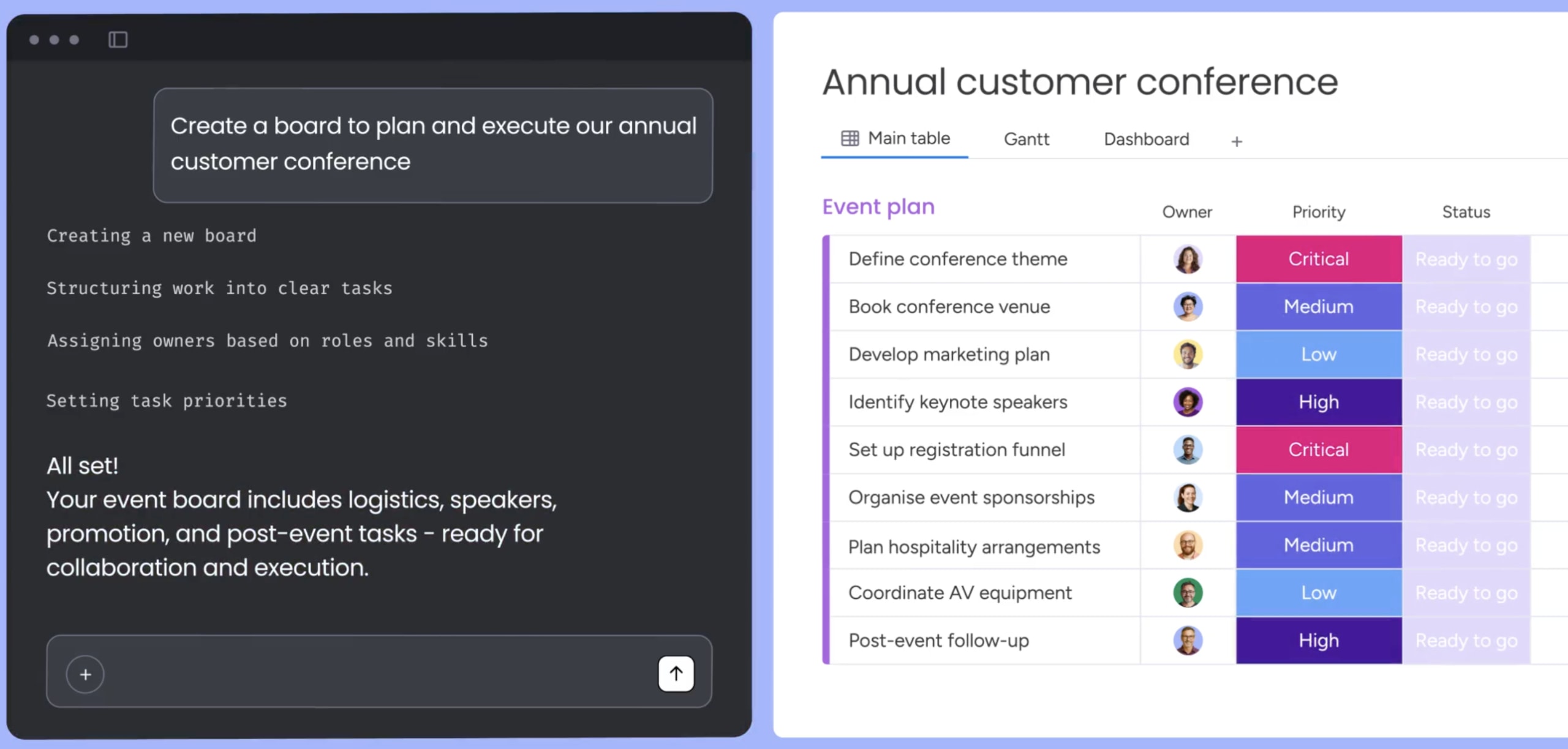
- monday sidekick: A context-aware AI assistant that can answer questions about work, generate content, and take action through natural-language conversations.
- monday vibe: A no-code app builder that turns natural-language prompts into custom business applications.
- AI Blocks: Ready-made AI capabilities for tasks such as summarizing information, categorizing data, and extracting details within existing workflows.
- AI Workflows: Combine AI-powered steps with automations and integrations to coordinate work across processes.
Teams can also use monday MCP to connect external AI assistants, including ChatGPT and Claude, with their monday AI Workspace. This lets employees work with their existing information from the AI tools they prefer, subject to their access permissions.
Keep AI adoption secure and under control
As more employees and agents use AI, businesses need confidence that their information remains protected. monday AI Workspace provides enterprise-grade security, supported by SOC 2 Type II and ISO 27001 certifications. Existing access permissions apply to AI features, and administrators can control AI availability at the account, workspace, and user-role levels.
Customer data isn’t used to train AI models, helping organizations introduce new capabilities without compromising their data governance requirements.
Build a more connected approach to AI
The findings of the 2026 AI report make one thing clear: confidence in AI is only part of the equation. Organizations also need the right foundations to help employees and agents work effectively together.
With monday AI Workspace, teams can bring AI into the work they’re already doing, introduce agents where they add value, and maintain the visibility and control needed as adoption grows.
Download monday’s AI report 2026FAQs about AI in the workplace in 2026
How is AI changing the role of managers in 2026?
AI is shifting managers' responsibilities towards overseeing AI-assisted work and ensuring employees use the technology effectively. Managers increasingly need to assess AI-generated outputs, establish accountability, and decide when human intervention is necessary. They're also adapting how they support employees as AI takes on more routine work.
What skills do managers need to lead AI-powered teams?
Managers need AI literacy, sound judgment, and the ability to redesign workflows around people and AI capabilities. They should understand what AI can reliably accomplish, recognize its limitations, and give employees guidance on appropriate use. Evaluating AI output and managing agents are becoming increasingly important management skills.
How should managers evaluate employees who use AI?
Managers should assess employees' judgment and contributions alongside the quality of their finished work. Performance reviews can consider how effectively employees use AI, whether they verify its outputs, and how they apply their own expertise. Clear records of AI involvement help managers recognize individual contributions fairly.
What's the difference between managing AI agents and employees?
Managing AI agents focuses on defining tasks, setting permissions, and monitoring outputs, while managing employees involves supporting their development and performance. Agents can execute workflows independently within defined boundaries, but managers remain responsible for appropriate oversight. Your real-life employees also need feedback and opportunities to develop their skills.
How can organizations maintain control over AI agents?
Organizations can maintain control by defining agent permissions, restricting access to sensitive data, and requiring human approval for important actions. Activity logs make it easier to review agent decisions, while regular checkpoints help managers identify problems before they escalate. Clear accountability ensures employees know when to intervene.

 Get started