


Ask what is productivity in most workplaces and you’ll hear about jam-packed calendars and long to-do lists. But being busy isn’t the same as moving your business forward. Instead, real productivity is related to the output you produce from the time, effort, and resources you put in.
This guide shows you how to define productivity and track it using metrics that reflect real value. You’ll also learn how AI plays a role in productivity by taking repetitive tasks off your plate and giving your people chance to focus on higher-value output. Whether you run one team or an entire function, you’ll see how to turn daily effort into measurable results.
Get startedKey takeaways
- Productivity measures the value you create per unit of input, not the number of hours you work or tasks you complete.
- To measure productivity accurately, compare output against inputs like time, labor, and capital over a fixed time period.
- Productivity, efficiency, and busyness are distinct: the first two create value, while busyness is motion without meaningful results.
- AI is shifting productivity by removing busywork so people focus on high-value work, with people and agents working together.
- On monday AI Workspace, dashboards, automations, and AI turn scattered activity into real-time, measurable output across every team.

What is productivity?
Productivity measures how efficiently you turn inputs like time, labor, and capital into valuable output. It’s the value created per unit of input, not a signal of how busy you look.
Productivity is a measure of production over time. Defining and fixing the time period is important for accurate productivity measurement.
Example: Consider a business that manufactures shoes. The factory team can produce 20 pairs of shoes an hour but a rival business can produce 35 pairs of shoes an hour. The second factory is more productive and we know this because the output is easy to count and the time period is clear. Both factories run for the same hour, so the comparison is fair. When you fix the time period this way, you can compare teams, machines, and processes on an apples for apples basis.
The same logic applies to knowledge work, though the output is harder to see. A team that ships 3 well-scoped features in a planned sprint is more productive than one that ships 8 features nobody uses. Value, not volume, is the point to keep in mind.
Productivity vs efficiency: what's the difference?
Productivity and efficiency sound alike, but they answer different questions. Productivity focuses on how much valuable output you produce. Efficiency focuses on the ratio of that output to the input you spent getting there. Busyness is a third state worth naming, because it often gets mistaken for both.
You can be efficient at the wrong task and still create little value. You can also be busy all day and produce nothing of importance. The goal is to raise output that counts while using fewer inputs to get there. The table below shows how the 3 concepts differ.
| Concept | What it measures | Example |
|---|---|---|
| Productivity | Total valuable output produced in a fixed period | A team ships 12 usable customer requests this month |
| Efficiency | Output relative to the inputs used to create it | The same 12 requests ship using half the previous hours |
| Busyness | Activity and motion without a link to value | Back-to-back meetings that produce no decisions |
5 types and levels of productivity
Productivity is not a single number. It shows up across 5 different levels, from a single person’s day to an entire country’s economy:
- Personal productivity: the value one person creates in a set period, shaped by focus, skill, and the systems around them.
- Team or department productivity: the combined output of a group, where coordination and handoffs matter as much as individual effort.
- Workforce or business productivity: the output of an entire organization relative to the people, capital, and processes it uses.
- Sector productivity: the output of an industry, such as manufacturing or healthcare, compared across the companies within it.
- National productivity: the output of a whole economy, often reported by governments to track growth and living standards.
Economists also describe productivity by the input you measure against. These economic types help you see where value comes from, whether that’s people, equipment, or the way you combine them.
- Labor productivity: output per hour worked, often expressed as GDP per hour at the national level or revenue per hour at the business level.
- Capital productivity: output produced relative to the physical and financial capital invested, such as machinery, software, and facilities.
- Multifactor or total factor productivity: output relative to a combination of inputs, capturing the gains from better processes, skills, and technology rather than any single factor.
Most workplace conversations focus on the first three levels and on labor productivity. That’s where you have the most direct influence and the fastest feedback loop. A frontline manager can change how a team plans its week, while national productivity moves slowly over years. Match your metric to the level you can affect, and you’ll set goals your team can meet.
The levels also connect. Personal gains roll up into team output, team output shapes business performance, and business performance contributes to sector and national figures. When you improve conditions for individuals, the effect travels upward through every level above them.
How to measure productivity
You measure productivity by dividing the valuable output you produce by the inputs you use over a fixed period.
The core formula is: Productivity = output / input.
Example: If a support team resolves 400 tickets in a 40-hour week, its labor productivity is 10 resolved tickets per hour. Change one side of the equation and you can see progress: resolve 480 tickets in the same 40 hours and productivity rises to 12 per hour. The formula stays constant even as the work changes.
Different metrics answer different questions, so most teams track several at once. The table below pairs common productivity metrics with what each one tells you.
| Metric | What it tells you |
|---|---|
| Revenue per employee | How much value each person contributes to the top line over a period |
| Output per hour | How much useful work gets produced for each hour of effort |
| Labor utilization rate | How much of paid time goes toward productive work versus idle capacity |
| Cycle time | How long it takes to move work from start to finish |
| Employee turnover rate | How stable your workforce is, since churn drains knowledge and momentum |
| Customer satisfaction score | Whether the output you produce creates real value for the people you serve |
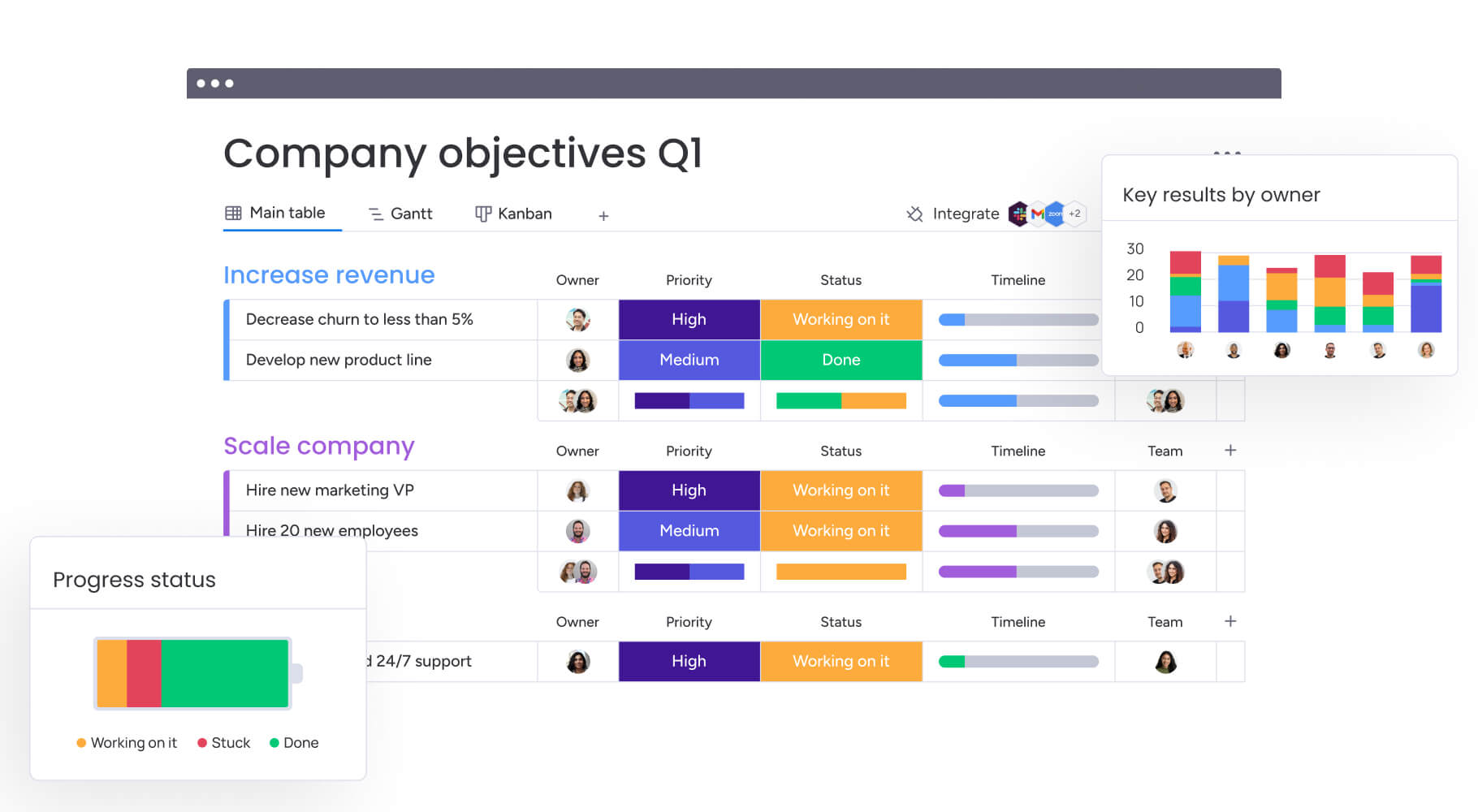
Knowledge work is harder to measure than factory output because value and activity often look the same on the surface. Counting emails sent or hours logged rewards motion, not results. The better approach ties measurement to outcomes: decisions made, problems solved, and work that customers use. Dashboards help here by turning raw work data into real-time views of progress, so you track output rather than activity. The dedicated product section below covers how that works in practice.
What affects productivity in the workplace?
Productivity rarely rises or falls for one reason. It reflects the conditions around your people, from the space they work in to the clarity of what you ask them to do. Improve the conditions and output tends to follow, often faster than any single motivational push. The following factors have the biggest effect on workplace productivity:
- Work environment: a calm, well-equipped space, whether physical or remote, reduces friction and helps people concentrate on priority work.
- Clear expectations: people produce more when they know the goal, the priorities, and how their work connects to the wider business.
- Access to tools and technology: the right platforms (such as the best productivity planners) and data let people finish work quickly instead of fighting manual steps and workarounds.
- Leadership: managers who remove blockers, give useful feedback, and protect focus time lift the output of everyone around them.
- Employee well-being: rested, healthy people sustain higher-quality output, while burnout destroys speed and judgment.
- Company culture: a culture that values outcomes over hours signals that results are more important than looking busy.
The good news is you can influence every factor on this list. Start with the variables your team names most often, then measure whether output improves as conditions change. Small, steady adjustments usually beat one large overhaul, because they let you see which change made the difference. Simple, repeatable productivity tips often lead to the highest-value fixes hiding in plain sight.
5 productivity challenges and how to beat them
Even well-run teams hit predictable obstacles. Here are 5 that show up across almost every organization, along with practical ways to beat them and increase productivity.
1. Maintaining motivation
Motivation fades when people lose sight of their work’s purpose. The fix is a golden thread that connects each person’s daily tasks to a goal they care about. Tie work to shared values and a clear purpose, and effort becomes easier to sustain. Many teams also respond well to a healthy competitive nature, where friendly targets and visible progress keep energy high. When people can see how their contribution moves the bigger picture, motivation tends to hold.
2. Ignoring distractions
Distractions like email, meetings, and phone calls remain top drains on productive time. The answer isn’t to ban interruptions but to contain them. Give every meeting an agenda and a purpose, and cancel everything else. Batching similar topics together so people switch context less often is just one of several time management strategies. Protect blocks of focus time, and build in real breaks, since rest sustains concentration rather than competing with it. A few deliberate habits recover hours you didn’t know you were losing.
3. Navigating inefficient processes
Complex, tangled processes slow everyone down and hide where work stalls. Simplify the steps, remove approvals that add no value, and document the path so nothing depends on one person’s memory. Support newer team members with clear guidance, since a confusing process hurts them most and drags down the whole team’s output. A focused effort on business process improvement turns a source of friction into a repeatable advantage.
4. Poor collaboration between teams
When teams work in isolation, handoffs break and the same problems get solved twice. Strong cross-functional collaboration improves processes, lifts motivation, and speeds up organizational learning, because knowledge moves freely instead of getting stuck in one group. Give teams a shared view of the work, agree on how information passes between them, and make joint outcomes something everyone owns. Collaboration built into daily work, rather than bolted on through extra meetings, produces the most durable gains.
5. Doing the wrong things
There’s a difference between doing things right and doing the right things. A team can execute flawlessly on work that doesn’t matter and still fall short of its goals. The fix is to align effort with business goals before you optimize how the work gets done. Define key performance indicators that reflect real value, then judge activity against them. Productivity is about value created, not busyness, so make sure the work you speed up is the work worth doing.

How AI has changed workplace productivity
AI removes busywork so people can focus on high-value work. Instead of spending hours on repetitive tasks, teams hand those steps to AI and spend their time on judgment, creativity, and decisions instead. The result is more output from the same headcount.
The productivity gains are measurable. PwC’s 2026 AI Jobs Barometer found that productivity growth is 40% higher at companies most exposed to AI than at the least exposed, with the effect strongest where repetitive knowledge work is common. That’s exactly where AI frees the most capacity, letting people spend their time on judgment and decisions instead of manual steps.
The shift works best when you frame it as collaboration, not replacement. People and agents work together as one team: people set direction and make the calls, while AI handles defined, high-volume work. In practice, automations remove repetitive manual actions like notifications and handoffs, and AI agents run clearly defined tasks end to end within guardrails you control. This combination scales output without asking people to work longer hours.
How monday AI Workspace helps you maximize productivity
monday AI Workspace helps you turn scattered activity into measurable output by making progress visible, removing busywork, and scaling capacity with AI.
Everything runs on one connected data layer, so people and agents work from the same picture across departments. Here’s how specific features maximize productivity:
- Real-time dashboards: Turn cross-team work data into no-code views of progress, workload, and throughput, so you track output instead of guessing at it.
- AI-generated summaries and risk alerts: Move teams from hindsight to foresight, flagging what needs attention before it becomes a problem.
- No-code automations: Replace repetitive manual actions like notifications, approvals, task creation, and handoffs, so people spend less time on administration. Oscar saves about 1,850 hours of staff time and around $50,000 a month on monday AI Workspace.
- monday agents: Handle defined, high-volume work end to end, from research and triage to reporting and risk analysis, with guardrails and full transparency into every action.
- monday vibe: Turns plain-language prompts into custom apps like OKR trackers, time-tracking apps, and executive overviews, so you build the view you need without waiting on engineering.
- monday MCP: Securely connects assistants such as Claude and Microsoft Copilot to your workspace data, within the same permissions your team already uses.
Turn activity into measurable output
Productivity is about the value you create, not the hours you fill. The biggest gains for any team come from a system that makes output visible and frees capacity from repetitive work. When you can see progress in real time and hand busywork to automation, you spend your effort on the work that moves the business forward. A shared, customizable work calendar is a simple place to start making commitments visible.
As AI joins your team, the winning move stays the same: measure value, then let people focus on it. Agents take on defined, high-volume tasks while your people apply judgment and creativity to the decisions that count. Keep the focus on measurable output, and productivity becomes something you can steer, not something you hope for.
Get startedFAQs about productivity
How should you measure productivity at a corporate level?
At a corporate level, you measure productivity by comparing total valuable output against the inputs used to create it over a fixed period. Common measures include revenue per employee, output per hour, and multifactor productivity, which captures gains from better processes and technology, not just individual effort.
Who is responsible for productivity in an organization?
Productivity is a shared responsibility across the organization. Leaders set clear goals and remove blockers, managers protect focus and coordinate work, and individuals own their output. When everyone tracks the same measures of value, productivity becomes a collective outcome rather than any single person's job.
Which is more important, productivity or efficiency?
Neither productivity or efficiency is more important on its own, because they answer different questions. Productivity focuses on producing valuable output, while efficiency focuses on the ratio of output to input. The strongest teams raise both, making sure the work they speed up is work that creates value.
What is the most common measure of productivity?
The most common measure of productivity is labor productivity, expressed as output per hour worked. At a national level it often appears as GDP per hour, and at a business level as revenue or units produced per hour. It's popular because it's straightforward to calculate and compare.
How is AI changing productivity?
AI is changing productivity by removing repetitive busywork so people focus on high-value work. Automations handle manual actions and AI agents run defined tasks end to end within guardrails. People and agents work together, which raises output without adding headcount or asking people to work longer hours.
How does monday AI Workspace measure productivity?
The AI Workspace measures productivity by turning cross-team work data into real-time output views. On monday AI Workspace, dashboards track progress, workload, and throughput without code, while automations capture the work as it happens. AI-generated summaries and alerts then highlight value created and where work is stalling.

 Get started