


Building a startup budget sounds straightforward until the numbers stop making sense. Early estimates often feel like guesswork, unexpected costs creep in, and suddenly the runway looks shorter than planned. Even strong ideas can stall when finances aren’t clearly mapped, because uncertainty quietly builds with every decision.
That’s why budgeting, especially at the early stage, carries more weight than most founders expect. A well-structured startup budget template provides clarity where things usually feel scattered. It connects assumptions to actual numbers, helping teams understand exactly where money goes and how long it will last.
In 2026, the pressure is on. AI initiatives and customer expectations require coordination across IT, operations, and business units. Effective cross-functional or cross-team collaboration transforms how teams execute strategy and deliver value in practice. By establishing these foundations early, you can move from reactive spending to proactive scaling with total confidence.
Key takeaways
- Break down silos to accelerate execution: Replace sequential handoffs with parallel workstreams where marketing, engineering, and operations work simultaneously toward shared goals.
- Align teams around outcomes, not departments: Measure success through shared KPIs like revenue contribution and customer satisfaction rather than individual departmental metrics.
- Use AI to automate routine coordination: Let technology handle status updates, request routing, and risk identification so teams focus on strategy and creative problem-solving instead of administrative processes.
- Build trust through transparency and shared visibility: Create open communication channels and real-time project visibility to prevent conflicts and ensure everyone understands constraints and priorities.
- Transform coordination across departments: Unify cross-departmental workflows through visual boards, automated handoffs, and AI-powered insights with platforms like monday.com that keep every team aligned and moving forward together.
What is cross-functional collaboration?
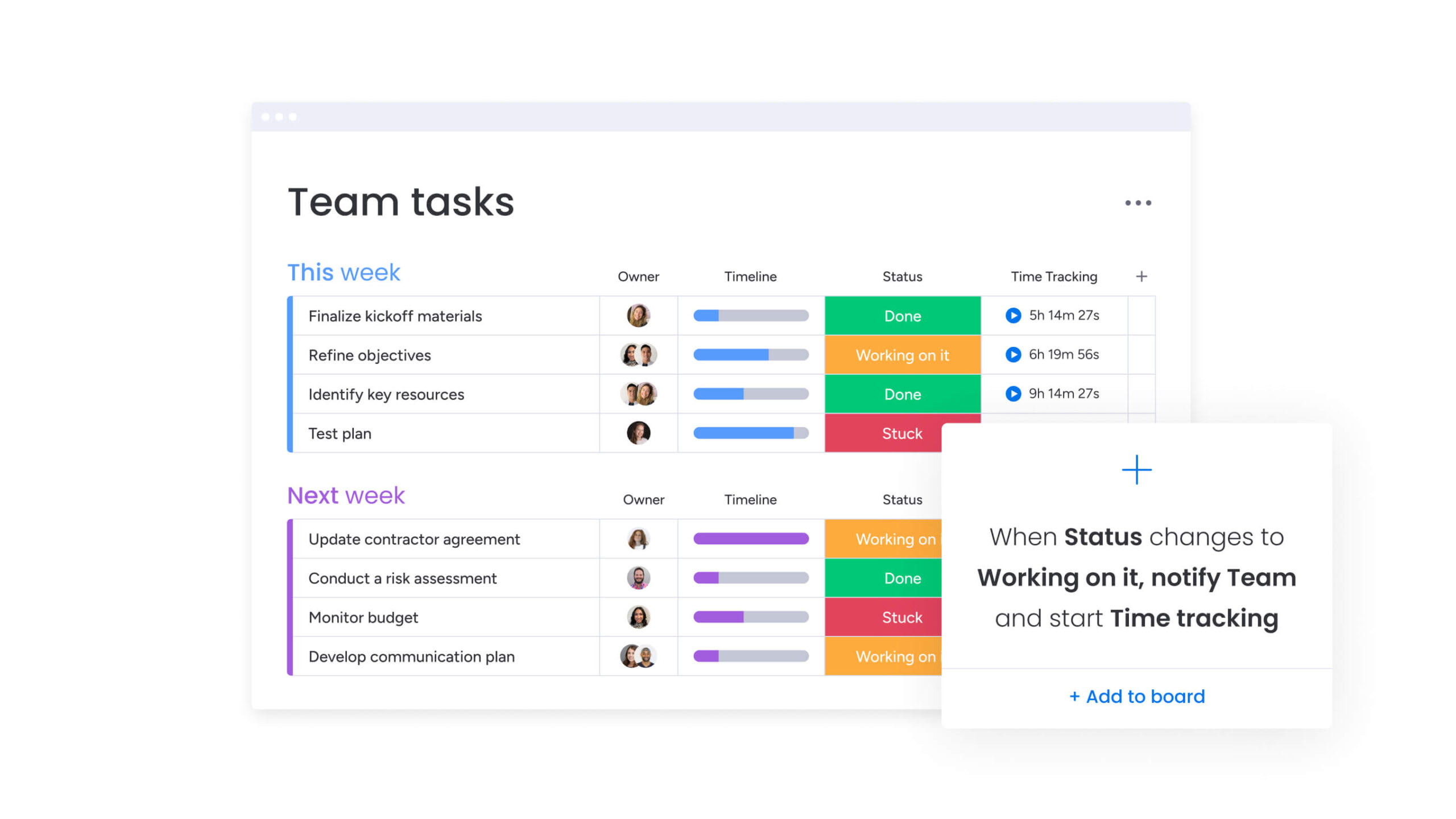
Cross-functional collaboration is the practice of bringing together individuals from different departments, specializations, and functional areas to work toward shared organizational goals. It requires shared accountability, connected workflows, and success metrics that no single team could hit alone.
In practice, this means a product launch isn’t a series of sequential handoffs where marketing waits for engineering who waits for design. Instead, it’s a synchronized effort where messaging, supply chain logistics, budget allocation, and support preparation happen in parallel, guided by a single strategic vision.
This is a real shift, from traditional department silos to teams focused on outcomes. While departments provide the home base for skill development, cross-functional teams provide the vehicle for value delivery.
Breaking down organizational silos
As companies expand, departments start speaking their own language. They build their own processes, track their own metrics, and set their own priorities. Marketing focuses on lead volume while sales prioritizes deal velocity, making cross-team collaboration essential for alignment. IT prioritizes security while business units demand rapid deployment.
These conflicting incentives create friction that slows everything down. The hidden costs of silos add up fast and often go unnoticed until they become major problems that impact the entire organization.
- Duplicated efforts: Multiple teams researching the same solutions independently.
- Shadow work: Employees spend hours reconciling data between incompatible systems.
- Misaligned priorities: Resources wasted on initiatives that don’t serve the broader strategy.
- Delayed decision-making: Approvals getting stuck between departments.
- Reduced creativity: Ideas dying because they cannot cross departmental borders.
- Missed revenue opportunities: Slow handoffs delay time-to-market.
- Fragmented customer view: Support doesn’t communicate with product, and product doesn’t sync with sales.
How cross-functional teams work together
Effective cross-functional collaboration operates on a foundation of shared objectives and defined roles rather than reporting lines. They create a common language and reporting structure that cuts through departmental jargon.
Cross-functional teams take many forms depending on the business context. These configurations address specific organizational challenges:
- Product development teams: Engineers, designers, product managers, and marketers collaborate from concept through launch, ensuring technical feasibility matches market needs.
- Customer experience teams: Support, product, marketing, and sales unite to map and improve the entire customer journey.
- Digital transformation initiatives: IT, operations, finance, and business units coordinate complex technology implementations.
Digital workspaces support these mechanics by providing real-time visibility through collaborative project management. When a designer updates a file, the marketer sees it instantly. When a developer flags a delay, the project manager adjusts the timeline automatically.
The shift from department-first to outcome-first thinking
Department-first thinking optimizes for local efficiency, with each team maximizing its own metrics at the expense of the whole, while modern business management prioritizes organizational outcomes. In contrast, outcome-first thinking focuses on what works for the entire company, where all teams align around shared results.
| Focus area | Department-first approach | Outcome-first approach |
|---|---|---|
| Marketing | Measures lead volume regardless of quality | Measures contribution to revenue alongside sales |
| IT | Measures system uptime and ticket closure speed | Measures business process efficiency and user adoption |
| Operations | Measures cost reduction in isolation | Measures impact on customer satisfaction and delivery speed |
| Leadership | Rewards protecting departmental budget | Rewards resource sharing to achieve strategic goals |
This shift requires new business management approaches where leadership rewards collaborative behavior and shared KPIs over individual departmental achievements.
Why cross-functional collaboration matters in 2026
In 2026, companies need to move fast. Therefore, cross-functional collaboration became a competitive necessity. Organizations that master the ability to mobilize diverse talent quickly through enterprise collaboration will outpace those trapped in rigid hierarchies.
The ROI of connected teams
Connected teams deliver measurable business value that directly impacts financial performance. When organizations remove barriers between functions, they achieve improvements in revenue generation, cost efficiency, and risk mitigation:
- Faster execution: Parallel workstreams replace sequential handoffs, reducing time-to-market.
- Higher quality outcomes: Multiple perspectives identify issues early in the process.
- Resource optimization: Shared resources and expertise prevent bloat.
- Accelerated problem solving: Diverse viewpoints generate breakthrough solutions.
How AI makes cross-departmental work essential
AI projects fail when teams work in silos. To deploy AI effectively, you need data from sales, infrastructure from IT, process knowledge from operations, and compliance oversight from legal. It’s a team effort. AI demands serious cross-functional collaboration. The technology only works when data and workflows are connected.
Success depends on teams aligning around shared technical and strategic goals. Several scenarios demonstrate that AI relies entirely on departmental synchronization:
- AI-powered customer service: Success requires coordination between IT for infrastructure, customer service for process design, marketing for tone and messaging, and product for technical integration.
- Predictive analytics: Accurate predictions depend on unified data streams from sales, marketing, operations, and finance.
- Automated workflows: Designing algorithms requires deep process knowledge from every department involved.
Organizations using a central work platform can leverage AI to automate routine coordination, categorize incoming requests, and surface insights across departmental boundaries.
Meeting the speed of market change
Markets move fast, as customer expectations, competitive threats, and regulations change faster than traditional planning cycles can keep up. Successful organizations respond with coordinated, cross-functional teams that mobilize instantly.
Agility depends on high-level synchronization across several key business areas:
- Customer experience shifts: A sudden change in consumer sentiment requires immediate adjustments from product, marketing, sales, and support.
- Competitive threats: A competitor’s new feature demands a rapid product pivot involving engineering, marketing, and operations.
- Regulatory changes: New compliance laws need coordinated efforts across legal, operations, IT, and business units.
Strategic value for growing organizations
Once you hit 100 employees, you naturally lose that startup speed. More managers and specialized roles create distance between strategy and execution. Cross-team collaboration keeps you agile as you grow.
It lets a 500-person company pivot as fast as a 50-person team because strategic changes get communicated and executed instantly across all departments. This means faster market response, stronger innovation, and the ability to launch complex solutions that need input from legal, security, and product — all at once.
6 key benefits of cross-functional collaboration
Cross-functional collaboration delivers real benefits that show up in your business results. These advantages show up in the metrics executives and department leaders care about — transforming how companies execute strategy and deliver value.
1. Faster project delivery
When teams collaborate, projects move faster because work happens in parallel. Traditionally, marketing waits for the product to be finished. However, with cross-functional teams, marketing builds campaigns while engineering builds features.
Shared project visibility and automated status updates keep teams aligned, without the manual coordination that usually slows things down. Teams using monday.com rely on Gantt charts and timeline views to see dependencies and keep work synchronized.
2. Driving new solutions through diverse expertise
Bringing together different perspectives creates a collision of ideas that sparks breakthrough solutions through effective collaboration. Diverse thinking helps companies avoid blind spots and build stronger solutions.
Cross-functional creativity shows up in different ways:
- Customer experience: Combining support’s pain-point data, marketing’s journey mapping, and product’s technical capabilities leads to features that solve real user problems.
- Process improvements: Merging operations’ efficiency focus with IT’s automation capabilities and finance’s cost data creates streamlined workflows.
- Market expansion: Integrating sales’ market knowledge with marketing’s positioning skills allows for successful entry into new territories.
3. Reduced compliance risk
Compliance failures usually happen in the gaps between departments, where no one’s sure who’s responsible. Cross-functional collaboration reduces this risk by creating clear oversight and shared accountability.
When teams coordinate on compliance, they protect the company in multiple ways:
- Data privacy: IT, legal, and business units work together to ensure GDPR compliance across every customer touchpoint.
- Financial reporting: Finance, operations, and business units coordinate to ensure data accuracy.
- Industry regulations: Compliance, operations, and product teams collaborate to meet sector-specific standards.
4. Optimized resource utilization
Silos waste resources, and, as a result, teams duplicate work or leave talent underused. Cross-functional collaboration helps you allocate resources better by showing you skills, capacity, and priorities across the company.
When leaders can see resources in real time, they can put talent where it’s needed most. The Workload View on monday.com helps leaders balance team resources and adapt fast when priorities shift.
5. Strengthen employee engagement and retention
Top talent wants meaningful work and room to grow. Cross-team collaboration exposes people to different parts of the business, helping them build new skills and understand company strategy.
This visibility cuts the frustration of throwing work over the wall and builds a sense of shared purpose. Employees who feel connected to the mission and see how their work matters are way more likely to stay — cutting turnover costs and keeping institutional knowledge.
6. Stronger customer outcomes
Customers see your company as a single, unified entity. Cross-functional collaboration makes sure marketing promises match what sales says and what support delivers.
When teams coordinate, customers get a unified experience:
- Integrated journeys: Marketing, sales, and support provide consistent messaging and smooth handoffs.
- Faster resolution: Support, product, and engineering collaborate to fix bugs quickly.
- Proactive service: Sales, marketing, and customer success work together to anticipate needs.
Shared project visibility and automated status updates keep teams aligned, without the manual coordination that usually slows things down.
How AI transforms cross-team collaboration
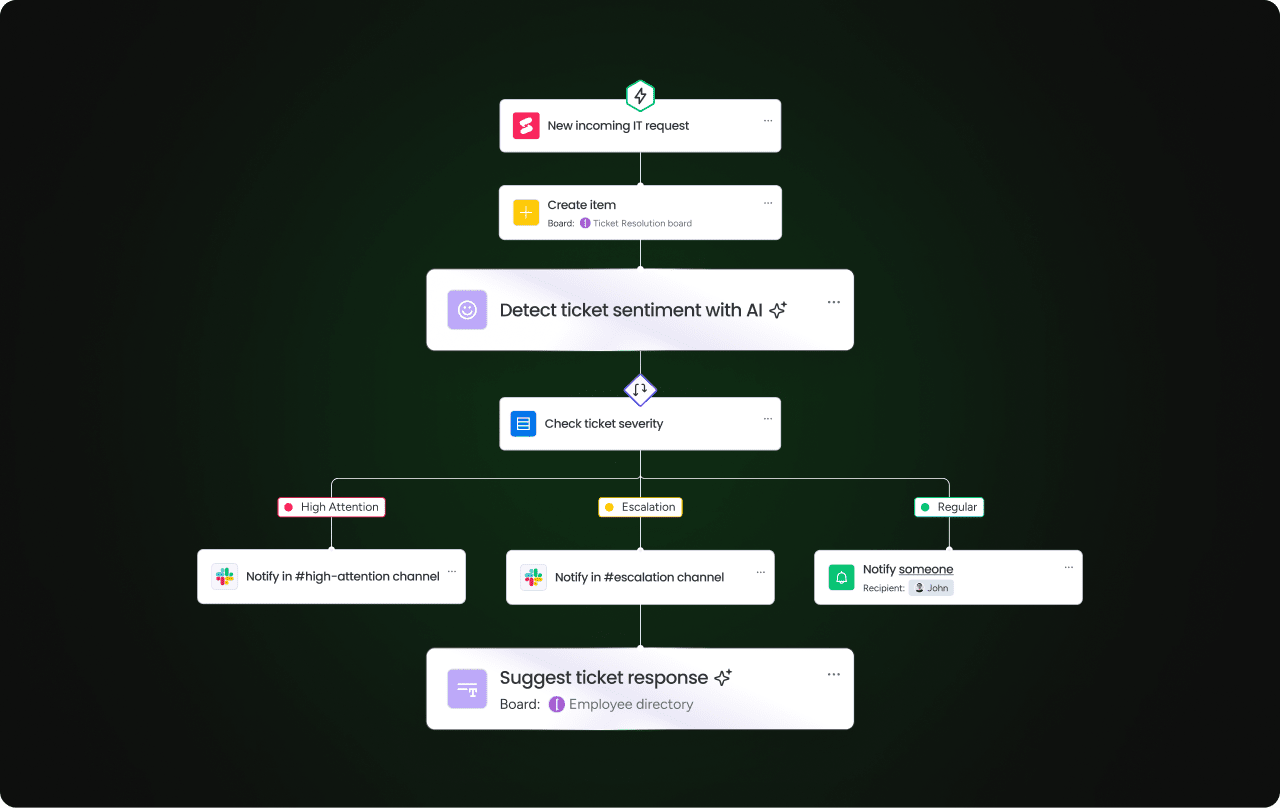
AI removes the friction that slows teams down. It handles routine coordination, delivers smart insights, and powers complex workflows, so teams can focus on strategy and creativity. This tech foundation lets companies scale collaboration while minimizing administrative overhead.
AI blocks that connect departments
AI-powered building blocks plug directly into cross-departmental workflows to automate routine tasks and coordinate work. These capabilities keep teams aligned across departments, without manual work.
Imagine if your platform could automatically route customer feedback to the right team, summarize project updates for leadership, and translate documents for global teams. These AI-powered capabilities can deliver:
- Categorization: AI analyzes incoming customer feedback and automatically routes it to product, support, or marketing.
- Summarization: AI generates executive summaries of complex cross-departmental project updates.
- Translation: Global teams collaborate efficiently as AI translates comments and documents in real-time.
- Sentiment analysis: AI monitors cross-team communications to identify potential conflicts before they escalate.
Digital workers as cross-functional partners
AI-powered digital workers act like specialized team members working across departments. They handle the admin work of collaboration, keeping things accurate and on track.
These digital partners support teams with specialized functions:
- Project analyzers: Digital workers monitor cross-departmental projects to identify risks and optimization opportunities.
- Resource coordinators: AI agents optimize team assignments based on real-time skills analysis and availability.
- Communication facilitators: Digital workers ensure information flows to the right stakeholders at the right time.
Automated workflows across teams
AI powers automated workflows that span departments and adapt when conditions change. These workflows keep teams coordinated, without constant manual work.
Smart automation coordinates complex processes across departments:
- Customer onboarding: Workflows coordinate sales handoff, account setup, training scheduling, and success check-ins across four different teams.
- Product launches: Automation synchronizes marketing campaigns, sales enablement, and support preparation based on engineering milestones.
- Issue escalation: Intelligent routing sends problems to the exact team member best suited to solve them.
Real-time intelligence for informed decisions
AI pulls information from multiple sources to deliver real-time insights, so teams can make faster decisions. Portfolio Risk Insights on monday.com scans all project boards and flags potential risks by severity — fast.
Smart analytics help teams make proactive decisions across departments:
- Portfolio risk analysis: Real-time identification of risks across multiple projects allows leaders to mitigate issues early.
- Resource optimization: Dynamic recommendations for team assignments ensure the right people work on priority activities.
- Performance insights: Cross-departmental analytics identify collaboration bottlenecks and suggest improvements.
AI-powered building blocks plug directly into cross-departmental workflows to automate routine tasks and coordinate work. These capabilities keep teams aligned across departments, without manual work.
7 essential skills for cross-functional leadership
Leading cross-functional teams requires a different toolkit than managing a single department. These specialized abilities help leaders navigate AI-enabled, fast-paced environments to keep diverse teams accountable and aligned toward shared outcomes.
1. Precise cross-team communication
Great cross-functional leaders adapt how they communicate to different audiences, while keeping the message consistent. They translate between departments, explaining technical constraints to marketing or business needs to engineering.
Learn more: Team communication
2. Systems-level thinking
This involves understanding how various parts of the company connect. Leaders must recognize how a change in one area ripples through other departments to prevent unintended bottlenecks.
3. Data-driven decision making
Relying on objective data rather than departmental gut feelings provides a common language that cuts across silos. Centralized dashboards provide a single source of truth by displaying live project data — including budgets, goals, and schedules — automatically.
4. Conflict resolution across functions
Relying on objective data rather than departmental gut feelings provides a common language that cuts across silos. Centralized dashboards provide a single source of truth by displaying live project data — including budgets, goals, and schedules — automatically.
5. Resource orchestration
This skill focuses on the sophisticated coordination of people, budget, and assets across multiple departments. Leaders use specialized management tools to plan, schedule, and allocate these resources based on real-time organizational needs.
6. Digital collaboration mastery
Technical proficiency with digital platforms is required to automate routine coordination. By using automations and templates within monday.com, leaders save time and allow new projects to scale faster.
7. Adaptive leadership
Successful leaders shift their style and processes as circumstances change. They rely on continuous feedback loops and real-time data to guide these shifts and maintain momentum.
9 steps to build cross-functional collaboration
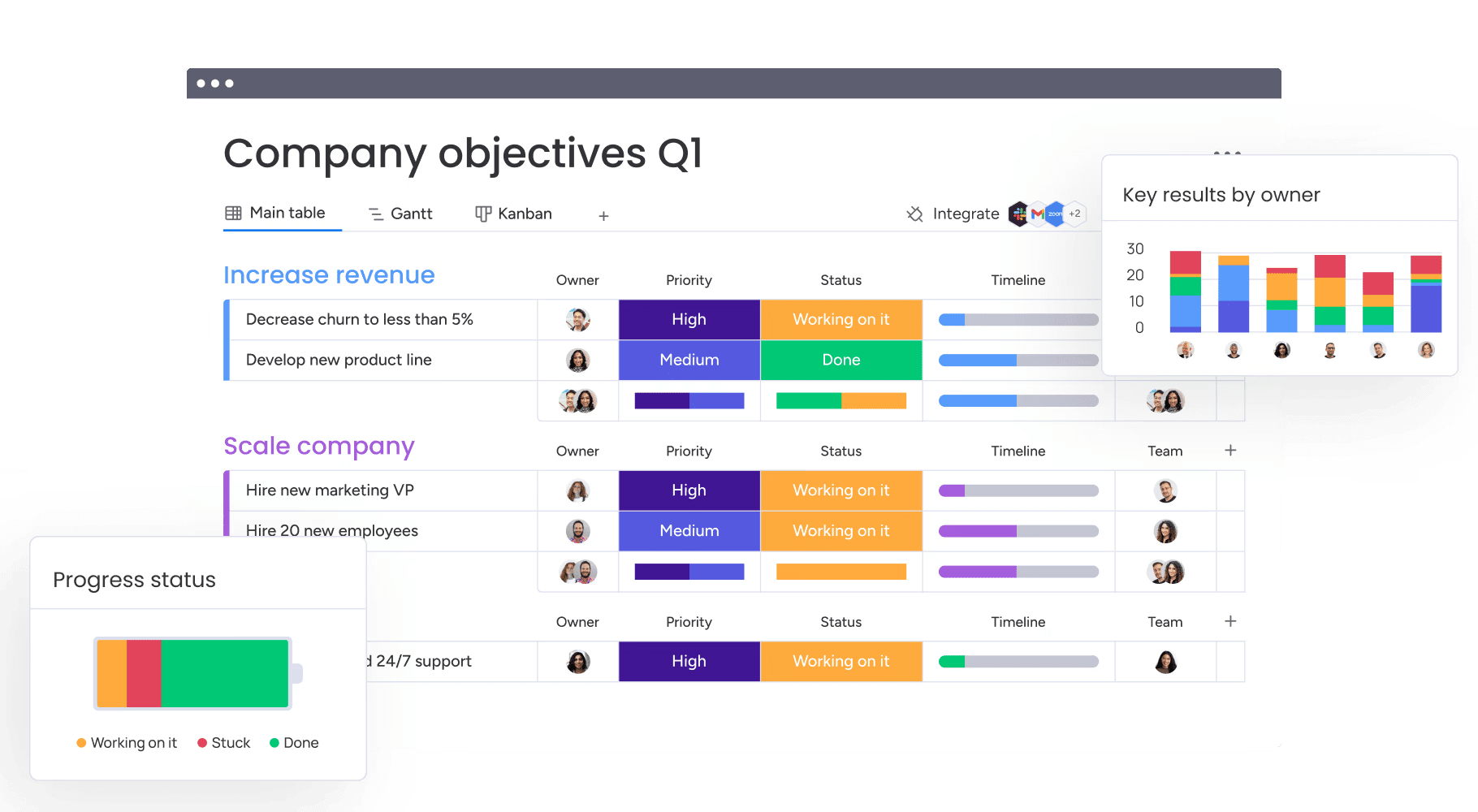
Building effective cross-functional collaboration takes a structured approach. Organizations can follow this framework to build a connected, efficient operating model. This systematic approach ensures sustainable transformation rather than temporary improvements.
Step 1: Map your current collaboration maturity
Start with assessing the current state objectively. Identify which departments work together regularly, where silos exist, and where communication bottlenecks occur.
Step 2: Define shared objectives and KPIs
Common goals align diverse teams. Therefore, move beyond departmental KPIs to establish outcomes that require collaborative effort.
Goals and OKRs capabilities help teams track progress towards strategic objectives.
Step 3: Design your cross-functional team structure
Next, define roles, responsibilities, and decision-making authority to maintain accountability while enabling flexibility. Options include matrix organizations, cross-functional squads, or center of excellence models.
Ambiguity breeds conflict. Before work begins, define who decides, who executes, and who needs to be informed.
Using a RACI framework clarifies these relationships across team boundaries. Explicitly state that accountability doesn’t mean doing all the work but ensuring the work gets done.
Step 4: Establish communication channels
Communication systems must bridge departmental boundaries. Define both formal meeting rhythms and informal information-sharing protocols.
Using workdocs provided by monday.com, teams can execute workflows with live boards and dashboards embedded directly.
Step 5: Select your collaboration platform
Remember that the right platform offers cross-departmental visibility, workflow integration, and automation capabilities. It must be flexible enough to adapt to different departmental needs while maintaining a unified data layer.
Learn more: monday.com alternatives
Step 6: launch targeted pilot programs
Don’t boil the ocean. Select one high-impact, cross-functional initiative to pilot the new framework.
This could be a specific product launch or customer journey revamp. Use this pilot to test the technology, roles, and communication protocols. Learn what works for your specific organizational culture and refine the process before wider rollout.
Step 7: Create automated handoffs
Automated processes coordinate work between departments, reducing friction and ensuring consistency. Teams can set up automated notifications and reminders for approval workflows and status changes.
Step 8: Build feedback mechanisms
Continuous improvement requires systematic feedback. Regular retrospectives, cross-departmental surveys, and performance analytics contribute to ongoing refinement.
Step 9: Measure and scale success
Finally, track effectiveness to validate the value of collaboration and expand successful approaches. Use portfolio management capabilities to see the big picture and detect bottlenecks.
3 ways to measure cross-team collaboration success
Collaboration improves when progress is visible. Measuring the right indicators helps teams understand whether coordination is actually improving speed, alignment, and outcomes across departments.
The following metrics highlight how effectively work moves between teams and whether collaboration efforts are delivering measurable business value.
1. Track efficiency and productivity gains
Measure the reduction in cycle time for key cross-functional processes. Track the time from idea to launch or lead to cash.
Monitor resource utilization rates to see if teams spend less time on administrative activities. A decrease in status meetings and email volume can also serve as a proxy for improved workflow efficiency.
2. Monitor innovation velocity
Innovation can be quantified by tracking:
- Rate of new product or feature releases.
- Time to validate new hypotheses.
- Percentage of revenue from products launched in the last 24 months.
Higher velocity indicates that friction between product, engineering, and go-to-market teams has been reduced.
3. Assess team and stakeholder alignment
Finally, use quantitative surveys and qualitative feedback to measure alignment. High Employee Net Promoter Scores within cross-functional teams suggest healthy collaboration.
Track the frequency of rework caused by miscommunication. A downward trend indicates teams are aligned and getting it right the first time.
Turning collaboration barriers into opportunities
Implementing cross-functional collaboration presents challenges. Organizations can transform these common barriers into sources of competitive advantage. Rather than viewing obstacles as roadblocks, forward-thinking leaders reframe them as opportunities to build stronger, more resilient operating models.
Aligning different team priorities
Departments naturally develop different priorities based on their functions. This diversity of perspective becomes a strategic advantage when aligned correctly.
Shared outcome definitions and cross-functional planning ensure different priorities contribute to a common goal.
Building trust across departments
Trust issues arise from different cultures and past conflicts. Therefore, building trust involves transparency, reliability, and shared success.
Collaborative platforms support this by providing transparency into work progress and decision-making.
Managing shared resources effectively
Resource conflicts occur when multiple departments need the same assets. The Workload View provides real-time visibility into team capacity across departments, enabling dynamic management.
Creating accountability structures
Accountability can become diffuse in cross-functional environments. RACI matrices define roles while shared success metrics require joint effort.
Platforms providing task ownership and progress tracking support this balance.
4 major opportunities in cross-team collaboration
If you want to modernize operations, focus on these four areas for the biggest ROI. These aren’t just problems to fix — they’re chances to upgrade how your business runs.
1. Unifying fragmented systems and information
The average enterprise uses dozens of disconnected SaaS apps. This sprawl creates pockets of isolated data. The opportunity? Set up one work management layer that sits above all these specialized systems.
Integrate workflows into one central platform, and you get one view for decision-making. You don’t need to replace every system — just connect them so status changes in developer platforms show up instantly on marketing roadmaps. Teams using powerful platforms like monday.com connect all their existing systems — Microsoft Teams, Gmail, Slack, Jira, Salesforce — and run projects without switching tabs.
2. Aligning goals across departments
Most companies struggle to connect high-level strategy with daily execution. Cross-team collaboration lets you set goals that cascade down and stay visible to everyone.
When developers see how their sprint initiatives tie to revenue goals, they’re more aligned. This transparency helps teams focus on work that matters instead of busywork. How visible are your company goals to the people doing the work?
3. Bridging communication gaps between teams
Communication breaks down because different departments speak different languages. The opportunity? Design communication rules that translate between these languages.
This involves moving away from unstructured email and chat toward contextual communication within the work itself. When discussions happen directly on the project, context stays intact and anyone joining later can see why decisions were made.
Learn more: Team communication
4. Accelerating adoption of collaborative practices
Technology alone doesn’t solve collaboration. Culture does. The opportunity here is to systematically build collaborative muscle through deliberate change management.
This involves:
- Training leaders to facilitate rather than dictate.
- Rewarding teams for collective outcomes rather than individual performance.
- Treating collaboration as a skill to be developed.
Organizations that treat collaboration as a skill to be developed accelerate their transformation and realize value from their platforms much faster.
Cross-functional collaboration examples by team
Real-world scenarios demonstrate how different departments collaborate to achieve superior results. These examples illustrate practical applications of cross-functional principles across various organizational contexts.
Sales and marketing alignment
Sales and marketing teams often experience tension between volume and quality that can be resolved through effective cross-team collaboration. Lead scoring developed jointly ensures sales focuses on the right prospects.
Marketing creates sales enablement materials based on real customer conversations.
Product and engineering synchronization
Product and engineering collaboration balances market needs with technical feasibility. Joint sprint planning based on business value and technical reality leads to sustainable products.
Operations and IT partnership
Operations and IT collaborate to implement technology that improves business processes. This partnership ensures digital transformation initiatives deliver actual business value through process automation.
Finance and business unit integration
Finance works with business units to improve budgeting and forecasting while maintaining control. Dynamic budgeting allows real-time adjustments based on performance.
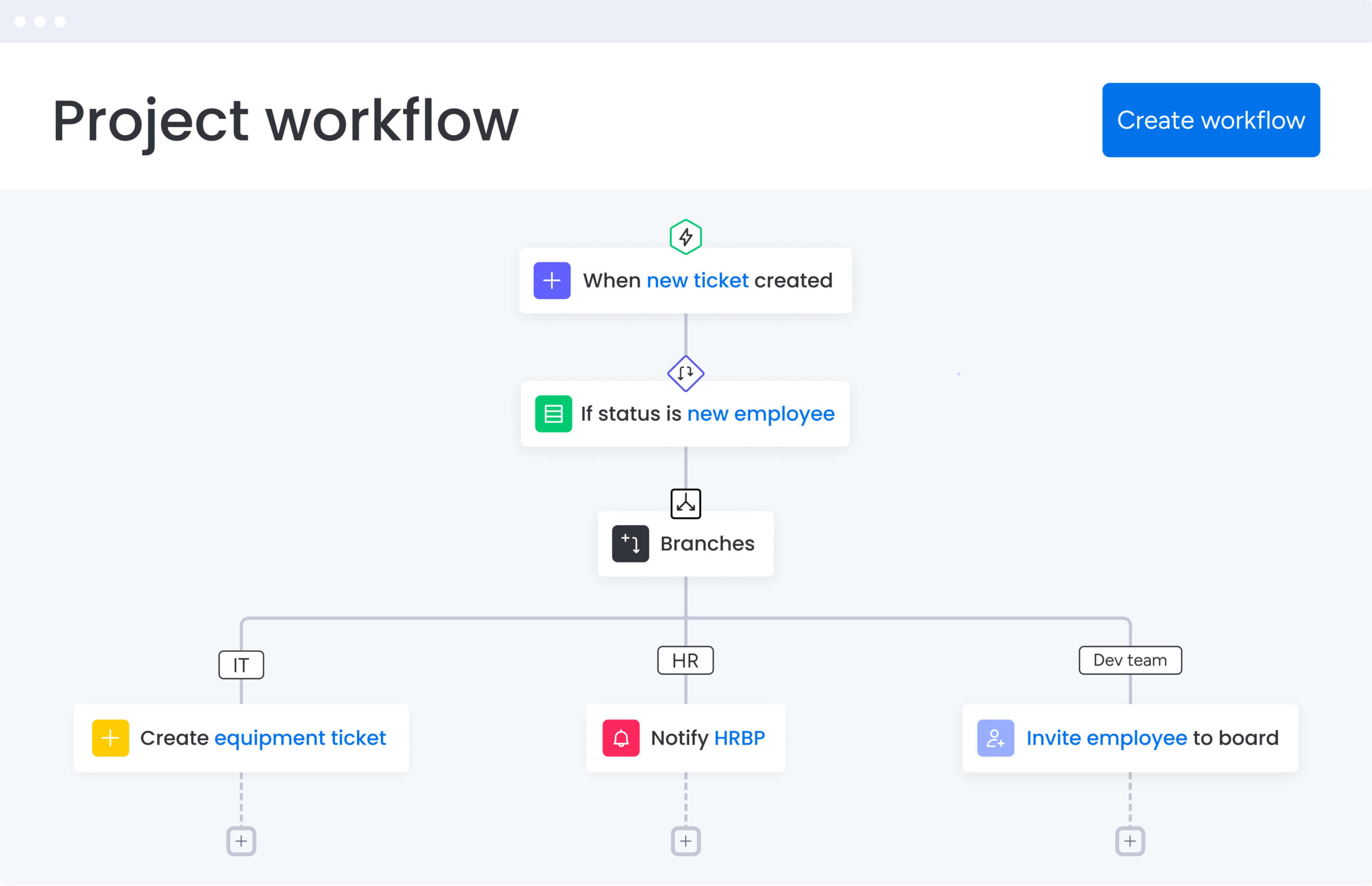
Enable cross-functional success with monday.com
For teams looking to transform scattered departmental efforts into synchronized execution, monday.com provides a unified workspace for cross-functional collaboration, providing the visibility, automation, and intelligence teams need to work as one. The platform transforms scattered departmental efforts into synchronized organizational execution.
Visual workflows that connect every team
Visual project boards and workflow capabilities enable cross-functional teams to coordinate effectively. Cross-departmental project views accommodate different team preferences through Gantt, Kanban, and timeline views.
Shared dashboards provide real-time visibility into status, resources, and metrics.
AI-powered insights across projects
AI capabilities specifically support cross-functional collaboration by providing intelligence and automation. Portfolio Risk Insights identify risks across multiple projects and departments.
Furthermore, AI blocks route requests and feedback to appropriate teams based on content analysis.
Automated cross-department processes
Automation reduces manual coordination and ensures consistency. Handoff automation creates and assigns activities when a department completes its work.
Status synchronization reflects updates across all relevant boards instantly.
Real-time resource management
Resource management capabilities allow organizations to optimize allocation across departments. Workload views provide real-time visibility into team capacity.
Capacity planning forecasts work across departmental boundaries.
Portfolio views for executive visibility
Executive-level visibility into cross-functional initiatives supports strategic decision-making. Portfolio dashboards offer high-level views of all initiatives with status and risk indicators.
Cross-departmental analytics reveal collaboration patterns and bottlenecks.

“monday.com has been a life-changer. It gives us transparency, accountability, and a centralized place to manage projects across the globe".
Kendra Seier | Project Manager
“monday.com is the link that holds our business together — connecting our support office and stores with the visibility to move fast, stay consistent, and understand the impact on revenue.”
Duncan McHugh | Chief Operations OfficerTransform your organization through unified collaboration
Cross-functional collaboration represents more than a management trend — it is the foundation for organizational resilience in an AI-driven business environment. Organizations that master this capability will outpace competitors trapped in departmental silos.
The path forward requires intentional design of workflows, communication systems, and performance metrics that reward collaborative behavior. Success depends on leadership commitment to outcome-focused thinking and the right technology foundation to support coordination across every department.
For teams looking to transform scattered departmental efforts into synchronized execution, monday.com provides a unified platform. With AI-powered insights, automated workflows, and real-time visibility, you can focus on strategy and creative problem-solving while the platform handles routine coordination.
Frequently asked questions
What is cross-functional collaboration?
Cross-functional collaboration is the practice of bringing together individuals from different departments to work toward shared organizational goals, requiring shared accountability, integrated workflows, and unified success metrics.
Why is cross-functional collaboration important?
Cross-functional collaboration enables faster project delivery, drives breakthrough solutions through diverse perspectives, reduces compliance risk, optimizes resource utilization, and creates stronger customer outcomes.
What are the main challenges of cross-functional teams?
The main challenges include aligning different departmental priorities, building trust across organizational cultures, managing shared resources effectively, and creating accountability structures that maintain individual responsibility.
How do you measure cross-functional collaboration success?
Measure success through outcome metrics like project delivery time and customer satisfaction, process metrics like workflow efficiency, and satisfaction metrics from stakeholder surveys and team feedback.
What skills do cross-functional leaders need?
Cross-functional leaders need precise communication skills, systems-level thinking, data-driven decision-making abilities, conflict resolution capabilities, resource orchestration expertise, digital collaboration mastery, and adaptive leadership.
How does AI support cross-functional collaboration?
AI supports collaboration by automating routine coordination, categorizing and routing requests, summarizing complex updates, flagging risks across projects, and providing real-time insights for faster decision-making.
What is the difference between cross-functional and cross-team collaboration?
Cross-functional collaboration typically refers to structural, ongoing cooperation between departments like marketing and sales. Cross-team collaboration is often more dynamic, involving project-based squads formed to achieve specific, time-bound objectives.
How do you facilitate cross-team collaboration?
To facilitate cross-team collaboration, establish shared strategic goals that align incentives across departments and implement a unified work management platform to centralize information. Support this with defined communication protocols and accountability structures like RACI to ensure smooth execution.
How long does it take to implement cross-functional collaboration?
Initial implementation of a pilot program typically takes four to eight weeks. Scaling cultural change and full organizational adoption is an ongoing journey that typically matures over six to twelve months depending on organization size and complexity.

 Get started