


Everyone drops balls. And for most people, this is a systems problem. Work arrives faster than you can process it, and the thing you carefully planned your morning around gets ambushed by someone else’s emergency. The best planner apps solve this by giving you a repeatable system that holds things together when reality doesn’t cooperate. This guide covers 14 of the best planner apps, including monday.com, and how you can use them to scale your work.
Try monday.comQuick overview: best planner apps at a glance
Planner apps aren’t just for managing simple processes anymore. The best ones now connect teams and track progress to help you you ship work faster. When your team grows, you need a platform that works for solo planning and cross-team projects without breaking.
To help you make a decision in a crowded marketam, we’re breaking down 14 leading apps, each with a distinct approach to planning. We’ll show you what each one does best and who it’s built for.
| App name | Primary strength | Key differentiator | Starting price |
|---|---|---|---|
| monday work management | Comprehensive work platform | Scales from personal to enterprise | Free tier available |
| Todoist | Task management | Natural language processing | Free |
| Motion | AI-driven scheduling | Automatic time blocking | $19/month |
| Sunsama | Intentional planning | Daily reflection rituals | $20/month |
| Akiflow | Universal command center | Consolidates 3,000+ integrations | $19/month |
| Morgen Calendar | Calendar optimization | AI Planner with Frames system | Free tier available |
| Routine | Habit-driven scheduling | Offline-capable, local-first architecture | Free |
| Notion | All-in-one workspace | Database-driven customization | Free tier available |
| ClickUp | All-in-one platform | Deep customization with AI scheduling | Free tier available |
| Trello | Visual Kanban boards | Zero learning curve simplicity | Free |
| Ellie Planner | Visual timeboxing | Infinite Calendar Kanban | Free tier available |
| Amazing Marvin | Anti-procrastination system | Behavioral psychology framework | $96/year |
| Goodnotes | Digital handwriting | Pen-on-paper experience with AI | Free tier available |
| Artful Agenda | Aesthetic planning | Paper planner look with digital sync | $39.99/year |
Your best choice depends on what you need to fix. Are you organizing personal projects, or do you need to orchestrate company-wide initiatives? The right platform isn’t just about managing your day; it’s about using business planning software to run your business.
14 best planner apps for daily planning success
Most planner apps force an impossible choice: lightweight tools that collapse under real workloads, or bloated platforms that bury you in features you’ll never use. The tools below adapt to your work and help you convert intentions into delivered outcomes.
1. monday.com
monday.com pulls scattered planning into one place. It connects daily tasks to big-picture goals, so strategy turns into work. It handles tiny project details and big-picture portfolio management. Teams can standardize how they work while still customizing workflows for their department.
Key features:
Look for features that align departments without killing flexibility. monday.com combines planning, automation, reporting, and AI in one workspace.
- Visual planning flexibility: Use dynamic project views including Gantt, Kanban, Workload, Calendar, and Timeline to match how different teams think and plan.
- Advanced project controls for PMOs: Track complex schedules with dependencies, milestones, baseline, and critical path so you can understand what drives delivery dates.
- Dashboards and live reporting: Build executive-ready dashboards with drag-and-drop widgets to monitor budgets, progress, workload, and timelines across multiple boards.
- Work intake that stays structured: Use Forms to capture requests and route them into the right workflow with consistent fields and ownership.
- Work where context lives: Collaborate in monday workdocs, and embed live boards and dashboards so updates stay tied to the work.
- AI-powered planning assistance: Add AI Blocks to categorize work, summarize text, extract information from files, translate content, and more, directly inside boards.
- Comprehensive integration ecosystem: Connect your workflows with 72+ integrations, including options like Slack, Microsoft Teams, Gmail, Outlook, Google Drive, and Jira Cloud.
Pricing:
- Free: $0 (up to 2 seats, 3 boards maximum)
- Basic: $9/seat/month (billed annually)
- Standard: $12/seat/month (billed annually)
- Pro: $19/seat/month (billed annually)
- Enterprise: Contact sales for custom pricing
- Annual billing saves 18% compared to monthly plans.
- Teams over 40 users should request a quote for volume pricing.
Why it stands out:
Many tools work great in isolation but fall apart when projects cross departments. monday.com skips this problem. It scales across portfolios, resources, and processes without forcing every team into the same box.
- Portfolio visibility that leaders can use: Roll up project data into shareable dashboards and reports, so stakeholders can review progress without chasing updates.
- Resource and workload visibility for managers: Use Workload View and the Workload Widget to spot over- or under-utilization and rebalance work early.
- Workflows you can standardize without slowing teams down: Launch faster with templates and then tailor columns, views, and automations to match each team’s operating rhythm.
- Enterprise-ready control: Use multi-level permissions to manage access for internal teams, guests, or vendors, without disrupting day-to-day collaboration.
Advanced AI features:
AI only boosts productivity if it lives where the work happens, not in a separate tab. By embedding AI in columns and automations, monday.com turns messy inputs into clean data instantly.
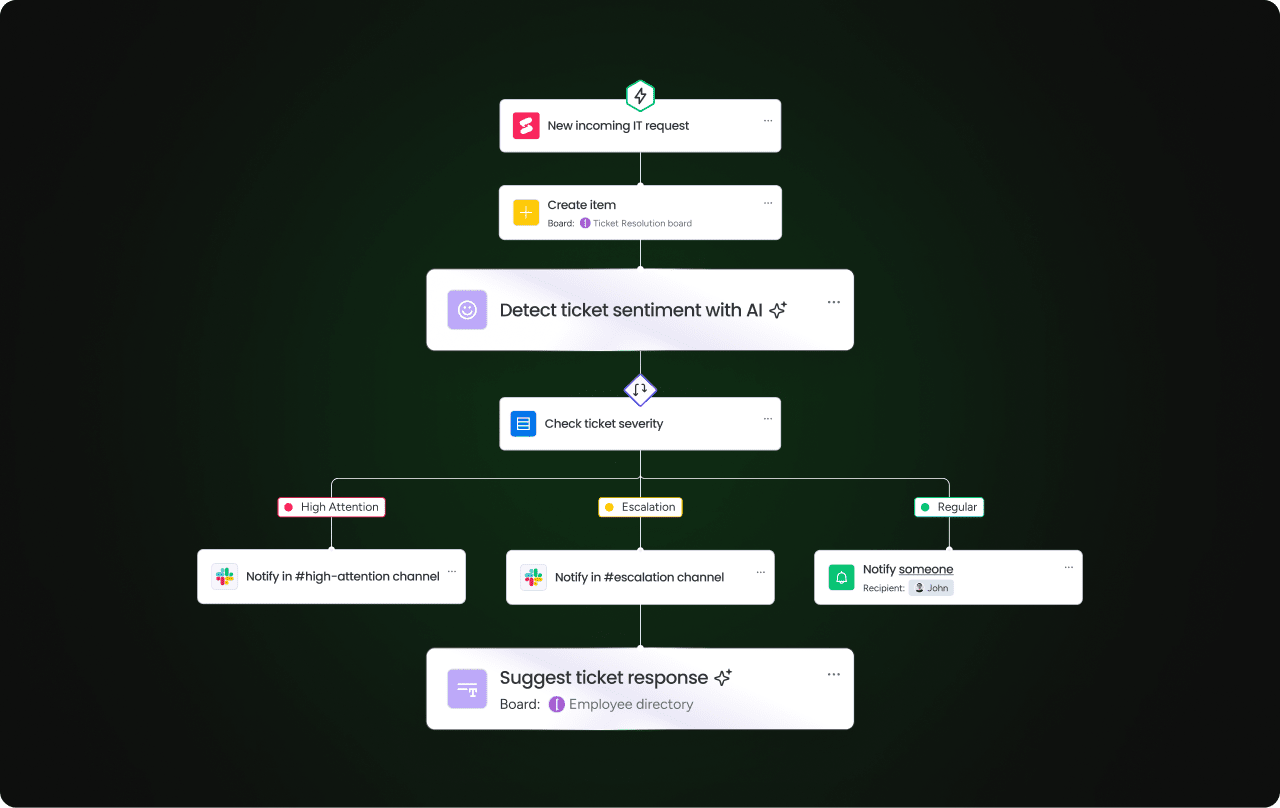
- AI Blocks inside boards: Add AI actions like Summarize, Extract info, Categorize, Detect sentiment, Translate, Improve text, and Custom block to the columns and workflows you already use.
- Autofill with AI: Set up AI on a column to run automatically, preview the results, then save.
- AI Automations (Pro and Enterprise): Use AI actions in the automation center to apply AI across complex workflows.
- AI Templates: Start with pre-built AI templates that link AI columns into workflows you can run right away.
- Digital workforce: AI specialists like Project Analyzer are designed to monitor projects in real time, flag bottlenecks, pinpoint key dependencies, and predict delays.
Automations:
Real automation keeps execution consistent across the company. In monday.com, automations keep ownership, approvals, and handoffs moving without manual nudges.
- Automation center with templates: Pick pre-built automation recipes to standardize approvals, notifications, and board creation.
- Cross-team coordination: Set automations to alert stakeholders when statuses change, dates shift, or deliverables hit review.
- AI inside automations (plan-dependent): Add AI actions such as categorize, summarize, or extract information as part of a workflow, then troubleshoot outcomes with Run history.
Integrations:
Connecting your tech stack only pays off if it kills duplicate data entry and keeps context intact. monday.com connects communication, email, files, and project tools.
- Work where teams already talk: Connect workflows with Slack and Microsoft Teams so updates and notifications reach the right channels.
- Turn messages into tracked work: Use integrations like Gmail and Outlook to convert emails into actionable items on monday.com.
- Keep files attached to execution: Use Google Drive to attach, share, and preview files directly on monday.com.
- Connect delivery systems: Use Jira Cloud with two-way syncing to keep engineering-related work aligned when needed.
- Bring existing plans forward: Import project data via Excel, so teams can transition from spreadsheets into live workflows.
- Open API: Build custom integrations for specialized systems.
2. Motion
Stop playing calendar tetris. Motion uses AI to optimize your schedule automatically in the background. Built for professionals juggling multiple clients, Motion adapts when priorities shift or meetings pop up.
Key features:
- Intelligent auto-scheduling: AI analyzes tasks, deadlines, and availability to build time-blocked schedules that adjust when priorities change.
- Multi-calendar unification: Connects all your calendars with two-way syncing for Google, Outlook, and iCloud.
- Native booking links: Built-in scheduling with real-time availability, buffer times, daily limits, and invitee questions across all calendars.
Pricing:
- Pro AI: $19/month with 7,500 AI credits monthly, includes AI scheduling, docs, and core features.
- Business AI: $29/month with 15,000 AI credits monthly, adds team capacity planning, advanced dashboards, and priority support.
- Annual discount: Save 33% when paying annually.
- AI credit overages: $0.25 per 100 credits (Pro) or $0.19 per 100 credits (Business).
Considerations:
- Mobile app is a companion to desktop with limited features compared to the web version.
- User reviews mention a learning curve and pricing concerns, despite strong automation.
3. Sunsama
Sunsama adds intention to chaotic days with guided daily and weekly reflections. Tailored for knowledge workers who crave mindful productivity, the platform champions sustainable habits over sheer output volume, helping you build realistic schedules that protect your focus.
Key features:
- Daily planning flows with time estimation, workload warnings, and realistic scheduling to prevent over-commitment
- Focus Mode with Pomodoro timers, break reminders, and a floating Focus Bar to maintain deep work sessions
- Comprehensive integrations with task managers, calendars, and communication platforms to consolidate planning activities
Pricing:
- Pro plan: $20/month (billed annually) or $25/month (billed monthly)
- Enterprise: Custom pricing with SSO, SCIM, and audit logs
- Free trial: 14 days, no credit card required
- Annual discount: 20% savings compared to monthly billing
- Student discount: Available with .edu email verification
Considerations:
- Mobile experience serves as a companion to desktop rather than a full standalone solution
- Manual planning approach requires daily engagement and may not suit users preferring automated scheduling
4. Akiflow
Think of Akiflow as a universal command center for your fragmented digital life. It pulls scattered items from dozens of different platforms into one centralized inbox. Heavily focused on AI-assisted time-blocking, it serves as a vital hub for project managers and executives who need to coordinate deliverables across a massive software stack.
Key features:
- Universal inbox that consolidates tasks from 3,000+ integrations including Slack, Gmail, Notion, Asana, and project management platforms
- Advanced time-blocking with drag-and-drop scheduling, natural language planning, and automated replanning for incomplete tasks
- AI-powered executive assistant (Aki) that automates routine planning decisions and Meeting Assistant for transcribing action items
Pricing:
- Pro Monthly: $34/month (billed monthly)
- Pro Yearly: $19/month (billed annually, 44% savings)
- Team plans: Contact for pricing
- 7-day free trial available
- Student and researcher discounts available on request
Considerations:
- Limited calendar integration options — no native Apple/iCloud Calendar support may restrict Apple-centric users
- Desktop-first approach with mobile features still catching up, potentially affecting on-the-go planning workflows
5. Morgen Calendar
Calendar-centric planning gets a massive upgrade with Morgen. By blending multi-calendar management with intelligent time-blocking, it keeps you firmly in the driver’s seat while AI handles the logistical friction. The platform relies on a unique “Frames” system—a guided approach that uses your ideal week template to dictate realistic daily execution.
Key features:
- AI Planner with preview-and-approve workflow that suggests 1-8 day schedules while maintaining user control
- Frames system that templates your ideal week to guide when different types of work should be scheduled
- Built-in scheduling links with multi-person coordination and automatic conflict detection across all connected calendars
Pricing:
- Basic: Free tier available with core calendar and task management features.
- Personal: Starts at $9/month (billed annually) for advanced scheduling and integrations.
- Pro: Starts at $15/month (billed annually) for access to the AI Planner and advanced team features.
- Discounts: 25% off for students, academics, and nonprofits; 15% off for one year when switching from Motion, Reclaim, Fantastical, or Sunsama.
Considerations:
- The free tier is limited to basic features and a smaller number of calendar sets and scheduling links.
- Some integrations like Obsidian are desktop-focused and not fully supported on mobile devices.
6. Routine
Master your schedule, master your life. That core philosophy drives Routine, a lightning-fast, offline-capable workspace designed to turn your calendar into an engine for consistency. By seamlessly merging tasks, habits, and recurring events, it helps users carve out dedicated time for what moves the needle.
Key features:
- Natural language console for quick task capture, scheduling, and universal search across all data
- Time blocking with drag-and-drop scheduling that syncs tasks and habits directly to your calendar
- Local-first architecture providing instant response times and full offline functionality
Pricing:
- Free: Unlimited tasks, calendars, notes, contacts, custom types, and integrations
- Professional: $10/month with AI meeting notes, time tracking, and menu-bar widget
- Business: $15/seat/month adding workspaces, access control, and AI agents
- Enterprise: Custom pricing with unlimited history and compliance features
Considerations:
- Web app performs 30% slower than desktop versions and lacks key features like AI meeting recording
- Mobile apps are still developing, with some user-reported quirks and missing recurring event functionality
7. Notion
Operating as a completely blank canvas, Notion refuses to box you into a specific methodology. It merges documentation, databases, and scheduling into a single, highly malleable workspace. Ambitious teams and power users flock to this platform to architect bespoke planning systems from scratch, weaving deep knowledge management directly into their daily timelines.
Key features:
- Notion Calendar integrates seamlessly with Google Calendar and Apple iCloud, featuring built-in scheduling links and multi-timezone support
- Database-driven project management where dated items from your timelines and boards can be viewed and updated directly within Notion Calendar
- AI-powered automation through Notion Agent and AI Meeting Notes that extract action items and create follow-up workflows
Pricing:
- Free: $0 per member/month for individuals with basic features and limited AI trials
- Plus: $10 per member/month with unlimited collaborative blocks and file uploads
- Business: $20 per member/month including Notion Agent, AI Meeting Notes, and enterprise search
- Enterprise: Custom pricing with advanced security and compliance features
- Annual billing saves up to 20% across all plans
- Custom domains cost $10 per domain/month, Custom Agents require usage-based credits at $10 per 1,000 credits
Considerations:
- Calendar provider support limited to Google Calendar and Apple iCloud (Microsoft Outlook support coming)
- Steep learning curve for building effective custom planning systems requires understanding database concepts and view configurations
8. Todoist
Speed and simplicity define the Todoist experience. Relying on lightning-fast natural language processing, it interprets your scheduling intentions the moment you type them. Bridging the gap between personal productivity and lightweight team collaboration, it offers robust calendar-integrated workflows and AI-powered capture without burying you in complex menus.
Key features:
- Calendar layout with time-blocking, drag-and-drop scheduling, and native Google/Outlook integration that syncs tasks as calendar events
- AI-powered Ramble feature converts voice input into structured tasks with dates, durations, and priorities automatically
- Cross-platform availability with real-time sync across desktop, mobile, wearables, and browser extensions
Pricing:
- Beginner (Free): Core personal tasking with 5 personal projects, basic filters, and limited Ramble usage
- Pro: $7/month or $60/year with Calendar layout, task durations, custom reminders, and full AI features
- Business: $10/user/month or $96/user/year with team workspaces, shared templates, and activity logs
- Note: Pricing reflects the latest plan structure; older pricing models may differ.
- Annual billing provides significant savings over monthly rates.
- Local taxes may apply to Business plans.
Considerations:
- Calendar layout and advanced planning features require Pro subscription, limiting free users to basic task management
- No multi-day task durations or start dates, with maximum 24-hour duration per task restricting complex project scheduling
9. ClickUp
Positioning itself as the ultimate all-in-one workspace, ClickUp aims to replace your entire software stack. It aggressively merges tasks, meetings, and AI-powered scheduling into one sprawling platform. Tech-savvy teams willing to navigate its steep learning curve will find an incredibly deep feature set capable of handling highly complex, customized workflows.
Key features:
- AI-powered Planner that merges tasks, meetings, and time-blocking with intelligent scheduling recommendations
- Multiple calendar views (day, week, month) with drag-and-drop scheduling, custom fields, and shareable calendar options
- Two-way sync with Google Calendar and Outlook, plus AI Notetaker for automatic meeting transcription and action item creation
Pricing:
- Free Forever: Core features including unlimited tasks, Calendar view, and 60MB storage
- Unlimited: $7/month per user (billed yearly) with unlimited storage, Gantt charts, goals, and AI compatibility
- Business: $12/month per user (billed yearly) adding unlimited dashboards, workload management, and advanced automations
- Enterprise: Custom pricing with advanced security, SSO, data residency options, and dedicated support
- AI add-ons: Brain AI at $9/user/month or Everything AI at $28/user/month for enhanced capabilities
- Annual billing saves up to 30% on core plans and 20% on AI features
Considerations:
- Outlook Calendar integration has limitations — events sync to ClickUp but tasks don’t reflect back to Outlook
- AI Notetaker remains in early access with evolving availability and pricing structure
10. Trello
Visual project management owes a lot to Trello’s pioneering Kanban boards. By keeping things incredibly simple, it makes project planning accessible to users of any technical background. You get intuitive drag-and-drop functionality paired with surprisingly robust background automation, allowing the platform to scale from a solo content calendar to enterprise-wide collaboration.
Key features:
- Iconic drag-and-drop Kanban boards that make task management visual and intuitive
- Butler automation to build custom rules and commands, putting repetitive tasks on autopilot
- Multiple project views including Timeline, Calendar, Table, and Dashboard for comprehensive visibility (Premium and Enterprise only)
- Extensive library of Power-Ups to connect with tools like Slack, Google Drive, and Salesforce
Pricing:
- Free: $0/month with up to 10 collaborators per workspace, unlimited cards, and 250 automation runs monthly
- Standard: $5/user/month (billed annually) unlocking advanced checklists and 1,000 automation runs
- Premium: $10/user/month (billed annually) adding advanced views, unlimited automation, and workspace-level features
- Enterprise: $17.50/user/month (billed annually) with Atlassian Guard Standard and enhanced security controls
- 75% discount available for eligible nonprofits
Considerations:
- Advanced views (Timeline, Dashboard, etc.) are locked behind the Premium plan, limiting Free and Standard users to the core Kanban board experience.
- The desktop app lacks offline functionality, requiring a constant internet connection to sync changes and disrupting workflow continuity.
11. Ellie Planner
Built by a solo developer with a strong stance on user privacy, Ellie Planner takes a highly visual approach to timeboxing. Its standout feature is an “infinite” Calendar Kanban that lets you effortlessly drag tasks across different days. It caters specifically to users who want a frictionless brain-dump workspace and the flexibility of calendar-optional planning.
Key features:
- Infinite scrolling Calendar Kanban with drag-and-drop task management across days
- Calendar-optional timeboxing that works independently or syncs with Google, Apple, and Outlook
- Brain Dump workspace for frictionless task capture with Siri shortcuts and iOS widgets
Pricing:
- Free: Unlimited tasks and brain dump with iOS and web access
- Pro (monthly): $9.99/month with full feature access
- Pro (annual): $99.99/year for cost savings
- Pro (lifetime): $299.99 one-time payment
- Student discount available at 50% off yearly plans
Considerations:
- No Android app currently available, limiting accessibility for Android users
- Single-developer operation raises questions about long-term platform continuity and support scalability
12. Amazing Marvin
Rooted deeply in behavioral psychology, Amazing Marvin tackles procrastination head-on. It breaks down overwhelming backlogs into focused, actionable daily steps. Because of its highly customizable anti-overwhelm strategies, it has become a beloved tool for individuals with ADHD or anyone who struggles with decision paralysis.
Key features:
- Task Funnel workflow: Progressive filtering from complete backlog to single-task focus through multiple organizational levels
- Capacity-aware day planning: Time estimates with visual capacity bars and flexible daily sections (Morning/Afternoon/Evening)
- Anti-overwhelm strategies: Task Jar, Random Task Picker, Spotlight sessions, and Super Focus Mode for decision paralysis
Pricing:
- Marvin Pro: $96/year ($8/month effective when billed annually)
- Monthly billing: Available but pricing not publicly listed
- Student discount: 50% off monthly or annual plans
- Free trial: 14 days with full feature access
Considerations:
- Mobile apps lag behind desktop functionality, with the company acknowledging mobile remains “very basic” compared to web/desktop versions
- Limited team collaboration features, focusing primarily on individual productivity rather than group project management
13. Goodnotes
For those who refuse to give up the feeling of pen on paper, Goodnotes bridges the analog-digital divide. Paired with an Apple Pencil, it turns your iPad into a tactile digital planner. Beyond just replicating the physical writing experience, it layers on powerful modern features like searchable handwriting and AI-powered math recognition, earning its massive user base.
Key features:
- Curated marketplace with hundreds of interactive planners featuring hyperlinked navigation and calendar deep links
- Advanced handwriting recognition with AI-powered features for math, Q&A, and meeting transcription
- Apple Pencil Pro integration with Palette and Dynamic Ink for enhanced writing realism
Pricing:
- Free: Up to 3 files, 5MB import limit, core writing tools
- Essential: $11.99/year with unlimited files and exclusive templates
- Pro: $35.99/year including Google Calendar integration and real-time collaboration
- Special Edition: $35.99 one-time purchase for Apple devices only
- AI Pass: $9.99/month add-on for expanded AI capabilities
- Teams: $10/user/month with SAML SSO and admin controls
- Enterprise: Custom pricing with advanced security features
Considerations:
- Cross-platform sync still rolling out gradually, potentially limiting multi-device planning workflows
- Premium planners in the marketplace require additional purchases beyond the subscription cost
14. Artful Agenda
Aesthetics meet productivity in Artful Agenda. Rivaling the visual charm of high-end paper planners, this platform proves that digital organization doesn’t have to look sterile. It wraps robust calendar syncing and lifestyle tracking inside a beautifully customized interface complete with handwriting-style fonts and digital stickers.
Key features:
- Two-way calendar sync with Google, iCloud, and Outlook for seamless integration across all devices
- Extensive customization options including handwriting-style fonts, covers, stickers, and color palettes
- Built-in lifestyle planning features like meal planning, water tracking, and goal setting beyond basic calendar functions
Pricing:
- Artful Agenda: $39.99/year with core planning features and ad-free experience
- Artful Plus: $49.99/year adding habit tracking, drawing mode for tablets, custom sticker uploads, and custom color palettes
- Free trial: 2 weeks for new users to explore all features
- Add-ons: Premium covers and sticker packs available for $1.99-$7.00
Considerations:
- Limited printing functionality with no confirmed timeline for native print features
- Android experience receives lower ratings compared to iOS, suggesting platform-specific performance differences
How to choose your ideal planner app
A true planner app acts as the central nervous system for your business. Selecting software based purely on flashy marketing guarantees future bottlenecks. To secure a platform capable of long-term scaling, you must evaluate the structural elements that separate temporary band-aids from robust operating systems.
Evaluate manual control versus intelligent automation
Certain tools hand you a blank canvas, demanding you architect every workflow from scratch. This granular control thrills teams with highly bespoke processes. Conversely, intelligent automation engines handle the logistical heavy lifting, freeing your staff to focus purely on strategy.
Deciding between the two dictates your entire operational flow. A hybrid solution like monday.com often provides the best of both worlds — allowing custom builds while deploying AI to eliminate repetitive administrative drag.
Assess connectivity with your existing tech stack

Isolated software creates data silos. If your new planner refuses to talk to your existing tools, your team will drown in manual data entry while leadership loses critical visibility. True connectivity establishes a seamless, two-way dialogue across your entire digital infrastructure.
Map your daily operations to identify exactly where data needs to flow automatically. Using monday.com as a blueprint, you can:
- Unify data: Connect work management to your entire tech stack for a single source of truth.
- Automate updates: Ensure changes in one system are instantly reflected everywhere else.
- Build custom connections: Use strong API integrations for any specialized systems your teams rely on.
Integrating your platforms ensures your team operates from a single source of truth without constantly switching contexts.
Plan for scalability from team projects to enterprise operations
Growth breaks weak systems. Launching a simple project tracker today often leads to a painful, expensive data migration tomorrow when your headcount doubles. You need architecture that supports a 10-person startup just as flawlessly as a global, cross-functional enterprise.
Identify your software’s breaking point before you buy. Forward-thinking organizations leverage monday.com to bypass these growth ceilings entirely, scaling from basic task lists to a comprehensive business operating system without ever changing platforms. Consider your growth plans for the next 2-3 years and choose a solution that empowers that future, instead of limiting it.

Transform your daily planning into enterprise execution
Most teams outgrow their planner apps the moment real work scales. What starts as a simple task list collapses under the weight of cross-functional projects, leaving you stuck between a tool that’s too basic or a migration that kills momentum. monday.com skips this trap entirely by giving you a platform that scales from personal planning to enterprise operations without forcing you to rebuild your workflows.
You get the structure to standardize processes across departments while keeping the flexibility teams need to move fast. Connect your daily execution to company-wide goals, automate the administrative work that bogs down progress, and give leadership real-time visibility into what’s getting done. When your planning system grows with your business instead of against it, you stop reacting to chaos and start running operations that scale. Take a free monday.com trial today.
Try monday.comFrequently asked questions
Which planner app works best for ADHD and neurodivergent users?
For users with ADHD and other neurodivergent needs, the best planner apps are those with highly visual interfaces and customizable workflows that actively reduce cognitive load. Platforms like monday.com let individuals design an environment that complements their specific cognitive style rather than fighting against it.
Can monday.com function as a personal daily planner?
Absolutely. You can easily set up private boards and custom dashboards to track individual priorities. Because it scales effortlessly, your personal workflow can seamlessly expand into team collaboration whenever your responsibilities grow.
What's the best free planner app for budget-conscious users?
The ideal choice balances immediate utility with long-term scalability. For example, the free tier on monday.com delivers robust core capabilities that easily transition from solo use to broader team collaboration as your needs evolve.
Do AI-powered planner apps actually reduce workload?
They do, primarily by eliminating administrative drag. By automatically categorizing workflows, summarizing meeting notes, and handling routine logistics, the AI tools in platforms like monday.com free up your team to focus on high-leverage strategic decisions.
Which planner apps offer reliable offline functionality?
While a few platforms offer basic offline modes, the vast majority of enterprise-grade platforms rely on real-time, cloud-based syncing. This constant connectivity is essential for complex, cross-departmental work, ensuring every team member always sees the most up-to-date information.
How do I successfully migrate from my current planner app?
Roll out the transition in distinct phases and leverage automated data import tools to prevent data loss. Platforms like monday.com provide built-in import features and dedicated onboarding resources to help your team adapt quickly without losing project momentum.
 Get started