


AI has woven its way into our daily lives to the extent that most of us use it before we’ve even had breakfast. Whether you’re asking your phone a question or scrolling recommendations, AI is layered into just about every type of technology we rely on. Yet, when someone asks “how does AI work?”, the answers tend to swing between oversimplified analogies and technical explanations that require a computer science degree to follow.
To learn more about the science behind AI, this guide breaks down the fundamentals: how AI learns, what separates machine learning from deep learning, how generative AI creates content, and how AI agents get work done instead of just answering questions. We’ll also cover what trustworthy AI governance looks like in practice, which is critical if you’re dealing with compliance requirements. For teams already working on monday.com’s AI Work Platform there’s a dedicated section on how monday agents put these concepts to work directly inside your existing workflows.
Try monday agentsKey takeaways
- AI learns from data, not rules. Unlike traditional software, AI spots patterns across thousands of examples and improves over time.
- Trust is built in, not bolted on. Before deploying any AI, confirm it offers approval controls, clear permissions, and a full audit trail of every action taken.
- Generative AI can get things wrong. AI-generated content should always be reviewed by a person before it’s shared or used to make decisions — accuracy isn’t guaranteed.
- AI agents do the work, not just the thinking. AI agents can monitor boards, score leads, flag project risks, and route tickets automatically, so your team focuses on decisions that need them.
- You don’t need to be a data scientist to use AI. Understanding a few core concepts, such as how AI learns, what agents can do, and the importance of governance, is enough to evaluate and deploy AI with confidence.
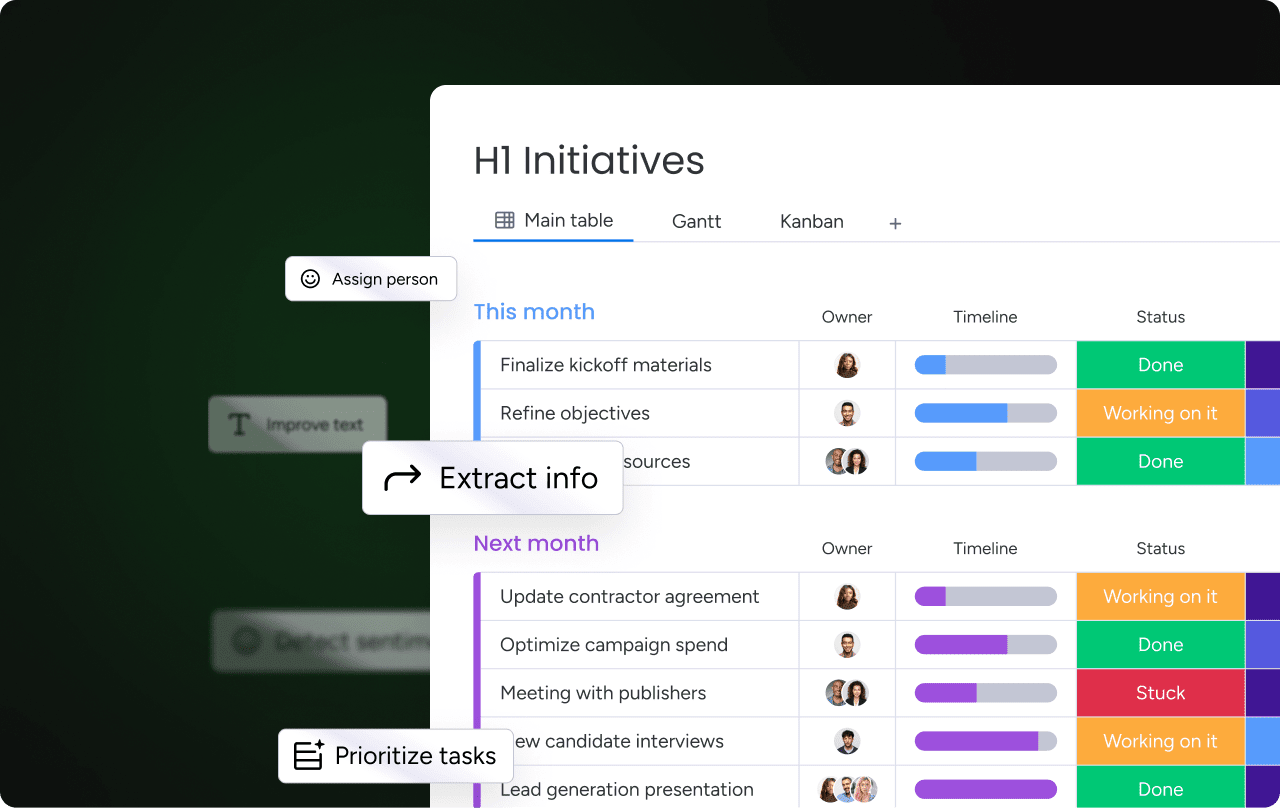
What is artificial intelligence?
Artificial intelligence is the ability of a computer system to perform activities that normally require human intelligence: recognizing patterns, making decisions, understanding language, and generating content.
Don’t worry if this sounds abstract; AI is already part of your daily routine.
- The spam filter in your inbox learned which messages to block by analyzing millions of emails.
- The voice assistant on your phone uses AI to interpret spoken language.
- The streaming service that knows exactly what you want to watch next runs AI-powered recommendation engines that study your viewing habits and match them against patterns from millions of other viewers.
These examples share commanilities. The system takes in information, identifies patterns, and uses those patterns to make useful decisions without anyone manually writing rules for every scenario. And it’s this ability to learn and adapt that separates AI from the software most people grew up using.
Learn more: AI models
How AI differs from traditional software
One main difference separates AI from traditional software: rules (or the absence of them.)
- Traditional software follows exact rules written by a programmer (“if X happens, do Y”).
- AI learns from data and improves its responses over time without being explicitly programmed for every scenario.
Here’s an easy way to remember it. Traditional software is like a recipe that produces the same dish every time. AI is more like a chef who tastes, adjusts, and gets better with every meal as the chef becomes more capable.
| Dimension | Traditional software | AI-powered software |
|---|---|---|
| How it makes decisions | Follows pre-written rules | Learns patterns from data |
| Handling new situations | Fails or returns an error | Adapts based on prior learning |
| Improvement over time | Requires manual code updates | Improves automatically with more data |
| Example | A calculator app | A sales forecasting engine that refines predictions as it processes more deals |
What defines AI is its ability to learn and adapt. A traditional program can only do what the developer planned for. In contrast, an AI system can handle situations its creators never planned for because it draws on patterns from thousands or millions of examples.
How does AI work step by step?
Whether sorting support tickets, predicting conversions, or generating status reports, AI moves through the same fundamental cycle. Understanding these 4 core stages (from raw information to useful output) makes it easier to evaluate, adopt, and trust AI in your organization.
Stage 1. Collect and ingest data
Every AI system starts by ingesting data — the raw material it learns from. “Data” is a broad term — it can include:
- Text: emails, chat messages, documents
- Numbers: sales figures, dates, budgets
- Media: images, audio recordings
- Structured records: database entries, CRM logs
Think about a CRM that collects every sales interaction: emails, calls, deal updates, meeting notes. All of this information becomes the data that AI uses to identify what successful deals have in common.
The quality and breadth of data directly determines how well AI performs. Incomplete or biased data leads to incomplete or biased results.
Stage 2. Recognize patterns across the data
Once AI has data, it analyzes that data to find patterns — recurring relationships or trends that would take a person far longer to identify manually. Pattern recognition means finding meaningful connections in large amounts of information.
Here’s a business example: an AI analyzing thousands of closed deals might find that prospects who attend a demo in the first week and get a follow-up within 24 hours convert at much higher rates. A person reviewing spreadsheets might spot this eventually, but AI pinpoints it across millions of data points in seconds.
Stage 3. Generate predictions and outputs
After identifying patterns, AI uses those patterns to make predictions or generate outputs. This is where AI produces something useful — a recommendation, classification, score, generated text, or automated action.
AI outputs cover many business functions:
- Lead scoring: AI assigns a numerical score to each prospect based on how closely they match the patterns of past successful deals.
- Content generation: AI produces a draft email, meeting summary, or status report based on patterns it learned from thousands of similar documents.
- Anomaly detection: AI flags a support ticket as high-urgency because its language patterns match previous escalated cases.
- Workflow automation: AI routes an incoming request to the right team member based on the request’s content and historical assignment patterns.
Remember: AI outputs are predictions, not certainties. They’re the system’s best guess based on available data.
Stage 4. Incorporate feedback and improve continuously
When people correct, accept, or reject AI outputs, that feedback becomes new data. The system uses it to refine future predictions. This feedback loop makes AI fundamentally different from static software.
Here’s how it works: a sales manager overrides an AI lead score because the prospect’s company just got new funding — information the AI didn’t have. The system incorporates that correction. Over time, the AI learns to factor in similar signals, and its scores become more reliable.
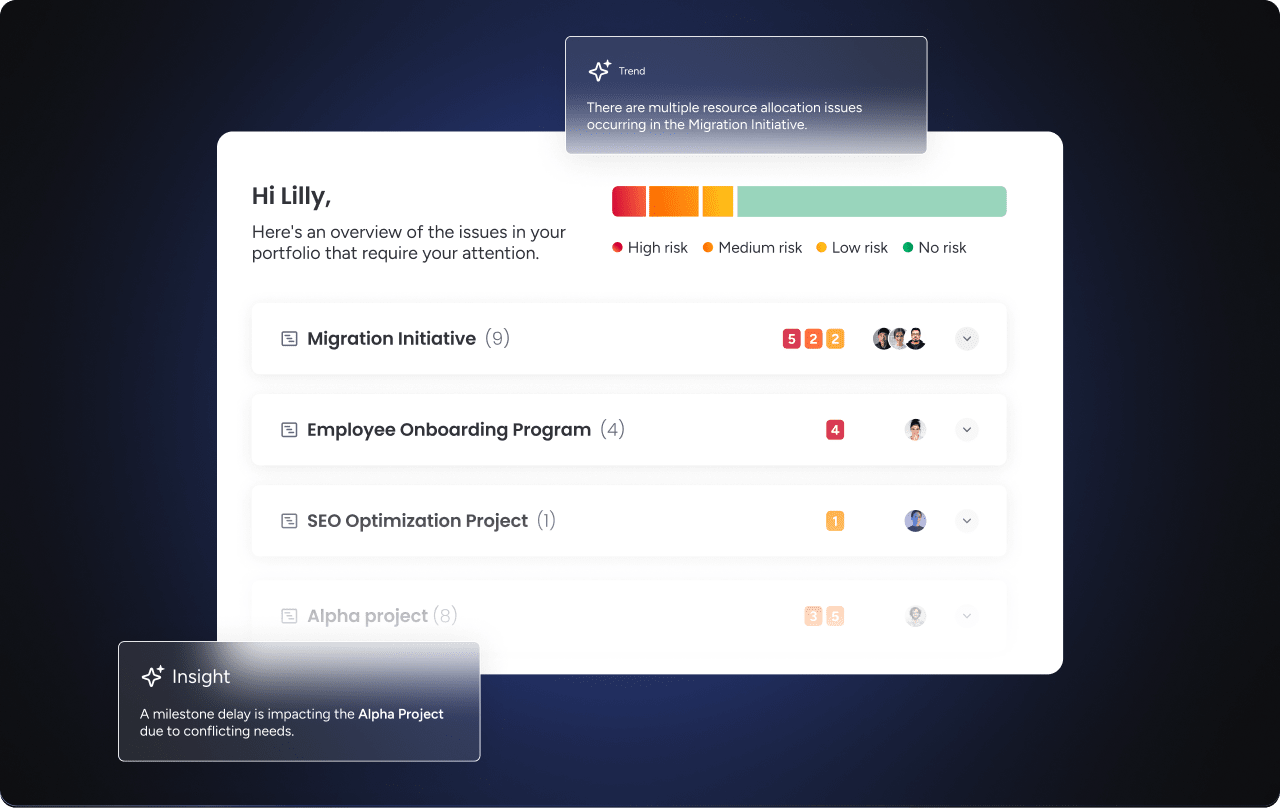
How does AI learn from data?
AI doesn’t learn the same way every time. The 3 primary learning methods work like different teaching approaches. Knowing the difference helps you pick the right AI for your business problem.
Method 1: Supervised learning — learn from labeled examples
Supervised learning is the most common method — and the most intuitive. You give the AI labeled examples (input paired with the correct answer) and it learns to connect inputs to outputs. It’s like a teacher grading flashcards: the AI sees the question and answer together, then learns to answer new questions on its own.
Workplace example: Training an AI to classify customer support tickets by showing it thousands of past tickets already labeled as “billing issue,” “technical problem,” or “feature request.” After enough examples, the AI can classify new tickets automatically — even ones it’s never seen before.
Method 2: Unsupervised learning — find hidden structure independently
With unsupervised learning, AI gets data without labels and finds structure on its own. Imagine sorting unlabeled photos into groups: the AI spots similarities and clusters items together without anyone telling it what the categories are.
Business example: An AI analyzing customer behavior data that groups buyers into distinct customer segments — frequent purchasers, seasonal buyers, one-time visitors — without being told those categories exist. Marketing teams can then tailor campaigns to each segment based on what the AI found.
Method 3: Reinforcement learning — improve through trial and reward
With reinforcement learning, AI learns by taking actions and getting rewards or penalties based on outcomes. It’s like training a dog: the AI tries different approaches, gets positive feedback when it succeeds, and adjusts to maximize rewards over time.
Business example: An AI agent that learns the best time to send follow-up emails by testing different send times and measuring response rates. Over weeks, it figures out the timing that gets the highest engagement for each recipient.
Try monday agentsAI vs. machine learning vs. deep learning
AI, machine learning, and deep learning are three terms that confuse people more than almost anything else in AI. But the relationship is straightforward if you think of them as nesting layers. AI is the broadest concept, referring to any system that mimics human intelligence. Machine learning is a subset of AI — its systems learn from data. Deep learning is a subset of machine learning — systems that use layered neural networks to learn from massive datasets.
Here’s a brief overview of the differences between them.
| Attribute | AI | Machine learning | Deep learning |
|---|---|---|---|
| Scope | Broadest category | Subset of AI | Subset of ML |
| Data requirements | Varies | Moderate datasets | Very large datasets |
| Human involvement | Can include rule-based systems | Requires feature selection by people | Learns features automatically |
| Common applications | Chatbots, robotics, expert systems | Spam filters, recommendation engines, lead scoring | Image recognition, language translation, generative AI |
4 types of AI and how they compare
You can categorize AI by capability — from systems that exist today to theoretical systems that are still science fiction. This framework sets realistic expectations about what AI can (and can’t) do for your organization right now.
| Type | Exists today? | Memory and learning | Example |
|---|---|---|---|
| Reactive AI | Mostly historical | No memory | Basic chess engines |
| Limited memory AI | Yes, widely used | Learns from recent data | Lead scoring, chatbots, recommendation engines |
| Theory of mind AI | No, in research | Would understand emotions and intent | Hypothetical emotionally aware assistant |
| Self-aware AI | No, purely theoretical | Would have consciousness | Science fiction only |
Reactive AI is the simplest form: it responds to specific inputs with specific outputs and has no memory of past interactions.
Limited memory AI powers most AI applications in use today. It can learn from recent data and past interactions to improve its responses. When people talk about “AI” in a business context, they’re almost always referring to limited memory AI.
Learn more: AI for work
Key technologies that power artificial intelligence
AI isn’t a single technology, but rather a collection of specialized technologies working together. These 3 are the most important ones you’ll encounter in business contexts.
Neural networks: the brain-inspired foundation
A neural network is a computing system modeled after the human brain. It’s made of layers of interconnected nodes (called neurons) that process information in stages. Each layer transforms the data slightly, extracting increasingly complex features until the system can make a decision or prediction.
A helpful analogy: Imagine a series of filters, where each filter catches finer and finer details:
- The first layer might recognize basic shapes.
- The next layer combines shapes into objects.
- The final layer identifies what the object is.
“Deep learning” refers to neural networks with many layers — hence “deep.”
Conversational AI: how AI understands and generates text
Conversational AI is the branch of AI that lets computers understand, interpret, and generate human language. This is the technology behind chatbots, email summarization, sentiment analysis, and AI assistants that respond to typed or spoken requests.
Conversational AI has two sides:
- Understanding language (input): Breaking down sentences into meaning, identifying intent, and recognizing entities like names, dates, and product references.
- Generating language (output): Producing human-readable text such as email drafts, meeting summaries, status reports, or conversational responses.
Computer vision: how AI interprets visual information
Computer vision is the branch of AI that lets computers interpret and analyze visual information from images, videos, or camera feeds. Common examples include:
- Facial recognition for security systems
- Quality inspection on manufacturing lines
- Document scanning that extracts text from handwritten notes
How does generative AI work?
Generative AI is the category of AI that creates new content (text, images, code, audio, and video) rather than just analyzing or classifying existing data. This powers systems like ChatGPT, Claude, Gemini, and image generators.
How large language models predict and generate content
A large language model (LLM) is a type of neural network trained on massive amounts of text data that learns to predict the most likely next word (or “token”) in a sequence. When you type a prompt, the model reads it and generates a response one word at a time. Each word is chosen based on what’s statistically most likely to come next.
An important distinction: LLMs don’t “understand” language the way people do. They’re performing very advanced pattern matching which explains why generative AI is so capable and why it sometimes produces confident-sounding but incorrect responses.
Why generative AI sometimes gets things wrong
“Hallucination” in the AI context refers to when a generative AI produces information that sounds plausible but is factually incorrect, fabricated, or unsupported by its training data. This happens because the model is predicting statistically likely word sequences, not retrieving verified facts.
The practical implications are significant:
- Fact-checking is essential: AI-generated content should always be reviewed by a person before being shared externally or used for decision-making.
- Context improves accuracy: AI systems that have access to your organization’s actual data produce more relevant and accurate outputs.
- Guardrails matter: Responsible AI platforms build in review steps, permissions, and audit trails so that people maintain oversight of AI-generated outputs.
How AI agents execute work autonomously
AI agents go a step beyond generative AI. While generative AI responds to prompts and produces content, AI agents can plan multi-step workflows, take actions across systems, and operate continuously without waiting for a person to issue each instruction. According to McKinsey’s 2025 global survey, 62% of organizations are experimenting with AI agents, and 23% are already scaling an agentic AI system somewhere in the enterprise.
What separates AI agents from AI assistants?
The distinction between an AI assistant and an AI agent is the difference between a system that helps you do work and a teammate that does work alongside you.
| Attribute | AI assistant | AI agent |
|---|---|---|
| Interaction model | Responds when asked | Acts proactively based on triggers and goals |
| Scope of action | Single-turn responses | Multi-step workflows |
| Autonomy | Waits for each instruction | Operates independently within defined guardrails |
| Memory | Limited to the current conversation | Retains context across interactions and workflows |
| Example | Summarize this meeting | Monitors project boards 24/7, flags risks, and reassigns items automatically |
How agents plan, act, and learn from results
Every AI agent follows a continuous 4-stage cycle:
- Perceive: The agent monitors its environment — a project board, CRM pipeline, or support ticket queue — for triggers or changes that require action.
- Plan: Based on its goal and available context, the agent determines the sequence of steps needed to address the situation.
- Act: The agent executes those steps, which might include updating records, sending notifications, or routing items.
- Learn: The agent incorporates feedback from the results of its actions, including human corrections, to refine its future behavior.

How to build trust in AI systems
Understanding how AI works is only half the equation. The other half is trusting it enough to put it to work. McKinsey’s 2026 AI Trust Maturity Survey found that only about 30% of organizations have reached maturity level 3 or higher in strategy, governance, and agentic AI controls.
The 3 pillars of trustworthy AI governance
- Granular permissions: Defining exactly what data an AI system can access and whether it can read, create, or modify information.
- Human-in-the-loop controls: Requiring human review and approval before AI actions take effect, especially for high-impact decisions.
- Audit trails: Maintaining a complete, transparent record of every action an AI system takes, including what it did and why.
5 questions to evaluate AI trustworthiness
- Can you see exactly what the AI did and why it made each decision?
- Can you set boundaries on what the AI is allowed to access and modify?
- Can you require human approval before the AI executes high-impact actions?
- Does the vendor provide compliance certifications and a dedicated trust center?
- Does the AI operate within your existing permission model?
How AI works on monday.com's AI Work Platform
The AI concepts covered throughout this guide are the foundation of monday.com’s AI Work Platform. Rather than bolting AI onto existing workflows, monday.com embeds it directly where work happens, using the following features.
monday agents: autonomous workflows built into your workspace
monday agents are AI agents that operate directly on monday.com, inside the workspaces your team already uses. Ready-made agents handle high-value processes from day one. Each agent is purpose-built for a specific workflow, so teams can activate value immediately without building from scratch. Here are a few examples already available to AI Work Platform customers:
- Lead Scorer: Helps revenue teams act on the right opportunities at the right time by scoring leads on fit, intent, and engagement — and stepping in when buying signals spike.
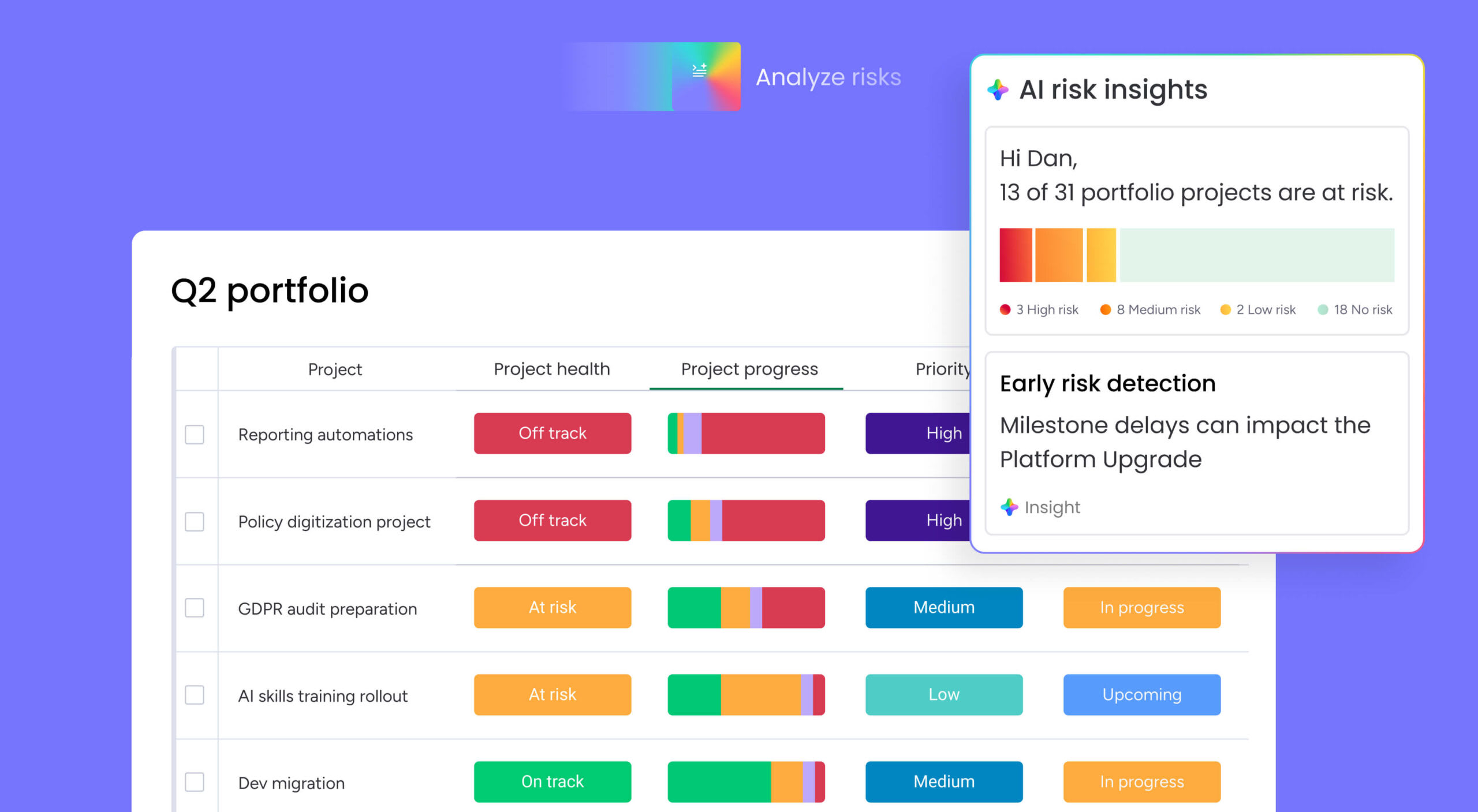
- Risk Analyzer: Gives project leaders early warning on schedule, dependency, and workload risks, so issues get resolved before they affect delivery.
- Sentiment Detector: Helps service teams retain customers by spotting sentiment shifts across tickets and emails before they escalate.
- Ticket Assignment: Routes each request to the right person based on intent, urgency, and expertise — shortening resolution times and improving customer experience.
Enterprise-grade AI trust and security
- Control: Administrators explicitly define what each agent can and cannot do.
- Permissions: Granular settings determine which data AI can access.
- Individual review: Simulation Mode allows teams to validate agent actions before activating them.
- Compliance: monday.com holds SOC 2 Type II, ISO/IEC 27001, and ISO/IEC 27701 certifications.
- Data ownership: Organizations retain full ownership of the content they provide; third parties are not permitted to train on customer data.
monday sidekick: your AI assistant for everyday work
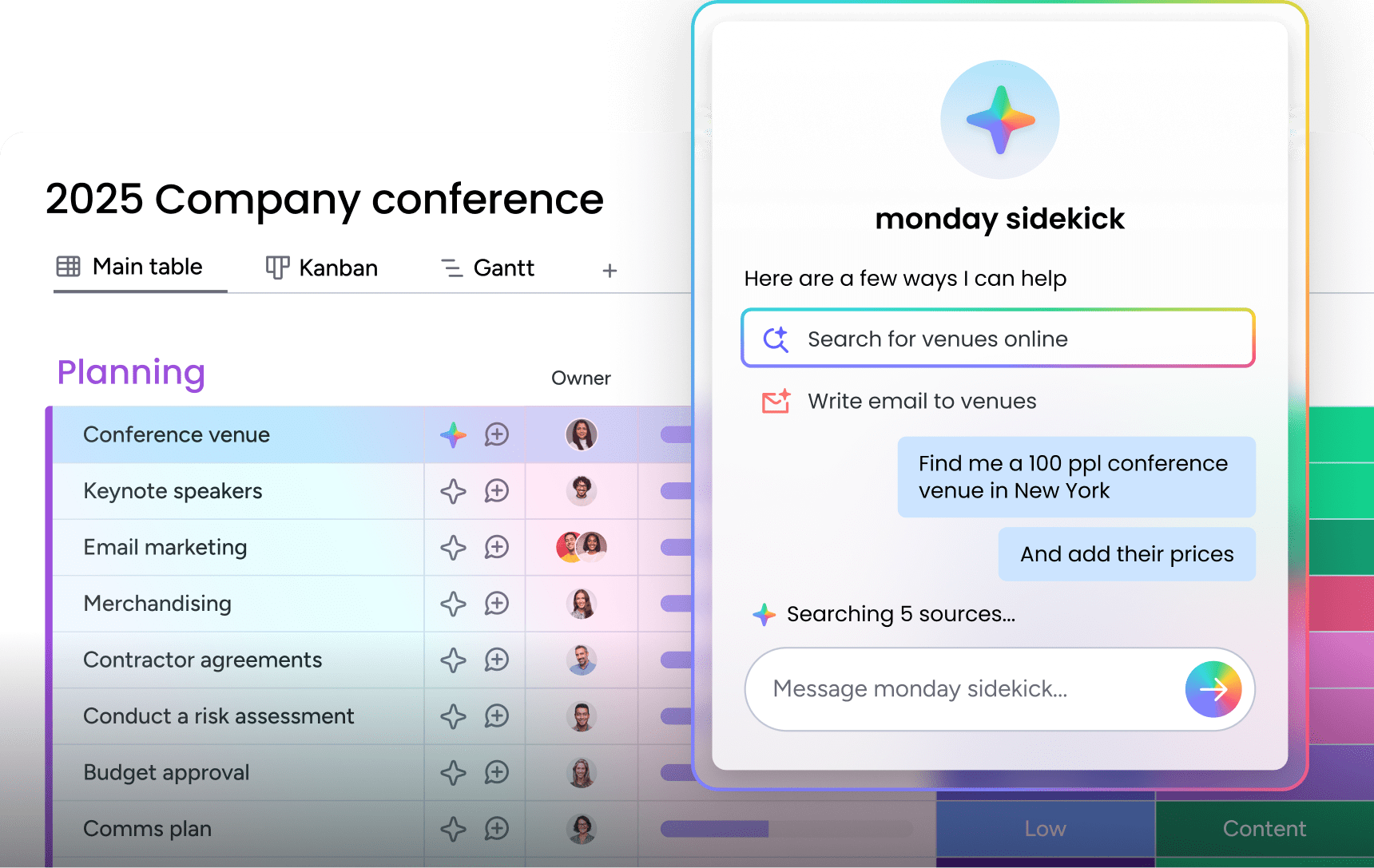
monday sidekick is an AI assistant embedded directly into your workspace that helps you draft updates, summarize threads, generate action items, and answer questions about your boards — all without leaving the context of your work. Unlike standalone AI tools that require switching tabs and copying information back and forth, sidekick operates where your team already collaborates, making AI assistance feel like a natural extension of your workflow rather than an interruption.
AI building blocks: from AI blocks to monday magic and vibe
monday.com’s AI capabilities extend across multiple features designed to accelerate specific tasks:
- AI blocks: Pre-built components you can add to any board to generate summaries, extract insights, or create content based on the data already in your workspace.
- monday magic: One-click AI actions that help you build boards, create automations, write formulas, and generate content faster — turning hours of setup into seconds.
- monday vibe: AI-powered search that understands your regular language queries and finds the exact information you need across all your boards, docs, and conversations, even when you don’t remember where it lives.

How to put AI to work and make it stick
The most important shift is moving from AI as a tool you consult to AI as a teammate that operates alongside you. This shift requires defining clear boundaries, building human oversight into every high-stakes workflow, and choosing systems that give you full visibility into what AI is doing and why.
Organizations that get this right save time by automating repetitive workflows while freeing up their people to focus on the decisions, relationships, and creative challenges that AI just can’t handle.
Try monday agentsFAQs about how AI works
Can AI think or feel like a person?
No, AI can't think or feel like a person. Current AI systems process data and identify patterns to generate outputs, but they do not possess consciousness, emotions, or subjective experience.
How is artificial intelligence programmed?
AI systems are programmed by data scientists who design model architectures and select training data. The AI then "programs itself" by adjusting internal parameters during training to minimize errors.
What are the biggest risks of using AI at work?
The biggest risks of using AI at work include:
How do AI models improve after they're deployed?
Deployed AI models improve through feedback loops where human corrections and new data are used to retrain or fine-tune the model.
What is the difference between narrow AI and general AI?
Narrow AI is designed to perform a specific set of activities and is the only type of AI that exists today. General AI (AGI) would be able to perform any intellectual activity a person can, but it remains a theoretical concept.

 Get started