


What if your sales team could deliver personalized outreach at scale while spending more time building relationships and closing deals? Generative AI transforms sales by automating research, drafting, and data entry — creating unique, contextual messages for each prospect based on their industry, company news, and interaction history.
In this guide, you’ll discover 5 quick wins you can deploy before next quarter, 7 real-world examples driving measurable growth, and proven strategies to measure ROI and turn AI investment into lasting pipeline results. Learn how to implement generative AI within a single, connected Work OS that keeps your team focused on what matters most: revenue growth.
Key takeaways
- Deploy AI for personalized outreach, meeting intelligence, or proposal generation to build team confidence and show results in a few months before tackling complex implementations.
- Track win rates, sales cycle length, and revenue per rep to prove AI’s business value to leadership and justify continued investment beyond simple time savings.
- Expect performance to drop for several weeks as teams learn new workflows, then watch it exceed baseline over the next few months with proper change management.
- Link AI research, personalized messaging, and automated follow-up together in integrated workflows rather than using isolated point solutions for maximum impact.
- Eliminate manual CRM updates while maintaining complete visibility into every customer interaction using AI Timeline Summary and automated follow-ups in monday CRM.
Generative AI for sales creates new content, insights, and recommendations built specifically for revenue work. Traditional AI analyzes existing data. Generative AI produces something new — tailored to specific prospects, deals, and selling situations.
Think of the difference this way: A rule-based system sends the same follow-up email to every lead after 3 days. Generative AI writes a unique message based on that prospect’s industry, recent company news, and previous interactions with your team. It powers personalized email drafts, predictive pipeline forecasts, and more — all by learning from historical sales patterns and customer interactions.
Sales teams are stretched thin. Meanwhile, buyers expect every interaction to feel personal — even when you’re reaching hundreds of prospects. Generative AI handles the repetitive work — research, drafting, data synthesis — that used to eat hours of selling time. It automates the grunt work while enhancing human judgment.
75% of B2B buyers prefer a rep-free sales experience, making effective B2B sales lead generation strategies essential (Gartner)
Beyond chatbots to revenue-driving AI
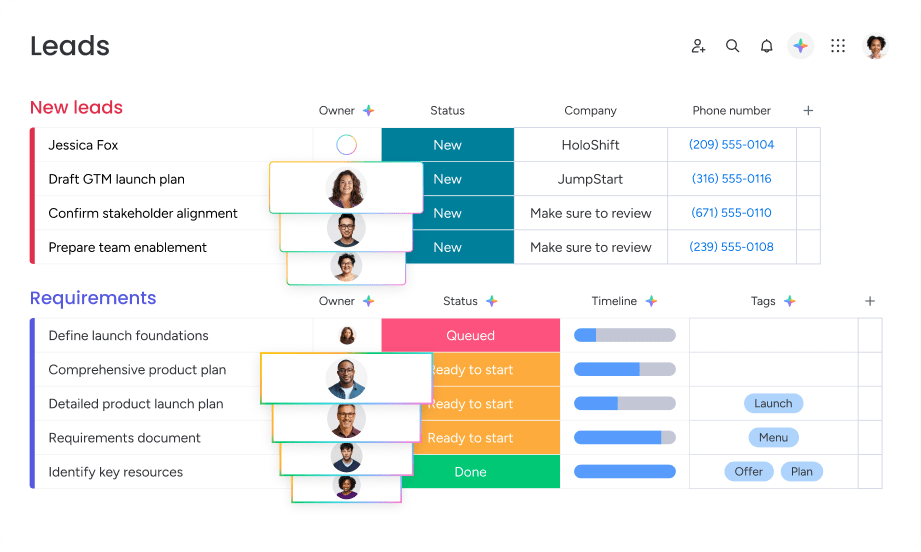
Most people think generative AI for sales means chatbots or email assistants. That misses what’s really happening across revenue operations. Revenue-driving AI works across the entire cycle — lead qualification, deal forecasting, customer expansion. It creates measurable impact at every stage.
Here’s how generative AI goes way beyond simple automation:
- Predictive deal scoring: AI analyzes hundreds of signals including engagement patterns, stakeholder involvement, competitive presence, and historical win/loss data to identify which opportunities will close.
- Dynamic pricing recommendations: AI suggests optimal pricing based on customer profile, competitive factors, deal size, and historical win rates at similar price points.
- Account expansion intelligence: Systems identify upsell opportunities by analyzing usage patterns, support ticket trends, and customer health signals.
- Competitive battlecard generation: AI synthesizes competitive intelligence including recent product announcements, pricing changes, and customer reviews into actionable talking points for specific deals.
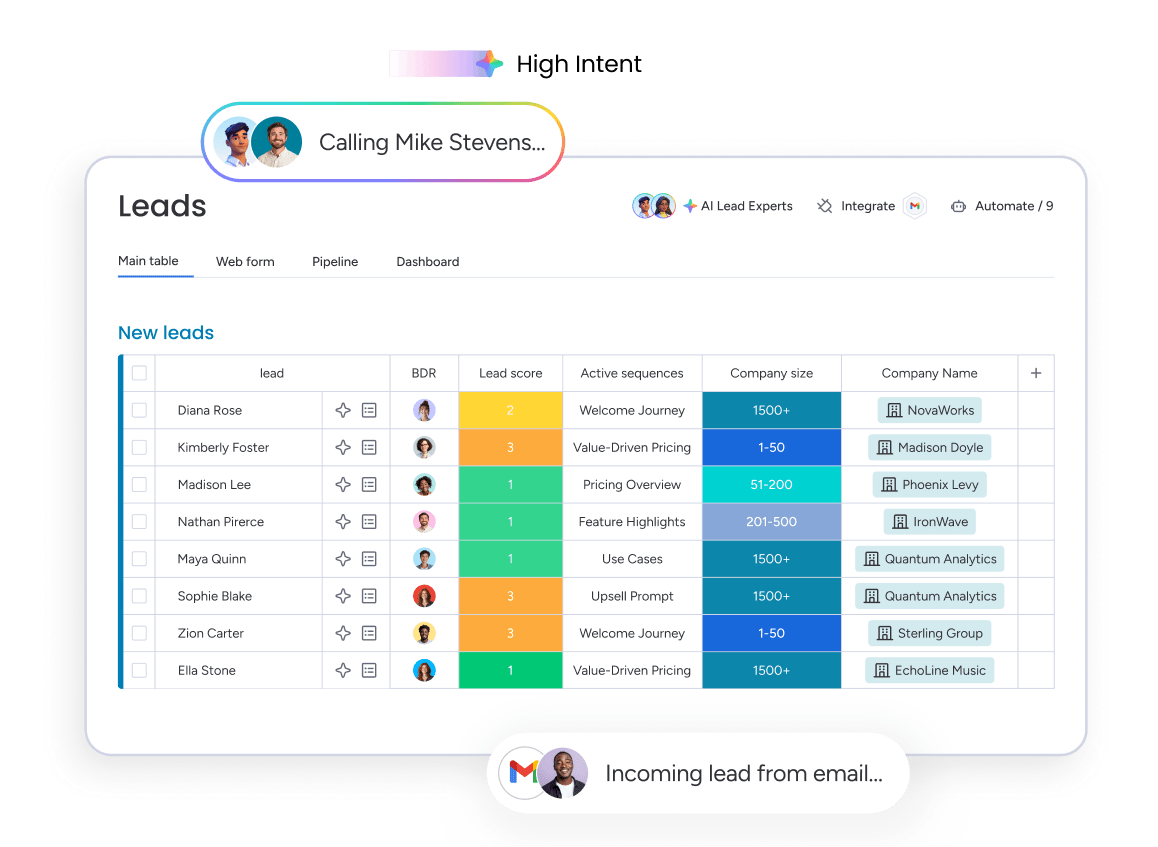
The best setups combine multiple AI capabilities into integrated workflows instead of using isolated tools. A single prospect interaction might involve AI-generated research, personalized messaging, meeting intelligence, and automated follow-up — all working together.
From AI copilots to autonomous sales workflows
Sales AI implementation falls on a spectrum. Understanding where different capabilities fit helps you set realistic expectations and prioritize investments.
| Category | AI copilots | Autonomous workflows |
|---|---|---|
| Decision-making | Human makes final decisions | System executes without approval |
| Best use case | Complex, high-value deals | High-volume, repeatable processes |
| Risk level | Lower risk, faster adoption | Higher efficiency, requires strong governance |
| Examples | Email drafting, research summaries | Lead routing, follow-up sequences |
AI copilots are what most teams use today. These assist sales reps by suggesting next actions, drafting content, or surfacing relevant information while enabling human-AI collaboration in sales and keeping the rep in control. Copilots cut down on mental overhead and admin work while keeping reps in control.
Agentic AI in sales represents an emerging capability where systems execute complete processes with minimal human intervention. They work best for high-volume, repeatable processes with well-defined decision criteria. Think: automatically qualifying inbound leads based on firmographic and behavioral signals, or scheduling meetings when buying intent hits a certain level.
Start with copilot capabilities and gradually expand to autonomous workflows as you build data quality, team trust, and governance. Here’s how the progression typically plays out over 6-12 months:
- Master copilot capabilities first.
- Identify processes with defined rules and high volume.
- Automate those specific workflows while maintaining human oversight for complex decisions.
5 quick wins to deploy before next quarter
Quick wins build confidence in AI, prove ROI to skeptics, and create momentum for bigger projects. You can deploy each one independently within 30-60 days using your existing team and established processes.
These applications consistently deliver measurable results. Start with 1 or 2 that address your biggest pain points instead of trying all 5 at once.
1. Deploy personalized outreach that actually converts
Outreach sales automation analyzes prospect data to generate customized messages that reference specific, relevant context. The workflow operates in seconds:
- Sales rep selects a prospect.
- AI pulls relevant signals from multiple sources.
- System generates 3-4 message variations with different angles.
- Rep selects and refines the best option.
What used to take precious time for manual research and drafting now takes mere minutes. Personalized outreach also gets a higher response rates than template-based approaches because it shows genuine research and relevance.
Track these metrics to measure impact:
- Response rate: Percentage of prospects who reply
- Meeting conversion rate: Percentage of responses that become scheduled meetings
- Time per outreach: Minutes spent per personalized message
2. Implement meeting intelligence that updates your CRM
AI-powered meeting assistants join video calls, transcribe conversations, and identify key moments. Then they automatically log relevant information to the CRM, keeping your data current and accurate. This solves 2 persistent sales challenges: reps stay present in conversations instead of taking notes, and CRM data quality improves dramatically.
During a discovery call, the AI identifies when the prospect mentions a Q3 budget cycle, expresses concerns about implementation time, and requests a security review. After the call, these details automatically populate the appropriate CRM fields, trigger a follow-up for the security team, and update the deal timeline.
Teams using monday CRM benefit from AI Timeline Summary, which creates a short summary of all communication events including emails, calls, meetings, and notes. This helps sales and support teams save valuable time by eliminating the research process many reps and managers take to understand their team’s history with a client.
3. Set up instant account research and buying signals
AI monitors multiple data sources to identify accounts showing buying intent or experiencing trigger events that create sales opportunities. Account research goes from a manual, time-consuming process to an automated alert system.
When a target account posts a job opening for a VP of Sales, AI detects this signal, cross-references it with other indicators, and alerts the rep with a briefing that includes:
- The trigger event
- Relevant talking points
- Similar customers in their portfolio
- A suggested outreach angle
The rep reaches out while the need is fresh, often before competitors even know about the opportunity.
4. Create AI battle cards for every sales call
AI generates customized competitive intelligence and objection handling guidance for specific deals. Traditional battle cards are static documents that go stale fast. AI battle cards pull from your knowledge base, recent win/loss analysis, and competitive intelligence to provide relevant talking points.
Before a call with a prospect evaluating your solution against a specific competitor, AI generates a brief that includes:
- The competitor’s likely positioning
- Their typical pricing approach
- Common objections and proven responses
- Differentiation points that resonate with this prospect’s industry
- Questions to ask that expose competitor weaknesses
5. Enable proposals that write themselves
AI-powered proposal generation pulls from approved content libraries, past winning proposals, and deal-specific information. It creates customized proposals in minutes. Manually, reps spend 3-5 hours copying content, updating pricing, and customizing case studies.
The streamlined process works like this:
- Rep enters basic deal parameters.
- AI selects relevant case studies.
- System pulls appropriate product descriptions.
- AI generates pricing tables.
- System assembles a branded proposal.
The rep reviews, makes strategic adjustments, and sends within 30 minutes instead of the next day.
Measuring real ROI from sales AI
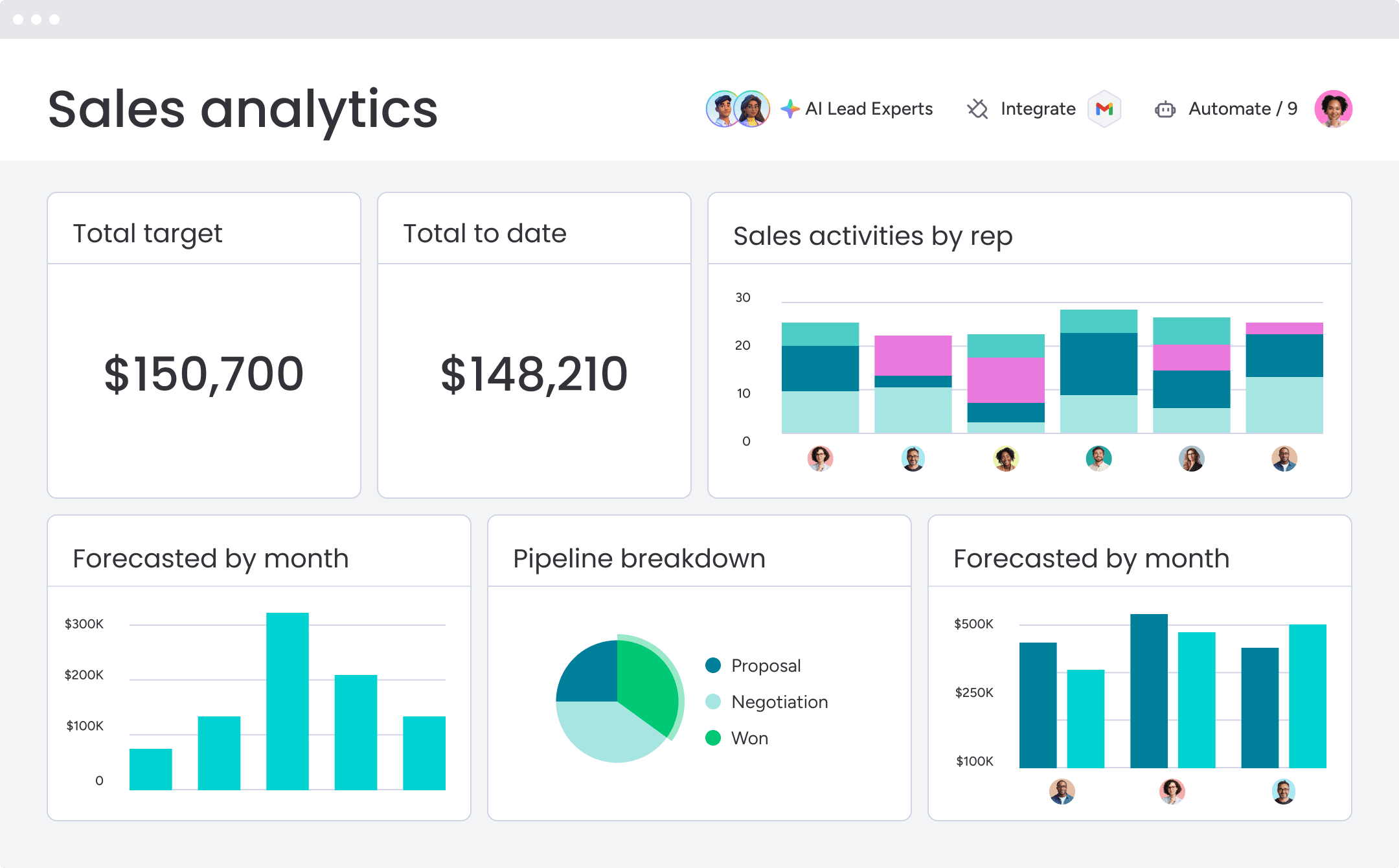
Many AI implementations fail because teams don’t measure the right outcomes or can’t connect AI usage to revenue impact. To measure ROI effectively, track both leading indicators and lagging indicators. Start measuring before implementation to establish baselines.
Metrics that matter to your CFO
Financial metrics translate AI impact into outcomes CFOs care about. These metrics justify continued investment and expansion.
| Metric | Calculation | Target improvement | Measurement frequency |
|---|---|---|---|
| Revenue per rep | Total revenue ÷ number of reps | 15–25% increase | Quarterly |
| Customer acquisition cost | Sales & marketing spend ÷ new customers | 20–30% decrease | Monthly |
| Sales cycle length | Avg. days from first contact to close | 15–20% reduction | Monthly |
| Cost per opportunity | Sales costs ÷ qualified opportunities | 25–35% decrease | Quarterly |
| Win rate | Closed-won deals ÷ total opportunities | 3–5 percentage points | Monthly |
Revenue per rep should increase as reps handle more opportunities or close deals faster. To isolate AI’s contribution, compare reps using AI capabilities against those who aren’t during the same period.
Customer acquisition cost drops as AI improves conversion rates at each funnel stage and cuts time spent on prospects who won’t convert. Win rate measures the percentage of opportunities that close successfully. Even small improvements create massive revenue impact.
Building dashboards that track AI impact
Dashboards connect AI usage to business outcomes, making ROI visible to everyone who needs to see it. Structure your dashboard to serve different audiences with different needs.
- Executive dashboards focus on 3-5 high-level metrics showing overall business impact: revenue per rep, win rate, sales cycle length, and AI adoption rate. This dashboard should answer “Is AI investment paying off?” in under 30 seconds.
- Sales leadership dashboards include operational metrics showing where AI drives performance. Track metrics by team, region, or rep segment to identify adoption patterns and coaching opportunities.
- Rep-level dashboards show personal performance metrics and AI usage patterns to encourage adoption and highlight individual impact. Teams using monday CRM can build these views without technical resources, connecting AI-assisted activities directly to pipeline and revenue outcomes. Sales-specific widgets like the leaderboard and funnel help identify strong and weak points in your pipeline.
Revenue lift vs. time saved
There are 2 different ROI narratives, and both matter depending on who you’re talking to and how much you’re investing.
| ROI type | What it measures | Example outcome |
|---|---|---|
| Time saved | Value of hours saved through automation | ~$19,500/year per rep (based on 5 hrs/week saved) |
| Revenue lift | Incremental revenue from improved performance | +$1M from win rate increase (22% → 26%) |
Early-stage implementations should lead with time saved because it’s easier to measure and prove quickly. Mature implementations should lead with revenue lift because it justifies continued investment and expansion.
Try monday CRM7 examples driving measurable sales growth
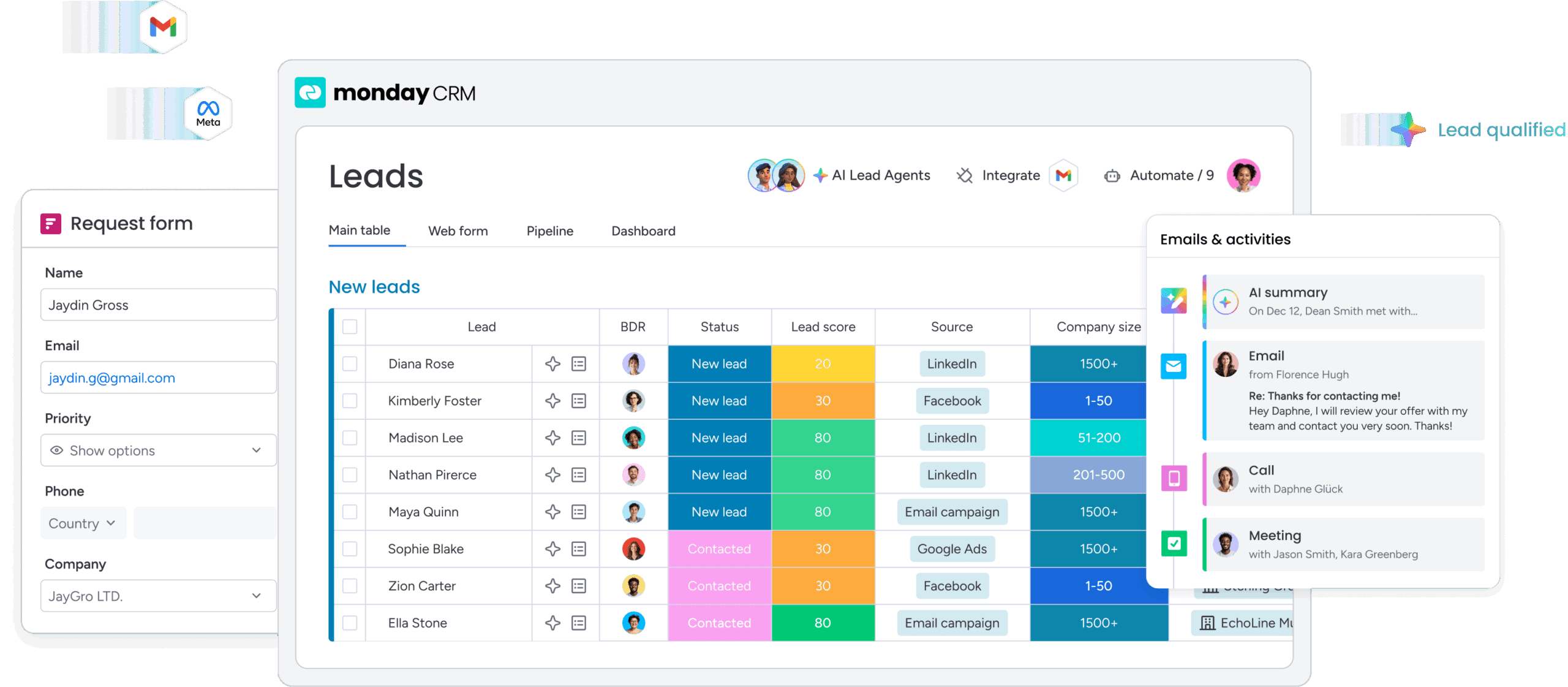
These examples are the highest-ROI applications based on current adoption patterns, listed in order of implementation complexity. Each one builds on proven patterns that deliver results across different industries and team sizes.
1. Smart lead scoring that finds hidden opportunities
AI-powered lead scoring analyzes hundreds of data points to help reps prioritize leads most likely to convert. Traditional lead scoring uses simple rules. AI identifies complex patterns across multiple variables that human-designed models can’t capture.
The system might discover that prospects who visit your pricing page twice within 48 hours and work in companies with recent leadership changes convert at 3x the average rate.
2. Conversation intelligence for faster deals
AI systems analyze sales conversations to identify patterns that correlate with won deals. Then they provide real-time coaching to help reps replicate successful behaviors. Analysis reveals that top performers:
- Ask 11-14 questions per discovery call
- Spend 60% of the call listening
- Address pricing proactively
The system coaches other reps to adopt these patterns through real-time prompts and post-call feedback.
3. Follow-up sequences that never miss
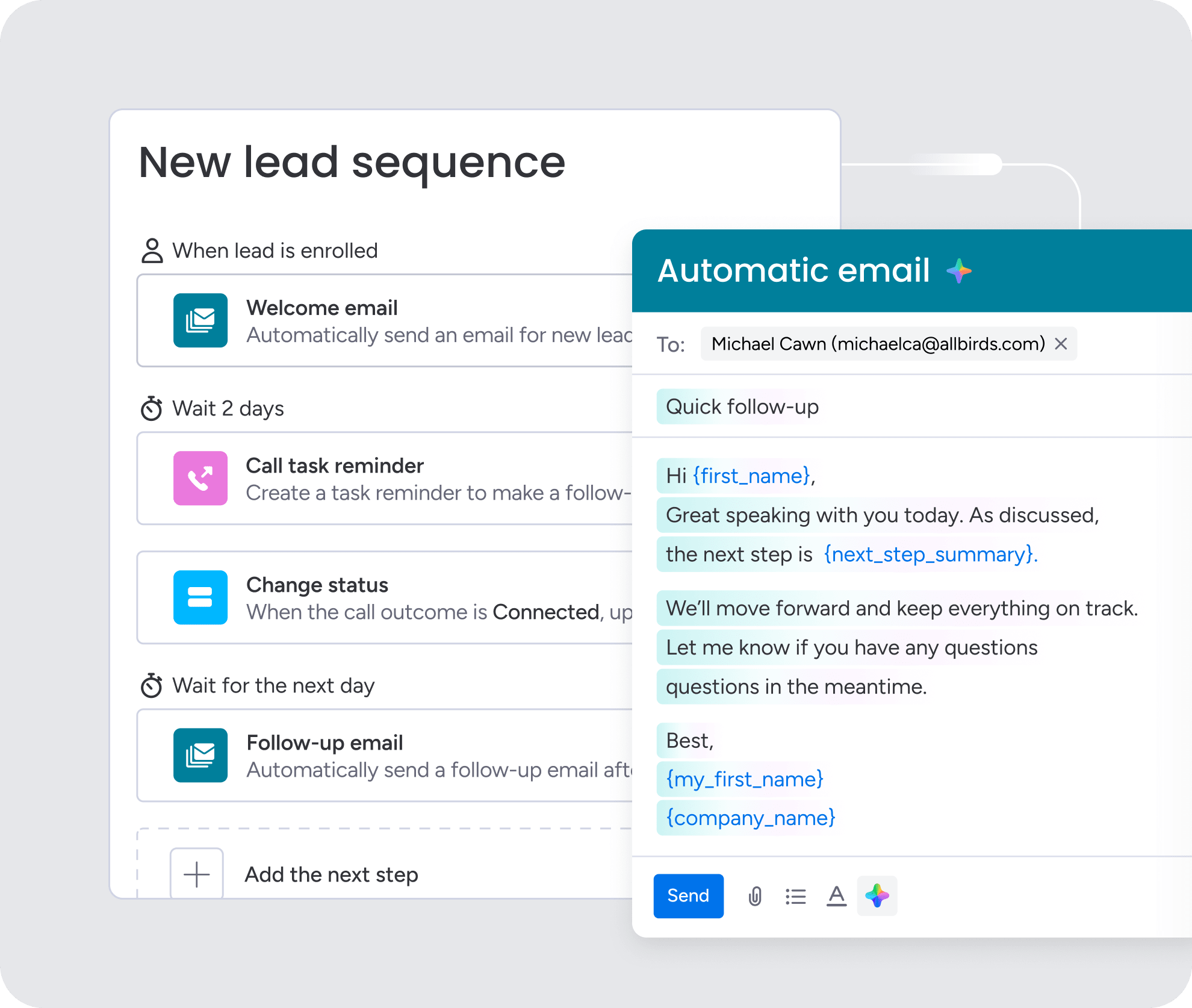
AI-powered follow-up automation monitors deal activity and triggers personalized re-engagement sequences when prospects go silent. Reps juggling dozens of opportunities inevitably let some prospects go cold. AI ensures every prospect receives timely, relevant follow-up based on their behavior and deal stage.
Teams using monday CRM can set up automated email follow-ups and track individual and mass emails including open rate and link clicks. This ensures every prospect gets the right follow-up at the right time.
4. Real-time coaching during live calls
AI systems provide in-the-moment guidance during sales conversations. They suggest questions to ask or information to share based on what the prospect is saying. The system listens to the conversation in real-time and surfaces relevant battle cards, case studies, or talking points on the rep’s screen. No interruptions.
5. AI forecasting that predicts pipeline changes
AI-powered forecast models analyze deal characteristics, historical patterns, and behavioral signals. They predict which deals will close, which will slip, and which are at risk. Traditional forecasting relies on rep judgment, which is often optimistic. AI removes bias by analyzing objective signals.
Revenue teams using monday CRM gain predictability with accurate forecasts and projections. They use reports to track forecast vs. actual sales and drill down by month, sales rep, or any other criteria.
6. Account expansion alerts before competitors
AI systems monitor customer accounts for expansion signals. They alert account managers to upsell or cross-sell opportunities before customers start evaluating alternatives. It’s widely accepted that acquiring new customers costs 5-7x more than expanding existing accounts, yet most teams lack a systematic way to identify expansion opportunities.
7. Competitive intelligence on autopilot
AI systems monitor competitor activities and automatically update battle cards. They alert relevant reps about changes affecting their deals and identify competitive vulnerabilities to exploit. By the time sales enablement updates battle cards manually, the information’s often outdated. AI ensures competitive intelligence is current and automatically distributed to reps who need it.
Navigate the AI productivity dip
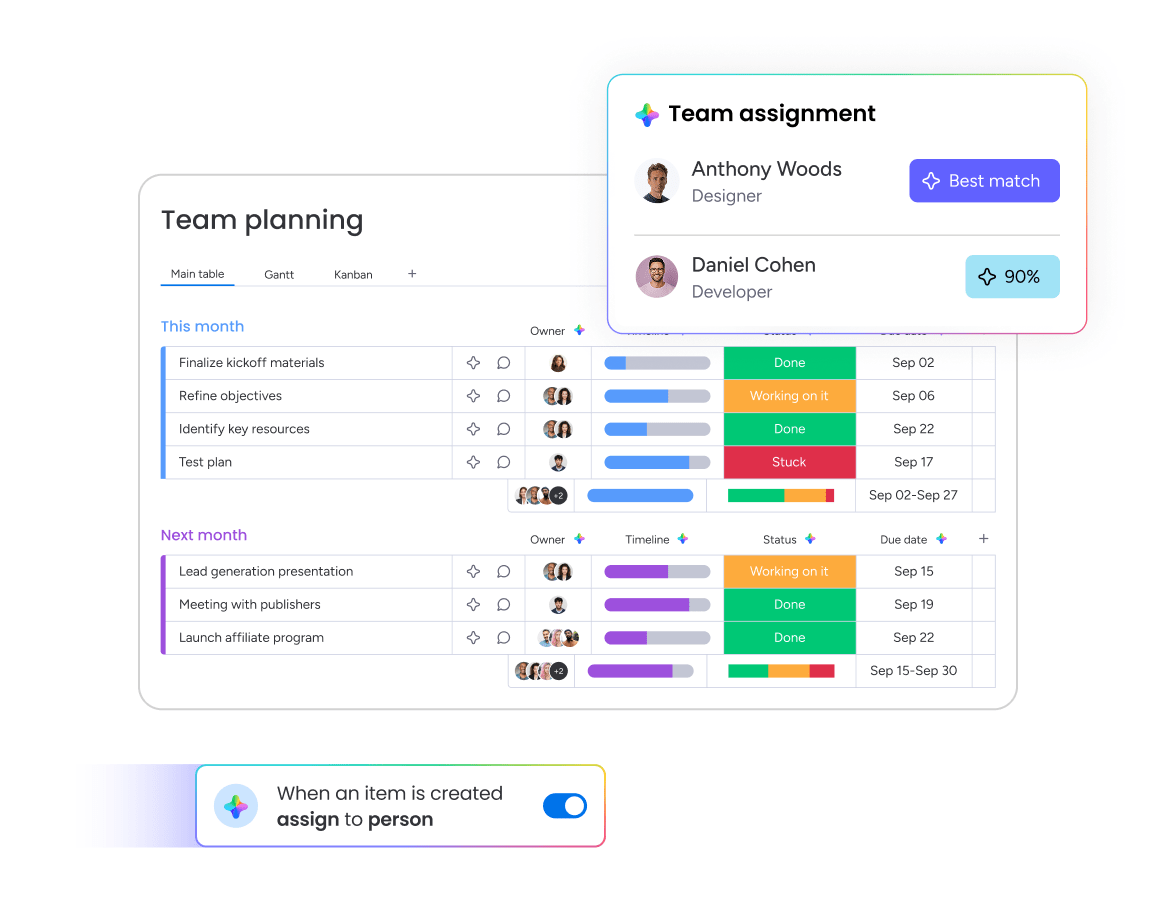
Productivity often decreases before it improves when implementing AI. This J-curve effect occurs because of the natural learning curve and workflow adjustment period. Understanding and planning for this prevents teams from abandoning AI projects prematurely.
Why your numbers drop before they soar
Performance drops initially because of 3 key factors that affect every AI implementation:
- Learning curve overhead means reps spend time learning new capabilities and adjusting to new workflows instead of selling. Even if AI ultimately saves 10 hours per week, reps might spend 15 hours in the first month just learning how to use it effectively.
- Workflow disruption happens when established routines get interrupted as reps figure out how to incorporate AI into their process. A rep who could write a proposal in 3 hours using their familiar method might take 4 hours initially while learning the AI-assisted approach.
- Trust building period occurs because reps don’t initially trust AI outputs, so they spend extra time verifying and double-checking everything the AI produces. This verification overhead disappears as confidence builds.
Most organizations see the productivity dip last several weeks for simple implementations and a few months for complex implementations. Performance typically returns to baseline shortly thereafter.
Phased rollout that protects your pipeline
A 4-phase implementation strategy minimizes risk by rolling out AI capabilities gradually. This approach protects your pipeline while building organizational confidence.
- Phase 1 involves selecting 3-5 top-performing reps who are tech-savvy and open to change. Have them test AI capabilities in real workflows while maintaining their current processes as backup.
- Phase 2 expands to 20-30% of the team who expressed interest during the pilot. Pair each new user with a champion from Phase 1 for peer coaching.
- Phase 3 rolls out to the remaining team in waves. By this point, you have proven workflows, trained champions, and documented success stories.
- Phase 4 focuses on optimization and expansion. Performance should be measurably above baseline, allowing you to identify advanced use cases and expand to additional AI capabilities.
Teams using monday CRM benefit from the platform’s no-code/low-code infrastructure, which supports this phased approach by allowing teams to enable AI features incrementally without disrupting existing processes.
Change management without quota disruption
Specific change management tactics drive adoption while maintaining sales performance and team morale:
- Communicate the “why” relentlessly. Reps need to understand how AI helps them personally, not just how it helps the company. Hold team meetings where champions share specific examples of how AI helped them close deals.
- Create visible wins early by identifying 2-3 quick wins that demonstrate value within the first 2 weeks. When a rep closes a deal faster because AI handled proposal generation, celebrate it publicly.
- Provide just-in-time training instead of front-loading all training before implementation. Deliver basic training to get started, then provide advanced training as reps encounter specific situations.
- Remove friction points immediately when reps report issues or frustrations. Nothing kills adoption faster than unresolved friction. The Run history feature in monday CRM allows teams to review AI actions taken and the logic behind results, making troubleshooting straightforward.
Turn AI investment into revenue growth
Generative AI transforms sales from a reactive, manual process into a proactive, intelligent system that scales personalization without sacrificing quality. The technology delivers measurable results when implemented strategically with proper measurement frameworks and change management practices.
Start with quick wins that address your team’s biggest pain points. Focus on 1 or 2 applications that can show results within 30-60 days rather than attempting comprehensive transformation immediately. Build confidence through visible successes, then expand to more sophisticated use cases as your team develops trust and expertise.
The organizations seeing the biggest returns combine multiple AI capabilities into an AI agent for sales workflows rather than deploying isolated point solutions. Revenue teams using monday CRM can implement these capabilities without technical complexity, connecting AI-powered activities directly to pipeline outcomes and revenue growth.
FAQs
How does generative AI directly increase sales revenue?
Generative AI increases sales revenue by improving conversion rates at each funnel stage, shortening sales cycles through faster follow-up and proposal generation, and enabling reps to handle more opportunities without sacrificing personalization quality.
What are the fastest generative AI wins sales teams can implement right now?
The fastest wins include AI-powered email composition, meeting transcription with automatic CRM updates, and automated account research that surfaces buying signals before outreach.
Which sales workflows benefit most from generative AI inside a CRM?
Sales workflows that benefit most include lead qualification and routing, personalized outreach at scale, meeting follow-up and CRM data capture, proposal generation, and competitive intelligence preparation.
How do you scale generative AI across a sales team while increasing efficiency?
Scaling requires no-code configuration, reusable prompts and saved preferences, phased rollout starting with champions, and integration directly into the CRM where reps already work.
How can sales leaders measure the impact of generative AI on pipeline and forecast confidence?
Leaders measure impact by tracking revenue per rep, win rate changes, sales cycle length, and forecast accuracy improvement while comparing performance between reps actively using AI versus those not using it.
What risks should sales teams manage when using generative AI in a CRM?
Teams should manage data quality issues affecting AI output accuracy, over-reliance on AI without human review for high-stakes communications, and adoption resistance through phased rollout and visible early wins.
