


Anyone using AI in their work needs it available whenever they reach for it. monday AI credits make that possible by turning AI usage into something you can see and plan for.
Credits work like a phone plan: you buy a monthly credit allocation alongside your seats, and each AI action draws from it as your team works. This guide covers how monday AI credits work in more detail. This guide explains how monday AI credits work, including the minimum credits for each plan and how to estimate what your team needs.
Get startedKey takeaways
- Your AI credit balance is shared: every team member draws from one account-level pool, so departments across the business can use AI without managing separate budgets.
- Many built-in AI features cost zero credits: the AI Formula Builder and the AI Updates assistant are included with your subscription, so start there before spending credits on heavier actions.
- monday agents take on multi-step work so your team can focus on higher-value activities: each task costs roughly 10–50 credits when simple and 250+ when extra-complex, and a single agent run can include several tasks.
- Credit costs depend on the task: an AI block costs a flat 8 credits per action, while agent and Sidekick costs rise with complexity. In monday vibe and monday agents, the model you choose also affects the cost.
- AI governance turns AI spend into a managed cost: track usage by feature and by user, and set usage limits per use case or per user. Automatic alerts at 80% and 100% warn you before credits run out.
What are monday AI credits?
A monday AI credit is the unit that measures AI usage across the monday AI Workspace. Think of credits like prepaid minutes on a phone plan: you buy a monthly allocation alongside your seats, and each AI action deducts credits from it. This makes usage easy to monitor, so you can top up your AI credits whenever you need them.
Each AI action deducts credits from a shared, account-level pool, and the amount depends on the capability. For example, a sales rep categorizing a lead or an operations manager triggering sentiment analysis both draw from the same bucket.
Credits are deducted each time someone triggers a metered AI action. These actions include:
- Running an AI block
- Sending a monday sidekick message
- Running a monday agent
- Running an AI workflow
- Recording a meeting with the AI Notetaker
- Building or running a monday vibe app
Important: Not every AI feature costs credits. Many built-in AI capabilities are included in your subscription, such as the AI Formula Builder and the AI email assistant in monday CRM.
The credit system makes AI budgeting transparent and predictable, which goes some way to appeasing the 46% of CFOs who cite cost uncertainty or lack of transparency as their biggest internal concern about AI, according to Deloitte’s Q2 2026 CFO Signals survey. With monday AI, you can plan, forecast, and scale AI adoption as your team grows.
How credits relate to AI token usage
If you’re familiar with token-based pricing from other AI providers, monday AI credits replace that math with one unit across every monday AI capability.
Instead of calculating token counts or comparing model-specific price sheets, teams work from published credit rates and ranges. AI blocks cost a flat 8 credits per action whichever model runs them. In monday vibe and monday agents, the model you choose affects the cost: a Gemini Flash message in vibe uses ~10–20 credits, compared with ~50–500 for Claude Opus. Vibe also shows how many credits each message used, so you see what you actually spent as well as the estimate. This helps, given that in 21.8% of model-pair comparisons, the cheaper listed model cost more in practice, sometimes by up to 28×, due to token consumption variability (Microsoft Research, 2026).

What are the minimum AI credits for each monday AI Workspace plan?
AI credits are purchased alongside your seats in the monday AI Workspace, either as a bundle or as separate seat and credit line items. There’s no separate AI add-on to evaluate, because credits cover every supported AI capability. Know your tier’s minimum so you can forecast whether your team’s planned workflows fit within it or need a larger credit bucket.
AI credits on Basic, Standard, Pro, and Enterprise plans
Each paid plan has a minimum monthly AI credit bucket, which you buy as part of your setup. The minimum rises with each tier, and higher tiers can run more active AI workflows.
| Plan | Minimum monthly AI credits | Active AI workflows |
|---|---|---|
| Basic | 1,000 | n/a |
| Standard | 2,000 | Up to 3 |
| Pro | 3,000 | Up to 20 |
| Enterprise | Custom | Custom |
Credit minimums apply to customers who joined on or after May 6, 2026, and may change. Some customers receive discounted introductory pricing. monday CRM and monday service customers may receive trial or grant credits when they start, but these aren’t recurring credits included in every paid plan. Check the monday.com pricing page or help center for current allocations before you buy.
How credit allowances scale with your team
The credit pool is account-level, not per-person. Your entire organization shares one credit bucket regardless of how many people are on the account. Credits scale separately from seats: you start with your tier’s minimum and move up to a larger credit bucket as AI adoption grows, without changing your seat count.
This shared-pool model is especially practical for cross-functional teams. A small marketing team draws from the same credit bucket as operations and every other department on the account, so teams work in parallel without managing separate AI budgets.
A 5-person marketing team on a 50-seat account can run AI agents and automate content categorization using the shared pool. If admins want to cap a team’s spend, they can set usage limits per user or per use case in AI governance.

Which monday AI capabilities consume credits?
The monday AI Workspace includes a range of AI capabilities, and each one consumes credits differently. Know these rates so your team can forecast monthly usage accurately and put credits toward the actions that drive the most value.
| AI capability | Credit consumption |
|---|---|
| monday agents (ready-made and custom) | Per task, by complexity: Simple ~10–50, Intermediate ~50–150, Complex ~150–250, Extra complex ~250+. One run can include several tasks. |
| monday sidekick | Per message, by complexity: Simple ~10–30, Intermediate ~30–80, Complex ~80–150, Extra complex ~150+ |
| AI blocks (assign labels, summarize text, improve text, detect sentiment, translate text, writing assistant, extract information, generate docs, custom block with optional web search) | 8 credits per action. Actions on the same item within 24 hours count once; subitems count separately. |
| AI Notetaker | 120 credits per meeting hour, measured by the minute |
| AI workflows | Based on the complexity of each run. Building or editing a workflow with the prompt box also uses credits. |
| monday vibe | Building: per message, by complexity and model. Running: each time a published app uses AI, by model. Publishing a live app needs a paid app bucket. |
AI blocks in columns, automations, and workflows
AI blocks add AI to board columns and automations, and you can also use them in the workflow builder. They include actions like assign labels, summarize text, improve text, detect sentiment, translate text, writing assistant, extract information, generate docs, and a custom block with optional web search. Each AI block action costs 8 credits, including when it runs on an AI template board.
AI blocks are available on all paid plans and can be triggered in two ways:
- Manually: By choosing an AI-powered action from a column’s three-dot menu, or adding an AI column from the Column Center
- Automatically: Through automations, where the block runs each time the automation triggers
All actions on the same item within 24 hours count once, so credit use in automations depends on how many items the block processes each day rather than how often a status changes. Subitems count separately, so boards with many subitems use credits faster.

monday sidekick messages and actions
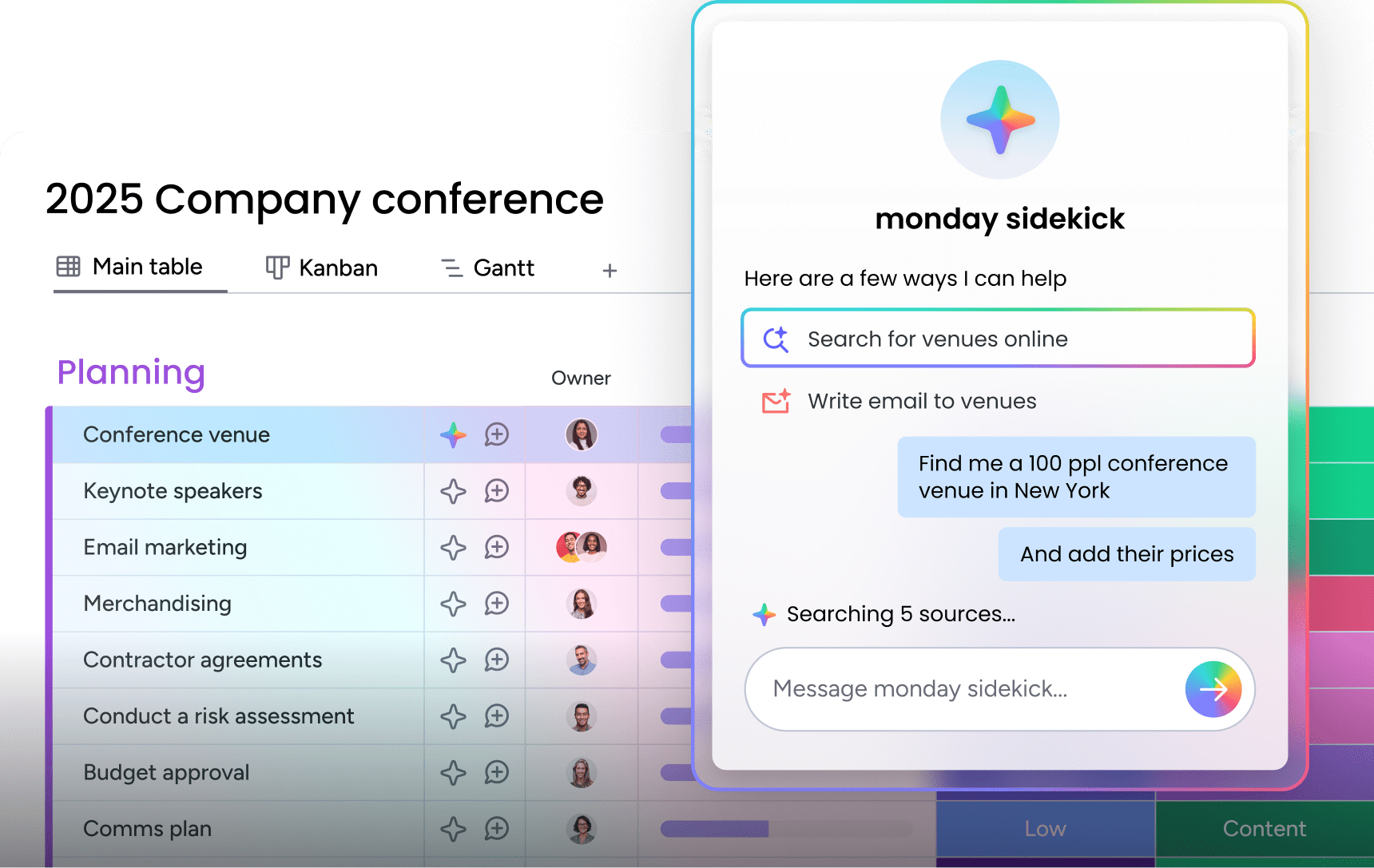
monday sidekick is the platform’s built-in AI assistant. Each message you send consumes credits based on its complexity, so a simple question about board status uses fewer credits than a multi-step analysis with content generation.
| Task type | Approx. credits per message | Examples |
|---|---|---|
| Simple | ~10–30 | Board status check, summarizing a single item |
| Intermediate | ~30–80 | Building a chart, drafting a monday doc from board notes |
| Complex | ~80–150 | Cross-board workload analysis, restructuring a board |
| Extra complex | ~150+ | Batch updating hundreds of items, a full board rebuild |
Consumption also depends on how much board context sidekick reads and which tools it uses, such as search or chart building. For example, a daily morning check of overdue items on a sprint board can use about 770 credits a month across 22 workdays, while building 10 charts or reports can use about 660.
monday agents and autonomous agent runs
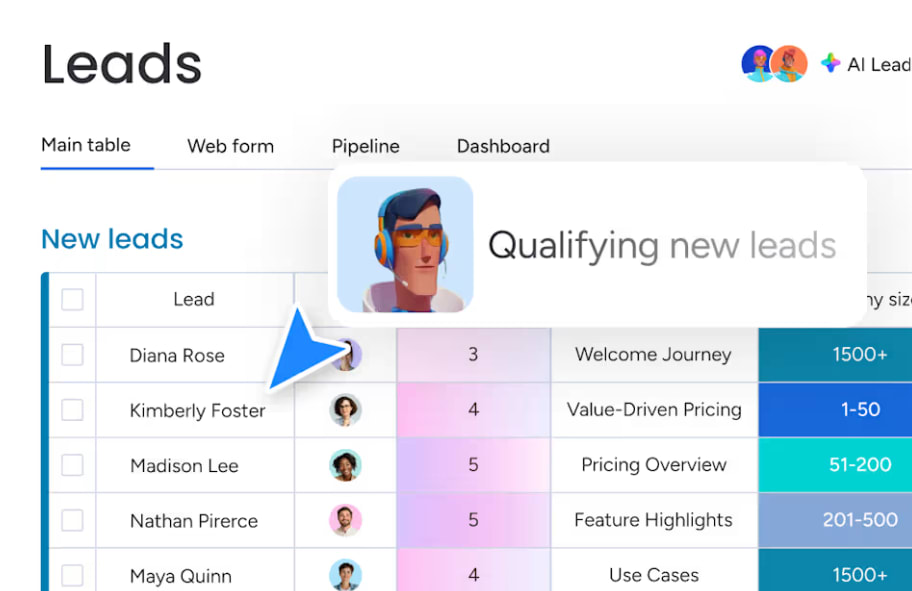
monday agents are autonomous AI agents that run workflows for team members. Ready-made agents include the Lead Qualifier, Dependency and Risk Mapper, Support Signal Agent, and Ticket Management Agent.
You can also build custom agents with prompts alone, no code required, using the AI agent builder in 3 steps:
- Describe the role and triggers: Define what the agent does and what activates it.
- Connect relevant knowledge and integrations: Link the agent to the data sources and platforms it needs.
- Test and refine: Run the agent, then check the Activity tab to see what it did and how many credits it used.
Each agent run consumes credits based on the complexity of its tasks. A simple task such as a status update uses roughly 10–50 credits, while multi-system work like deep web research can use 250+. One run can include several tasks. For example, an agent that reviews a development board each Friday and writes a sprint retrospective uses about 63 credits per run. An agent that scores 50 candidate CVs a day against job criteria uses about 12,500 credits a month.
AI Notetaker for meeting transcription and summaries
The AI Notetaker feature transcribes meetings and generates summaries and action items. It uses 120 credits per meeting hour, measured by the minute, so a 30-minute call uses about 60 credits. As an example, it can capture your sales team’s call notes and automatically extract follow-up items after prospect conversations.
AI workflows and active workflow limits by plan
AI workflows are multi-step automated processes with AI actions built in. Each AI-powered run consumes credits based on its complexity, and building or editing a workflow with the prompt box also uses credits.
Different plans have different limits on active AI workflows. Standard plans can run up to 3 active workflows, Pro up to 20, and Enterprise up to 250.
monday vibe app building and running
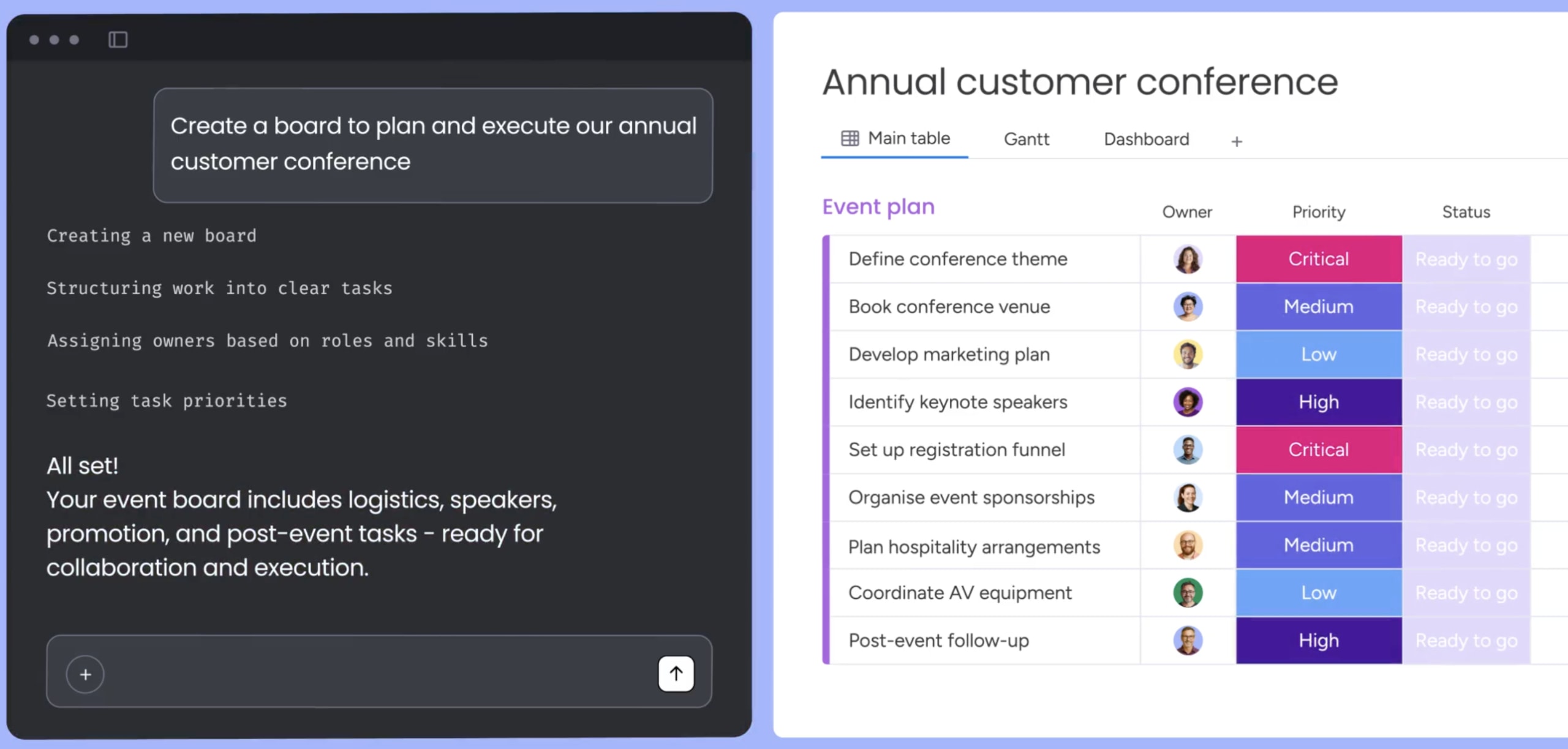
monday vibe is the platform’s AI-powered no-code app builder. Building an app uses credits for each message you send, based on the request’s complexity and the model you choose. Once an app is published, it uses credits each time it calls on AI. Publishing a live app also needs a paid app bucket.
| Model | Approx. credits per message | Best for |
|---|---|---|
| Gemini Flash | ~10–20 | Simple tweaks, such as colour or text edits |
| Claude Sonnet (default) | ~30–50 | Most builds and everyday edits |
| Claude Opus | ~50–500 | Complex multi-page apps and deep troubleshooting |
| Auto-Select | Varies | Letting monday pick the model for each request |
Chat mode uses fewer credits than Build mode because no code is written, so it’s a good place to plan or troubleshoot before making changes. After each message, vibe shows how many credits that interaction used. As a guide, a simple OKR tracker built with a handful of prompts uses about 140 credits, while a full venue management system built over ~95 prompts uses about 3,000.

Which monday AI Workspace features are free?
Many of the most valuable AI capabilities on the monday AI Workspace cost zero credits. These features cover everyday writing and board setup: the kinds of actions teams use dozens of times a day.
Platform-wide AI features that cost zero credits
Teams can experience AI value immediately with these features, which are included in your subscription.
- AI Formula Builder: Describe a formula objective in conversational language, such as “calculate the number of days between the start date and today,” and AI generates the formula for you without you needing to memorize syntax or look up function references.
- AI Updates assistant: Summarize a long thread or draft a status update with AI in the updates section of any item.
- AI Docs Assistant and Start docs with AI: Generate a new monday doc from a prompt, such as a project brief or meeting agenda, then summarize or write text inside it with AI.
- Refine text with AI: Improve the clarity and tone of text in a text column without rewriting it yourself.
- Prompt to board: Describe the board you need, and AI builds a customized board for you.
- AI Text to board filters: Filter your board by typing what you’re looking for in natural language.
This list may change as new features are released. Check the complete free feature list in the current AI Feature Catalog in the monday.com help center.
Why monday MCP does not consume AI credits
monday MCP (Model Context Protocol) connects external AI assistants like Claude, ChatGPT, Cursor, and Microsoft Copilot Studio to your monday.com workspace. Connecting through MCP doesn’t consume AI credits. MCP connections use API calls instead, which count toward your account’s API limit.
Although the MCP connection costs no credits, you may incur costs from the external AI assistant you connect through MCP. Those are billed separately by the provider (OpenAI, Anthropic, etc.). It’s important to account for this when you’re designing how monday agents and connected assistants should work together. monday MCP expands AI access at zero credit cost, while monday agents handle execution built around the context of your work.
How much do AI credits cost?
Knowing the per-credit cost helps you plan AI spending as your team’s usage grows.
Cost per credit
One AI credit costs $0.01 in US dollars. Local rates include €0.01, £0.00875, CA$0.01375, and AU$0.01625. Rates follow the pricing plans in effect when you buy, so check the monday.com pricing page for current rates in your local currency.
How to buy more AI credits
Additional AI credits are available in predefined buckets, not as individual credits. If your team runs out before the end of the billing cycle, you can move up to the next credit bucket without changing your seat count.
- Step 1: Go to the Administration section. Account admins open the Administration section of their monday.com account.
- Step 2: Open AI governance. Select AI governance, then the Credits Usage tab.
- Step 3: Buy more credits. Click Buy more credits and choose the bucket that fits your team’s projected usage. A smaller bucket works well for teams testing new AI workflows, while teams running daily automations and agents may need a larger one.
Teams with high-volume AI usage or specific requirements, such as enterprise-wide agent deployments or custom credit allocations across business units, can contact monday.com directly for tailored options.
How to estimate AI credit usage for your team
Credit usage depends on which AI features your team uses and how often those features run. The scenarios below show how different team profiles translate into monthly credit consumption.
Scenario 1: A small project team with occasional AI usage
A 3-person project team on the monday AI Workspace uses the Assign labels AI block to categorize incoming tasks twice per week and drafts updates with the AI Updates assistant (free, zero credits) a few times daily. They occasionally ask monday sidekick to summarize project status, a simple task at roughly 10–30 credits per message.
| Feature used | Credits per action | Frequency per month | Subtotal |
|---|---|---|---|
| AI block: Assign labels | 8 per action | ~24 items (8 per team member × 3 members) | 192 |
| monday sidekick messages (simple) | ~10–30 per message | ~40 messages | ~400–1,200 |
| AI Updates assistant | 0 | Daily use | 0 |
| Estimated monthly total | ~600–1,400 credits |
This team’s usage fits within the Standard plan’s minimum of 2,000 credits per month, leaving room to try heavier features such as AI Notetaker.
Scenario 2: A mid-size team running daily AI workflows
A 10-person operations team uses the Detect sentiment AI block in an automation to score stakeholder feedback daily, and records three one-hour meetings a week with AI Notetaker. Team members also ask monday sidekick for a weekly status report and send quick questions throughout the day.
| Feature used | Credits per action | Frequency per month | Subtotal |
|---|---|---|---|
| AI block: Detect sentiment | 8 per action | ~200 items | 1,600 |
| monday sidekick: Weekly status reports (intermediate) | ~30–80 per report | ~4 reports | ~120–320 |
| AI Notetaker | 120 per meeting hour | ~12 meeting hours | 1,440 |
| monday sidekick messages (simple) | ~10–30 per message | ~300 messages | ~3,000–9,000 |
| Estimated monthly total | ~6,200–12,400 credits |
Daily automations consume credits at a higher rate than occasional manual usage because they run on every qualifying item without human intervention.
Scenario 3: A project management team using the Dependency and Risk Mapper agent and AI Notetaker
A 5-person project management team on the monday AI Workspace uses the Dependency and Risk Mapper agent to map dependencies and flag project risks, plus AI Notetaker to capture action items and decisions from meetings. The agent runs once each workday without anyone needing to trigger it.
| Feature used | Credits per action | Frequency per month | Subtotal |
|---|---|---|---|
| Dependency and Risk Mapper runs (intermediate) | ~50–150 per task | ~20 runs | ~1,000–3,000 |
| AI Notetaker | 120 per meeting hour | ~15 meeting hours | 1,800 |
| AI block: Assign labels | 8 per action | ~100 items | 800 |
| AI Updates assistant | 0 | Daily use | 0 |
| monday sidekick messages (simple) | ~10–30 per message | ~250 messages | ~2,500–7,500 |
| Estimated monthly total | ~6,100–13,100 credits |
Agent-driven workflows represent a higher credit investment, but they directly identify project risks and capture critical decisions. This makes the credit spend a measurable input to project success and team efficiency rather than an abstract cost.
Why different AI actions use different credit amounts
Credit costs vary because different AI actions require different levels of computational resources. Understanding this relationship helps teams plan where credits go and, in monday vibe and monday agents, which models to use.
How complexity and AI model selection affect consumption
A simple text categorization, where an AI block reads a short text field and selects from a predefined list of labels, costs a flat 8 credits. A complex agent task that combines deep web research with analysis across multiple boards can use 250+ credits.
Think of it like different types of phone calls: a local call costs less than an international call with translation services. The underlying infrastructure required to complete the action determines the cost.
Each AI model sits at a different point between speed and intelligence. A more capable model reasons more deeply and takes more steps, so it uses more credits than a lighter, faster one.
Choosing the right model for cost and quality
monday vibe and monday agents let you choose which AI model powers your work, and the model you pick directly affects credit cost. Other features, including AI blocks and monday sidekick, cost the same regardless of model.
- In monday vibe: Use a lighter model for simple edits like color or text changes, and save the most capable models for complex multi-page apps. Claude Sonnet is the default for most builds.
- In monday agents: Claude Sonnet is the recommended default, with more capable models best kept for complex, multi-system tasks. Anthropic models generally consume fewer credits than OpenAI equivalents at the same complexity.

How to track and control AI credit usage
Visibility into AI credit consumption is essential for budget planning and scaling AI adoption with confidence. AI governance provides the data foundation for treating AI credits as a managed cost center, giving finance and operations leaders the same visibility into AI spend they have into other operational costs.
Use AI governance to monitor consumption
Navigate to Administration → AI governance → Credits Usage. From there, admins can track:
- Credit usage by feature
- Credit usage by user
- Agent activity across the account
On the Enterprise plan, admins can also use the AI permissions tab to control which account roles can use each supported AI feature.
Automatic alerts at 80% and 100% usage
As your account approaches its credit limit, admins receive notifications at 2 thresholds:
- At 80% usage: Admins get enough lead time to buy more credits or adjust how the team uses AI before reaching the limit.
- At 100% usage: Some AI capabilities keep running for a short period, giving you time to top up before credit-consuming usage is paused. Included AI features that don’t use credits continue to work normally.
Your team keeps access to the included AI features even after credits run out, and the alerts give advance warning before you reach the limit.
Allocate credits with usage limits
The Usage Limits tab in AI governance lets admins allocate credits per use case and per user. This makes it easier to tie AI spend to specific departments, such as capping the credits a sales team’s agents can draw, and to forecast future needs from past consumption.
Organizations that treat AI credits as a managed cost center, rather than an unmonitored expense, are positioned to scale AI adoption confidently. AI governance provides the data foundation for that discipline.
How governance enables confident AI scaling
Credit visibility is part of a broader governance framework that separates controlled AI adoption from unmanaged AI sprawl. Organizations that succeed with AI at scale treat governance as a strategic advantage that helps them expand AI use safely.
The monday AI Workspace builds visibility and oversight directly into everyday work, so AI operates transparently within the guardrails teams already rely on.
The governance framework includes several key components:
- Control: Explicitly decide what agents can and cannot do, both inside monday and across external integrations.
- Permissions: Define exactly which data agents can access, and whether they have permission to edit, create, or only read information. On the Enterprise plan, the AI permissions tab also controls which account roles can use each AI feature.
- Human in the loop: Review each agent run in the Activity tab and refine its instructions before scaling it up.
- Compliance: monday is HIPAA compliant, as well as holds ISO/IEC 27001, SOC 2 Type II, and ISO/IEC 27701 certifications.
- Content ownership and data rights: You retain ownership of the content you provide and the content generated by AI. monday.com does not allow third parties to train on your data.
This governance framework encourages organizations to scale AI with control. Only 21% of enterprises report having “mature governance” in place to manage the risks of agentic AI, according to Deloitte’s 2026 survey of 3,235 IT and business leaders. The ability to monitor credit usage by feature and by user is essential for building internal business cases and maintaining stakeholder confidence in activating agents as part of their lineup.
Scale AI with confidence using monday AI
AI credits give teams on the monday AI Workspace transparent costs and clear visibility into where every credit goes. Start with the included AI features to build confidence, then put credits toward the agents and automations that save your team the most time.
The shared credit pool means AI works across every department without siloed budgets, while usage limits and automatic alerts keep spending under control as you scale.
Get startedFrequently asked questions about monday AI credits
Are AI credits shared across the entire monday.com account or assigned per person?
AI credits are pooled at the account level and shared across all team members. By default, any team member with AI permissions can use credits from the shared pool, and admins can set usage limits per user or per use case in AI governance.
Can I try monday AI features before purchasing a paid plan?
monday AI features are available on all paid plans, and AI credits are purchased alongside your seats. Many AI features, such as the AI Formula Builder and the AI Updates assistant, cost zero credits, so teams can start using AI before spending any credits. New monday CRM and monday service customers may also receive trial credits to explore AI capabilities.
Does monday.com use customer data to train AI models?
No, our platform doesn't use customer data or content to train its AI models and doesn't allow third parties to do so. Full details are available in the monday.com AI Trust Center.
How do AI credits work with external agents connected through monday MCP?
monday MCP doesn’t consume AI credits. MCP connections use API calls instead, which count toward your account’s API limit. Costs from the external AI assistant (such as Claude or ChatGPT) are billed separately by that provider.

 Get started