


Supply chain management is a highly sensitive operation that could break under the weight of a single delayed shipment or a sudden demand spike. In the past, the success of your business hinged on each supply chain component working in perfect harmony with the rest. But now, AI helps businesses manage this complexity by predicting disruptions and automating routine decisions to keep operations moving before small issues become costly problems.
But AI supply chain management solutions aren’t built the same way. Some focus on forecasting and planning; others help teams research vendors and keep status updates moving. To select the best platform for your needs, this guide covers 15 AI for supply chain management platforms, what each one does well, and how to evaluate fit based on your systems, governance needs, and operating model.
Try monday agentsWhat is AI in supply chain management?
AI in supply chain management uses machine learning and automation to optimize operations and execute decisions across procurement, logistics, and inventory management. Instead of reacting to problems after they occur, AI analyzes patterns in real time to anticipate disruptions and keep operations moving smoothly, which reduces costs in turn.
AI agents handle repeatable tasks like vendor research, risk assessment, and status reporting within the rules you define. Your people set the strategy and approval thresholds; the agents execute the work. This shift frees operations teams from manual coordination and lets them focus on higher-value decisions that require hands-on judgment.
The difference between effective AI and basic automation comes down to context. A model trained only on logistics data will miss the demand spike triggered by a marketing campaign or the quality issue in customer service tickets. When AI connects to signals across sales, marketing, service, and operations on a unified AI Work Platform, it stops optimizing in isolation and starts supporting business-wide priorities.
The result is better judgment, quicker response times, and execution that keeps pace with the rest of the organization.
15 best AI supply chain platforms for operations teams
The best supply chain AI platform for your business matches the way your team operates. Some platforms are heavyweight programs that demand years of implementation and dedicated data science support before they show meaningful results. Others put AI agents beside your team immediately, acting on live work instead of stopping at dashboards and recommendations.
Use this guide as a quick way to get oriented. Start with the comparison table to narrow the field based on your goals, resources, and operating model, then dig deeper into the platforms that look like the strongest fit.
| Platform | Primary strength | Best for | Notable AI capability | Starting price |
|---|---|---|---|---|
| monday agents | Cross-department context and agent execution | Operations teams needing AI embedded in existing workflows | Autonomous agents that execute vendor research, risk analysis, and status reporting | $12/seat/month |
| IBM | Enterprise-scale predictive analytics | Large enterprises with complex global supply chains | Watson Supply Chain Insights cognitive capabilities | Custom pricing |
| Kinaxis | Concurrent planning and scenario analysis | Complex manufacturing with multi-tier supplier networks | Real-time what-if analysis across supply chain variables | Custom pricing |
| SAP | Deep ERP integration | Organizations invested in SAP ecosystems | SAP Business AI for integrated planning | Custom pricing |
| Oracle | Unified ERP-to-supply-chain visibility | Oracle ecosystem organizations | Demand sensing and inventory optimization | Custom pricing |
| C3 AI | Custom AI application development | Organizations with data science resources | Flexible AI model development on supply chain data | Custom pricing |
| Coupa | Spend management and procurement | Procurement-focused supply chain optimization | Supplier risk management and spend analytics | Custom pricing |
| Zebra Technologies | Warehouse and logistics optimization | Organizations prioritizing last-mile visibility | Real-time tracking and workforce optimization | Custom pricing |
| Altana | Supply chain visibility and risk intelligence | Organizations needing deep supplier network mapping | Multi-tier supplier visibility and compliance monitoring | Custom pricing |
| Google Cloud | AI infrastructure for custom solutions | Organizations with technical resources for custom builds | Supply Chain Twin and Vertex AI applications | Usage-based pricing |
| LeewayHertz | Custom AI development | Organizations wanting bespoke AI solutions | Custom supply chain AI application development | Project-based pricing |
| Deloitte | Strategic consulting and implementation | Large enterprises needing transformation guidance | Consulting-led AI strategy and implementation | Engagement-based pricing |
| EY | Supply chain transformation services | Enterprise transformations with strategic advisory | Strategic advisory alongside technology implementation | Engagement-based pricing |
| AI CERTs | Training and certification | Organizations building internal AI capabilities | AI certification programs for supply chain contexts | Course-based pricing |
| Accelalpha | Oracle implementation expertise | Organizations implementing Oracle supply chain solutions | Specialized Oracle supply chain AI implementation | Project-based pricing |
1. monday agents
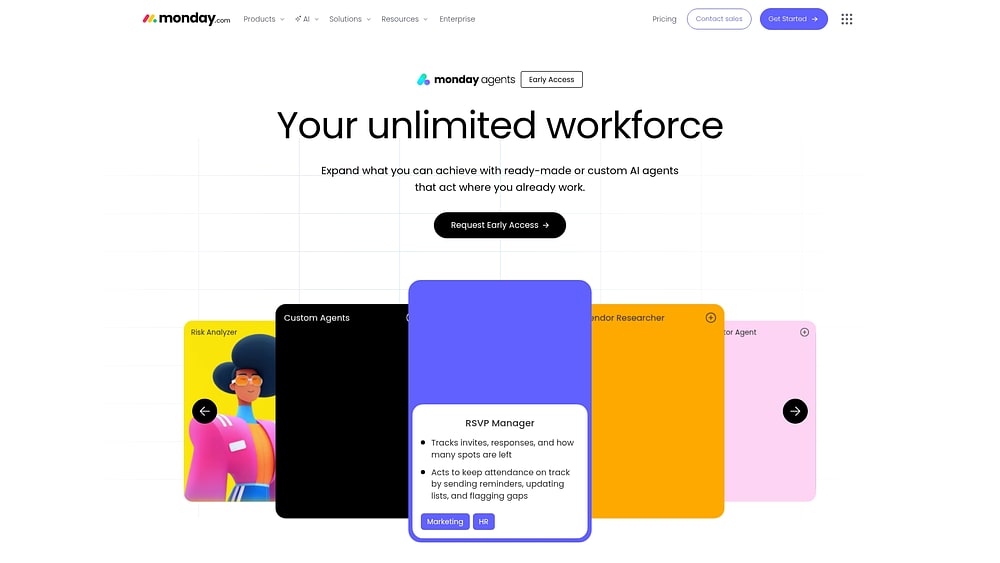
monday agents works directly inside monday.com’s AI Work Platform, where many teams already coordinate vendor reviews, risk tracking, and reporting. Work can keep advancing without the usual wait for manual handoffs. Your agents use the same boards, docs, PDFs, and process context your team already depends on. With 250,000+ organizations already running work on monday.com, teams also inherit enterprise-grade governance, permissions, and oversight across every automated action.
Use case:
Operations, procurement, and supply chain teams that need AI agents to handle vendor research, risk analysis, and cross-team status reporting inside the same digital workspace where work already happens.
Key features:
- Vendor Researcher agents: Analyze procurement requirements, research and prioritize supplier lists, and gather details such as pricing, security information, reviews, and contract terms. They also build a structured vendor summary and request missing details, which helps sourcing teams compare options faster and keep evaluations moving.
- Risk Analyzer agents: Detect schedule, dependency, and risks related to workload management across projects in real time. For supply chain teams, that can mean flagging when a supplier delay may affect a launch date, then notifying stakeholders, reassigning owners, or updating timelines so the response happens while there’s still room to act.
- Status reporter agents: Automatically generate and send status updates that highlight progress, risks, and blockers across multiple boards. That’s especially helpful when procurement, operations, finance, and project teams all need the same current picture before a weekly review or executive check-in.
- Custom agent builder: Build supply chain-specific agents in three steps: describe the role and triggers, connect the knowledge and systems the agent needs, then test and refine. Agents can be grounded in boards, docs, and PDFs, and teams can define permissions and review behavior before activation.
Pricing:
AI features are available on these monday.com plans, which use a transparent credit-based model for AI actions.
- Standard: $12 per seat/month, billed annually
- Pro: $19 per seat/month, billed annually
- Enterprise: Custom pricing, contact sales
Why it stands out:
- Agents that execute, not just monitor: agents move from insight to action across workflows, whether building a vendor brief, generating a report, assigning follow-ups from a meeting summary, or updating work items around the clock.
- Full organizational context: monday agents structure work context across departments, not just one function. That means a supply chain workflow can connect procurement activity with project timelines, service signals, or operational updates in one place.
- Trust and control built in: teams can decide what each agent can access and do, review actions with human-in-the-loop validation, and rely on audit trails for visibility. monday.com also supports HIPAA compliance and holds ISO/IEC 27001, SOC 2 Type II, and ISO/IEC 27701 certifications, which is vital for organizations with stricter governance requirements.
- Easy adoption for existing teams: because agents work where teams already manage projects and processes on monday.com, adoption feels natural. You can start with ready-made agents, then expand into custom agents as your workflow matures.
2. IBM
For large enterprises already running IBM infrastructure, IBM brings AI-driven supply chain operations into the systems you already use. Its Sterling Supply Chain Suite combines cognitive AI with one of the largest multi-enterprise B2B networks in the market, connecting more than 3.1 million trading partners. The result is broad visibility across order management, fulfillment, and inventory, all backed by IBM’s longstanding experience in enterprise systems.

Use case:
Large enterprises with complex global supply chains that need predictive analytics at scale, cognitive AI for demand sensing, and deep integration with existing IBM infrastructure.
Key features:
- Watson Supply Chain Insights: Analyzes structured and unstructured data, including weather patterns, geopolitical events, and market signals, to identify risks, predict disruptions, and recommend mitigation actions across global networks.
- Sterling Supply Chain Suite: Delivers end-to-end visibility across order management, fulfillment, and inventory optimization, with AI-powered demand forecasting built into core workflows.
- Scenario modeling: Simulates potential supply chain disruptions and tests response strategies before events occur, so teams can act on a plan rather than react to a crisis.
Pricing:
- Custom pricing is available for larger deployments based on scope, modules, and data volume.
Considerations:
- Full deployments typically require 6-18 months and dedicated technical resources, which means organizations should plan for significant integration work before realizing full value.
- Native warehouse management and transportation management capabilities are limited, so many teams pair IBM with third-party logistics platforms to cover those functions.
3. Kinaxis
When one disruption can ripple across multiple supplier tiers, Kinaxis keeps planning synchronized. Its concurrent planning model links demand, supply, inventory, and sales in a single environment, so a change in one area updates the rest of the network immediately. After 11 straight years as a Gartner Magic Quadrant Leader, Kinaxis has earned a solid reputation among global enterprises that need scenario-based planning at scale.
Use case:
Complex manufacturing environments with multi-tier supplier networks that require concurrent planning, real-time scenario analysis, and coordinated response to supply chain variability.
Key features:
- Concurrent planning across all functions: Instead of relying on sequential planning cycles across siloed teams, Kinaxis unifies sales, operations, inventory, and supply in one environment, so any shift propagates instantly across the network.
- Unlimited what-if scenario modeling: Teams can test multiple scenarios at the same time, weighing trade-offs between cost, service levels, and risk before choosing a path, which is especially useful during supplier disruptions or sudden demand changes.
- AI-powered demand sensing: The platform ingests real-time market signals, including external data like weather and social trends, to continuously adjust forecasts and identify demand-at-risk before it affects fulfillment.
Pricing:
- Custom pricing: Quote-based; no public pricing tiers are available
Considerations:
- Kinaxis is purpose-built for supply chain planning, so organizations that also need execution management, cross-functional collaboration, or broader operational workflows will likely require additional platforms alongside it.
- Pricing is entirely quote-based, which means buyers need to engage the sales team before understanding total investment — a consideration for organizations with tighter evaluation timelines.
4. SAP
SAP’s advantage comes from closeness to the systems many enterprises already run. By linking AI-powered supply chain planning directly to financial, procurement, and manufacturing workflows, it narrows the gap between planning decisions and operational execution. For organizations already running SAP ERP, native integration is a major strength. Customer outcomes reflect the upside: SLB reported about 90% forecast accuracy and $1 billion in inventory savings after deploying SAP’s supply chain capabilities.

Use case:
Organizations with existing SAP ERP investments that want AI-powered supply chain planning connected natively to financial, procurement, and manufacturing systems, without manual handoffs or data synchronization delays.
Key features:
- SAP Integrated Business Planning (IBP): Unified demand, supply, and inventory planning with embedded analytics, AI-driven forecasting, and scenario planning that feeds directly into execution systems.
- SAP Business AI: Machine learning embedded across supply chain modules to support demand forecasting, inventory optimization, and supplier risk assessment, including Joule agents that identify AI explanations and recommendations within planning workflows.
- Sustainability analytics: Track and optimize carbon footprint across supply chain operations, giving leadership teams visibility into environmental performance alongside operational metrics.
Pricing:
- Custom pricing is based on selected modules, number of users, and deployment model
Considerations:
- Full AI capabilities often require additional modules and implementation investment beyond base ERP licensing, which can increase total cost of ownership for organizations still scoping their deployment.
- Organizations not already on SAP infrastructure face significant migration considerations before realizing the platform’s native integration advantages.
5. Oracle
Oracle Fusion Cloud SCM connects product design, planning, manufacturing, and logistics on one platform instead of forcing teams to piece together separate systems. For mid-to-large enterprises in sectors such as manufacturing, retail, and life sciences, that can simplify visibility and reduce integration overhead. Nearly 10,000 organizations run mission-critical functions on Oracle, and the platform combines that scale with embedded AI and real-time operational data.

Use case:
Organizations seeking unified visibility from ERP through supply chain execution within Oracle’s ecosystem, with AI capabilities for demand sensing and inventory optimization.
Key features:
- Demand sensing: AI analyzes point-of-sale data, market signals, and historical patterns to sharpen short-term forecast accuracy, helping planning teams respond to shifts before they become disruptions.
- Inventory optimization: Machine learning balances service levels against carrying costs across distribution networks, giving operations leaders a data-backed foundation for stocking decisions.
- IoT integration: Sensor data from warehouses, transportation, and manufacturing feeds into a single view, so teams can act on real-time operational signals rather than lagging reports.
Pricing:
- Custom pricing is based on modules selected, transaction volume, and user count
Considerations:
- Multi-module packaging across planning, execution, logistics, and PLM requires careful license scoping, and minimums on certain SKUs may be prohibitive for smaller operations.
- Organizations with non-Oracle systems already in place should evaluate integration requirements and ecosystem dependencies before committing.
6. C3 AI
If you want to build or heavily customize AI applications, C3 AI gives you a flexible foundation to do it. The platform supports a mix of pre-built and customizable applications across demand forecasting, inventory optimization, and supplier risk management, while also allowing teams to develop new solutions on top of existing ERP, WMS, and TMS environments. Its appeal is strongest for companies that see AI as a strategic buildout rather than a light-touch add-on.

Use case:
Organizations looking to deploy AI applications, either by customizing pre-built solutions or building their own, across supply chain planning and execution.
Key features:
- Supply chain digital twin: Unifies demand, supply, production, fulfillment, and risk signals into a single AI-ready data model. This enables what-if scenario modeling through natural language and stochastic optimization across the full planning horizon.
- Agentic AI orchestration: Deploys coordinated networks of AI agents, covering demand plan optimization, disruption detection, and schedule optimization—that continuously adapt plans in near real time as conditions shift.
- Explainable AI: Generates transparent reasoning for AI recommendations to build user trust and support compliance. Specific applications, such as Supply Network Risk and Inventory Optimization, provide detailed evidence packages to document their outputs.
Pricing:
- Custom quotes are based on applications selected, data volume, and compute requirements.
Considerations:
- Building and maintaining custom applications on the platform requires data scientists and ML engineers. Organizations without these resources may find the platform more demanding to operate than pre-built alternatives.
- Implementation cycles are resource-intensive, with significant integration work required to build the supply chain digital twin from ERP, WMS, and TMS data sources.
7. Coupa
Coupa tackles supply chain optimization by focusing on procurement, spend, and network design. This focus gives enterprise teams a strong data base for sourcing and supplier decisions, especially when those decisions are tied closely to contracting and payment. With $8 trillion in spend data and a network of more than 10 million buyers and suppliers, its community-powered AI provides benchmarking and external intelligence that traditional internal analytics cannot easily replicate.

Use case:
Procurement-focused supply chain optimization where spend management, supplier risk assessment, and sourcing decisions drive supply chain performance.
Key features:
- AI-powered spend analytics: Surfaces savings opportunities, maverick spend patterns, and contract compliance gaps across procurement data, so finance and procurement leaders can act on real numbers, not estimates.
- Supplier risk management: Continuously monitors supplier financial health, compliance status, and operational risks, with automated alerts that give teams time to respond before disruptions escalate.
- Community intelligence: Benchmarks supplier performance and pricing against anonymized data from Coupa’s customer network, giving organizations an external reference point that internal data alone cannot provide.
Pricing:
- Custom pricing based on spend under management and modules deployed; available via sales inquiry
Considerations:
- Coupa’s strengths are concentrated in procurement and spend management; organizations that also need logistics optimization, manufacturing planning, or demand forecasting may need to integrate additional platforms to cover the full supply chain scope.
- Building and governing robust digital twin models typically requires skilled modelers and strong data foundations, so teams should plan for a meaningful onboarding investment before realizing full value.
8. Zebra Technologies
When supply chain performance depends on what happens in the warehouse or in transit, Zebra Technologies stands out. Its platform turns physical operations into a stream of real-time data, connecting warehouses, distribution centers, and transportation networks through rugged hardware, RFID, and workforce optimization tools. Many Fortune 500 companies use Zebra, and its phased Warehouse Maturity Model gives teams a way to modernize progressively instead of all at once.

Use case:
Organizations prioritizing warehouse automation, last-mile visibility, and workforce optimization where physical operations and real-time tracking drive supply chain performance.
Key features:
- Real-time asset tracking: RFID, barcode, and IoT sensors deliver continuous visibility into inventory location and movement across warehouses and transportation networks, reducing stock discrepancies and inbound processing time.
- Workforce optimization: AI-powered workforce planning assigns work based on workload forecasting and individual performance data, helping operations leaders right-size labor and reduce travel time on the warehouse floor.
- Warehouse automation: Integration with autonomous mobile robots (AMRs), pick-to-light systems, and automated guided vehicles synchronizes workers and machines to increase fulfillment throughput, with Zebra’s Symmetry Fulfillment achieving comparable productivity gains with up to 30% fewer robots.
- Predictive maintenance: AI analyzes device performance data to forecast and prevent hardware failures, minimizing downtime for critical equipment like printers and mobile computers.
Pricing:
- VisibilityIQ Foresight and Workcloud suites are available as subscription services; pricing on request.
Considerations:
- Zebra’s strengths are concentrated in physical operations; organizations seeking end-to-end supply chain planning or cross-functional visibility will likely need to integrate the platform with a separate WMS or planning solution.
- Many deployments rely on third-party integrators, meaning outcomes can vary depending on the partner and the complexity of existing systems.
9. Altana
Altana doesn’t run transactions; instead, it makes the supplier network itself visible. Using an AI-built knowledge graph that covers more than 50% of global trade, it maps multi-tier relationships for enterprises, logistics providers, and government agencies that need continuous risk monitoring, compliance coverage, and product-level traceability. Its Product Passports are verified, shareable records of origin from raw materials through finished goods; they also support pre-border validation with regulators such as U.S. Customs and Border Protection, which gives it a distinctive position in the market.
Use case:
Organizations managing complex, multi-tier global supply chains that need continuous risk intelligence, trade compliance monitoring, and regulator-facing product traceability in a single platform.
Key features:
- Multi-tier supplier network mapping: AI continuously maps supplier relationships across multiple tiers, surfacing hidden dependencies, concentration risks, and sub-tier vulnerabilities, with one Fortune 10 automaker reporting a 7,000% increase in sub-tier visibility within four weeks of deployment.
- Risk and compliance monitoring: Continuous screening across sanctions, forced labor regulations, environmental requirements, and financial stability risks, with government-reported outcomes including 95% faster detection of critical supply chain vulnerabilities.
- Product Passports for pre-border validation: Verified, shareable product provenance records that CTPAT-certified importers can attach to customs entries for faster CBP clearance, reducing border delays and detention risk.
Pricing:
- Commercial pricing is quote-based
Considerations:
- The platform’s graph covers over 50% of global trade, which means organizations operating in thinner data sectors or less-documented trade lanes may encounter gaps in supplier coverage.
- Commercial pricing is not publicly listed, which can extend the budgeting process before an initial engagement is established.
10. Google Cloud
Google Cloud sees supply chain complexity as a data and AI challenge, then gives you the infrastructure to build around it. Instead of replacing ERP or planning systems, it layers BigQuery, Vertex AI, and Looker on top of them to create a composable analytics and machine learning foundation. It’s an approach that appeals to organizations in retail, manufacturing, logistics, and consumer packaged goods that want flexibility. The U.S. Defense Logistics Agency’s use of this stack to modernize global supply chain operations underscores its credibility for large-scale deployments.

Use case:
Organizations with technical resources that want to build custom supply chain AI solutions on Google’s infrastructure, layering demand forecasting, inventory optimization, and end-to-end visibility on top of existing systems.
Key features:
- Supply Chain Twin: Creates a digital representation of your supply chain by fusing enterprise, supplier, and external data, including weather and risk signals, into a single view, with real-time dashboards, mobile alerts, and AI-driven scenario simulation via the Supply Chain Pulse module.
- Vertex AI and Cortex Demand Sensing: Prebuilt and customizable ML models for demand forecasting, risk detection, and generative AI-powered intercompany search, with documented results such as reducing analytical processing time from 2.5 hours to 8 minutes.
- BigQuery and Looker integration: Analyze large-scale supply chain data with SQL and ML capabilities in a unified environment, then locate KPIs and executive dashboards through Looker for faster, evidence-based decisions.
Pricing:
- Pay-as-you-go pricing is available across compute, storage, and AI services
Considerations:
- Because solutions span multiple metered services, cost predictability requires active FinOps governance and architecture optimization to avoid unexpected spend.
- Google Cloud augments existing systems rather than offering a full transactional SCM suite, so organizations seeking end-to-end order management or manufacturing execution will need to pair it with additional platforms.
11. LeewayHertz
LeewayHertz is built for companies that don’t want to force-fit a packaged platform into a complex environment. Now part of The Hackett Group following its 2024 acquisition, the firm combines strategic advisory work with hands-on AI engineering to create custom solutions that integrate with existing ERP, WMS, and TMS systems. Its ZBrain platform adds generative AI capabilities and no-code orchestration, which makes it particularly relevant for brownfield environments where replacement is not realistic.

Use case:
Organizations with specific operational requirements that need custom-built AI applications designed to integrate with their existing supply chain systems, rather than adopting a pre-packaged platform.
Key features:
- Custom AI and generative AI development: LeewayHertz engineers supply chain applications from the ground up using its ZBrain platform, covering demand forecasting, inventory optimization, route planning, and supplier management — all wired to existing enterprise systems via no-code Flow orchestration.
- Blockchain-backed traceability: For organizations in regulated or high-risk supply chains, the firm builds Hyperledger-based provenance platforms with role-based portals and real-time shipment tracking, reducing audit overhead and improving delivery accountability.
- Enterprise-grade security and compliance: Solutions are built to SOC 2 Type II and ISO/IEC 27001:2022 standards, with HIPAA and GDPR alignment — a meaningful advantage for organizations managing multi-party supplier networks with strict data governance requirements.
Pricing:
- Engagements are quote-only
Considerations:
- LeewayHertz delivers custom-built solutions rather than a self-service platform, so time-to-value depends on data readiness, integration complexity, and internal change management — there is no trial or instant deployment path.
- Publicly documented large-scale supply chain rollouts are limited to a small number of case studies, which may give organizations seeking proven, at-scale references less to evaluate upfront.
12. Deloitte
Deloitte sits at the consulting end of the spectrum, combining strategy, implementation, and managed services for enterprises redesigning supply chains at scale. With relationships across nearly 90% of the Fortune Global 500, it brings significant industry depth and proprietary AI-powered platforms to complex transformation programs. Its “Advise–Implement–Operate” model is designed to keep the firm involved well past early planning, supporting both execution and longer-term operations.

Use case:
Large enterprises undertaking major supply chain transformations where strategy, technology, and organizational change must evolve together under a single partner.
Key features:
- SupplyHorizon: An AI-powered risk monitoring platform that tracks 11+ risk categories, ingests data from 200,000+ news sources, and integrates with existing ERP systems — deployable in days or weeks.
- Supply chain control tower: An end-to-end orchestration capability combining real-time visibility, exception management, scenario analysis, and automated response execution — with Deloitte citing $1B+ in value delivered across 20+ control towers.
- Procurement managed services: A digital procurement offering powered by proprietary platforms including CognitiveSpend and D-ICE, backed by 1,500+ practitioners managing $195B+ in spend across 300+ categories.
Pricing:
- Custom-scoped per engagement
Considerations:
- Deloitte delivers consulting-led transformation rather than a standalone software product, which means organizations invest significantly in professional services alongside any technology implementation.
- Programs often require cross-functional alignment, strong data governance, and sustained organizational commitment to realize full value, making this a stronger fit for enterprises with dedicated transformation capacity than for teams seeking a faster, self-serve deployment.
13. EY
When supply chain transformation overlaps with regulation, tax, trade, sustainability, and large-scale change, EY becomes especially relevant. The firm combines strategic advisory, proprietary technology assets, and a broad alliance ecosystem for enterprises operating across complex global environments. Named a Leader in the IDC MarketScape: Worldwide Supply Chain Overall Ecosystem Services 2025–2026, EY also brings a multidisciplinary footprint spanning consulting, tax, sustainability, and technology implementation across 150+ countries.

Use case:
Enterprise supply chain transformations that require strategic advisory, technology implementation, and change management, particularly for organizations operating across complex global or regulatory environments.
Key features:
- Supply Chain Intelligence Platform (SCIP): A cloud-based analytics platform with intelligence, visualization, and optimization engines that accelerates cross-functional decision-making and scenario modeling across complex supply networks.
- EY Smart Factory: A people-centered digital manufacturing platform that embeds operational excellence on the shop floor using predictive analytics and AI, helping organizations scale performance improvements across production sites.
- Risk, compliance, and sustainability transformation: Integrated supply chain risk management, regulatory compliance planning, and decarbonization strategy, uniquely combining trade and tax optimization with network design decisions.
Pricing:
- Engagement-based pricing developed via RFP or statement of work
Considerations:
- Most consulting and managed services engagements are scoped case-by-case, which can extend procurement timelines for organizations seeking faster deployment.
- EY’s premium pricing model is best suited to large-scale, multi-workstream transformations; organizations with narrowly scoped needs may find more cost-efficient options with specialist providers.
14. AI CERTs
Not every organization starts with software when adopting AI. Some begin by building internal capability, and that is where AI CERTs fits. The platform offers role-based certification programs aimed at helping supply chain professionals understand how AI applies to real operational workflows. Its AI+ Supply Chain certification spans demand forecasting, inventory optimization, logistics routing, and supplier selection, giving teams a practical foundation as they prepare for wider adoption.

Use case:
Organizations investing in workforce development to build internal AI competency across supply chain roles, rather than purchasing a standalone technology platform.
Key features:
- Role-based AI curriculum for supply chain: Eight structured modules covering demand forecasting, inventory optimization, logistics, warehouse management, supplier selection, and risk management, plus an optional AI agents module for teams ready to go deeper.
- Flexible delivery formats: Self-paced access with a one-year subscription and all updates included, or instructor-led delivery through a network of authorized training partners for team-wide rollouts.
- Verifiable credentials: Online proctored exams, blockchain-verified digital badges, and QR-enabled certificates that give employers a reliable way to validate AI competency.
Pricing:
- Volume-based and white-label pricing is available for authorized training partners and academic institutions
Considerations:
- AI CERTs was founded in 2023, so employer recognition may vary compared to longer-established credentialing bodies like ASCM, particularly for organizations where credential brand equity influences hiring or promotion decisions.
- The certification covers AI concepts and tool ecosystems rather than providing hands-on platform access, so teams will need separate technology investments to put their new skills into practice.
15. Accelalpha
For enterprises implementing Oracle Cloud SCM, software alone often isn’t enough; execution depends heavily on the right partner. IBM Accelalpha fills that role with specialized expertise across Oracle Transportation Management (OTM), Warehouse Management (WMS), and Global Trade Management (GTM), paired with IBM’s global delivery reach and AI capabilities. With 790+ Oracle consultants and 600+ Oracle certifications, the practice is built for large-scale Oracle supply chain programs that need disciplined deployment and optimization.

Use case:
Organizations implementing Oracle Cloud SCM who need a specialized partner to deploy, configure, and optimize transportation, warehouse, and trade management capabilities at enterprise scale.
Key features:
- Oracle SCM deployment and configuration: End-to-end implementation across Oracle Order Management, Inventory, Manufacturing, OTM, WMS, and GTM, supported by the iAccel toolkit to accelerate time-to-value and standardize configurations across programs.
- AI-assisted supply chain analytics: Embeds IBM’s AI capabilities, including watsonx, into Oracle supply chain workflows to support demand sensing, inventory optimization, and operational decision-making.
- Enterprise system integration: Connects Oracle SCM with carriers, automation systems, ERP platforms, and other enterprise data sources to create a connected, end-to-end supply chain environment.
Pricing:
- Quote-only pricing is based on program scope, modules selected, and duration.
Considerations:
- IBM Accelalpha’s offering is purpose-built for the Oracle ecosystem, so organizations running non-Oracle supply chain platforms will find limited applicability here.
- Enterprise-scale SCM programs require significant change management and process preparation; teams should anticipate meaningful effort around data migration, integrations, and adoption before going live.
How to evaluate AI supply chain software for your organization
Choosing an AI platform for supply chain operations is high-stakes, resulting in a more responsive, resilient operating model if you get it right. Focus on the factors that most directly shape adoption and long-term value. In real operations, the platforms that hold up are those that fit your existing systems, respect governance requirements, and move at the pace your team can absorb.
Evaluate ERP and warehouse management system connections
It all starts with current data. If an AI platform can’t connect to your ERP or WMS in real time, teams are stuck making decisions from stale exports and manual workarounds.
Bidirectional flow matters even more. Once data can move in and out, the platform stops being a passive analytics layer and starts participating in the systems your team already uses to make decisions and execute work.
- Read access: Confirm the platform can ingest live operational data, not yesterday’s spreadsheet.
- Write-back capability: Check whether it can update records, trigger workflows, or create follow-ups in connected systems.
- Coverage: Review support for your current ERP, WMS, TMS, and procurement stack.
- Latency: Ask how quickly data refreshes and how exceptions are handled.
Review data quality and governance capabilities
Few organizations begin with spotless data, and that’s normal. The better platforms improve data quality over time while keeping recommendations traceable back to their sources. This is a great trust-builder. If people can understand why the system suggested an action, they’re far more likely to use it consistently.
- Source traceability: Make sure recommendations link back to the records or documents they came from.
- Permission controls: Verify who can see, edit, approve, or block AI actions.
- Audit trails: Look for action histories that show what happened, when, and under whose authority.
- Feedback loops: Check whether teams can correct outputs so the system improves over time.
Assess cross-department visibility and context
Demand changes, campaign launches, service trends, and finance decisions all influence what operations should prioritize next. This broader context makes AI meaningfully better. Once it can connect signals across the company rather than reading from a single stream, its recommendations become far more relevant.
- Sales inputs: Can the platform account for pipeline changes, large deals, or territory shifts?
- Marketing signals: Can it factor in campaigns, promotions, or planned launches?
- Service data: Can it detect quality patterns or delivery urgency from ticket trends?
- Finance signals: Can it reflect budget constraints, vendor terms, or cost targets?
Confirm trust controls and compliance coverage
AI adoption accelerates once leadership believes the guardrails are real. Certifications are only one piece of the story. The more practical question is whether your team can set clear boundaries with confidence. That includes approval workflows, data access, and oversight for autonomous actions.
- Human approvals: Identify which actions need sign-off before they happen.
- Role-based access: Review how permissions are assigned across departments.
- Compliance support: Look for standards such as SOC 2 Type II, ISO certifications, or sector-specific requirements.
- Operational oversight: Confirm whether admins can review, pause, or refine automated behavior.
Estimate adoption timeline and implementation effort
The platform that looks strongest in a demo isn’t always the one people adopt successfully. If the rollout drags on for months or depends on specialist support from the start, enthusiasm can disappear before outcomes show up.
- Ready-made workflows: See whether you can start with prebuilt agents or templates.
- Setup effort: Estimate admin time, integration work, and process redesign needs.
- Training load: Review how much onboarding team members will need.
- Pilot path: Ask what a 30-day or 60-day rollout could realistically achieve.
Most effective evaluations reach the same conclusion: choose the platform that fits your current operating model, shows visible governance, and delivers value fast enough to sustain momentum.
Try monday agentsHow to implement AI in supply chain operations
The most effective way to introduce AI into supply chain operations is a phased rollout that proves value quickly while keeping teams in control. Here’s how to structure that rollout in three practical steps.
Step 1: Pick one workflow with fast, measurable payback
The first use case should create confidence, not complexity. Choose a process where the business value is easy to measure and the data is dependable enough to support a fair test. Strong starting points often include:
- Automating vendor research: Reduce manual sourcing work and speed up supplier comparisons.
- Flagging supply risks earlier: Identify supplier or logistics issues while there is still time to respond.
- Generating status reports automatically: Keep procurement, operations, and leadership aligned without manual follow-up.
Step 2: Incorporate AI actions inside everyday workflows
To drive real change, insights should appear directly within the workflows where your team operates. For AI to be meaningful, recommendations need to show up in the same places people already manage work every day. This involves embedding AI into familiar workflows like the following, using business process automation rather than asking teams to open another tool:
- Update project boards automatically: Turn recommendations into visible next steps.
- Notify the right owners: Route issues to people who can act on them.
- Trigger follow-up workflows: Keep work moving without extra coordination.
- Keep context attached: Make sure the source data, rationale, and status live in the same digital workspace.
Step 3: Set approval rules and boundaries for autonomous work
Giving an AI agent autonomous authority can feel like a big step. It becomes much more practical when you define exactly the guardrails of automation by:
- Defining data access permissions: Decide what each agent can see and use.
- Setting approval thresholds: Identify which actions can happen automatically and which need review.
- Maintaining an audit trail: Keep a record of actions, approvals, and changes.
- Refining based on results: Review outcomes and adjust rules as your team gains confidence.
The aim isn’t full automation on day one. It is to begin with one useful workflow, embed AI into real execution, and expand autonomy only as quickly as your team is comfortable managing it.
How monday agents supports supply chain visibility and execution
Supply chains generate signals everywhere: supplier evaluations, shifting project timelines, service updates, meeting notes, and more. The hard part is converting those signals into action quickly enough to adjust sourcing, timelines, and handoffs before the effects reach customers or revenue.
monday agents embeds AI directly into the work platform your team already uses. Rather than adding another tool, agents operate inside monday.com’s AI Work Platform, executing tasks, updating records, and moving work forward right where your team collaborates every day. This approach reduces the distance between insight and execution.
Cross-department context is the real advantage. People and agents operate as one coordinated system; agents handle execution while people set direction, approvals, and exceptions.
It also gives teams a practical route to adopt AI for supply chain work without introducing another disconnected platform. You can begin with a ready-made agent or create a custom one by defining its role, triggers, knowledge, and permissions, then testing and refining before launch.
With 24/7 autonomy, audit trails, access controls, and human-in-the-loop validation, agents help teams move faster without losing oversight. Get a free trial today.
Try monday agentsFAQs about AI for supply chain
What is the best AI for supply chain?
The best AI for supply chain connects data across procurement, logistics, and sales to deliver complete operational visibility. Choose platforms that integrate with your existing systems, provide cross-department context, and execute actions autonomously. The right fit depends on your team's workflows and governance requirements.
How much does AI for supply chain management cost?
AI for supply chain management costs range from $12 perseat/month for subscription platforms to custom enterprise pricing. Total cost of adoption matters more than list price. Platforms that integrate with your existing workflows typically deliver faster value and lower implementation overhead than solutions requiring extensive customization.
Can AI replace supply chain jobs?
AI won't replace supply chain jobs; it handles repetitive tasks like vendor research and status reporting so your team can focus on strategic decisions. AI augments individual judgment by automating routine coordination, which frees operations professionals to manage supplier relationships, resolve complex disruptions, and drive business priorities.
How long does it take to implement AI in supply chain?
AI implementation in supply chain takes anywhere from hours to months depending on the platform. Ready-made agents, like those on monday.com's AI Work Platform, can automate workflows immediately with minimal setup, but custom deployments on other platforms may require 6-18 months for integration, data preparation, and organizational change management before delivering full value.
What data do I need for supply chain AI?
AI performs best with structured data on suppliers, inventory, and logistics. The real advantage comes from connecting data from other teams, like sales and service, to help agents anticipate disruptions instead of just reacting to them.
How do AI agents differ from traditional supply chain software?
Traditional software follows fixed rules, while AI agents adapt to new information and execute processes autonomously based on your guidelines. This shifts your team from managing a system to acting on proactive insights.
 Get started