


Business strategies built on a single view of the future tend to crumble when reality shifts. As economic volatility rises and CFOs increasingly step into broader strategic roles, organizations are rethinking how they plan for uncertainty. Scenario planning is the structured practice of envisioning multiple plausible futures so you can make stronger decisions today, no matter what happens tomorrow.
This guide covers what scenario planning is, where it originated, why it matters more than ever in 2026, and a step-by-step process for building your own scenarios. You’ll also find real examples, best practices, and common pitfalls to avoid. Platforms like monday.com’s AI Work Platform make scenario planning collaborative and data-driven, bringing together cross-functional teams, AI-powered risk analysis, and real-time dashboards in one workspace.
Key takeaways
- Scenario planning defined: A strategic method for exploring multiple plausible futures rather than betting on a single forecast.
- Proven business value: Organizations that scenario plan respond faster to disruption, allocate resources with greater confidence, and keep stakeholders aligned.
- A repeatable 5-step process: From defining your focal issue to monitoring leading indicators, scenario planning follows a structured framework any team can adopt.
- AI accelerates the practice: Automated risk identification, real-time data integration, and scenario modeling reduce the manual effort from weeks to hours.
- Start where you are: You don’t need a consulting firm or a massive budget. Begin with 3 scenarios, a cross-functional team, and a collaborative platform to track progress.
What is scenario planning?

Scenario planning is a strategic planning method that organizations use to create flexible long-term plans by exploring multiple possible futures. Unlike traditional forecasting that predicts a single outcome, scenario planning helps businesses prepare for uncertainty by considering various potential developments and their implications for decision-making.
A scenario is a detailed description of one possible future situation, complete with specific conditions and circumstances.
In a business context, it’s a narrative that explores how current uncertainties might unfold and affect your organization. Strategic scenario planning integrates this analysis directly into long-term business strategy, helping organizations test assumptions and build resilience against unexpected changes.
Scenario planning fits into broader strategic frameworks by helping executives make informed decisions under uncertainty. Rather than relying on single-point forecasts, this method explores multiple possibilities and their potential impacts on business operations.
A brief history of scenario planning
Scenario planning has roots in military strategy. The RAND Corporation developed early versions in the 1950s to help the U.S. Department of Defense think through nuclear deterrence strategies and Cold War contingencies. The approach was systematic: rather than predicting what an adversary would do, analysts explored a range of plausible actions and prepared responses for each.
The practice entered the corporate world in the early 1970s when Royal Dutch Shell adopted scenario planning to evaluate long-term energy futures. Shell’s planners, led by Pierre Wack, developed scenarios that anticipated the 1973 oil crisis before it happened. While competitors scrambled, Shell’s scenario work gave executives a framework for rapid decision-making during the embargo. That success cemented scenario planning as a foundational tool for corporate strategy.
Scenario planning vs. forecasting
Forecasting and scenario planning address uncertainty differently. Forecasting predicts a single likely outcome based on historical trends and statistical models. It works well in stable environments where past performance reasonably predicts future results.
Scenario planning, by contrast, explores multiple plausible futures without assigning a single probability to any one outcome. It’s designed for environments where the variables are too complex or too uncertain for linear projections. Where a forecast asks “what will happen?”, scenario planning asks “what could happen, and how would we respond?”
Why scenario planning matters in 2026
The business environment in 2026 is defined by overlapping uncertainties: AI-driven disruption across industries, geopolitical instability reshaping supply chains, evolving regulatory frameworks for data and AI, and shifting workforce expectations. Organizations that don’t prepare for these intersecting forces end up reactive, spending more time putting out fires than pursuing strategy.
Scenario planning turns that equation around. It gives teams a structured way to anticipate disruption, test strategies against a range of conditions, and build the organizational agility needed to respond quickly. As MIT Technology Review noted, organizations must be flexible, to be nimble in environments where change is constant.
The data backs this up. According to the monday.com World of Work Report, 82% of employees now rely on work management software to track and coordinate their work, and 86% of IT professionals already leverage AI for automation and data management. These numbers point to a workforce that’s ready for structured, data-informed planning practices. Are your teams equipped to turn uncertainty into a competitive edge?
Scenario planning also strengthens strategic decisions by forcing leaders to consider second- and third-order effects. Instead of asking “what’s our plan?”, teams ask “what’s our plan if conditions change?” That shift in mindset is what separates resilient organizations from fragile ones.
Common challenges with scenario planning
Scenario planning delivers significant value, but the practice comes with real obstacles. Recognizing these challenges early helps you design a process that avoids the most common failure points.
- Analysis paralysis: Teams sometimes create too many scenarios, diluting focus and making it impossible to develop actionable strategies for each one. Limiting your set to 3-4 well-differentiated scenarios keeps the process manageable.
- Data quality gaps: Scenarios are only as strong as the inputs that inform them. When teams rely on incomplete data or outdated assumptions, the resulting scenarios miss critical signals. Regular risk assessments help surface blind spots before they become costly.
- Organizational bias: Teams tend to gravitate toward optimistic scenarios that confirm existing strategies, while underweighting disruptive possibilities. Bringing in diverse perspectives from across departments reduces this tendency.
- Failure to maintain plans: Many organizations invest significant effort in building scenarios but then file them away. Without a regular review cadence and trigger-based updates, scenarios go stale and lose their strategic value.
- Inaction after planning: The most common pitfall is completing the scenario exercise without embedding the results into actual decision-making. Scenarios need owners, action plans, and monitoring systems to drive real strategic outcomes.
5 benefits of scenario planning
When done well, scenario planning delivers tangible advantages that extend far beyond the strategy team. Here are 5 core benefits that make the investment worthwhile.
- Stronger risk preparedness: By exploring a range of possible futures, your organization identifies threats before they materialize. Teams develop response playbooks in advance, reducing the time and cost of reacting to disruption.
- More confident decision-making: Leaders who’ve stress-tested their strategies against multiple scenarios make choices with greater conviction. They’ve already considered the downsides and prepared contingencies.
- Improved resource allocation: Scenario planning reveals which investments hold up across multiple futures, helping you direct budget and headcount toward initiatives that deliver value regardless of how conditions unfold.
- Greater organizational agility: Teams that regularly practice scenario planning build the muscle memory for rapid adaptation. When conditions shift, they don’t start from zero because they’ve already explored the territory.
- Stronger stakeholder alignment: The collaborative nature of scenario planning brings leaders, functional teams, and external partners around a shared understanding of risks and opportunities. That alignment speeds up execution when conditions change.
Who uses scenario planning
Scenario planning isn’t limited to corporate strategy departments. Teams across functions and industries use it to navigate uncertainty in their specific domains. How does your team currently prepare for the unexpected?
- Strategy and executive teams use scenario planning to evaluate long-term direction, test strategic assumptions, and prepare board-level presentations that account for a range of outcomes.
- Finance and FP&A teams model revenue scenarios, stress-test budgets, and develop contingency funding plans.
- Supply chain and operations teams explore disruption scenarios including supplier failures, logistics bottlenecks, and demand volatility.
- Product management teams use scenarios to evaluate market timing, competitive moves, and technology adoption curves.
- HR and workforce planning teams model scenarios around talent availability, remote work trends, and regulatory changes affecting employment.
Across industries, the practice has deep roots. Energy companies have used scenario planning since Shell popularized it in the 1970s. Healthcare organizations applied it extensively during pandemic planning and continue using it to prepare for regulatory changes and demographic shifts. Technology companies rely on it to navigate rapid market disruption and emerging competition.
How to build a scenario plan in 5 steps
Creating effective scenarios requires a structured approach that engages the right stakeholders and considers relevant uncertainties. The following 5-step process provides a practical framework for developing scenarios that inform strategic management and improve organizational preparedness.
Step 1: Define the focal issue and time horizon
Start by articulating the specific strategic question your scenario planning effort will address. Vague questions like “what does the future hold?” produce vague scenarios. Instead, frame your focal issue tightly: “How will AI regulation affect our product roadmap over the next 3 years?” or “What workforce models will our industry require by 2029?”
Set a planning horizon that matches the decision at hand. Short-term operational decisions typically warrant a 1-2 year horizon, while strategic investments may require 5-10 years. The time horizon affects which uncertainties matter most and how many data points you’ll have to inform your scenarios.
Step 2: Identify the key driving forces
Map the external factors that could significantly influence your focal issue. PESTLE analysis provides a useful structure: political, economic, social, technological, legal, and environmental forces. For each category, identify the specific variables most relevant to your question.
The critical distinction here is between predetermined elements and critical uncertainties. Predetermined elements are trends that are already underway and highly likely to continue (e.g., aging demographics in developed economies). Critical uncertainties are factors that could plausibly go in very different directions (e.g., the pace of AI regulation). Your scenarios will be built around these critical uncertainties.
- Economic factors: Interest rates, inflation, currency volatility, and market growth patterns.
- Technological changes: AI adoption rates, automation trends, and platform shifts.
- Regulatory shifts: Data privacy legislation, industry-specific compliance requirements, and trade policies.
- Competitive landscape: New market entrants, industry consolidation, and pricing pressures.
Step 3: Develop 3-4 distinct scenarios
Create 3-4 scenarios that explore different combinations of your critical uncertainties. Avoid the trap of developing only “bestcase” and worst-case scenarios, which lack nuance and tend to become anchoring biases rather than useful planning tools.
The 2×2 matrix method is one of the most effective approaches. Select your two most impactful critical uncertainties, place them on perpendicular axes, and develop a scenario for each quadrant. For example, if your uncertainties are “AI regulation speed” and “market demand growth,” each quadrant produces a meaningfully different future.
Name each scenario descriptively rather than emotionally. Labels like “Rapid regulation with flat demand” provide more strategic guidance than “Optimistic scenario” or “Doomsday.” Write a narrative for each scenario that describes the future state in concrete terms: what has changed, why, and what it means for organizations in your industry.
Step 4: Assess implications and develop strategies

For each scenario, evaluate the specific impacts on your business across operations, finance, talent, technology, and competitive positioning. Look for strategies that remain robust across multiple scenarios. These “no regret” moves represent the safest strategic investments because they deliver value regardless of which future materializes.
Develop contingency plans for high-impact scenarios, even those that seem less likely. These plans don’t need to be fully detailed, but they should outline key decision points, trigger conditions, and response options. The goal is to ensure your team can act quickly when signals emerge.
Step 5: Monitor indicators and update regularly
Establish monitoring systems to track real-world developments against your scenarios. Assign leading indicators to each scenario, including quantitative metrics (market data, regulatory milestones, technology adoption rates) and qualitative signals (competitive moves, industry sentiment shifts).
Build a risk management plan with specific trigger points that prompt scenario reassessment or strategy adjustment. Set a regular review cadence, typically quarterly, to evaluate scenario validity and update your strategic responses based on new information. monday.com’s AI Work Platform’s customizable dashboards make it easy to track these indicators in real time, so your team can spot shifts as they happen rather than waiting for the next planning cycle.
Regular updates ensure your planning remains relevant. Scenarios that seemed unlikely a year ago may now look increasingly plausible. The value of scenario planning compounds over time as your team builds fluency with the practice.
Get startedScenario planning best practices
The difference between scenario planning that drives action and scenario planning that gathers dust comes down to execution. These best practices help ensure your effort delivers lasting strategic value.
- Involve diverse perspectives: Bring cross-functional teams into the scenario development process. Strategy, finance, operations, product, and customer-facing roles each see different risks and opportunities. The more perspectives represented, the more robust your scenarios will be.
- Limit to 3-4 scenarios: More scenarios create more complexity without proportional insight. Three to four well-differentiated scenarios strike the right balance between comprehensive coverage and actionable focus.
- Blend quantitative data with qualitative narratives: Numbers ground your scenarios in reality, while narratives make them accessible and memorable. The strongest scenario plans use both to inform strategy.
- Tie scenarios to specific strategic decisions: Scenarios created in a vacuum rarely influence real decisions. Anchor each planning effort to a concrete strategic question that leaders need to answer.
- Review and refresh quarterly: The external environment shifts constantly. Quarterly reviews keep your scenarios current and your team engaged with the practice.
- Communicate scenarios broadly: Share scenario outputs across the organization, not just within the strategy team. When everyone understands the range of possible futures, alignment and response speed both improve.
- Start small and scale: Pilot scenario planning with one business unit or strategic question before rolling it out enterprise-wide. Early wins build credibility and organizational buy-in for broader adoption.
Scenario planning examples and techniques
Scenario planning applications vary across industries, but the fundamental principles remain consistent. Organizations use this approach to navigate everything from technological disruption to regulatory changes, supply chain challenges, and market evolution.
Here are some real-world examples of how scenario planning is applied across different industries.
- Technology: Companies explore scenarios related to AI adoption, shifting data privacy regulations, and evolving competition in new markets to inform decisions on product development and market expansion.
- Healthcare: Organizations plan for demographic shifts, treatment breakthroughs, and policy reforms by envisioning futures with aging populations, new medical technologies, and changing healthcare funding models.
- Manufacturing: Businesses focus on scenarios involving supply chain disruptions, resource scarcity, and automation trends to guide investment and operational planning.
Types and techniques
Different scenario planning techniques serve different strategic purposes and planning horizons. Understanding these approaches helps your organization choose the most appropriate method.
- Exploratory scenarios start with current trends and project them forward, making them useful for anticipating gradual changes and their cumulative effects.
- Normative scenarios begin with desired future states and work backward to identify required actions and conditions. They’re particularly useful when an organization has a specific strategic goal it wants to achieve.
- Challenge scenarios test existing strategies against extreme or disruptive conditions. These stress tests help identify vulnerabilities that might not be apparent under normal conditions.
- Simulation models and Monte Carlo analysis add a quantitative layer to scenario planning. These techniques run thousands of iterations with varying inputs to generate probability-weighted outcomes, giving teams a data-driven view of the range of possible results. They’re especially useful for financial scenario planning and supply chain risk modeling.
The most effective organizations combine multiple techniques. They might use exploratory scenarios for long-term strategic direction, Monte Carlo simulations for financial modeling, and challenge scenarios to stress-test adaptive strategies against worst-case scenarios.
How monday.com supports scenario planning
Scenario planning often stalls when it lives in spreadsheets, slide decks, and email threads. Teams lose visibility into which scenarios are being tracked, indicators go unmonitored, and action items fall through the cracks.The result is a strategy exercise that looks impressive in a quarterly meeting but doesn’t drive real decisions.
monday.com’s AI Work Platform brings scenario planning into a collaborative, AI-powered workspace where plans stay connected to execution. Instead of static documents, your scenarios become living workflows with owners, timelines, dashboards, and automated monitoring. The platform combines cross-functional collaboration with intelligent automation, so your team can build scenarios, track leading indicators, and trigger response plans without switching between tools.
AI agents for continuous scenario intelligence
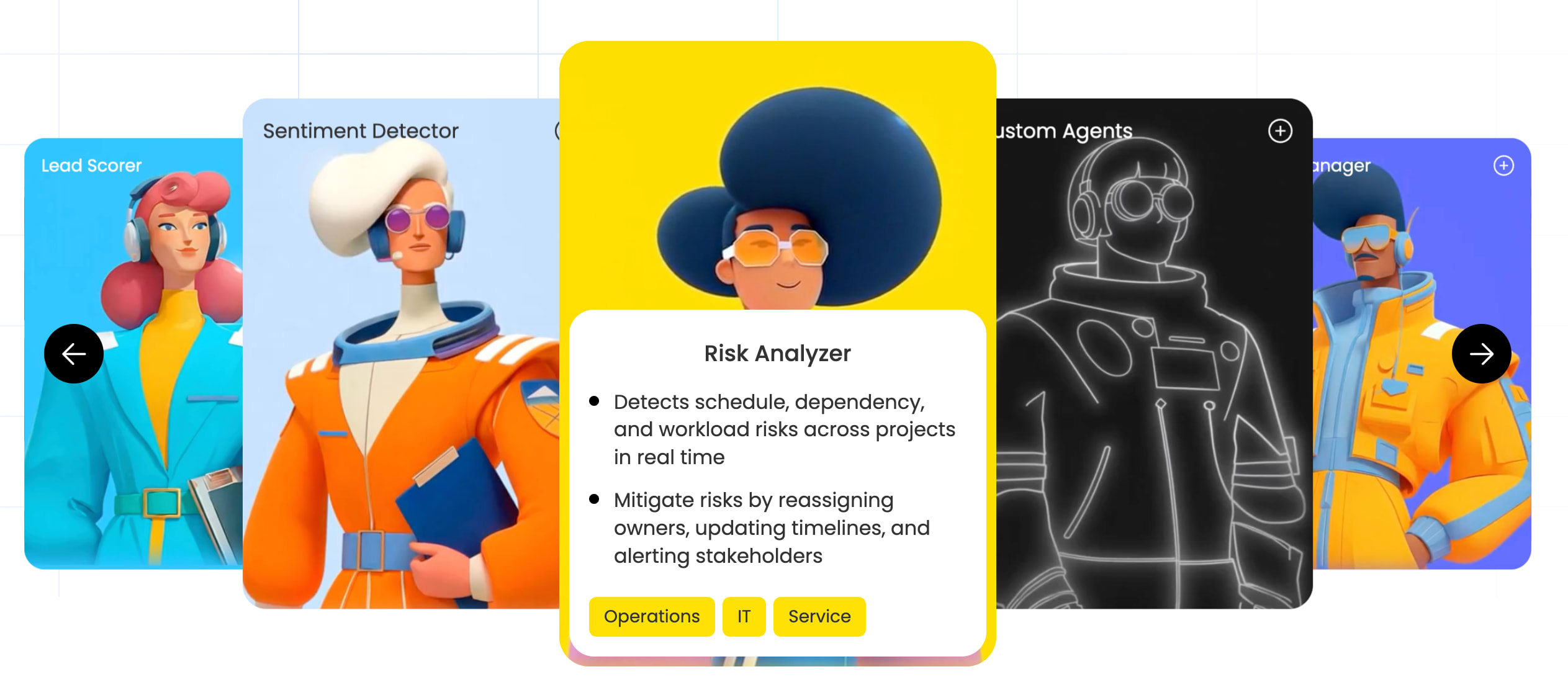
monday.com’s AI agents automate scenario monitoring and stakeholder communication. The Risk Analyzer agent identifies risks across your portfolio and surfaces signals that trigger scenario reassessment, delivering continuous risk intelligence instead of quarterly snapshots. TheStatus Reporter agent keeps stakeholders aligned with automated updates from live project data, generating summaries of scenario-relevant developments for the right people at the right time. Together, these agents reduce manual effort while ensuring everyone works from the same set of facts.
Scenario tracking dashboards

Customizable dashboards let you map scenarios, assign owners, track leading indicators, and trigger action plans when conditions shift. Every scenario has a single source of truth. You can visualize multiple futures side by side, monitor the metrics that matter most for each one, and set threshold alerts that notify your team when a scenario moves from theoretical to active. Dashboards update in real time, so strategic conversations start with shared visibility rather than conflicting spreadsheets.
Collaborative workspaces

Scenario planning requires input from across the organization, and monday.com’s collaborative workspaces bring cross-functional teams together in one place. Strategy, finance, operations, and product teams can contribute to scenario development, comment on assumptions, and track action items without switching between tools. Real-time collaboration features ensure that scenario planning becomes a shared practice rather than a siloed exercise, building organizational alignment and accelerating response times when conditions change.
Resource allocation tools

Model resource shifts across scenarios with drag-and-drop planning. When a scenario triggers action, you can reallocate budget and headcount without rebuilding your plans from scratch. The platform’s resource allocation features let you test different investment strategies against each scenario, compare outcomes, and move quickly when conditions change. Teams that plan resources across multiple futures avoid the scramble that comes with single-path planning.
Turn uncertainty into a strategic advantage with scenario planning
Scenario planning transforms uncertainty from a source of anxiety into a competitive advantage. Organizations that embrace this approach develop stronger strategic thinking capabilities, allocate resources with greater precision, and respond to disruption faster than competitors who rely on single-point forecasts.
Start by identifying the key uncertainties facing your organization over the next 2-3 years, then build 3 scenarios with cross-functional input. monday.com’s AI Work Platform gives you the dashboards, AI agents, and automation capabilities to turn scenario planning from a periodic exercise into an ongoing strategic advantage.
Get startedFAQs
What is scenario planning?
Scenario planning is a strategic planning method that helps organizations prepare for uncertainty by exploring multiple plausible futures rather than relying on a single forecast. The practice originated in military strategy at the RAND Corporation in the 1950s and was popularized by Royal Dutch Shell in the 1970s, when its planners used scenario analysis to anticipate the oil crisis before competitors.
What is the difference between scenario planning and forecasting?
The difference between scenario planning and forecasting lies in their approach to uncertainty. Forecasting predicts one likely outcome based on historical trends and statistical models, while scenario planning explores multiple plausible futures without assigning a single probability. Scenario planning is more effective in complex, volatile environments where linear projections fall short.
What are the steps in scenario planning?
The steps in scenario planning follow a 5-step process: (1) define the focal issue and time horizon, (2) identify key driving forces and critical uncertainties, (3) develop 3-4 distinct scenarios with narrative descriptions, (4) assess implications and develop strategies for each scenario, and (5) monitor leading indicators and update scenarios regularly.
How many scenarios should you create?
You should create 3-4 scenarios for effective scenario planning. Fewer than 3 limits the range of possibilities you explore, while more than 4 creates analysis paralysis and makes it difficult to develop actionable strategies for each scenario. The 2x2 matrix method naturally produces 4 scenarios by mapping two critical uncertainties against each other.
How often should you update scenario plans?
You should update scenario plans at least quarterly, with additional reviews triggered by major external events such as regulatory changes, economic shocks, or significant competitive moves. The review process should evaluate whether leading indicators have shifted, whether new uncertainties have emerged, and whether strategic responses still align with current conditions.
How can AI help with scenario planning?
AI helps with scenario planning by automating data gathering, generating multiple what-if scenarios from live business data, and monitoring leading indicators in real time. For example, monday.com's Risk Analyzer agent automatically identifies risks across project portfolios, surfacing signals that should trigger scenario reassessment without waiting for manual review cycles.

 Get started