


When a critical system goes offline, IT teams without a structured approach spend as much time figuring out who owns the problem as they do fixing it. Meanwhile, users go round in circles submitting duplicate or even triplicate tickets when the same underlying issues return month after month.
An IT service management (ITSM) framework gives your team a shared playbook for how to deliver and improve your approach to service management, so when something breaks, everyone knows exactly what to do.
This article covers the most widely adopted frameworks, the core practices that underpin all of them, and a practical guide to implementation. Whether you’re building a service operation from scratch or bringing more consistency to an existing one, you’ll find a clear path forward here.
Try monday serviceKey takeaways
- Without a structured framework, IT support becomes reactive — requests get lost and ownership blurs.
- ITIL is the most popular starting point, but the right framework depends on your size and governance requirements.
- Incident management, problem management, and change enablement are the core practices that keep service delivery consistent.
- Start with your highest-volume processes, measure resolution times, and improve from there.
- monday service brings your ITSM framework together in one place, with no-code workflows and AI agents for IT service handling routing and triage automatically.
What is an ITSM framework and how does it support service delivery?
An ITSM framework is a structured set of best practices that defines how IT teams deliver, support, and improve services across an organization.
A solid framework like ITIL, COBIT, or ISO/IEC 20000, establishes the processes, roles, and standards that keep service delivery consistent, so when something breaks or someone needs help, your team already knows what to do.
With clear processes in place, requests are tracked, ownership is defined, and recurring problems are addressed at the source. A framework brings order to the chaos by standardizing how services are requested, delivered, and improved.
For IT directors and service desk leaders, the value shows up in several ways:
- Faster resolution times: Teams follow a defined path instead of improvising, which cuts the time users spend waiting.
- Clearer ownership: Everyone knows who handles what, so you stop losing track of requests.
- Stronger alignment with business goals: A framework connects IT activity to outcomes leadership cares about.
- A shared language across teams: Incidents, requests, and changes mean the same thing to everyone, which makes cross-team work easier.

5 popular ITSM frameworks
The right ITSM framework depends on your size, industry, and how much governance you need. Here’s a quick glimpse of the 5 most widely used options followed by a deeper explanation of each.
| Framework | Best for | Core focus |
|---|---|---|
| ITIL | Most organizations | Service lifecycle and value |
| COBIT | Regulated industries | Governance and risk |
| ISO/IEC 20000 | Enterprise compliance | International service standard |
| MOF | Microsoft-heavy environments | Microsoft service operations |
| DevOps | Software delivery teams | Speed and collaboration |
ITIL (Information Technology Infrastructure Library)
ITIL is the most widely adopted ITSM framework worldwide. The current version, ITIL 5, launched in February 2026 and builds on ITIL 4’s foundation of 34 management practices, extending them with stronger guidance for AI adoption, digital product management, and aligning strategy with day-to-day operations. ITIL 4 remains active and valid while organizations transition.
ITIL’s main strength is flexibility. You can adopt the practices that fit your needs rather than treating the framework as all-or-nothing, and its well-established certification path makes it the most common starting point for service managers and IT leaders.
COBIT (Control Objectives for Information and Related Technologies)
COBIT is a governance-focused framework developed by ISACA. It emphasizes IT governance, risk management, and compliance.
This makes COBIT a strong fit for financial services, healthcare, and government, where auditability and regulatory oversight are central requirements. COBIT works well alongside ITIL because it adds governance discipline to service delivery.
ISO/IEC 20000
ISO/IEC 20000 is the international standard for IT service management. Unlike ITIL, which is a best-practice framework, ISO/IEC 20000 is a formal standard you can be audited and certified against.
It’s an important certification for enterprises that need to prove service management compliance to customers, partners, or regulators.
Microsoft Operations Framework (MOF)
MOF is Microsoft’s service management framework for organizations operating heavily within the Microsoft ecosystem. It’s a practical fit for Windows, Azure, and Microsoft 365-centric environments.
It’s less common as a standalone framework today because ITIL 4 works across more platforms, but still has value where Microsoft architecture shapes most of the IT environment.
DevOps
DevOps is a cultural and operational approach that connects software development and IT operations. Many organizations use it alongside ITSM as a complementary framework for faster delivery and stronger collaboration.
DevOps doesn’t replace service management governance. It works best when paired with structured practices that control risk and maintain service quality.
Core components of an ITSM framework
Most ITSM implementations share the same core building blocks, even when the framework differs. The following ITSM processes define how services are supported, improved, and governed day to day.
Incident management
An incident is any unplanned interruption to an IT service. Incident management restores normal service as quickly as possible through triage, prioritization, escalation, and resolution.
The focus is speed of recovery, not finding the deeper cause. Every minute saved during recovery keeps business work moving forward.
Problem management
A problem is the underlying cause of one or more incidents. Problem management investigates root causes and removes the conditions that allow the same incidents to keep happening.
While incident management fixes the symptom, problem management fixes the cause.
Change management
Change management controls the lifecycle of changes to IT services. It evaluates risk, approves changes, and coordinates implementation so updates happen safely.
Controlled changes are one of the most reliable ways to maintain uptime and ensure successful releases. Strong change enablement protects service continuity while still letting the business move forward.
Service request management
A service request is a formal user request for something to be provided, like a laptop, software access, or a password reset. Service request management routes, approves, and fulfills those requests through a standardized process. Keeping requests separate from incidents prevents routine work from clogging up urgent support queues.
Knowledge management
ITSM knowledge management captures and shares information across support teams and end users. A strong knowledge base gives agents proven fixes and helps users solve simple issues on their own. It also creates the foundation for AI-powered search and self-service experiences.
IT asset and configuration management
In IT asset management, assets include the hardware, software, and infrastructure your organization owns. Configuration management tracks how those assets are set up and how they relate to each other, usually through a Configuration Management Database, or CMDB.
Accurate asset data helps teams understand impact before making changes or troubleshooting incidents.
Service catalog and self-service portal
A service catalog is a centralized list of the IT services available to users. It explains what each service is, how to request it, and who supports it.
A self-service portal gives users direct access to that catalog so they can submit requests and find answers without emailing the helpdesk.
Service level management with SLAs
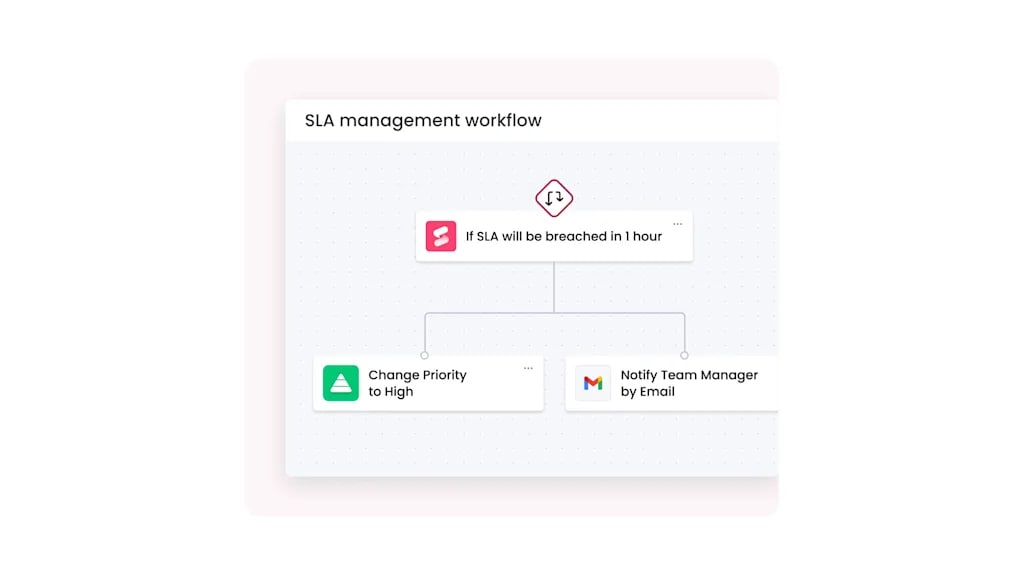
A service level agreement, or SLA, is a documented commitment about the expected speed and quality of service. Service level management tracks performance against those commitments and adjusts resources when needed.
Many modern teams also track Experience Level Agreements, or XLAs, which measure how users feel about the service, not just whether a ticket closed on time.
The 5 stages of the ITSM lifecycle
The ITSM lifecycle describes how services are planned, built, delivered, and improved. The model comes from ITIL and remains a useful way to understand how strategy connects to daily support work.
Stage 1: Service strategy
Service strategy defines which services IT should provide and how they create value for the business. Leadership decides what belongs in the service portfolio and what outcomes those services need to support.
The question at this stage is simple: what should we deliver, and why is it important?
Stage 2: Service design
Service design turns strategy into a workable plan. It defines workflows, ownership, SLAs, capacity, security, and availability before the service goes live.
Strong design reduces ambiguity later because the operating model is clear from the start.
Stage 3: Service transition
Service transition moves new or changed services into the live environment. It includes testing, release coordination, training, and documentation so support teams are ready on day one.
Strong transition planning leads to smoother launches and a confident user experience.
Stage 4: Service operation
Service operation is the day-to-day delivery of live IT services. This is where the service desk, incident management, request fulfillment, and user support work happen.
It’s also the stage most visible to employees, because it shapes their direct experience with IT.
Stage 5: Continual service improvement
Continual service improvement, or CSI, is the ongoing review of service performance to find gaps and make incremental improvements. It uses data, feedback, and operational insight to refine services over time.
Teams that practice CSI avoid stagnation because they keep adjusting to new demands.
The 3 pillars of ITSM
A successful ITSM framework depends on more than software. It works when people, process, and technology support each other in a balanced way.
- People: Service desk teams, engineers, managers, and the employees who depend on IT. Clear roles, training, and a service-oriented culture decide whether the framework is followed.
- Process: The repeatable workflows that define how services are requested, delivered, and improved. Strong ITSM makes the right path the easiest path to follow.
- Technology: The platform that runs those processes at scale. Platforms like monday service combine workflow flexibility, visibility, and automation in one environment, so teams can run their service model without forcing it into rigid defaults.
If one pillar is weak, the others carry more strain and service quality suffers.
7 steps to implement an ITSM framework
Implementing an ITSM framework is a structured transformation effort, not a one-time software rollout. These 7 steps apply regardless of which framework you choose.
Step 1: Define goals and business outcomes
Start with a clear definition of success in business terms, remembering that clear targets keep teams focused on outcomes rather than activity. Common goals include reducing mean time to resolution, improving employee satisfaction, or preparing for ISO/IEC 20000 certification.
Step 2: Select the right framework for your organization
Framework selection depends on size, regulatory pressure, service maturity, and the level of governance you need. A fast-growing software company may combine ITIL with DevOps, while a regulated enterprise may need the control of COBIT. The right fit reflects your operating reality, not what’s trending.
Step 3: Audit current processes and service data
A current-state audit shows which processes are documented, which run informally, and where the biggest pain points sit. It also reveals how work flows, which is often different from how leaders think it does.
Service data like ticket volumes, resolution times, and SLA performance creates a baseline you can improve against.
Step 4: Choose an ITSM platform that supports your workflows
The platform choice works best after process priorities are clear. You need ITSM software that supports integrations, automation, configurability, and AI-assisted workflows without forcing heavy customization.
For organizations that want no-code workflow design and support for both ITSM and broader service operations on one connected platform, monday service offers a strong fit.
Step 5: Roll out in phases starting with core practices
Phased rollout reduces risk and helps teams absorb change. Most organizations start with incident management and service request management because those practices are high-volume and immediately useful.
From there, you can expand into problem management, change enablement, knowledge management, and service level management.
Step 6: Train teams and drive adoption
Training is an ongoing effort, not a one-time launch event. Teams need to understand how the platform works and why the new workflows exist.
ITSM adoption succeeds when behavior changes, not just when the software goes live.
Step 7: Measure outcomes and continually improve
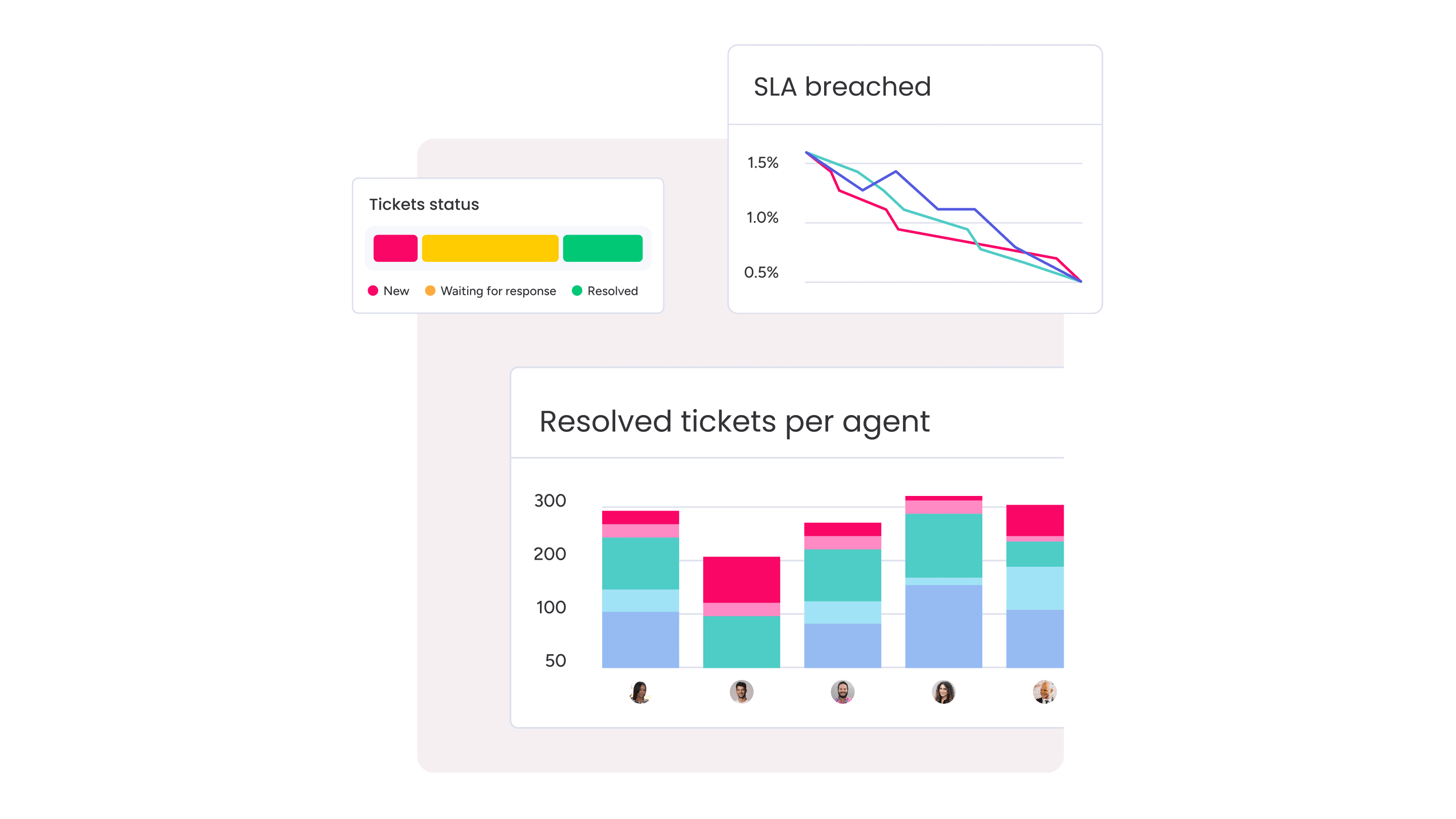
Go-live is the start of operational learning, not the end of the project. Track metrics like mean time to resolution, first-contact resolution rate, SLA compliance, and user satisfaction to see whether the framework is producing the results you wanted. Those insights feed directly into continual service improvement.
Common ITSM implementation pitfalls
Even well-planned ITSM programs run into friction but most setbacks come from a handful of predictable mistakes, which means they’re also avoidable.
- Customize the platform once usage data is clear: Launch core processes first, learn from real usage, and customize where the data shows a clear need.
- Treating ITSM as an IT-only initiative: Service management affects every department. Leaving stakeholders out of design creates workflows that don’t match how requests happen.
- Skipping the service catalog: Without a clear catalog, users don’t know what services exist or where to go for help, which leads to shadow processes.
- Measuring activity instead of outcomes: High ticket volume doesn’t prove service quality. Focus on resolution quality, user satisfaction, and reduction of recurring issues.
- Underinvesting in change management: Adoption improves when leaders explain why the changes matter and reinforce the new ways of working over time.
- Implementing every practice at once: Broad rollouts create fatigue and slow down go-live. Phased implementation keeps the program manageable.
How AI and automation reshape ITSM frameworks
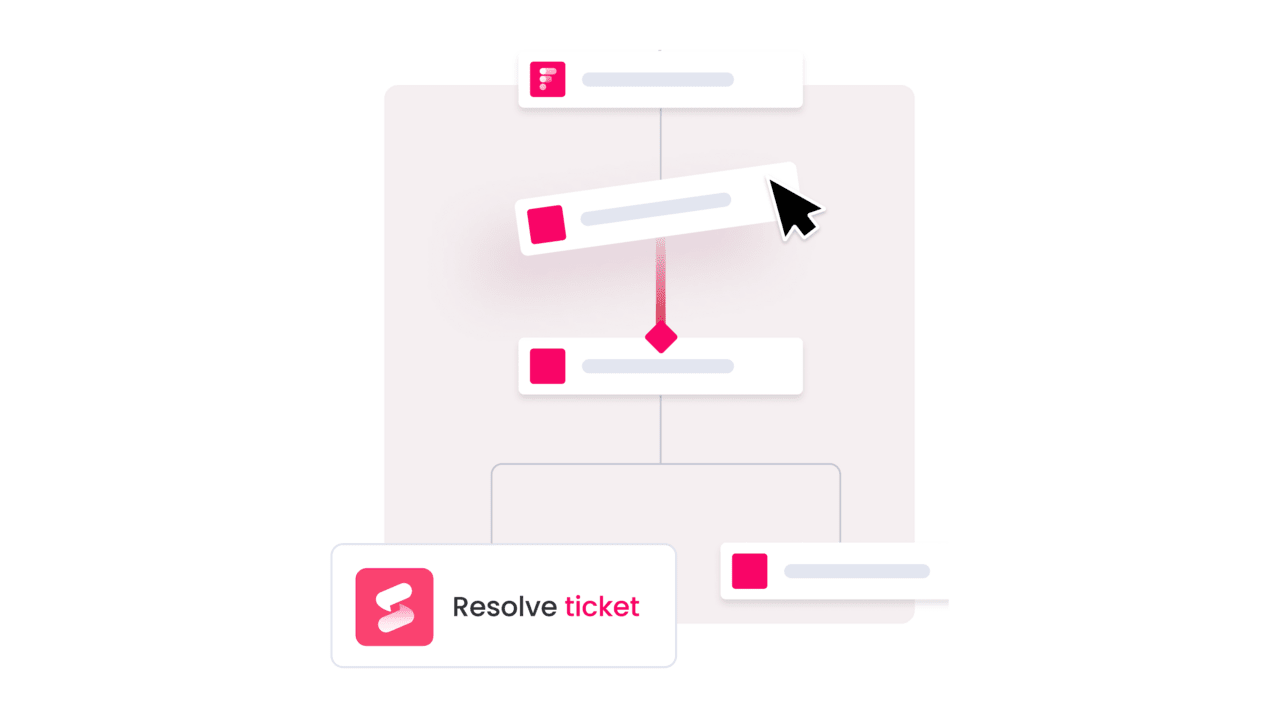
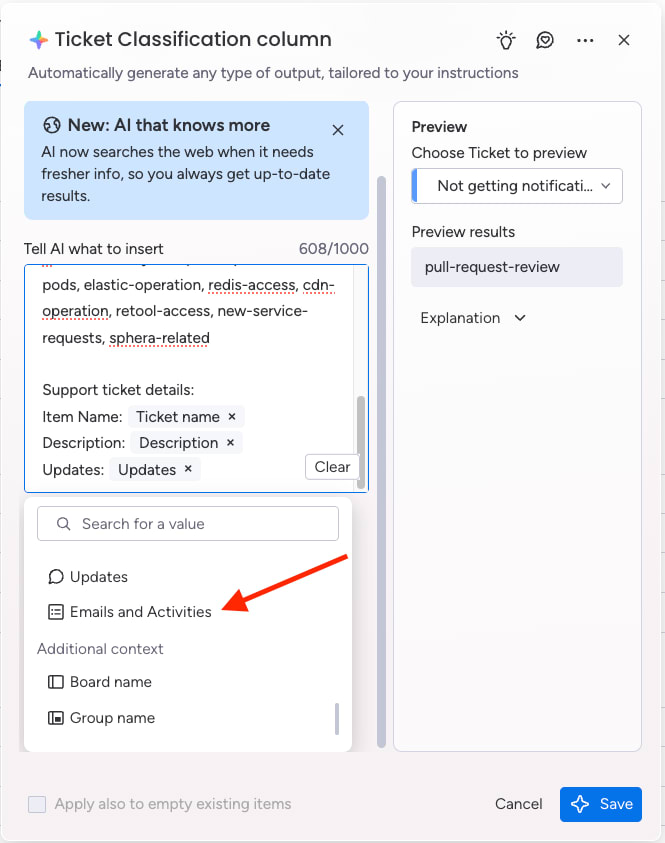
AI acts as a capability layer on top of service management which makes ITSM practices faster, more responsive, and easier to scale. In triage, it classifies incoming tickets and routes them to the right queue, suggesting resolutions and in some cases closing the request automatically.
This is especially useful for high-volume service desks handling repetitive work like password resets and access requests. With monday service, AI-driven workflows automate common service actions while keeping full visibility into what’s happening.
AI also improves self-service by pinpointing the most relevant knowledge articles as soon as a user describes their issue. In many cases, the user solves the problem before a ticket ever reaches an agent. The urgency is reflected in the numbers: according to Gartner’s 2026 Customer Service Leader Survey, 91% of customer service leaders are under executive pressure to implement AI in 2026, with 58% planning to upskill agents into knowledge management specialists to support AI and self-service.
Learn more: AI for enterprise service management
Extending ITSM into enterprise service management
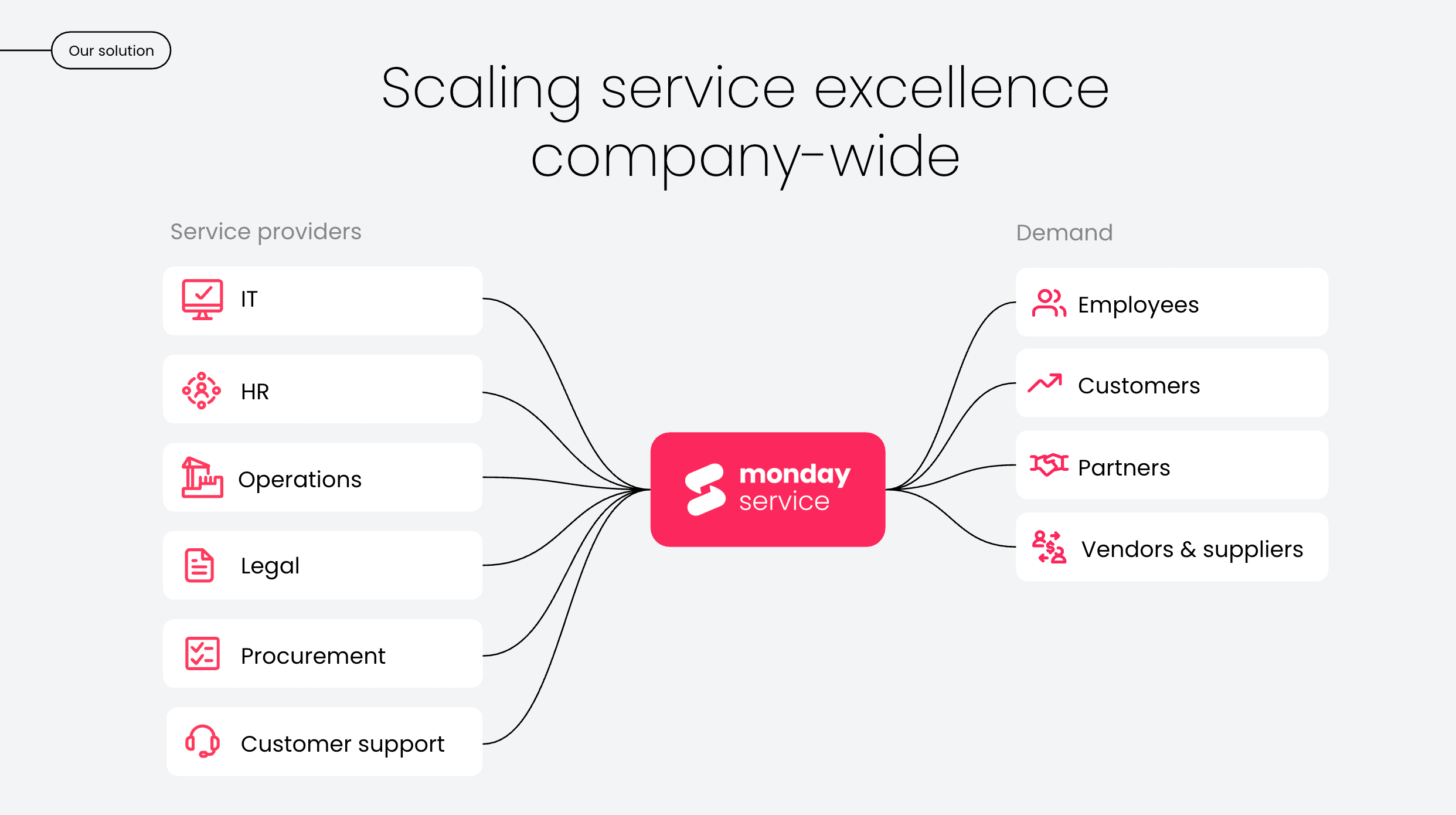
Enterprise service management, or ESM, applies ITSM principles to service-delivering teams outside IT, such as HR, finance, facilities, legal, procurement, and operations. ESM uses the same ideas as ITSM — service catalogs, request workflows, SLAs, approvals, knowledge bases, and automation — but expands them to any department that provides internal services. For example, HR gains structured onboarding workflows and facilities gains organized request intake.
This model is supported in monday service, where both IT and non-IT teams manage service workflows on the same flexible platform. The result is a shared environment helps you standardize request intake, automate approvals, and give employees a consistent service experience across departments.
How to choose the right ITSM platform
Your choice of ITSM platform influences how easily your framework can be implemented, adopted, and improved. The right choice supports strong adoption and avoids technical debt. It feels like an enabler that helps your team move faster. Here’s what to evaluate:
- Fit to your operating model: The platform should support your real workflows without forcing major process distortion.
- Integration architecture: Look for native integrations with monitoring platforms, identity systems, HR platforms, Slack, and Microsoft Teams. Strong APIs are a good fit too.
- No-code customization: Service teams should be able to adjust forms, workflows, and automations without waiting for engineering capacity.
- Total cost of ownership: Look beyond licensing. Implementation services, training, and administration time all affect the real investment over three years.
- AI and automation capabilities: Native AI for ticket routing, triage, self-service, and knowledge surfacing should be built in, not bolted on.
These priorities come together in monday service, which combines workflow automation, no-code configuration, and embedded AI in one place.
Try monday service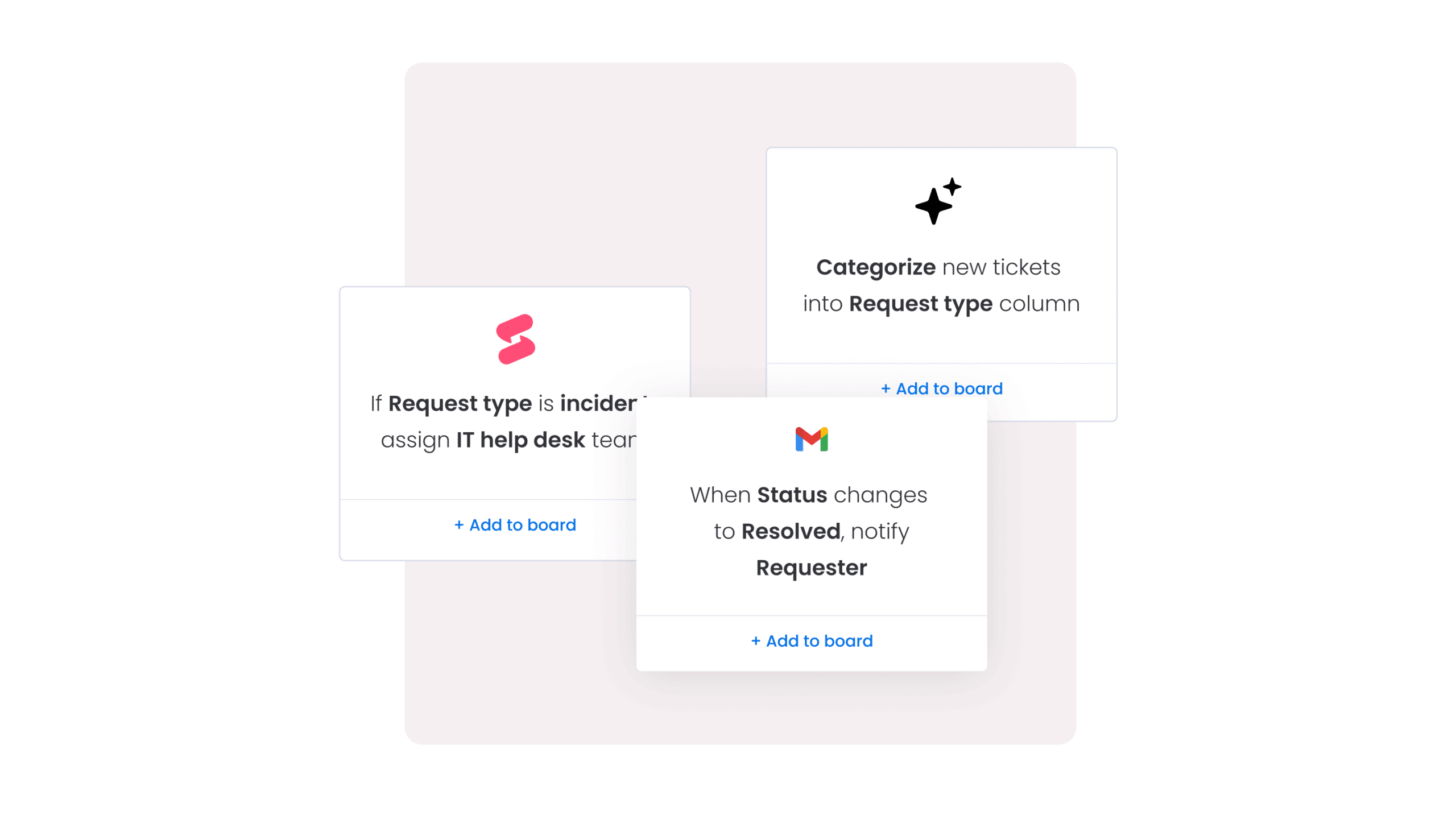
Accelerate your ITSM framework with monday service
monday service is a no-code service platform that connects ticketing, workflows, and cross-department teams in one place — giving IT leaders full visibility into their service operation without the implementation overhead of traditional ITSM tools.
Core practices like incident management, service request handling, knowledge management, and SLA tracking all run on the same platform. Service teams build and refine their own workflows without waiting on developers, which means faster time to value and more control over how your operation grows.
- Instant triage, without the manual work: AI Blocks categorize incoming tickets by type, urgency, and sentiment the moment they arrive, routing each one to the right team automatically.
- Proactive reporting, without anyone pulling the data: The AI Service Agent monitors request volumes, spots recurring issues, and generates reports on demand. Ask it to flag problems with increasing volume from last week, and it delivers.
- Faster resolutions, without switching context: monday sidekick is built into the platform so agents can summarize ticket history, draft responses, and identify next steps from inside their existing workflow.
- SLA compliance, before a breach happens: Automated alerts flag tickets approaching their deadline early, keeping your team ahead of commitments rather than reacting after the fact.
The right ITSM framework gives your team a clear path through every incident, request, and change. monday service gives you the platform to run it, with AI built in from the start, not bolted on later.
Try monday serviceFrequently asked questions
What are ITSM frameworks?
ITSM frameworks are structured sets of guidelines and best practices that organizations use to manage IT services. They define how services are designed, delivered, supported, and improved over time.
What are the 5 stages of ITSM?
The 5 stages of ITSM are service strategy, service design, service transition, service operation, and continual service improvement. Each stage represents a phase in how IT services are planned, built, delivered, and refined.
What are the 3 pillars of ITSM?
The 3 pillars of ITSM are people, process, and technology. A successful ITSM framework depends on all three working together, because weakness in any one area undermines the others.
Which framework is most commonly associated with ITSM?
The framework most commonly associated with ITSM is ITIL, or Information Technology Infrastructure Library. It's the most widely adopted ITSM framework globally and provides structured best practices for delivering and improving IT services.
What does ITSM stand for?
ITSM stands for IT service management. It refers to the policies, processes, and practices organizations use to design, deliver, manage, and improve IT services for end users.
What is the difference between ITSM and ESM?
The difference between ITSM and ESM is scope. ITSM focuses on managing IT services, while ESM extends the same service management principles to other business functions such as HR, finance, and facilities.
What is the difference between ITSM and ITIL?
ITSM is the broader practice of managing how IT services are designed, delivered, and supported. ITIL is the most widely adopted framework within that practice, providing detailed guidance on specific processes like incident management, change enablement, and service level management. The simplest way to think about it: ITSM is the field, ITIL is the playbook most organizations use to work within it.

 Get started