


In July 2024, a routine software update at cybersecurity company CrowdStrike spiraled into a global outage affecting airlines, banks, and hospitals. The incident made it clear that even sophisticated organizations aren’t immune to sudden disruption. Incident management is the structured process that turns chaos into coordinated response. As AI-driven operations reshape how teams detect and resolve disruptions, a reliable incident management framework isn’t optional anymore.
This guide walks you through the fundamentals of incident management, including the lifecycle, best practices, common challenges, and how AI is changing the game. You’ll also see how monday service brings it all together in a single platform designed for speed, clarity, and continuous improvement.
Key takeaways
- Incident management is the structured process that helps organizations identify, log, prioritize, and resolve issues quickly to reduce business impact.
- A clear incident management process improves accountability, speeds up recovery, and strengthens trust with customers and stakeholders.
- The incident management lifecycle provides a repeatable framework, from detection to post-incident review, promising consistency and continuous learning.
- Common challenges include alert fatigue, poor communication, and lack of visibility.
- AI-powered platforms bring those best practices to life with intelligent workflows, seamless collaboration, and a single source of truth for your incident response.
What is incident management?
Incident management is the structured process organizations use to identify, log, prioritize, and resolve incidents to restore normal service operations as quickly as possible. It creates order by giving teams a repeatable way to handle issues without wasting time or reinventing the wheel each time something goes wrong.
Modern incident management increasingly relies on AI-powered triage and automated workflows, not just manual ticketing. Teams that embrace intelligent automation can detect issues faster, route them to the right responders instantly, and resolve routine incidents without human intervention.
Incident management is realistic. It’s not about eliminating every problem, but about giving your teams the processes they need to respond with confidence and protect customers as you minimize business impact.
What are the primary objectives of the incident management process?
The purpose of incident management is to create a framework for teams so they can respond consistently to whatever’s thrown their way and limit disruption to the business. Without clearly defined objectives, even experienced teams can lose valuable time during high-pressure situations. At its core, the incident management process is designed to:
- Standardize response procedures by creating a clear framework for identifying, logging, and handling incidents.
- Ensure accountability by assigning ownership and responsibilities for faster, more effective resolution.
- Facilitate clear communication with a structured information flow among teams and stakeholders.
- Capture and document incidents using accurate records for tracking, auditing, and learning.
- Enable prioritization by assessing severity and impact to allocate resources appropriately.
- Support root cause analysis providing data and context for identifying long-term fixes.
- Drive continuous improvement using incident insights to strengthen processes and systems.
- Enable proactive incident prevention through predictive analytics that identify patterns and anomalies before they escalate into full-blown disruptions.
Why is incident management crucial for your business?
Here are the specific benefits you can expect when you commit to building an incident management plan.
Reduced downtime and disruptions
Time is money, and every minute of downtime impacts operations. With a solid incident management process, organizations can resolve issues faster and minimize service interruptions. Palo Alto Networks reports that 86% of major cyber incidents in 2024 caused downtime, reputational damage, or financial loss, underscoring the cost of a delayed response.
Improved customer trust and satisfaction
Customers judge reliability not only by uptime but also by how clearly and quickly you communicate during a crisis. Incident management offers transparency and consistency, helping users feel informed and valued. When handled well, even unexpected disruptions will reinforce confidence in your brand.
Stronger alignment with SLAs and compliance
Service level agreements (SLAs) and regulatory requirements demand clear response and resolution timelines. And incident management provides the structure to meet those commitments consistently. This approach also reduces the risk of penalties and keeps the organization in good standing with auditors, regulators, and partners who rely on dependable service delivery.
Lower operational costs
Without clear processes, incidents can absorb more resources and linger longer than necessary. Effective incident management avoids costly fire drills by assigning ownership quickly and reducing duplication of effort. Over time, this efficiency lowers the overall cost of IT operations and support.
Enhanced cross-team collaboration
Incidents rarely stay confined to one team, instead spanning IT, customer support, and business operations. Structured incident management creates a shared playbook, encouraging teams to communicate seamlessly and coordinate effectively. By doing so, you’‘ll speed up resolution when every second counts.
Greater resilience and adaptability
The real measure of incident management isn’‘t just how quickly you recover but how well you prepare for the next challenge. By documenting incidents and learning from them, organizations build resilience. Over time, this adaptability strengthens your systems and processes, resulting in smoother responses to future disruptions.
What is the incident management lifecycle?
The incident management lifecycle is the step-by-step framework that organizations use to handle each incident, from the moment it’s reported until lessons are learned. What are the 5 core stages of the incident management process? While frameworks vary, most follow these key stages:
- Identification and logging: You’ll detect the incident through monitoring systems, customer reports, or automated alerts, and record it with all relevant details.
- Categorization and prioritization: This stage enables you to classify the incident type (such as a critical outage vs. a minor bug) and rank it based on business impact and urgency.
- Triage and assignment: Based on the classification, you’ll route the incident to the right team or individual with the skills to resolve it.
- Investigation and diagnosis: The assigned team members analyze any available data, and even try to replicate the issue if necessary to determine the root cause.
- Resolution and recovery: They’ll implement a fix or workaround to restore service and verify the system is functioning normally.
- Closure: Once the incident is resolved, they’ll close the incident in the tracking system and confirm whether users are satisfied with the outcome.
- Post-incident review: The final stage should not be skipped. It involves conducting a retrospective to capture any lessons learned in your incident documentation to shape your future prevention strategies.
How AI fits into the incident management lifecycle
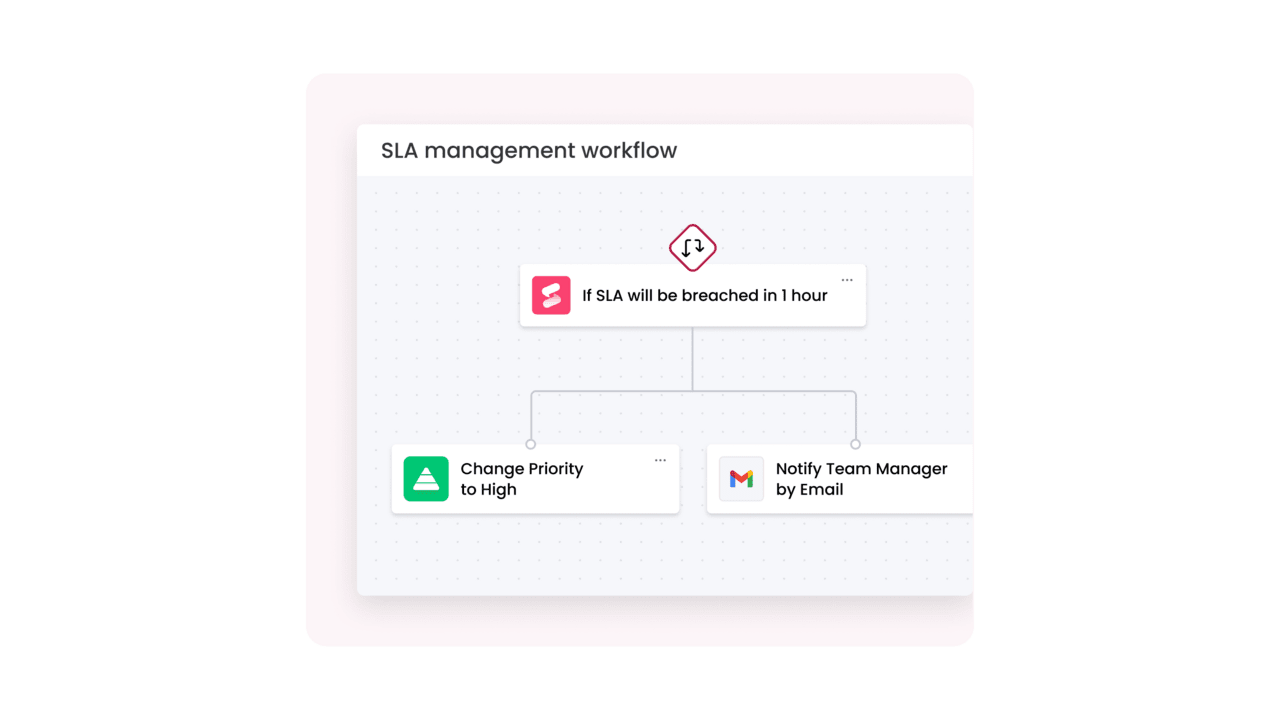
At every stage, intelligent automation is compressing timelines. Detection becomes real-time anomaly recognition. Triage shifts from manual sorting to AI-driven categorization and routing. Resolution gets faster when AI agents handle routine fixes autonomously and surface relevant knowledge articles for complex ones. And postmortem analysis becomes automated, with AI generating summaries and identifying recurring patterns.
Some platforms structure this lifecycle directly into their workflows. For example, an incident board might organize work into groups (New reported, In review, In progress, Prepping postmortem, and Resolved) so teams always know exactly where each incident stands and what happens next.
SLA timers also integrate into the lifecycle, tracking elapsed time from the moment an incident is logged. The most effective systems auto-pause timers outside working hours and when awaiting customer input, so your metrics reflect actual response effort rather than clock time.
Incident management in different contexts
Incident management doesn’t look the same in every setting. A financial institution may focus on regulatory compliance, while a hospital would prioritize patient safety, for example. But while the specific risks shift by industry, the foundation should always be a structured, repeatable approach.
Before diving into specific contexts, it’s worth clarifying three terms that are often confused. What’s the difference between an incident, a service request, and a problem?
| Term | Definition | Example |
|---|---|---|
| Incident | An unplanned interruption or degradation of a service | Email server goes down unexpectedly |
| Service request | A planned, pre-defined request from a user | New employee requests a laptop |
| Problem | The underlying root cause of one or more recurring incidents | A misconfigured load balancer causing repeated outages |
Understanding these distinctions is essential for ITIL incident management and for routing work correctly within your service management workflows.
Learn more: Incident management vs service request
Incident management in ITIL and IT service management
In the ITIL framework, incident management is a fundamental IT service management process designed to restore normal service operations at speed. ITIL incident management is the gold standard across industries, helping IT teams reduce downtime, improve communication, and meet strict service level agreements.
Incident management in cybersecurity
In cybersecurity, IT incident management takes on a high-stakes role. Threats evolve quickly, and the cost of delay is steep. According to Palo Alto Networks, the fastest 25% of intrusions reached exfiltration in 1.2 hours.
Adding to the challenge, the same report finds that 87% involved activity across two or more attack surfaces, making response far more complex than dealing with a single breach point. Therefore, effective cybersecurity incident management requires rapid detection and response and also coordinated workflows across IT security solutions and business leaders to contain damage and recover with minimal impact.
Incident management in DevOps
DevOps teams move fast, meaning incidents could arise just as quickly. Instead of treating them as disruptions, incident management becomes part of the workflow: spotting issues early, rolling back or patching as needed, and capturing lessons to improve the next release. The goal is always to keep development velocity steady without sacrificing quality.
Incident management in site reliability engineering (SRE)
Site reliability engineering, or SRE, is an operations model that grew out of Google. It shifts the focus from manual, reactive work to software-driven practices that keep large systems stable.
In incident management, SRE puts heavy emphasis on learning and prevention. A single outage might trigger a blameless postmortem, or prompt engineers to add new automation that removes a weak point. Error budgets guide decisions on when to prioritize reliability over new features, making sure systems don’‘t tip past acceptable risk.
Incident management in customer support or service desks
In customer support, incidents can be as simple as a failed payment or as widespread as a full-scale outage. But what customers care about most is acknowledgment. Even if the fix takes time, they want confirmation that their problem has been recognized and that progress to resolve it is underway.
For service desk teams, incident management provides the guardrails. It keeps every issue documented, making sure urgent cases get the right attention, and helps agents keep customers updated while the work continues. This steady communication prevents frustration from turning into lost trust.
Incident management in healthcare and emergency response
When healthcare systems fail, the impact is immediate. A hospital that can’‘t access patient records, or an ambulance team cut off from dispatch means that care is delayed. And in this field, delays carry risks that no spreadsheet can capture.
That’‘s why healthcare and emergency response teams treat incident management as part of the core infrastructure. They rehearse scenarios the same way they train for clinical procedures, making sure handoffs are clean and communication never goes dark. Most importantly, this process gives staff the confidence to keep moving when everything around them feels unstable.
How AI is transforming incident management
If there’s one trend reshaping IT incident management in 2025 and beyond, it’s the rise of AI. What used to require manual triage, human judgment at every step, and hours of repetitive work is now being augmented, and in some cases fully automated, by intelligent systems. Here’s how AI is changing each dimension of the process.
- AI-powered triage: AI categorizes, prioritizes, and routes incidents automatically based on sentiment analysis, urgency signals, and historical patterns. Instead of a human scanning each ticket to decide where it goes, AI handles the sorting in seconds, reducing misroutes and accelerating first response times.
- Predictive incident detection: AIOps and machine learning models analyze system telemetry to identify anomalies before they become full incidents. This shift from reactive to proactive means teams can intervene during the warning stage rather than scrambling during an outage.
- Autonomous resolution: AI agents now handle routine incidents end-to-end (password resets, access requests, known-error fixes) and escalate complex ones to humans with full context attached. This frees up skilled staff to focus on the incidents that genuinely require human judgment and creativity.
- Addressing the toil problem: According to Runframe’s State of Incident Management 2026 report, operational toil rose 30% in 2025, the first increase in 5 years, driven by growing infrastructure complexity and manual processes. AI directly combats alert fatigue and repetitive manual work by filtering noise, consolidating duplicate alerts, and automating low-value tasks that previously consumed hours of an engineer’s day.
The shift is about creating a partnership where AI handles volume and speed, while humans provide judgment and context for the incidents that matter most. Platforms like monday service bring this partnership to life, embedding AI-powered triage, routing, and autonomous resolution directly into your incident workflows so teams can focus on what genuinely requires human expertise.
What are the challenges of incident management?
Incident management promises structure, but in practice, many teams struggle with messy realities. These are some of the most common barriers that slow resolution and increase risk.
- High volume of incidents: A flood of alerts or tickets can overwhelm even large, well-established teams. When every ping looks urgent, important work slows down, and real issues risk being buried in the noise.
- Alert fatigue and noise: Teams receive thousands of alerts daily, most of which are false positives. Without intelligent filtering, critical incidents get buried under a constant stream of notifications that wear down attention over time.
- Poor categorization: Without clear severity levels, teams waste hours debating what matters most. Resources end up chasing small issues while more damaging ones wait in the queue.
- Siloed communication: When operations, IT, and support use different workflows, updates are lost. Lack of coordination can double response times and leave customers in the dark.
- Inconsistent processes: Ad hoc fixes feel faster in the moment, but they create unpredictable outcomes. One incident might be resolved quickly, while a nearly identical one drags on because the team needs to start from scratch.
- Limited visibility: Fragmented systems mean no one has a full picture of what’s happening. Teams lose time piecing information together, and decisions are made without context.
- Platform sprawl: Organizations use an average of 4 – 6 incident management platforms that don’t integrate well, creating data silos and slowing response times. Every context switch between systems adds friction and delays resolution.
- Bad KPI selection: Metrics like mean time to resolution (MTTR) or ticket volume are useful but incomplete. If they aren’t tied to business outcomes, leaders can’t see whether incident management is truly improving resilience.
5 best practices in incident management
What separates teams that consistently recover well from those that don’t? Best practices turn incident management from a reactive scramble into a steady, repeatable process. These guidelines keep teams focused under pressure so you can capture lessons that make the next response stronger.
1. Create a clear incident response plan
An incident response plan removes guesswork when the pressure is on. By defining roles, responsibilities, and workflows ahead of time, teams know exactly who does what and how decisions get made.
2. Establish a single source of truth
Your incident response plan should live in a central, secure location that every stakeholder can access. Instead of hunting through files or email threads, teams can access the plan, track live incidents, and update documentation in one place. Shared visibility removes confusion and keeps everyone on the same page when speed matters most.
3. Reduce manual work with intelligent automation
Manual triage and routing waste precious time and increase the risk of mistakes. AI agents and intelligent automation handle repetitive tasks in the background: categorizing tickets, routing incidents to the right team, and even resolving routine issues autonomously. AI agents can resolve common incidents like password resets or access requests end-to-end, escalating only the complex cases that need human expertise.
4. Practice regular incident simulations
Plans look perfect on paper, until they’re tested. Running simulations gives teams a safe way to rehearse responses and uncover any weak spots. The more familiar people are with the process, the less likely panic will take over when a real incident hits.
5. Measure and refine continuously
Incident management gets sharper with every round of measurement and refinement. KPIs like MTTR, SLA compliance, or incident volume by type reveal how well your processes perform. Tracking them over time exposes bottlenecks and shows whether changes are making the desired impact.
How monday service streamlines incident management
Most teams juggle tickets, alerts, and cross-department updates in a patchwork of systems that slows everything down. The result is extended resolution times, missed handoffs, and frustrated customers. What if your incident management software, communication, analytics, and AI-powered automation lived in one place?
monday service is an AI-powered service management platform that connects every moving part of your incident response, from ticket intake to resolution to postmortem, in a single, customizable workspace. Instead of forcing teams to adapt to rigid incident management software, the platform adapts to you. Here’s what that looks like in practice.
Dedicated Incidents Board
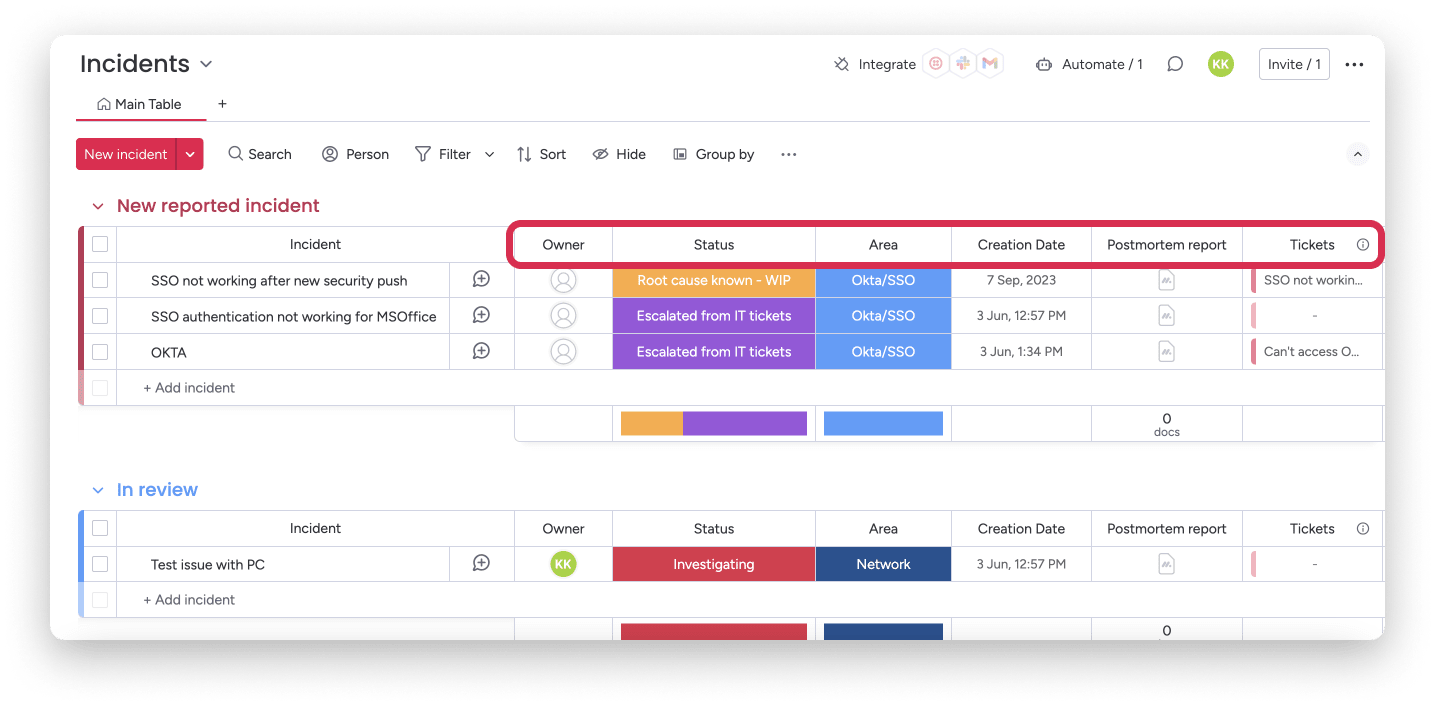
Escalated tickets move to a separate Incidents Board designed specifically for high-priority issues. Incidents flow through structured groups (New reported, In review, In progress, Prepping postmortem, and Resolved) so ownership, status, and linked tickets are always visible. Key columns track the owner, area, creation date, postmortem documentation, and related tickets, giving responders full context at a glance.
AI-powered incident triage and resolution
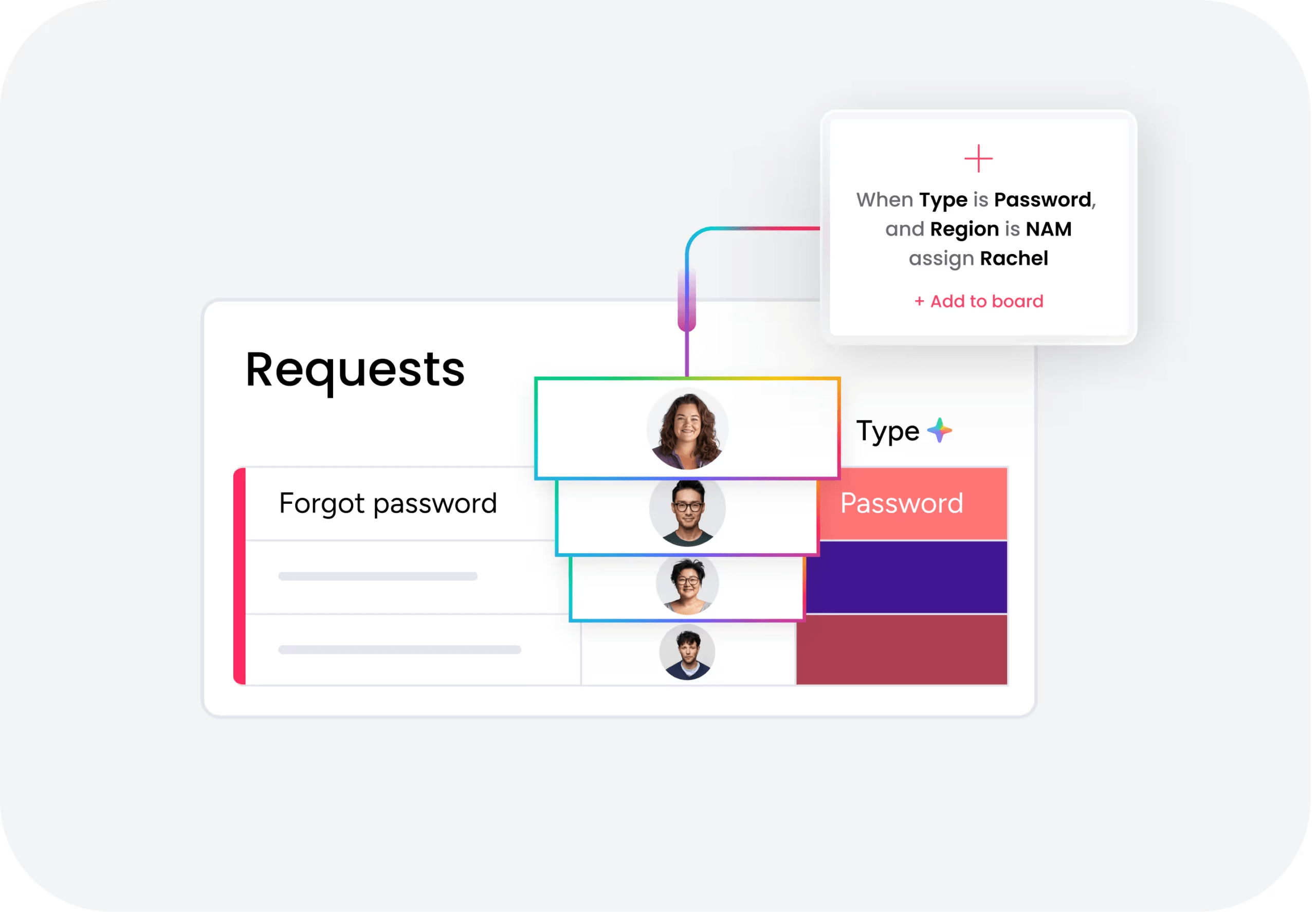
Speed and accuracy start at triage. AI Ticket Triage summarizes incoming tickets, categorizes request types, detects sentiment, and auto-assigns them to the right agents without manual intervention. monday sidekick reviews workload, surfaces urgent issues, flags SLA risks, and recommends next stepsat the board level. At the ticket level, it drafts replies, summarizes context, and finds similar resolved tickets. For routine incidents, AI Workforce deploys specialized agents that handle requests autonomously, from password resets to access provisioning. The Service AI Supervisor routes each request to the most relevant agent (human or AI) and escalates only what genuinely requires human judgment.
SLA tracking with live timers
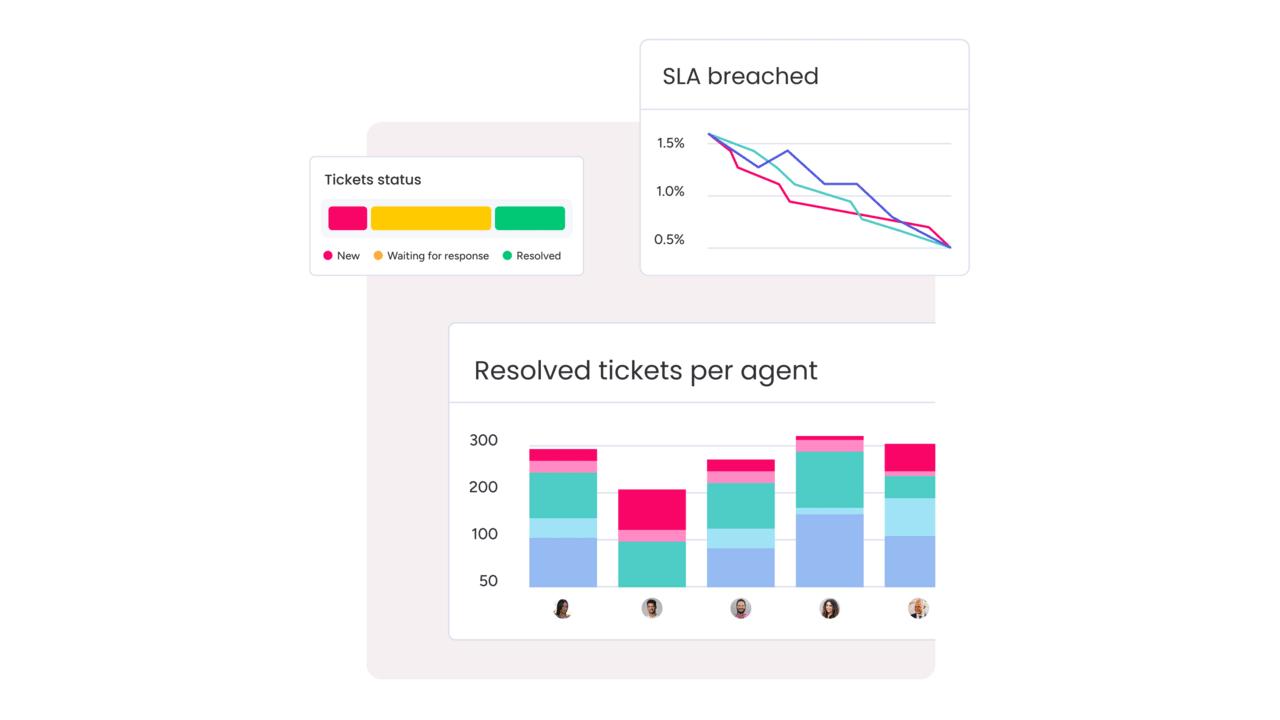
A dedicated SLA Column tracks time to resolution with live status indicators: Within, About to breach, Breached, or Paused. Timers auto-pause outside working hours and when awaiting customer responses, so your SLA tracking reflects actual response effort. You can set targets by priority or request type with fallback targets for edge cases.
Postmortem and continuous improvement
Every resolved incident can trigger a structured postmortem report through the Doc Column. Templates pull live field values (incident name, resolution time, owner) directly into the document, ensuring consistent and thorough documentation. Automated CSAT surveys fire on ticket resolution, giving your team direct feedback to close the loop.
Self-service and automation
The Customer Portal gives end users a branded, external-facing portal to submit requests, check ticket status, browse self-service articles, and track their open issues, all without contacting support directly. Pre-built automations handle status changes, group moves, and timestamping in the background. The Email Automation app sends automated responses at any stage, and the Workflow builder (Enterprise) enables deeper customization for complex escalation paths.

The Customer Portal gives end users a branded, external-facing portal to submit requests, check ticket status, browse self-service articles, and track their open issues, all without contacting support directly. Pre-built automations handle status changes, group moves, and timestamping in the background. The Email Automation app sends automated responses at any stage, and the Workflow builder (Enterprise) enables deeper customization for complex escalation paths.
How does the approach compare?
Here’s how this integrated incident management system stacks up against traditional alternatives.
| Capability | monday service | Traditional ITSM | Standalone alerting |
|---|---|---|---|
| AI triage and routing | Built-in with unlimited AI credits | Limited or add-on | Not available |
| SLA tracking | Live timers with auto-pause | Manual configuration | Not available |
| Incident lifecycle boards | Structured groups with full context | Rigid predefined workflows | Not available |
| Postmortem workflows | Integrated Doc Column with templates | Separate documentation | Not available |
| Self-service portal | Branded Customer Portal | Available (complex setup) | Not available |
| No-code automation builder | Drag-and-drop with pre-built recipes | Requires scripting or admin setup | Limited rule engines |
How to build a resilient incident management strategy
Incidents are inevitable; every organization will face them regardless of size, industry, or maturity. What separates high-performing teams is having a structured incident management process, investing in continuous improvement, and embracing AI-powered automation that handles volume so your people can handle complexity.
The practices and frameworks covered here give you a foundation to move from reactive firefighting to proactive resilience. And when you’re ready to bring it all together, monday service provides the unified platform to manage incidents from detection through postmortem, with AI, automation, and full visibility built in.
FAQs
What is incident management in ITIL?
Incident management in ITIL is a core IT service management practice focused on restoring normal service operations as quickly as possible after an unplanned disruption, while minimizing impact on the business.
What are the 5 stages of incident management?
The five stages of the incident management lifecycle are identification, categorization and prioritization, investigation and diagnosis, resolution and recovery, and post-incident review.
What is the difference between incident management and problem management?
The difference between incident management and problem management is that incident management focuses on restoring service quickly when a disruption occurs, while problem management investigates the underlying root cause of recurring incidents to prevent them from happening again.
What is an example of an incident in IT?
An example of an IT incident is an email server going offline unexpectedly, preventing employees from sending or receiving messages and disrupting normal business operations until the service is restored.
Why is incident management important?
Incident management is important because it reduces downtime, lowers operational costs, improves customer trust, and gives organizations a structured approach to recovering from disruptions and meeting SLA commitments.
How does monday service handle incident management?
monday service provides a dedicated Incidents Board with automated workflows that move incidents from detection through postmortem, plus AI-powered triage that categorizes and routes incidents automatically.
What role does AI play in modern incident management?
In modern incident management, AI plays a central role by automating triage, categorization, and routing. It can resolve routine incidents autonomously while escalating complex ones to human agents with full context.

 Get started