


ITIL has become the go-to framework for service teams ready to move beyond reactive support toward structured, value-driven operations. Since ITIL v5 was launched in February 2026, the framework continues to evolve, embracing AI-native automation, product-centric service delivery, and experience management as core disciplines.
This article serves as a practical guide to making ITIL work for your organization. You’’ll learn how to apply the framework‘s 7 guiding principles, master the 5 foundational practices that drive service excellence, implement ITIL step by step, and measure success with meaningful metrics. We’ll also explore how platforms like monday service make it easier to put these practices into action and support your IT service delivery.
Key takeaways
- Start with core practices: focus on incident, problem, change, knowledge, and service request management before expanding into specialized areas.
- Apply ITIL principles: use guiding ideas like “focus on value” and “start where you are” to improve processes without starting from scratch.
- Empower teams with automation: AI-powered ticket routing, auto-categorization, and workflow automation reduce manual effort and accelerate resolution.
- Measure what matters: track service performance, customer satisfaction, and operational efficiency to understand true impact.
- Stay current with ITIL’s evolution: from ITIL 4 to the newly launched v5, the framework integrates with agile and DevOps for faster, collaborative service delivery.
What ITIL best practices look like in 2026
ITIL best practices are proven methods for delivering IT service management that create value for your organization. These practices help teams move from chaotic, reactive support to organized service delivery that meets business needs — a shift that more organizations are prioritizing as digital services become the backbone of every department.
Modern ITIL focuses on flexibility and outcomes rather than rigid processes. You adapt practices to fit your organization instead of forcing your teams into predetermined workflows.
How ITIL evolved from v3 to v5
The journey from ITIL v3 to ITIL v5 represents a fundamental shift in how organizations think about service management. Each version addresses the limitations of its predecessor while preserving the principles that made ITIL valuable in the first place.
| Aspect | ITIL v3 | ITIL 4 | ITIL v5 |
|---|---|---|---|
| Philosophy | Rigid service lifecycle with 5 stages | Flexible practices and the Service Value System | Product-and-service-centric with 8-stage lifecycle |
| Structure | Prescriptive processes, heavy documentation | 34 adaptable practices, 4 dimensions | 34 practices retained, new AI governance and experience management modules |
| AI and automation | Not addressed | Encouraged through the "optimize and automate" principle | AI-native by design, aligned with EU AI Act requirements |
| Key addition | Formalized ITSM as a discipline | Service Value System and guiding principles | Product and Service Lifecycle, dedicated experience management |
What’s reassuring for teams already running ITIL 4 is that the 7 guiding principles, all 34 practices, and the Service Value System carry forward into v5 unchanged. Your existing ITIL skills remain fully relevant — v5 builds on that foundation with a product-centric lens, dedicated AI governance, and an 8-stage Product and Service Lifecycle (Discover, Design, Acquire, Build, Transition, Operate, Deliver, Support).
Why successful teams choose ITIL standards
ITIL standards give your service teams a common language and proven methods for handling requests, so you can explore what ITIL is in greater depth. This consistency reduces confusion when complex issues span multiple departments.
Leadership sees direct business impact from ITIL adoption. Faster incident resolution means less downtime. Documented processes support compliance requirements, paving the way for efficient asset lifecycle management. Clear service level agreements also set realistic expectations with customers.

7 ITIL guiding principles for service excellence
ITIL is built on 7 guiding principles that shape every decision in modern service management; they remain unchanged from ITIL 4 through v5, reinforcing their enduring importance. They act as a compass, keeping teams in line with business goals while adapting to constant change.
Rather than rigid rules, these principles promote a mindset of continuous improvement, encouraging teams to think critically, collaborate openly, and design services that deliver real value. So, what are the 7 guiding principles, and how do they work in practice?
1. Focus on value
Value means understanding what your customers actually need, not what you think they need. Every service decision should answer one question: how does this help our customers achieve their goals?
This means prioritizing requests based on business impact. A CEO’s laptop issue might take priority over routine software updates. Platforms like monday service help teams track this context automatically.
2. Start where you are
You don’t need to throw away existing processes to implement ITIL. Assess what’s working, identify gaps, and build from there.
Many teams already have informal ITSM processes that link to ITIL principles. Document these workflows, then gradually introduce improvements.
3. Progress iteratively
Small changes prove more successful than massive overhauls. Test new practices with pilot groups before rolling them out company-wide.
This approach reduces risk and lets you learn from each iteration. If something doesn’t work, you can adjust quickly without disrupting entire operations.
4. Collaborate across teams
Service requests rarely stay within one department. A new employee needs IT access, HR onboarding, and facilities setup. Collaboration makes these multi-team requests seamless.
Break down silos by creating shared workspaces and clear handoff procedures. monday service enables this collaboration with unified boards where all teams can track progress.
5. Think holistically
To avoid unintended mishaps, it’s crucial to view service delivery from a holistic perspective. ITIL outlines 4 key dimensions that influence every decision, ensuring you consider the full context.
- Organizations and people: who delivers and receives the service?
- Information and technology: what systems and data support delivery?
- Partners and suppliers: which external relationships impact service?
- Value streams and processes: how does work flow through your organization?
Considering all dimensions prevents solutions that fix one problem while creating others.
6. Keep it simple
Complex processes confuse teams and frustrate customers. Simplify by removing steps that don’t add value.
Ask yourself: would a new team member understand this process? If not, it’s probably too complicated.
7. Optimize and automate
Automation handles repetitive work so your agents can focus on complex problems. But optimize first — automating a bad process just makes problems happen faster.
Start with high-volume, low-complexity requests like password resets. Then expand automation as you identify more opportunities.
Essential ITIL practices every service team needs
ITIL 4 outlines 34 practices that support effective service management, but you don’t need to master them all at once.
The 5 below form the foundation for every successful IT service team — giving you structure, consistency, and a clear path to improvement before expanding into more advanced areas.
Incident management
An incident is any unplanned interruption to service. Your goal is restore normal operations as quickly as possible.
The incident management workflow follows clear steps: detect, log, categorize, prioritize, investigate, resolve, and close. Communication throughout keeps everyone informed.
Save deep investigation for problem management; quick restoration is more important than finding root causes during incident management.
Problem management
Problems are the root causes behind incidents. While incident management puts out fires, problem management prevents them from starting in the first place.
Problem management is divided into distinct approaches to address issues before and after they impact services. Understanding these components helps teams build a more resilient and proactive service environment.
- Reactive problem management: investigating after incidents occur.
- Proactive problem management: identifying issues before they cause incidents.
- Known error management: documenting workarounds for recurring issues.
Change management
Every change carries risk. IT change management balances the need for improvements with service stability.
Not all changes are created equal, and a one-size-fits-all approval process can cause unnecessary delays. ITIL categorizes changes based on risk and impact, allowing teams to apply the right level of governance for each type.
- Standard changes: pre-approved, low-risk changes like software updates.
- Normal changes: require assessment and approval before implementation.
- Emergency changes: fast-track process for critical fixes.
Knowledge management
Knowledge management captures solutions and shares them across your team. This prevents agents from solving the same problems repeatedly, an approach also essential for IT asset management.
Create knowledge articles during ticket resolution. Review and update them regularly to maintain ITSM knowledge management best practices. Make them searchable for both agents and customers through self-service portals.
Service request management
Service requests ask for something new — access to systems, equipment, or information, which often relates to IT asset tracking. Unlike incidents, they don’t fix broken services.
Standardize common requests with catalog items and automated fulfillment. This speeds delivery while reducing manual work for your team.
Service desk optimization
The service desk is the primary point of contact between your organization and its users. Optimizing it means faster resolutions, higher satisfaction, and more efficient resource allocation.
Effective service desk optimization focuses on multi-channel intake (email, chat, portal, phone), tiered support structures that route requests to the right expertise level, and self-service portals that deflect routine questions before they become tickets. Teams that invest in ticket deflection through knowledge bases and service desk automation help teams reduce the volume of routine tickets over time, freeing agents to focus on complex issues.
Integrating ITIL with agile and DevOps
Modern teams don’t have to choose between stability and speed. ITIL 4 works alongside agile and DevOps, providing structure without slowing innovation. Together, they create a service environment where development, operations, and support move in sync to deliver value faster and more reliably. ITIL v5 takes this further with a digital-first, AI-native design philosophy that naturally complements DevOps CI/CD pipelines and agile sprints.
Breaking down silos
Traditional organizations separate development, IT operations management, and service management. This creates handoff delays and communication gaps.
Integration brings these teams together. Developers understand operational constraints. Operations teams participate in sprint planning. Service management teams provide feedback that improves future releases.
Continuous delivery models
Modern change management supports automated deployments and continuous integration. Pre-approve standard changes for automated release. Streamline review processes for normal changes.
Risk assessment focuses on impact rather than frequency. Ten small changes might carry less risk than one large monthly release.
Sprint-based improvements
Use sprint retrospectives to identify service improvements. Implement changes in the next sprint and measure results.
This creates regular improvement cycles aligned with your development rhythm. Small, frequent improvements prove more sustainable than annual service reviews.
How to automate ITIL processes for faster results
Automation turns ITIL from a framework into a daily advantage. Removing manual steps and locating insights automatically, teams can resolve issues faster, reduce errors, and focus on higher-value work. The key is knowing where to begin: from intelligent ticket management to predictive analytics that keep services running smoothly.
AI-powered ticket management
AI categorizes and routes tickets based on content analysis. Natural language processing identifies urgency even when requesters don’t explicitly state it, and automated case summarization gives agents a head start on wrapping up incidents, reducing the time spent on documentation.
Modern AI-driven service management performs several key functions that reduce manual effort and accelerate resolutions. These capabilities work together to create a faster, more consistent ticket lifecycle from intake to closure:
- Classify tickets: automatically apply categories and priority levels.
- Route intelligently: send tickets to the right team based on expertise and workload.
- Suggest solutions: recommend resolutions based on similar past tickets.
Workflow automation
Automate routine requests that follow predictable patterns, incorporating IT inventory management for clear resource tracking. Routine requests like password resets and access provisioning can run without manual intervention. Standard change workflows follow the same automated path.
Build approval workflows that route to the right stakeholders automatically. Set up notifications to keep everyone informed without manual follow-ups.
Predictive service analytics
Analytics help you spot problems before they impact service. Track patterns in ticket volume, resolution times, and customer satisfaction to identify trends before they become recurring issues. Use these insights to drive three key outcomes:
- Forecast demand: plan resources based on historical trends.
- Identify problem areas: find recurring issues that need permanent fixes.
- Optimize performance: adjust processes based on actual data.
Measuring ITIL success with the right metrics
What gets measured gets managed. But which metrics are important for service excellence? The following three categories that provide complete visibility:
| Metric type | What it measures | Why it matters |
|---|---|---|
| Service performance | System availability, response times | Shows technical service quality |
| Customer satisfaction | CSAT scores, Net Promoter Score | Reveals actual user experience |
| Operational efficiency | Resolution times, first-call resolution | Indicates process effectiveness |
Service performance KPIs
Track availability and response time to understand how quickly your service picks up and acts on issues. Resolution time tells you how long fixes take — together, these metrics build a complete picture of service health.
Customer satisfaction scores
Customer satisfaction goes beyond a single number. Different metrics capture different dimensions of the experience:
- CSAT: immediate reaction to specific interactions.
- NPS: long-term loyalty and likelihood to recommend.
- Customer Effort Score: how easy it is to get help.
Collect feedback consistently and act on results. Share improvements with customers to show you’re listening.
Operational efficiency metrics
First-call resolution shows how often issues are solved without escalation. Mean time to resolution indicates overall speed. Agent utilization reveals workload balance.
Balance efficiency with quality. Fast resolution means nothing if problems aren’t actually solved.
Common ITIL implementation challenges and how to solve them
Even the very best ITIL plans can stumble without the right mindset. Most challenges come from culture and communication, not the framework itself. Recognizing these obstacles early helps teams build lasting change — from gaining buy-in to scaling successful practices across the organization.
Getting team buy-in
Different stakeholders need different messages about ITIL value. Technical teams want less firefighting and clearer processes. Business leaders want improved customer satisfaction and reduced costs.
Involve teams early in the planning process, let them shape new practices, and celebrate early wins to build momentum across the organization.
Managing cultural change
Moving from reactive to proactive service management requires new mindsets. Teams accustomed to heroic firefighting might resist structured processes.
Resistance to change often comes from common misconceptions about ITIL. It’s important to address these concerns directly with clear, value-focused explanations:
- “ITIL is too rigid”: show how ITIL 4 emphasizes flexibility.
- “It will slow us down”: demonstrate how good processes actually speed delivery.
- “We don’t need documentation”: explain how knowledge sharing reduces repeat work.
Scaling ITIL practices
Start small with pilot teams, then expand based on success. Core practices should remain consistent while allowing local adaptations.
Create centers of excellence to share best practices. Regular communication between teams prevents divergence enabling continuous improvement across the organization.
How to implement ITIL best practices in 6 steps
A structured approach to ITIL helps you build momentum without overwhelming your team. These 6 steps take you from initial assessment through full operational maturity.
Step 1. Assess your current service management maturity
Before you change anything, document what’s already working. Audit existing workflows, map your current ticket lifecycle, and identify gaps where requests fall through the cracks. This connects directly to ITIL’s second guiding principle — “start where you are.”
Interview frontline agents and stakeholders to understand pain points. Many teams already follow informal ITIL-aligned processes without realizing it. Your job is to capture that institutional knowledge and build on it.
Step 2. Define your ITIL goals and select priority practices
Choose 2 to 3 practices to implement first based on business impact, drawing on broader ITSM best practices to guide your selection. Prioritize based on where the pain is most acute and what resources your team can realistically commit. Every selected practice should align directly with current business objectives.
Set clear success metrics for each practice so you can measure progress from day one. Avoid the temptation to implement everything at once — focused rollouts consistently outperform broad ones.
Step 3. Set up incident management as your foundation
Incident management is the most impactful starting point for most teams. Establish ticket intake channels, define categorization and prioritization rules, and create resolution workflows with clear escalation paths.
Document your incident workflow: detect, log, categorize, prioritize, investigate, resolve, and close. Communication templates keep stakeholders informed throughout the process.
Step 4. Build a knowledge base and self-service portal
Capture solutions during every ticket resolution. Create searchable articles that both agents and customers can access. Enable self-service to deflect routine requests before they become tickets.
A strong knowledge base compounds over time — each resolved ticket becomes a resource that prevents future tickets. Start with your top ten most-repeated requests.
Step 5. Introduce change management to reduce risk
Categorize changes into standard, normal, and emergency types following ITIL change management best practices. Set up approval workflows appropriate to each category. Start with pre-approved standard changes to build team confidence in the process.
Change management protects service stability while allowing your organization to evolve. The goal is governance that matches the level of risk — not a one-size-fits-all approval chain.
Step 6. Layer in automation and measure results
Automate high-volume, low-complexity requests first. Set KPIs for each practice area and review metrics monthly. Iterate based on what the data tells you, not assumptions.
This is where ITIL’s seventh principle — “optimize and automate” — comes to life. Automation frees your team to focus on complex, high-value work while ensuring routine requests receive fast, consistent handling.
How monday service supports ITIL best practices
Once you’ve defined your ITIL practices, the right platform can accelerate adoption. monday service is built to support ITIL workflows with AI-native automation, real-time visibility, and no-code customization — so your team spends less time configuring processes and more time delivering value.
AI-powered service operations
monday service includes an AI workforce with specialized agents — including an IT Help Agent, Device Agent, and Access Agent — that handle routine requests autonomously with built-in guardrails. A Service AI Supervisor intelligently routes incoming requests to the right agent or human team member based on complexity and context.
monday sidekick, the platform’s context-aware AI assistant, drafts replies, finds similar resolved tickets, flags urgent issues, and analyzes workload patterns. AI-powered columns on every ticket automatically categorize request types, detect sentiment, and suggest agent assignments, reducing manual triage to near zero.
Customizable service workflows
The SLA column provides live breach tracking with Within, Paused, and Breached indicators that auto-pause outside working hours — so your metrics reflect actual working time. The workflow builder includes dedicated blocks for round robin assignment, auto-reply, SLA time tracking, and Microsoft Teams integration.
Mandatory fields for resolution enforce data quality before agents can close tickets, ensuring every resolution captures the information needed for knowledge management and reporting. Incident escalation flows seamlessly between the Tickets board and a dedicated Incidents board for complex, multi-team issues.
Self-service and visibility
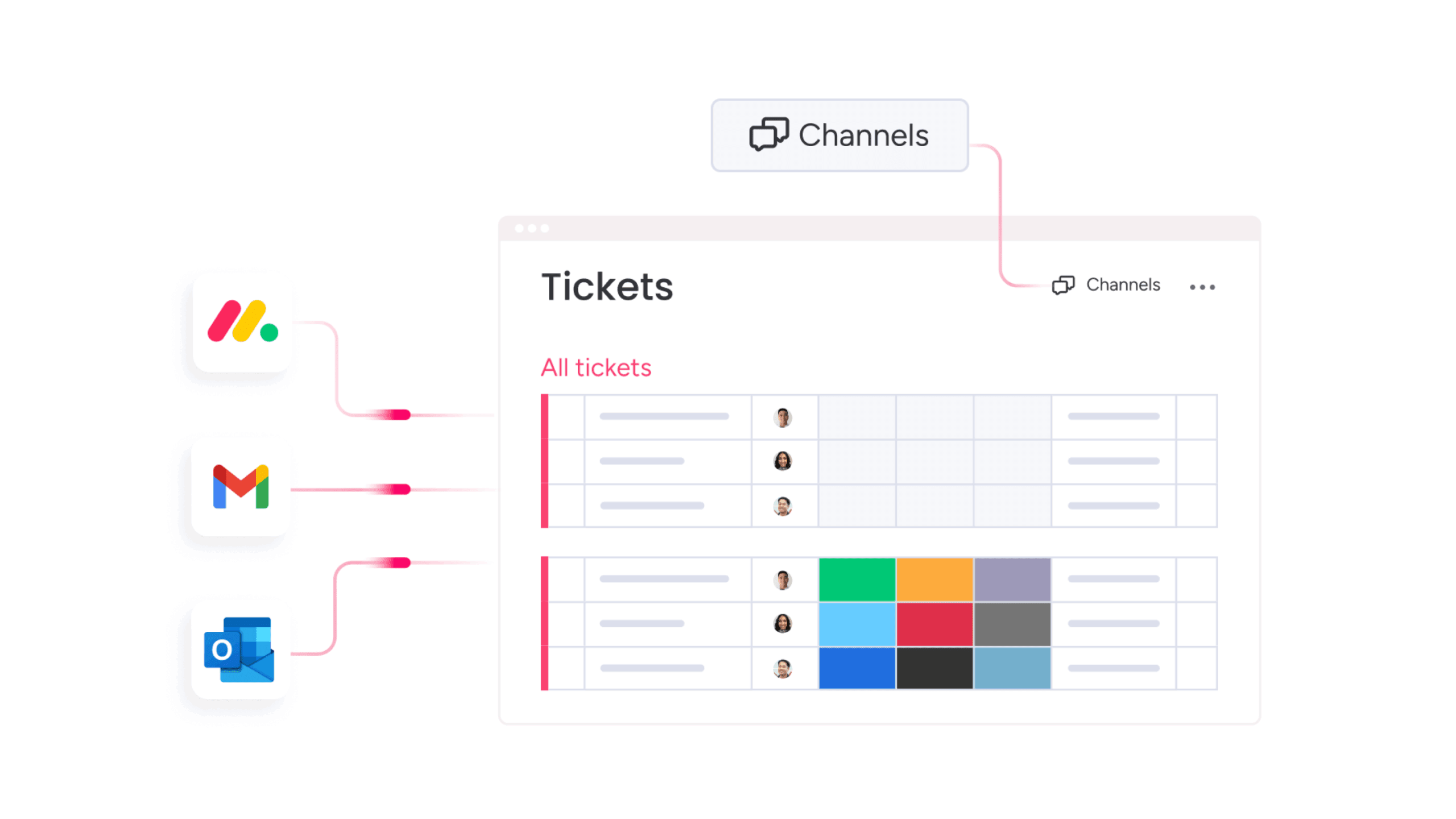
The Customer Portal gives end users a centralized space for knowledge articles, request forms, and self-service — reducing ticket volume while improving user satisfaction. Multi-channel support brings requests from Gmail, Outlook, monday Inbox, and WorkForms into a single view.
Real-time dashboards track SLA compliance, workload distribution, and satisfaction scores at a glance. Every stakeholder — from agents to leadership — sees the metrics that matter to their role.
Extending ITIL with AI and custom apps
monday MCP (Model Context Protocol) connects external AI assistants like Claude, ChatGPT, and Copilot Studio directly to your monday.com workspace data — enabling cross-platform service reporting and intelligent workflow management without manual data transfers.
monday vibe, the platform’s no-code AI app builder, lets teams create custom service apps, dashboards, trackers, and chatbots from natural language prompts. No engineering resources required — service teams can build exactly what they need to support their ITIL processes.
Why ITIL best practices still drive service excellence
ITIL best practices provide the framework for service excellence, and they keep evolving to stay relevant. The launch of ITIL v5 in 2026 proves that this framework continues to adapt, embracing AI governance, experience management, and product-centric delivery while preserving the guiding principles and core practices that teams rely on every day.
Success comes from adapting these practices to your unique needs, not forcing your organization into rigid templates. Start with the fundamentals, measure your progress, and iterate. Whether you’re on ITIL 4 or exploring v5, the path forward is the same: focus on value, collaborate across teams, and continuously improve.
With monday service, you can implement ITIL your way — the platform meets you where you are and grows with your service maturity.
Frequently asked questions
How long does ITIL implementation take for small vs large organizations?
ITIL implementation typically takes three to six months for small organizations focusing on core practices, while large enterprises may need 12-18 months for comprehensive rollout across multiple departments and locations.
What is the difference between ITIL v3, ITIL 4, and ITIL v5?
The difference between ITIL v3, ITIL 4, and ITIL v5 reflects 3 generations of service management thinking. ITIL v3 focused on a rigid service lifecycle with 5 distinct stages. ITIL 4 introduced flexible practices, the Service Value System, and integration with agile and DevOps. ITIL v5, launched in February 2026, shifts to a product-and-service-centric approach with an 8-stage lifecycle, dedicated AI governance, and experience management modules — while keeping all 7 guiding principles and 34 practices intact.
Do small businesses really need ITIL practices?
Small businesses benefit from ITIL by starting with essential practices like incident and service request management, which provide immediate value through organized service delivery without overwhelming small teams.
Which ITIL practice should my organization implement first?
Organizations should implement incident management first because it provides immediate value by organizing how teams handle service disruptions and creates the foundation for other practices.
How do you measure ROI from ITIL implementation?
Measure ITIL ROI by tracking reduced incident resolution times, decreased service downtime costs, improved customer satisfaction scores, and operational cost savings compared to pre-implementation baselines.
What's the minimum ITIL certification needed for service desk staff?
Service desk staff benefit most from ITIL 4 Foundation certification, which provides essential knowledge of core concepts and practices without requiring advanced strategic or management focus — especially relevant for IT help desk support.
What changed in ITIL version 5?
ITIL v5 launched in February 2026 and shifts from a service-centric model to a product-and-service-centric approach with an 8-stage Product and Service Lifecycle. It introduces dedicated AI governance aligned with EU AI Act requirements and an experience management module. The 7 guiding principles, 34 practices, and Service Value System carry forward unchanged from ITIL 4.
Can monday service help implement ITIL practices?
monday service supports ITIL implementation with AI-powered ticket management, SLA tracking with live breach indicators, workflow automation, self-service portals, and real-time analytics dashboards. Its AI workforce includes specialized agents for IT help, device management, and access requests, while the no-code workflow builder lets teams customize ITIL processes without engineering support.

 Get started