


Nearly 70% of projects miss at least one of their original objectives, whether that’s scope, budget, or timeline. For project managers and team leads, that statistic is not a reflection of skill. It is a reflection of how complex modern project execution has become, especially across distributed teams managing competing priorities.
This article breaks down 12 of the most common project management challenges, from unclear goals and scope creep to unrealistic deadlines and resource gaps. For each one, you will find practical solutions you can apply immediately, along with a look at how AI is reshaping the way teams plan, execute, and deliver projects.
Whether you rely on spreadsheets or a dedicated platform like monday AI Workspace, understanding these challenges is the first step toward consistent project delivery. Let’s get into it.
Get startedKey takeaways
- Scope creep and poor communication are the two most common reasons projects go off track, and both are preventable with the right processes
- Setting goals using frameworks like SMART and CLEAR prevents misalignment before it starts
- AI-powered features, such as automated risk detection and predictive scheduling, are becoming essential for proactive project management
- Accountability improves when every team member has visible ownership of their deliverables on a shared board
- monday AI Workspace gives project managers real-time visibility, automated workflows, and resource balancing in one platform
1. Setting clear goals and objectives
Getting aligned on what you need to accomplish is the foundation of successful project delivery. Without well-defined goals, teams drift, and that drift compounds into poor resource allocation, missed milestones, and frustrated stakeholders. What are the most common reasons projects fail? According to TeamStage research, a lack of defined goals is the most common factor (37%) behind project failure.
Consider a marketing team launching a new product campaign. If the brief says “increase brand awareness,” that goal is too vague to measure. Does awareness mean social impressions, press mentions, or website traffic? Without specificity, the team cannot prioritize channels, allocate budget, or know when they have succeeded. A goal like “generate 5,000 qualified leads from paid social in Q3” gives every team member a target they can act on.
Goals should be realistic, broken down into achievable milestones, and connected to the actions that move the project forward. Every team member should understand how their contribution maps to the larger objective.
How to set goals and objectives that stick
- Use a goal-setting framework: Choose one or blend these two popular approaches:
- SMART: Specific, Measurable, Achievable, Relevant, and Time-bound
- CLEAR: Collaborative, Limited, Emotional, Appreciable, and Refinable
- Conduct a project kickoff meeting. Gather all stakeholders to discuss the project’s scope, goals, and project constraints to align everyone’s understanding from the start
- Break the project into manageable pieces. Assign each piece to the most appropriate person, with objectives and deadlines outlined
- Track goals in a shared workspace. With monday AI Workspace, project leaders can build custom goal trackers using a quarterly goal-tracking template, so teams always know whether they are on track. AI Blocks can automatically categorize and summarize goal progress, flagging misalignment before it becomes a problem
2. Scope creep
Scope creep is a classic project management challenge that refers to how a project’s requirements expand beyond what was initially agreed upon. It’s quite common. According to PMI research, scope creep affects a significant portion of projects globally, but it doesn’t need to derail your project if managed proactively.
Take a simple example from construction: a client makes unauthorized changes to the building’s initial drawings. Those changes affect both deliverables and the project’s purpose. Managing this scope change is possible if an increase in funds or timeline can be agreed upon, but only if the team has a formal process for handling change requests.
How to deal with scope creep
- Define requirements upfront. Document the project scope, objectives, deliverables, and timeline in detail at the start. Get stakeholder approval on this scope document to establish a baseline
- Create a formal change management plan that outlines procedures for requesting, reviewing, and approving any changes. Set up automated alerts that notify stakeholders whenever a scope-change request is submitted, ensuring nothing slips through without review
- Communicate regularly with stakeholders. Keep everyone informed about project progress and potential scope changes. Resurface the original project scope if stakeholders push for additions
- Monitor progress with the right structure. An Agile project management methodology, such as Scrum, helps your team focus on specific goals while continuously reviewing priorities. Try the Scrum sprint planning template on monday.com to contain scope within sprints
3. Budget restrictions and changes
When scope starts to creep, so does the budget. For example, a marketing project manager discovers that promoting a new product requires more online advertising spend than originally planned. If the campaign is necessary, the manager may need to request additional funds or reallocate existing resources.
Project managers must plan budgets accurately and ensure projects stay within financial boundaries. Efficient cost management strategies and real-time visibility into spending are essential to avoiding unpleasant surprises.
How to deal with budget restrictions and changes
- Monitor and update the budget regularly. Keep a close eye on expenses and compare them to the planned budget to identify potential overruns early. Real-time dashboards let you compare planned vs. actual spend at a glance, so you can catch overruns before they compound. The monday AI Workspace budget tracker template helps project managers stay on track with live views of total spent vs. remaining work
- Implement change control processes. Establish a formal procedure for reviewing and approving changes to project scope or budget. This prevents uncontrolled spending
- Communicate transparently. Keep stakeholders informed about budget constraints and necessary adjustments. Open communication helps manage expectations and build trust
- Use contingency funds wisely. If you have included a contingency reserve, use it judiciously to address unexpected costs
4. Lack of communication
Communication can make or break a project. Good communication means team members collaborate effectively, work is allocated efficiently, and stakeholders stay informed about progress. Without it, misunderstandings multiply, deadlines slip, and frustration builds across the team.
How much time does your team lose searching for the right update in the wrong channel? If there is an issue with effective communication on your team, you need to tackle it directly. That might mean bringing people together to resolve a specific problem, or creating a project environment where constructive feedback is valued. What are the top challenges facing project managers today? Communication consistently ranks at the top, especially for distributed and hybrid teams.
How to deal with communication issues
- Develop a comprehensive communication plan. Outline objectives, target audiences, preferred channels, and frequency of updates
- Tailor communication to your audience. Adapt your style and content to suit different stakeholders; technical teams need different updates than senior management
- Establish regular check-ins. Schedule recurring meetings, like daily stand-ups and one-on-ones, to align priorities and address issues early
- Centralize communication where work happens. Integrations with Slack, Microsoft Teams, and Gmail keep conversations connected to their projects, without switching apps. An AI assistant embedded in your workspace can surface relevant updates, summarize threads, and recommend next steps so no one has to dig through message history.
Here are four ways monday AI Workspace helps drive communication on your team:
- Color-coded status updates: Customizable status columns let you see where every item stands at a glance

- Contextual notes: Team members can leave notes directly on status columns for others to review at their convenience

- Visible ownership: Assigning items to individuals removes any confusion about who is responsible for what

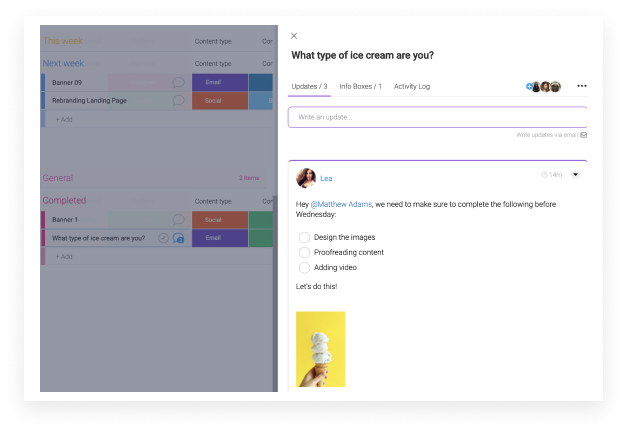
- In-context collaboration: Within each item, team members and project managers can communicate by tagging one another, attaching files, and creating checklists
5. Team conflict
5. Team conflict
When asked about project management challenges, the lack of strategic direction and leadership surfaces as a recurring theme. 14% of project managers reported that lack of direction was a cause of conflict in their projects, while 12% pointed to miscommunication and misunderstandings within the team.
When was the last time your team sat down to align on what success actually looks like? Ignoring conflict is not an option for project managers. You need to identify the root cause, whether it’s competing priorities, unclear roles, or personality clashes, and address it head-on.
The Thomas-Kilmann conflict model identifies 5 styles of conflict resolution (competing, collaborating, compromising, avoiding, and accommodating), and choosing the right approach for the situation can prevent minor disagreements from escalating.
How to deal with team conflict
- Acknowledge the conflict early. Be attentive to signs of tension, disagreements, or communication breakdowns before they escalate
- Identify the root cause. Speak with the individuals involved to uncover what is actually driving the disagreement
- Foster a collaborative environment. Emphasize teamwork and mutual respect. Features like Workdocs let the whole team contribute to a shared vision document, creating alignment and reducing misunderstandings
- Focus on solutions, not blame. Shift the conversation from assigning fault to identifying practical steps that benefit the project
6. Mismatched team skills
As a project manager, you want to create the most productive work environment for your team. That starts with matching work to team members who have the right skills to deliver. If there is a mismatch between requirements and skill levels, the project suffers inefficiencies that could lead to failure.
Matching the right person to the right project is only half the equation; you also need to know whether they have the bandwidth. Appropriately aligning skills to project requirements takes experience, a deep understanding of your team, and real-time data about capacity.
How to deal with mismatched team skills
- Assess skills and capabilities. Conduct a thorough assessment of each team member’s skills, experience, and strengths to identify any gaps or mismatches
- Reassign work based on strengths. Based on the assessment, redistribute work to ensure people are contributing where they are most effective
- Use a skills matrix. Create a visual representation of the team’s skills to quickly identify gaps and overlaps. This helps with allocation and highlights areas for professional development
- Leverage capacity data. A workload view shows each team member’s capacity at a glance, helping you avoid burnout and underutilization
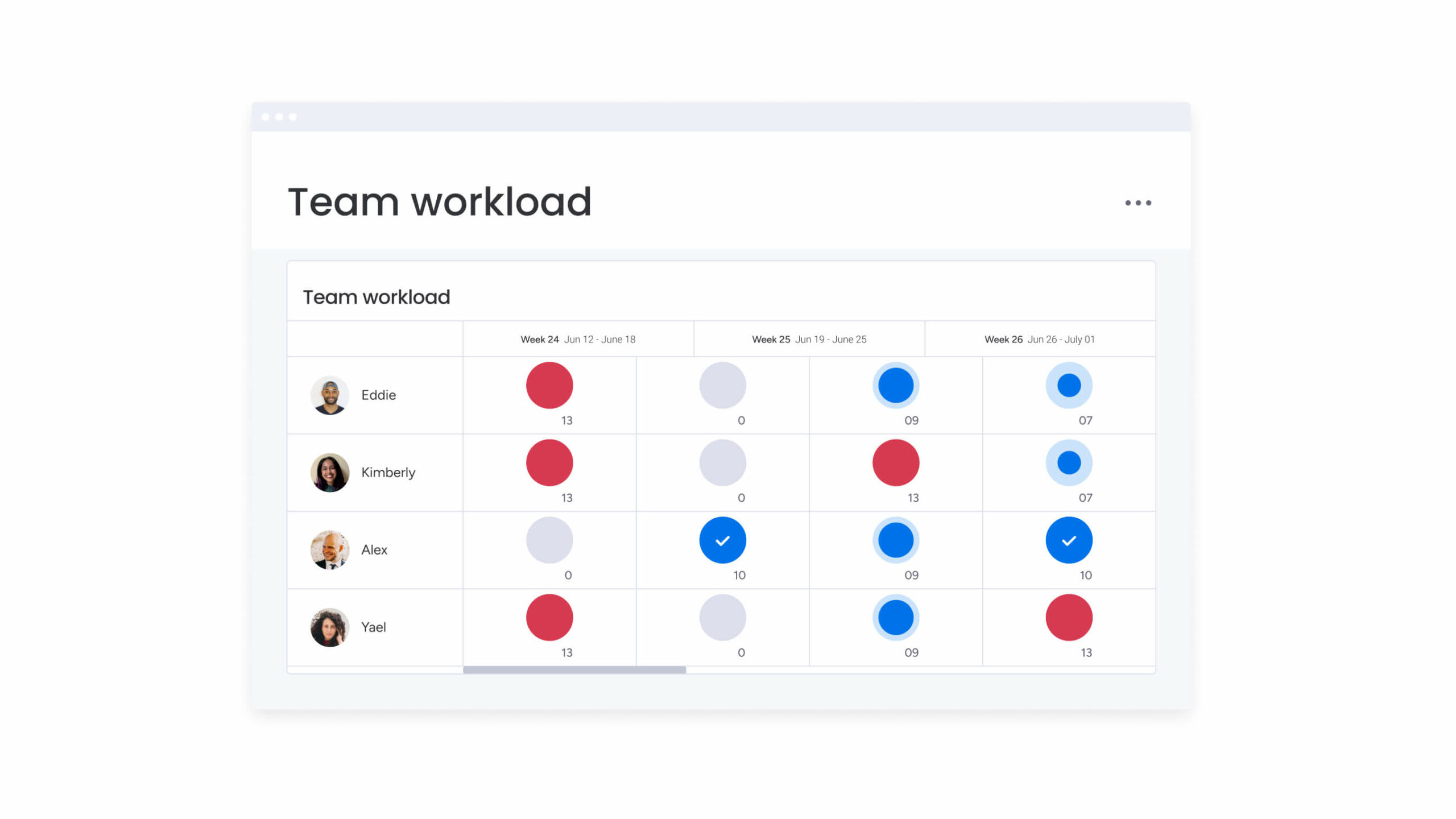
For a deeper dive into how to use Workload View to manage team workload, check out our YouTube video:
7. Absence of accountability
Accountability means every member of your team is responsible for their decisions and actions. Research from Gallup shows that teams with high accountability are significantly more likely to meet performance targets. However, most project teams lack accountability, and when ownership is unclear, commitment to the project goal and the likelihood of success drop.
How to deal with a lack of accountability
- Set expectations and responsibilities upfront. Define roles, deliverables, and deadlines for each team member at the start of the project so everyone understands their responsibilities
- Lead by example. As the project manager, demonstrate accountability in your own actions and decisions to set the tone for the team
- Foster a culture of ownership. Encourage team members to take ownership of their outcomes. Visible ownership columns on a shared board create natural accountability without micro-management
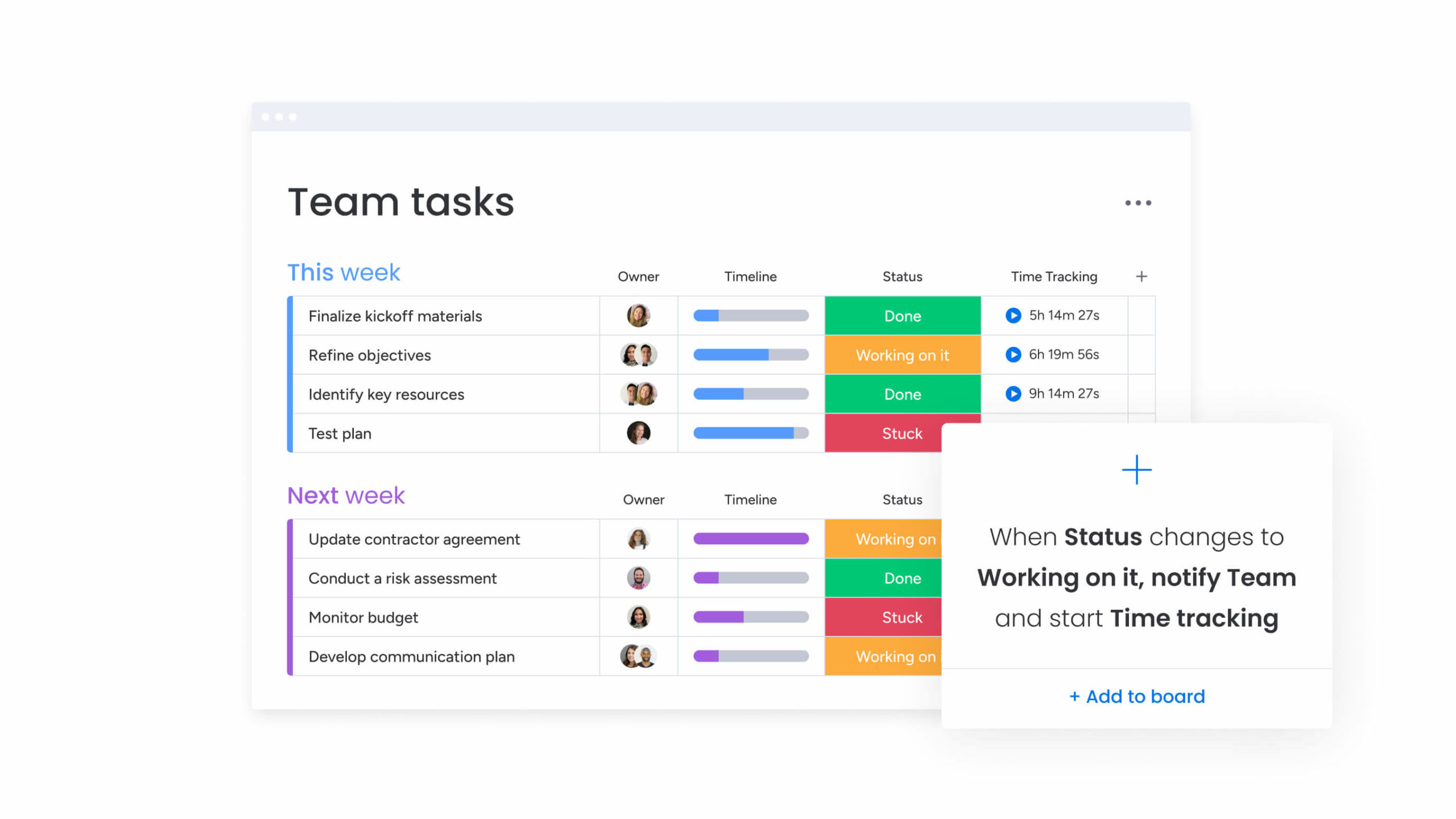
- Automate status notifications. Automated status-change notifications ensure that when someone marks a deliverable as complete, or overdue, the right people know instantly. The team management template on monday.com enables managers to assign owners and track status and progress throughout the project lifecycle
8. Unrealistic deadlines
Have you ever heard the warning: “Don’t overpromise and underdeliver?” Only 29% of projects are completed on time, according to the Standish Group, and unrealistic deadlines are a major contributor. Ignoring this reality results in missed milestones, reduced quality, stressed team members, and disappointed stakeholders.
Unrealistic deadlines are a classic way to overpromise, and they need to be addressed during the project planning phase. An effective project manager knows their team’s strengths and capacity, and can negotiate for achievable deadlines without rushing the work. What would your project look like if every dependency were visible from day one?
How to deal with unrealistic deadlines
- Evaluate and communicate the reality. Assess whether the deadline is genuinely unrealistic or just challenging. Provide data and evidence to explain why the original timeline is not feasible
- Negotiate for a reasonable timeline. Propose alternative solutions, reducing scope, changing specifications, or offering different timelines. Be respectful but firm
- Break down the work and prioritize. Divide the project into smaller pieces and assign each one sufficient time. Prioritize the most impactful deliverables and base estimates on previous experience
- Visualize dependencies. Gantt charts with dependency mapping show exactly which deliverables are blocking others, making it impossible to ignore cascading delays. AI-powered project analysis can flag timeline risks before they become missed deadlines
For example, monday AI Workspace has a deadline mode that lets you set and adhere to project timelines. Here you can see how deadlines are displayed directly beside the project status:

You can also display deadlines as time spans, so you are not locked to a single day:
9. Poor risk management
Project managers have to evaluate and manage risks throughout the lifecycle of their projects. No one is psychic; some risks will materialize no matter how much you plan. However, experienced project managers mitigate the impact of these problems by identifying “what-if” scenarios and devising contingency plans.
As a project manager, you must ensure your team can adapt when things go off course. AI agents like the Project Analyzer continuously monitor your projects, flagging potential bottlenecks and suggesting optimizations before risks materialize.
How to deal with poor risk management
- Create a risk register. Develop a comprehensive risk register to document all identified risks, including likelihood, impact, owner, response plan, and status. The monday.com risk register template helps you identify, evaluate, and plan for possible risks in one place
- Identify and assess risks collaboratively. Conduct risk identification sessions with key stakeholders and team members to uncover potential risks related to requirements, technology, budget, and timeline. Assess each risk’s likelihood and impact to prioritize them effectively
- Develop mitigation strategies. For each identified risk, establish a strategy to reduce its likelihood or impact, whether by avoiding, reducing, transferring, or accepting it.
- Assign risk owners. Designate specific team members as risk owners responsible for monitoring and managing assigned risks. This ensures risks are actively managed throughout the project
10. Lack of stakeholder engagement
A lack of stakeholder engagement occurs when key stakeholders are not actively involved in or supportive of the project. This leads to misaligned expectations, poor communication, and potential resistance to project outcomes.
Stakeholder disengagement can result in delayed decision-making, inadequate resource allocation, and a lack of buy-in for project goals. Overcoming this challenge requires proactive communication, defined roles and responsibilities, and consistent efforts to demonstrate the project’s value. Customizable dashboards give stakeholders a real-time window into project health.
How to deal with a lack of stakeholder engagement
- Identify and prioritize stakeholders. Categorize all project stakeholders based on their interest and influence on the project. This helps you understand who needs to be engaged and to what extent
- Develop a comprehensive engagement plan. From your stakeholder analysis, create an engagement strategy that outlines objectives, roles, and methods for maintaining communication. Try using a RACI matrix template to visually represent stakeholder roles and responsibilities
- Establish consistent communication channels. Regular updates and check-ins keep stakeholders informed and involved. Tailor communication, including meetings, surveys, and focus groups, to meet the preferences of different stakeholders.
- Involve stakeholders early and often. Engage stakeholders from the beginning of the project to ensure they feel invested. Early involvement leads to stronger support and cooperation
11. Resource deprivation
According to an RGPM survey, 44% of project managers say a lack of resources is a common project challenge. This shortage can manifest as inadequate staffing, limited budget, insufficient equipment, or a lack of required expertise. In distributed teams, the problem is compounded; remote work makes resource visibility harder when team members are spread across time zones and projects.
Resource deprivation often leads to project delays, compromised quality, increased stress on team members, and potential project failure. It requires creative resource allocation, effective prioritization, and sometimes renegotiating scope or timelines with stakeholders.
How to deal with resource deprivation
- Create a resource allocation plan. Develop a detailed plan outlining the project’s resources: personnel, equipment, and budget. Prioritize critical work and allocate resources efficiently. Resource management features let you see who is overloaded and who has capacity, across teams and projects
- Leverage alternative resources. Look for ways to fill gaps: cross-training team members, using existing capabilities in new ways, or partnering with other departments to share resources
- Adjust scope and priorities. If resources are limited, focus on the most impactful deliverables that can be completed with what you have
- Communicate with stakeholders. Keep stakeholders informed about resource constraints and their potential impact on the project. Transparent communication helps manage expectations and can unlock additional funding. For executives managing multiple projects, portfolio management views provide the visibility needed to allocate resources across the organization
12. Choosing the right project management platformt management software
While many project managers rely on project management platforms, some still lack access to purpose-built technology. According to one survey, 28% of project managers say they enter dates into a spreadsheet and use it for project scheduling.
The biggest advantage of a dedicated platform is that project managers can access it remotely and track progress in real-time. Platforms also centralize data and enable all stakeholders to access it via multiple devices. But how do you choose the right one when the options seem endless?
How to select the right project management platform
- Identify your needs. Assess your team’s specific requirements: team size, project complexity, and the types of work you manage. Determine which features are essential: workflow management, resource allocation, budget tracking, reporting, and collaboration capabilities
- Evaluate against key criteria. Compare platforms based on ease of use, integrations, automations, AI capabilities, mobile access, and reporting depth. Look for platforms with 200+ integrations and the flexibility to build custom workflows that match how your team actually works
- Prioritize AI capabilities. Look for platforms with built-in AI; automated workflows, predictive scheduling, and AI assistants can save hours every week.
- Consider usability and accessibility. Ensure the platform is user-friendly and accessible across devices, including mobile devices, to accommodate remote or hybrid work environments
How monday AI Workspace helps you manage projects
The cost of project management challenges can be substantial. Unforeseen issues can result in wasted budget, frustrated top performers, and difficult conversations with leadership when projects overrun. The monday AI Workspace brings together the visibility, automations, and AI capabilities teams need to tackle every challenge across a project’s lifecycle.
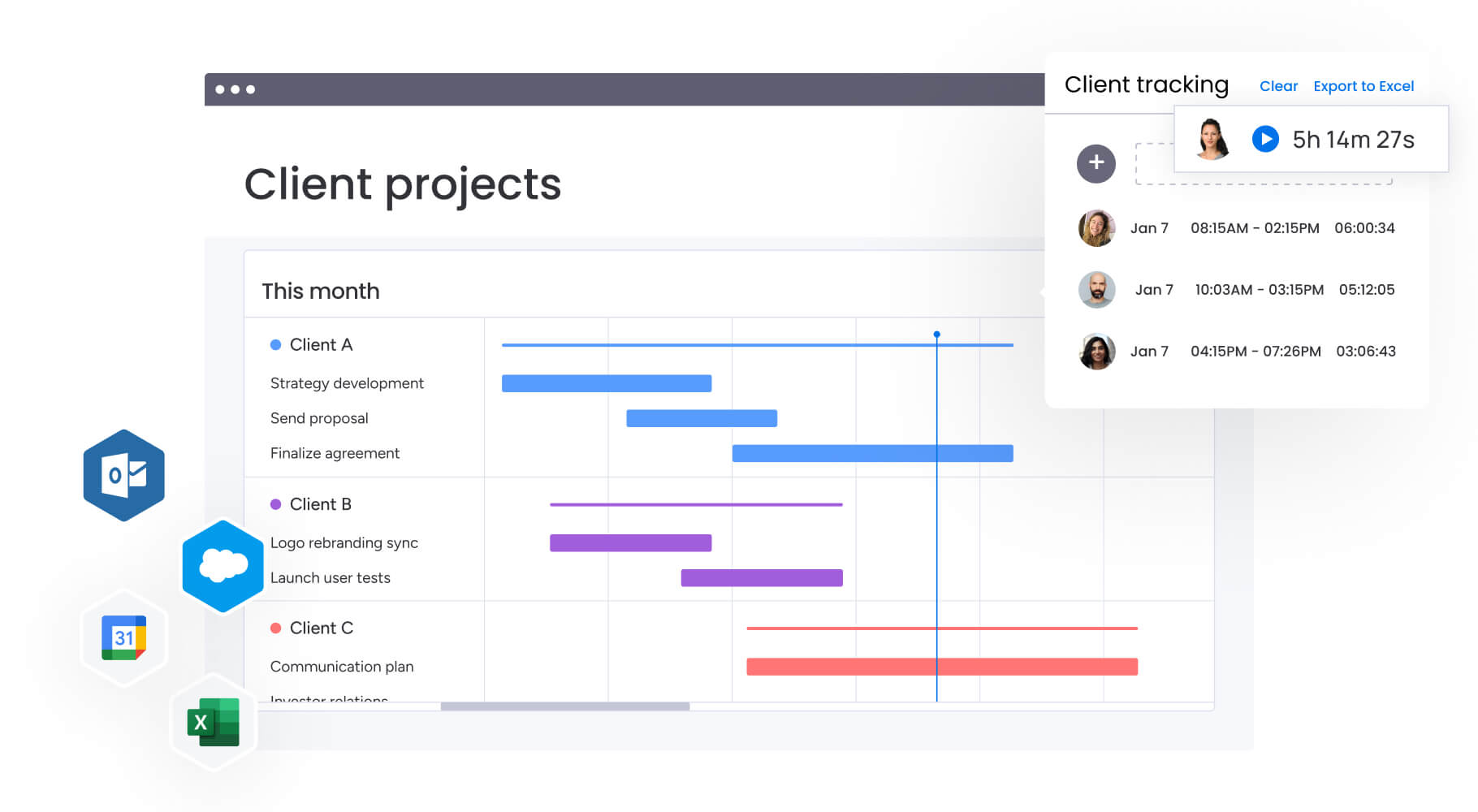
See every project at a glance
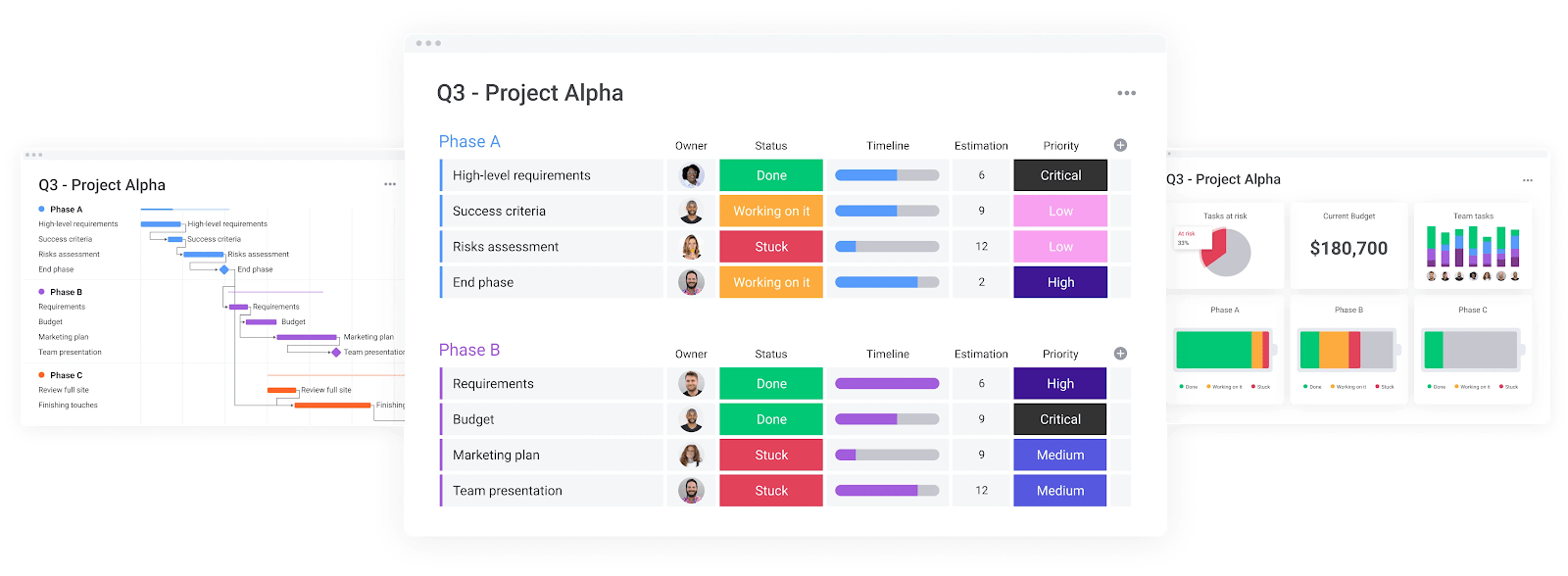
Visualize your data and project plans the way you need them with 15+ board views, including Timeline, Kanban, and Gantt charts. Whether your team prefers a high-level overview or a granular breakdown, monday AI Workspace adapts to how you work, not the other way around.
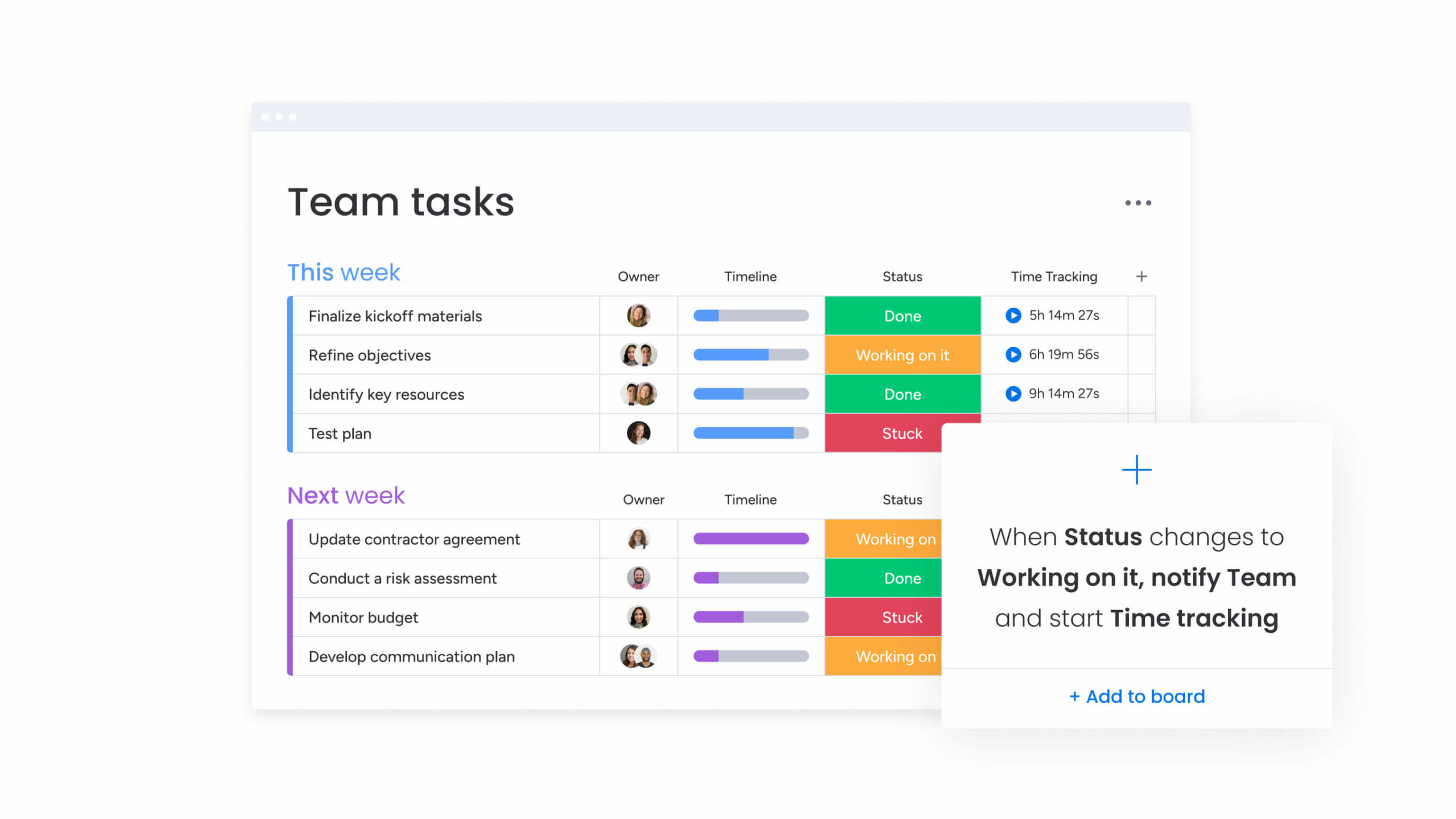
Automate repetitive work
Automations handle the operational overhead that slows teams down: email sends, status updates, deadline reminders, and assignment notifications all happen without manual intervention. Set up automations in minutes with no-code recipes, so your team can focus on the work that requires human judgment.
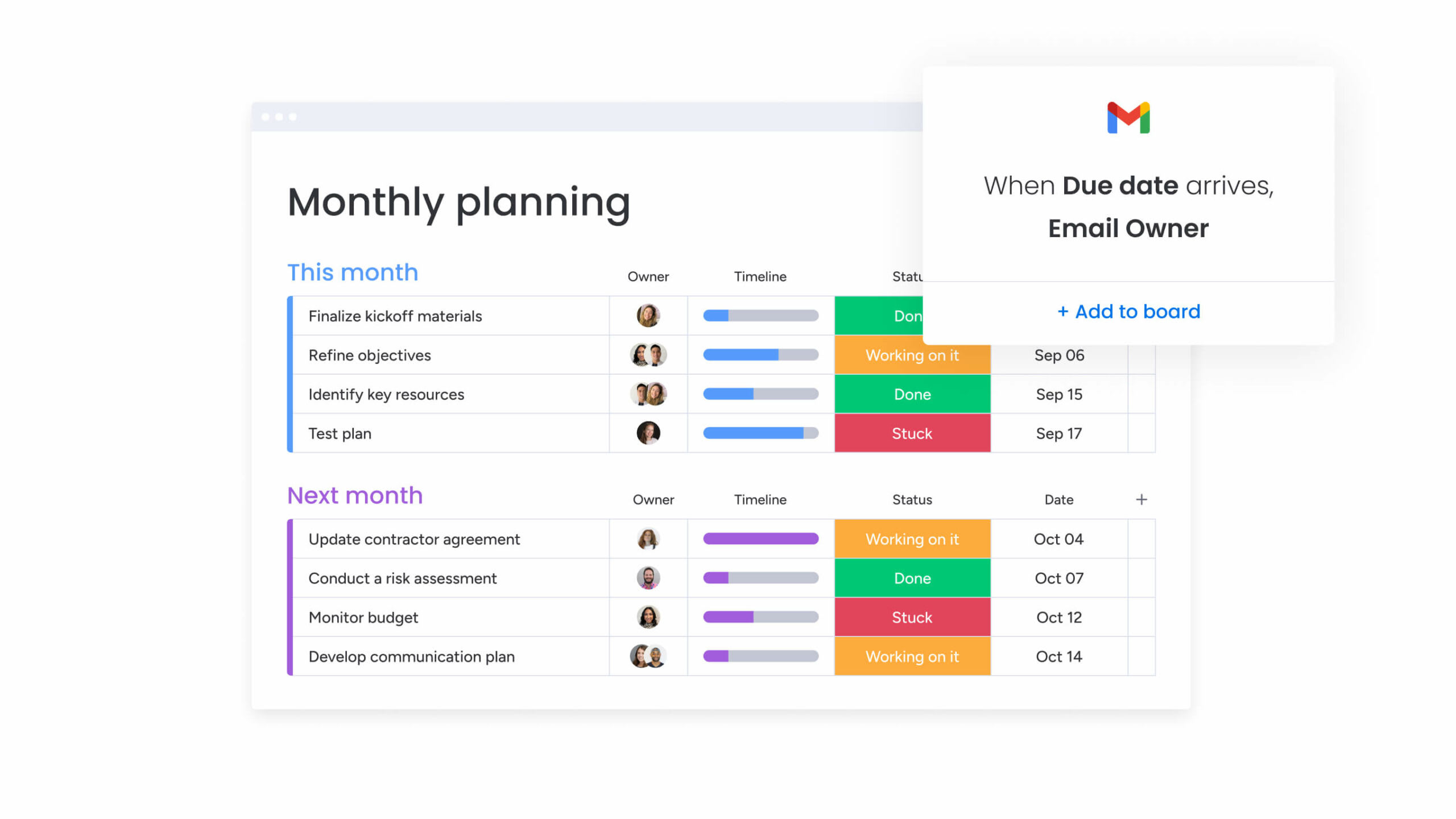
Connect your existing apps
With 200+ integrations, including Slack, Microsoft Teams, Gmail, and Salesforce, you can run entire projects on monday without switching tabs. Data flows automatically between your favorite apps and your project boards.
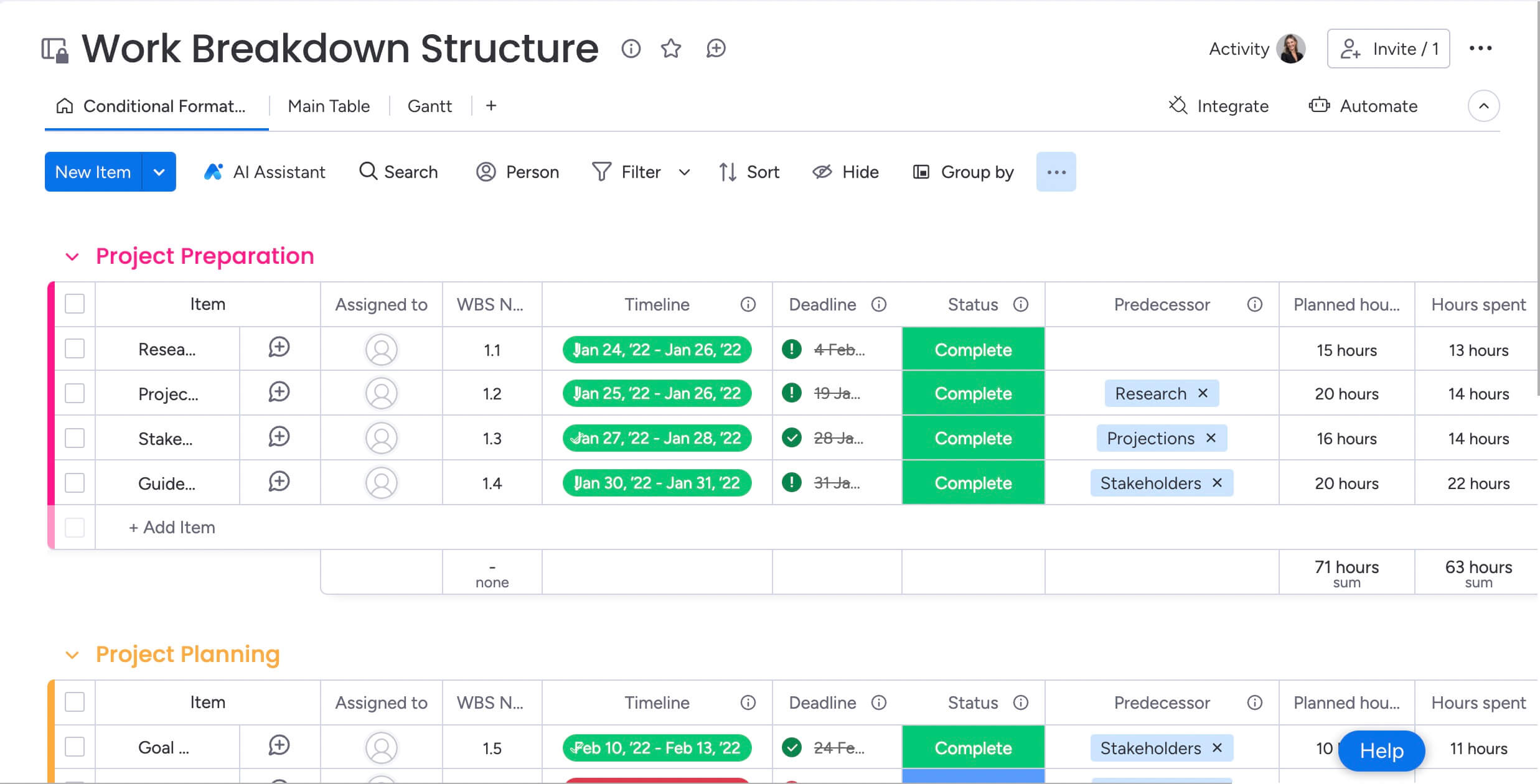
Start fast with ready-made templates
Choose from 200+ templates so you never have to start from scratch, no matter what type of project you are handling. From work breakdown structures to sprint planning boards, every template is fully customizable to fit your team’s process.
Built-in AI that works alongside your team
monday sidekick, AI Blocks, and monday agents bring intelligence directly into your workspace. From generating project summaries to building natural-language workflows with monday vibe, AI capabilities help teams move faster without adding complexity.
Turning project challenges into opportunities
Every project will encounter challenges; that’s the nature of complex work. But with the right frameworks, team habits, and platform support, those challenges become opportunities to improve how your team plans, communicates, and delivers.
The 12 challenges covered in this article are not rare exceptions. They are the everyday realities of project management. The difference between teams that struggle and teams that thrive comes down to preparation, visibility, and the willingness to adapt.
With monday AI Workspace, your team gets the visibility, automations, and AI-powered support to turn every project challenge into a step forward.
FAQs
What are the three main challenges in project management?
The three main challenges in project management are scope creep, poor communication, and resource allocation. Scope creep expands requirements beyond the original agreement, poor communication creates misalignment across teams, and insufficient resources, whether budget, staffing, or expertise, force project managers to make difficult trade-offs. Addressing all three requires defined processes, transparent communication channels, and real-time visibility into project status.
What are the top challenges facing project managers today?
The top challenges facing project managers today include insufficient resources, unrealistic deadlines, poor communication across distributed teams, and the growing need to adopt AI-powered workflows. Remote and hybrid work has amplified coordination difficulties that barely existed a few years ago. Modern project managers must balance traditional challenges, such as budget constraints, with newer demands, such as integrating AI capabilities and managing asynchronous teams.
What is the first challenge faced by project managers?
The first challenge faced by project managers is typically goal-setting and alignment. Before work begins, the team needs to agree on what success looks like, what the project scope includes, and what falls outside it. Without that alignment, every downstream decision rests on an unstable foundation.
How do you identify challenges in a project?
Identifying challenges in a project starts with a thorough risk assessment during the planning phase, followed by ongoing monitoring throughout execution. Practical approaches include maintaining a risk register, conducting regular retrospectives to surface issues early, and using dashboards that provide real-time visibility into project health. AI-powered monitoring can also automatically flag potential bottlenecks and timeline risks, giving project managers time to respond before small problems become large ones.
What are the triple constraints of project management?
The triple constraints of project management, also known as the "Iron Triangle", are scope, time, and cost. These three constraints are interconnected: changes to one typically affect the others. Increasing the scope often requires more time and budget, while cutting the budget might mean extending the timeline or reducing the project's deliverables.
How can AI help with project management challenges?
AI helps with project management challenges by automating repetitive work, detecting risks before they escalate, generating intelligent status updates, and suggesting realistic timelines based on historical data. On the monday AI Workspace, AI agents like the Project Analyzer continuously monitor project health, while monday sidekick summarizes progress and recommends next steps. These capabilities shift project management from reactive problem-solving to proactive execution.
 Get started