


Organizations frequently begin a quarter with three major initiatives, only to find themselves managing five active projects by mid-quarter and facing additional urgent requests shortly thereafter. This progression from planned work to portfolio complexity is a common reality for most leaders managing multiple projects.
The central challenge lies in coordinating these initiatives while maintaining focus on strategic objectives. When priorities compete for limited resources, deadlines overlap, and stakeholders have conflicting requirements, even experienced teams face difficulties delivering consistent results. Success in this environment depends on implementing scalable systems that can accommodate portfolio growth.
In sections below we’ve covered twelve proven strategies for how to manage multiple projects effectively. You’ll discover how to centralize work for instant visibility, prioritize based on business value, leverage AI for proactive decision-making, and design flexible workflows that adapt when conditions change. These approaches turn scattered initiatives into work that actually ships on time and hits your goals.
Key takeaways
- Centralize all projects in one digital workspace: Stop wasting time hunting for updates across scattered tools and create a single source of truth where every stakeholder sees the same reality.
- Prioritize projects based on measurable business value: Use objective criteria like ROI and strategic alignment to ensure your team’s energy flows toward initiatives that actually drive results.
- Set work-in-progress limits that protect team capacity: Limit active projects to prevent burnout and quality issues — fewer concurrent projects actually increases overall throughput.
- Use AI to stay ahead of project risks: Predictive analytics can forecast delays weeks in advance, transforming reactive firefighting into strategic prevention. Platforms like monday.com embed AI directly into workflows to flag risks before they become crises.
- Map dependencies across your entire portfolio: Visualize how projects connect to spot resource conflicts and timeline risks before they derail your deadlines.
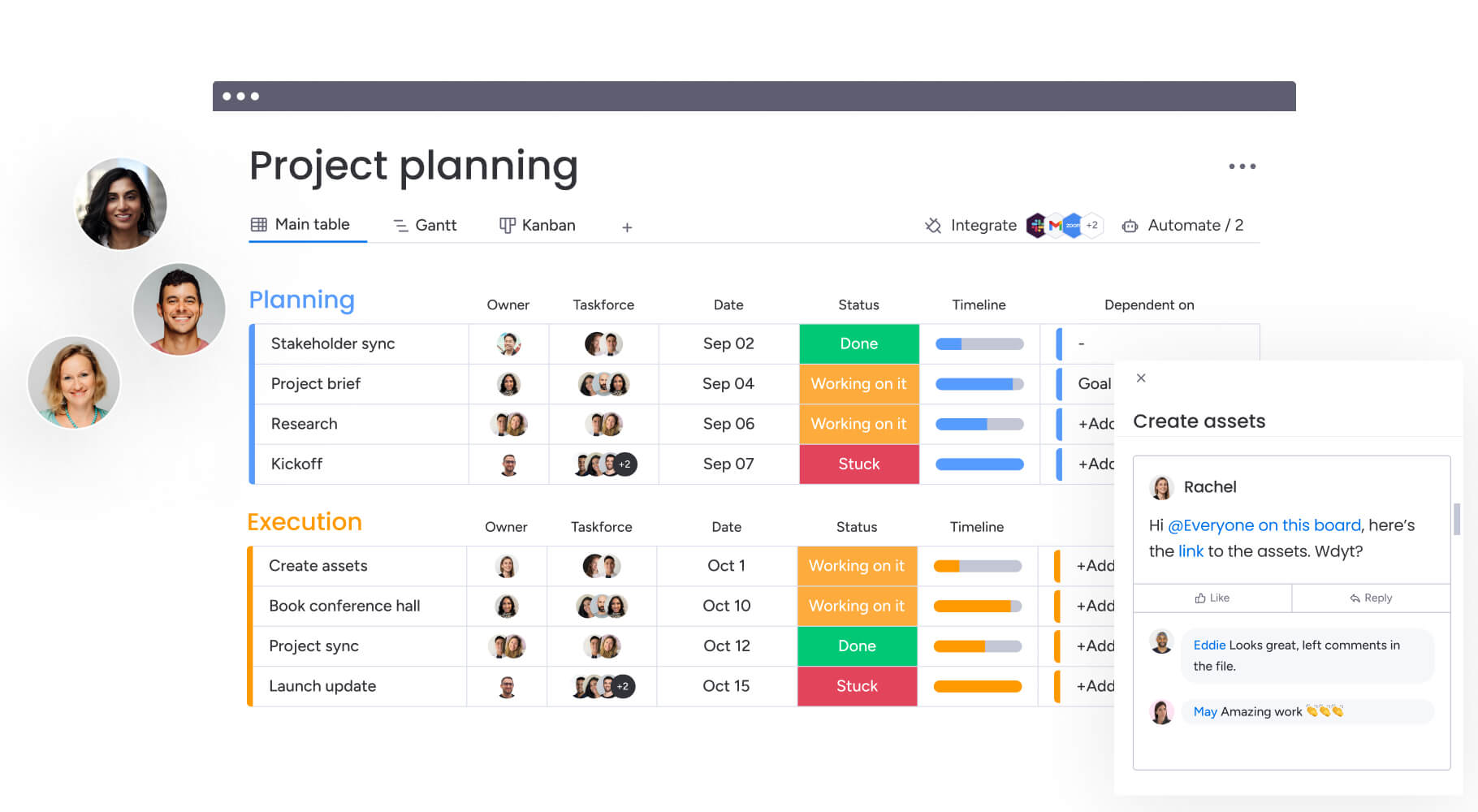
The core challenges of multi-project management
Managing multiple projects rarely fails because teams lack effort — it usually breaks down because coordination becomes harder as complexity increases. Priorities shift, timelines overlap, and the same people are often needed in several places at once. Without a clear system, even well-planned projects start competing for attention.
As the number of active initiatives grows, small inefficiencies begin to compound. Teams spend more time switching between tasks, clarifying ownership, and responding to urgent requests instead of focusing on meaningful progress.
Common challenges include:
- Frequent context switching: Moving between projects reduces focus and slows down complex work.
- Competing resource demands: Key contributors are often stretched across multiple initiatives at the same time.
- Unclear priorities: Teams may stay busy without always working on the initiatives that drive the most value.
- Limited visibility: Without a shared view of progress, risks and delays surface later than they should.
Recognizing these patterns makes it easier to introduce structure that keeps multiple projects aligned and moving forward.
Proven strategies for managing multiple projects at scale
High-performing teams manage multiple projects by creating clarity at both the portfolio and execution level. Instead of treating projects as separate efforts, they connect planning, prioritization, and delivery within one consistent system.
The strategies in this guide follow four core principles:
- Centralize visibility: Keep timelines, responsibilities, and progress connected in one place.
- Prioritize with intention: Focus resources on projects that deliver the greatest strategic value.
- Improve execution consistency: Use shared structures, automation, and clear ownership to reduce friction.
- Adapt as priorities change: Build flexibility into plans so teams can respond without losing momentum.
Together, these principles create a scalable approach to managing multiple projects without losing focus or slowing delivery.
Strategy 1: select a platform built for portfolio management
You need high-level visibility alongside granular task control. Therefore, look for a platform that offers cross-project reporting and scalable architecture.
The right platform does more than just store work items. It shows you how daily work connects to your bigger strategic goals.
Look for these capabilities when choosing a platform:
- Cross-project visibility: Aggregate data from dozens of projects into one view to identify trends and bottlenecks instantly.
- Unified reporting: Standardize data formats across teams, making reporting automatic rather than manual.
- Scalable architecture: Handle increasing complexity without performance degradation as you grow from ten projects to thousands.
Structure projects for consistent navigation
Consistency makes work easier on your brain. When every project follows a predictable structure, team members jump between initiatives without relearning layouts. As your portfolio grows, this standardization keeps you sane.
Consider implementing these structural elements:
- Standardized folder hierarchies: Group projects by department, client, or strategic initiative.
- Uniform board layouts: Keep columns for status, owner, and timeline in the same order across all boards.
- Access permission tiers: Define rules for viewing, editing, and administering projects.
Implement naming conventions that scale
A scalable naming system makes every file easy to find and impossible to confuse with something else. For example, “2024_MKT_Q1_Campaign” is infinitely more useful than “New Marketing Project.”
This simple discipline prevents duplicate files and ambiguous project titles as your portfolio expands.
Strategy 2: prioritize projects based on business value
Prioritizing projects strategically protects your team’s focus and energy. Traditional methods — first-in, first-out or whoever yells loudest — waste your best people on work that doesn’t matter. In contrast, smart prioritization puts your team’s energy where it’ll actually move the needle.
Define measurable value criteria
Objective metrics take the emotion out of prioritization. Define what “value” means before stakeholders start competing for resources. This framework settles disputes when stakeholders compete for resources.
Key criteria to consider include:
- Strategic alignment scores: Assign numerical values to how well projects support company objectives.
- ROI and revenue potential: Prioritize initiatives with direct paths to financial return.
- Resource efficiency ratios: Evaluate estimated effort against potential impact.
Build a dynamic prioritization matrix
Static lists go stale the moment business conditions shift. A dynamic matrix plots projects against key variables to show you where to invest your time.
| Prioritization framework | Use case | Key metric |
|---|---|---|
| Value vs. effort | Quick decision-making on backlogs | Impact / hours required |
| Eisenhower matrix | Daily task management and delegation | Urgency / importance |
| MoSCoW method | Scope management and release planning | Must / should / could / won't |
| Weighted scoring | Complex portfolio allocation | Custom weighted criteria |
Navigate conflicting stakeholder priorities
The most effective approach is to let objective data guide the conversation. When stakeholders compete for resources, the prioritization matrix serves as a neutral framework for decision-making.
Present stakeholders with how projects rank against agreed-upon criteria. This allows you to explain deferrals based on measurable business value rather than subjective preferences.
Strategy 3: create portfolio dashboards for instant visibility
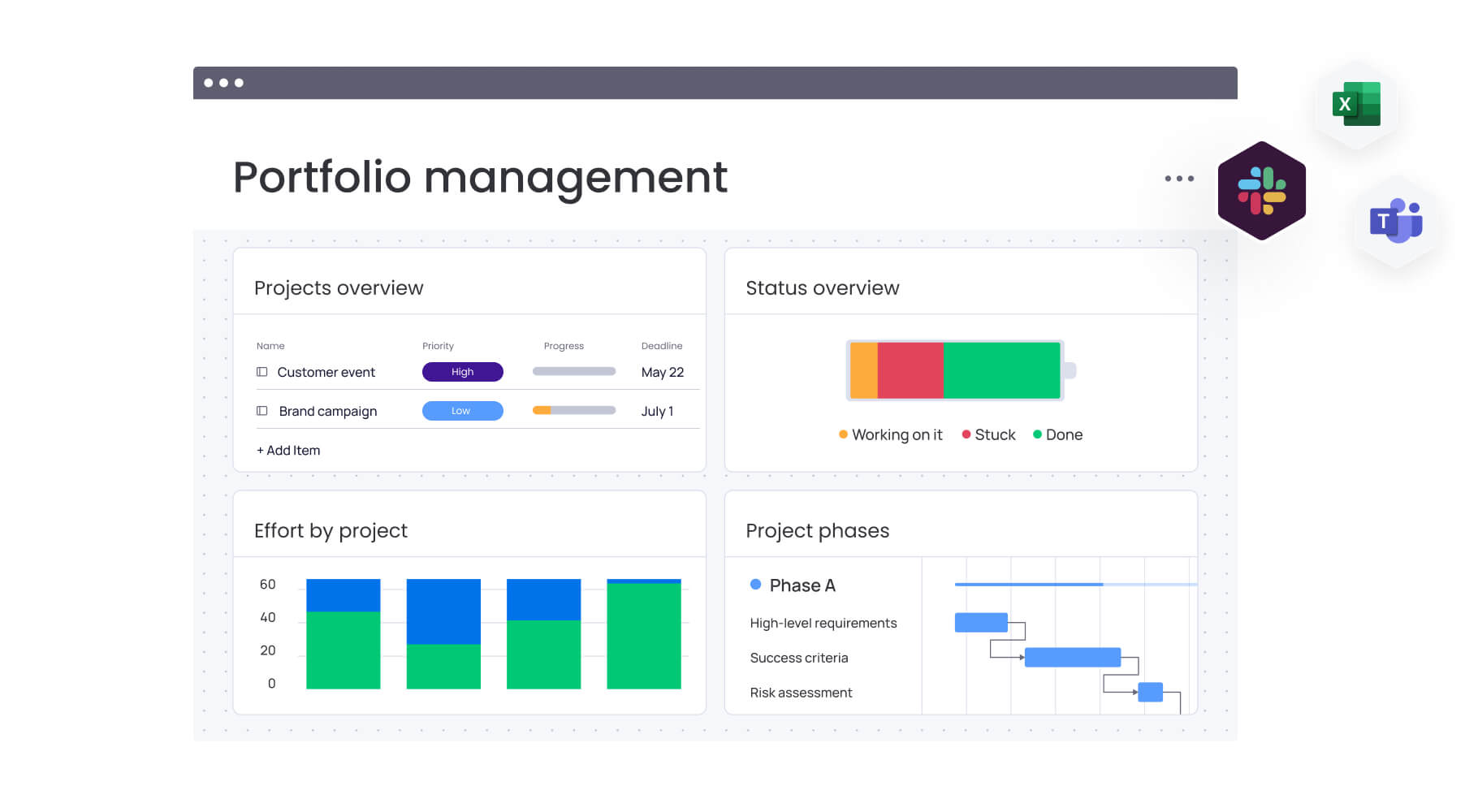
Portfolio visibility distinguishes leaders who anticipate challenges from those who react to them. While project plans track execution details, portfolio dashboards provide organizational health indicators. These high-level views aggregate data across the organization to answer a critical question: Are you on track to meet your objectives?
Executive dashboard design principles
Executives need intelligence they can act on, not a list of every task. That’s why an effective executive dashboard shows three things: health, budget, and timeline risks. Meanwhile, charts and summary widgets let leadership assess portfolio status in seconds.
Automated health tracking systems
Automation takes the spin out of status reporting. Instead of subjective updates, dashboards pull real-time data and calculate health on their own.
Key indicators to implement:
- Red/yellow/green status: Automate color coding based on timeline adherence and budget consumption.
- Trend arrows: Show whether a project’s risk profile is improving or deteriorating.
- Exception alerts: Flag anomalies like sudden spikes in overdue tasks.
Escalation protocol frameworks
Data becomes actionable when it drives clear responses. Escalation protocols define specific actions triggered by dashboard indicators, ensuring teams respond consistently to emerging risks.
For example, a 10% budget variance might trigger an automated email to the project manager, while a 20% variance initiates a steering committee review.
Strategy 4: block time for focused work on each project
Context switching taxes your productivity, and every interruption makes it worse. Jumping between unrelated projects drains your mental energy, leaving less for deep problem-solving. Time blocking protects your mental energy for complex work.
Energy-based task scheduling
Your nine a.m. brain isn’t the same as your three p.m. brain. That’s why you should schedule high-complexity tasks when your energy peaks. Meanwhile, low-energy periods suit administrative assignments, status updates, or routine correspondence.
Context switching minimization techniques
Grouping similar work makes it easier to stay in the zone. These techniques protect focus time:
- Thematic days: Dedicate specific days to specific projects or work types.
- Transition rituals: Establish short routines to signal focus shifts.
- Notification management: Silence alerts from other projects during dedicated blocks.
Task batching strategies
You get faster when you batch the same type of work together. For example, instead of answering emails sporadically, process all stakeholder communications in one block.
Similarly, review all budget updates in a single sitting. Batching builds momentum and cuts down the time it takes to get started on each task.
Strategy 5: set work-in-progress limits that protect capacity

Overload a system and it slows down. Similarly, overload a team and they burn out while quality tanks. That’s where work-in-progress limits come in — they keep work flowing and actually finishing. Limit active projects and you’ll actually ship more work.
Capacity calculation methodologies
Capacity planning needs real math, not wishful thinking. Instead, look at historical data to figure out what your team can realistically deliver.
Essential calculations include:
- Resource availability analysis: Account for non-project time like administrative duties and holidays.
- Complexity weighting: Assign weight based on difficulty, acknowledging one complex initiative may consume the capacity of three smaller ones.
- Velocity tracking: Use past performance to predict future output.
Project intake gate design
A formal intake process keeps low-value projects out of your portfolio. New requests pass through evaluation gates where they’re assessed against current capacity and strategic alignment.
If the WIP limit is reached, new projects cannot start until existing ones complete or pause.
Strategic deferral mastery
Saying “not yet” is a strategic competency. When capacity is full, leaders must defer lower-priority requests to a backlog.
This protects your team’s ability to deliver on current commitments instead of spreading them too thin.
Strategy 6: delegate work while maintaining strategic oversight
To scale your portfolio, you must empower your team through delegation. However, delegation multiplies capacity only if you build accountability without breathing down people’s necks. Smart delegation gives teams autonomy while keeping you in the loop on what matters.
Skills-to-project matching strategies
Delegation works when you match the right person to the right project. Start by mapping the skills each project needs against what your team can actually do.
Key matching strategies:
- Skill matrices: Maintain current inventories of team skills for quick identification.
- Developmental delegation: Assign tasks slightly beyond comfort zones to build future capacity.
- Capacity balancing: Prevent overloading skilled individuals while others are underutilized.
Accountability without micromanagement
Trust comes from transparency. Instead of constant check-ins, set clear expectations and measure outputs.
Accountability frameworks include:
- Outcome-based objectives: Define what “done” looks like, leaving the “how” to team members.
- Regular checkpoints: Schedule predictable reviews rather than random status queries.
- Ownership assignment: Explicitly assign single owners to every task or deliverable.
Smart reporting for visibility
Automated reporting means you stop hovering over people’s shoulders. When team members update status in the central platform, leaders get instant visibility into progress.
As a result, you only step in when data shows a problem. Everyone else gets autonomy by default.
Strategy 7: map dependencies across your project portfolio
In multi-project environments, one delay ripples everywhere. That’s why dependency mapping shows you interconnected risks so you can spot conflicts before they blow up your timelines. Understanding these connections turns firefighting into prevention.
Cross-project connection visualization
Dependencies don’t respect project boundaries. For instance, a shared resource, common code base, or prerequisite regulatory approval can link seemingly independent projects.
Visualization methods include:
- Gantt charts with dependency lines: Draw connections between predecessor and successor tasks across boards.
- Critical path analysis: Identify task sequences determining shortest possible duration.
- Milestone synchronization: Align key delivery dates across projects for smooth handoffs.
Resource conflict identification
The most common dependency is resource-based: two projects competing for the same person at the same time. Mapping resource allocation across the portfolio spots double-booking weeks in advance, allowing you to resolve conflicts before they derail timelines. The table below breaks down common dependency types and how to mitigate each one effectively.
| Dependency type | Description | Mitigation strategy |
|---|---|---|
| Finish-to-start | Task B cannot start until Task A finishes | Buffer time between tasks |
| Start-to-start | Task B cannot start until Task A starts | Synchronized kick-off meetings |
| Resource dependency | Both tasks require the same person | Staggered scheduling or resource leveling |
| External dependency | Task relies on vendor or regulatory body | Early engagement and extended buffers |
Flexible resource planning approaches
Rigid plans break the moment reality hits. Therefore, build in buffer capacity so you can handle the inevitable timeline shifts.
This slack lets your portfolio absorb shocks without everything falling apart.
Strategy 8: automate communication across multiple stakeholders
More projects means exponentially more communication channels. Automation brings order by getting information to the right people automatically. Smart automation cuts the noise and amplifies what matters.
Intelligent alert system configuration
Make notifications actionable, not annoying. Intelligent automation triggers alerts based on specific criteria, such as status changes or looming deadlines.
Alert configurations to implement:
- Deadline reminders: Notify assignees 24 hours before tasks are due.
- Status change notifications: Alert stakeholders when major milestones complete.
- Criteria-based triggers: Send alerts only when specific conditions are met.
Self-service dashboard provision
Stakeholders interrupt you because they can’t see what’s happening. Give them read-only access to live dashboards and they’ll answer their own questions.
These views show high-level progress while keeping granular details internal.
Stakeholder-specific update cadences
Different stakeholders need updates at different frequencies. Set update cadences upfront to avoid both information overload and radio silence.
Standard cadences include:
- Core team: Daily stand-ups or real-time platform updates.
- Sponsors/executives: Weekly or bi-weekly summary reports focusing on risks and milestones.
- External clients: Milestone-based updates or monthly progress reviews.
Strategy 9: reassess project parameters continuously
Business moves fast and January’s plan might be irrelevant by June. That is why, continuous reassessment keeps your portfolio aligned with current goals and market reality. Regular evaluation stops strategic drift and wasted resources.
Portfolio health check scheduling
Regular reviews keep you from drifting off strategy. Quarterly portfolio reviews bring leadership together to evaluate performance and relevance of active projects.
Review components include:
- Review frequency: Monthly for tactical adjustments; quarterly for strategic alignment.
- Participants: Project managers, department heads, and executive sponsors.
- Decision criteria: Pre-defined metrics for continuing, pausing, or canceling projects.
Value realization pivoting
When a project stops delivering value, you face a binary choice: pivot or terminate. Don’t let sunk costs cloud your judgment — base continuation decisions on forward-looking potential, not past investment.
Use real-time performance data to identify underperforming initiatives early, then reallocate those resources to higher-impact opportunities. This disciplined approach transforms your portfolio from a collection of commitments into a dynamic engine for strategic value.
Business needs adaptation strategies
Agility separates leaders from laggards. When market conditions shift, your portfolio management system needs to support rapid resource reallocation without breaking existing workflows.
This flexibility requires more than tools — it demands a culture that treats change as strategic adaptation, not failure. Teams that embrace this mindset turn volatility into opportunity while competitors scramble to catch up.
Strategy 10: develop templates that accelerate project launch
Starting every project from scratch wastes time and invites mistakes. Instead, templates bake in best practices so new projects start with solid structure. Smart templating captures what you’ve learned and speeds up delivery.
Reusable project blueprint creation
Blueprints capture what your organization has learned. In turn, they help teams start new projects faster by automating crucial elements of work.
Blueprint components include:
- Standard task lists: Pre-populate projects with essential steps for that project type.
- Pre-set dependencies: Include standard workflows and task relationships.
- Embedded documentation: Attach guides, briefs, and procedures directly to template tasks.
Standardization and customization balance
Templates provide the skeleton, and then, project managers add the flesh. Good templates enforce standards while leaving room for customization.
As a result, this hybrid approach keeps portfolios consistent while giving teams flexibility.
Lessons learned template integration
Feed post-mortem insights directly into your template library. For example, if a team overlooks a specific risk that causes a project to fail, add a risk assessment step to the template.
Now your organization gets smarter with every project you ship.
Strategy 11: leverage AI for proactive project management
AI has moved past the hype to become a practical asset for managing portfolios. Specifically, it shifts you from reactive to proactive — spotting and fixing issues before they blow deadlines. AI turns data into insights you can act on.
AI-powered risk detection deployment
AI analyzes historical and real-time data to spot patterns you’d miss. For instance, organizations using monday.com can leverage Portfolio Risk Insights to scan project boards and flag potential risks by severity.
As a result, you can step in weeks before deadlines slip.
Automatic resource allocation optimization
AI matches tasks to the right people based on skills, availability, and past workload. In turn, this automated balancing prevents burnout and puts your best people on critical tasks.
Teams coordinate work on monday.com by letting AI assign the right people to projects, considering effort, level, availability, and skills.
Predictive project analytics generation
AI forecasts the future using current data. These capabilities transform how leaders plan and respond:
- Completion estimation: Predict realistic finish dates based on actual work rates.
- Bottleneck identification: AI blocks categorize and analyze workflow data to highlight consistent stalls.
- Digital workers: Project Analyzers continuously monitor project health, surfacing insights without human prompting.
Strategy 12: design projects for maximum flexibility
Resilient plans beat rigid ones. In complex environments, expect the unexpected. Therefore, build flexibility into projects so they can handle shocks without breaking. Adaptive planning creates portfolios that actually get stronger under pressure.
Adjustable project element identification
Not everything in a project is set in stone. Instead, figure out what’s fixed (scope, time, cost) and what’s flexible.
Adjustable elements include:
- Scope laddering: Identify must-have versus nice-to-have features that can be dropped if timelines compress.
- Resource fungibility: Design workflows allowing different team members to step in if key resources become unavailable.
Strategic buffer planning
Buffers aren’t padding — they’re strategic insurance against the inevitable surprises that hit every portfolio. Build them in deliberately, and you’ll absorb shocks without derailing timelines or burning out your team.
Buffer types to implement:
- Time buffers: Add contingency at critical phase ends, not just project completion.
- Budget reserves: Set aside percentage for unforeseen costs.
- Capacity buffers: Plan team utilization at 80%, leaving 20% for unexpected issues.
Multiple outcome scenario preparation
Scenario planning gets your team ready. Specifically, mapping “Best Case,” “Worst Case,” and “Most Likely” scenarios provides pre-approved action plans for whichever reality unfolds.
As a result, this reduces panic and speeds decision-making during crises.
A formal intake process keeps low-value projects out of your portfolio. New requests pass through evaluation gates where they’re assessed against current capacity and strategic alignment.

“monday.com has been a life-changer. It gives us transparency, accountability, and a centralized place to manage projects across the globe".
Kendra Seier | Project Manager
“monday.com is the link that holds our business together — connecting our support office and stores with the visibility to move fast, stay consistent, and understand the impact on revenue.”
Duncan McHugh | Chief Operations OfficerTurn portfolio complexity into competitive advantage
Managing multiple projects doesn’t have to mean chaos. When you implement these twelve strategies systematically, scattered initiatives transform into orchestrated execution. Your team gains clarity, stakeholders get visibility, and leadership makes informed decisions based on real-time data rather than guesswork.
The key lies in building systems that scale with your ambitions. Start with centralization to create your foundation, then layer on prioritization, automation, and intelligence. Each strategy reinforces the others, creating a portfolio management approach that grows stronger as complexity increases.
monday.com provides the platform to execute these strategies at scale. It unites projects with powerful portfolio management, harnesses AI to predict and prevent issues, and connects every team in one collaborative workspace. The result is a Work OS that transforms how organizations coordinate work across departments, projects, and strategic initiatives.
Unite projects with powerful portfolio management
The platform brings order by aggregating data from every team into one cohesive picture. Cross-project dashboards give executives high-level views of progress, budget, and health across the organization.
The Workload View allows managers to visualize team capacity in real-time, enabling instant task redistribution to prevent burnout.
Harness AI to predict and prevent issues
monday.com embeds AI deeply into workflows for proactive decision-making. Portfolio Risk Insights flags projects at risk of delay, allowing early intervention.
AI Blocks automate categorization and analysis of complex data sets, turning raw information into actionable strategy. The Project Analyzer acts as an always-on assistant, monitoring project health and suggesting optimizations.
Connect every team in one collaborative platform
Silos disappear when everyone works in the same digital space. The platform connects with existing solutions like Microsoft Teams, Gmail, Slack, Jira, and Salesforce to centralize data without disrupting team workflows.
Cross-departmental automations trigger actions across different boards and departments, ensuring handoffs happen instantly without error.
| Feature | Spreadsheets / basic tools | Enterprise PMO software | monday work management |
|---|---|---|---|
| Visibility | Siloed, manual updates | High-level, often rigid | Real-time, customizable, drill-down capable |
| Flexibility | High, but unscalable | Low, requires heavy config | High, adapts to any workflow |
| AI capabilities | None | Limited / add-on | Native, predictive, and actionable |
| Adoption | High (familiarity) | Low (complexity) | High (intuitive UI) |
| Automation | None / complex scripts | Rigid workflows | No-code, cross-board automation |
Frequently asked questions
How many projects can one person realistically manage?
The number of projects one person can realistically manage is typically three to five medium-complexity initiatives simultaneously. The exact number depends on project complexity and team autonomy. Platforms with strong workload management and capacity planning features can increase this number by automating administrative overhead.
What is the difference between multi-project and portfolio management?
Multi-project management focuses on tactical execution of several distinct initiatives. Portfolio management is the strategic selection and prioritization of projects to align with business goals. Portfolio features enable leaders to view aggregate health and strategic value of all initiatives combined.
How do you handle conflicting deadlines across projects?
Conflicting deadlines require objective prioritization based on business value and critical path analysis. Automated scheduling and dependency mapping help visualize conflicts early, allowing for resource reallocation or timeline negotiation before crises occur.
Which project management methodology works use case multiple projects?
A hybrid approach often works best, utilizing Waterfall for fixed-requirement projects and Agile for initiatives requiring flexibility. Flexible platforms support both methodologies simultaneously, allowing teams to use templates and workflows matching specific project type needs.
How do you track time accurately across multiple projects?
Accurate tracking requires integrated time-tracking capabilities allowing team members to log hours directly against specific tasks. This data feeds into reporting dashboards providing real-time insights into resource utilization and budget consumption without manual timesheets.
When should you add another project manager to your team?
Add a new project manager when administrative load exceeds ability to perform strategic oversight or when project quality suffers due to divided attention. Team collaboration features can extend capacity, but consistent bottlenecks in decision-making signal need for additional leadership resources.

 Get started