


Most teams know retention matters, but few have systems that make it happen consistently. The difference between companies that keep customers and those that lose them comes down to execution and turning retention from a reactive scramble into repeatable workflows your team can actually follow.
This guide walks through 10 customer retention strategies built for daily use, from centralizing customer data and automating follow-ups to building loyalty programs and reactivating at-risk accounts. You’ll also learn which 5 metrics actually matter and how the right platform turns these strategies into workflows your team executes every day.
Key takeaways
- Build repeatable customer retention workflows with defined ownership and triggers so your team acts consistently instead of relying on memory.
- Centralize customer data across sales, support, and account management teams to prevent customers from falling through the cracks during handoffs.
- Track customer health scores, login frequency, and support patterns to identify at-risk customers before they churn.
- Automate behavior-based follow-ups for renewals, inactivity, and milestones to ensure no critical customer touchpoint gets missed.
- Use monday CRM to turn customer retention strategies into daily workflows with automated alerts, shared profiles, and real-time dashboards.
What is a customer retention strategy?
A customer retention strategy is a systematic plan that helps businesses keep existing customers engaged, satisfied, and actively using their product or service over time. It’s about building repeatable processes that reduce churn and increase lifetime value — with every team working from the same playbook.
What separates a retention strategy that works from one that doesn’t? It comes down to these 3 things:
- Repeatable processes: Retention isn’t a one-off campaign. It’s a set of workflows teams execute consistently, including automated check-ins, health score monitoring, and renewal sequences that run whether someone remembers to trigger them or not.
- Cross-team coordination: No single department owns retention. Sales hands off to onboarding, onboarding hands off to account management, account management loops in support. When these handoffs break down, customers fall through the cracks.
- Data-driven triggers: Strong retention strategies don’t rely on gut instinct. They use customer behavior signals like login frequency, support ticket volume, feature adoption, and payment history to prompt timely action before problems escalate.
Curious about the role of AI? Read about AI for customer retention.
Why customer retention strategies matter
According to McKinsey, businesses need to acquire 3 new customers just to make up for the loss of 1. Customer retention drives revenue growth, profitability, and stability. If you’re deciding where to invest your time, the case for retention is simple.
| Business impact | What it means | Why it matters |
|---|---|---|
| Lower cost per customer | Retained customers have already been onboarded and understand the product | Service costs drop while margins increase on every transaction |
| Predictable revenue | Recurring revenue from existing customers is easier to forecast | Creates a stable foundation for growth planning and resource allocation |
| Competitive positioning | High retention signals product-market fit and customer satisfaction | Attracts investors, partners, and prospects while reducing acquisition costs |
| Reduced operational chaos | Proactive systems prevent issues before they escalate | Teams focus on delivering value rather than plugging holes |
Customers that stick with you know your product and trust the relationship. Loyal customers drive predictable revenue and are more likely to expand usage, upgrade plans, or purchase additional services, creating natural upsell opportunities without the acquisition cost. That predictability gives you a stable base to build on.
High retention tells you customers are getting real value from your product. Loyal customers refer others and vouch for you publicly — cutting your customer acquisition costs even more. When the market dips, companies with strong retention stay afloat because their revenue doesn’t disappear overnight.
10 customer retention strategies your team can implement today
These 10 strategies work because they’re built for execution, not theory. You can start using any of them today.
1. Build a customer retention model your team can follow
A customer retention model is your system for spotting at-risk customers, deciding what to do about it, and tracking whether it works. It’s built around your business, your customers, and why they leave.
Without a model, you’re just reacting to problems as they pop up. One account manager might check in with at-risk customers weekly; another might wait until renewal. Build your model using these steps:
- Define retention stages: Map the customer journey into distinct phases like onboarding, active usage, at-risk, and renewal. Each stage has different retention priorities and actions.
- Assign ownership: Specify who owns each stage. Customer success might own onboarding, account management owns renewals, and marketing owns re-engagement campaigns for inactive users.
- Establish triggers: Create specific rules for action. If a customer hasn’t logged in for 14 days, send a re-engagement email. If a health score drops below 60, schedule an account manager call.
2. Centralize every customer profile in one workspace
Centralizing customer profiles means putting all your customer data in one place where every team can see it. Contact info, interaction history, support tickets, purchases — everything.
Fragmented customer data kills retention. Sales might know a customer is unhappy from a recent call, but support doesn’t see that note when the customer submits a ticket. Marketing sends a promotional email to a customer who just complained about billing. These disconnects frustrate customers and break trust.
Here’s how to do it:
- Audit your current data landscape: Map where customer data lives across your CRM, support platform, spreadsheets, email inboxes, and individual team notes. Most organizations discover data scattered across 5–10 different systems.
- Consolidate into one platform: Move everything into a single workspace where every team can access and update records in real time.
- Build complete customer profiles: Each profile should include customer engagement history, support interactions, renewal dates, purchase history, and notes from sales or account management conversations.
3. Personalize onboarding and education from day one
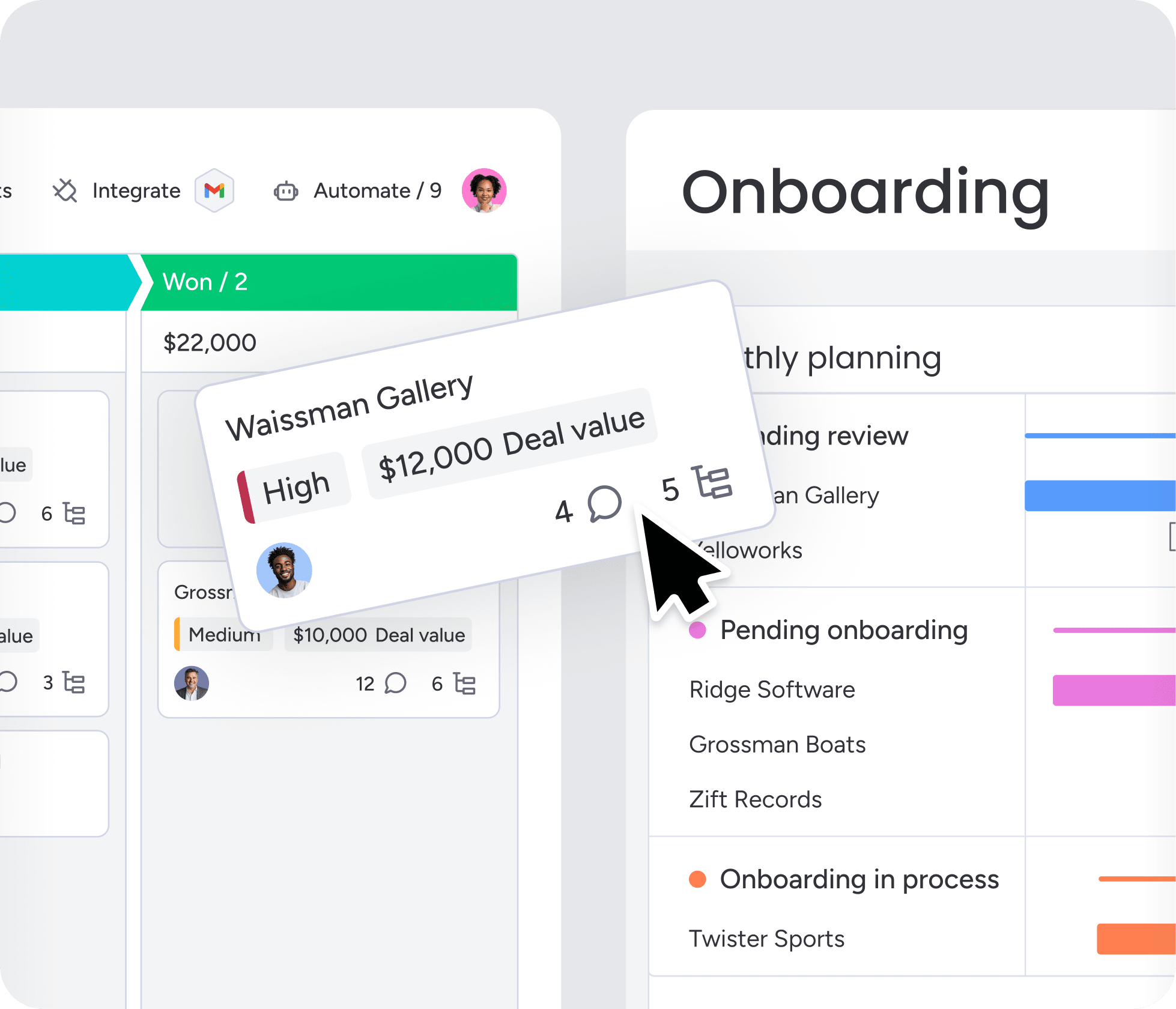
Personalized onboarding shapes each customer’s first experience around their use case, goals, and industry. When customers see value fast, they stick around.
Generic onboarding gets you generic results. A manufacturing company and a marketing agency have completely different needs, even if they’re using the same product. When onboarding treats them identically, neither gets the focused guidance that drives adoption. Fix it like this:
- Segment customers during signup: Capture use case, industry, company size, and goals during the signup or sales process. This data powers personalization from the first interaction.
- Deliver tailored onboarding content: Build different email sequences, tutorials, and check-in schedules based on customer type rather than sending everyone the same flow.
- Assign a customer success contact early: For high-value accounts, make this assignment during onboarding, not after problems arise.
4. Automate proactive follow-ups at key moments
Automated follow-ups kick in based on customer behavior, eliminating the need for manual intervention. When things get busy, critical moments slip through.
The table below maps the most important trigger events to the right timing and action:
| Trigger event | Timing | Recommended action |
|---|---|---|
| Post-purchase | 7–14 days | Check-in email asking about initial experience |
| Inactivity | 14–30 days | Re-engagement email with a value reminder |
| Milestone completion | Immediate | Congratulations message with next steps |
| Support ticket closed | 24–48 hours | Follow-up asking if the issue was resolved |
| Renewal approaching | 60–90 days | Renewal reminder with an account review offer |
| Usage threshold hit | Immediate | Upsell notification to the account manager |
Here’s how:
- Identify key retention moments: Map the customer journey and pinpoint where engagement matters most. These become your automation triggers.
- Build automated workflows: Set up workflows that trigger emails, tasks, or notifications when these moments occur.
- Keep follow-ups personal: Use the customer’s name, reference their specific usage or industry, and write in a conversational tone so automated messages don’t feel robotic.
5. Use customer feedback to improve every handoff
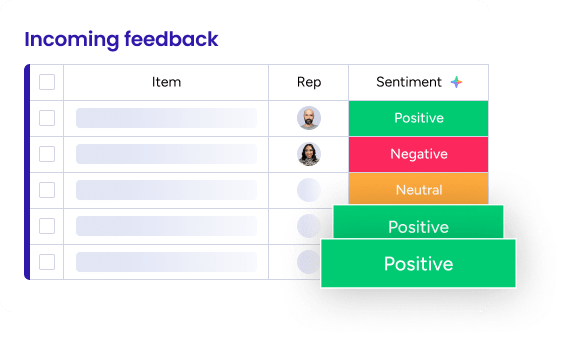
Use customer feedback from surveys, support tickets, and usage data to improve how teams hand off customers. Poor handoffs confuse customers and drive churn.
The most common handoff failures occur at predictable points:
- Sales to onboarding: Customer expectations set during sales don’t match the onboarding experience.
- Onboarding to account management: Context from onboarding doesn’t transfer, forcing customers to repeat themselves.
- Support to account management: Support resolves the immediate issue but doesn’t flag the underlying relationship risk.
Fix these gaps by:
- Collect feedback at key handoff points: Use brief surveys after major transitions. Ask specific questions like whether the onboarding experience matched what they expected from the sales process.
- Review feedback with cross-functional teams: Share findings in regular meetings so every team understands where friction is occurring.
- Adjust the handoff process based on patterns: If customers consistently report confusion after onboarding, add a follow-up call or create a handoff checklist for sales-to-onboarding transitions.
6. Create client retention programs that reward ongoing value
Client retention programs reward ongoing engagement, loyalty, and customer advocacy. The right program structure depends on your customer base and what motivates them. Here are the most common program types and how they work:
| Program type | Reward trigger | Example reward |
|---|---|---|
| Loyalty points | Purchases, referrals, engagement | Discounts, account credits, free months |
| Tiered membership | Usage milestones, tenure | Priority support, early access, dedicated account manager |
| Referral incentives | Successful referrals | Account credits, gift cards, exclusive perks |
| Anniversary rewards | Tenure milestones | Branded gifts, service upgrades, recognition |
Design your program around retention milestones like 1-year anniversaries, referral completions, or usage thresholds. Offer perks that deliver ongoing value, like free training, priority support, and account credits. Also, introduce the program early, during onboarding and renewal, so customers know about participation opportunities from the start.
Example: Starbucks Rewards uses points and gamification to encourage repeat purchases for its 75 million global members. In fact, loyalty members spend 3X more than non-members and 41% of U.S. sales are attributed to loyalty members.
7. Improve service retention across every customer channel
Service retention means giving customers great support no matter how they reach you. Bad support drives churn. Fast, helpful support keeps customers around.
Service retention requires 2 things: speed and context. Customers expect quick responses, but they also expect support teams to understand their history. Nothing erodes trust faster than explaining the same problem to 3 different agents. Do both by:
- Give support teams full customer history: This includes past tickets, purchase details, engagement data, and any notes from sales or account management.
- Set and track response time standards: Define SLAs for each channel and measure adherence consistently.
- Follow up after every support interaction: Proactively reach out to confirm the issue is truly resolved, not just closed.
8. Use account retention strategies for high-value customers
Account retention strategies give your most valuable customers dedicated resources, proactive check-ins, and custom support. Enterprise accounts, high-LTV customers, strategic partners — the ones who matter most.
For example, if 20% of customers generate 80% of revenue, then those customers deserve proportional retention attention. Account retention strategies allocate resources based on value, and here’s how to build one:
- Segment customers by value: Use revenue, contract size, strategic importance, or expansion potential as your criteria.
- Assign dedicated account managers: These should be people who know the customer’s business, understand their goals, and proactively identify opportunities and risks.
- Schedule regular check-ins: Quarterly business reviews, proactive strategy sessions, and consistent touchpoints ensure high-value customers never feel neglected.
9. Turn loyal customers into referrals and social proof
Loyal customers refer new business, give testimonials, and leave positive reviews. Referrals from loyal customers often generate higher conversion rates and lower acquisition costs than many acquisition channels.
Advocacy doesn’t happen automatically. Even satisfied customers need prompting, and the ask needs to come at the right moment with the right incentive. Turn advocacy into a system:
- Identify highly engaged customers: Look for signals of loyalty like high usage, positive feedback, long tenure, and expansion purchases.
- Ask at natural moments: Request referrals or testimonials after a win, such as post-renewal, after a successful project, or following a positive support interaction.
- Incentivize participation: Referral rewards increase participation. Testimonial requests should offer something in return, like recognition, case study co-marketing, or early access to new features.
Learn more: AI account signal agent
10. Reactivate customers with retention marketing strategies
Retention marketing targets inactive or at-risk customers with campaigns that bring them back before they leave. Many customers go inactive due to temporary circumstances like busy season, budget constraints, or lack of engagement.
The window for re-engagement is limited. Wait too long, and the customer has already switched to a competitor or forgotten why they signed up. Act fast:
- Define what “inactive” means for your business: No login in 30 days, no purchases in 90 days, or no feature usage in 2 weeks are common thresholds.
- Launch targeted re-engagement campaigns: Use personalized emails, special offers, and check-in calls that acknowledge the absence without being accusatory.
- Test different messaging approaches: Value reminders, new feature announcements, and limited-time incentives each resonate differently. Test to find what works for your audience.
5 customer retention metrics to track
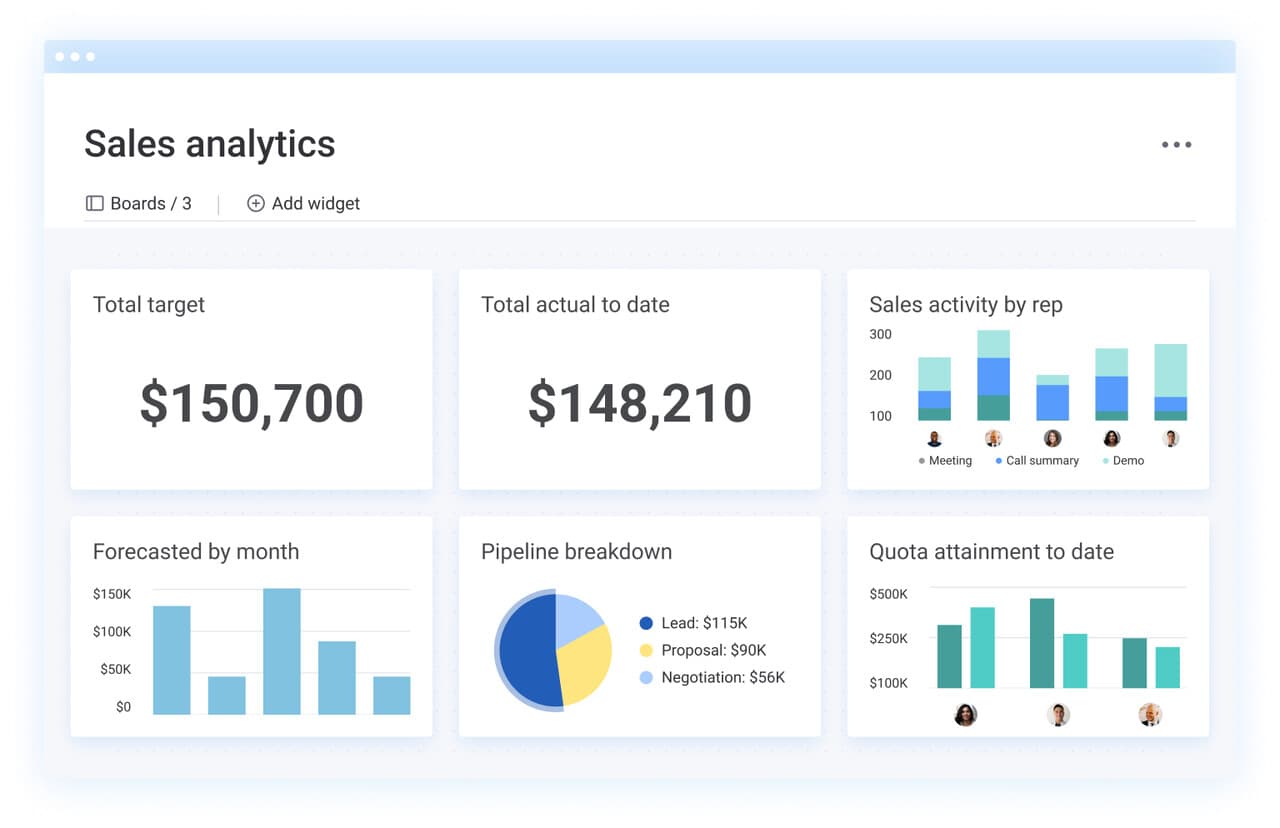
Track the right metrics to know if your retention strategies work. These 5 metrics help you spot problems early and measure what’s working.
1. Customer retention rate (CRR)
Customer retention rate is the percentage of customers who remain active over a specific period. It tells you how well you’re keeping customers. Here’s the calculation:
(Customers at end of period – new customers) ÷ customers at start of period × 100
Benchmarks to know:
- SaaS companies typically aim for 90%+ annual retention
- B2B service businesses often target 80–85%
- Anything below 70% signals a serious retention problem
2. Customer lifetime value (CLV)
Customer lifetime value (CLV) is the total revenue a customer generates over their entire relationship with the business. CLV helps determine how much to invest in retention efforts. Here’s how to calculate:
Average purchase value × purchase frequency × customer lifespan
Your CLV should be at least 3x customer acquisition cost (CAC). If it’s lower, retention strategies aren’t generating enough long-term value to justify acquisition spending.
3. Repeat customer rate
Repeat customer rate is the percentage of customers who make multiple purchases or renew their subscription over a given period. To calculate:
Customers who made multiple purchases ÷ total customers × 100
4. Customer health score
Customer health score is a composite metric that combines engagement signals like product usage, support interactions, and payment history to predict churn risk. To build one, assign point values to key behaviors, then aggregate scores to create a health rating.
Health scores should be actionable. If a score drops below a defined threshold, it should automatically trigger a retention workflow.
5. Net revenue retention (NRR)
Net revenue retention (NRR) is the percentage of recurring revenue retained from existing customers, including expansions, upgrades, and downgrades. To calculate:
(Starting revenue + expansion revenue – churned revenue) ÷ starting revenue × 100
While strong SaaS companies target 120%+ NRR, an NRR below 100% signals that churn is outpacing expansion.
How monday CRM helps teams turn retention strategies into workflows
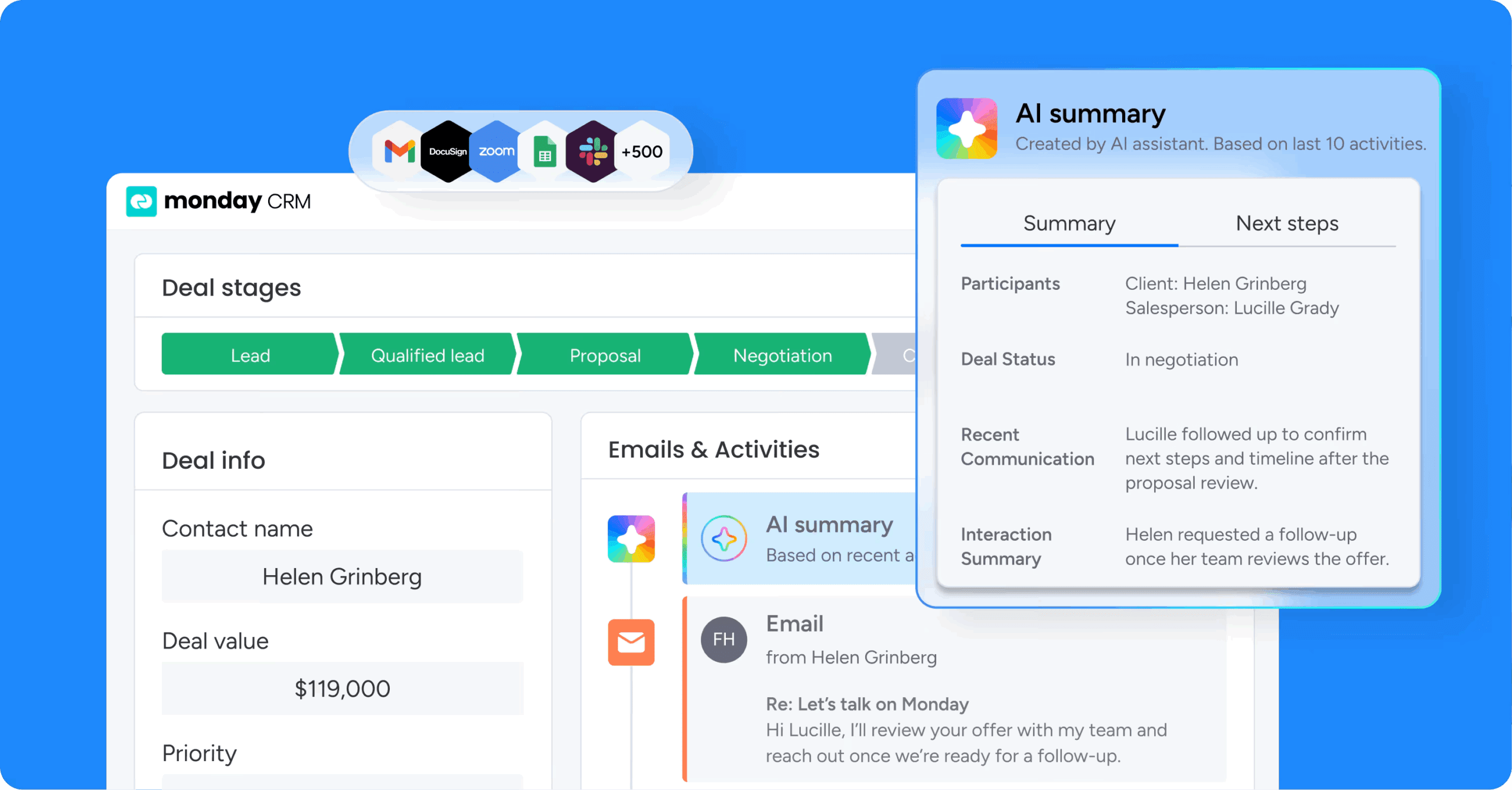
Retention strategies only work if your team can actually execute them. monday CRM gives you the tools to turn retention strategy into daily work — centralizing customer data, automating critical touchpoints, and giving every team the visibility they need to act fast.
Here’s how the platform helps you execute the strategies that matter most:
- Unified customer profiles: Consolidate every customer interaction into a single profile accessible to sales, support, and account management. Customer profiles include complete interaction history, deal and purchase records, support ticket integration, and custom fields for retention signals like health scores and at-risk flags. All customer context is preserved during handoffs so no one starts from scratch.
- Behavior-based automation: Build workflows that trigger retention actions automatically based on what customers do. Send re-engagement emails when customers go inactive, alert account managers when health scores drop, notify teams when renewals approach, and route feedback to the right team without manual intervention. Critical moments never get missed.
- Real-time retention dashboards: Track customer health overview, renewal pipeline, retention trends, and team performance metrics in customizable dashboards. Spot at-risk accounts before they churn and prioritize intervention efforts based on customer value with visibility that updates as your data changes.
- Cross-team collaboration workspace: Break down silos between sales, marketing, service, and account management with shared customer boards, automated handoff workflows, cross-team notifications, and unified communication history. Every team operates from the same customer data, eliminating the gaps that cause customers to fall through the cracks.
- AI-powered retention insights: Leverage AI capabilities to identify retention risks and opportunities faster. Get sentiment analysis from customer communications, auto-generated customer summaries, predictive health scoring based on behavior patterns, and email composition assistance for personalized outreach. Less manual work, more personalized engagement — even as you scale.
- Seamless integrations: Connect monday CRM with your existing tools to create a complete retention system. Integrate with support platforms, marketing automation, billing systems, and communication tools so customer data flows automatically across your tech stack.
The result is a retention system that runs consistently across your entire organization. Teams know exactly when to act, what context matters, and how their work connects to broader retention goals.

“With monday CRM, we’re finally able to adapt the platform to our needs — not the other way around. It gives us the flexibility to work smarter, cut costs, save time, and scale with confidence.”
Samuel Lobao | Contract Administrator & Special Projects, Strategix
“Now we have a lot less data, but it’s quality data. That change allows us to use AI confidently, without second-guessing the outputs.”
Elizabeth Gerbel | CEO
“Without monday CRM, we’d be chasing updates and fixing errors. Now we’re focused on growing the program — not just keeping up with it."
Quentin Williams | Head of Dropship, Freedom Furniture
“There’s probably about a 70% increase in efficiency in regards to the admin tasks that were removed and automated, which is a huge win for us.“
Kyle Dorman | Department Manager - Operations, Ray White
"monday CRM helps us make sure the right people have immediate visibility into the information they need so we're not wasting time."
Luca Pope | Global Client Solutions Manager at Black Mountain
“In a couple of weeks, all of the team members were using monday CRM fully. The automations and the many integrations, make monday CRM the best CRM in the market right now.”
Nuno Godinho | CIO at Velv
“monday.com provides developmental flexibility, operational efficiency, and data transparency — all in one place. We became a company that moved from chasing data to leading with it.”
Hyunghan Lee | Team Lead, Sandbox Network
"monday.com brought every part of our business into one connected space. The harmony between work management and CRM has become our operating system — giving us the clarity and confidence to scale.”
Jennifer Chinburg | Executive Vice President of Corporate Development & Brand, Chinburg Properties
“We just weren’t getting value from our old CRM. With monday.com, it's a thousand times better. Our sales teams are more informed, more consistent, and far more connected."
James Arnold | Chief Operating Officer, CenversaTurn customer retention into a repeatable process
You can’t keep customers with one campaign or a discount. You need systems that catch problems early, reward loyalty, and give every team the context to act fast.
These strategies work because you can actually execute them. Each one maps to a workflow your team can own, automate, and improve over time. Start with the areas where your current process has the most gaps, whether that’s centralizing customer data, automating follow-ups, or building out your health score model.
Try monday CRMFAQs
What are the most effective customer retention strategies?
The most effective customer retention strategies are those that combine proactive onboarding, automated health-based follow-ups, structured renewal workflows, and cross-team visibility. Success comes from implementing strategies with clear ownership, defined triggers, and measurable outcomes that teams can execute consistently.
How do you identify at-risk customers before they churn?
Identify at-risk customers by monitoring inactivity signals like reduced login frequency, declining feature usage, and missed milestones. Track sentiment through support interactions and communication tone, watch for unresolved tickets or escalations, and flag accounts approaching renewal without engagement.
Which customer retention metrics should you track?
Track customer retention rate to measure overall success, customer lifetime value to understand revenue impact, repeat customer rate for engagement trends, customer health scores for predictive insights, and net revenue retention to balance churn against expansion revenue.
How do you personalize customer communication at scale?
Personalize communication at scale by segmenting customers during onboarding, setting milestone-based triggers for automated outreach, using account context in every message, and leveraging AI-assisted writing tools to maintain a human touch while reducing manual work.
What's the difference between customer retention and customer loyalty?
Customer retention measures whether customers continue doing business with a company over time. Customer loyalty goes deeper, measuring emotional attachment and advocacy. Retention is necessary for loyalty, but a customer might renew out of convenience while actively seeking alternatives.
How can a CRM help with customer retention?
A CRM helps with customer retention by centralizing customer records and communication history, automating follow-ups and renewal reminders, providing AI-powered insights for risk detection, enabling cross-team collaboration on retention efforts, and tracking retention metrics in real-time dashboards.
