

Your funnel is already working — just not as efficiently as it could.
Prospects are engaging with your brand every day, but too many drop off before converting, expanding, or recommending you to others. Each missed handoff, delayed follow-up, or disconnected experience quietly limits growth potential.
Marketing funnel optimization unlocks the value already inside your pipeline. By improving how prospects move between stages, teams increase conversions without needing more budget, more campaigns, or more complexity.
In 2026, optimization is no longer about isolated tactics. It’s about building connected workflows that align marketing, sales, and customer success around shared performance signals. When teams operate from the same data and priorities, improvements scale faster and results compound.
This post walks through the framework modern organizations use to optimize funnels systematically — combining AI insights, experimentation, and structured workflows to turn interest into long-term revenue.
Key takeaways
- Focus on the entire customer journey, not just individual stages: Optimize every touchpoint from awareness to advocacy to maximize revenue and reduce acquisition costs across your complete funnel.
- Break down team silos with shared goals and unified dashboards: Marketing, sales, and customer success must work together with the same metrics and real-time visibility to drive consistent results.
- Coordinate complex optimization workflows on monday work management: Use AI Blocks for lead categorization, Digital Workers for campaign insights, and centralized dashboards to manage multiple funnels without losing visibility.
- Measure what matters with stage-to-stage conversion rates: Track how prospects move between awareness, consideration, and decision stages to identify specific bottlenecks that limit growth.
- Build repeatable optimization processes, not one-time fixes: Create systematic frameworks for testing, measuring, and scaling improvements so optimization becomes a sustainable competitive advantage.
What is marketing funnel optimization?
Marketing funnel optimization is the systematic process of analyzing, testing, and improving every stage of the customer journey to increase conversion rates and maximize revenue. You identify bottlenecks, remove friction, and create smooth experiences that take prospects from discovery to advocacy.
It’s helpful to imagine your customer journey like water flowing through pipes. In an unoptimized funnel, blockages and leaks slow everything down — you’re losing prospects before they convert. Optimization finds these blockages (confusing landing pages, slow sales follow-up, missing social proof) and clears them so more prospects convert.
Effective funnel optimization today goes beyond tweaking ad copy or button colors. It needs coordinated workflows across marketing, sales, and customer success. A work management platform serves as the operational backbone for this coordination, ensuring that data, insights, and actions flow freely between departments to support the customer journey.
How does marketing funnel optimization drive business growth?
Funnel optimization links small improvements to real business results. When you focus on the entire system instead of isolated metrics, you get three major benefits:
- Revenue acceleration: Small improvements stack up fast. A 2% increase in conversion at each stage doesn’t just add 2% overall. It compounds, generating much higher revenue without needing more traffic.
- Cost efficiency: Optimization lowers Customer Acquisition Cost (CAC) because your marketing spend converts more customers. Better conversion rates mean every marketing dollar works harder.
- Predictable growth: When you know how traffic and leads turn into revenue, you can forecast growth accurately and scale with confidence.
The shift from isolated tactics to unified workflows
The best teams have ditched siloed campaigns, disconnected platforms, and fragmented data. In the old model, marketing ran campaigns without sales input, sales couldn’t see prospect history, and customer success worked separately from acquisition.
The new standard for 2026 is integrated funnel management, where optimization is a cross-functional discipline. Unified workflows smooth out handoffs between teams, keep everyone accountable for revenue, and maintain consistent messaging.
Effective funnel optimization today goes beyond tweaking ad copy or button colors. It needs coordinated workflows across marketing, sales, and customer success.
Understanding marketing, conversion, and sales funnel optimization
Funnel optimization isn’t one single activity — it happens across multiple layers of the customer journey. Some improvements focus on attracting the right audience, others improve how prospects interact with your content, and others help sales convert qualified opportunities into revenue.
Understanding where each type of optimization fits prevents teams from solving the wrong problem. Strong traffic won’t fix weak conversion experiences, and better landing pages won’t resolve slow sales cycles. Each layer of the funnel requires a different approach, but they work best when optimized together.
| Optimization type | Primary focus | Key activities | Core metrics |
|---|---|---|---|
| Marketing funnel | Top and middle of funnel (awareness, interest, consideration) | Content strategy, SEO, social media, paid advertising | Traffic volume, engagement rates, lead quality, cost per lead |
| Conversion funnel | Specific interaction points across the journey | Landing page optimization, A/B testing, form optimization | Conversion rates, click-through rates, form completion rates |
| Sales funnel | Bottom of funnel (qualified leads to customers) | Personal outreach, demos, negotiations, proposals | Close rates, average deal size, sales cycle length |
Marketing funnel optimization
Marketing funnel optimization targets the awareness, interest, and consideration stages. It’s about attracting the right audience and nurturing them until they’re ready to buy.
Key characteristics include:
- Audience focus: Attracting, educating, and qualifying potential customers through targeted messaging.
- Content-driven approach: Relying heavily on blog posts, social media, webinars, and whitepapers to build authority.
- Long-term metrics: Tracking traffic volume, engagement rates, lead quality, and cost per lead.
- Relationship building: Focusing on longer-term relationship building and market education.
Conversion funnel optimization
Conversion funnel optimization (CFO) focuses on turning visitors into leads and leads into customers. It works within the broader marketing and sales funnels but focuses on specific touchpoints to boost efficiency.
This approach includes:
- Tactical optimization: Optimizing landing pages, forms, calls-to-action, and checkout processes.
- Testing methodology: Utilizing A/B testing, multivariate testing, and user experience analysis to validate improvements.
- Immediate metrics: Measuring conversion rates, form completion rates, and click-through rates.
- Short-term focus: Concentrating on immediate to short-term conversion events and user behaviors.
Sales funnel optimization
Sales funnel optimization targets the bottom of the funnel — converting qualified leads into paying customers and increasing deal value. It’s process-heavy and depends on human-to-human interaction.
The approach involves:
- Personal engagement: Personal outreach, demos, negotiations, and custom proposals.
- Process refinement: Refining sales methodologies, pipeline management, and objection handling.
- Revenue metrics: Tracking close rates, average deal size, and sales cycle length.
- Extended timelines: Managing direct sales interactions and deal progression over weeks or months.
Choosing the right optimization approach
The right focus depends on where performance is breaking down. Some teams need more qualified traffic, others need better conversion from existing demand, and many need stronger alignment between marketing and sales to turn pipeline into revenue.
Early-stage companies often focus on marketing funnel optimization to build awareness and generate leads. As traffic grows, conversion funnel optimization helps improve how efficiently visitors become opportunities. More established organizations typically prioritize sales funnel optimization to shorten deal cycles and improve win rates.
As teams scale, optimizing stages separately becomes harder to manage. Connected work platforms help coordinate improvements across the full funnel, giving teams shared visibility into performance and handoffs. Solutions like monday work management support this approach by aligning marketing, sales, and customer success around the same workflows and metrics.
Try monday work managementThe 5 stages of effective marketing funnel optimization
Optimization isn’t a one-time project — it’s an ongoing process. A solid framework covers five stages, each with clear objectives and metrics that work together to create a smooth customer experience.
Awareness stage
The awareness stage is when potential customers discover your brand or realize they have a problem to solve. You need to reach the right audience and make a strong first impression that keeps them exploring.
At this stage, your goal is to reach the right audience and make a strong first impression that keeps them exploring. To achieve this, you need to focus on activities that build brand recognition and address audience pain points directly.
- Content strategy: Developing valuable, discoverable content that directly addresses audience pain points and questions.
- SEO and search optimization: Ensuring high visibility when prospects search for relevant solutions or topics.
- Social media presence: Building brand recognition and thought leadership through consistent engagement.
- Paid advertising: Executing targeted campaigns that reach ideal customer profiles efficiently.
Success metrics include brand awareness, organic traffic growth, social media reach, and share of voice.
Consideration stage
In the consideration stage, prospects are actively comparing solutions. Optimization positions the brand as the preferred choice through education, trust-building, and differentiation.
Key optimization activities include:
- Educational content: Publishing in-depth guides, case studies, and comparison charts that aid decision-making.
- Lead nurturing: Deploying automated email sequences that provide value and build trust over time.
- Social proof: Highlighting customer testimonials, reviews, and success stories to validate claims.
- Personalization: Tailoring content recommendations based on prospect behavior and preferences.
Success metrics include email engagement rates, content consumption depth, lead scoring progression, and time on site.
Decision stage
In the decision stage, prospects are ready to purchase. Optimization efforts focus on removing final barriers, simplifying the buying process, and providing compelling reasons to choose your solution over competitors.
Key optimization activities include:
- Sales enablement: Equipping sales teams with the right content, competitive battle cards, and insights.
- Proposal optimization: Simplifying the quote and proposal process to reduce friction.
- Objection handling: Proactively addressing common concerns regarding price, implementation, or features.
- Urgency creation: Utilizing limited-time offers or implementation timelines to encourage action.
Success metrics include proposal-to-close rates, sales cycle length, average deal size, and win rates.
Retention stage
Customer retention optimization focuses on keeping customers engaged and satisfied immediately after purchase. This stage is critical for long-term profitability, as retaining existing customers is significantly more cost-effective than acquiring new ones.
Key optimization activities include:
- Onboarding optimization: Ensuring customers achieve time to value quickly through structured onboarding.
- Customer success programs: Providing proactive support and regular check-ins to ensure value realization.
- Usage monitoring: Identifying at-risk customers based on low engagement before they churn.
- Expansion opportunities: Identifying natural points in the customer lifecycle for upsells and cross-sells.
Success metrics include customer satisfaction scores (CSAT), product adoption rates, churn rates, and expansion revenue.
Advocacy stage
Advocacy occurs when satisfied customers become active promoters of the brand. This stage creates a powerful multiplier effect, where existing customers drive new awareness and consideration, lowering overall acquisition costs.
Key optimization activities include:
- Referral programs: Implementing systematic approaches to encourage, track, and reward referrals.
- User-generated content: Encouraging customers to share their success stories and experiences publicly.
- Community building: Creating digital spaces for customers to connect, share best practices, and network.
- Case study development: Documenting and promoting customer success stories for use in marketing.
Success metrics include Net Promoter Score (NPS), referral rates, volume of user-generated content, and customer lifetime value (CLV).
Success metrics include brand awareness, organic traffic growth, social media reach, and share of voice.
7 essential metrics for marketing funnel optimization
Data-driven optimization requires a foundation of actionable metrics. These seven indicators work together to provide a complete picture of funnel health and performance, helping you identify where your funnel needs attention and which improvements will drive the greatest impact.
1. Customer Acquisition Cost (CAC)
Customer Acquisition Cost represents the total cost of acquiring a new customer, including all marketing and sales expenses, salaries, and overhead. Calculate it by dividing total sales and marketing costs by the number of new customers acquired.
CAC determines the sustainability of a growth strategy — a rising CAC without a corresponding increase in customer value signals a need for immediate optimization.
2. Customer Lifetime Value (CLV)
Customer Lifetime Value represents the total revenue a customer generates throughout their relationship with a company. Calculate it by multiplying average purchase value by purchase frequency and customer lifespan.
The ratio of CLV to CAC is a vital health metric — a ratio of 3:1 or higher is typically required for sustainable growth.
3. Stage-to-stage conversion rates
These metrics measure the efficiency of prospect movement from one funnel stage to the next. Key conversion points include:
- Visitor-to-lead conversion: How effectively you capture contact information.
- Lead-to-opportunity conversion: How well marketing qualifies prospects for sales.
- Opportunity-to-customer conversion: How efficiently sales closes deals.
Analyzing these rates isolates specific bottlenecks. A high lead volume but low opportunity rate suggests a lead quality issue or friction point in the handoff to sales.
4. Marketing Qualified Lead (MQL) to Sales Qualified Lead (SQL) ratio
The MQL-to-SQL ratio measures the percentage of marketing-generated leads that sales teams accept as qualified opportunities. This metric serves as a barometer for alignment between marketing and sales.
A low ratio indicates either poor lead quality or misaligned qualification criteria.
5. Average time to conversion
Average time to conversion tracks the duration from first touch to closed deal. While this metric varies by industry and deal size, tracking it reveals friction in the process.
Reducing time to conversion accelerates revenue recognition and frees up sales resources.
6. Return on Ad Spend (ROAS)
Return on Ad Spend measures the revenue generated for every dollar spent on advertising. Calculate it by dividing revenue from ads by total ad spend.
While ROAS measures immediate advertising effectiveness, view it alongside CLV for the full picture.
7. Incremental revenue lift
Incremental revenue lift measures the additional revenue generated specifically from optimization efforts compared to baseline performance. Establishing baselines and using control groups allows organizations to isolate the impact of specific changes.
Try monday work management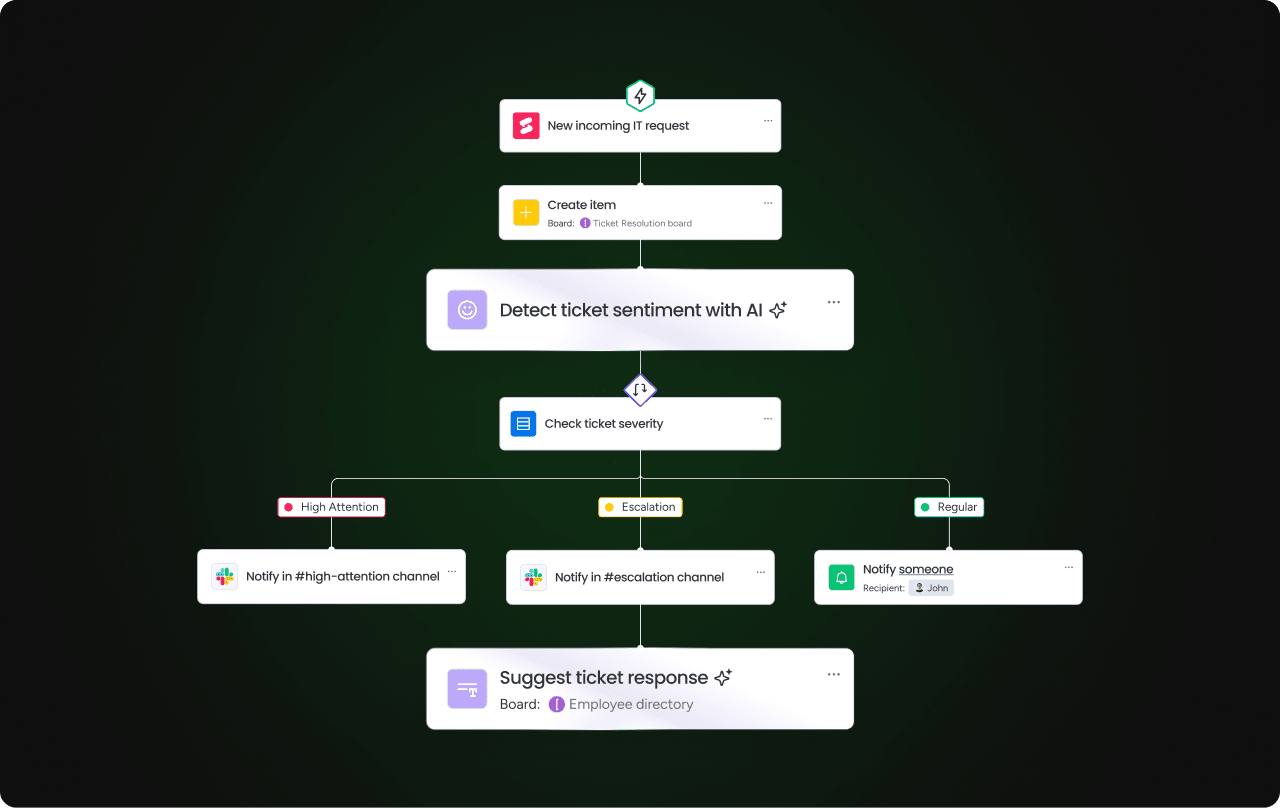
How to optimize your awareness stage for maximum reach
The awareness stage is where potential customers first discover your brand. Strong visibility ensures your funnel consistently attracts the right audience and creates momentum for the stages that follow.
The following approaches focus on expanding reach, improving discoverability, and attracting prospects who are more likely to convert later in the journey.
Scale content marketing with AI-powered workflows
AI transforms content marketing from a manual bottleneck into a scalable, data-driven operation. Work management platforms orchestrate these AI-powered workflows across teams through four key areas:
- Content ideation: AI analyzes search trends, competitor gaps, and audience behavior to generate high-impact topic clusters.
- Content creation: AI assistants draft, edit, and optimize content for search intent and readability.
- Content distribution: Workflows automatically publish and promote content across multiple channels simultaneously.
- Performance optimization: AI continuously analyzes engagement data to suggest real-time improvements.
Implement Answer Engine Optimization (AEO)
Answer Engine Optimization optimizes content to appear in AI-powered search results and voice search responses. Unlike traditional SEO, AEO focuses on providing direct, comprehensive answers through:
- Question-focused content: Creating content that directly answers user queries.
- Schema markup: Helping AI parse context and meaning.
- Featured snippet optimization: Structuring content for AI comprehension.
- Natural language format: Writing in conversational, accessible language.
Leverage commerce media networks
Commerce media networks allow brands to advertise within e-commerce ecosystems. These platforms offer unique advantages:
- High-intent audiences: Access to users already in a shopping mindset.
- Rich targeting options: Based on actual purchase history and behavior.
- Closed-loop attribution: Direct tracking from ads to sales.
- Competitive advantage: Reaching customers when they’re comparing options.
Build modern brand measurement systems
Modern brand measurement moves beyond vanity metrics like impressions to focus on business impact:
- Multi-touch attribution: Understanding how various touchpoints contribute to conversions.
- Brand lift studies: Measuring changes in awareness and perception.
- Cross-channel tracking: Following journeys across online and offline environments.
- Predictive analytics: Forecasting future campaign performance.
Drive consideration through advanced personalization
Personalization transforms the consideration stage from generic broadcasting into tailored experiences that address individual needs. When every prospect receives content that speaks directly to their specific challenges, engagement rates increase dramatically and sales cycles accelerate.
Create dynamic personalization workflows
Dynamic personalization automatically customizes content and messaging based on prospect data. Workflow automation platforms enable marketing teams to manage these complex rules without coding:
- Behavioral triggers: Adjust content based on website visits, email clicks, and resource downloads.
- Demographic personalization: Shift messaging based on the prospect’s industry, company size, or role.
- Journey stage customization: Change calls-to-action depending on where the prospect is in the buying cycle.
- Real-time adaptation: Update the experience instantly as new data is collected during the session.
Design multi-touch lead nurturing campaigns
Multi-touch nurturing coordinates engagement across channels to build trust. Effective campaigns rely on careful orchestration across four key touchpoints:
- Email sequences: Automated series of value-add content rather than sales pitches.
- Social media engagement: Retargeting and organic content to reinforce messages delivered via email.
- Retargeting campaigns: Display ads that keep the brand top-of-mind between direct interactions.
- Direct mail integration: Physical touchpoints that cut through digital noise for high-value prospects.
Deploy cross-channel attribution models
Cross-channel attribution reveals the true drivers of conversion. Models range from first-touch, which credits discovery, to multi-touch, which distributes credit across the journey.
Implementing these models requires integrated data from all marketing channels and sophisticated analytics to inform budget allocation and strategy adjustments.
How to accelerate decision-making with conversion optimization
The decision stage is where intent turns into action. Even small points of friction can delay purchases or cause prospects to reconsider, making this stage critical for improving overall funnel performance.
The following approaches focus on simplifying choices, strengthening confidence, and helping qualified prospects move forward faster.
Run AI-powered A/B testing programs
AI elevates A/B testing from manual experiments to continuous optimization through four key capabilities:
- Automated test design: AI tools create experiments based on best practices.
- Dynamic traffic allocation: Real-time allocation to winning variations.
- Statistical significance monitoring: Automated test completion at the right moment.
- Multi-variate testing: Complex testing to find optimal element combinations.
Align sales enablement workflows
Sales enablement bridges the gap between marketing leads and closed deals. Success depends on workflows that keep sales teams equipped:
- Content management: Organize and update sales materials centrally based on performance data.
- Lead intelligence: Provide sales reps with detailed prospect behavior history before outreach.
- Conversation guides: Offer scripts and talking points tailored to the prospect’s specific journey stage.
- Objection handling resources: Keep materials readily available to address competitive questions and concerns.
Implement real-time behavioral triggers
Behavioral triggers are automated responses to actions that signal high intent. Examples include:
- Immediate sales alerts: When a prospect visits a pricing page.
- Automated scheduling workflows: For demo requests.
- Competitive positioning alerts: When a prospect views comparison content.
Effective trigger management requires integrated systems that track behavior and instantly initiate cross-team actions.
Try monday work managementBuild retention through systematic customer success
Retention is where sustainable growth takes shape. When customers see consistent value, they stay engaged, expand their investment, and build stronger relationships with your brand over time.
Improving retention requires clear visibility into customer experience, proactive support, and structured processes that help teams identify risks early and strengthen long-term engagement.
Design predictive churn prevention workflows
Predictive churn prevention uses data to spot at-risk customers before they leave. Work management platforms coordinate the intervention through:
- Usage monitoring: Track drops in login frequency or feature adoption.
- Health scoring: Combine multiple data points to create dynamic customer health scores.
- Risk alerts: Trigger automated notifications when scores drop below thresholds.
- Intervention workflows: Assign tasks to customer success teams to reach out and resolve issues proactively.
Optimize customer journey mapping
Customer journey mapping documents and improves the post-purchase experience. Key elements include:
- Onboarding optimization: Ensuring early wins and value realization.
- Support touchpoint simplification: Reducing frustration and friction.
- Natural expansion identification: Finding opportunities based on usage patterns.
- Renewal process refinement: Ensuring seamless contract continuation.
Create automated engagement campaigns
Automated engagement keeps customers active and informed. Campaigns focus on:
- Feature adoption: Driving usage of underutilized capabilities.
- Educational content delivery: Series to deepen expertise.
- Success milestone celebration: Building loyalty through recognition.
- Expansion opportunity alerts: Based on customer growth patterns.
Turn customers into advocates with scalable programs
Advocacy optimization systematizes word-of-mouth marketing, turning happy customers into a growth engine. The key is creating structured programs that make it easy for satisfied customers to share their positive experiences while providing meaningful incentives for their efforts.
Manage referral programs at scale
Systematic referral management makes it easy for customers to drive new business. Programs require:
- Robust tracking systems: To attribute leads correctly and measure program effectiveness.
- Automated incentive management: To distribute rewards instantly and accurately.
- Referral enablement kits: Giving customers the language and assets they need to promote the brand effectively.
Systematize user-generated content
User-generated content builds trust through authenticity. Systematization involves:
- Automated outreach: To solicit reviews and stories from satisfied customers.
- Curation processes: To organize and approve content for brand consistency.
- Amplification workflows: To distribute UGC across marketing channels.
- Recognition programs: That reward contributors and encourage participation.
Build community engagement workflows
Community engagement fosters loyalty and peer-to-peer support. Management involves:
- Online discussion forums: Maintaining spaces for customer interaction.
- Content moderation: Ensuring positive interactions and valuable discussions.
- Expert facilitation: Connecting customers with internal experts.
- Event coordination: Managing user conferences and webinars.

8 proven marketing funnel optimization strategies
These battle-tested strategies provide a practical roadmap for organizations at any maturity level. Each strategy addresses a specific operational challenge that limits optimization effectiveness, offering concrete steps to improve funnel performance.
1. Establish full-funnel measurement frameworks
Comprehensive measurement requires tracking metrics across all funnel stages and understanding their interconnectivity. This involves:
- Standardizing metric definitions: Ensuring consistency across teams.
- Creating centralized dashboards: For real-time visibility.
- Implementing attribution modeling: To understand touchpoint impact.
- Benchmarking performance: To track improvements over time.
2. Create cross-functional team workflows
Funnel optimization demands collaboration. Effective workflows include:
- Communication protocols: Established rhythms for regular updates.
- Shared documentation: Acting as a single source of truth.
- Handoff procedures: Defined processes for transferring prospects between teams.
- Performance alignment: Through shared goals and metrics.
3. Automate manual marketing processes
Automation frees teams to focus on strategy. Key areas for automation include:
- Lead scoring and routing: Automatically directing qualified leads to sales.
- Email campaign management: Based on behavioral triggers.
- Social media scheduling: Consistent posting across platforms.
- Performance reporting: Automated insights and alerts.
4. Build dynamic content management systems
Dynamic content systems serve relevant material automatically. This requires:
- Content tagging: By topic and funnel stage.
- Personalization rules: Dictating what to show whom.
- Performance tracking: To identify winning content.
- Continuous optimization: Based on engagement data.
5. Deploy real-time personalization at scale
Scalable personalization uses technology to customize experiences for thousands of users simultaneously. This includes:
- Dynamic website content: Adapting based on visitor behavior.
- Personalized email messaging: Tailored to individual preferences.
- Targeted advertising: Based on detailed user profiles.
- Algorithmic product recommendations: Driven by purchase history.
6. Implement portfolio-level funnel management
Portfolio management optimizes multiple funnels simultaneously. It involves:
- Strategic resource allocation: Across different initiatives.
- Performance benchmarking: Between different funnels.
- Cross-funnel insights: Applying learnings broadly.
- Integrated reporting: For a holistic view of marketing health.
7. Enable incrementality testing programs
Incrementality testing measures the true impact of marketing by comparing exposed audiences to unexposed control groups. Success requires:
- Control group management: Strict protocols to maintain test integrity.
- Statistical analysis: Rigorous measurement of results.
- Test coordination: To avoid interference between experiments.
- Results application: Disciplined implementation of findings.
8. Standardize processes with templates
Standardization ensures consistency and speed. Organizations should develop templates for:
- Campaign planning: Structured approach to initiative development.
- Content creation: Consistent quality and messaging.
- Performance analysis: Standardized reporting and insights.
- Project management: Accelerated execution and reduced errors.
Comprehensive measurement requires tracking metrics across all funnel stages and understanding their interconnectivity.
Building cross-team workflows for funnel optimization success
Funnel performance also depends on how well teams work together across the customer journey. When marketing, sales, and customer success operate from separate priorities or disconnected data, progress slows and opportunities slip through gaps.
Shared workflows create alignment around the same goals, metrics, and customer context. With clearer handoffs and consistent visibility, teams can coordinate improvements that strengthen performance across the entire funnel.
Breaking down marketing and sales silos
Traditional structures create barriers that lead to misaligned goals. Breaking these silos involves:
- Shared goal setting: Creating objectives that require cooperation.
- Regular communication rhythms: Establishing consistent touchpoints.
- Integrated planning sessions: Joint strategy development.
- Cross-training initiatives: Teams understanding each other’s challenges.
Establishing shared KPIs across teams
Shared KPIs align incentives. Instead of optimizing for individual metrics, teams focus on:
- Revenue attribution: Understanding how each team contributes to sales.
- Customer lifetime value: Measuring long-term relationship success.
- Funnel velocity: Speed of prospect movement through stages.
- Customer satisfaction: Ensuring positive experiences throughout the journey.
These metrics require joint effort to improve.
Creating unified performance dashboards
Unified dashboards eliminate data disputes by providing a single source of truth. These dashboards display:
- Real-time metrics: Current performance across all teams.
- Historical trend analysis: Patterns and improvements over time.
- Automated alert systems: For anomalies and opportunities.
- Drill-down capabilities: Allowing stakeholders to investigate performance drivers.
Optimizing resource allocation across campaigns
Effective allocation places resources where they generate the most impact. Decisions should be based on:
- Performance data: Historical and real-time results.
- Market opportunities: External factors and timing.
- Team capacity: Available resources and skills.
- Strategic priorities: Long-term business objectives.
This ensures that high-potential campaigns receive the necessary budget and personnel.

How AI and automation transform marketing funnel optimization
AI and automation help teams identify opportunities faster, reduce manual work, and continuously improve funnel performance. Instead of reacting to reports after campaigns finish, teams can act on insights as performance data evolves.
Automate data organization and lead insights
AI structures large volumes of funnel data automatically, making performance patterns easier to understand and act on.
- Categorizing leads based on behavior or profile data.
- Extracting key details from forms and messages.
- Detecting sentiment in feedback.
- Summarizing reports into clear insights.
Support faster campaign decisions
AI highlights performance trends quickly, helping teams adjust strategy without waiting for manual analysis.
- Identifying engagement and conversion patterns.
- Recommending targeting or budget adjustments.
- Highlighting high-performing audience segments.
Identify risks earlier with predictive signals
Predictive insights help teams spot issues before they impact results or revenue.
- Flagging potential campaign underperformance.
- Identifying declining lead quality.
- Detecting churn risk indicators.
Turn insights into continuous improvement
AI-driven recommendations support ongoing testing and refinement, helping teams improve results over time.
- Detecting patterns across large datasets.
- Forecasting likely performance outcomes.
- Recommending adjustments to campaigns or messaging.
- Supporting faster experimentation cycles.
A framework for continuous marketing funnel optimization
Consistent funnel improvement comes from structured processes, not one-off experiments. When optimization follows a clear framework, teams can identify opportunities faster, test changes with confidence, and scale what works without losing momentum.
The steps below outline how to create a practical system for ongoing optimization, helping teams improve performance steadily as strategies, channels, and customer behavior evolve.
Step 1: map your current marketing funnel workflows
You cannot optimize what you do not understand. The mapping process involves:
- Identifying every customer touchpoint: From first awareness to advocacy.
- Assigning team responsibilities: Who owns each stage and handoff.
- Documenting handoff points: Where prospects move between teams.
- Cataloging all tools involved: Understanding the technology stack.
- Establishing baseline performance metrics: Current conversion rates and timelines.
This exercise often reveals immediate opportunities for improvement.
Step 2: identify high-impact optimization opportunities
Prioritization ensures resources focus on the most valuable improvements. Teams should assess opportunities based on:
- Performance gaps: Where current results fall short of goals.
- Volume impact: How many prospects are affected.
- Revenue potential: Expected financial return.
- Implementation feasibility: Required resources and timeline.
A prioritization matrix helps focus efforts on high-impact, low-effort wins first.
Step 3: build repeatable optimization processes
Optimization must be a habit, not an event. Repeatable processes include:
- Scheduled performance reviews: Regular assessment of funnel health.
- Systematic hypothesis development: Structured approach to identifying improvements.
- Standardized experimentation protocols: Consistent testing methodology.
- Defined rollout workflows: For implementing successful changes across the organization.
Step 4: measure and iterate framework performance
The optimization framework itself requires optimization. Teams must evaluate:
- Process effectiveness: Are improvements being identified and implemented?
- Resource efficiency: Is the team spending time on high-value activities?
- Team adoption: Are all stakeholders following the process?
- Business impact: Is the framework driving measurable results?
This ensures the system continues to deliver value as the organization scales.
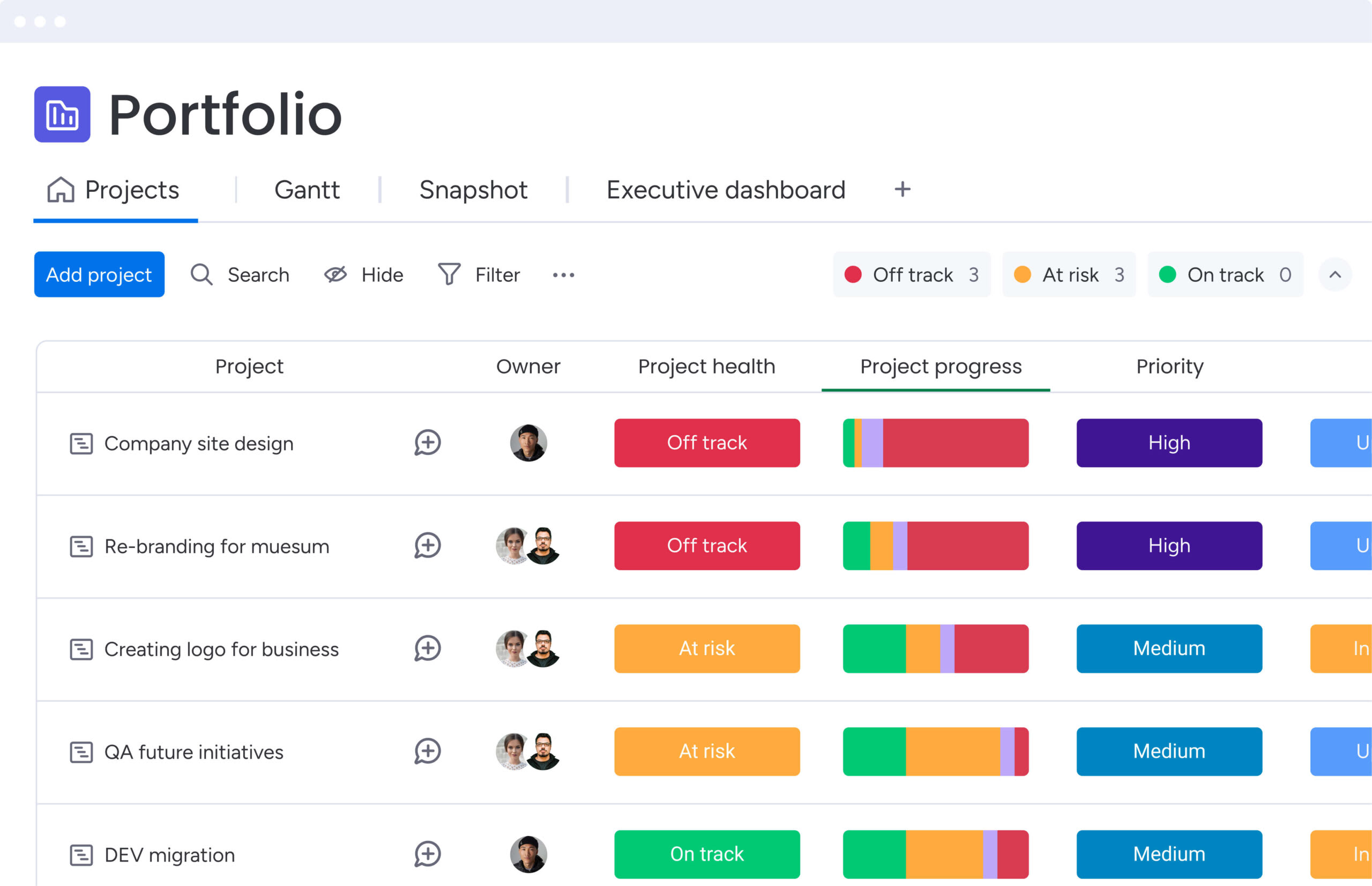
Scale your marketing funnel optimization with monday work management
Optimization works best when teams can see performance clearly and act on insights quickly. When experiments, metrics, and workflows are connected, improvements become easier to test, implement, and expand across the funnel.
monday work management helps teams coordinate optimization efforts in one place, giving visibility into performance, progress, and priorities so improvements can scale consistently over time.
Manage multiple funnels across your portfolio
The intelligent and powerful platform enables organizations to coordinate complex portfolios with ease:
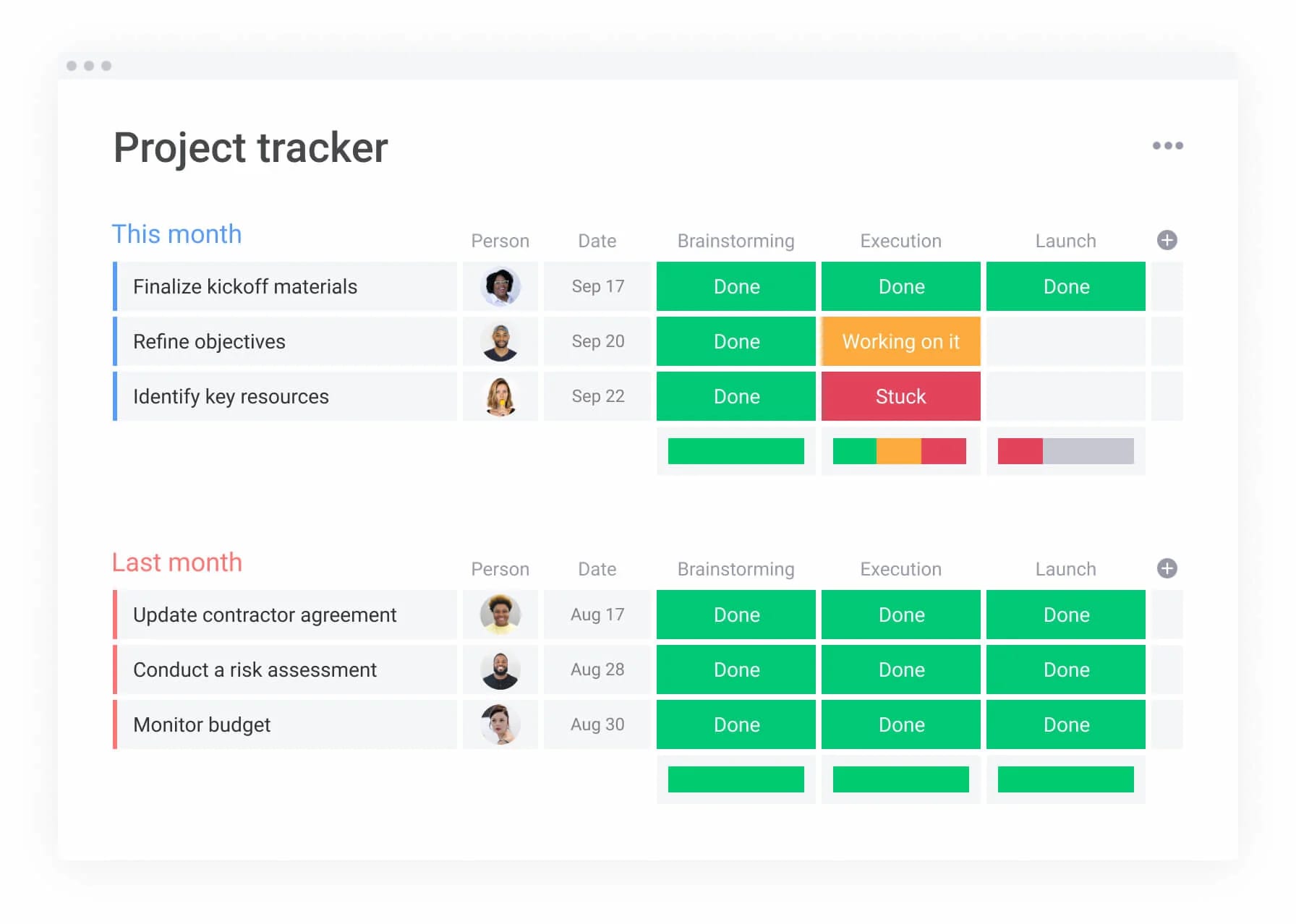
- Centralized dashboard: A single view of all campaigns and funnels.
- Visual workload management: Ensuring resources are balanced across initiatives.
- Cross-funnel insights: Teams can share learnings instantly.
- Dependency tracking: Highlighting how different initiatives interact.
Gain real-time visibility into funnel performance
The platform delivers comprehensive visibility through:
- Custom dashboards: Displaying relevant metrics for every role.
- Automated reporting: Keeping stakeholders informed without manual work.
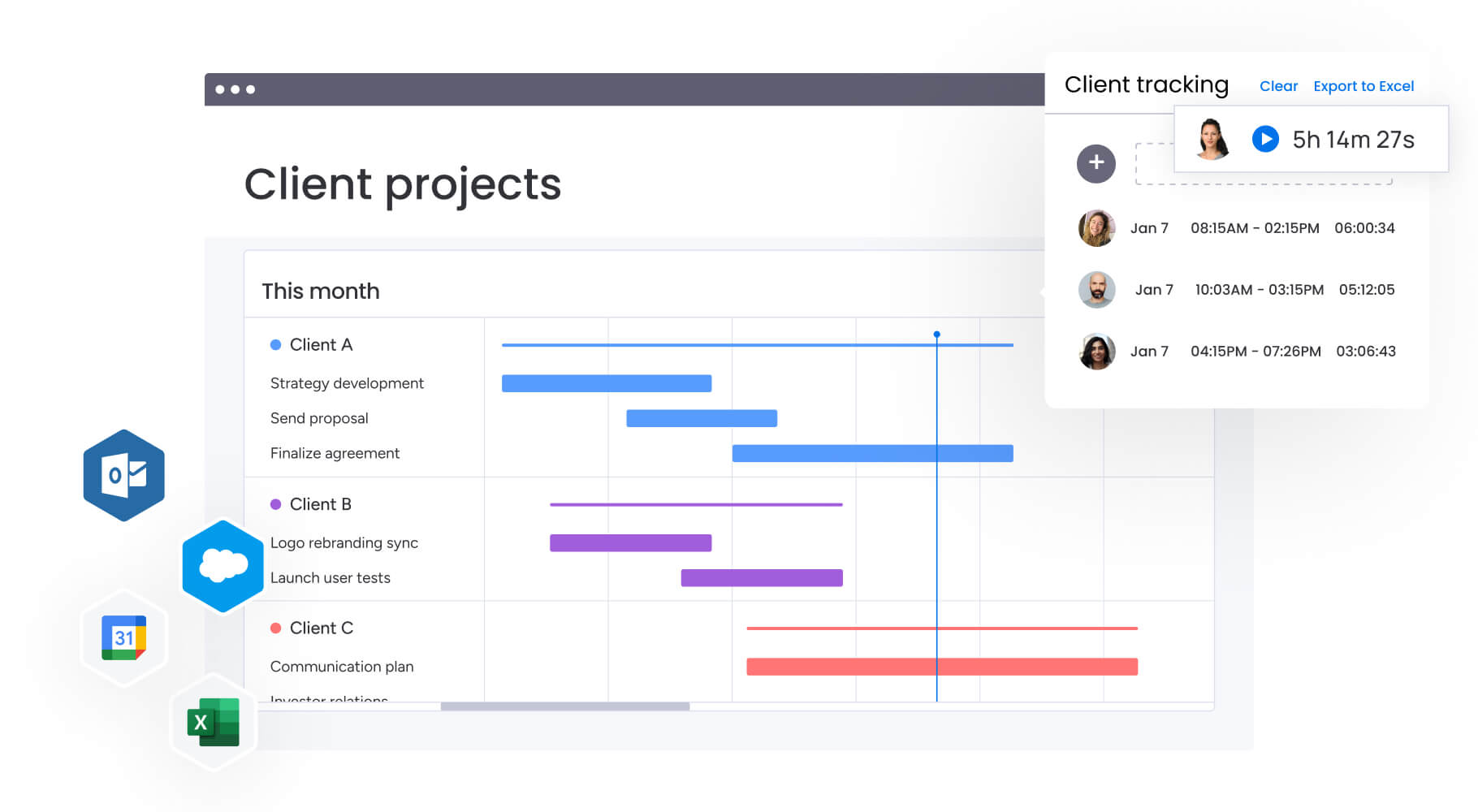
- Time tracking and milestone monitoring: Ensuring campaigns stay on schedule.
- 200+ integrations: Data flows seamlessly from marketing tools into a central view.
Leverage AI-powered optimization features
monday work management embeds AI deeply into the workflow:
- AI Blocks: Automate routine processes like lead categorization and sentiment analysis.
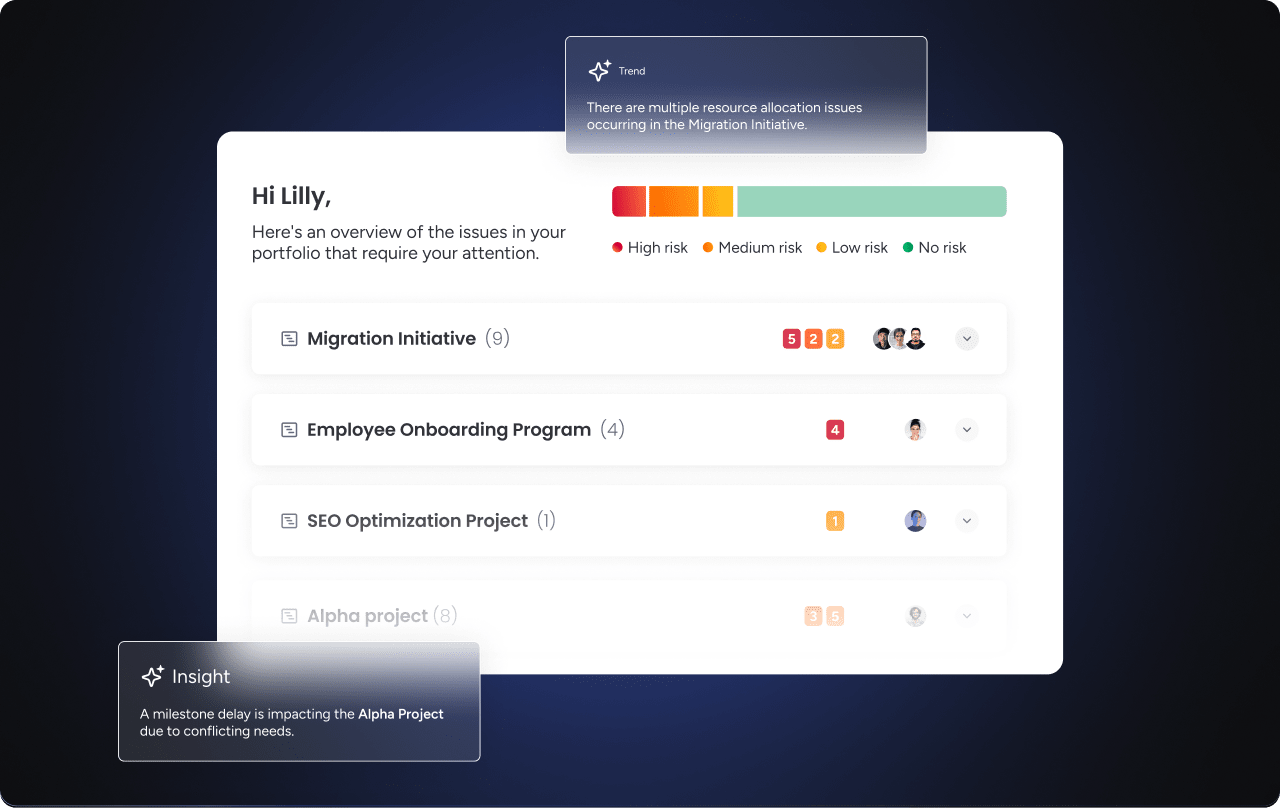
- Portfolio Risk Insights: Identify potential campaign issues before they occur.
- Campaign Manager Digital Worker: Provides proactive budget and performance recommendations.
Connect your entire marketing technology stack
As a central hub, the powerful solution eliminates data silos. It integrates with:
- Marketing automation platforms: For seamless lead management.
- Analytics tools: For comprehensive performance tracking.
- Social media platforms: For unified campaign coordination.
This ensures that optimization efforts are based on a complete, unified picture of the customer journey.
Try monday work management
“monday.com has been a life-changer. It gives us transparency, accountability, and a centralized place to manage projects across the globe".
Kendra Seier | Project Manager
“monday.com is the link that holds our business together — connecting our support office and stores with the visibility to move fast, stay consistent, and understand the impact on revenue.”
Duncan McHugh | Chief Operations OfficerMake funnel optimization a consistent growth advantage
Marketing funnel optimization delivers the greatest impact when it becomes part of how teams operate every day. Clear visibility into performance, structured experimentation, and strong alignment across marketing, sales, and customer success allow improvements to compound over time.
As channels evolve and customer journeys become less predictable, organizations benefit from systems that support continuous learning and adaptation. Small gains across multiple stages can significantly improve conversion rates, customer lifetime value, and overall marketing efficiency.
Platforms like monday work management help teams keep optimization efforts organized, visible, and connected to real outcomes. With shared workflows, centralized data, and ongoing insight into performance, teams can refine their funnel with confidence and sustain growth as strategies evolve.
Try monday work managementFrequently asked questions
What is a marketing funnel?
A marketing funnel is a model that represents the stages a potential customer goes through, from first becoming aware of a brand to making a purchase and becoming a loyal advocate. It visualizes how prospects move through awareness, consideration, decision, retention, and advocacy stages.
Why are marketers questioning the traditional funnel model?
Marketers are questioning the traditional funnel model because customer journeys have become non-linear, with buyers looping between exploration and evaluation across multiple channels including AI-powered search and social platforms. The "messy middle" means prospects no longer follow a predictable linear path from awareness to purchase.
How is generative AI changing product discovery?
Generative AI is changing product discovery by providing direct answers to user queries through platforms like ChatGPT and Perplexity, reducing the need for traditional search engine results pages. This shift requires marketers to optimize content for AI comprehension and direct answer formats rather than traditional keyword optimization.
What is generative engine optimization (GEO)?
Generative engine optimization (GEO) is the practice of optimizing content to appear in AI-powered search results and answer engines, focusing on providing comprehensive, direct answers rather than traditional keyword optimization. It differs from SEO by prioritizing structured data, natural language, and complete answers that AI systems can easily parse and present to users.
How does social search affect the marketing funnel?
Social search affects the marketing funnel by turning platforms like TikTok and Instagram into discovery engines where users search for product recommendations and reviews, creating new awareness touchpoints. This shift requires marketers to create visual, authentic content optimized for social discovery rather than traditional search engines.
When does it make sense to work with an agency on your funnel?
Working with an agency makes sense when you need specialized tactical execution like advanced paid media or technical SEO, surge capacity for large-scale initiatives, or expertise in emerging channels like GEO and social search optimization. Keep strategy, measurement, and coordination internal while leveraging agencies for specialized execution and creative production at scale.

 Get started