


A signed contract shouldn’t trigger chaos. But for most sales teams, that’s exactly what happens: order details get lost in email threads, fulfillment teams scramble for information, and your reps waste hours tracking down statuses instead of closing new deals. This handoff nightmare erodes customer trust. A CRM with integrated order management eliminates this friction, connecting sales directly to fulfillment in one streamlined workflow so your team can focus on what they do best: winning deals.
In this guide, we’ll break down everything you need to know about CRM order management systems. You’ll discover the essential features that actually move the needle, see how the top platforms stack up side-by-side, and get actionable best practices to ensure your implementation drives real results from day one.
What is CRM order management software
CRM order management software is your team’s central digital workspace that connects customer details directly with order processing so nothing gets lost in translation. It brings every interaction, purchase history, and order detail into one unified view, eliminating the need to jump between systems just to piece together the customer story.
When these two critical parts of your sales process talk to each other, your team gets a massive advantage: less manual data entry and fewer crossed wires, freeing everyone up to focus on building relationships and closing deals.
The result is a sales team that’s faster and more aligned. With complete visibility from the first conversation to the final delivery, everyone knows exactly where things stand. This is how you empower your team to not just hit their targets, but to build lasting customer loyalty along the way.
Benefits of CRM order management software
Here’s what teams consistently see when they bring CRM and order management together:
Unified customer and order data
Unified data gives your reps the customer’s entire story—past purchases, support tickets, and order history—in one view. Every call becomes an opportunity to build trust through informed, personalized conversations.
monday CRM centralizes this complete picture so your team acts with confidence. Smarter sales conversations based on purchase history and faster issue resolution give everyone the context to make customers feel valued.
Automated workflow management
Manual data entry creates errors that frustrate customers. Automation handles repetitive tasks—order confirmations, inventory updates, fulfillment notifications—with perfect consistency, ensuring nothing slips through the cracks.
A new order triggers an automated chain reaction: inventory updates, fulfillment receives details, and customers get confirmations instantly. Your team escapes administrative drag to focus on building relationships and closing deals.
Better real-time visibility across teams
Real-time visibility gives your entire team the same up-to-the-minute playbook. When sales sees live inventory and support knows exact order status, you eliminate the miscommunication that erodes customer trust.
monday CRM creates a single source of truth across departments. Sales reps and warehouse teams see identical information, preventing over-promising and conflicting messages while building confidence in every customer interaction.
Enhanced customer experience
Integrated systems shift your team from reactive to proactive, sending updates before customers ask and solving problems before they notice. This transforms transactions into memorable moments that build customer loyalty.
Proactive service turns satisfied customers into loyal advocates. A seamless journey from first click to final delivery creates a competitive advantage that drives sustained growth.
Essential features of CRM with order management
The right CRM with order management transforms messy, manual processes into a streamlined revenue engine. These core features aren’t just bells and whistles—they’re the building blocks that help your team work faster, stay aligned, and deliver experiences that keep customers coming back.
Order processing and fulfillment
This is where a signed deal transforms into a happy customer experience. When your system handles order capture, processing, and shipping seamlessly, the entire process feels effortless for your customer.
With monday CRM, this entire flow is integrated directly into your sales pipeline, so your team isn’t bouncing between spreadsheets and shipping apps. This unified approach means fewer errors, faster fulfillment, and a consistent experience that builds trust from the very first purchase.
Inventory management
Great inventory management gives your sales team the power to sell with absolute confidence. Real-time visibility into what you can actually sell means reps can provide accurate delivery dates on the spot, eliminating those awkward “sorry, we’re out of stock” conversations after a deal is done.
This sync prevents lost sales, keeps your forecasts accurate, and ensures your sales reps look like heroes who always deliver on their promises.
Multi-channel support
Your customers can buy from anywhere — your website, email, or social media—and all those orders need to land in one unified system. monday CRM’s flexibility ensures that no matter where an order comes from, it’s processed with consistency, keeping your team aligned and your customers happy.
Reporting and analytics
Effective reporting converts raw data into actionable insights that drive genuine growth. With intuitive, visual dashboards, you can spot your most profitable products, track sales performance, and forecast future revenue with confidence. monday CRM turns data into your strategic advantage, helping you make smarter decisions faster.
Workflow automation
Automation crushes the repetitive, manual tasks that slow your team down. By automating things like quote-to-order conversions and customer notifications, you free up your team to focus on high-value work—building relationships and closing deals.
Imagine a deal closes and monday CRM instantly creates the order, updates inventory, and sends a confirmation email—all without anyone lifting a finger.
This creates a faster, more reliable process that boosts team morale and builds incredible customer trust.
Try monday CRMComparing top CRM order management platforms
Choosing the right CRM order management platform comes down to three things: flexibility to match your process, ease of use that drives adoption, and visibility that keeps everyone aligned. Let’s see how the top contenders stack up side-by-side.
| Platform | Setup complexity | User adoption | Order tracking | Automation | Customization | Integration options |
|---|---|---|---|---|---|---|
| monday CRM | Intuitive, no-code setup | High (visual, familiar interface) | Real-time pipeline visibility | Conditional automations, AI-powered | Drag-and-drop customization | 200+ native integrations |
| Salesforce | Complex, requires technical expertise | Moderate (steep learning curve) | Comprehensive but rigid | Powerful but complex to configure | Highly customizable (with development) | Extensive but often requires custom work |
| HubSpot | Moderate setup time | Good (user-friendly design) | Strong pipeline management | Good automation suite | Limited without paid tiers | Strong integration ecosystem |
| Pipedrive | Quick setup | High (simple interface) | Basic order tracking | Limited automation options | Minimal customization | Decent integration options |
monday CRM
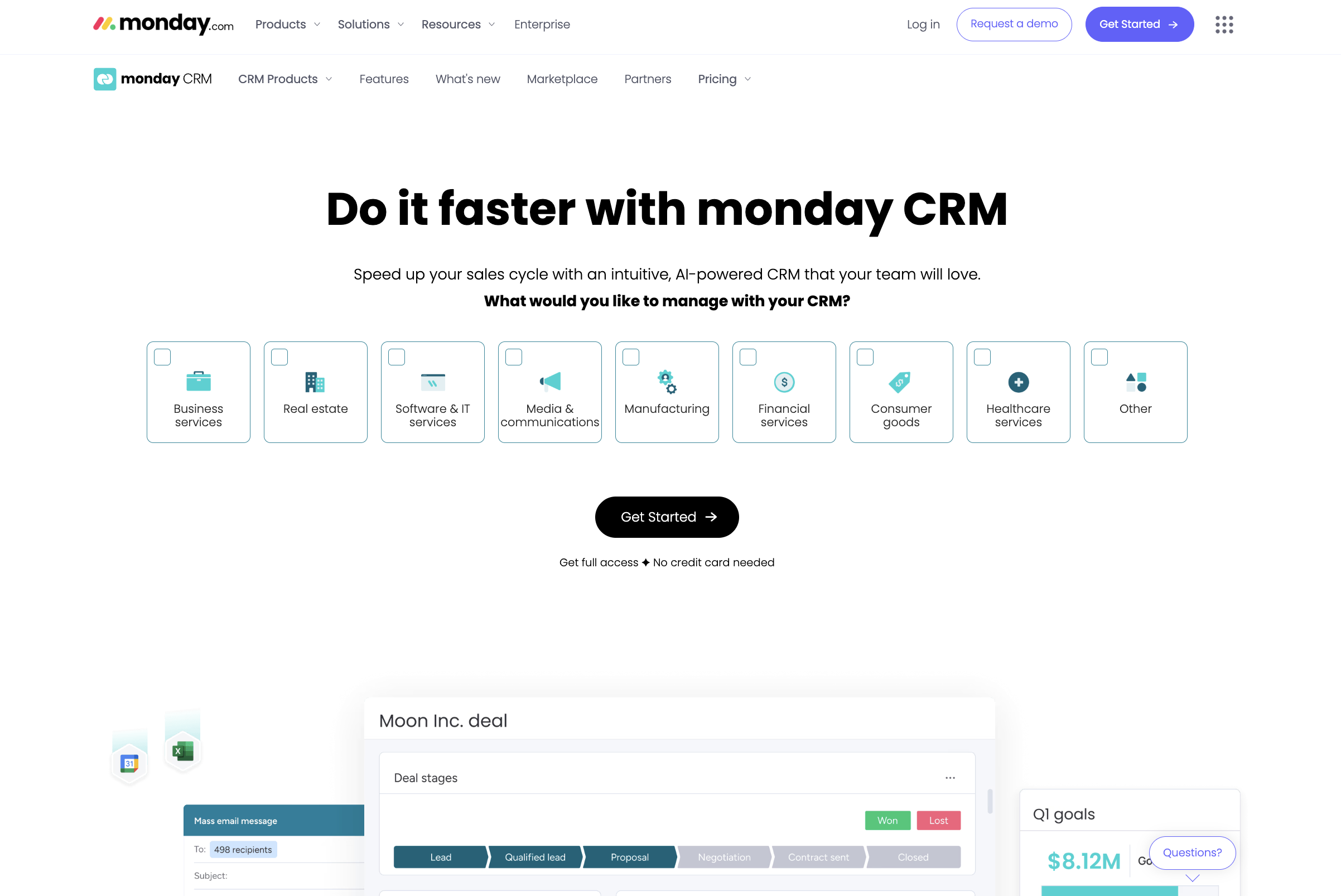
monday CRM transforms order management from a chaotic juggling act into a streamlined, visual workflow that keeps your entire sales team aligned. The platform specializes in no-code customization and integrated work management, making it ideal for teams who want powerful CRM functionality without the complexity of traditional systems.
 Example:
monday CRM serves as a comprehensive Work OS that combines order management with customer relationship management, allowing teams to track orders from placement through delivery while maintaining complete visibility across the entire sales process.
Key features:
- Multichannel order consolidation — Centralize orders from various platforms such as Shopify, with other connections available through third-party connectors
- Visual workflow management — Track order status through customizable Kanban boards, Timeline views, and Gantt charts that make progress instantly visible
- Automated inventory tracking — Monitor stock levels across multiple sales channels and configure automations to provide inventory updates and notifications
Pricing:
- Free: $0 forever (up to 2 seats, 3 boards, basic features)
- Basic: $9/month per seat (billed annually, unlimited items, 5GB storage)
- Standard: $12/month per seat (billed annually, 250 automation actions and 250 integration actions per month)
- Pro: $19/month per seat (billed annually, 25,000 automation actions and 25,000 integration actions per month)
- Enterprise: Contact sales for pricing (250,000+ automation/integration actions per month, advanced security)
Minimum 3 users required, 18% discount for annual billing. Nonprofit discounts available.
Why it stands out:
- No-code customization — Build your ideal order management system without technical expertise, adapting workflows to match your exact business processes
- Visual transparency — Color-coded statuses and drag-and-drop interfaces make order tracking intuitive for every team member, eliminating confusion about order status
- Unified workspace — Manage orders, customer relationships, and team collaboration in one platform, reducing the need to switch between multiple systems
Advanced AI features:
- AI-assisted task generation — Automatically create follow-up tasks and action items based on your project data
- AI-powered email writing — Draft personalized customer communications and order updates quickly with AI assistance
- Data summarization — Use AI to summarize complex information and get key insights from your boards instantly
Automations:
- No-code automation builder — Create custom workflows with thousands of automation actions per month, depending on your plan, without requiring technical skills
- Pre-built automation recipes — Deploy ready-made automations for common order management tasks like status updates, inventory alerts, and customer notifications
- Cross-board automation — Automatically sync order data between different boards and departments, ensuring everyone stays updated on order progress
Integrations:
- Native e-commerce connections — Direct integration with Shopify for seamless order import, with access to hundreds of other apps through Zapier
- Email and communication tools — Built-in connections with Gmail, Outlook, and other email providers for automated customer communication throughout the order lifecycle
- Third-party ecosystem — Access to hundreds of integrations through Zapier and native connections, including accounting software like QuickBooks and shipping providers
CRM with order management features:
- Order-to-cash visibility — Track the complete customer journey from initial order through payment and delivery, with customizable stages that match your business process
- Customer communication automation — Send automated order confirmations, shipping updates, and delivery notifications while maintaining personalized customer relationships
- Returns and refund management — Use dedicated boards and workflows for handling product returns, exchanges, and refunds
Salesforce
Salesforce delivers enterprise-grade CRM with integrated order management that unifies customer data across every touchpoint. Built for large organizations managing complex, omnichannel journeys, it connects commerce, service, and sales through its Customer 360 ecosystem with deep AI integration and extensive customization.
 Use case:
Salesforce Order Management excels at creating unified customer experiences by connecting order data with CRM insights, enabling service teams to handle order inquiries, returns, and upselling opportunities from a single platform.
Key features:
- Distributed order management with intelligent routing to optimize fulfillment locations based on inventory, proximity, and business rules
- Native CRM integration providing service agents with complete customer context including order history, payment terms, and service tools
- Omnichannel inventory visibility with real-time tracking across warehouses, stores, and distribution centers for accurate order promising
Pricing:
- Contact Salesforce sales for custom enterprise pricing
- Pricing varies by product combination (Sales Cloud, Service Cloud, Commerce Cloud)
- Most products require annual contracts with some monthly options available
- Free trials available for select products
Considerations:
- High implementation complexity requiring specialized expertise and potentially lengthy setup times
- Premium pricing structure that may be cost-prohibitive for smaller businesses or those with straightforward order processes
HubSpot
HubSpot delivers an all-in-one marketing, sales, and service platform built around a central CRM. With a freemium model and strong inbound marketing integration, it’s ideal for small to medium-sized businesses looking to streamline their entire customer journey and unify marketing with order management.
 Use case:
HubSpot’s Commerce Hub integrates order management directly into their CRM, creating a unified quote-to-cash process that eliminates data silos between sales, marketing, and finance teams.
Key features:
- Orders object that tracks customer purchases with automated invoicing and payment processing through HubSpot Payments
- Product library with subscription management tools for recurring billing and automated revenue collection
- Custom order pipelines with reporting dashboards that provide real-time insights into revenue trends and customer purchase behavior
Pricing:
- Professional Plan: $800/month (includes 3 Core Seats, additional seats $45/month each)
- Enterprise Plan: $3,600/month (includes 5 Core Seats, additional seats $75/month each)
- Professional Onboarding: One-time $3,000 fee
- Enterprise Onboarding: One-time $7,000 fee
- Both plans include 2,000-10,000 marketing contacts with additional contacts incurring extra costs
Considerations:
- The orders object is relatively new and lacks advanced features like deduplication that other HubSpot objects offer
- Limited native e-commerce functionality requires integration with platforms like Shopify for full online store capabilities, and orders cannot be associated with companies by default
Zoho CRM
Zoho CRM delivers a comprehensive suite of business applications that integrates order management with customer relationship tools. The platform provides an all-in-one ecosystem at competitive pricing, making it ideal for small to medium-sized businesses streamlining their sales-to-fulfillment process.
 Use case:
Zoho CRM excels at managing the complete order-to-cash cycle through deep integration between its CRM, inventory management, and accounting applications within a unified business suite.
Key features:
- Blueprint process management: Low-code workflow builder that guides sales teams through structured order management processes with automated approvals and validations
- Multi-app integration: Seamless data flow between Zoho CRM, Zoho Inventory, and Zoho Books for end-to-end order tracking from quote to invoice
- Multi-channel order consolidation: Centralizes orders from various sales channels including e-commerce platforms like Shopify, Amazon, and eBay into a single management interface
Pricing:
- Free: Free for up to 3 users with essential features like leads, documents, and mobile apps
- Standard: $14/user/month (billed annually) with mass email, custom modules, workflows, and sales forecasting
- Professional: $23/user/month (billed annually) including Blueprint, inventory management, and webhooks
- Enterprise: $40/user/month (billed annually) featuring Zia AI assistant, territory management, and journey orchestration
- Ultimate: $52/user/month (billed annually) with enhanced limits, custom AI/ML platform, and advanced analytics
- Team User Add-on: $7/user/month for non-sales roles in the new CRM interface
Considerations:
- Complex setup process requiring configuration across multiple integrated applications, which can overwhelm new users without technical expertise
- Customer support quality varies, with some users reporting slow response times and inconsistent assistance quality
Pipedrive
Pipedrive delivers a sales-focused CRM that transforms complex deal tracking into visual, intuitive pipeline management. Built by salespeople for salespeople, the platform excels at order process simplification for small and medium-sized businesses that need straightforward sales-to-order workflows.
 Use case:
Pipedrive streamlines the transition from closed deals to sales orders through its Smart Docs add-on, allowing sales teams to generate quotes, proposals, and contracts directly within their familiar CRM environment.
Key features:
- Smart Docs integration creates trackable sales documents with auto-fill functionality from CRM data
- Visual pipeline management with drag-and-drop deal tracking and automated notifications
- Extensive marketplace with 500+ integrations including Order Desk, Shopify, and major ERP systems
Pricing:
- Lite: $14/month per user (billed annually)
- Growth: $39/month per user (billed annually)
- Premium: $59/month per user (billed annually)
- Ultimate: $79/month per user (billed annually)
- Smart Docs add-on: $32.50/month per company (free with Premium, Power, and Ultimate plans)
- 14-day free trial available for all plans
Considerations:
- Limited native order management capabilities require third-party integrations for inventory tracking and fulfillment
- Advanced features like Smart Docs require additional paid add-ons on lower-tier plans
How to choose the right CRM order management system
Finding the right CRM order management system comes down to checking the boxes that actually matter for your team’s success. Use this checklist to evaluate platforms and ensure you’re making a choice that drives real results:
✓ User adoption potential: Will your team actually want to use this daily? Look for intuitive interfaces and visual workflows that make adoption natural, not forced.
✓ Process alignment: Does it bend to fit your sales process, or will you have to change everything to match the software? Prioritize no-code customization that adapts to your unique playbook.
✓ Integration capabilities: Can it connect seamlessly with your existing tools—accounting software, email platforms, inventory systems? Data should flow automatically without manual transfers.
✓ Automation power: Does it eliminate repetitive tasks like order confirmations, status updates, and inventory syncs? The right platform handles busywork so your team can focus on selling.
✓ Real-time visibility: Can everyone see the same up-to-the-minute information across departments? A single source of truth prevents miscommunication and builds confidence.
✓ Scalability for growth: Will it handle 2x your current order volume, team size, and data without slowing down? Think 18 months ahead to avoid switching systems mid-growth.
✓ Implementation speed: How quickly can you get up and running? Look for platforms with pre-built templates and simple setup that deliver value from day one.
The platform that checks the most boxes while amplifying your team’s strengths is the one that will transform your order management from chaos into a competitive advantage.
More info: If you want to learn more about supercharging your business toolstack, here’s a guide about CRMs with inventory management.
Implementation best practices for CRM order management
Start with clean data and quick wins
A successful implementation begins with a clean foundation and immediate value. Start by migrating essential customer data into monday CRM with simple import tools, ensuring a clean slate. Simultaneously, activate automations for repetitive tasks like order confirmations and status updates to deliver instant time-savings for your team.
Drive adoption through role-specific training
A tool is only as good as the team using it, which is why adoption hinges on role-specific training that shows each person exactly how the CRM makes their day-to-day work easier and more impactful. Skip the generic slideshows; instead, empower internal champions and celebrate early wins together to build momentum that makes adoption a natural team habit.
Continuously optimize with feedback loops
The launch is just the beginning. Use monday CRM’s dashboards to track what’s working and where you can get even better. Pairing that data with your team’s direct feedback creates a powerful improvement loop, allowing you to continuously fine-tune workflows and add new automations that keep your sales process getting faster, smarter, and more aligned.
Transform your order management with monday CRM
Your team’s best work happens when they’re focused on selling, not wrestling with software. monday CRM clears the path by turning chaotic order management into a smooth, predictable revenue machine, giving everyone the visibility and control they need to win.
We believe your order management process should be the energized core of your sales engine, not a disconnected afterthought. That’s why we built monday CRM to be a flexible Work OS that molds to your team’s unique process, connecting every step from quote to cash in one intuitive workspace. Your team gets to spend less time wrestling with software and more time building relationships.
Imagine your entire tech stack, from accounting to inventory, working in perfect sync, creating a single source of truth for every order.
Our platform makes this a reality with simple integrations and powerful, AI-driven automations that handle the manual work for you. When we bring all your customer data into one place and automate the busywork, the entire team moves faster and smarter.
The result is complete visibility and control over your entire sales cycle. When your team can see the full picture, from the initial lead to final fulfillment, they can make smarter decisions, collaborate seamlessly, and close deals faster. Suddenly, everyone knows exactly where each deal stands and what their next move is, building the kind of momentum that closes deals.
It’s time to equip your team with a platform that works as hard as they do. Try monday CRM and see how it gives your team the confidence and alignment to crush their goals.
