


A new lead comes in during a showing. A maintenance request lands while someone is chasing signatures. By lunch, your team is still moving information between inboxes, spreadsheets, and systems instead of progressing the deal itself. This all-too-familiar scenario is exactly why AI for real estate is getting so much attention. The best platforms help teams sort leads, summarize meetings, and generally support day-to-day real estate operations by removing a ton of legwork.
This guide covers how AI works in real estate, 15 platforms worth considering, and the practical details that matter when you compare them, from lead generation and valuation to governance and system fit. You’ll also see how monday agents can support connected workflows across sales, operations, and service.
Try monday agentsWhat is AI for real estate?
AI for real estate refers to intelligent software that helps agents, brokers, and operations teams automate workflows, analyze data, and execute tasks across the deal cycle. It ranges from simple chatbots that answer listing questions to advanced agents that qualify leads, coordinate transactions, and manage property operations autonomously. The common thread is using AI to handle work that would otherwise require constant manual attention, like following up with prospects who toured a property last week or flagging deals at risk of falling through. And by handling these tasks, your team is free to focus on higher-value work like building client relationships and closing deals.
Here’s how three main categories of AI compare.
| AI category | What it does | Where it helps most in real estate | Where agents and brokers still step in |
|---|---|---|---|
| AI assistants | Respond to prompts and requests | Listing descriptions, market research, email drafts | Agents need to request each task and review output |
| AI automations | Follow pre-set rules | Lead routing, showing reminders, status updates | Agents define triggers, conditions, and exceptions |
| AI agents | Manage workflows proactively | Lead qualification, buyer follow-up, transaction coordination, maintenance requests | Agents set guardrails, review exceptions, and approve offers or key client decisions |
Why choose AI for your real estate business
AI adoption in real estate is not about replacing expertise—it’s about removing the friction that keeps teams from using it effectively. The right AI platform helps you respond faster, prioritize smarter, and execute more consistently across lead generation, market analysis, property operations, and compliance.
Here’s where AI creates the most immediate impact:
- Lead generation and client engagement: AI scores leads based on behavior and intent, personalizes follow-up timing, and qualifies prospects around the clock through chatbots—so your team focuses on the conversations most likely to close.
- Property valuation and predictive analytics: AI evaluates thousands of signals—comps, neighborhood trends, property characteristics—in seconds, giving you faster valuations, forward-looking price forecasts, and data-backed guidance that strengthens client confidence.
- Property management operations: AI automates tenant screening, lease data extraction, maintenance request routing, vendor coordination, rent collection reminders, and financial reporting—freeing your team to focus on relationships, exceptions, and portfolio oversight.
- Compliance and governance: AI helps maintain audit trails, enforce approval workflows, detect bias in recommendations, and protect client data with role-based access and encryption—so you can adopt automation with confidence and accountability built in.
The teams seeing the strongest results are the ones using AI to support full workflows rather than isolated tasks. When AI has the context to act across marketing, sales, transactions, and operations, it becomes an execution layer that keeps work moving—not just a tool that answers questions.
15 best AI platforms for real estate workflows
This list covers 15 leading AI platforms built for real estate, from valuation tools to virtual staging software. Use the table below for a quick side-by-side view of which option best fits your team’s main bottleneck, whether that’s lead quality, transaction coordination, or something else entirely.
| Platform | Primary use case | Notable feature | Starting price |
|---|---|---|---|
| monday agents | Cross-department workflow orchestration | Agents see context across marketing, sales, and operations | $12/seat/month (3-seat minimum) |
| HouseCanary | Property valuation and market analytics | Automated valuation models with predictive accuracy | Enterprise/custom pricing |
| Matterport | 3D property visualization and virtual tours | AI-enhanced immersive property experiences | $0–$69/month per space |
| Cloze | Relationship intelligence CRM | Automatic communication tracking and follow-up timing | $17–$42/user/month |
| OpenAI | General-purpose AI assistance | Versatile content generation and research | Free–$25/user/month |
| RealScout | Intelligent home search and matching | AI-powered buyer-property matching | Custom pricing |
| Cotality | Property data and risk analytics | Comprehensive property databases with AVM tools | Enterprise pricing |
| PropStream | Investor lead generation and property data | Off-market opportunity identification | $99/month |
| Lofty | CRM and marketing automation | AI assistant with IDX website integration | $449+/month |
| Smartzip | Predictive seller analytics | Homeowner likelihood-to-sell modeling | Custom pricing |
| CINC | Lead generation with AI nurturing | Paid advertising plus automated follow-up | $899+/month |
| REimagineHome | Virtual staging and renovation visualization | AI-powered photo transformation | $12–$59/month |
| Roof AI | Conversational lead qualification | 24/7 chatbot with qualification conversations | Custom pricing |
| AvidXchange | Accounts payable automation | Invoice processing and vendor payment automation | Enterprise pricing |
| DealMachine | Driving-for-dollars and direct mail | Property owner lookup and outreach automation | $49–$99/month |
1. monday agents
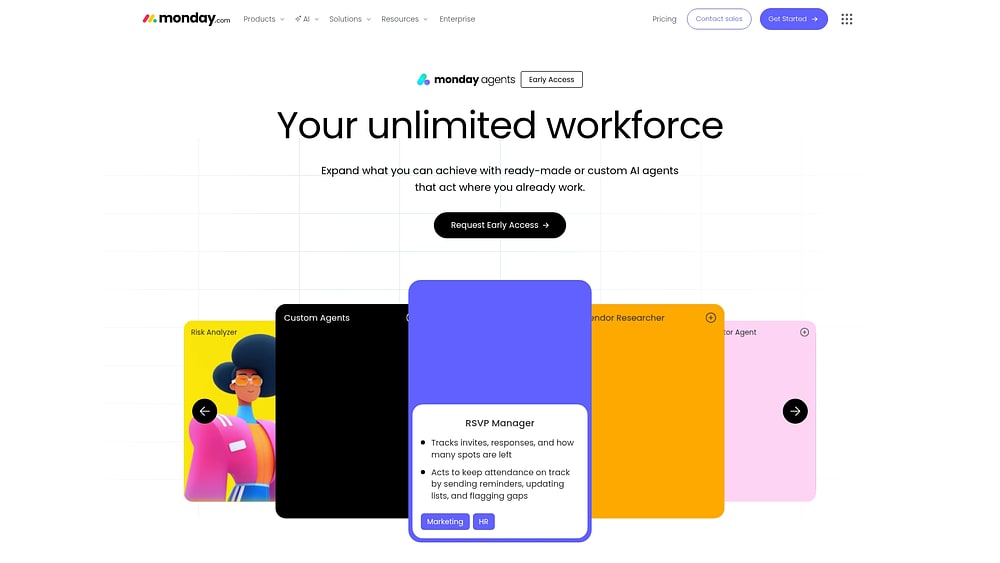
If your team already runs work on monday.com’s AI Work Platform, monday agents adds an autonomous layer right on the workspace where leads, transactions, marketing, vendor reviews, and service operations already live. Instead of shifting context between standalone AI tools and separate systems, teams can use ready-made agents or build custom ones that act on the same boards, docs, and PDFs they use every day.
Best for:
Real estate teams and brokerages that need AI-powered workflow automation integrated directly into their operational workspace, without managing multiple disconnected platforms.
Key features:
- Lead scoring and prioritization: The Lead Scorer agent evaluates fit, intent, and engagement signals across the funnel, then routes leads, schedules follow-ups, and alerts reps when intent spikes. For real estate teams, that means responding faster when a prospect engages heavily with a listing, a campaign, or a contact form.
- Risk analysis for transactions and operations: The Risk Analyzer agent watches schedule, dependency, and workload risk in real time. It reduces exposure by reassigning owners, adjusting timelines, and notifying stakeholders — especially useful when a closing workflow, approval, or vendor handoff starts drifting.
- Meeting summarization and follow-through: The Meeting Summarizer creates notes, transcripts, and summaries, then pulls out follow-ups, assigns owners, and creates updates accordingly. Brokers, coordinators, and operations leads can keep every conversation tied to the next step.
- Sentiment detection across communications: The Sentiment Detector spots changes in tone across tickets, emails, and feedback in real time, then flags risks and alerts the right owner. For real estate teams, that’s especially useful when client or tenant conversations need quick attention.
- Service intake and routing: Ticket Assignment detects request intent, urgency, and the expertise needed to resolve it, then assigns owners, sets priority, and reroutes as needed. Teams handling property operations or internal service workflows can keep incoming requests moving without manual triage.
- Custom agents grounded in your business context: Teams can build custom agents in 3 steps: describe the role and triggers, connect the relevant knowledge and tools, then test and refine. Agents use the docs, PDFs, and boards you define as context, so their actions stay grounded in your actual processes and guidelines.
Pricing:
- Basic: $12/seat/month, billed annually
- Standard: $17/seat/month, billed annually
- Pro: $28/seat/month, billed annually
- Enterprise: available through sales consultation
Why it stands out:
- Cross-department context: monday agents works on the same AI Work Platform many teams already use across marketing, sales, operations, and service. That shared context matters in real estate, where lead source data, deal stages, vendor approvals, and internal updates all shape the same outcome.
- Built for execution and insights: Agents go beyond summarizing information. They take actions across workflows, keep work in sync across integrated systems, and operate around the clock to send reminders, create updates, route work, or move a process forward under your direction.
- Trust and control built in: monday.com gives teams visibility into what agents did, why they did it, and what they’ll do next. With permissions, audit trails, human-in-the-loop validation, simulation mode, and enterprise-grade AI infrastructure backed by SOC 2 Type II, ISO certifications, GDPR compliance, and HIPAA support, teams can adopt AI with guardrails already in place.
- Easy to adopt for teams already on monday.com: With nearly 250,000 organizations already running work on monday.com, agents fit into familiar workflows instead of forcing a separate rollout. That lowers the barrier for brokerages and operations teams who want AI working inside the systems they already know.
2. HouseCanary
At scale, valuation speed matters. HouseCanary gives investors, lenders, and brokerages AI-powered property valuations and market analytics across 136 million+ U.S. residential properties. Teams can reach data-backed conclusions without waiting on traditional appraisals. Its generative AI assistant, CanaryAI, makes institutional-grade property intelligence available through a conversational interface that anyone on the team can use.

Use case:
Portfolio analysis, lending decisions, and market research requiring rapid, data-driven property valuations across multiple properties simultaneously.
Key features:
- Automated valuation models (AVMs): Analyze comparable sales, property characteristics, market trends, and location factors to generate valuations in seconds, with confidence scores and accuracy metrics included so teams understand reliability before acting.
- Market forecasting: Predictive analytics project price trajectories, days-on-market estimates, and neighborhood trend analysis across a 36-month horizon, giving investors and lenders a forward-looking view for timing decisions.
- CanaryAI assistant: Built directly on HouseCanary’s valuation and forecasting data, this conversational AI lets team members ask natural-language questions and get immediate answers on comps, investment screening, and market insights, without switching platforms.
Pricing:
- Basic: $19/month (monthly billing) or $190/year
- Pro: $79/month (monthly billing) or $790/year, including 15 custom valuation reports and 15 AVM PDF reports monthly
- Teams: $199/month (monthly billing) or $1,990/year, including 10 users and property monitoring for 50 properties
- Enterprise: custom pricing, available on request
Considerations:
- AVM outputs are estimates, not appraisals — regulated lending contexts may still require human review or a formal appraisal process.
- Teams operating in non-disclosure states may encounter data gaps that affect valuation accuracy for certain properties or markets.
3. Matterport
For marketing teams that need listings to stand out visually, Matterport turns physical properties into interactive 3D digital twins buyers can explore from anywhere. More than 1.2 million subscribers and 50.7 billion square feet of digitized property point to its reach across agents, brokerages, and property marketers. AI-assisted virtual staging and automated floor plan generation help produce listing-ready assets far faster than traditional methods.

Use case:
Agents and brokerages focused on property marketing who want to differentiate listings, qualify buyer interest remotely, and reduce unnecessary in-person showings.
Key features:
- 3D digital twins and virtual tours: Cortex AI automatically reconstructs dimensionally accurate, navigable property models from captured scans, giving buyers an immersive remote experience without requiring a site visit.
- AI-powered virtual staging and Defurnish: These tools can furnish empty rooms or remove clutter from occupied ones, helping buyers picture a property’s potential without the cost or logistics of physical staging.
- Automated property intelligence: Room identification, accurate measurements, and floor plans are generated automatically from each scan, eliminating the need for separate measurement services or manual documentation.
Pricing:
- Free: limited use at no cost
- Starter: $9.99/month (billed annually)
- Professional: $55/month (billed annually)
- Business: $269/month (billed annually)
- Enterprise: contact sales for pricing
- Annual billing saves up to 16% compared to monthly plans
- Schematic floor plans and MatterPak technical files are available as paid add-ons
Considerations:
- Matterport is centered on visualization and marketing, so teams will need separate platforms to manage lead nurturing, transaction workflows, and operational processes.
- Costs rise with the number of active spaces, and widely used deliverables like floor plans cost extra, which can increase total spend as portfolio volume grows.
4. Cloze
Cloze is built for real estate professionals who want customer relationship management without constant manual entry. The platform uses CRM automation to track emails, calls, and texts, then suggest the right timing and cadence for follow-up. That makes it especially appealing for agents and small teams trying to stay top of mind while cutting down on administrative work.

Use case:
Individual agents and small teams who want AI to handle communication tracking, relationship scoring, and follow-up reminders automatically — so no contact goes cold.
Key features:
- Automatic communication tracking: Every email, call, text, and social media interaction is logged without manual data entry, giving agents a complete, always-current relationship history.
- AI-driven follow-up suggestions: Cloze analyzes communication patterns and relationship health to recommend the right moment to reach out, reducing the risk of letting warm contacts go quiet.
- Relationship scoring: Contacts are scored based on engagement strength and recency, helping agents focus their outreach on the relationships most likely to convert.
Pricing:
- Pro: $17/user/month (billed annually)
- Business Silver: $21/user/month (billed annually)
- Business Gold: $29/user/month (billed annually)
- Business Platinum: $42/user/month (billed annually)
Considerations:
- Cloze is designed for relationship management first, so teams with complex transaction management or cross-department operational needs may use it alongside a broader platform rather than in place of one.
- Some advanced AI features, including Maia and certain integration actions, require higher-tier plans or enterprise-level add-ons, which can affect ROI calculations for larger teams.
5. OpenAI
Sometimes the need is not a real-estate-specific platform but a flexible assistant that can write, research, and summarize on demand. OpenAI fills that role for agents and teams that want enterprise-grade language capabilities without technical setup.

Use case:
Agents and teams seeking a versatile AI assistant for listing copy, client correspondence, and market research without industry-specific workflow integration.
Key features:
- Listing and marketing copy: Draft property descriptions, email templates, and social media content quickly using natural language prompts, reducing time spent on repetitive writing.
- Market research support: Ask questions about neighborhoods, pricing trends, and comparable properties to get synthesized responses that inform client conversations and presentations.
- Document summarization: Paste in lengthy market reports, inspection summaries, or disclosure documents and receive concise takeaways that help agents prepare faster.
Pricing:
- Free: $0/month with limited capabilities
- Plus: $20/month per individual
- Business: $25/user/month billed annually, or $30/user/month billed monthly
- Enterprise: custom pricing with advanced security, data residency options, and dedicated support
Considerations:
- OpenAI sits outside core real estate workflows, so team members must manually move information between systems — it has no awareness of CRM data, transaction status, or pipeline context.
- It helps with one-off writing and research tasks, but it does not execute workflows, trigger automations, or act on behalf of a team without manual input at each step.
6. RealScout
Buyer-side agents spend enormous time matching people to listings. RealScout turns that into an automated process that keeps improving as clients interact with the platform. Built for agents working closely with buyers, it analyzes search behavior and finds properties that match stated and inferred preferences.

Use case:
Agents who want to deliver personalized property recommendations at scale, without manually combing through MLS listings for every client.
Key features:
- Intelligent matching: AI analyzes stated preferences, search behavior, and engagement patterns to surface properties that fit buyer criteria — including factors clients may not have explicitly articulated — and refines recommendations over time based on what they view, save, or dismiss.
- Client collaboration portals: Buyers access agent-branded portals where they can review recommendations, provide feedback, and communicate directly, keeping the relationship active between conversations.
- Natural-language listing alerts: Automated notifications inform buyers when new properties matching their criteria hit the market, written in plain language to drive higher engagement and timely responses.
Pricing:
- Core (solo agents): $149/month with a 12-month term, or $179/month billed monthly — includes 1 license and 500 nurtured contacts
- Build (teams): $249/month billed annually, or $299/month with a 12-month term — includes 2 licenses and 2,500 pooled nurtured contacts; additional licenses at $39/month
- Enterprise (brokerages/brands): custom pricing with SSO, roster sync, and enterprise-wide MLS credentialing
Considerations:
- The platform is centered on buyer-side workflows, so listing agents, transaction coordinators, and operations teams will find limited functionality for their specific needs.
- Access depends on MLS coverage and credentialing; some MLSs require approval processes before searches can run, which may delay initial setup.
7. Cotality
Data depth is the main draw with Cotality. It serves lenders, insurers, appraisers, and real estate organizations that need governed, high-confidence property intelligence at scale. Its AI tools span automated valuation, climate risk modeling, and — in select markets like Australia and New Zealand — agent-facing lead automation, making it particularly relevant for enterprise teams where compliance and data fidelity are essential.

Use case:
Organizations that require deep property data, risk analytics, and AI-powered valuation for lending decisions, portfolio management, or market research at scale.
Key features:
- Automated valuation models (AVMs): Generate property value estimates using proprietary algorithms trained on decades of transaction data, supporting faster and more consistent lending and appraisal decisions.
- AI-powered risk assessment: Address-level climate and hazard models cover 99.9% of U.S. properties with 30-year forward projections, giving insurers and lenders a precise view of property-level exposure.
- MCP Server for enterprise AI workflows: A governed connector that lets AI models and agents securely retrieve real-time property intelligence — including CLIP property identity data and market analytics — while operating within a governance framework designed to align with over 130 state and federal regulations.
Pricing:
- Enterprise plans: Quote-based pricing for core data and platform products, including Matrix, Araya, and the MCP Server; contact sales for a custom quote
- Appraiser software (a la mode Elite): Starting at $1,799 for the suite; additional modules and add-ons are itemized separately
- Data delivery: Pricing varies based on dataset scope, API usage, and delivery method (including Snowflake, Google Cloud, and Databricks integrations)
Considerations:
- Its strength lies in data depth rather than end-to-end workflow automation, so teams will need a separate operational platform to act on the insights it surfaces.
- Enterprise pricing and implementation complexity may be more than smaller teams or independent brokerages need.
8. PropStream
For investors and wholesalers hunting off-market opportunities, PropStream bundles nationwide property data, predictive scoring, and outreach tools into one acquisition-focused platform. Coverage spans 160M+ properties, and the system is built to take users from research to contact without constant platform switching. A property-aware AI assistant, predictive scoring models, and integrated skip tracing keep the workflow tightly connected.

Use case:
Real estate investors and wholesalers who need to identify acquisition opportunities, assess property value, and contact owners directly — all without switching between platforms.
Key features:
- Predictive AI scoring: Photo AI rates property condition from MLS images, Foreclosure Factor assigns default propensity scores, and Estimated Wholesale Value auto-calculates at 70% of AVM — giving investors fast, machine-scored signals to prioritize the strongest leads.
- Property-aware AI assistant: The PropStream Intelligence Assistant lives inside each Property Details page, answering investment questions, surfacing comparable sales with transparent MLS vs. public record sourcing, and auto-populating Fix & Flip and Rental ROI calculators from chat.
- Integrated outreach stack: Skip tracing, direct mail, email campaigns, and AI-guided Click-to-Dial calling scripts are all available within the platform, reducing the need for separate prospecting platforms.
Pricing:
- Free trial: 7 days plus 50 free leads
- Essentials: $99/month (or $81/month billed annually)
- Pro: $199/month (or $165/month billed annually); includes two team members, free skip tracing, and Click-to-Dial
- Elite: $699/month (or $583/month billed annually); includes nine team members and Lead Automator
Considerations:
- This platform is tailored to investor and wholesaler workflows; agents focused on buyer representation, listed properties, or transaction coordination will find limited applicability.
- Photo AI accuracy depends on the availability and recency of MLS photos, and predictive scores are model outputs rather than guaranteed outcomes.
9. Lofty
Lofty combines CRM, marketing automation, and IDX website integration for real estate professionals ranging from solo agents to large brokerages. It is a strong fit for teams investing in digital lead generation and looking to convert online inquiries without stitching together multiple vendors. Its “agentic AI operating system” approach is a notable differentiator, using specialized AI agents to handle distinct workflows autonomously around the clock.

Use case:
Real estate teams that need automated lead capture, multi-channel follow-up, and MLS-connected website integration to turn digital inquiries into booked appointments.
Key features:
- AI Sales Agent: Acts as a virtual inside sales agent, engaging leads across SMS, email, website chat, and Facebook Messenger. It can respond to email inquiries in approximately 15 seconds, qualifying prospects and setting appointments automatically.
- Homeowner Agent: Monitors existing databases, classifies contacts by selling intent, and sends personalized home and market reports, escalating high-intent homeowners to agents when action is needed.
- IDX website and MLS integration: Captures lead information directly from property search activity, connecting prospect behavior to CRM records for more relevant, timely follow-up.
Pricing:
- Core platform tiers (Agent, Team, Broker, Enterprise): Start at approximately $449/month, with final pricing quote-based.
- AI Assistant: $9.99/month
- AI Sales Agent: Starts at $60/month for 200 engaged leads, with additional leads available at $30/month per 100.
- Branding Bundle — Growth: $99/user/month
- Branding Bundle — Elite: $149/user/month
Considerations:
- Because the Sales Agent uses a quota model, costs can rise as database size grows, making total spend less predictable for high-volume teams.
- Several AI capabilities, including the SEO Agent and some Smart Plan workflows, remain in beta, which may limit access or introduce occasional inconsistencies during rollout.
10. Smartzip
Listing-focused agents use Smartzip to identify homeowners who are statistically more likely to sell before those owners ever list. The platform blends machine learning with multi-channel marketing automation to help agents get in front of likely sellers within target farm areas.

Use case:
Agents focused on listing acquisition who want to proactively identify and nurture potential sellers in their target geographic areas, rather than waiting for listings to appear.
Key features:
- Seller prediction modeling: Machine learning scores homeowners by likelihood to sell within the next 12–18 months, drawing on data points including life events, property tenure, equity position, and market conditions.
- Multi-channel marketing automation: Automated direct mail, online display ads, and email nurture campaigns target high-propensity homeowners with relevant messaging, supported by a standardized drip cadence that runs even without heavy agent involvement.
- Territory management and lead scoring: Geographic farming workflows help agents define target areas, receive ranked prospect lists, and prioritize outreach based on predicted seller likelihood.
Pricing:
- SmartTargeting and Smart Data: Custom pricing only; independent coverage indicates a starting price around $500/month, with territory size and feature mix influencing the final quote
- Reach150 Basic: $50/month
- Reach150 Pro: $199/month, or $99/month with annual billing
- Reach150 Enterprise: Contact sales for volume pricing
Considerations:
- Smartzip is narrowly focused on seller-side prospecting and does not cover buyer representation, transaction management, or broader operational workflows, so agents will need separate solutions for those areas.
- Predictive accuracy varies by market, and the platform does not include a native conversational AI agent for voice or text follow-up, meaning teams seeking that capability will need to pair Smartzip with a third-party engagement platform.
11. CINC
CINC takes a different path, focusing on community association management rather than brokerage sales workflows. It unifies accounting, operations, and resident engagement in one system for HOA and COA management firms, layering in AI through Cephai and Cephai+ to automate the high-volume financial and operational work that consumes manager time.

Use case:
Community association management firms that want to automate back-office financial workflows, reduce homeowner contact volume, and scale operations without adding headcount.
Key features:
- AI-powered accounts payable automation: Cephai+ ingests invoices, auto-codes them, routes approvals, and processes vendor payments through an integrated AvidXchange workflow — reducing manual billing time by up to 75%, according to CINC customer results.
- Automated board packet and budget generation: Intelligent agents pull historical data to build board packets with agendas and executive summaries, and generate budget line items with explanations, freeing managers from hours of document preparation each week.
- Resident support and violation automation: Cephai handles homeowner inquiries around the clock and detects violations from photos, triggering automated letters and workflows — with one CINC customer reporting a 50% reduction in homeowner contact volume after rollout.
Pricing:
- Pricing is quote-based and customized according to number of doors, integrations, banking partners, and payment solutions selected
- An Enterprise Package includes CINC Connect Essential at no additional cost
- Revenue-share economics are available through Payables+, positioning AI as a potential revenue source alongside cost savings
Considerations:
- Public pricing is not available, which makes comparison shopping harder without entering a sales process.
- Some AI features and CINC Connect upgrades follow a phased rollout schedule, meaning full functionality may not be available immediately upon onboarding.
12. REimagineHome
Presentation matters, especially for vacant or dated listings. REimagineHome uses AI-powered virtual staging and renovation visualization to turn ordinary property photos into polished, buyer-ready visuals without the cost or logistics of physical staging. With 2.1M+ users and 30M+ designs created across 185+ countries, it has built strong traction in organized real estate, including direct distribution through CRMLS.

Use case:
Agents marketing vacant or outdated properties who want to help buyers visualize potential without the expense of physical staging or renovation.
Key features:
- Virtual staging and renovation visualization: AI adds furniture, decor, and finishes to empty or dated spaces, and can simulate updates like new flooring, paint colors, and kitchen renovations — giving buyers a concrete sense of what a property could become.
- Batch listing workflow: The Smart Media Module ingests up to 50 listing photos, sorts them by room, flags compliance issues, and runs one-pass corrections in as little as 2–5 minutes, reducing manual editing time at gallery scale.
- Exterior and decluttering enhancements: Landscaping improvements and curb appeal updates can be visualized before any physical work begins, while occupied spaces with excess furniture or personal items can be digitally cleaned up for presentation-ready marketing photos.
Pricing:
- Free: First 3 designs at no cost, same quality as paid tiers
- Essential: $19/month for 30 credits (excludes conversational/agentic workflow and reference-guided generation)
- Pro: $36/month for 200 credits, including conversational design flow, reference photos, real-product visualization, and batch listing processing
- Advanced: $59/month for 400 credits, same features as Pro at a lower per-credit cost
- Agency: $119/month for 900 credits, with team workflow support and the lowest per-credit pricing
Considerations:
- The conversational, agentic design experience is only available on Pro plans and above — teams on the Essential plan work with a more limited feature set.
- MLS compliance review remains the agent’s responsibility; the platform provides checks and guidance, but brokerage and MLS policy sign-off still falls to the team.
13. Roof AI
Roof AI is built to turn brokerage websites into always-on lead qualification channels. Rather than offering a basic chatbot experience, it engages visitors with conversations grounded in live MLS data and asks the practical questions agents care about — budget, timeline, pre-approval status. The result is a warmer, better-qualified lead handoff. With over 90 million visitors served and 1.3 million leads generated, the platform has meaningful volume behind its claims.

Use case:
Brokerages that want to capture and qualify website leads 24/7 through AI-powered conversations, without adding headcount.
Key features:
- MLS-grounded qualification conversations: The AI assistant asks prospects about timeline, budget, property preferences, and pre-approval status, then routes qualified leads to the right agent with full conversation context already attached.
- Persistent memory and multilingual support: The platform recognizes returning visitors and resumes where previous conversations left off, with automatic support for English, French, and Spanish.
- CRM-aware lead routing: Qualified leads sync directly to existing CRM systems, so agents can prioritize follow-up without re-entering information or chasing down context.
Pricing:
- Custom pricing: Quote-based; no public tiers or dollar amounts are listed
- Pricing is tailored to website traffic, conversation volume, and integration requirements
- A demo is required to receive a quote
Considerations:
- Roof AI is focused on top-of-funnel engagement; brokerages that need end-to-end transaction management or cross-department coordination will require additional systems alongside it.
- Commercial property search is not supported, and live agent handoff within the chat widget is not available — if the AI cannot answer a question, it captures contact details and notifies the team by email.
14. AvidXchange
Accounts payable is where AvidXchange concentrates its effort, helping property management companies automate invoice processing, approval routing, and vendor payments without adding manual finance work. Its AI agents operate inside existing invoice workflows, which means teams can gain speed and accuracy without redesigning the whole process.

Use case:
Property management companies that need to automate invoice processing, approval routing, and vendor payments at scale — without adding headcount to the finance team.
Key features:
- AI invoice capture: Extracts data from invoices regardless of format with 99.2% extraction accuracy, reducing manual entry and the exceptions that follow from it.
- AI Approval Agent and PO Matching Agent: Learns from historical approval patterns to surface real-time recommendations for approvers, while automatically matching invoice line items to purchase orders — with visual indicators showing exactly where AI is acting.
- Automated payment execution: Processes vendor payments across multiple methods with scheduling, tracking, and full audit trail visibility to support financial reporting and cash flow forecasting.
Pricing:
- Enterprise pricing: Quote-based; costs vary based on invoice volume, payment volume, and integration requirements
- Contact AvidXchange directly for a custom quote
Considerations:
- AvidXchange’s AI agents are limited to AP workflows — invoice capture, coding, approval likelihood, and PO matching — rather than a broader cross-department automation framework, so teams managing tenant communication, maintenance coordination, or leasing workflows will need separate systems.
- The AI Approval Agent performs best when trained on historical decision data, which means newer customers or those with sparse transaction histories may see more limited predictive value during the initial period.
15. DealMachine
DealMachine is designed for investors who identify opportunities while driving neighborhoods and want to move from spotted property to owner outreach quickly. It combines skip tracing, AI-assisted contact workflows, and direct mail in a mobile-first system aimed at wholesalers and fix-and-flip investors pursuing off-market deals.

Use case:
Real estate investors who identify potential acquisition targets while driving neighborhoods and want to research ownership and initiate contact without switching between multiple platforms.
Key features:
- AI Vision Builder: Scores properties using satellite and street-view imagery, helping investors prioritize the most promising targets before spending time on outreach.
- AI-powered dialer: Combines real-time call transcription, AI-assisted prompts, automated call-result tagging, and optional AI voice cloning for voicemail drops, keeping outreach moving without manual follow-up logging.
- Alma AI assistant: Answers investment questions, drafts outreach scripts, and produces property insights, giving investors on-demand guidance throughout the prospecting process.
Pricing:
- Starter: $119/month (or $99/month billed annually); 1 user; unlimited contact info; up to 20,000 leads; AI-powered dialer and AI voicemail access
- Pro: $179/month (or $149/month billed annually); 3 users; adds Alma AI assistant, route planning, and mail sequences
- Pro Plus: $279/month (or $232/month billed annually); 6 users; higher lead and export limits with advanced customization
- Unlimited dialer and AI voicemail licenses: $99/month per user (or $990/year per user), available as an add-on across plans
- AI Vision Builder scans and direct mail pieces are charged separately via marketing credits
Considerations:
- AI Vision Builder charges per property scanned via marketing credits, so high-volume list building adds costs that teams should model against expected deal flow.
- The platform is U.S.-only for owner data, and Alma’s guidance is currently available in English only, which limits applicability for investors operating in international markets.
How to choose the right AI software for real estate teams
Selecting an AI platform affects how your team works every day. The right choice supports your operating model, keeps adoption high, and delivers value without becoming another disconnected layer in the stack.
So what usually separates a strong fit from shelfware? Most often, it comes down to team size, system connectivity, and pricing logic.
Step 1: Match AI capabilities to your team size
The needs of a solo agent look very different from those of a 50-person brokerage. Before comparing long feature lists, align the platform with the way your team operates.
When the structure fits, adoption has a far better chance of sticking. Teams tend to use software that reflects their workload, not software that expects them to redesign the business around it.
Step 2: Confirm connections with your CRM, MLS, and other systems
AI is only as effective as the information it can reach. For AI to be effective, it must connect to your CRM, MLS, and other core systems to operate with full context.
As you assess platform connectivity, ask these questions:
- Does it connect out of the box? Native integrations reduce setup time and limit operational friction.
- Is the data flow two-way? Records should stay aligned automatically across systems.
- Is access simple and secure? SSO helps team members log in without juggling more passwords.
- Can it act on the data it sees? Reading information is useful, but moving work forward is where value compounds.
Strong connectivity gives your team one working view of the business. In practice, that matters just as much as the AI layer.
Step 3: Evaluate pricing models and expected ROI
The monthly subscription price never tells the whole story. You also need to account for usage-based costs, implementation effort, and how quickly the platform delivers measurable value.
Review pricing with the full operating picture in mind:
- Seat costs: Know what each additional team member adds to the bill.
- Usage-based pricing: Check for credits, message volumes, exports, or AI action limits.
- Admin effort: Include the time needed to manage workflows, permissions, and support.
- Revenue impact: Estimate gains from faster response, steadier follow-up, and more consistent execution.
Do not stop at the sticker price. Calculate the value of time returned to the team and revenue preserved through better execution. When a platform fits your team, your systems, and your economics, the case for adoption becomes much easier to make.
Step 4: Verify compliance and governance capabilities
Real estate teams operate under strict regulatory expectations, from fair housing laws to data privacy requirements. The AI platform you choose should support those obligations with built-in safeguards, not create new compliance risks.
As you evaluate governance capabilities, focus on these essentials:
- Bias detection and fair housing alignment: Look for platforms that include output review processes, human checkpoints for sensitive decisions, and policy controls that reflect fair housing standards.
- Data security and privacy controls: Confirm that the platform offers role-based access, encryption, and recognized certifications like SOC 2 Type II or ISO 27001. Make sure client data is never used to train third-party models.
- Audit trails and oversight: Choose a platform that logs AI actions, allows you to set approval requirements, and provides simulation or testing modes so you can validate workflows before they touch live work.
Strong governance is not what slows adoption down—it is what makes sustainable adoption possible. When compliance and control are built into the platform from the start, your team can move faster with confidence.
Learn more: AI voice agents for real estate
Run connected real estate workflows with monday agents
Instead of being bogged down by a mountain of disconnected tools, real estate teams need AI that works inside the systems where deals, operations, and client relationships already live. monday agents delivers exactly that—autonomous execution layered directly into the AI Work Platform your team already uses, with full visibility into what agents are doing and why.
Unlike standalone AI platforms that require constant context switching, monday agents operates on the same boards, docs, and workflows where your leads, transactions, vendor coordination, and service requests are managed. This gives AI the full picture: lead source data, deal stage, approval status, client history, and operational dependencies. Using this context, agents can qualify leads, route work, detect risk, summarize meetings, assign tickets, and keep processes moving around the clock and under your direction.
For real estate teams serious about execution speed, operational consistency, and scalable growth, monday agents is the difference between AI that answers questions and AI that truly supports you. The platform includes enterprise-grade governance, permissions, audit trails, human-in-the-loop validation, and SOC 2 Type II compliance, so you can adopt AI with confidence and control built in from day one.
Start with one high-impact workflow: inbound lead routing, maintenance request triage, or post-meeting follow-through. Define the trigger, set the guardrails, and let agents handle the execution. Once your team sees the impact, expand across sales, operations, and service. This is how real estate teams turn AI from a nice-to-have into a competitive advantage.
Try monday agentsFAQs about AI for real estate
Is there an AI specifically designed for real estate?
Yes, many AI platforms are built for specific real estate needs, including valuation, lead generation, virtual staging, and property operations. The key decision is whether you need a single-function platform or a connected work platform like monday.com's AI Work Platform that can automate processes across your brokerage.
Do I need technical expertise to implement AI in my brokerage?
Most current AI platforms are built for business teams, not developers, so you can configure workflows with no-code automation. Many let you configure workflows with no-code automation, especially if your team already manages work on a platform like monday.com.
How much does real estate AI software typically cost?
Costs vary widely, from low monthly subscriptions for individual assistants to enterprise pricing for workflow automation and property data platforms. The more useful calculation is the value of the time recovered, the response speed gained, and the revenue protected through steadier follow-up.
Can AI integrate with my existing MLS and CRM systems?
Yes, many platforms integrate with major MLS and CRM systems, but the depth of that connection varies. Always confirm whether the platform offers a direct, two-way sync and whether it can act on that data inside your workflows.
What is the difference between AI assistants and AI agents?
Assistants respond to prompts, while agents can act on your behalf across an entire workflow. In real estate, that means an assistant might draft an email, while an agent can qualify the lead, route the follow-up, update records, and keep the process moving under your rules.
 Get started