


Finance teams everywhere know the frustration of rebuilding their budgets every time leadership asks questions. They rely on financial projections that must adapt quickly to changing assumptions without starting over each time. A pro forma template gives you a repeatable structure for building financial projections you can adjust on the fly. Unlike historical reports that document what already happened, these templates help you model different scenarios, evaluate opportunities, and make strategic decisions based on projected outcomes rather than past performance.
Here’s how to build pro forma templates that grow with you, from startup to scale-up. We’ll break down what every template needs, how to tailor projections for your industry, and how to turn spreadsheets into live financial systems connected to your real business data.
Try monday.comKey takeaways
- Build templates that adapt to your business reality: Incorporate well-defined assumptions, multiple scenarios, and automated calculations that match how your business makes and spends money.
- Turn spreadsheets into live financial tools: Connect pro forma templates directly to your CRM, accounting software, and operational data so forecasts update automatically as business conditions change.
- Focus on cash flow timing, not just profit projections: Model when cash moves through your business (from customer payments to supplier invoices) so you spot funding gaps before they’re urgent.
- Make financial planning easier with monday.com: Ditch version-controlled Excel files for real-time workspaces where you can compare scenarios, automate approvals, and build custom dashboards for different stakeholders.
- Document every assumption to build credible projections: Document why you chose specific growth rates, pricing changes, and cost drivers. Stakeholders can check your work, and you can improve future models based on what happens.
What is a pro forma template?
A pro forma template helps you build financial projections based on assumptions about the future, not just past performance. Traditional financial reports show what already happened. Pro forma templates help you model what could happen next.
Think of it as your financial planning sandbox. You can adjust variables like pricing, headcount, or market expansion to see how changes impact your bottom line. Teams use these templates to evaluate opportunities consistently, include all the right components, and stick to proven calculation methods.

Financial planning framework for business projections
Pro forma templates are built on 3 components that work together to create reliable projections. Get this framework right, and you’ll build templates that give your whole team useful, consistent insights.
Standardized formatting streamlines revenue categories, expense line items, and calculation formulas across projects and departments. When everything’s formatted the same way, leadership can compare investment opportunities. Same framework across the board means less confusion and faster decisions.
Assumption documentation separates the logic from the data. Your gross margin formula stays constant, but input variables like material costs or pricing adjust based on each scenario. This makes templates easier to use across your whole organization. Teams can tweak assumptions without starting over.
Scenario comparison capabilities let you toggle between best case, worst case, and most likely outcomes. Instead of separate files for each scenario, you’ve got one template that adjusts as conditions change.
When organizations need pro forma statements
You need pro forma statements when past performance can’t tell you what’s next. Know these scenarios ahead of time so you’ve got the right template ready when big decisions hit.
Mergers and acquisitions
Buyers project how the combined companies will perform — revenue gains, cost savings, and financing effects. You need to see how the 2 companies perform together, not just on their own.
New product launches
Without historical data for products that haven’t launched, teams estimate development costs, marketing investments, and adoption rates. Pro forma templates show when you’ll break even and what resources you’ll need.
Capital investment decisions
Building new facilities or upgrading tech? Model the long-term returns against what you’ll spend upfront. The template shows when you’ll see returns and what could go wrong.
Strategic planning cycles
During annual planning, departments use pro forma templates to request budgets and show how their plans drive growth. This connects day-to-day plans to bigger company goals.
Key advantages of pro forma financial analysis
Pro forma analysis does more than crunch numbers; it gives you real competitive edge. Connect financial planning to your operations, and these benefits multiply.
- Enhanced decision confidence comes from data-driven scenarios rather than intuition. Model different assumptions and you’ll see the full range of what could happen.
- Early risk identification happens naturally when building pro forma statements. The process makes you examine every cost driver and revenue assumption, so you catch hidden risks before they hit operations.
- Improved stakeholder alignment results from using standardized templates as communication tools. Finance, operations, and sales leaders use the same framework and agree on key assumptions.
- Strategic agility increases when you have dynamic templates that adjust quickly to market changes. You can immediately see how market changes affect your cash and profits.
Pro forma financial statements vs GAAP statements
Knowing the difference between pro forma and GAAP statements helps you manage your finances. Each has its place. Know when to use which, and you’ll give stakeholders what they need.
| Characteristic | GAAP statements | Pro forma statements |
|---|---|---|
| Time orientation | Retrospective (what happened) | Prospective (what could happen) |
| Primary purpose | Regulatory compliance and accountability | Strategic planning and decision-making |
| Data source | Verified transactions and documented events | Assumptions and projections |
| Flexibility | Strict rules, no customization | Customizable presentation for different audiences |
| Audience | External stakeholders, regulators | Internal management, investors, lenders |
Both use similar formats (balance sheets, income statements, and cash flow statements). But they serve different masters. GAAP statements are official scorecards that follow strict rules so everyone can compare apples to apples. Pro forma statements help you plan and make decisions internally.
Purpose and timing differences
GAAP statements report what already happened and keep you compliant with regulations. They’re finalized after each accounting period ends. Pro forma statements project what could happen, helping you plan, secure financing, or evaluate strategy before you commit.
Say your company faces a huge legal settlement. GAAP makes you record it, which might show a quarterly loss. A pro forma statement might exclude that one-time cost to show investors the underlying operational profit and loss.
Assumptions vs historical data
The data sources are completely different. GAAP statements rely on verified transactions (invoices sent, bills paid, assets purchased). Every number has a paper trail.
Pro forma statements build on documented assumptions: educated guesses about future market conditions, customer behavior, and how efficiently you’ll operate. Your projections are only as good as your assumptions. That’s why tracking assumptions matters so much. When projections miss, figure out which assumptions were off so you can do better next time.
Flexibility in financial reporting
Pro forma statements let you do things GAAP won’t allow. Finance teams can tailor presentations for different audiences. Internal management might focus on contribution margins by product line for detailed profit analysis. For bank loans, you’d emphasize debt service coverage and stable cash flow.
This flexibility lets you run detailed scenario analysis. You can build multiple versions with different growth rates or market conditions. GAAP gives you one official version of what happened. Pro forma templates let you model multiple futures at once.
Core components of a pro forma template
Good financial models need specific structural elements to make sure your projections are complete, accurate, and hold up under review. These components work together to give you a complete financial picture for better decisions.
Revenue forecasting elements
The revenue section requires more than a single “Total Sales” line. Good templates break revenue into parts that match how your business works:
- Pricing assumptions: Document your pricing strategy and any planned changes
- Volume projections: Estimate units sold, customers acquired, or contracts signed
- Growth rate logic: Explain the reasoning behind projected increases
- Seasonality factors: Account for quarterly or monthly variations in demand
For subscription businesses, include churn rates and expansion revenue. For retail, incorporate foot traffic and average transaction values. The template shows the numbers and why you chose them, so reviewers can check your thinking instead of just trusting the math.
Operating expense projections
Model expenses accurately or you’ll overestimate profits. Templates categorize costs based on how they change as you grow:
- Fixed costs: Rent, salaries, insurance that remain stable regardless of volume
- Variable costs: Shipping, commissions that rise directly with sales
- Semi-variable costs: Utilities, support staff that increase in steps
The template accounts for rising costs, such as inflation, salary bumps, and vendor price increases. Break expenses down by department so you can allocate budgets precisely. Timing matters too. Marketing campaigns might need Q1 spending to generate Q2 revenue.
Capital investment planning
Want to grow? You’ll probably need to invest in infrastructure. The CapEx section plans for major asset purchases that affect your long-term capacity.
Templates auto-calculate depreciation based on how long you expect assets to last. They connect investments to what you can produce (like how a new factory boosts production 20%). This section lets you model different scenarios, like leasing versus buying, to see which preserves more cash.
Cash flow pro forma structure
Profit doesn’t equal cash. The cash flow pro forma bridges the gap between income statements and bank accounts. It tracks 3 key flows:
- Operating cash flow: Cash generated from core business activities
- Investing cash flow: Cash spent on assets and infrastructure
- Financing cash flow: Cash from debt, equity, or distributions
This component adjusts for working capital timing: the lag between when you invoice and when you get paid, or when you buy inventory and when you sell it. It shows when you might be profitable on paper but short on cash, so you know when you’ll need a credit line or more equity.
Pro forma balance sheet items
The balance sheet shows your projected financial health at specific moments. It projects your assets, liabilities, and equity at future points in time.
This section serves as a sanity check for the entire model. The balance sheet must balance — if it doesn’t, there’s a logic flaw somewhere. It tracks key ratios like debt-to-equity and current ratio, ensuring projected growth doesn’t violate loan covenants or create precarious financial positions.

6 steps to build your pro forma template
Building a reliable pro forma template follows a systematic process that moves from data collection through assumption building to scenario modeling. Follow these steps.
Step 1: Compile historical financial data
Start by gathering 3 to 5 years of historical financial statements. This data reveals baseline trends, like average growth rates and typical seasonality. It also shows the historical relationships between your revenue and expenses.
Clean the data to remove anomalies. One-time events like lawsuit settlements or natural disasters should be normalized so they don’t skew trend analysis. This establishes your starting point for projections.
Step 2: Document key business assumptions
Define the variables driving your future before inputting formulas. Document market assumptions (industry growth rates), operational assumptions (production capacity), and external assumptions (interest rate stability).
Validate assumptions against external benchmarks and internal expertise. Sales teams validate pricing power. Operations teams confirm capacity limits. Creating an audit trail for each assumption improves credibility and enables future refinement.
Step 3: Project revenue streams
Build your revenue model using documented assumptions. Choose between bottom-up methodology (multiplying projected unit sales by price) or top-down (estimating market share percentage) for revenue forecasting.
Incorporate business model nuances. Account for sales hire ramp-up time, customer demand seasonality, and planned marketing initiative impacts. Revenue projections should reflect operational reality, not wishful thinking.
Step 4: Forecast operating expenses
Align spending with your revenue plan through expense forecasting. Categorize expenses and apply appropriate drivers. Calculate variable costs as revenue percentages or per-unit costs. Project fixed costs based on contracts and headcount plans.
Account for step-function costs — thresholds where growth triggers new requirements. A warehouse might handle $10M in inventory, but $10.1M requires a second facility. Models must anticipate these breakpoints to avoid underestimating growth period costs.
Step 5: Model cash flow impact
Convert income statement projections into cash flow forecasts. Adjust for cash movement timing by modeling the cash conversion cycle, essentially how long cash stays tied up in inventory and receivables.
Model payment terms for suppliers and collection terms for customers. Schedule cash outflows for capital expenditures and debt service. This reveals liquidity needs and indicates when external financing might be required.
Step 6: Create multiple scenario versions
Transform static plans into dynamic tools. Create a Base Case (most likely), Optimistic Case (everything goes right), and Pessimistic Case (market downturn or execution failure).
Vary key assumptions from Step 2 to generate outcome ranges. Sensitivity analysis helps management understand risks. If sales miss targets by 10%, do you still have enough cash for payroll? Multiple scenarios prepare you for different futures.
Pro forma template examples (by business need and industry)
Mathematical principles stay consistent, but value drivers differ significantly across sectors. Templates must adapt to reflect specific operational realities and KPIs for each industry, so projections align with how different businesses generate revenue and incur costs.
Startup pro forma model
Startups often lack historical data, making templates rely heavily on unit economics and growth assumptions. Key drivers include:
- Customer Acquisition Cost (CAC): Cost to acquire each new customer
- Lifetime Value (LTV): Total revenue expected from each customer
- Monthly burn rate: Cash consumed each month before profitability
The model focuses intensely on cash runway, calculating exactly how many months until the next capital injection is needed. Startup templates also model equity dilution and funding milestones, showing investors how Series A funding fuels growth to reach Series B metrics.
Real estate development pro forma
Real estate templates are project-based and time-sensitive. They focus on absorption rate, which is how quickly units lease or sell after construction completion. Models track construction loan draws, where cash releases in stages as work completes.
These templates account for long negative cash flow periods during pre-development and construction, followed by stabilization. They model specific exit strategies like refinancing upon stabilization or asset sales.
Business acquisition pro forma
Acquisition models merge buyer and target financials. The template core calculates synergies — revenue enhancements through cross-selling and cost reductions by eliminating duplicate functions.
Templates model purchase price allocation and financing structure impacts on earnings per share. They account for one-time integration costs that often depress first-year post-acquisition earnings.
Project investment pro forma
This template isolates specific internal initiatives like IT system upgrades or new division launches. It focuses on incremental cash flows — money generated or saved only if the project proceeds.
Models calculate return metrics like Net Present Value (NPV) and Internal Rate of Return (IRR). They force organizations to consider capital opportunity costs when evaluating competing investments.
Transform static Excel into dynamic pro forma workflows
Excel has been the default for pro forma analysis for decades, but as organizations grow, spreadsheet limitations become strategic liabilities. Version control chaos emerges when multiple stakeholders edit different files. Manual data entry introduces errors. Static snapshots become obsolete immediately.
Work management platforms transform pro forma templates from isolated files into centralized, dynamic financial operating systems. Teams using monday.com can build living forecasts that connect cross-functional teams, automate data collection, and provide real-time visibility into financial performance.
Visual financial dashboards
Instead of wading through spreadsheet tabs, executives view high-level widgets visualizing revenue trends, cash flow status, and expense breakdowns. These dashboards aren’t static screenshots, but live views of underlying data.
Dashboards can be customized for different stakeholders:
- CFO view: Liquidity ratios and covenant compliance
- Head of Sales view: Revenue versus target and pipeline velocity
- Operations view: Cost center performance and resource utilization
All views draw from the same single source of truth, ensuring organizational alignment.
Automated formula builders and calculations
The platform reduces human error through automated formula columns. Revenue projections automatically trigger corresponding tax and commission calculations. When users update key assumptions, changes cascade instantly through the entire model.
Automations handle routine model maintenance:
- Inflation adjustments: Automatically apply to fixed costs
- Depreciation schedules: Calculate based on asset life assumptions
- Tax calculations: Update based on revenue and expense changes
This frees finance teams to focus on analysis rather than checking cell references.
Track multiple scenarios simultaneously
Teams manage parallel realities without file duplication. Users create distinct views for Base, Best, and Worst case scenarios within the same board. This allows side-by-side outcome comparison without opening multiple windows.
Stakeholders toggle between scenarios to see immediate impacts on resource requirements and profitability. This capability supports real-time strategic discussions, allowing leaders to stress-test decisions during meetings rather than waiting for new analysis.
Connect your financial data sources
Direct integrations with CRMs, accounting software, and ERP systems allow data to flow automatically into pro forma templates:
- Pipeline data: Sales systems update revenue projections
- Expense data: Accounting systems update budget versus actuals analysis
- Operational metrics: Production systems feed capacity utilization data
This connectivity means forecasts always reflect the latest actuals. When deals close or expenses post, the model updates automatically without manual intervention.
Collaborative approval workflows
Financial planning requires governance. Automated approval workflows formalize this process:
- Assumption changes: Headcount adjustments require HR and Finance approval
- Budget modifications: Department heads approve expense increases
- Scenario updates: Executive team signs off on planning assumptions
The system notifies relevant approvers, tracks sign-offs, and maintains permanent decision records. This ensures the final pro forma statement is a validated, authorized plan of record.
How monday.com transforms pro forma planning
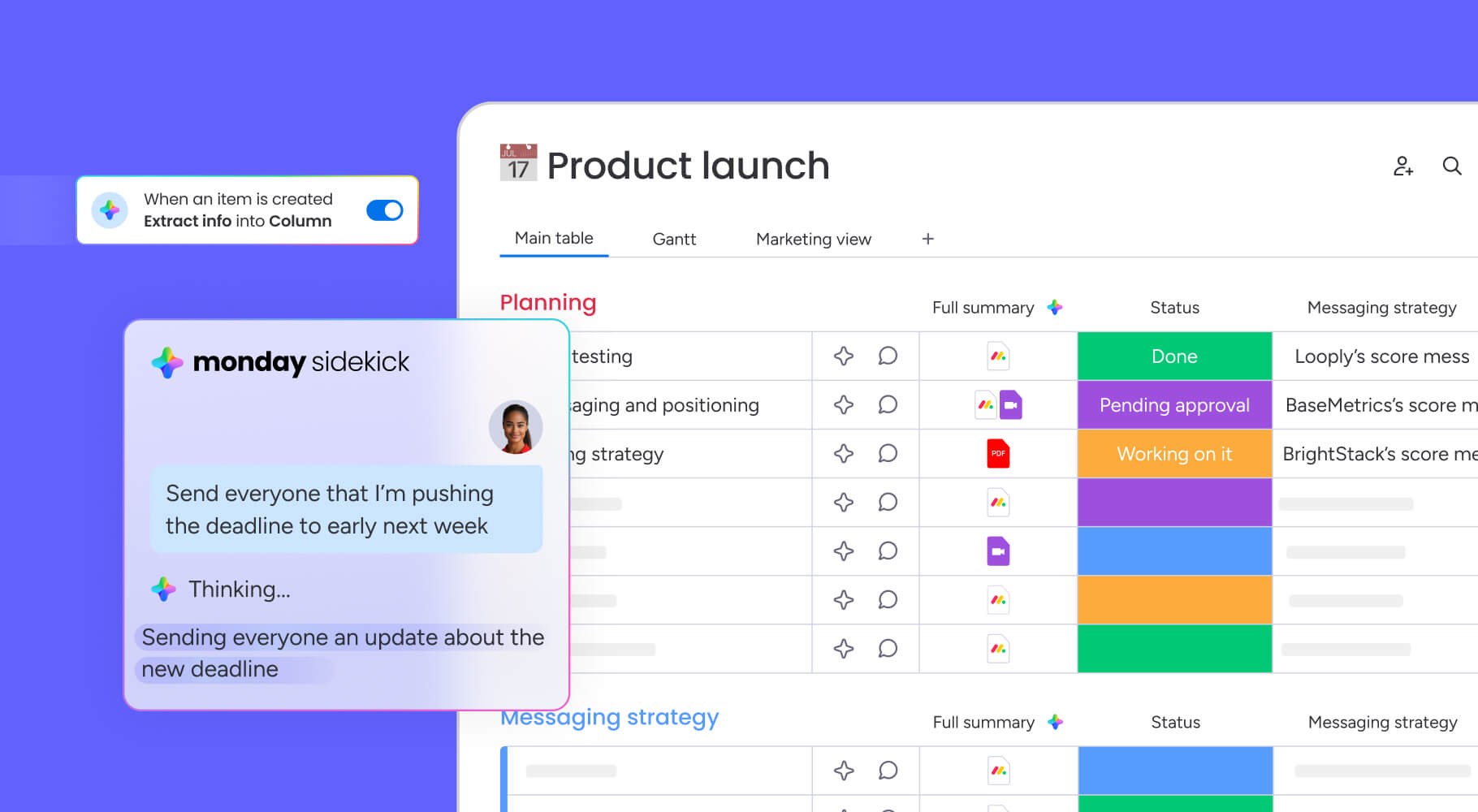
monday.com is a complete financial planning platform that turns static pro forma templates into dynamic, collaborative systems. Instead of wrestling with version-controlled spreadsheets and manual data entry, finance teams get a centralized workspace where AI handles the heavy lifting. Here’s how monday.com changes the game for pro forma financial modeling.
AI-powered forecasting that learns from your business
monday.com’s AI capabilities go beyond basic automation. The platform’s agentic AI analyzes historical patterns in your data, identifies trends you might miss, and suggests adjustments to your assumptions based on actual performance. When your Q1 actuals come in 15% above projections, AI automatically flags the variance and recommends updated growth rates for the rest of the year.
The AI assistant can also generate entire pro forma scenarios based on simple conversations. Ask “What happens if we delay our product launch by 2 months?” and watch as AI builds a complete alternative scenario, adjusting revenue timing, marketing spend, and cash flow projections accordingly. This transforms scenario planning from a multi-hour spreadsheet exercise into a conversation.
Real-time collaboration that eliminates version chaos
Finance teams waste hours reconciling different versions of the same model. monday.com solves this with a single source of truth where everyone works simultaneously. When your VP of Sales updates pipeline assumptions, the CFO sees changes instantly. When Operations adjusts capacity constraints, Finance immediately understands the revenue implications.
Built-in approval workflows ensure governance without slowing things down. Set up automated notifications when assumptions change beyond certain thresholds, require sign-offs from department heads before budget modifications go live, and maintain a complete audit trail showing exactly who changed what and when. No more “final_v3_ACTUAL_FINAL.xlsx” files cluttering your inbox.
Connected data that keeps forecasts current
Pro forma templates are only useful if they reflect reality. monday.com integrates directly with your CRM, accounting software, ERP systems, and operational tools, pulling actual performance data automatically. When deals close in Salesforce, revenue projections update. When invoices post in QuickBooks, expense actuals flow into budget-versus-actual analysis.
This connectivity means your pro forma becomes a living forecast that evolves with your business. Custom dashboards give each stakeholder exactly the view they need: executives see high-level KPIs and variance analysis, department heads track their specific cost centers, and board members access investor-ready financial summaries. All pulling from the same underlying data, all updating in real-time.
Try monday.com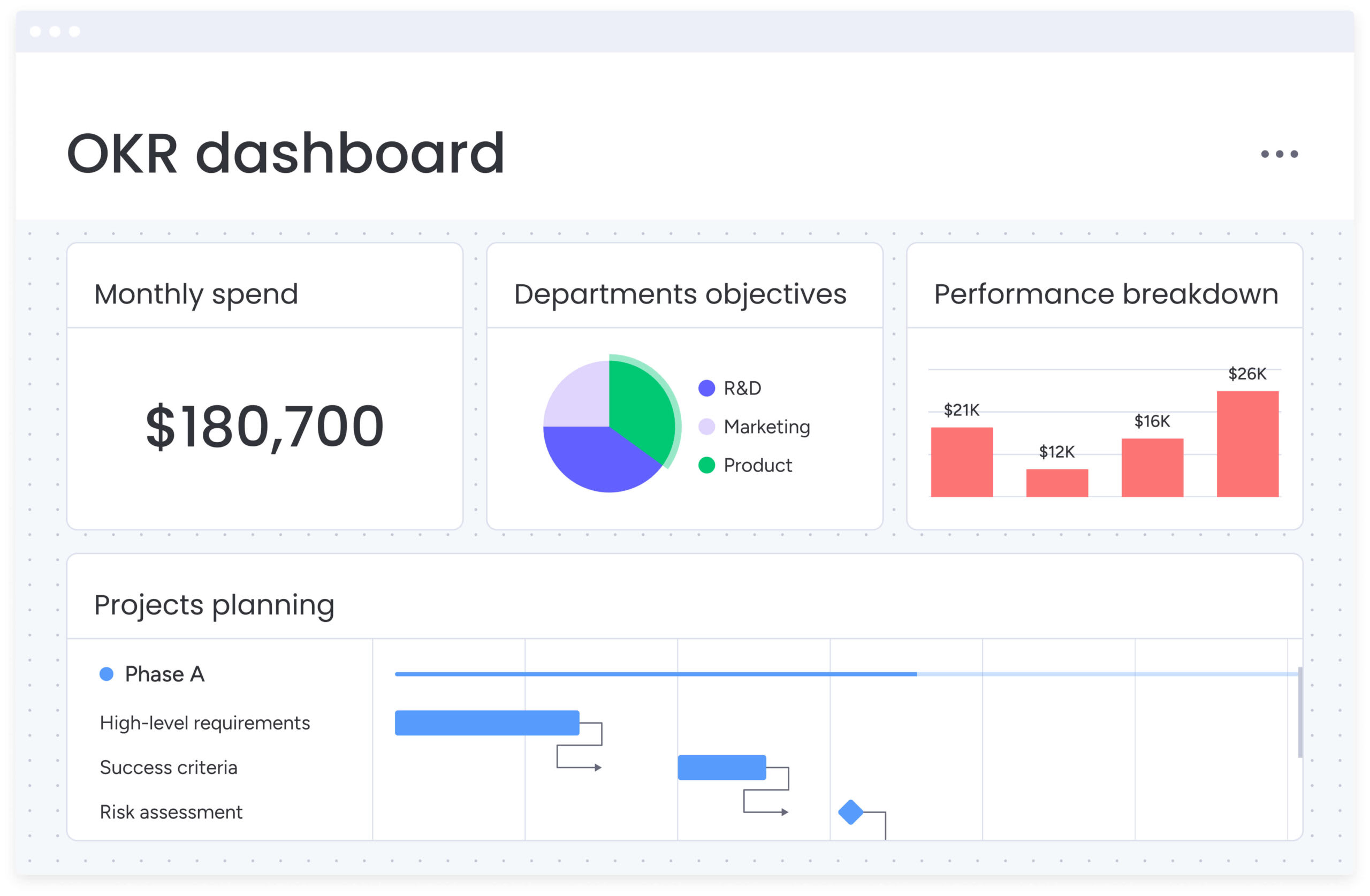
Build financial models that drive strategic execution
Pro forma templates are more than financial documents — they’re the foundation for strategic decision-making. The right template transforms scattered assumptions into structured projections that guide investment decisions, secure funding, and align teams around shared financial goals.
Static spreadsheets served their purpose, but organizations need living financial systems that evolve with business conditions. When forecasts connect directly to operational data, update automatically as conditions change, and enable real-time scenario planning, finance teams shift from reactive reporting to proactive strategy.
monday.com brings these capabilities together in one platform. From automated calculations and integrated data sources to collaborative workflows and AI-powered insights, it helps organizations build dynamic pro forma templates that scale with their business.
Try monday.comFAQs
What is a pro forma template used for?
A pro forma template is used to create standardized forward-looking financial statements that project future business performance based on assumptions rather than historical data. Organizations use these templates for strategic planning, budgeting, investment analysis, and securing financing.
How do I create a pro forma income statement in Excel?
To create a pro forma income statement in Excel, start with historical financial data, document key assumptions for growth and costs, project revenues and expenses based on those drivers, and create multiple scenarios. Build formulas that link assumptions to calculations and use separate tabs for different statement types.
What's included in a pro forma cash flow statement?
A pro forma cash flow statement includes operating cash flows adjusted for timing differences, investing cash flows for capital expenditures, and financing cash flows from debt and equity transactions. It shows how cash moves through your business and identifies periods where external financing might be needed.
How does a pro forma differ from GAAP financial statements?
Pro forma statements are forward-looking and based on assumptions to support planning, whereas GAAP statements are historical, based on actual transactions, and designed for compliance and accountability. Pro forma offers flexibility in presentation while GAAP follows strict accounting rules.
Can AI improve pro forma accuracy?
AI enhances pro forma accuracy by automating data extraction from documents, identifying patterns in historical data to predict trends, and performing sophisticated sensitivity analysis. AI can also flag anomalies, suggest adjustments based on market conditions, and reduce manual calculation errors.
What are common pro forma modeling mistakes?
Common pro forma modeling mistakes include inadequate documentation of assumptions, overly optimistic revenue projections, ignoring seasonal patterns, and failing to update models with actual performance data. Other errors include not accounting for step-function costs, missing working capital requirements, and creating models that are too complex to maintain.

 Get started