


Performance reviews continue to miss the mark: only 20% of employees strongly agree that their performance is managed in a way that motivates them to do outstanding work. That disconnect leaves managers frustrated, and employees disengaged. A performance improvement plan (PIP) bridges that gap by replacing vague feedback with a structured, documented path to team productivity gains.
In this article, you’ll find everything you need to create and manage an effective PIP: a working definition, guidance on when a PIP is the right move, a step-by-step writing guide, free templates, real-world examples, tips for running PIP meetings, common mistakes to avoid, and what happens after a PIP ends.
Whether you’re building your first performance improvement plan or refining an existing process, the monday AI Workspace makes it simple to create, track, and manage PIPs from one place, with ready-made templates, automations, and real-time dashboards that keep everyone aligned.
Key takeaways
- A PIP is a structured document that gives underperforming employees a specific, measurable roadmap to succeed
- Every PIP should include documented performance issues, measurable goals, a timeline, support resources, and consequences
- Writing a PIP in five steps keeps the process fair, consistent, and legally sound
- Specific goals, regular check-ins, and a genuine support mindset are what turn a PIP into a true development opportunity
- The monday AI Workspace gives HR teams a ready-made PIP template with built-in automations, dashboards, and AI-powered tracking
What is a performance improvement plan?
A performance improvement plan (PIP) template helps you lay out a performance action plan, or employee improvement plan, a corrective strategy for addressing recurring behavioral or performance issues. This plan is both a procedure and a document detailing corrective actions. It provides resources and sets an expected timeline for the outcome for underperforming employees.
A performance improvement plan template typically includes several core components. Understanding these elements helps you build a PIP that’s thorough, fair, and actionable for both the manager and the employee:
- Corrective actions
- Resources
- Timelines
- Consequences of failing to meet your company’s stipulations
A performance action plan holds employees accountable when they are unable to meet the acceptable standard of performance outlined in their job description. If an employee fails to meet the PIP’s expectations within the specified timeframe (usually 30, 60, or 90 days) and does not improve their work performance, the PIP outlines explicit repercussions. This includes possible termination of their employment.
When to use a PIP (and when not to)
Not every performance issue calls for a formal improvement plan. A PIP is a structured intervention, and deploying it at the wrong moment can damage trust or waste everyone’s time. Knowing when a PIP is the right move, and when an alternative fits, is one of the most important judgment calls a manager can make.
A PIP is typically appropriate when informal coaching has already been tried, and the performance gap persists. These scenarios signal that a structured plan is the right next step:
- Informal feedback has already been given: The employee has received verbal or written coaching on the issue, but performance hasn’t improved
- The issue is documented: You have specific records (missed deadlines, quality reports, behavioral incidents) that demonstrate a pattern
- The role is a good fit: The employee has the skills for the position but isn’t meeting expectations due to behavior, effort, or work habits
- The gap is measurable: You can define the improvement with numbers, dates, or observable actions rather than subjective impressions
When should you use a PIP versus informal coaching? If the issue is new, situational, or tied to a skills gap the employee hasn’t been trained for, consider these alternatives first:
- Informal coaching: A direct conversation paired with follow-up check-ins, effective for first-time issues or minor dips in performance
- Mentorship: Pairing the employee with a higher-performing peer helps when the root cause is a lack of guidance rather than effort
- Role clarification: Sometimes performance drops because expectations are unclear. Revisiting the job description and deliverables can resolve the problem without a formal plan
- Training programs: If an employee lacks a specific skill, enrolling them in targeted development is faster and more effective than documenting a gap they never had the resources to close.
A quick decision checklist: Have you already given informal feedback? Is the issue documented over time? Is the role still the right fit? If you answered yes to all three, a PIP is the logical next step.
What to include in a performance improvement plan
A PIP is only as effective as the information it contains. Vague plans lead to vague outcomes, leaving both managers and employees guessing. A well-structured PIP removes ambiguity by spelling out exactly what needs to change, how it will be measured, and what support the employee will receive along the way.
Every performance improvement plan should include the following components. Think of this as your PIP checklist. If any element is missing, the plan is incomplete.
- Employee information: Full name, job title, department, manager name, and the date the PIP is issued. This establishes a formal record
- Specific performance issues: Describe the exact behaviors or outcomes that fall short of expectations. Use data and examples. “Missed four of six project deadlines in Q1” is actionable; “needs to be more productive” is not
- Measurable improvement goals: Define the target outcome in numbers, percentages, or observable actions. Each goal should answer: what does success look like, and how will we measure it?
- Action steps and resources: List what the employee will do to reach each goal and what the organization will provide: training sessions, mentorship, adjusted workload, or access to new resources
- Timeline: Set a 30, 60, or 90-day window depending on the complexity of the issue. Shorter timelines work for straightforward behavioral changes; longer timelines suit skill development.
- Check-in schedule: Define when formal progress reviews will happen (weekly, biweekly, or at specific milestones). Regular check-ins keep the plan on track and show the employee that managers are invested in their success
- Consequences: State what happens if the employee meets the goals and what happens if they don’t. This includes continued employment, extended PIP, role reassignment, or termination
- Signatures: Both the manager and employee should sign and date the PIP. If the employee refuses to sign, document the refusal and note that the plan remains in effect
Having every component in place protects the organization legally, gives the employee a fair chance, and ensures managers have a defensible record of the process.
Five steps to write a performance improvement plan
Writing a PIP doesn’t have to feel overwhelming. When you break it into a repeatable process, each plan comes together faster, and the result is more consistent, fair, and effective. The steps below work for any performance issue, from missed deadlines to behavioral concerns.
Step 1: Assess and document the performance gap
Before you open a template, gather the evidence. Pull performance data, project records, feedback from peers, and any notes from previous coaching conversations. The goal is to identify a specific, measurable gap between the employee’s current performance and the expected standard.
Ask yourself: can I describe this gap with data and examples rather than subjective feelings? If the answer is yes, you have enough to move forward.
Step 2: Set specific, measurable improvement goals
Each goal should answer three questions: what the employee needs to achieve, by when, and how you will measure it. Avoid vague targets like “improve communication.” Instead, try “respond to all Slack messages from direct reports within four business hours during the PIP period.”
Limit the plan to two to four goals. Too many targets dilute focus and make the PIP feel punitive rather than developmental.
Step 3: Define action steps and resources
For every goal, map out what the employee will do and what support the organization will provide. This might include enrolling in a training course, scheduling weekly one-on-ones with a mentor, or reassigning certain responsibilities to reduce overload.
When the action plan includes resources and support, it signals that the PIP is an investment in the employee’s growth, not just a paper trail for termination. Consider linking to a formal performance action plan to add structure.
Step 4: Establish a timeline with check-in milestones
Set the overall duration (30, 60, or 90 days) and schedule formal check-ins at regular intervals. Weekly or biweekly check-ins work well for most plans. Each check-in should review progress against the goals, surface obstacles, and adjust the plan if needed.
Work management platforms make this step significantly easier. Set up automations to send check-in reminders to both managers and employees, so no milestone slips through the cracks. A shared dashboard provides everyone with a single source of truth for PIP progress.
Learn more: 30-60-90 day plan template
Step 5: Communicate the plan and get employee input
A PIP works when the employee co-owns it. Present the plan in a private meeting, walk through every section, and invite the employee to share their perspective. Are the goals realistic? Do they have the resources they need? Is there context you’re missing?
Document the conversation and any agreed-upon adjustments. When both sides have contributed to the plan, the employee is more likely to engage with it and less likely to feel blindsided. Share the finalized PIP through your workspace so it’s accessible, transparent, and trackable.
Five performance improvement plan examples
Real-world examples make it easier to see how the components of a PIP come together. Each scenario below uses a structured table you can copy and adapt for your own organization. The examples cover the most common PIP triggers, from productivity issues to remote collaboration gaps, and include goals, action steps, timelines, and assessment criteria.
These examples follow the format outlined in the “What to include” section above, ensuring that every critical element is represented.
Example 1: Low productivity and missed deadlines
An employee consistently misses project deadlines and delivers below the expected output volume. Previous coaching conversations haven’t resulted in sustained improvement.
| PIP component | Example |
|---|---|
| Performance issue | Employee has missed 4 of the last 6 project deadlines and is completing fewer assigned tasks than expected |
| Expected improvement | Complete assigned tasks by agreed deadlines and maintain consistent weekly output |
| Action steps | Review workload with manager each Monday; break large tasks into milestones; update task status by end of day every Friday |
| Support provided | Weekly manager check-ins, workload prioritization support, access to project planning template |
| Timeline | 30 days |
| Success criteria | 90% of assigned tasks completed on time; no missed priority deadlines; weekly status updates submitted consistently |
Example 2: Poor work quality
An employee’s deliverables consistently require significant revisions. Error rates have increased over the past quarter, and peer reviewers have flagged recurring issues.
| PIP component | Example |
|---|---|
| Performance issue | Deliverables require frequent revisions due to recurring errors, incomplete details, or failure to follow guidelines |
| Expected improvement | Submit work that meets quality standards with fewer revisions |
| Action steps | Review quality checklist before submission; complete peer review for major deliverables; document recurring feedback themes |
| Support provided | Quality checklist, sample approved deliverables, weekly feedback session with manager |
| Timeline | 45 days |
| Success criteria | Revision requests reduced by 50%; no repeated critical errors; deliverables meet agreed standards before submission |
Example 3: Inappropriate workplace behavior
An employee’s interactions with coworkers have generated complaints. Documented incidents include dismissive communication in meetings and failure to respond to team messages.
| PIP component | Example |
|---|---|
| Performance issue | Employee has used dismissive communication in meetings and has not responded consistently to team messages |
| Expected improvement | Communicate respectfully and respond to team members within expected timeframes |
| Action steps | Acknowledge team messages within one business day; use constructive language in meetings; attend communication coaching session |
| Support provided | Clear communication expectations, manager check-ins, coaching or HR support |
| Timeline | 30 days |
| Success criteria | No further documented complaints; consistent response times; manager and team feedback show improved collaboration |
Example 4: Customer complaint-driven PIP
An employee in a customer-facing role has received repeated negative feedback from clients. Customer satisfaction scores have dropped, and escalation frequency has increased.
| PIP component | Example |
|---|---|
| Performance issue | Employee has received repeated customer complaints and has a higher-than-average escalation rate |
| Expected improvement | Improve customer communication, reduce escalations, and meet service quality expectations |
| Action steps | Follow customer response script; review 3 customer interactions weekly with manager; complete service training module |
| Support provided | Customer communication training, call or ticket review, manager coaching |
| Timeline | 60 days |
| Success criteria | Customer satisfaction score improves to target range; escalation rate decreases; no repeated complaint themes |
Example 5: Remote employee communication and collaboration issues
A remote employee has become increasingly unresponsive during working hours. They miss virtual meetings, delay responses to messages, and fail to update shared project boards, creating visibility gaps for the rest of the team.
| PIP component | Example |
|---|---|
| Performance issue | Employee misses virtual meetings, delays responses, and does not update shared project boards consistently |
| Expected improvement | Improve responsiveness, meeting attendance, and visibility into work progress |
| Action steps | Attend all required meetings; respond to messages within agreed working hours; update project board at least 3 times per week |
| Support provided | Clear communication norms, weekly manager check-ins, shared project board expectations |
| Timeline | 30 days |
| Success criteria | 100% attendance at required meetings; timely responses during working hours; project board updates completed consistently |
How to conduct a PIP meeting
How do you deliver tough feedback without putting an employee on the defensive? The PIP meeting sets the tone for the entire process. Handle it well, and the employee is more likely to engage constructively. Handle it poorly, and even the most thoughtful plan can feel like a punishment.
Preparation matters. Before the meeting, review all documentation, finalize the PIP, and consider how the employee might react. Book a private space (or a private video call for remote employees) and allocate enough time so the conversation doesn’t feel rushed.
Here’s a practical meeting agenda that keeps the conversation productive:
- Open with context, not accusations: Start by explaining why the meeting is happening. Frame it as a structured support plan, not a disciplinary action. “We’ve noticed a pattern we want to address together,” works; “you’ve been underperforming” does not
- Present the PIP document: Walk through each section: the performance issues, goals, action steps, timeline, and consequences. Use specific examples and data rather than generalizations
- Invite the employee’s perspective: Ask open-ended questions. “What’s been making it difficult to meet these deadlines?” or “Is there anything we’re missing about what’s going on?” Employees who feel heard are more likely to commit to the plan
- Agree on next steps: Confirm the check-in schedule, clarify who the employee can go to for support, and set the date for the first progress review
- Document the conversation: Record key points from the discussion, any adjustments agreed upon, and whether the employee signed the PIP. If they refuse to sign, note the refusal and confirm the plan is still in effect
Keep the tone direct, respectful, and forward-looking. The goal isn’t to dwell on past failures. It’s to build a shared plan for success.
Common PIP mistakes to avoid
Even well-intentioned performance improvement plans can backfire when they’re built on shaky foundations. The mistakes below are the most frequent reasons PIPs fail, and each one is avoidable with a small shift in approach.
Recognizing these patterns before you issue a PIP saves time, protects employee trust, and produces outcomes that actually stick.
- Setting vague or unmeasurable goals: “Improve your attitude” isn’t a goal; it’s an opinion. Every PIP goal should be specific enough to measure with data. Instead, define observable behaviors: “Participate in all weekly team syncs and contribute at least one update per meeting.”
- Skipping regular check-ins: A PIP without check-ins is just a deadline. Scheduled progress reviews give the employee a chance to ask questions, report obstacles, and adjust course. They also show that management is invested in the outcome, not waiting to catch the employee failing
- Using the PIP as a punishment rather than a development opportunity: If an employee feels the PIP is designed to push them out, they’ll disengage immediately. Frame the plan as an investment in their growth. Provide genuine resources, training, and mentorship alongside the expectations
- Failing to provide adequate resources or support: Asking an employee to improve without giving them the means to do so is setting the plan up to fail. Every action step in the PIP should pair an expectation with a resource, whether that’s training, mentorship, a reduced workload, or access to new workflows
- Not documenting the process: Verbal conversations don’t count. Every step of the PIP, from the initial meeting to check-in notes to the final outcome, should be recorded in writing. This protects both the employee and the organization, especially if the PIP leads to termination or a legal review
What happens when a PIP ends
A PIP doesn’t just expire; it concludes with a clear outcome that both the manager and employee understand. How you close the process matters as much as how you start it. A well-documented conclusion protects the organization, respects the employee, and sets the stage for whatever comes next.
There are four common outcomes when a PIP reaches its end date. Each outcome should be anticipated from the beginning, with the PIP document explicitly outlining what happens in each scenario:
- Successful completion: The employee meets all or most of the goals outlined in the PIP. The manager formally acknowledges the improvement, removes the PIP from active status, and documents the outcome. This is the ideal result, and it happens more often than many managers expect
- PIP extension: The employee shows meaningful progress but hasn’t fully met every goal. Extending the PIP by 15 to 30 days gives them additional time to close the gap while maintaining the structure and accountability of the original plan
- Role reassignment: Sometimes the PIP reveals that the employee’s strengths don’t align with their current position. Reassigning them to a role that fits their skills can salvage the working relationship and retain institutional knowledge
- Termination with documented cause: If the employee fails to improve despite receiving support, resources, and regular feedback, termination becomes a defensible decision. The PIP documentation provides the record needed to demonstrate that the process was fair, transparent, and thorough
Regardless of the outcome, a well-executed PIP creates a defensible record that shows the organization acted in good faith. That documentation matters whether the employee thrives, transitions, or exits.
How monday AI Workspace simplifies performance improvement plans
Writing a PIP is one challenge. Tracking it over 30, 60, or 90 days, with multiple check-ins, shifting deadlines, and stakeholders in different locations, is entirely different. This is where dedicated AI performance management software earns its keep, since most PIP processes break down in execution, not planning. That’s where most performance improvement processes break down: not in the planning, but in the execution.
The monday AI Workspace gives HR teams and managers a single workspace to create, manage, and monitor PIPs from start to finish. Instead of juggling spreadsheets, email reminders, and scattered documents, everything lives in one connected system that keeps the process moving.
Here’s how the platform supports every stage of the PIP lifecycle, from initial setup through final review. Each capability is designed to reduce manual effort and keep the focus on employee development:
- Ready-made PIP templates: Start in seconds with a customizable template and adapt it for any performance scenario. Skip the blank-page struggle. Choose from multiple formats and adjust columns, timelines, and status fields to match your organization’s policies
- Real-time dashboards: See every employee’s PIP status, milestones, and check-in history in one view. Managers always know when to step in, and HR leaders can track PIP outcomes across the organization without having to chase down individual updates
- Automations: Auto-send check-in reminders, notify managers of upcoming deadlines, and escalate overdue milestones, so nothing falls through the cracks during a 30, 60, or 90-day plan
- AI Blocks: Summarize check-in notes, categorize performance data, and flag at-risk employees without manual effort. Built-in AI turns raw data into actionable insights that help managers intervene earlier
- monday agents: Deploy AI agents that monitor PIP progress, surface bottlenecks, and generate status updates automatically. Agents work in the background so managers can focus on coaching rather than administration
- monday vibe: Build a custom PIP tracking app tailored to your organization’s exact policies, no code required. If your performance management process has unique approval workflows or escalation paths, vibe turns that into a working application in minutes
- Integrations: Push PIP updates to Slack, Microsoft Teams, or email so everyone stays informed. Connect your existing HR systems to keep data flowing without manual entry
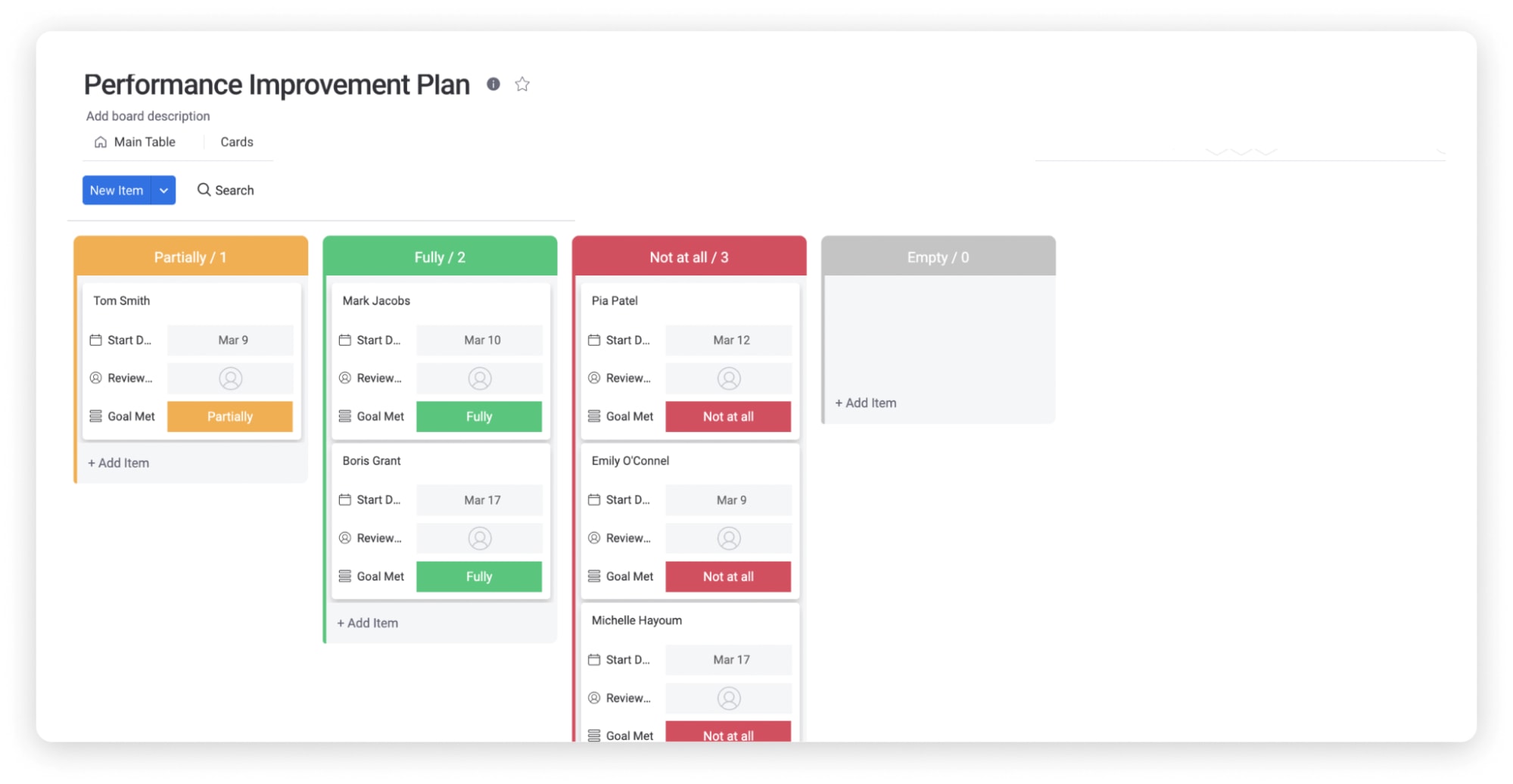
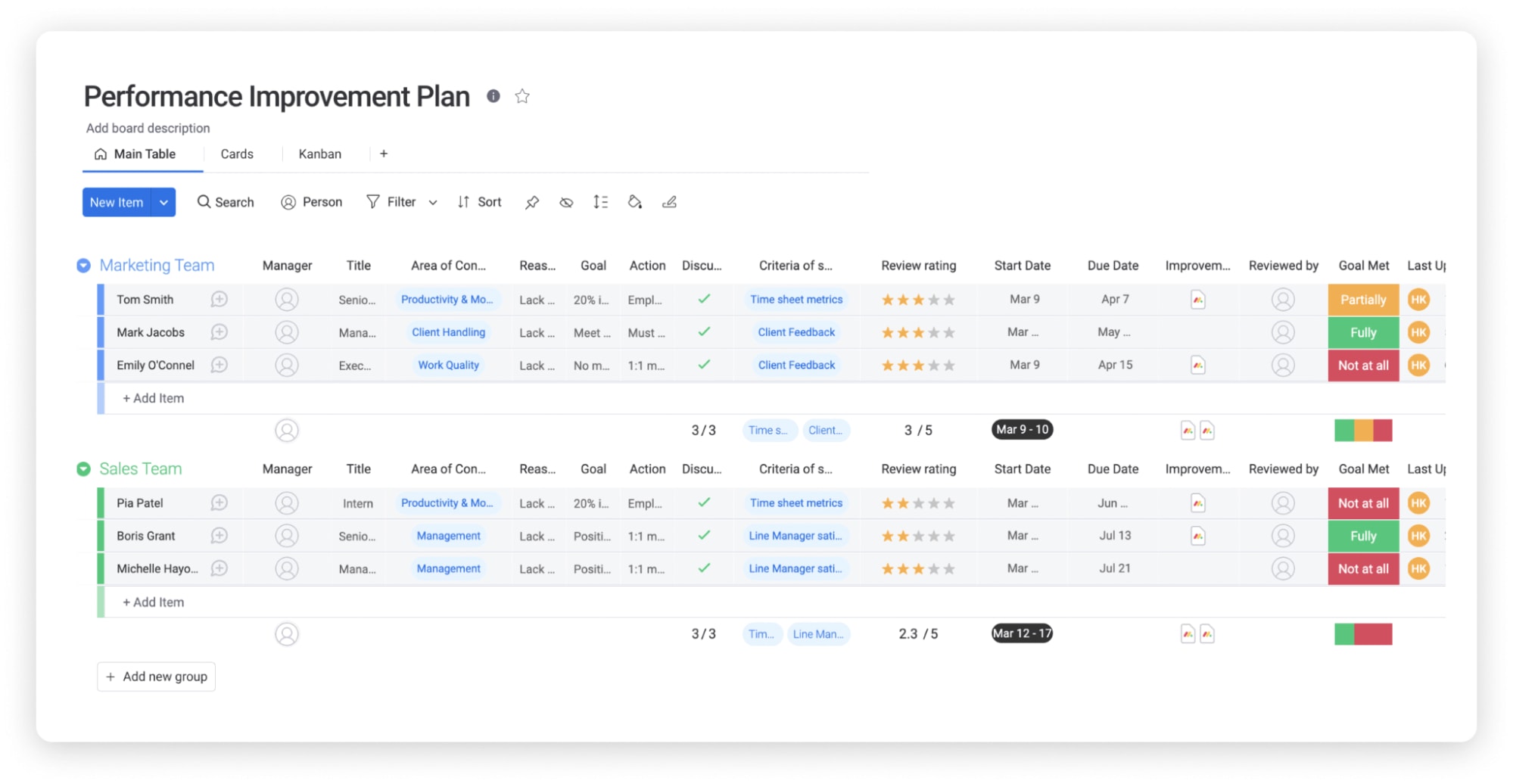
With fully customizable boards and automation rules, you can create an efficient workflow for getting your employees back on track. Set up a board that gives you a bird’s-eye view of every active PIP across your organization, who’s on track, who needs attention, and what’s coming due next.
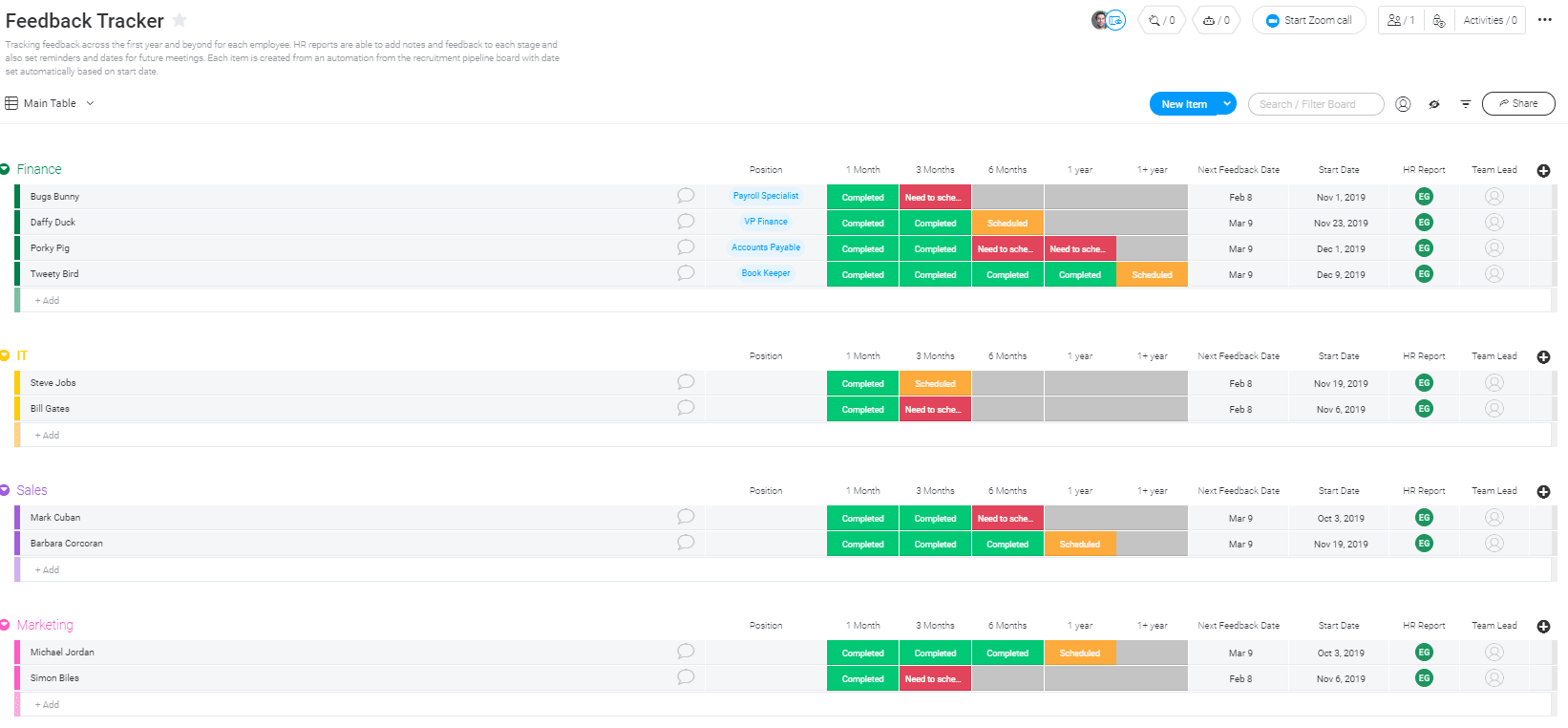
You can also use native integrations to track employee performance in real-time, for example, the percentage of resolved customer tickets, using real-time dashboards to feed that data directly into the PIP board for a complete picture.
Tips for creating performance improvement plans that work
A PIP is only as effective as the effort behind it. The templates and steps above give you the structure, but the tips below help you separate plans that actually drive improvement from those that collect dust in an HR folder.
These recommendations come from real-world patterns in organizations that use PIPs as genuine development opportunities rather than exit paperwork.
Communicate expectations from day one
Ensure that your employees understand why improvement is needed and what’s expected of them. Explain why a performance improvement plan is necessary and how their work is falling short of expectations. Detail what the ideal outcome looks like, and ask them for feedback so that you both agree on the goals that have been laid out.
Let employees lead the conversation
Ask your underperforming employees for input on how their progress should be measured. Work with them to define what success looks like and the interventions that would be most appropriate. When employees shape the plan, they’re more invested in following through.
Set realistic and measurable objectives
It’s unrealistic to expect an employee who struggles to meet deadlines to solve this issue in a day or a week. A more effective approach is to set incremental goals, gradually improving their ability to meet deadlines over the quarter. You must also provide them with relevant training so they have the resources they need to succeed.
Schedule regular check-ins
Check in with your employees to ensure they are working towards the PIP’s goals, understand these goals and how to reach them, and have the resources and guidance they need. Make it clear that they are always welcome to ask questions about any aspect of the plan they are unsure about. Automations can send check-in reminders automatically, so neither managers nor employees forget a scheduled review.
Keep everything in writing
Using templates from monday.com helps ensure that your performance improvement plan is documented and can be referred back to at any time. The platform also allows you to track how your employees measure up against the PIP in real-time, so your managers know exactly when they should reach out to an employee and offer extra guidance.
Account for remote and hybrid employees
Remote employees face unique PIP challenges: fewer casual check-ins, communication delays across time zones, and the risk of feeling isolated from support. Adapt your PIP process by scheduling video check-ins instead of in-person meetings, using async standup boards for daily updates, and ensuring remote employees have equal access to training and mentorship resources. A shared digital workspace keeps everyone, regardless of location, connected to the same goals and timelines.
Build a performance management culture that drives results
A performance improvement plan isn’t a punishment; it’s a structured investment in employee growth. When you combine a specific template, consistent check-ins, and genuine support, most employees rise to the challenge. The organizations that get the most from PIPs are the ones that treat them as part of a broader culture of accountability and development.
The monday AI Workspace gives teams everything they need to create, track, and manage PIPs from start to finish, ready-made templates, automations that keep check-ins on schedule, dashboards that surface progress in real time, and AI-powered features that reduce the manual work behind performance management. Start building a performance culture that supports your people and protects your organization.
FAQs
What is a performance improvement plan?
A performance improvement plan is a formal document that outlines specific performance deficiencies, sets measurable improvement goals, defines a timeline (typically 30 to 90 days), and specifies the consequences if goals are not met. It gives employees a structured path to address performance issues and succeed in their role.
What should a performance improvement plan include?
A performance improvement plan should include the employee's information, specific documented performance issues, measurable improvement goals, action steps with resources, a timeline, a check-in schedule, consequences for meeting or not meeting the goals, and signatures from both the manager and employee.
How long should a PIP last?
A PIP typically lasts between 30 and 90 days, depending on the complexity of the performance issues it addresses. Straightforward behavioral changes may require only 30 days, while skill development or sustained performance gaps often benefit from a 60 or 90-day window.
Does a PIP always lead to termination?
A PIP does not always lead to termination. A well-designed performance improvement plan is built to help the employee succeed by providing specific goals, resources, and support. Termination is one possible outcome if the employee fails to improve, but many employees complete their PIPs successfully and continue in their roles.
Can an employee refuse to sign a PIP?
An employee can refuse to sign a PIP, but the plan still takes effect. If an employee declines to sign, the manager should document the refusal, note the date, and confirm in writing that the PIP expectations and timeline remain active regardless of the signature.
Is a PIP a legal document?
A PIP is not a legally binding contract, but it serves as critical documentation if the employment relationship ends and the decision is challenged. A well-documented PIP demonstrates that the organization identified the issue, provided resources, set expectations, and gave the employee a fair opportunity to improve.
How does monday AI Workspace help manage performance improvement plans?
The monday AI Workspace helps manage performance improvement plans by providing a ready-made PIP template with built-in automations for check-in reminders, real-time dashboards to track employee progress, and AI-powered features that summarize notes and flag at-risk milestones. HR teams can focus on supporting employees rather than chasing paperwork.
 Get started