


If your team’s performance is lacking, good intentions alone aren’t enough to change the situation. Instead, team performance improves when managers change specific habits, such as how they set goals, run meetings, give feedback, and track progress.
This article covers 8 strategies that help teams work faster and help managers catch problems earlier. Combined with organizing your work on monday.com’s AI Work Platform, you’ll learn how to hit your goals without friction.
Get startedKey takeaways
- Set measurable goals: teams with defined KPIs and OKRs consistently outperform those without structured targets.
- Build psychological safety: high-performing teams share a culture of trust where people speak up without fear.
- Standardize workflows: repeatable processes reduce confusion and free up time for higher-value work.
- Give continuous feedback: regular check-ins and 1:1s keep team performance on track far more effectively than annual reviews.
- Use AI to remove friction: monday.com’s AI Work Platform automates routine work so teams focus on what moves the needle.

What is team performance?
Team performance is the collective ability of a group to meet its objectives, deliver quality work, and improve continuously. It goes beyond individual output, meaning that a team can be full of top performers and still underperform if collaboration, communication, and shared accountability aren’t functioning well.
What separates high-performing teams from average ones boils down to how effectively people:
- align on goals
- divide responsibilities
- share information
- support each other through setbacks
While individual skills are important, team effectiveness depends on how those skills combine under real working conditions.
Why should this be a priority for managers and leaders? Because team performance directly impacts the metrics executives care about most. Research from Gallup shows that highly engaged teams (a key driver of team performance) see 23% higher profitability and 18% higher productivity compared to disengaged ones. The ripple effects extend to customer satisfaction, employee retention, and the speed at which your organization can innovate.
In other words, investing in team performance is the single highest-leverage thing a manager can do.
8 strategies to improve team performance
Improving team performance isn’t about finding one silver bullet. It requires a combination of goal-setting, cultural foundations, operational systems, and the right technology working together. The strategies below cover all of these areas, and they’re sequenced so each one builds on the last. Here’s how to improve team performance in a way that sticks.
1. Set measurable goals and KPIs
Before you and your team can set out for success, you need to be on the same page about what that looks like. You can’t expect an employee to work towards a goal they don’t know about. Vague objectives like “do great work” or “grow the business” leave too much room for interpretation. When everyone’s running in a slightly different direction, team productivity takes a hit, even if everyone’s working hard.
Start by determining metrics for success, both for the team as a whole and for individual positions. You can be flexible about what those look like, depending on what your team does. But two frameworks stand out for structuring your goals effectively:
- SMART goals: specific, measurable, achievable, relevant, and time-bound targets that give everyone a finish line to aim for.
- OKRs (objectives and key results): a framework that connects ambitious objectives to 3-5 measurable results, making it easier to cascade goals from company-level strategy down to individual contributors.
Example: Your marketing team sets a quarterly objective to increase qualified pipeline by 30%. The key results might include launching 4 campaigns, improving landing page conversion by 15%, and generating 200 MQLs per month. Each person knows exactly what they own, and the team can track weekly progress against those numbers.
Research from Edwin Locke and Gary Latham, who’ve spent decades studying goal-setting theory, found that specific, challenging goals lead to higher performance 90% of the time compared to vague or easy goals. The takeaway? Don’t just set goals. Make them visible, measurable, and connected to the larger mission. Real-time dashboards make this practical by giving your whole team a shared view of where things stand, no status meetings required.
2. Define roles and build accountability
Role ambiguity is one of the most common and most expensive drains on team effectiveness. When ownership isn’t defined, work gets duplicated, things get lost, and conflicts emerge over who was supposed to do what.
The fix starts with making responsibilities explicit. Frameworks like RACI (responsible, accountable, consulted, informed) give you a structured way to map out who owns each piece of a project. You don’t need to document every micro-task, but the high-impact items (deliverables, decisions, approvals) should have a single owner that everyone knows about.
Accountability doesn’t mean micromanagement. In fact, it’s the opposite. When people know exactly what’s expected of them, they need less oversight, not more. The goal is to pair ownership with autonomy: you’re responsible for this outcome, and you have the freedom to decide how you get there.
One often-overlooked aspect of role definition is workload balance. If your top performers consistently carry a heavier load than everyone else, you’re building a team that runs on burnout. Over time, those high performers either disengage or leave, and the imbalance that caused the problem gets worse. Workload views and team management dashboards make distribution visible so you can spot and correct imbalances before they become retention problems.

3. Create systems and standardize processes
Once everyone’s aligned on their responsibilities, the next question becomes: how do they get the work done? If every project starts from scratch, with team members reinventing the process each time, you’re burning time and mental energy that should go toward the work.
Having set steps for how sales meetings are run or what’s required to launch a new campaign means you’re not spending hours planning before each initiative. Your team members aren’t scrambling to pull together materials at the last minute. Instead, everyone follows the same proven set of steps every time. Not only does this reduce mental friction, standardized systems also make collaborating and handing off projects between team members significantly more organized.
Here’s what effective process standardization looks like in practice:
- Standard operating procedures (SOPs): document the steps for recurring processes so new and existing team members follow the same playbook.
- Workflow templates: create reusable project structures that include pre-assigned owners, deadlines, and dependencies.
- Automated handoffs: use automations to trigger notifications, status changes, and task assignments so nothing stalls between stages.
- Status tracking: give everyone visibility into where each piece of work sits, without requiring a check-in meeting.
The impact can be significant. Teams that template their intake and kickoff processes often reduce project startup time by 30-40%, simply by eliminating the “how do we do this again?” phase. That’s team productivity you can measure week over week.
4. Foster psychological safety and trust
You can have perfect goals, defined roles, and streamlined processes and still have a team that underperforms. Why? Because none of those systems work well if people don’t feel safe enough to use them honestly. Psychological safety, a concept developed by Harvard professor Amy Edmondson, is the shared belief that you won’t be punished or humiliated for speaking up with ideas, questions, concerns, or mistakes.
Google’s Project Aristotle, a multi-year study of 180 teams, found that psychological safety was the single strongest predictor of team effectiveness. It outranked dependability, structure, meaning, and impact. Teams that felt safe took more risks, flagged problems earlier, and innovated faster than teams that didn’t.
To build it, start at the top. When leaders admit their own mistakes, ask genuine questions, and respond to bad news with curiosity instead of blame, they set the tone for the entire team. Here are practical tactics that work:
- Normalize failure: frame setbacks as learning opportunities, not career-defining moments.
- Encourage dissent: actively ask for opposing viewpoints before making decisions.
- Model vulnerability: share your own uncertainties and areas where you need help.
- Respond to mistakes constructively: focus on what happened and what to do next, not who’s to blame.
For remote and hybrid teams, psychological safety requires even more intentional effort. Without the informal hallway conversations and body language cues of in-person work, misunderstandings happen more easily and people are more likely to stay silent when something feels off. Building in regular, low-stakes opportunities for connection (informal standups, team retrospectives, even virtual coffee chats) helps bridge that gap.
5. Communicate effectively and give regular feedback
Annual reviews might be part of your traditional picture of management, but the modern workforce moves way too fast for just one performance review per year. If someone’s heading in the wrong direction, waiting 12 months to tell them doesn’t just hurt their growth. It hurts the team’s results too.
Instead, reconvene with your team as frequently as possible without it becoming redundant or disruptive to their work. A common structure at high-performing, fast-paced companies is to hold weekly team meetings (or standups), plus individual reviews monthly or quarterly. This schedule means your group connects frequently enough that you’re always aware of what your team’s working on and how it’s going.
But effective communication goes beyond meeting cadences. It’s also about what kind of feedback you’re giving. Not all feedback serves the same purpose:
- Coaching feedback: helps someone develop a skill or improve their approach to a specific type of work.
- Recognition feedback: reinforces what’s working and keeps people motivated to continue doing it.
- Corrective feedback: addresses a gap between current performance and expectations, best delivered privately and with a specific plan for improvement.
For distributed teams, communication takes on an added layer of complexity. The default should be over-communication, not under-communication. When you can’t tap someone on the shoulder, documentation becomes your most important communication channel. Centralized platforms where updates, decisions, and context live in one place reduce the “where did that message go?” chaos that plagues teams spread across multiple apps and time zones.
Most importantly, frequent reviews let you get proactive about any possible performance issues before they become full-blown problems. A performance improvement plan is always more effective when it starts early, based on real-time observations rather than vague memories from months ago.
6. Invest in professional development
Professional development isn’t a perk you offer when the budget allows. It’s a performance strategy. Teams that stop learning eventually stop improving, and the people who care most about growth are usually the first ones to leave when they feel stagnant.
Employees are more likely to stay with a company longer if it invests in their development, creating a direct link between learning opportunities and team effectiveness. When people develop new skills, they bring new capabilities back to the team.
You don’t need a massive L&D budget to make development a priority. Here’s where to start:
- Skills gap analysis: identify the capabilities your team needs now and in 6-12 months, then match individuals to the gaps they’re most motivated to fill.
- Stretch assignments: give people projects slightly outside their comfort zone, with support, so they build new skills in real work contexts.
- Mentorship: pair less experienced team members with senior colleagues for informal learning and career guidance.
- Learning budgets: even a small per-person allocation for courses, conferences, or certifications signals that growth matters.
The key is treating development as part of work, not separate from it. When managers discuss growth during regular 1:1s and tie development goals to team objectives, learning becomes embedded in how the team operates rather than something that only happens during dedicated “learning days.”
7. Motivate, recognize, and empower your team
As a manager, you’re as responsible for your team’s attitude as their output. Fortunately, improving the former usually improves the latter too. But motivation isn’t one-size-fits-all, and generic pizza parties won’t move the needle on team performance.
Daniel Pink’s research on motivation identifies 3 core drivers of intrinsic motivation that every manager should understand:
- Autonomy: people perform at their peak when they have control over how they do their work.
- Mastery: the desire to get progressively more skilled at something that matters.
- Purpose: connecting daily work to a larger mission that gives it meaning.
These intrinsic drivers work alongside extrinsic motivation, but they’re more durable. Incentive programs like bonuses and perks provide short-term boosts, which are valuable. But autonomy, mastery, and purpose are what keep people engaged over the long haul.
Recognition is the bridge between motivation and team performance. When good work goes unacknowledged, people stop going above and beyond. Specific recognition tactics that work include:
- Public shout-outs: call out specific contributions in team meetings or shared channels.
- Peer recognition: create systems where teammates can recognize each other, not just managers recognizing direct reports.
- Milestone celebrations: mark project completions, work anniversaries, and individual achievements.
Employee empowerment means delegating decisions, not just assigning work. When you trust your team members to make calls within their area of ownership and support them when those calls don’t pan out perfectly, you’re building the kind of team that doesn’t need to be managed closely. That’s the ultimate measure of team effectiveness: a team that drives its own performance.
8. Use AI and technology to remove friction
How much of your team’s time goes to updating spreadsheets, chasing status updates, or switching between disconnected apps? For most teams, the answer is: more than they’d like to admit. Technology doesn’t replace the individual elements of team performance (goals, trust, feedback, and motivation still matter most). But the right platform acts as a multiplier, removing the friction that slows everything else down.
Here’s where AI-powered work management changes the equation. Modern platforms go beyond static task lists and offer capabilities that directly improve team productivity:
- Workflow automation: eliminate repetitive manual steps like status updates, assignment notifications, and approval routing. When the system handles the busywork, your team reclaims hours every week.
- AI-assisted management: AI assistants can summarize project updates, suggest next steps, generate reports, and flag risks, reducing the cognitive overhead of staying on top of complex projects.
- Real-time collaboration: when updates, documents, and decisions live in one shared workspace, teams spend less time searching and more time executing.
- Integration ecosystems: connecting your existing apps (Slack, Gmail, Jira, Salesforce) into a single workflow eliminates tab-switching and ensures nothing falls through the cracks between platforms.
Think about the meetings that should be dashboards. The manual updates that should be automated. The scattered conversations across 5 different apps that should live in one place. Those are the friction points that compound quietly and drain team performance over time.
The shift to AI-powered work management gives your team the capacity to focus on high-impact work instead of operational overhead. When routine processes run on autopilot, your team’s energy goes toward the creative, strategic, and collaborative work that drives results.

How to measure team performance improvement
You can’t improve what you don’t measure, but you also can’t reduce team performance to a single number. Effective measurement combines quantitative metrics with qualitative signals to give you a complete picture of how your team’s doing.
Start with the quantitative side. These metrics give you hard data to track over time:
| Metric | What it measures | Cadence |
|---|---|---|
| Project completion rate | Percentage of projects delivered on time and within scope | Monthly |
| Cycle time | Average time from project kickoff to completion | Weekly |
| Goal attainment | Progress against quarterly OKRs or KPIs | Quarterly |
| Quality scores | Error rates, rework frequency, or client satisfaction scores | Monthly |
| Velocity/throughput | Volume of work completed per sprint or period | Weekly |
Then add qualitative signals that numbers alone won’t capture:
- Engagement surveys: measure how connected and motivated your team feels about their work and the organization.
- 360 feedback: gather perspectives from peers, direct reports, and cross-functional partners, not just the manager’s view.
- Team health checks: quick pulse surveys that ask teams to self-assess on dimensions like collaboration, trust, and workload balance.
- Employee Net Promoter Score (eNPS): a simple gauge of whether your team members would recommend your team as a great place to work.
The key is making performance data accessible to the whole team, not locked in a manager’s spreadsheet or buried in an HR system. Dashboards that display real-time progress against success metrics create transparency and shared ownership of results. When everyone can see how the team’s performing, accountability becomes a natural byproduct rather than something a manager has to enforce.

How monday.com's AI Work Platform drives team performance
Every strategy in this guide, from goal-setting to AI-powered automation, requires the same three foundations: visibility into what’s happening, structure to keep work organized, and automation to eliminate repetitive overhead. That’s exactly what monday.com’s AI Work Platform delivers.
monday.com’s AI Work Platform connects every level of work, giving teams flexibility and leaders the visibility and control to drive strategy to execution, all in one place. Here’s how the platform maps to the strategies above:
- Dashboards and goals: track KPIs, OKRs, and project progress in real time with customizable dashboards. Your entire team sees the same data, no status meetings required.
- Workload views: visualize how work distributes across your team so you can spot imbalances, prevent burnout, and make sure the right people are on the right projects.
- Automations and templates: standardize processes without manual enforcement. Automated workflows handle status changes, notifications, approvals, and handoffs so your systems run consistently every time.
- Workdocs and updates: centralize communication and async collaboration. Embed live boards, dashboards, and files directly into documents so context never gets lost.
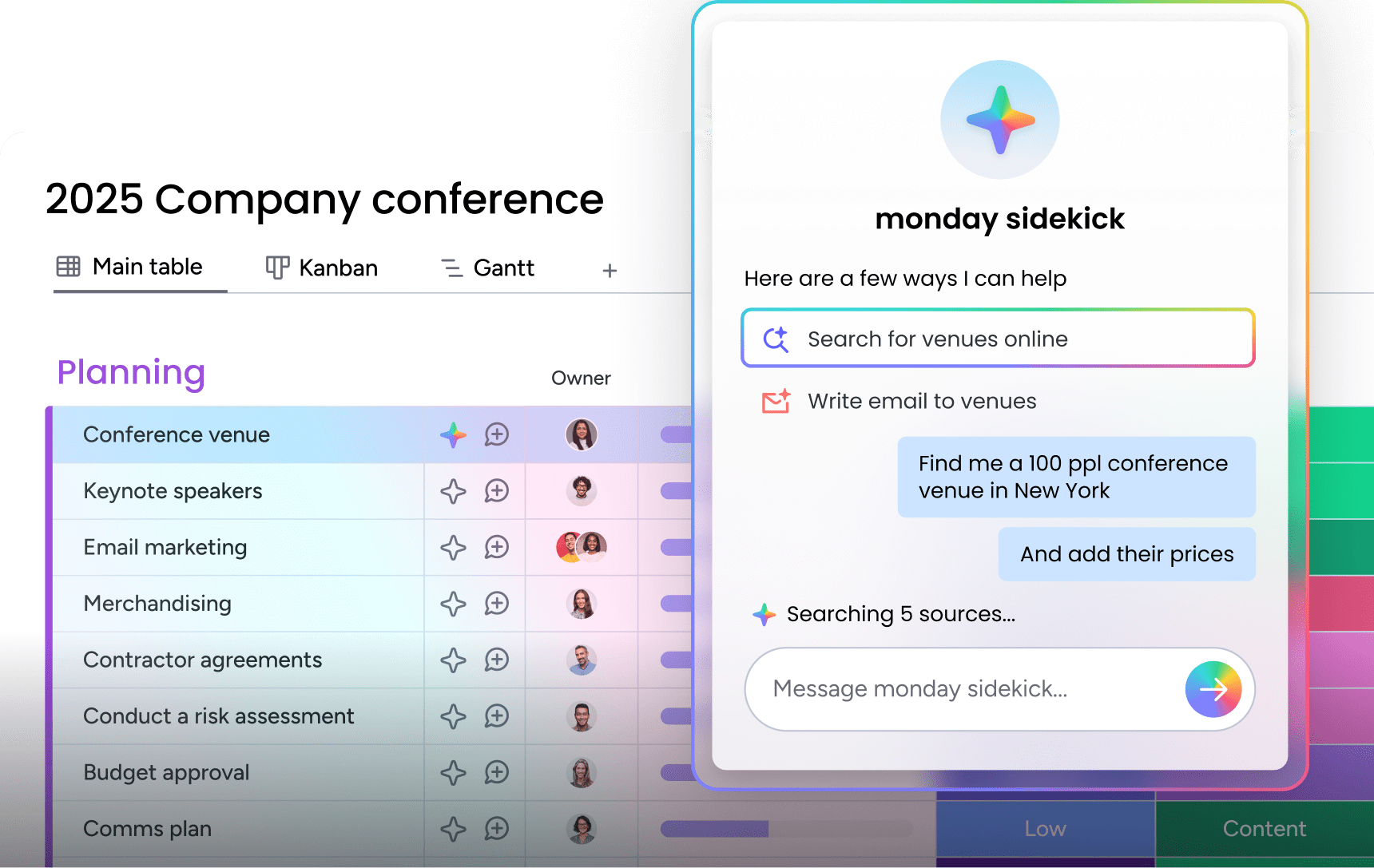
- monday sidekick: an AI assistant that summarizes updates, suggests next steps, generates reports, and automates routine work, giving your team more time for high-impact activities.
- 200+ integrations: connect the apps your team already uses (Slack, Microsoft Teams, Gmail, Jira, Salesforce) into unified workflows with no tab-switching.
What makes monday.com’s AI Work Platform different is that it actively removes the friction between strategy and execution. When goals, processes, communication, and automation live in one connected platform, team performance isn’t something you have to chase. It becomes a natural outcome of how your team works every day.
Build a team that gets stronger over time
Improving team performance isn’t a one-time initiative. It’s an ongoing system, one that evolves as your team grows, your goals shift, and your industry changes. The 8 strategies in this guide give you a framework for building that system: set measurable goals, define ownership, standardize processes, build trust, communicate continuously, invest in growth, recognize great work, and use technology to remove friction.
The teams that consistently perform at a high level aren’t the ones with the most talent or the biggest budgets. They’re the ones with the strongest systems — systems that make it easy to stay aligned, adapt quickly, and focus on the work that matters most.
What would your team accomplish if the friction disappeared? If goals were always visible, handoffs were seamless, and routine work ran on autopilot? That’s the shift monday.com’s AI Work Platform is designed to create. Start building a team that doesn’t just perform. It gets stronger with every sprint, quarter, and year.
Get startedFAQs
What are the key factors that affect team performance?
The key factors that affect team performance include goal alignment, role definition, communication quality, psychological safety, and process consistency. When these elements work together, teams deliver stronger results and adapt more effectively to change.
How do you improve team performance in a remote or hybrid environment?
To improve team performance in remote or hybrid settings, prioritize async communication, centralize project updates on a shared platform, and schedule intentional check-ins that build trust. Over-communication is almost always preferable to under-communication when your team isn't in the same room.
What is the difference between team performance and team productivity?
Team performance encompasses the full picture: quality of output, collaboration, goal attainment, and continuous improvement. Team productivity focuses more narrowly on output volume and efficiency. A productive team can still underperform if quality or collaboration suffers.
How often should you evaluate team performance?
Evaluate team performance on multiple cadences: weekly lightweight check-ins to track progress, monthly reviews to assess trends, and quarterly deep dives to measure goal attainment and recalibrate strategy.
Can AI help improve team performance?
Yes. AI automates routine work like status updates, report generation, and task routing, freeing your team for strategic activities. Platforms like monday.com's AI Work Platform include AI assistants (like monday sidekick) that summarize project updates, suggest next steps, and spot risks automatically.
How does monday.com's AI Work Platform help teams perform at a higher level?
monday.com's AI Work Platform centralizes goals, projects, communication, and automation in one connected workspace. With real-time dashboards, workload views, 200+ integrations, and built-in AI, it gives teams the structure and visibility they need to execute consistently.

 Get started