


Best supplier. Best price. Least amount of hassle. This trifecta is the holy grail for procurement teams, but it’s not easy to achieve when demands are high and resources are stretched thin.
That’s where AI in procurement is starting to prove its worth as a practical tool that helps teams see clearer and spend wiser. In this guide, we’ll unpack how AI is already a mainstay of procurement, where it’s delivering real results, and how tools like monday service make it easier to get started.
Try monday serviceKey takeaways
- AI is already making an impact in procurement, as a tool teams use every day to make better deals.
- From drafting supplier emails to classifying spend data, AI shines when it removes friction from the flow of work.
- Getting started doesn’t require a transformation program. Small steps, like improving data hygiene or automating routine approvals, are already providing quick wins.
- Challenges like data quality, change resistance, and legacy tools are real, but they’re not deal-breakers. Most can be addressed with stringent planning and stakeholder buy-in.
- monday service brings every aspect of procurement management software together and lets AI work its magic. With no-code features and flexible workflows, our platform is built for real-world procurement teams, with no tech background required.
What is AI in procurement?
AI in procurement involves using artificial intelligence to make buying smarter, faster, and more efficient. Whether it’s sourcing a vendor, managing contracts, or tracking spend, AI helps teams cut down on manual work and make better decisions, backed by real-time data and intelligent automations.
Procurement covers the full source-to-pay process, from spotting a need to paying the supplier. Traditional procurement relies heavily on email threads, spreadsheets, and manual reviews. AI-powered procurement replaces that with automated analysis, guided workflows, and real-time monitoring.
It’s an approach that sounds almost futuristic, but the reality is that 62% of companies are already making use of generative AI tools in procurement. From auto-classifying supplier requests to drafting contracts and detecting pricing anomalies, AI has transformed how procurement teams operate and what they’re capable of.
Why is AI in procurement important today?
Procurement leaders face increasing pressure to control costs, manage risk, and respond faster, without the headcount to match the KPIs. Thankfully, AI’s maturation has expanded what your team can handle without adding more manual steps.
Generative AI can draft contracts and summarize risk in plain language, while agentic AI can run multi-step workflows under defined rules. Unsurprisingly, 40% of procurement functions have already implemented or piloted generative AI, according to McKinsey.
What types of AI support procurement?
Smart procurement management platforms combine several types of AI to classify data, read documents, generate content, and automate actions. Understanding the building blocks helps you pick the right approach for each problem you’re solving.
- Machine learning (ML): Learns patterns from historical data to make predictions. In procurement, ML powers spend categorization, anomaly detection, and supplier scoring — recognizing that “Acme Tech LLC” and “Acme Technologies” are the same supplier, for example.
- Natural language processing (NLP): Reads and understands human language in contracts, emails, and requests. NLP extracts renewal dates, payment terms, and risk clauses from thousands of documents at once.
- Generative AI: Creates new content like RFP drafts, supplier emails, and contract summaries. It works best when grounded in approved templates and policy rules, so outputs match your standards.
- Agentic AI: Completes a sequence of actions toward a goal, like running a full renewal workflow within guardrails set by procurement, legal, and finance.
- Robotic process automation (RPA): Mimics repetitive human actions in digital systems, such as entering invoice data or updating vendor records. RPA isn’t AI in the learning sense, but it sits alongside AI in many platforms

7 AI examples in procurement
The strongest AI procurement programs start with concrete problems, not abstract ambition. The following use cases span the source-to-pay lifecycle and create value in different ways.
1. Spend analytics and AI-driven categorization
Spend analytics is about understanding where your money goes and who receives it. In many companies, that work still happens through spreadsheet exports and manual clean-up.
AI classifies transactions in real time, even when supplier names and invoice descriptions are inconsistent. Procurement leaders can spot fragmented spend, off-contract buying, and duplicate suppliers earlier, giving them stronger leverage in supplier negotiations.
2. Demand forecasting and category planning
Demand forecasting predicts what the business will need and when. AI improves this by combining purchasing history with business signals like hiring plans, seasonality, and project pipelines.
That gives category managers a forward-looking planning view instead of a backward-looking report. The function shifts from order processing to helping the business make smarter commitments before spend happens.
3. Supplier discovery and evaluation
Supplier discovery has traditionally been a slow mix of web searches, RFI documents, and spreadsheets. AI accelerates the process by scanning supplier databases, financial records, certifications, and risk signals at scale.
It finds qualified suppliers and flags concerns like financial instability or compliance gaps. The selection process also becomes more defensible because the supporting data and decision trail are easier to document.
4. Contract generation and contract intelligence
Generative AI drafts NDAs, MSAs, and amendments using approved clause libraries, cutting the time between commercial agreement and legal review. According to Deloitte, the top GenAI examples in procurement include RFP/RFQ generation (53%), spend analytics (42%), and contract summaries (41%). Contract intelligence then uses NLP to read existing agreements and pull out renewal dates, obligations, and non-standard clauses.
For teams managing thousands of contracts, this turns a buried document archive into a usable system. Procurement can see which agreements are renewing soon and where commercial terms differ from approved standards.
5. Invoice matching and payment automation
Invoice matching verifies that the purchase order, goods receipt, and supplier invoice all align before payment, which is also known as three-way matching. It’s one of the most repetitive workflows in source-to-pay.
AI extracts invoice data, compares it against records, and routes only the exceptions to a human reviewer. Teams reduce duplicate payments, catch suspicious activity earlier, and lower the cost of accounts payable operations.
6. Procurement intake and request orchestration
For many teams, an AI procurement portal becomes the front door to purchasing. In many organizations, that front door is a mess of emails, chats, and forms that make requests hard to track.
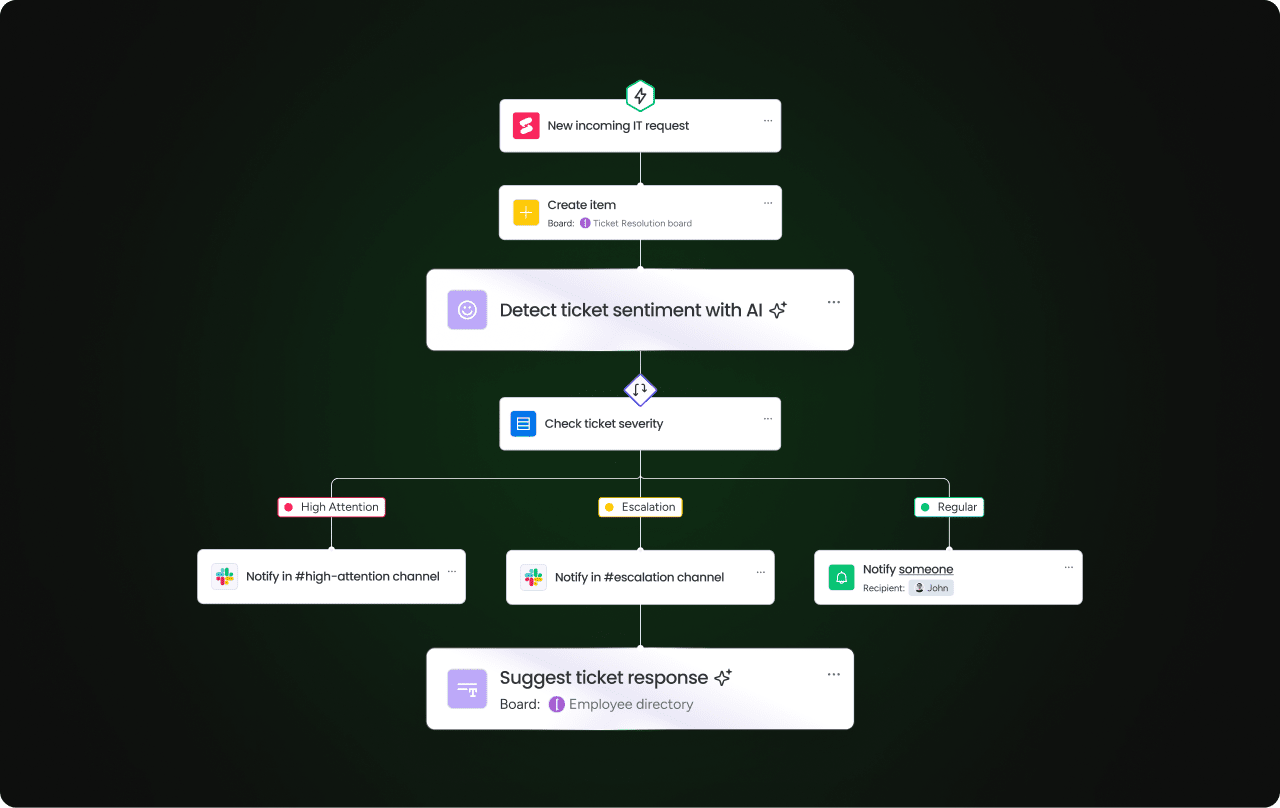
An AI procurement portal interprets requests in plain language, classifies them, checks policy, and routes them to the right workflow. This is exactly where monday service helps, by unifying intake, routing, approvals, and visibility on one platform, so procurement runs the same way high-performing IT and HR teams already do.
7. Risk and compliance monitoring
In AI supplier management, supplier risk changes constantly. A one-time review can’t keep up with shifts in financial health, regulations, or geopolitical conditions.
AI watches risk signals across internal and external sources, flagging alerts when conditions change. On the compliance side, it flags maverick spend and missing documentation while the transaction is still in motion, so procurement spends more time preventing problems than discovering them after the fact.

What are the benefits of using AI in procurement?
AI changes the outcomes senior leaders care about most: spend control, resilience, working capital, and team capacity. The value shows up in shorter cycle times, stronger compliance, and smarter use of procurement talent. Here’s what to expect when AI is applied thoughtfully across the source-to-pay lifecycle:
- Compressed cycle times: Sourcing, contracting, and approval move with fewer manual handoffs, so procurement responds to business demand faster.
- Less value leakage: AI steers requests toward preferred suppliers and flags non-compliant spend before it becomes a budget surprise.
- Stronger negotiations: Teams walk into supplier conversations with credible performance data, pricing context, and contract history at their fingertips.
- Proactive risk visibility: Continuous monitoring catches financial distress, ESG issues, and compliance concerns earlier than periodic reviews.
- Strategic capacity: When AI handles categorization, triage, and routine approvals, procurement professionals focus on category strategy and supplier development.
5 steps to implement AI in procurement
Implementing AI is a phased change in operating model, data discipline, and user behavior. The strongest programs start small, prove value quickly, and scale through repeatable controls.
Step 1: Define outcomes and pick high-value use cases
Start with one or two concrete problems, not technology. High-value starting points usually include invoice matching, spend categorization, and procurement intake routing, all areas where impact is high and data is already accessible.
Step 2: Build a clean procurement data foundation
AI relies on connected, structured data like enterprise resource planning records, supplier master data, spend history, and contract metadata. When this foundation is fragmented, outputs become unreliable even if the model is strong.
You don’t need perfect data, just data that’s fit for your first use case. A spend categorization pilot needs clean supplier records, while intake automation needs standardized request fields and clear policy rules.
Step 3: Run a focused 30 to 90 day pilot
A strong pilot is narrow and measurable. It targets one example, one process area, and one success metric, like reduced manual review time or shorter intake-to-approval cycles.
The goal is to create a clear signal of whether:
- the workflow holds up in a live environment
- the data supports scaling
- users will adopt it
Step 4: Establish human-in-the-loop governance
Human-in-the-loop governance means AI can recommend or execute actions, but people retain oversight for consequential decisions related to final supplier awards or high-value exceptions, for example. Unfortunately, only 36% of chief procurement officers say they’re “very confident” in their ability to redesign roles and processes for AI, according to a Gartner survey fielded in early 2026.
Lower-risk tasks like categorization, triage, and clean invoice processing can run with more automation. Design these thresholds before the pilot ends so a successful test doesn’t hit a policy wall later.
Step 5: Scale across the source-to-pay lifecycle
AI delivers the most value when workflows connect. Spend insights inform category planning, contract intelligence shapes negotiation, and intake automation routes demand into approved suppliers.
This is where a unified workflow platform like monday service earns its keep, by connecting intake, routing, approvals, and service workflows across departments, so procurement doesn’t operate as a disconnected island.
Try monday serviceHow do you choose the right AI procurement platform?
The AI procurement market is crowded, and feature lists look suspiciously similar. The real differences show up in workflow depth, integration quality, and how quickly the platform delivers usable value. Here’s what to evaluate before signing a contract:
- Core workflow capabilities: Look for procurement management software with spend analytics, intake management, contract intelligence, and risk monitoring that move work through real processes rather than isolated features.
- Integration depth: Strong platforms offer pre-built connectors for ERP, finance, and contract systems, plus open APIs for custom environments.
- Security and auditability: Procurement data needs encryption, role-based access, and traceable AI decisions. In regulated industries, opaque AI is unusable.
- No-code customization: Procurement processes change constantly. Platforms that need developers for every adjustment become slow and expensive.
- Time to value: A strong platform shows results in weeks, not quarters, in areas like request visibility, approval routing, or invoice exception reduction.
monday service aligns with these requirements because it combines workflow structure, AI assistance, and no-code adaptability in one place, without locking you into a single department.
Common challenges in AI procurement and how to solve them
Most AI procurement programs run into the same predictable issues. The good news is these challenges are manageable when you treat them as design constraints, not surprises.
- Data quality and fragmented systems: Fix this with a data audit, a governed supplier master, and a phased integration plan that connects high-value sources first.
- Change management and adoption: Involve users early, frame AI as augmentation rather than replacement, and publicize visible wins from the first pilot.
- Trust and explainability: Require audit trails and vendor transparency around how models are trained, tested, and monitored for bias.
- Skills gaps: Build AI fluency by role, appoint internal champions, and partner closely with IT, data, legal, and finance teams.
How monday service powers AI-driven procurement
Procurement teams are under growing pressure to achieve more with less. But staying responsive while managing complexity across tools, teams, and time zones is no easy feat. That’s where the right service technology makes all the difference.
monday service uses AI-powered operations to bring structure and intelligence to your procurement workflows. Here’s what you can expect.
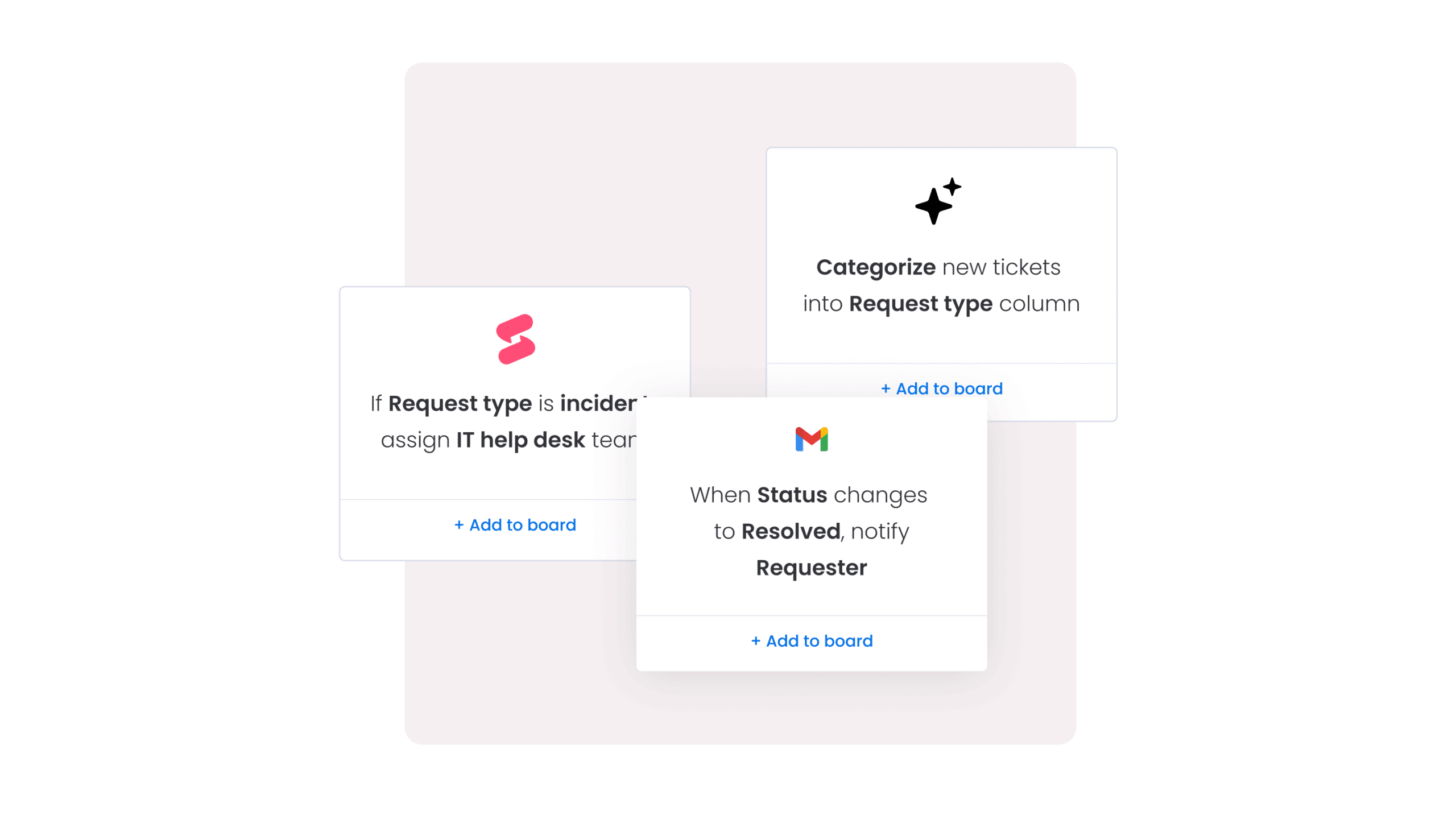
- Capture every request with complete context from day one: monday service’s unified intake portal consolidates all procurement requests into a single platform, replacing scattered emails and chat messages with structured forms that guide employees to provide the right information upfront. Your team will spend less time chasing details and more time processing requests.
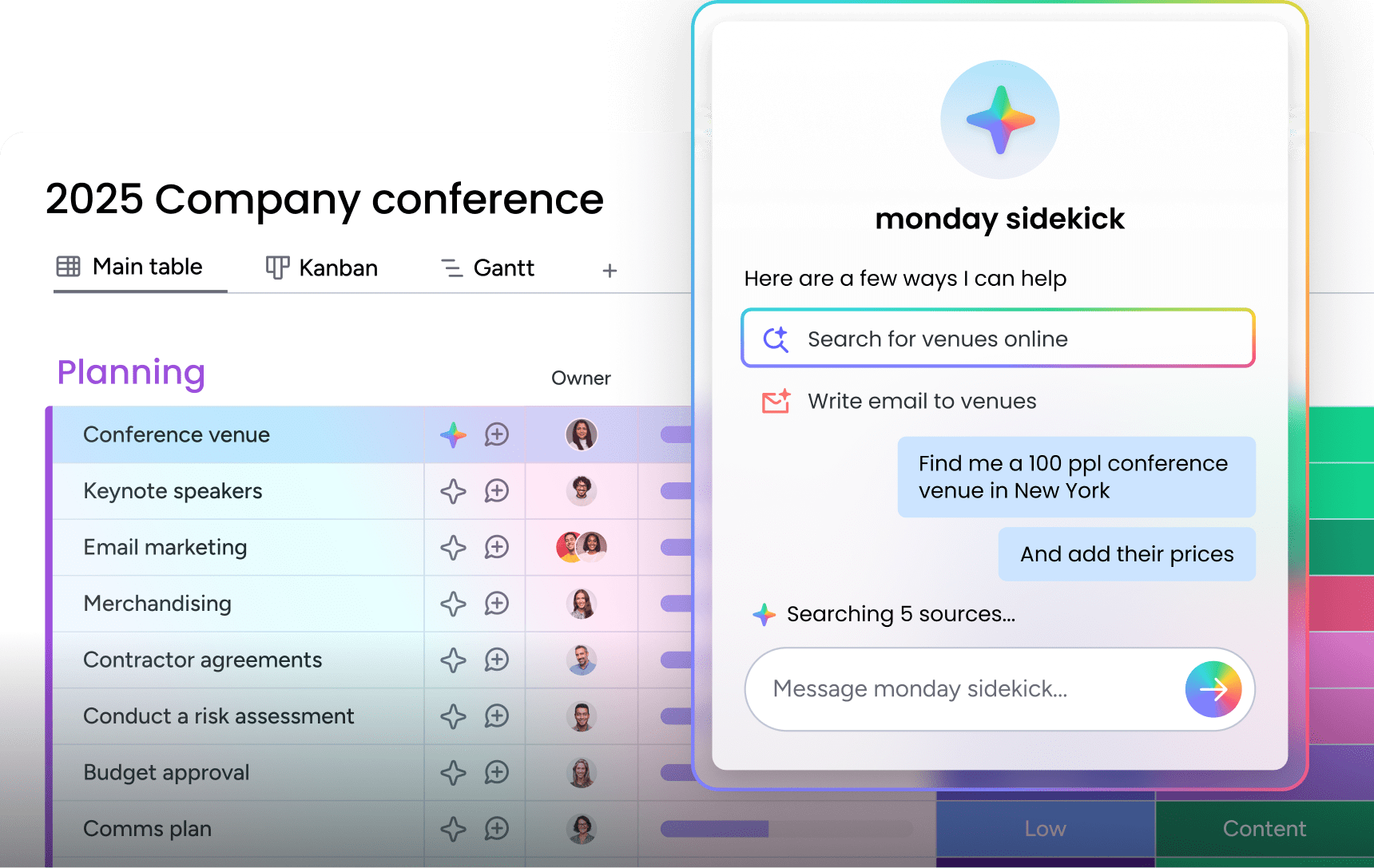
- Let AI handle the triage and response work: monday sidekick analyzes incoming requests, suggests contextual responses, identifies missing information, and auto-populates fields based on historical patterns. Meanwhile, monday agents autonomously route requests to the appropriate workflow, assign tasks to the right team members, and even execute multi-step processes like approval chains and vendor notifications, all within guardrails you define.
- See procurement performance as it unfolds, not after it’s over: Real-time dashboards surface actionable insights on request volume, SLA compliance, approval bottlenecks, category workloads, and spend patterns. You can ask questions like “which suppliers are causing the most delays?” and get instant visual answers without building custom reports.
- Adapt workflows without developer dependencies: Procurement operations teams use monday service’s no-code builder to modify intake forms, adjust approval logic, update routing rules, and create custom automations in minutes, so the platform evolves at the speed of your business, not your IT backlog.
- Connect procurement to every function that touches a purchase: Procurement requests automatically trigger cross-department workflows spanning finance approvals, legal contract reviews, IT security assessments, and facilities coordination. Every stakeholder works from the same source of truth with full visibility into status, history, and next steps, eliminating the handoff gaps that slow traditional procurement down.
Ready to see how AI-powered procurement works in practice? Try monday service and turn scattered requests into structured workflows that your entire organization can track and trust.
Try monday serviceFAQs about AI in procurement
How is AI used in procurement?
AI is used in procurement to automate and improve work across the source-to-pay lifecycle, including spend categorization, supplier discovery, contract generation, invoice matching, risk monitoring, and procurement intake management.
Will AI replace procurement professionals?
AI won't replace procurement professionals. It automates repetitive and data-heavy work so teams can focus more on supplier relationships, category strategy, and risk-informed decision-making.
What is the ROI of AI in procurement?
The ROI of AI in procurement comes from measurable outcomes like lower invoice processing costs, reduced maverick spend, shorter sourcing cycles, and stronger contract compliance. Returns depend on example selection and the quality of your procurement data.
What is the difference between AI and automation in procurement?
The difference between AI and automation in procurement is that automation follows fixed rules to complete repetitive work, while AI uses data to generate predictions and recommendations that adapt to more complex and variable scenarios.
How long does it take to implement AI in procurement?
A focused AI procurement pilot typically shows results within 30 to 90 days, while broader rollout across the source-to-pay lifecycle usually unfolds over 12 to 24 months depending on data readiness and integration complexity.
What is the best AI for procurement?
The best AI for procurement depends on your team's goals, existing tools, and level of digital maturity. Many organizations are seeing strong results with embedded AI in platforms like monday service, which combine automation, machine learning, and predictive insights in one place. Look for AI that can support your full procurement lifecycle, from spend analysis to supplier management, and integrates easily with your current systems.
Will procurement be replaced by AI?
No, AI will not replace procurement, but it will reshape it. AI is designed to assist, not replace procurement professionals by automating repetitive tasks and speeding up intelligent decision-making. The role of the procurement team is evolving to become more strategic, with AI handling the busywork so humans can focus on value creation, relationship building, and risk management.
How do you use AI for sourcing?
Procurement teams can use AI for sourcing by automating supplier identification, scoring vendor proposals, and predicting supplier performance based on historical data. AI tools can also analyze global market trends and pricing benchmarks to support better sourcing decisions. For example, generative AI can draft RFPs or summarize supplier bids, saving significant time and improving consistency.
How do you apply AI to the supply chain?
Procurement professionals can apply AI to the supply chain by:
- Forecasting demand
- Optimizing inventory levels
- Tracking shipments in real time
- Detecting potential disruptions
When integrated with supply chain platforms, AI creates a more agile and resilient end-to-end operation.
How do you use AI to source leads?
AI can source procurement leads by analyzing external data, such as supplier directories, product catalogs, and industry databases, to identify vendors that match specific criteria. As a bonus, machine learning models can also predict which suppliers are most likely to deliver on quality, price, and timeline, based on past performance and market data. Some platforms even use natural language processing to extract insights from sources like supplier websites, news, and reviews.

 Get started