


Startups rarely struggle because of a lack of ideas. They struggle when coordination breaks under growth. What worked at five people starts to fray at fifteen, and by the time you reach fifty, scattered spreadsheets, Slack threads, and disconnected tools begin to slow decisions instead of supporting them.
Project management software for startups plays a really important role at this stage. The right platform restores clarity without layering on bureaucracy. It connects product, marketing, operations, and leadership in one shared workspace so teams can move quickly while staying aligned. The wrong choice creates friction, demands heavy configuration, or forces a disruptive migration just when momentum matters most.
This article examines what growing teams should actually look for, from essential features and AI capabilities to pricing models and scalability tradeoffs. You will see how leading platforms compare across setup speed, cross-functional collaboration, reporting, and long-term flexibility, along with practical advice on implementation and ROI measurement.
Key takeaways
- Early-stage tools break down quickly as teams grow: Spreadsheets and chat-based coordination lack visibility, accountability, and structure once headcount and parallel projects increase.
- Scalability matters more than feature count: Platforms that support simple workflows today and expand into portfolios, resourcing, and reporting reduce future migration risk.
- Cross-functional alignment is a core requirement: Startups benefit most from tools that connect product, marketing, operations, and leadership workflows in one system.
- Implementation speed directly impacts ROI: Software that reaches productivity in days, not weeks, preserves momentum and minimizes hidden adoption costs.
- Modern platforms like monday.com support growth without rebuilds: Flexible workflows, portfolio visibility, and automation allow teams to scale execution without changing tools.

Why growing startups need purpose-built project management tools
7 best project management softwares for startup success
1. monday.com
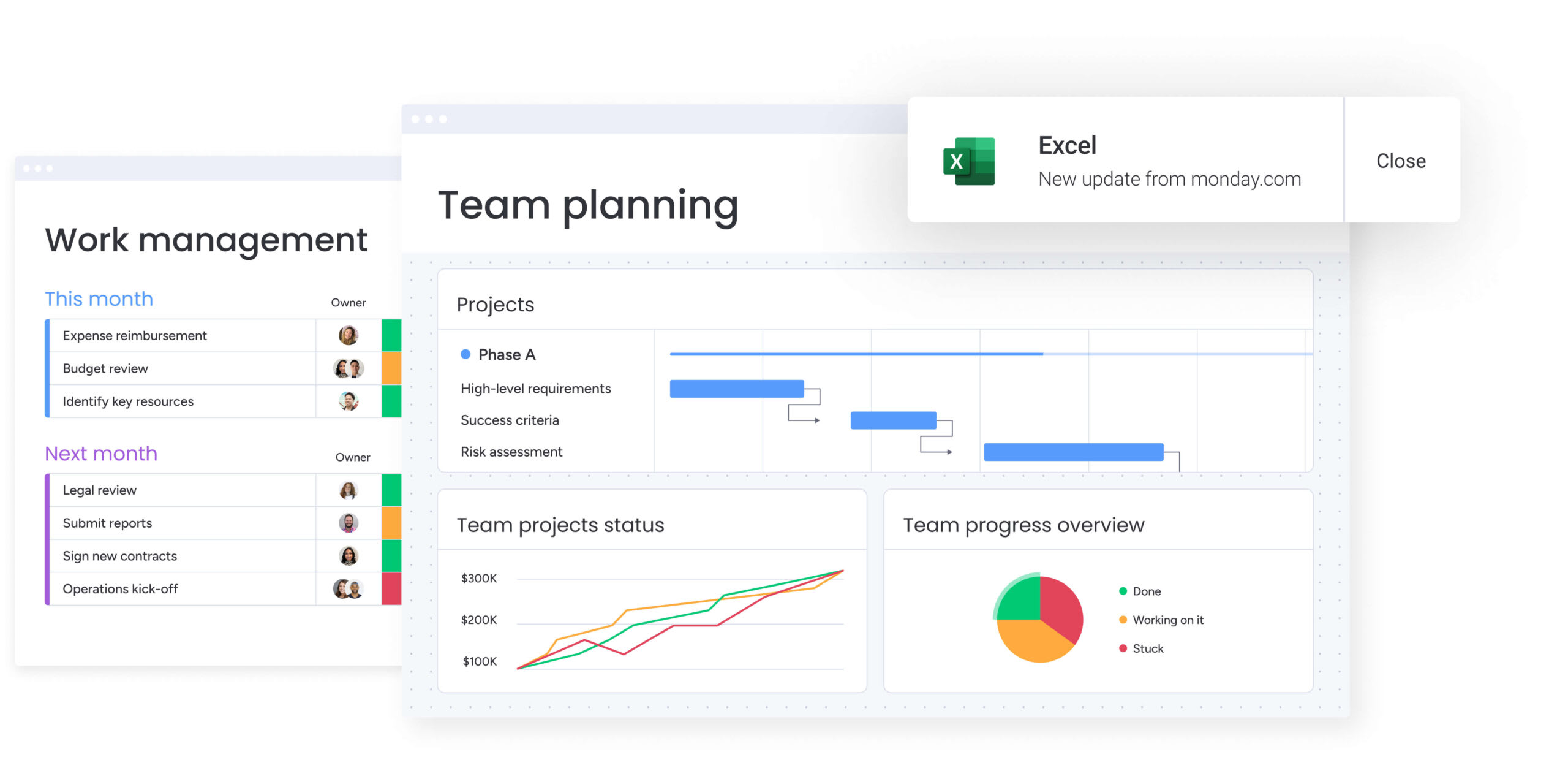
monday.com transforms chaos into organized workflows. It’s a system designed for adoption, allowing teams to start with a simple board and evolve into complex portfolios, resourcing, and goal tracking as the business matures.
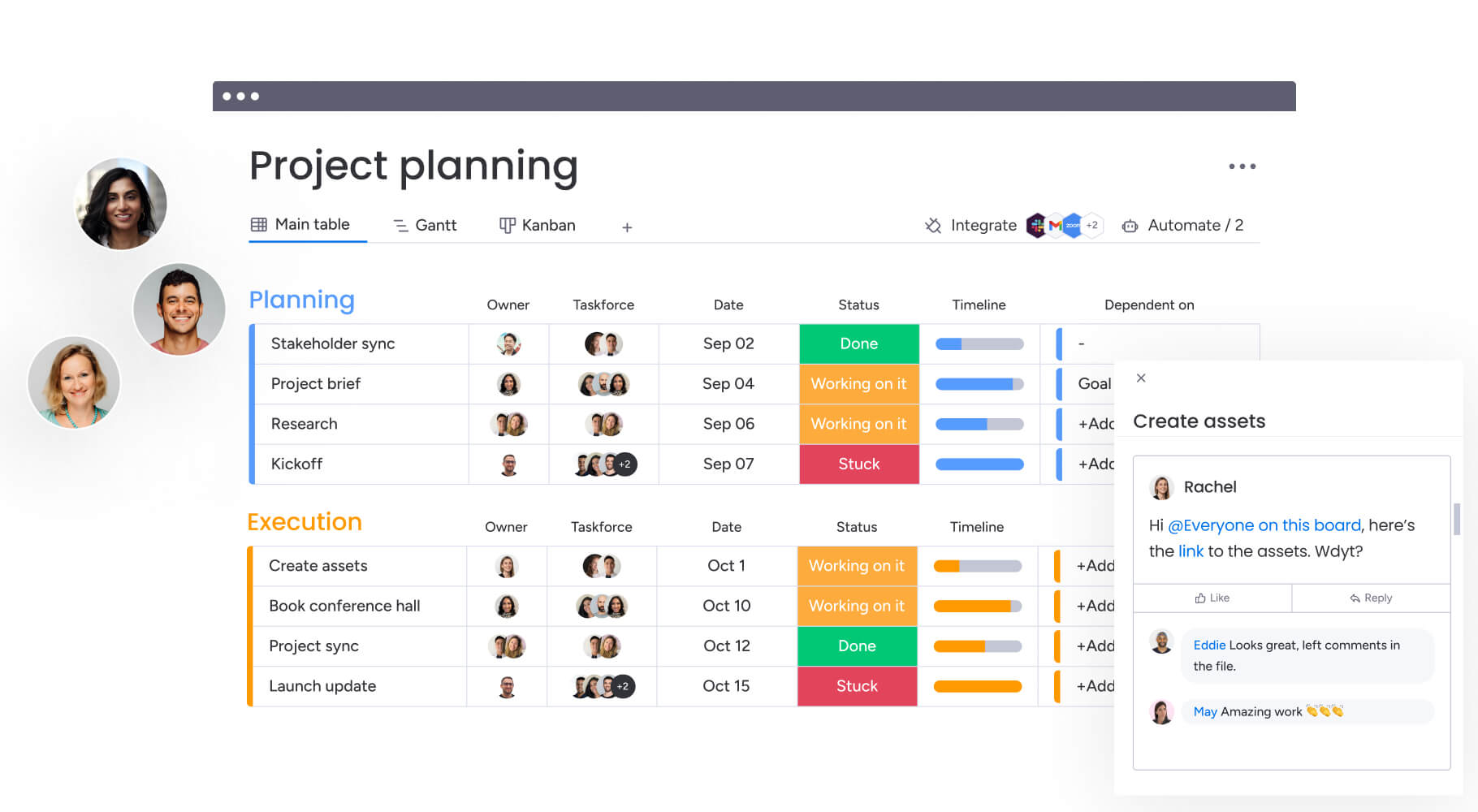
The platform’s visual, board-based architecture allows non-technical teams to coordinate complex work without needing a project manager to translate. Whether you need a Kanban view for launch tasks, a Gantt chart for dependencies, or a dashboard for leadership updates, the underlying workflow remains the same, displayed exactly how each group needs to see it.

Best for:
Series A to growth-stage startups (30+ people) that need one platform to scale from a simple board to full portfolio management without switching tools.
Use case:
See launches, campaigns, and ops work in one place. As you grow, connect projects into portfolios, track OKRs, and share dashboards with execs, no rebuild required.
A practical example: a growth team submits a campaign request through a form, ops reviews it for feasibility, and the approved work automatically lands on the right team’s board. Leadership tracks milestones and capacity in the portfolio view while teams work however they want.
Key features:
- Visual project boards that can be viewed as Kanban, Timeline, Calendar, Workload View, and Gantt chart through various project management apps, so each team sees work in the format they run with.
- Portfolio management that rolls up multiple projects so you can track dependencies, milestones, and progress in one view.
- Track goals and OKRs to tie daily work to outcomes, all within a single platform.
- Dashboards with custom widgets so execs see progress, workload, and timelines live.
- Simple forms for requests and approvals keep intake consistent and give teams the context they need.
Advanced AI features:
AI on monday.com delivers practical, impactful results. It lives inside columns and automations, right where teams work.
- AI Blocks let teams categorize incoming requests, summarize updates, and extract info from files (including PDFs and images) into board columns.
- Autofill with AI applies AI actions directly from a column menu, including categorization for status and dropdown columns, and “assign person” for people columns.
- AI automations let teams trigger actions (categorize, summarize, translate, detect sentiment, extract info) when work changes.
- Product power-ups like risk management and resource allocation are part of the AI offering roadmap from monday.com, designed to take on complex work challenges (availability depends on release status).
Automations:
Automations work best when they protect focus and keep handoffs clean. monday.com supports this through an Automation center with templates, plus the ability to customize automations to match how your teams work.
- Automate reminders, status changes, and approvals so work keeps moving without manual follow-ups.
- Standardize recurring work by pairing automations with templates, so new projects start with the same structure and ownership every time.
- Add AI actions into automations (available on pro and enterprise plans) to categorize, summarize, translate, detect sentiment, and extract information at scale.
Integrations:
Integrations work best when they reduce tab switching and keep updates close to where work happens. monday.com connects with 200+ apps and also supports API-based integrations.
- Keep communication and coordination connected with integrations like Slack and Microsoft Teams.
- Turn email into trackable work with Gmail and Outlook integrations.
- Keep files attached to execution with Google Drive.
- Support meetings and handoffs with integrations like Zoom.
- Bring existing work into monday.com with Excel import, which is especially helpful during a move away from spreadsheets.
Project management software for startups features:
Startups need execution that holds up when the pace spikes and priorities shift. monday.com supports that by letting teams build lightweight workflows now, then layer in portfolio oversight later.
- Build project management, client projects, business operations, and resource management workflows in the same workspace, without forcing every team into one format.
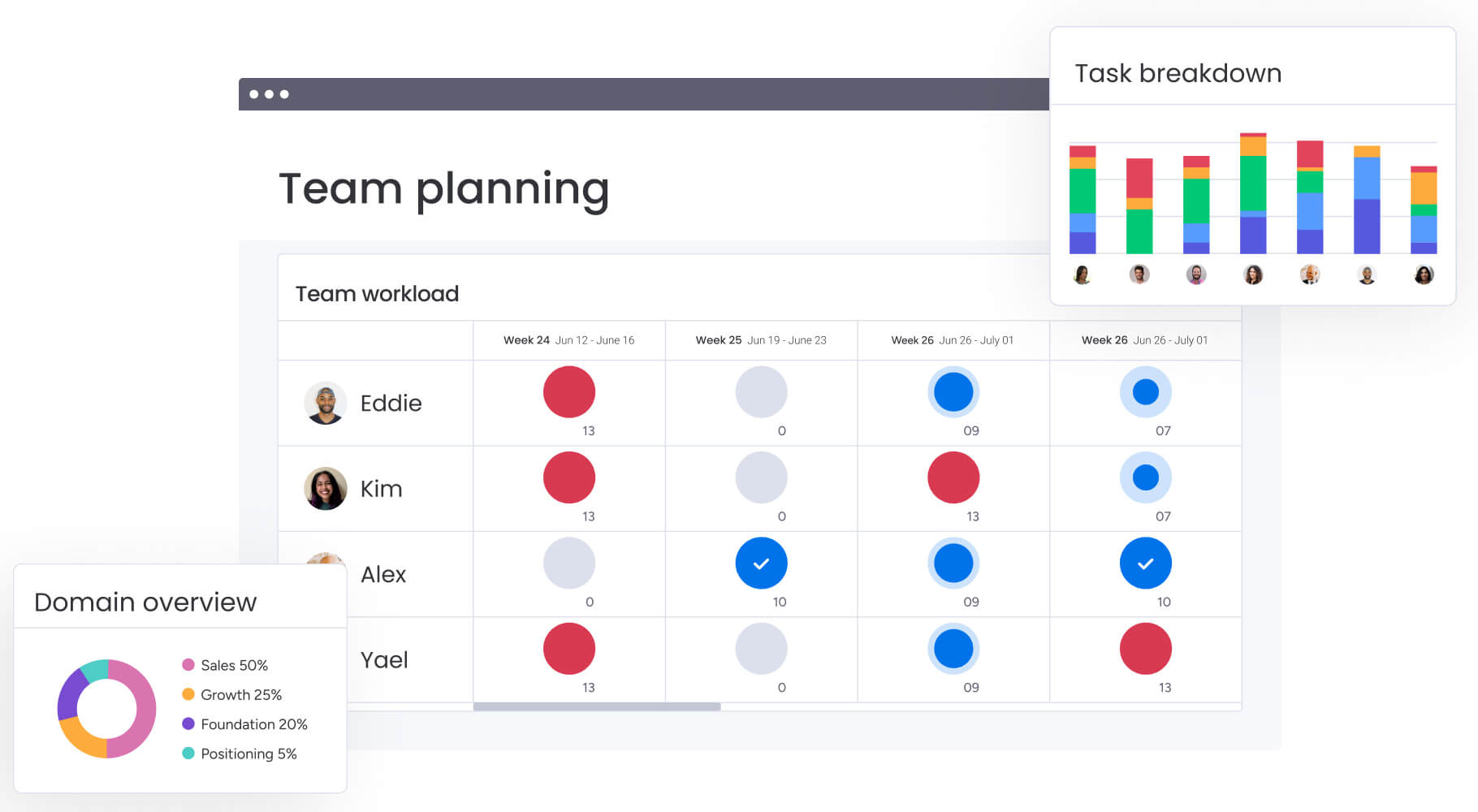
- Use time tracking plus Workload View to understand where time goes and how work is distributed.
- Set milestones, dependencies, baseline, and critical path views (commonly used by PMOs) when projects become multi-team and deadline-sensitive.
Pricing:
- Free: $0 (up to two seats) with three boards, 200+ templates, and mobile apps.
- Basic: $9/seat/month (annual) with unlimited items and prioritized support.
- Standard: $12/seat/month (annual) adds Timeline/Gantt views and 250 automation & integration actions monthly.
- Pro: $19/seat/month (annual) includes time tracking, advanced formulas, and 25,000 automation & integration actions monthly.
- Enterprise: Custom pricing with portfolio management, advanced reporting, and 250,000 automation & integration actions monthly.
- Annual billing: Saves 18% compared to monthly plans. Paid plans require a minimum of three seats.
Why it stands out:
- Teams adopt the platform quickly because workflows stay visual and flexible, even as complexity increases.
- It supports work at multiple levels, from individual projects to portfolios and goals, so leaders can review progress without chasing updates.
- Recognized as a Leader in the 2025 Gartner® Magic Quadrant™ for collaborative work management and the 2025 Gartner® Magic Quadrant™ for adaptive project management and reporting.
- Awarded highest user adoption for enterprises by G2, which matters when you need consistent participation for reliable reporting.
2. Workstatus
Workforce intelligence takes center stage with Workstatus. By integrating time tracking directly with project management, it caters specifically to professional services firms and distributed teams requiring granular visibility into execution. The platform combines automated time capture with coordination features to show exactly how work gets done.

Best for:
Seed to Series A startups with remote or distributed teams that need automated time tracking tied to client billing.
Use case:
Workstatus serves startups managing remote teams or client billing requirements by automatically capturing time data and generating productivity insights that eliminate manual timesheet processes.
Key features:
- Automatic time tracking to eliminate manual timesheets, with advanced productivity modules offering app/URL tracking and screenshot monitoring for detailed performance reports.
- GPS and geofencing capabilities for field teams, plus selfie validation for attendance verification.
- Integrated project management with Kanban boards, Gantt charts, and budget tracking that connects time data directly to invoicing.
Pricing:
- Time tracking: $1.60/user/month (annual billing)
- Attendance management: $1.60/user/month (annual billing).
- Project management: $4.00/user/month (annual billing).
- Productivity + projects bundle: Contact for pricing.
- Annual billing: Includes 20% discount.
- Volume discounts: Available for 50+ users.
- Offers: 30-day money-back guarantee.
Considerations:
- Screenshot monitoring and surveillance features may create trust issues in collaborative startup cultures that prioritize autonomy.
- Limited advanced project management capabilities compared to dedicated PM platforms, requiring additional platforms for complex portfolio management.
3. Notion
Knowledge and execution converge in Notion. It offers a unified environment where documentation lives alongside project tracking and team knowledge. This combination of wikis, databases, and management tools appeals to technical founders who prefer to architect their own information systems.
With massive adoption across the Fortune 100, it has demonstrated the capacity to support organizations from seed stage to enterprise.

Best for:
Pre-seed to seed-stage, documentation-heavy technical founders who want project tracking built alongside a company knowledge base.
Use case:
Notion excels for documentation-heavy startups that need to build comprehensive knowledge bases alongside project execution, offering the flexibility to create custom workflows from building-block components.
Key features:
- All-in-one workspace: Combines company wikis, product documentation, meeting notes, and project trackers in a single platform, reducing context switching between multiple platforms.
- Database flexibility: Build sophisticated relational databases that connect product specifications to development workflows to customer feedback, with multiple views including boards, timelines, and calendars.
- Integrated AI capabilities: Features AI Agent for multi-step task completion, Enterprise Search across connected apps, and AI-powered meeting notes to accelerate productivity.
Pricing:
- Free: $0 per member/month with unlimited content for individuals (block limits apply for teams), 5MB file uploads, and basic sites/forms.
- Plus: $10 per member/month with unlimited collaborative blocks, unlimited file uploads, and custom sites/forms.
- Business: $20 per member/month, including Notion AI features, SAML SSO, and granular database permissions.
- Enterprise: Custom pricing with advanced security controls, audit logs, and success manager support.
- Offers: Save up to 20% with annual billing.
- Additional: Notion for startups offers three to six months free Business plan for eligible startups.
Considerations:
- Learning curve complexity: Designing robust workspace schemas requires significant upfront investment, and the freeform structure can become a coordination liability as teams grow beyond 15-20 people.
- Performance limitations: Database performance can degrade with very large datasets, and advanced project management features like resource workload planning are less prescriptive compared to specialized PM platforms.
4. Linear
Speed is the defining characteristic of Linear. Built explicitly for engineering teams and product-centric startups, it bypasses the bloat of traditional management tools in favor of a keyboard-driven interface. Its opinionated workflows are designed to streamline the journey from product strategy to code deployment, appealing to technical teams who prioritize performance.

Best for:
Seed to Series B product/engineering teams that want a fast, keyboard-driven tool tightly synced to their dev workflow.
Use case:
Linear excels at connecting product roadmaps to development cycles, making it ideal for startups where engineering velocity directly impacts business outcomes.
Key features:
- Integrated development workflows: Issues automatically sync with Git commits, pull requests, and deployment pipelines to eliminate manual status updates.
- High-performance interface: Keyboard shortcuts, command palettes, and instant loading times match how developers naturally work.
- AI-powered triage: Intelligent issue categorization and assignment suggestions help teams prioritize work without administrative overhead.
Pricing:
- Free: Unlimited members, two teams, 250 issues with core integrations.
- Basic: $10/month per user (billed annually) with unlimited issues and up to five teams.
- Business: $16/month per user (billed annually), including Triage Intelligence, analytics, and support integrations.
- Enterprise: Custom pricing with advanced security, dashboards, and migration support.
Considerations:
- Limited cross-functional capabilities force startups to maintain separate platforms for marketing, sales, and operations workflows.
- Advanced features like detailed analytics and enterprise integrations require higher-tier plans, potentially increasing costs as teams scale.
5. ClickUp
Consolidation is the goal for ClickUp. Dubbed the “everything app for work,” it brings project management, docs, chat, and AI under one roof. While it targets teams looking to replace multiple disparate tools, the sheer breadth of features can sometimes present a challenge for startups needing rapid deployment over extensive configuration.

Best for:
Seed-to-Series A startups willing to trade a steeper learning curve for a customizable, all-in-one workspace.
Use case:
ClickUp serves organizations looking to replace multiple tools with a single, highly customizable platform that spans project management, knowledge management, and team collaboration.
Key features:
- Hierarchical workspace structure with 15+ views (List, Board, Gantt, Timeline, Workload) for flexible project visualization.
- Integrated docs, wikis, whiteboards, and chat alongside traditional project management capabilities.
- AI-powered agents for task assignment, prioritization, and automated standups with enterprise-grade security compliance.
Pricing:
- Free Forever: $0 (basic features for small teams).
- Unlimited: $7/user/month (annual billing, unlimited tasks and storage).
- Business: $12/user/month (annual billing, advanced features and reporting).
- Enterprise: Custom pricing (quote-only with SSO, SCIM, and data residency options).
- AI add-ons available: Brain AI at $9/user/month, Everything AI at $28/user/month.
- Annual billing: Saves up to 30% on core plans.
Considerations:
- Feature abundance creates decision paralysis for startups needing rapid deployment and immediate productivity.
- Steep learning curve extends onboarding timelines as teams navigate extensive customization options and configuration choices.
6. Basecamp
Simplicity reigns supreme with Basecamp. Instead of chasing enterprise complexity, it provides a straightforward workspace for project coordination, prioritizing ease of use. The platform combines communication and tracking in a way that avoids the steep learning curves of heavier tools, while its flat pricing model offers a predictable cost structure for growing teams.

Best for:
Pre-seed to seed-stage startups that want simple, flat-rate project coordination without a learning curve.
Use case:
Basecamp excels for early-stage startups managing simple projects with small teams who value ease of use and consolidated communication over advanced project management capabilities.
Key features:
- All-in-one project workspaces: Combines project lists, message boards, file storage, and team chat in predictable project spaces.
- Hill Charts progress tracking: Unique visual system that distinguishes between problem-solving phases and execution phases
- Flat-rate unlimited users: Pro unlimited plan removes per-seat costs for growing teams and client collaboration
Pricing:
- Free forever: One active project with core features.
- Plus: $15/user/month (employees only; clients and guests free) with 500 GB storage.
- Pro unlimited: $299/month billed annually (unlimited users) with 5 TB storage and advanced features.
- Add-ons: Timesheet ($50/month) and admin pro pack ($50/month) for plus plans.
- Discounts: 10% for nonprofits (free accounts for educational use).
Considerations:
- Limited scalability: Lacks advanced features like Gantt charts, resource management, and automation that growing startups typically need within twelve to 18 months.
- Basic reporting: No sophisticated analytics or portfolio-level visibility for leadership oversight as teams expand beyond 25 people.
7. Asana
Cross-functional clarity is where Asana built its reputation. It gives fast-growing teams a structured way to connect daily tasks to broader initiatives, without the heavier setup of enterprise-grade platforms. Startups that need multiple departments working from the same source of truth, without a steep configuration process, tend to gravitate here first.

Best for:
Seed-to-Series A startups that need basic cross-functional task coordination before they’re ready for more advanced, portfolio-level oversight.
Use case:
Asana works well for startups coordinating product, marketing, and ops work across a growing headcount, especially teams that want built-in goal tracking layered on top of day-to-day task management.
Key features:
- Multiple project views, including List, Board, Timeline, and Calendar, so different teams can track the same work in the format that fits them.
- Goals and portfolios that connect individual tasks to company-level objectives, giving leadership visibility without manual reporting.
- Workflow Builder for creating custom approval chains and automated handoffs between teams as processes mature.
Pricing:
- Personal: $0 for up to 10 teammates with basic task and project tracking.
- Starter: $10.99/user/month (annual billing) with Timeline, unlimited dashboards, and workflow builder.
- Advanced: $24.99/user/month (annual billing) adds goals, portfolios, and advanced reporting.
- Enterprise / Enterprise+: Custom pricing with advanced admin controls and security.
Considerations:
- The free and Starter tiers cap out quickly for startups running multiple concurrent, cross-functional initiatives, pushing teams toward Advanced sooner than expected.
- Complex dependency chains and multi-team resourcing require more manual setup than platforms built around portfolio-first structures.
8. Trello
Visual simplicity is Trello’s whole pitch. Built around Kanban boards, it strips project management down to cards, columns, and drag-and-drop movement, making it one of the fastest tools for a small team to pick up without any onboarding at all.

Best for:
Pre-seed to seed-stage, single-team startups that want the simplest possible visual board with zero onboarding time
Use case:
Trello fits early-stage startups running lightweight, single-team workflows, such as a small product or content team that just needs a shared visual board without portfolio-level reporting.
Key features:
- Kanban-first boards with unlimited cards and lists, ideal for simple pipelines like content calendars or sprint boards.
- Power-Ups that extend functionality with calendar views, voting, and basic automation (Butler) without leaving the board.
- Flexible permissions for adding outside collaborators or clients to a single board without giving full workspace access.
Pricing:
- Free: $0 for up to 10 collaborators per workspace with unlimited cards.
- Standard: $5/user/month (annual billing) with unlimited boards and advanced checklists.
- Premium: $10/user/month (annual billing) adds Timeline, Calendar, and Dashboard views.
- Enterprise: $17.50/user/month with advanced admin and security controls.
Considerations:
- Reporting stays basic even on paid tiers, so startups that need portfolio-level dashboards or resource planning typically outgrow it within a year.
- Boards can get unwieldy once a team is managing multiple overlapping projects with real dependencies, since Trello wasn’t built around cross-project structure.
9. Freedcamp
Budget-conscious simplicity is Freedcamp’s whole appeal. It bundles the core project management basics — tasks, milestones, discussions, and file storage — into a genuinely usable free plan, then layers on features like CRM and invoicing at a fraction of what most competitors charge. It’s built for teams that want to get organized without much setup or cost.

Best for:
Pre-seed, bootstrapped startups that need basic task and milestone tracking without paying for features they don’t need yet.
Use case:
Freedcamp works for cash-strapped early-stage startups that need basic task and milestone tracking across a small team, without paying for features they won’t use yet.
Key features:
- Unlimited projects, tasks, and users on the free plan, covering the basics most small teams need to get started.
- Milestone and calendar tracking to keep deadlines visible across a project without additional configuration.
- Optional add-on modules (CRM, invoicing, time tracking, Gantt charts) that can be toggled on individually as a team’s needs grow, instead of bundling everything into one plan.
Pricing:
- Free: $0/month with unlimited projects, tasks, storage, and users.
- Pro: $1.49/user/month (annual billing) adds calendar, discussions, files, and milestones.
- Business: $7.49/user/month (annual billing) adds CRM, Dropbox integration, and email-in.
- Enterprise: $16.99/user/month (annual billing) adds 2FA, daily data snapshots, and advanced admin controls.
Considerations:
- The interface and feature depth feel dated next to modern platforms, and reporting/dashboard capabilities are minimal even on higher tiers.
- Its à la carte module structure means teams have to actively enable features (like Gantt charts or time tracking) individually, which can get disorganized as a team scales past basic task tracking.
Essential features startup teams actually need
Velocity and impact drive startup success. Yet, many platforms introduce drag through feature bloat and lengthy configuration requirements. The right platform shouldn’t add administrative weight; it should remove friction, allowing you to translate ideas into execution immediately.
The most valuable capabilities for a startup are those that solve immediate coordination challenges while remaining flexible enough to scale. Here’s what actually matters.
- Rapid setup and onboarding: You cannot afford to lose weeks training your team on a new system. Teams streamline project execution on monday.com by launching workflows for product roadmaps or hiring pipelines in hours, not weeks, using a library of ready-made templates.
- Transparent visual tracking: Keeping marketing, sales, and product aligned without endless meetings requires a single source of truth. Visual boards and timelines turn complex project data into an understandable picture of progress that anyone can follow.
- Clear resource allocation: Burnout kills momentum. Leaders rely on monday.com to get a clear view of who is working on what, making it simple to balance workloads proactively and prevent bottlenecks before they derail key initiatives.
| Tool | Starting price | Setup time to productivity | Visual progress tracking | Resource management | Automated reporting | Integration ecosystem |
|---|---|---|---|---|---|---|
| monday work management | $9/seat/month (Basic) | two to three days | Board, timeline, Gantt, calendar views | Workload view, capacity planning, time tracking | Dashboard widgets, automated updates | 200+ native integrations, API access |
| Workstatus | $1.60/user/month (time tracking) | three to five days | Time reports only | Time tracking focus | Time and activity reports | Limited integrations |
| Notion | $10/member/month (Plus) | one to two weeks | Database views, limited visual tracking | Manual tracking only | Manual report building | Growing integration library |
| Linear | $10/user/month (Basic) | three to five days | Issue lists, sprint boards | Limited capacity views | Basic sprint reports | Developer platform focus |
| ClickUp | $7/user/month (Unlimited) | two to three weeks | Multiple view types (complex setup) | Available with configuration | Custom dashboards (complex) | Extensive integrations |
| Basecamp | $15/user/month (Plus) | one to two days | Simple lists and schedules | Not available | Basic reports | Minimal integrations |
| Height | $8/member/month (Basic) | one week | Board and list views | Basic workload view | AI-generated insights | Limited integrations |
| Asana | $10.99/user/month (Starter) | three to five days | List, Board, Timeline, Calendar views | Workload view on Advanced tier only | Dashboards and portfolios (Advanced tier) | 200+ integrations, API access |
| Trello | $5/user/month (Standard) | one to two days | Kanban boards only, basic calendar via Power-Up | Not available | Basic Dashboard view (Premium tier) | 200+ Power-Ups, API access |
The comparison above highlights where each platform creates leverage and where trade-offs begin to surface. Setup speed, visibility, resource management, reporting, and integrations all influence how well a system supports fast-moving teams. For startups, these differences are not minor details. They directly affect how quickly teams adopt the platform and how confidently leaders can scale operations.
The platforms that truly give startups an edge combine flexibility with clarity.
The right platform shouldn’t add administrative weight; it should remove friction, allowing you to translate ideas into execution immediately.
How to select project management software that scales
Selection isn’t just about solving today’s problems; it’s a bet on your organization’s future state. Choosing a platform that can’t handle where you’ll be in 18 months guarantees you’ll spend the next year rebuilding workflows instead of building momentum.
Look beyond the price tag
Subscription fees are only a fraction of the actual expenditure. The total cost of ownership includes hidden expenses that accumulate rapidly, particularly when your team’s time is the currency being spent.
Before committing, consider the full investment required. These costs often include:
- Implementation time: a platform that takes weeks to set up costs your team hundreds of hours in lost productivity. A solution that works in days keeps your team focused on what matters.
- Training and adoption: Complex platforms create a constant training burden as you hire. An intuitive platform lets new team members contribute from day one.
- Migration and data loss: Outgrowing a platform forces a painful migration process. This involves exporting data, rebuilding workflows, and losing historical context, setting your team back months.
Leaders use monday.com to sidestep these hidden costs. The platform’s quick implementation and intuitive design minimize ramp-up time, while its scalability eliminates the risk of a future migration as you grow from ten to 100+ employees.
Build a connected ecosystem, not a tangled web
Your project management platform should act as the connective tissue for your tech stack, not another isolated silo. It must integrate seamlessly with the systems your teams already rely on, from communication and design to development and sales.
Effective integration does more than just shuttle data back and forth. It creates a unified workspace where teams can update progress from their preferred tools, maintaining alignment without context switching.
Powerful platforms like monday.com offer over 200 native integrations and a robust API, so your workflows stay connected as your tech stack evolves.
Separate AI fact from AI fiction
While many platforms promise AI capabilities, few deliver practical utility. Focus on features that eliminate manual drudgery and surface insights that would otherwise remain hidden. This means moving beyond gimmicks to embrace AI that automates task creation, predicts project risks, and generates clear status updates.
With monday.com, AI isn’t a future promise; it’s a practical advantage. The AI offering helps teams categorize data, summarize notes, and extract action items instantly. These features are designed to give your team time back, delivering value from the moment you get started.
Fast-track your implementation in two weeks
Rolling out project management software for startups should not become a project in itself. The goal is to create momentum quickly, prove value early, and build habits that scale with the business. A focused two-week implementation plan keeps things practical, helping your team move from setup to measurable impact without overcomplicating the process.
Step 1: Build your foundation in week one
The initial week focuses on establishing your operational core without getting bogged down in complex configurations. The objective is to get your team active on the platform so you can see results almost immediately.
Before diving into the details, here are the key actions that will set you up for success.
- Get your team on board: Start by inviting everyone who will interact with daily workflows and set up workspaces that mirror how your team actually collaborates.
- Launch your first projects: Choose two to three active projects that represent your most common work, like a product launch or marketing campaign, and use pre-built templates to get moving instantly.
- Focus on essential skills: Train your team on the actions that deliver the most value, such as updating progress, collaborating on items, and viewing project dashboards.
Step 2: Connect workflows in week two
With the basics established, week two is about expanding across departments and unlocking new efficiencies. This is where you link disparate workflows into a single, unified system of record.
You can start building powerful, cross-functional processes with a few focused steps.
- Create connected workflows: Build the handoffs that matter most, from marketing to sales or from product specs to engineering. Teams streamline execution on monday.com by connecting it to the platforms they already use, like Slack and Google Drive.
- Give leaders real-time visibility: Create executive dashboards that aggregate data across all active projects, providing a transparent, portfolio-level view without the need for manual reports.
- Let automation do the heavy lifting: Implement automations that eliminate coordination overhead, moving work between stages and notifying stakeholders automatically when milestones are reached.
The initial week focuses on establishing your operational core without getting bogged down in complex configurations. The objective is to get your team active on the platform so you can see results almost immediately.
Track these 5 metrics to prove ROI
ROI isn’t just about vanity numbers; it’s about linking software spend to business acceleration, operational efficiency, and team performance. When you can draw a straight line from your platform to your bottom line, you’re not just justifying a purchase; you’re building a strategic advantage.
To demonstrate the direct impact of a unified platform, focus on the outcomes that resonate with leadership. These five core metrics provide the data needed to validate your investment and drive continuous improvement.
- Project delivery velocity: This measures the time from project kickoff to completion. Faster delivery means quicker time-to-market and a direct impact on revenue. Are your projects consistently hitting their deadlines? Teams using monday.com gain this visibility through automated timeline views, making it simple to measure velocity without manual tracking.
- Resource utilization rates: This shows how much of your team’s capacity is spent on valuable work versus administrative overhead. A healthy rate, typically 70-85%, means high productivity without burnout. Leaders rely on monday.com to get a clear picture of capacity, helping them plan more effectively and assign the right people to the right projects.
- Client satisfaction scores: How does your operational engine impact the client experience? Track metrics like NPS or renewal rates to connect internal efficiency with external happiness. When deliverables arrive on time and communication is proactive, satisfaction climbs, proving that a well-run project is a powerful competitive advantage.
- Revenue per project: This metric directly links operational efficiency to financial outcomes. For service teams, it means higher margins; for product teams, it means accelerating revenue from new features. How much more profitable could your projects be? Tracking this allows you to quantify the financial impact of a unified work platform.
- Team productivity indicators: Look at the ratio of planned work to completed work. High completion rates show that priorities are clear and dependencies are managed effectively. Dashboards on monday.com aggregate this data automatically, giving you a real-time pulse on productivity trends and helping teams focus on delivering what was promised.
Transform your startup operations with monday.com
Growth adds layers. More people, more moving parts, more interdependencies across product, marketing, sales, and operations. The informal systems that once felt efficient begin to stretch, and small coordination gaps start to compound. At this stage, the challenge is not just working harder, it’s building an operating model that keeps everyone aligned while preserving the speed that set you apart in the first place.
monday.com supports that shift by giving startups a flexible structure they can expand into over time. Instead of forcing a rebuild as complexity increases, the platform adapts alongside your processes, helping you automate repetitive work, connect departments, and scale confidently without losing momentum.
Automate repetitive work with AI
Automated administration frees up valuable time. monday.com leverages AI to handle repetitive tasks, freeing your people to focus on strategic execution. You can achieve these efficiency gains in days, not months, without requiring technical configuration.
- Instantly route incoming work: AI automatically categorizes support tickets, feature requests, and bug reports. The system intelligently routes them to the correct teams with initial priority levels, allowing a small operations team to manage the complexity of a much larger organization.
- Get to the point, faster: Turn lengthy meeting notes, project updates, and email chains into concise summaries with clear action items. The platform also extracts key data like deadlines and stakeholder names from unstructured text, so nothing gets missed.
- Build custom AI flows without code: Your teams can tailor AI workflows to their exact needs. A marketing team can flag underperforming campaigns, while a product team can instantly spot trending feature requests from user feedback.
Connect every department without switching platforms
True startup velocity happens when work flows seamlessly across functional lines. monday.com unifies your entire organization in a single workspace, so marketing campaigns can trigger product sprints and sales deals can kick off customer onboarding automatically.
This unified approach allows each department to work its own way while staying perfectly in sync. Marketing can use Kanban boards, engineering can run sprints, and operations can manage timelines, all while automations handle the handoffs between them.
This is how you eliminate silos and connect strategy directly to execution.
Scale confidently from 5-500 people
Choosing a platform requires thinking about your needs now and five years down the road. Scalability is more than just adding users; it’s about maintaining performance and control as your complexity grows. monday.com is built to scale with you at every stage.
The platform’s architecture supports you with pricing that aligns with your maturity, features that unlock as you need them, and enterprise-grade governance that’s simple to manage.
| Tool | Implementation speed | Learning curve | Pricing transparency | Integration ecosystem | AI capabilities | Scalability without migration | Cross-functional support |
|---|---|---|---|---|---|---|---|
| monday work management | two to three days to productivity | Intuitive visual interface, minimal training | Predictable per-user tiers, scaling aligned to growth | 200+ native integrations, comprehensive API | AI Blocks for categorization, summarization, extraction | Scales from simple to enterprise without switching | Unified workspace for all departments |
| Workstatus | three to five days | Simple time tracking focus | Per-user pricing | Limited integrations | Not available | Limited to time tracking scope | Time tracking across teams |
| Notion | one to two weeks | Moderate, custom structure | Generous free tier, per-user paid | Growing library, API available | AI writing assistant | Requires restructuring at scale | Flexible but requires custom setup |
| Linear | three to five days | Developer-friendly, limited scope | Per-user pricing | Developer platform focus | Not available | Engineering-focused, limited cross-functional | Engineering-centric |
| ClickUp | two to three weeks | Steep, extensive features | Per-user with usage caps | Extensive integrations | AI features in beta | Feature complexity increases | All functions with complex setup |
| Basecamp | one to two days | Very simple, limited features | Flat rate per team | Minimal integrations | Not available | Best suited for teams under 50 people | Basic coordination |
| Height | one week | Moderate, AI-focused | Per-user pricing | Limited, expanding | AI-native work creation | Unproven at scale | General project management |
| Asana | three to five days | Moderate, structured onboarding needed | Per-user pricing, jump to Advanced tier | 200+ integrations, comprehensive API | Asana AI Studio (Advanced tier and up) | Requires Advanced tier to unlock portfolio-level scaling | Strong across departments once on Advanced tier |
| Trello | one to two days | Very simple, minimal training | Per-user pricing, generous free tier | 200+ Power-Ups, API available | Basic Butler automation, no native AI | Requires switching tools once dependencies get complex | Best for single-team use, weak across departme |

“monday.com has been a life-changer. It gives us transparency, accountability, and a centralized place to manage projects across the globe".
Kendra Seier | Project Manager
“monday.com is the link that holds our business together — connecting our support office and stores with the visibility to move fast, stay consistent, and understand the impact on revenue.”
Duncan McHugh | Chief Operations OfficerBuild a foundation for sustainable growth
As startups move from scrappy execution to sustained growth, the biggest operational risk isn’t a lack of effort, it’s a lack of visibility and alignment. Teams juggle parallel projects, leaders struggle to see real progress, and decisions become reactive instead of intentional.
Project management software should solve these problems by connecting everyday work to strategic outcomes, without adding layers of process that slow teams down.
monday.com addresses these scaling challenges by giving startups a flexible operational backbone that evolves with them. It supports fast-moving teams today while providing the structure needed for tomorrow.
- Fragmented visibility across teams: A single workspace brings product, marketing, operations, and leadership views together, so progress and risks are visible in real time.
- Manual coordination and follow-ups: Automations and AI reduce status chasing, handoff delays, and repetitive admin work.
- Difficulty linking tasks to business goals: Built-in dashboards and goal tracking connect daily execution to OKRs and strategic priorities.
- Uneven workload and burnout risk: Workload and time tracking views help leaders balance capacity before bottlenecks form.
- Fear of outgrowing tools too quickly: Scalable workflows and portfolio views remove the need for disruptive migrations as complexity increases.
By reducing operational friction and improving clarity at every level, teams gain efficiency, stronger alignment, and better decision-making, turning execution into a measurable strategic advantage rather than an ongoing bottleneck.
Frequently asked questions
Which project management software has the best free tier for small startups?
When considering which project management software has the best free tier for small startups, it's important to look beyond basic needs. While some platforms offer simple free tiers, a full-featured trial on a scalable platform like monday.com allows you to test advanced capabilities before you commit. This approach helps you evaluate long-term value and avoid future migration costs.
How quickly can a startup implement new project management software?
A startup can implement new project management software in just a few days with an intuitive, no-code platform. More complex systems that require heavy configuration can take several weeks to adopt fully.
What integrations are essential for startup project management platforms?
Essential integrations for a startup platform include communication apps like Slack, cloud storage like Google Drive, and role-specific applications like GitHub or Figma. A robust API is critical for connecting your entire tech stack as you scale.
How much should a 25-person startup budget for project management software?
A 25-person startup should budget approximately $3,000 – $6,000 annually for its project management software. It is wise to invest in a platform that scales to avoid significant migration costs later on.
Can AI in project management software really reduce manual work for startups?
Yes, AI in project management software can reduce manual work by automating tasks like data categorization and summarizing documents. This can save teams five to ten hours per week.
Which project management platform is easiest for non-technical startup teams?
The easiest platforms for non-technical teams use highly visual, no-code interfaces, such as monday.com. This allows new users to become productive in hours, not days.

 Get started