


Scattered dates, missed deadlines, and schedules trapped in separate apps make it hard to see what’s actually due. When your plans live in email invites, spreadsheets, and half a dozen browser tabs, work quietly slips through the cracks. A shared monday.com calendar changes that by putting deadlines, tasks, and owners in one connected view your whole team can see.
This guide walks you through both calendar experiences on monday.com, the Calendar View and the Calendar Widget, and shows you how to set them up, customize them, and pick the right template. You’ll also see how external calendar integrations keep everything in sync, and how AI and automations turn a static schedule into a planning system that helps your team stay ahead of deadlines. Because all of this sits inside monday AI Workspace, your calendar connects directly to the same data layer that powers your boards, dashboards, and agents, so dates stay consistent across every view and every workflow without manual syncing.
Key takeaways
- The monday.com calendar comes in two forms: Calendar View for a single board, and Calendar Widget for a cross-board dashboard view
- You can set up a Calendar View in three steps: enable the view, customize the display, and add date or timeline columns
- Ready-made templates cover work, content, marketing, and production calendars, so teams can start scheduling in minutes
- Two-way integrations sync Google, Apple, and Outlook calendars so deadlines and meetings stay in one connected place
- AI and automations on monday AI Workspace, including Sidekick suggestions, date-triggered recipes, and AI dashboards, help teams plan proactively instead of reacting
Calendar view vs calendar widget: what's the difference?
In monday.com, there are two calendar experiences: Calendar View and Calendar Widget. Although they look similar at first glance, they serve different purposes depending on whether you’re managing work within a single board or monitoring schedules across multiple projects.
- Calendar View is a board-level view that shows items from one board in a calendar layout, organized by date or timeline columns. Teams use it to manage day-to-day project timelines and deadlines directly inside a board
- Calendar Widget is a dashboard widget that pulls calendar data from multiple boards into a single view. It’s designed for managers and stakeholders who need a high-level view of schedules across projects or teams
To make the differences even clearer, here’s a side-by-side comparison of Calendar View and Calendar Widget:
| Feature | Calendar View | Calendar Widget |
|---|---|---|
| What it is | A board view displaying items and tasks in a calendar format | A dashboard widget aggregating calendar data from multiple boards |
| Where it lives | Inside a specific board | On dashboards |
| Scope | Single board only | Multiple boards |
| Best for | Project teams managing day-to-day tasks and deadlines | Managers and executives tracking cross-team or portfolio-level work |
| Interactivity | Fully interactive for viewing and updating items | Interactive, but optimized for oversight and reporting |
| Primary use | Daily project execution | High-level visibility and monitoring |
Three steps to set up and customize your Calendar View
The setup process differs slightly depending on which calendar experience you’re using. Because most teams manage day-to-day project timelines in Calendar View, we’ll start there. Follow these three simple steps to configure calendar functionality in monday.com.
Step 1: Enable Calendar View on your board
In the project board where you want calendar visualization, navigate to the Views button in the top toolbar and select “Calendar” from the available view options to activate calendar display. If your board contains multiple date columns, choose which one to use for calendar positioning. Boards without Date Columns cannot display the Calendar View until you add at least one date column to define when items appear.
Step 2: Customize your monday.com calendar display

Calendar View supports extensive customization to improve readability and team adoption. These options help teams create calendar displays that match their specific workflow needs:
- Color coding: Assign colors based on status values, priority levels, or team assignments to provide at-a-glance status updates
- Filtering: Display only specific groups, status values, or team member assignments to focus on the most relevant details
- Display options: Switch between month, week, or day views depending on the details needed
- Item details: Configure which information appears on calendar entries
Proper customization improves calendar readability and increases team adoption by ensuring the calendar displays information relevant to daily workflows.
Step 3: Add Timeline and Date Columns
Date column setup determines how items appear on the calendar. There are 2 types of columns that support different scheduling needs:
- Date columns define specific deadlines, milestones, or single-day events, which appear as individual entries on the calendar
- Timeline columns include both start and end dates, allowing items to span multiple days and making it easier to visualize longer work phases
To add these columns, click the “+” button in the board header and select either “Date” or “Timeline” from the column type menu.
What about the Calendar Widget?
You add Calendar Widgets from dashboards rather than individual boards. Once added, you can choose which boards to pull data from, select date or timeline columns, and apply filters to create a high-level calendar view across multiple projects or teams.
Core calendar features to enhance productivity and visualization
Beyond displaying dates and deadlines, the monday.com calendar functionality integrates work management capabilities. This sets the Calendar View and Calendar Widget apart from standalone applications, turning calendars into strategic visibility platforms that support complex workflows. Here’s an overview of features teams can use in monday.com calendars.
1. Visual scheduling with color-coded calendars

Effective color coding strategies help teams quickly identify important deadlines, priorities, and project statuses. You can color calendar items based on your board groups, the Status Column, or the People Column.
- Status-based coloring: Green for completed, yellow for in-progress, red for overdue
- Team-based coloring: Different colors for each department or team member
- Priority-based coloring: Bright colors for high-priority, muted for low-priority
2. Advanced filtering and search capabilities

Calendar views support sophisticated filtering that helps teams focus on relevant schedule information. Filtering options provide granular control over calendar display:
- Team member filtering: Display only items assigned to specific people
- Status filtering: Show only items with certain status values
- Group filtering: Focus on specific project phases or board groups
- Custom field filtering: Filter based on any column data
Search functionality allows users to quickly locate specific calendar items by name, description, or any field content. This makes it easy to find specific deadlines or events on busy calendars.
Want your week to start on a different day while you filter and customize? Open your profile picture, go to your account settings, and choose Language and region. From there, you can set Sunday as the first day of the week, and the change applies across your monday.com calendars right away.
Learn more: events calendar (and how to build a successful one)
3. Multi-board calendar integration
Calendar Widgets enable cross-board calendar views that aggregate data from multiple project boards, eliminating the need to check multiple calendars individually. To do this effectively, standardize naming conventions, align status structures, and streamline tagging systems so multi-board calendar views stay readable and useful. Organizations using monday.com can centralize calendar data across departments.
4. Mobile access for monday calendar app
Calendar views and widgets are fully accessible through monday.com’s mobile app for iOS and Android. This mobile access supports remote teams and field workers who need schedule visibility and the ability to update project status while away from their desks. Teams can keep track of everything on the go and access important features like:
- Push notifications for upcoming deadlines
- The ability to update item status directly from calendar entries
- Offline caching for limited calendar viewing when internet connectivity is unavailable
5. External calendar integrations
If you already have a Google, Apple, or Outlook Calendar, you can sync it with monday.com so that data flows automatically between the two. This keeps all your important deadlines, meetings, and task dates in one place so you can avoid siloed data and switching between programs.
Once you’ve integrated your external calendars, you can also set up notifications for upcoming deadlines. That way, alerts will pop up in your monday.com calendar even without putting them in manually, meaning you’ll never miss a deadline again.

To integrate external calendars with monday.com, check out our support page for the Google Calendar integration or the Outlook Calendar integration page for more information.
5 types of calendar templates in monday.com
While setting up and customizing the Calendar View isn’t complicated, teams that want to get started faster can use a ready-made template to meet different project needs. With calendar templates in monday.com, teams can choose a Calendar View that fits specific needs, whether it’s tracking employee schedules or managing a content calendar. Here’s a brief overview of a few calendar templates.
1. Work calendar

Manage your entire team’s work schedules in one shared work calendar template. Team members can view their scheduled hours, upcoming due dates or important timelines, and monitor how work is progressing. You can even integrate your work calendar with Google Calendar to keep track of everything in one place.
2. Content calendar

Whether you want to create a social media calendar to organize posting dates across different channels or plan next month’s blog posts, monday.com’s content and editorial calendar template makes it easy to stay organized. Manage publishing schedules, draft due dates, and collaborate on content without letting anything fall through the cracks.
3. Marketing calendar

Create campaigns with dynamic marketing calendar templates to keep track of all your deadlines. Plan campaigns across channels, schedule them correctly, integrate your social media calendar, and make real-time changes while keeping your entire team updated.
4. Production calendar

Use the production calendar template to monitor important dates from pre- to post-production. Whether you’re filming promotional video content or producing a podcast, this template helps you track crews, locations, scenes, assets, and more.
5. Blank calendar

If you’re more into doing it yourself, then monday.com’s blank calendar template is the perfect place to start. You can use it to plan a specific event, track meetings and appointments, or keep track of your team members’ schedules to get the big picture in a daily, weekly, or monthly view.
Six ways teams use monday.com calendars
Calendars in monday.com serve diverse purposes, and their real-world applications show how teams use calendar features to improve coordination, visibility, and execution across business functions.
1. Project timeline visualization
Project teams can use the Calendar View to visualize project phases, milestones, and deliverables in a traditional calendar format. This visualization helps with dependency management and deadline coordination.
2. Resource and capacity planning
Operations teams managing multiple client implementations can use the same widget to balance workload distribution, identify capacity gaps, and ensure no team member is assigned to conflicting activities.
3. Marketing campaign scheduling
Marketing teams can coordinate campaign activities using calendar views that show content publication dates, event schedules, email send times, and social media posting calendars. This visualization helps with cross-functional marketing coordination by giving content creators, designers, and campaign managers shared visibility into upcoming deadlines.
4. Team workload management
Team leads can use the Calendar View to monitor individual and team workloads, identify periods of high activity, and flag potential burnout risk. This prevents scheduling conflicts and helps balance workloads.
5. Client project coordination
Calendar features allow client-facing teams to coordinate project deliverables and client meetings. When each client’s work is color-coded, consultants can easily view and filter their complete workload or focus on specific client timelines.
6. Time-blocking for deep work
Individual contributors use calendar views for personal productivity and time management. For example, a developer may block morning hours on their calendar for deep coding work so managers know not to schedule collaboration sessions at the same time.
The benefits of using a calendar template in monday.com
You may be asking yourself why you should use a calendar template like the ones in monday.com if you already have Google Calendar, Outlook, or even an Excel sheet calendar. If you just want a calendar to show dates and upcoming events, you’ll probably be fine with one of those options. But if you’re ready to supercharge your workflows, both calendar experiences in monday.com come with a lot of benefits.
Visibility matters more than most teams realize. According to Wellingtone’s State of Project Management Report 2026, only 36% of organisations always or mostly complete projects on time, which is exactly why connected, shared calendars beat static ones.
- Real-time collaboration: Unlike static calendars, your team sees updates right away, keeping everyone aligned on deadlines and priorities and working towards the same goals
- Intelligent automations: The calendars in monday.com allow you to trigger actions automatically based on dates, so you can reassign tasks, send due date reminders, or escalate overdue items without manual intervention
- Unified visibility: Visualize all your projects, tasks, and deadlines in one pane of glass so that you don’t need to check multiple tools or toggle between your project management platform and Google Calendar to stay on top of meetings
- Actionable insights: Go beyond viewing dates to learning work patterns by connecting your calendar to dashboards and reports to uncover productivity trends, potential risks or project delays, and anticipate resource needs
- Built-in accountability: Shared templates and calendars in monday.com create transparency around who owns which tasks. Color-coded priorities and automated status tracking keep everyone accountable and productive
How AI and automations can help you manage your calendars
While calendar templates offer many advantages, automations are arguably one of the biggest benefits of managing a shared calendar. With advanced automation and AI features like those in monday.com, managers and teams can streamline repetitive tasks, reduce manual data entry, and ensure nothing important falls by the wayside.
AI-powered calendar automations help teams reduce manual work and stay on track by supporting actions like:
- Automatically sending deadline reminders and notifications
- Triggering follow-up actions when dates change or deadlines pass
- Generating summaries and reports from calendar-linked board data
- Highlighting potential workload issues when calendars are connected to dashboards
You can ground these ideas in real, no-code automation recipes. Date-triggered recipes let you reassign an item, send a reminder, or escalate an overdue task the moment a due date arrives or passes. Two-way sync recipes connect Google Calendar and Outlook, so an event created in one place appears in the other without manual copying. The time this frees up adds up quickly. According to Federal Reserve Bank of St. Louis research, 20.5% of workers who used generative AI in the previous week reported saving four hours or more. When you put that recovered time toward planning instead of data entry, your calendar starts working for the team rather than the other way around.
The secret to maximizing your output with AI-driven calendar management is choosing the right platform that combines flexibility with tight integration for your existing workflows, which is exactly the promise behind dedicated AI calendar scheduling software. Next, we’ll look at specific AI and automation capabilities in monday.com that help teams make the most of their calendars.
Optimize projects with AI-powered calendars in monday AI Workspace
monday AI Workspace turns project calendars into connected planning tools by linking dates to live project data, automations, dashboards, and AI-powered workflows.
The platform’s AI capabilities take calendar and scheduling functionality a step further by providing data-driven insights and automated optimizations. These features help teams shift from reactive scheduling to proactive planning, so they can identify potential risks and optimize resource allocation before issues arise.
Let’s look at some AI features in monday.com that let you build intelligent calendars that adapt to your team’s workflows.
AI-powered calendar automations
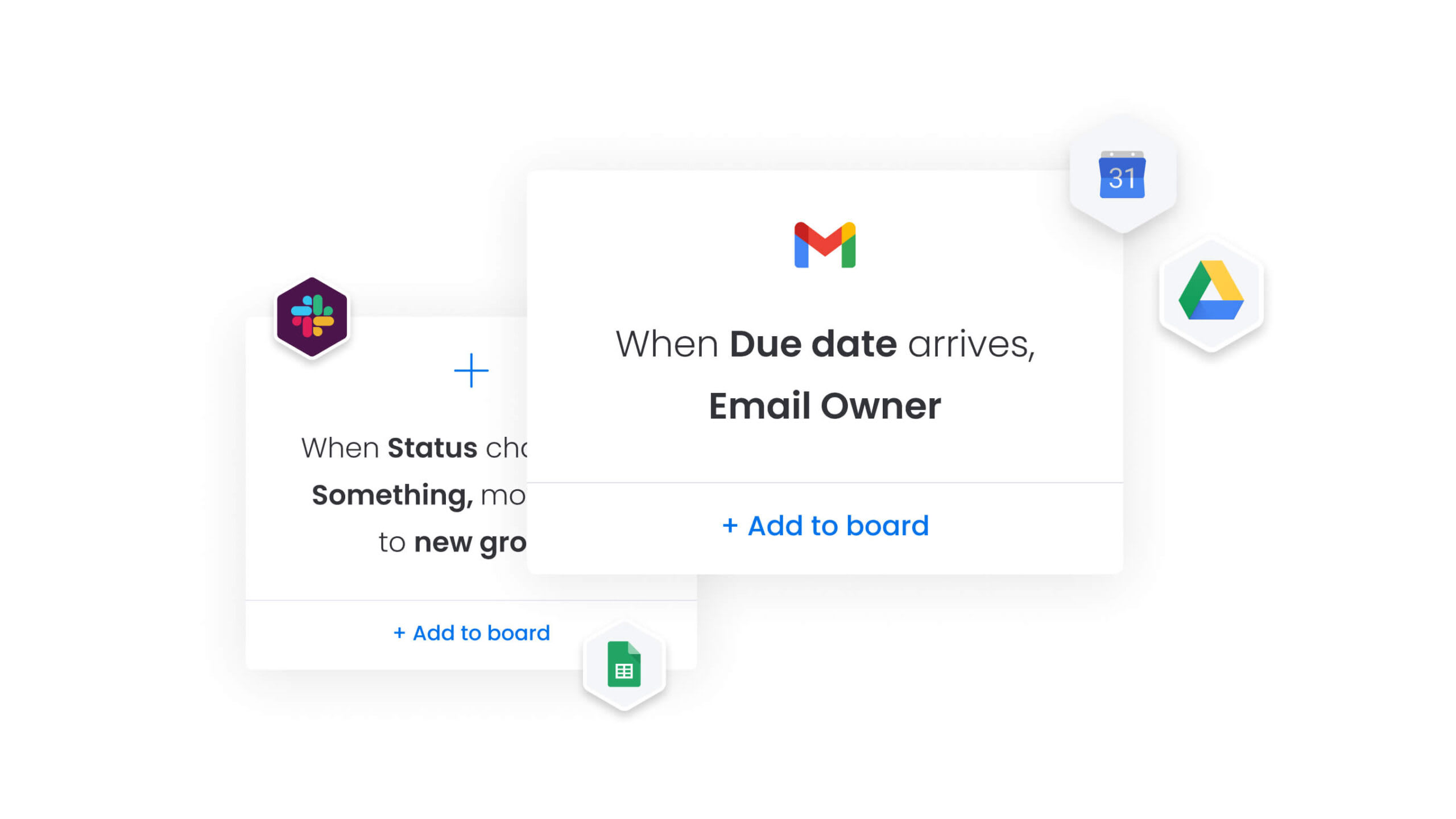 Use AI to build smart automations that connect to calendar items. You can set up automations to escalate overdue items to project managers, create follow-up tasks when calendar events are completed, or adjust task priorities based on approaching deadlines.
Teams can also use AI-powered insights in monday.com to surface potential scheduling risks, such as overlapping deadlines or overloaded team members, so managers can adjust before issues arise.
AI data insights and dashboards

The calendars built into monday.com not only help you visualize schedules and tasks, but also provide meaningful insights based on real-time data to help you make smarter decisions. With project dashboards and AI-generated reports connected to your calendar, you can track team productivity trends and identify risks and bottlenecks before they impact deadlines.
Smart AI assistant suggestions

With monday Sidekick built into monday AI Workspace, teams can get scheduling suggestions, reminders, and workspace-aware assistance while managing calendar-based work. With Sidekick, you’ll get suggestions on how to optimize scheduling and daily reminders for important upcoming events on your calendar. Armed with AI calendar recommendations, teams can improve scheduling practices based on data rather than assumptions.
Calendar data for smarter planning

By connecting calendar data to dashboards and workload views, teams can spot patterns over time, such as recurring bottlenecks or peak workload periods, and use those insights to plan future projects more realistically.
How monday AI Workspace approaches calendar management
So how does everything come together? monday AI Workspace treats your calendar as a live layer of your work, not a separate app you keep in sync by hand. Every date sits on mondayDB, one connected data layer, so a deadline on a board, a dashboard, and an automation all reference the same source of truth. That connection matters most when work gets complex, and dates shift across many teams, which is exactly where disconnected calendars and spreadsheets tend to break down.
Here’s how the platform’s calendar capabilities fit together, and where people and agents share the work:
- Calendar View and Calendar Widget: Manage dates inside a single board, then aggregate schedules across many boards on a dashboard for portfolio-level visibility
- Automations: Set no-code, date-triggered recipes to remind, reassign, and escalate, plus two-way Google Calendar and Outlook sync so nothing lives in one silo
- Dashboards: Connect calendar data to workload, Gantt, and portfolio views, with AI risk alerts and AI-generated summaries that flag scheduling pressure early
- monday vibe: Describe the calendar app you need in plain language, and Vibe builds it natively connected to your existing boards, no code required
- monday agents: These trigger-based workers act around calendar events, so a Risk Analyzer can surface scheduling risk while RSVP Manager and Meeting Summarizer support your events
- monday MCP: Connect compatible external AI assistants to your monday.com data for smart scheduling, within your existing permissions and at no extra cost
A quick word on Vibe and Agents in practice. When you ask Vibe for a social content calendar or a resource planner, it builds a working app on top of the boards you already use, so your team can adopt it the same day. Agents work alongside your team rather than replacing it: they watch for triggers, run their tasks end to end, and hand the decision back to a person. You stay in control, and the busywork moves off your plate.
To see how each approach compares, here’s a side-by-side look at monday AI Workspace calendar against the alternatives many teams start with:
| Capability | monday.com calendar | Google Calendar | Standalone calendar app or Excel |
|---|---|---|---|
| What it connects to | Live project boards, dashboards, and automations on one data layer | Email and meeting invites | Isolated dates and manual entry |
| Real-time collaboration | Yes, shared board and dashboard calendars | Limited to event sharing | Limited or none |
| Automation | Date-triggered recipes and two-way sync | Basic reminders | Manual |
| AI assistance | Sidekick suggestions, AI dashboards, agents, and Vibe-built apps | Scheduling suggestions only | None |
| Cross-board visibility | Calendar Widget aggregates many boards | Single calendar view | None |
Start building smarter calendars today
So there you have it. You now know the ways you can build a monday.com calendar, how to customize it for your team, and how to connect it with the external calendars you already rely on. Whichever template you choose, the real gain comes from turning scattered dates into a connected, visible scheduling system your whole team can act on.
The next step is pairing that calendar with AI. When you add date-triggered automations, AI dashboards, and agents that watch for scheduling risk, your team shifts from reacting to deadlines toward planning ahead of them, together with AI as part of the team.
FAQs
Does monday.com have a calendar?
Yes, monday.com has a calendar, and it offers two experiences. The Calendar View shows items from a single board in a calendar layout, while the Calendar Widget aggregates dates from many boards onto a dashboard. Both let your team collaborate in real time, filter by owner or status, and automate date-driven work.
What's the difference between the Calendar View and the Calendar Widget?
The Calendar View is a board-level view that displays items from one board based on its date or timeline columns, ideal for day-to-day execution. The Calendar Widget lives on a dashboard and pulls dates from multiple boards into one high-level view, which suits managers tracking schedules across teams or a portfolio.
How do I change the first day of the week on my monday.com calendar?
To change the first day of the week, open your profile picture and go to your account settings, then choose Language and region. From there, select Sunday, Monday, or another day as the first day of the week. The change applies across your monday.com calendars right away, with no board-by-board setup needed.
Can I sync monday.com with Google Calendar and Outlook?
Yes, you can sync monday.com with Google Calendar and Outlook using two-way integrations. Once connected, events and dates flow between the platforms automatically, so deadlines, meetings, and task dates stay in one place. You can also set up automations that trigger reminders and notifications as those synced dates approach.
How does monday AI Workspace handle calendar automation and AI scheduling?
monday AI Workspace handles calendar automation with no-code, date-triggered recipes that automatically remind, reassign, and escalate work. For scheduling intelligence, Sidekick suggests optimizations, AI dashboards flag risks like overlapping deadlines, and agents act around calendar events. People stay in control while agents handle the repetitive steps, so planning becomes proactive rather than reactive.
Can I create a content or marketing calendar in monday.com?
Yes, you can create both. The platform offers a content and editorial calendar template for planning posts and publishing dates, plus marketing calendar templates for coordinating campaigns across channels. Each template connects to your boards, supports real-time collaboration and color coding, and can sync with Google Calendar so your whole team works from the same schedule.
 Get started