

Your customer reads an email on the train, taps through to your website at lunch, then walks into your store that evening expecting you to remember all of it. A strong omnichannel strategy makes that memory real, turning scattered interactions into one continuous conversation. Getting there in practice usually means running every channel through a single campaign management software instead of disconnected point tools.
This guide breaks down what omnichannel means, why it drives revenue, and the 7 steps to build an approach that connects every channel. Getting there takes unified data, consistent messaging, and teams that share one view of the customer, which is exactly where a connected platform like monday campaigns earns its place.
Key takeaways
- Omnichannel strategy creates one continuous conversation across all touchpoints, eliminating friction and boosting revenue.
- Start by mapping your customer journey and identifying where context gets lost between channels.
- Focus on customer-centric metrics like lifetime value and cross-channel attribution to measure true omnichannel success.
- Break down team silos by sharing unified dashboards and customer intelligence to create seamless handoffs.
- AI-powered content creation combined with unified CRM data enables personalized campaigns that maintain consistency automatically.
What is an omnichannel strategy?
An omnichannel strategy is a unified approach to customer engagement across all touchpoints. This means your customers experience consistent messaging and seamless transitions whether they’re browsing your website, reading emails, or visiting your store.
Think of it as creating one continuous conversation with your customers instead of separate, disconnected interactions. This approach leverages relationship marketing to maintain strong connections at every touchpoint, boosting overall customer success.
The foundation of any omnichannel approach rests on 3 core elements: unified customer data, consistent messaging, and seamless transitions. This approach transforms scattered marketing strategies into coordinated experiences.
Omnichannel isn’t a channel count. It’s the connective tissue that makes separate channels feel like one brand.
When the pieces connect, a customer who abandons a cart online can get a timely, relevant nudge by email, and a rep can reference that same activity on a call.
This shift changes how success is measured, too. Instead of asking which channel performed, you ask whether the customer’s whole experience moved them forward. That customer-centric lens is what keeps an omnichannel strategy durable as new channels emerge.
So how do teams keep those elements aligned as they scale? In practice, many frame the work around the 4 C’s of omnichannel: customers, content, context, and collaboration. Put the customer first, tailor the content, respect the context of each channel, and keep teams collaborating on one shared record.
Omnichannel vs. multichannel: Key differences
Multichannel means being present on multiple platforms. Omnichannel means those platforms work together intelligently. With multichannel marketing, if your marketing teams operate in isolation, each channel still functions independently.
The distinction matters because it changes how customers experience your brand. The table below shows where the two approaches diverge, from how data flows to how the customer feels along the way.
The practical takeaway is simple. Multichannel spreads your presence, while omnichannel connects it. Most brands already have the channels, so the opportunity sits in linking them, not adding more.
| Attribute | Multichannel | Omnichannel |
|---|---|---|
| Customer data | Stored separately per channel | Unified into one shared profile |
| Messaging | Managed channel by channel | Consistent and coordinated everywhere |
| Channel behavior | Each channel runs on its own | Channels hand off context to each other |
| Customer experience | Repeats themselves at each step | Picks up right where they left off |
Why your business needs an omnichannel approach
B2B buyers now use an average of 10 channels throughout the purchasing journey, according to McKinsey’s 2026 Global B2B Pulse Survey. Consumers show the same cross-channel behavior, which makes a consistent approach to B2C sales just as crucial.
So what does that fragmentation cost you in revenue? McKinsey finds that AI-powered, cross-channel personalization can increase revenue by 5 to 8 percent. Revenue grows when marketing teams align with your sales strategy.
This kind of collaborative CRM fosters tighter alignment across the funnel. Customer retention improves, and cross-selling becomes more effective when every team works from the same customer record.
Consider the math behind those 10 channels. Each extra touchpoint is a chance to either reinforce your message or contradict it. An omnichannel approach makes sure every touch reinforces, which is where the revenue upside compounds.
The cost of getting this wrong is quiet but steady. Every disconnected handoff loses context, every duplicate message erodes trust, and every siloed report hides where revenue actually comes from. A unified approach recovers that lost ground by keeping teams and data in step.
What today's customers expect from omnichannel experiences
Customers don’t think about channels. They think about their relationship with your brand. Those expectations are specific, and they surface the moment an experience breaks down.
Modern customers demand recognition everywhere, effortless transitions, relevant personalization, and proactive communication:
- Recognition everywhere: They expect you to remember them across every channel.
- Effortless transitions: They want to continue where they left off without repeating themselves.
- Relevant personalization: They expect content shaped by their behavior, not generic blasts.
- Proactive communication: They want the next step surfaced before they have to ask.
monday campaigns enables this by connecting customer data with campaign execution, so recognition and relevance carry across every touchpoint.
Meeting these expectations isn’t about doing more. It’s about doing the same things in sync. When your data, content, and timing align, a single well-placed message can feel more personal than a dozen generic ones.
Expectations also keep rising. A frictionless experience from one brand quickly becomes the baseline every other brand is judged against. Meeting that bar consistently is what earns loyalty, not one-off campaigns.
7 steps to build your omnichannel strategy
A strong omnichannel strategy comes together in a repeatable sequence, not a single big launch. The 7 steps below move from understanding your customer to scaling what works. Treat it as a loop, since the last step feeds directly back into the first.
Step 1: Map your current customer journey
Start by documenting every touchpoint. This mirrors how a marketing funnel captures each stage of engagement. Note where customers switch devices or channels, and flag the moments where context gets lost between them. A shared journey map gives every team the same starting point.
Step 2: Set measurable omnichannel goals and KPIs
Establish measurable objectives focusing on metrics like customer lifetime value, cross-channel conversion rates, and multi-touch attribution. Tie each goal to revenue so marketing and sales chase the same outcomes, not separate scorecards. Measurable targets also make it easier to prove impact to leadership.
Step 3: Audit your marketing channels and tech stack
Take inventory of all your marketing platforms, CRM systems, and communication channels. Map which systems share data today and which ones force manual exports, since those gaps are where the customer experience fractures. The audit often reveals redundant platforms you can retire to cut costs.
Step 4: Build a unified customer data foundation
Create a centralized system. With a native CRM integration, monday campaigns excels here. When contact records, campaign activity, and sales notes live in one place, every channel draws from the same profile. This shared foundation is what separates true omnichannel from simple multichannel.
Step 5: Create seamless cross-channel campaigns
Design campaigns that work consistently across all channels. With monday campaigns, you can use trigger-based automation. A single message framework, adapted per channel, keeps your voice recognizable whether it lands in an inbox or a follow-up call. Automation then handles the timing, so the right message reaches each contact without manual sends.
Step 6: Align your marketing and sales teams
Break down the silos with shared goals, unified data access, and handoff procedures. When sales can see the emails a lead opened, their first conversation picks up exactly where marketing left off. Shared goals turn two teams into one revenue engine.
Step 7: Measure, learn, and scale what works
Track performance across all channels. Review what moves revenue, retire what doesn’t, and reinvest in the sequences that convert. Small, steady improvements compound into a measurable revenue lift over time.
Run this loop every quarter and the strategy compounds. Each cycle sharpens your segments, tightens your messaging, and reveals the next channel worth connecting.
Real-world omnichannel strategy examples
Theory lands faster with examples. The scenarios below show how different teams turn an omnichannel strategy into coordinated, revenue-driving experiences.
Retail: Online browsing meets in-store context
A leading apparel company integrated online behavior data with in-store systems. When a customer browsed jackets on mobile, then walked into a store that afternoon, the sales associate could see that browsing history and offer relevant recommendations. The result was higher conversion and a customer who felt recognized, not repeated.
B2B SaaS: Dynamic nurture to sales handoff
A software provider unified marketing and sales data, so leads moved seamlessly between teams. AI-driven segmentation in monday campaigns ensured each lead received tailored nurture content based on behavior. When a lead booked a demo, the CRM automatically shifted them into a sales-owned view with full campaign context, so the first call picked up exactly where marketing left off. After conversion, monday campaigns moved them into onboarding, keeping messaging consistent from first email to loyal customer.
What ties these examples together is data that follows the customer. None of them added channels for their own sake. Each connected the channels they already had, so the customer felt known at every step and the business could measure the result. The lesson repeats across industries: connection beats volume, and a shared record beats a longer list of platforms every time.
Essential technologies for omnichannel success
The right technologies turn an omnichannel strategy from ambition into daily execution. Each layer below solves a specific job, and together they keep data, messaging, and measurement connected.
- Customer data platforms: Unify profiles from every channel into one record.
- Marketing automation: Trigger the right message based on behavior and timing.
- AI-powered personalization engines: Shape content for each segment at scale.
- Analytics and attribution platforms: Connect channel activity back to revenue.
You don’t need every platform on day one. Start with a unified data foundation, since personalization and attribution only work when they read from the same source. A connected suite like monday campaigns layers these capabilities together instead of stitching them across vendors.
It also helps to think in layers rather than logos. The job to be done matters more than the brand name on the login screen. Ask what each layer contributes to a single, connected customer view, then choose platforms that share data freely.
Using AI to optimize and measure your omnichannel marketing
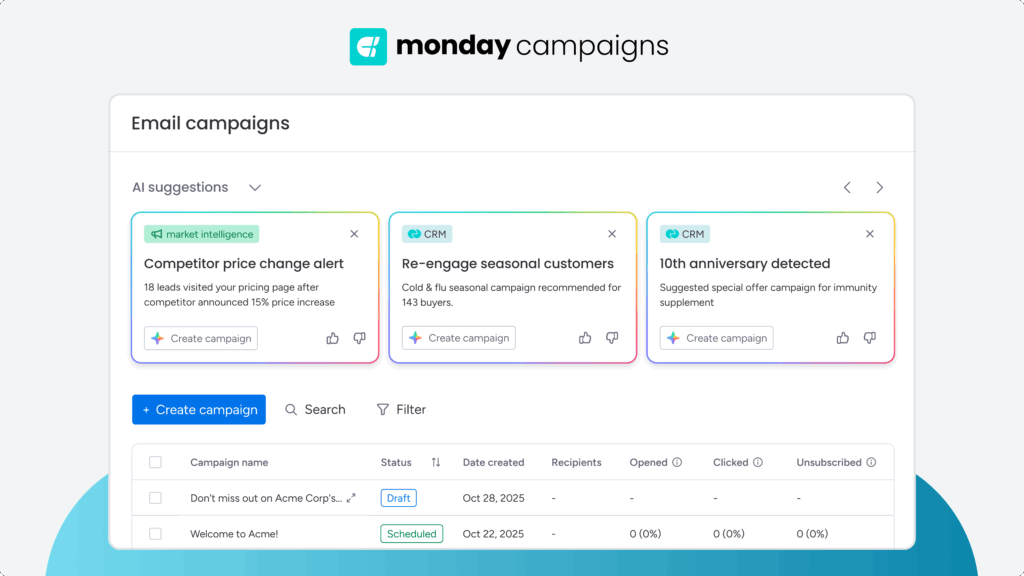 AI transforms omnichannel marketing. It enables personalization strategies at scale.
AI agents push this further. A Translator agent can localize campaigns across markets, a Sentiment Detector can flag when engagement shifts across channels, and a Campaign Manager agent can surface ROI recommendations. Together they extend omnichannel measurement from static dashboards into automation that acts on what it finds, so your strategy keeps improving between reporting cycles.
On the measurement side, AI helps you see across channels at once. It can spot which sequences drive pipeline, surface segments that are drifting, and recommend where to shift budget. That turns reporting from a monthly look back into a running signal your team can act on.
Personalization at scale used to mean choosing between relevance and reach. AI removes that trade-off. It can tailor subject lines, offers, and send times for thousands of contacts at once, using the behavioral signals already sitting in your CRM. None of this replaces marketers, but removes manual overhead that keeps them from strategy. Judgment stays human while AI handles the repetitive execution behind the scenes.
How to solve 5 common omnichannel challenges
Most omnichannel problems trace back to the same root: disconnected data and disconnected teams. The 5 challenges below show up in almost every rollout. Here’s how to address each one before it slows your strategy down.
| Challenge | How to solve it | Omnichannel |
|---|---|---|
| Siloed customer data | Consolidate contacts into one native CRM so every channel reads the same profile. | Unified into one shared profile |
| Inconsistent messaging | Build from a shared content and brand library, then adapt it per channel. | Consistent and coordinated everywhere |
| Disconnected marketing and sales | Give both teams one dashboard and defined handoff steps. | Channels hand off context to each other |
| Hard-to-prove ROI | Track cross-channel activity against pipeline and revenue, not channel vanity metrics. | Picks up right where they left off |
| Slow, manual execution | Use AI to draft copy, segment audiences, and trigger sends automatically. |
How monday campaigns transforms your omnichannel strategy
An omnichannel strategy only works when execution matches the plan. monday campaigns brings the pieces together on one platform, so data, content, and measurement stay connected as you scale.
Because monday campaigns connects natively to monday CRM, the marketing-sales handoff happens without exports or duplicate records. Marketing activity, sales notes, and pipeline updates flow through one record, so the customer view stays accurate no matter which team touches it last. That shared foundation turns coordinated messaging into measurable revenue, not guesswork.
AI-powered content creation
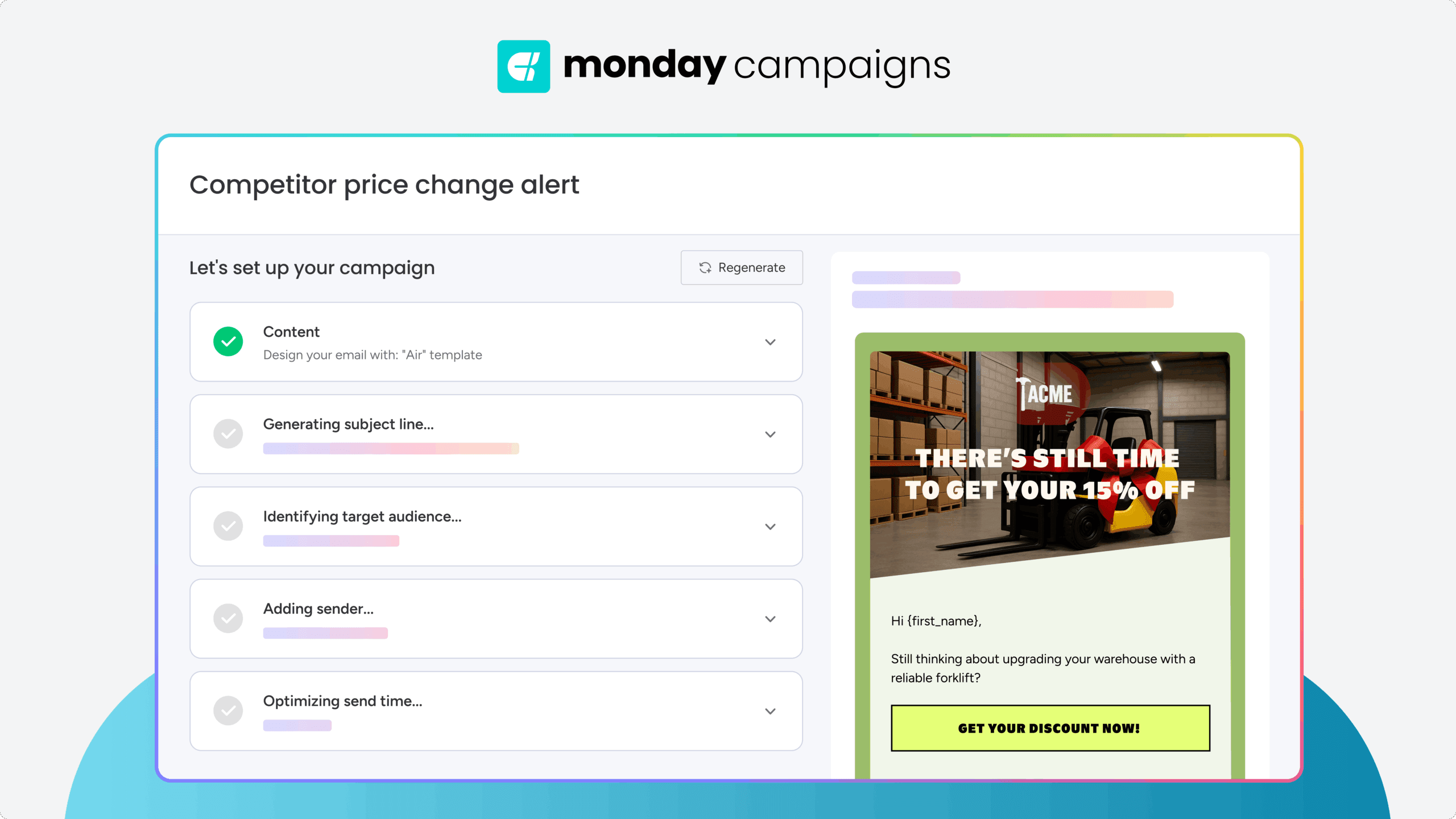
Instead of briefing a designer for every variant, marketers can generate on-brand copy in minutes and adjust it per segment. The AI drafts subject lines, body copy, and calls to action that match your voice, so you spend less time writing from scratch and more time refining what converts. This keeps content production moving at the speed your omnichannel strategy demands.
Unified customer intelligence
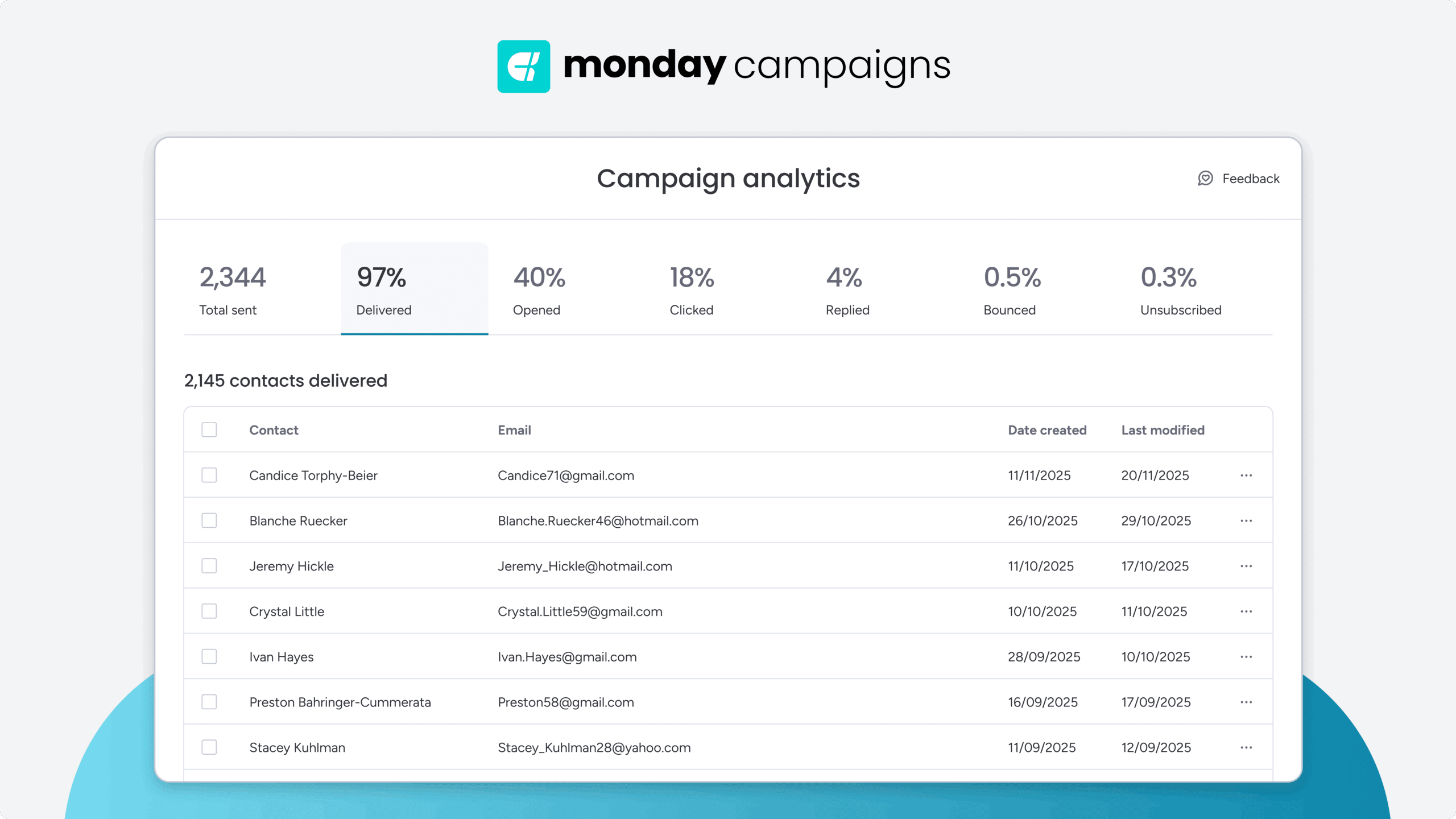
Every campaign reads from live CRM data, so personalization reflects what customers actually do, not what you assume. When a contact opens an email, visits your pricing page, or books a demo, that behavior updates their profile in real time. Your next message picks up exactly where they left off, creating the continuous conversation omnichannel requires.
Dynamic segmentation with AI

Lists update automatically as customer behavior changes, adding and removing contacts so no one receives a message meant for a different stage. AI-driven segmentation spots patterns across your audience and surfaces high-intent segments you might miss manually. This keeps your targeting sharp without constant list maintenance, so campaigns stay relevant across every channel.
AI agents for omnichannel optimization

monday’s AI agent capabilities extend your omnichannel strategy beyond static campaigns. Agents can localize content for new markets, flag shifts in engagement across channels, and surface ROI recommendations so your strategy keeps improving between reporting cycles. Teams can even build custom surfaces with monday vibe and connect external agents through MCP, extending the same customer data across the wider ecosystem without leaving the platform.
Launch a more unified customer experience
Omnichannel strategy is now essential for competitive success. Customers move fluidly between channels, and they reward the brands that move with them. The teams that win share one trait: marketing and sales work from the same customer record on one platform. That alignment turns coordinated messaging into measurable revenue, not guesswork.
With AI built in from the ground up and a native connection to monday CRM, monday campaigns gives revenue teams a practical path to a unified customer experience that lasts, from the very first email to a loyal, returning customer.
FAQs
What is an omnichannel strategy?
An omnichannel strategy is a unified approach to engaging customers across all touchpoints, so messaging and data stay consistent whether they use your website, email, or store. It connects channels into one continuous conversation rather than separate interactions.
What is the difference between omnichannel and multichannel?
The difference between omnichannel and multichannel is coordination. Multichannel means being present on several platforms that each run independently, while omnichannel means those platforms share data and hand off context to create one seamless experience.
What are the benefits of an omnichannel strategy?
The benefits of an omnichannel strategy include higher revenue, stronger retention, and more effective cross-selling. McKinsey reports that AI-powered personalization can lift revenue by 5 to 8 percent, and consistent experiences keep customers engaged across every channel.
How do you create an omnichannel strategy?
You create an omnichannel strategy by mapping the customer journey, setting measurable goals, auditing your channels, unifying customer data, building cross-channel campaigns, aligning marketing and sales, then measuring and scaling what works.
What is an example of an omnichannel strategy?
An example of an omnichannel strategy is a retailer that links online browsing data with in-store systems, or a B2B team that uses dynamic segmentation to move a lead from nurture emails to a sales conversation with full context.
What is omnichannel customer experience?
Omnichannel customer experience is how a customer feels moving across your channels when those channels work together. They're recognized everywhere, transitions feel effortless, and personalization stays relevant at every step.
What are the 4 C's of omnichannel?
The 4 C's of omnichannel are customers, content, context, and collaboration. They remind teams to put the customer first, tailor content, respect each channel's context, and collaborate from one shared record.
How does monday campaigns support an omnichannel strategy?
monday campaigns supports an omnichannel strategy by combining AI-powered content creation, native CRM data, and dynamic segmentation. This keeps messaging consistent across channels and connects marketing activity to sales and revenue on one platform.

 Get started