


Marketing teams that connect campaigns directly to closed deals gain the visibility leadership expects. AI email platforms embed intelligence at every stage — from building segments to writing copy to timing sends — so your data drives decisions, not just dashboards.
This guide shows you how AI-powered email platforms prove marketing’s real impact on revenue. You’ll discover how to automate campaigns from concept to conversion, connect email engagement to pipeline outcomes, and get marketing and sales working from the same playbook. Under the hood, most of these platforms are really just specialized AI marketing software focused on a single channel, which is worth knowing before you evaluate broader platform fit.
What is AI-powered email marketing?
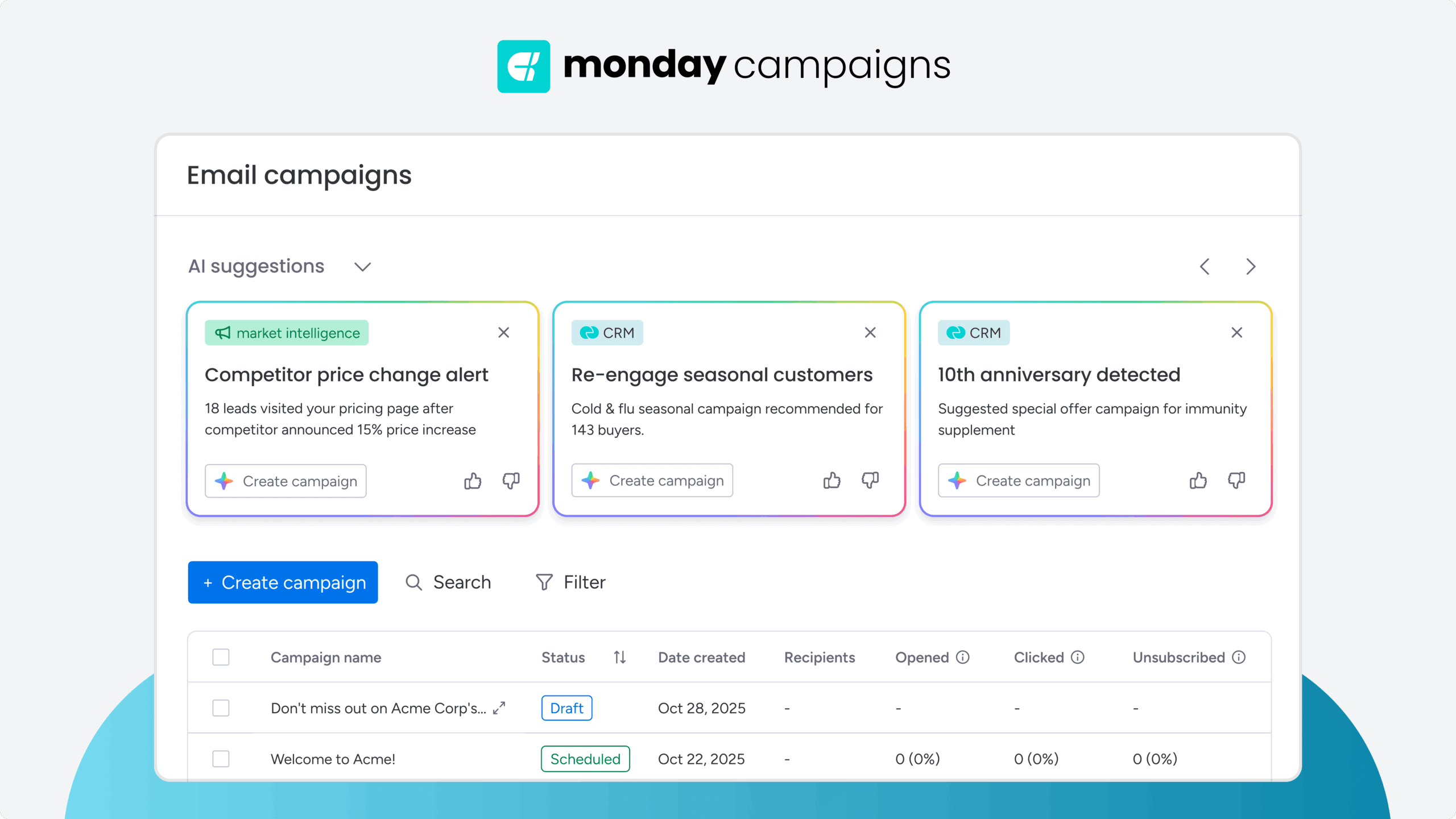
Email marketing with AI automates the tedious stuff, including list building, send timing, and personalization, so you can focus on strategy. Rather than relying on static lists and assumed send times, it analyzes CRM data and engagement patterns to decide who gets what message, and when. You stop batch-and-blasting and start sending messages that respond to what customers actually do, like opening 3 emails in a row or visiting your pricing page.
Here’s what that looks like:
- A lead who just moved to a new deal stage triggers an automated message that references exactly where they are in the buying process.
- A prospect who opens emails at 9 a.m. gets their message at 9 a.m., not whenever your team hits send.
How AI improves email campaigns
AI doesn’t just speed things up; it changes how campaigns move from concept to optimization. Here’s where AI cuts manual work and sharpens targeting:
- Content creation: Generate subject lines and messaging based on what’s worked before, giving your team a confident starting point.
- Audience segmentation: Target contacts based on behavior or lifecycle stage. Segments update automatically as customer data changes.
- Send-time optimization: Analyze engagement patterns to send emails when each contact is most likely to open them.
- Performance analysis: Pull insights from campaign results and tie them directly to closed deals.
Compare generative AI vs. predictive AI for email campaigns
Not all AI works the same way. Understanding the difference helps you spot which platforms actually deliver. Generative AI creates new content (like email copy and subject lines) based on your existing brand data. Predictive AI analyzes historical data to forecast future behavior, like which contacts are most likely to convert.
| AI type | Core function | Best used for |
|---|---|---|
| Generative AI | Creates new content based on existing brand data | Drafting email copy, generating subject lines, and maintaining brand voice |
| Predictive AI | Analyzes historical data to forecast future behavior | Identifying high-intent contacts, optimizing send times, and predicting churn |
What’s the point of writing the perfect email if it hits the wrong inbox at the wrong time? The best platforms use both types of AI to handle creation, targeting, and timing, all at once.
9 best AI marketing platforms for email campaigns
We collected these platforms based on real-world AI capabilities, ease of adoption, and whether they actually connect campaigns to revenue. Use this information to make a smart decision for your team.
| Platform | Best for | Free trial | Notable AI feature | Starting price* |
|---|---|---|---|---|
| monday campaigns | CRM and lifecycle marketing | 14 days | Revenue attribution tied to closed-won deals | Contact-based (2,000 contacts default) |
| ActiveCampaign | Advanced automation | 14 days | Predictive sending | $15/month |
| HubSpot | CRM-based marketing | Free plan | Unified CRM and marketing hub | $10/seat/month |
| Brevo | Multi-channel marketing | Free plan | Email, SMS, and WhatsApp AI workflows | $9/month |
| Klaviyo | Ecommerce marketing | Free plan | Predictive CLV and churn analytics | Active profile-based |
| Jasper | AI content creation | 7 days | Brand governance with Jasper IQ | $59/seat/month |
| GetResponse | All-in-one marketing | 14 days | AI campaign generation | $19/month |
| MailerLite | Small businesses | Free plan | Smart sending | $12/month |
| Mailchimp | Easy AI email marketing | Free plan | AI content generation and predictive analytics | $13/month |
*Pricing and trial availability subject to change. Check provider websites for current details.
1. monday campaigns
Built natively inside the monday CRM suite, monday campaigns is an AI-powered email marketing platform (though you can also use it standalone). It’s built for marketing teams that need to tie campaign performance directly to revenue. It’s designed for CRM and lifecycle marketers who want AI at every stage, from audience segmentation to content generation to send-time optimization. Because it lives on the same platform as monday CRM and monday AI Workspace, sales and marketing finally work from the same data.

Use case: Marketing directors who want a direct line between email engagement and pipeline impact
Key features
- End-to-end AI across the campaign lifecycle: From generating campaign ideas to writing copy to optimizing send timing, AI is embedded at every stage as a core part of the platform.
- Revenue-connected analytics: Campaign performance ties directly to pipeline metrics and closed-won deals. Marketing leaders get the attribution data they need to justify spend and prioritize future campaigns.
- Dynamic segmentation at send time: CRM-driven segments update automatically as contact data changes, keeping your audience lists accurate ahead of every send.
Pricing
- Pro: Contact-based pricing, defaulting to 2,000 contacts. Includes the drag-and-drop editor and AI features. Check the specific workflow and automation limits for this tier before purchasing.
- Enterprise: Expanded contact limits, dedicated IP for deliverability, advanced workflow automation, and enterprise-grade security.
- Visit the monday campaigns pricing page for current rates.
Why it stands out
- Native CRM alignment: Unlike standalone email platforms, monday campaigns connects directly to monday CRM, keeping data unified and attribution aligned between marketing and sales.
- AI with source transparency: The AI suggestions feature analyzes sales notes and external context to propose campaign ideas. You can view the sources behind each suggestion, giving you a level of transparency that’s rare across platforms.
- Single platform, full lifecycle view: From first lead touch to loyal customer, monday campaigns sits inside the same platform your sales team uses. Every stakeholder sees the full customer journey.

"With monday campaigns, we can launch professional emails in minutes and instantly see who engaged. Our sales team follows up directly with those showing interest - making outreach faster and more effective."
Michael Fitzpatrick | National Workplace Training Manager2. ActiveCampaign
ActiveCampaign embeds AI across the entire email lifecycle, from campaign creation to predictive send-time optimization. It’s a strong contender for teams that want deep automation. The platform targets small to mid-sized businesses in ecommerce, SaaS, and online education, especially those building complex email sequences based on customer behavior.

Use case: Marketing teams that need sophisticated multi-step automation workflows driven by CRM events, website activity, and contact behavior, all unified in one platform
Key features
- AI Campaign Builder: Generates full campaigns (subject line, layout, copy, and CTA) from a single prompt, with A/B versions built in and an “Edit with AI” option embedded directly in the email designer.
- Predictive sending: Uses machine learning to identify the optimal send time per contact. Recalculates weekly based on engagement patterns to boost opens and clicks.
- AI-suggested segments: Identifies high-value audiences automatically and uses fuzzy-matching to speed up segment creation, streamlining list management.
Pricing
- Starter: From $15/month for up to 1,000 contacts
- Plus, Professional, and Enterprise: Contact-based pricing tiers available on the ActiveCampaign pricing page
- Annual billing options are available across all plans
- WhatsApp messaging, SMS, custom reporting, and transactional emails are available as paid add-ons
Considerations
- Building and maintaining advanced automations takes time and some technical knowledge. Teams without a dedicated marketing ops person might not use the platform’s full capabilities.
- While ActiveCampaign has its own built-in CRM, it operates separately from your work management and external sales systems. Keeping marketing aligned with external platforms often requires third-party connectors like Zapier or custom API work, which adds maintenance overhead.
3. HubSpot
HubSpot brings together CRM data and AI-powered email marketing in a single platform. It’s a strong fit for scaling teams that want marketing and sales activity in one place. Its Marketing Hub connects contact data directly to campaign execution, making personalization a default part of the workflow. For teams already invested in the HubSpot ecosystem, the email capabilities extend naturally from the CRM foundation they’ve already built.

Use case: Scaling companies that want to run AI-assisted email campaigns directly from their CRM in a single unified workflow
Key features
- AI Email Writer: Drafts subject lines and body copy using CRM data, with a drag-and-drop editor and personalization tokens that adapt content to individual contacts at scale.
- Send time optimization: Analyzes each contact’s recent engagement history to deliver emails at the moment they’re most likely to open, available at the contact level on Enterprise plans.
- A/B testing and smart content rules: Tests subject lines and email variants against real engagement metrics, with smart content rules that serve different email modules to different audience segments without any code.
Pricing
- Free: $0/month
- Starter: From $10/seat per month
- Professional: From $1,450/month (includes 6 seats; one-time onboarding fee of $3,000 applies)
- Enterprise: From $4,700/month (includes 8 seats; one-time onboarding fee of $7,000 applies)
- Advanced AI features on Pro and Enterprise plans draw from a monthly HubSpot Credits quota; additional credits are available as pay-as-you-go packs
- Total cost scales with seat count, marketing contact volume, and AI credit usage
Considerations
- Contact-level send time optimization is Enterprise-only and was still in beta as of January 2026, meaning some of the most advanced AI personalization features aren’t accessible on lower-tier plans.
- Pricing can escalate quickly as contact lists grow or teams require advanced automation; what starts as an accessible entry point can become a significant investment for mid-sized teams managing large databases.
4. Brevo
Brevo brings multi-channel email marketing to teams that want affordability while keeping broad reach. Built for everyone from small businesses to enterprise organizations, the platform combines email, SMS, WhatsApp, and chat in a single workspace. Its AI assistant, Aura, is embedded directly in the campaign workflow, handling everything from content generation to send-time optimization.

Use case: Teams that prioritize multi-channel communication and cost-accessible AI features, particularly those in e-commerce or high-volume transactional email environments
Key features
- Aura AI assistant: Generates and refines email content, subject lines, and images directly inside the campaign editor; all suggestions remain fully editable and only apply with user approval.
- Send-time optimization: Analyzes each contact’s past engagement data to schedule delivery at the optimal moment, within a 24-hour window.
- AI-driven segmentation: Uses natural-language prompts to generate audience segments based on contact details, email behavior, SMS activity, and e-commerce data (available on Professional and Enterprise plans).
Pricing
- Free: $0/month, includes 300 daily email sends, up to 100,000 contacts, and access to Aura.
- Starter: From $9/month.
- Standard: From $18/month, includes AI send-time optimization.
- Professional: From $499/month, includes AI segmentation, AI product recommendations, and back-in-stock alerts.
- Enterprise: Custom pricing.
- Annual billing offers a 10% discount.
- Notable add-ons include: remove Brevo logo ($9/month), dedicated IP ($251/year), and SAML SSO ($324/month).
Considerations
- Advanced AI features, including segmentation, product recommendations, and contact scoring, are gated behind the Professional and Enterprise tiers, which start at $499/month, a significant jump from Standard.
- Send-time optimization is incompatible with A/B testing and dedicated IP warm-up, and works most reliably after several prior campaigns have been sent, limiting its value for newer senders.
5. Klaviyo
Klaviyo brings AI-powered precision to e-commerce email marketing, turning customer data into personalized campaigns that drive repeat purchases. Built specifically for direct-to-consumer brands, it combines predictive analytics, behavioral segmentation, and agentic AI to help marketers move from insight to execution quickly. With over 196,000 customers and deep integrations across Shopify, WooCommerce, and BigCommerce, it’s a platform built for scale.

Use case:
Klaviyo is purpose-built for B2C and e-commerce brands that want to use predictive customer data (like churn risk, lifetime value, and next purchase date) to send highly targeted, revenue-driving email campaigns.
Key features
- Predictive analytics: Models for customer lifetime value, churn risk, and next order date help marketers target the right customers at the right moment, not just the most recent ones.
- AI-powered segmentation: Natural-language prompts convert into precise segment rules, so marketers can build high-intent audiences without needing a data team.
- Marketing Agent and Composer: Agentic AI that drafts launch-ready campaigns, including segments, copy, and cross-channel plans, directly from a prompt or your brand’s catalog.
Pricing
- Free: Up to 250 active profiles and 500 email sends/month
- Paid plans: Scale by active profile count and monthly send volume; base email tiers start with core automation and segmentation
- Add-ons: Marketing Analytics and Advanced Klaviyo Data Platform (KDP) are available at additional cost; required for features like personalized send time
- Enterprise: Custom pricing via sales under “Klaviyo One”
- See full pricing details on the Klaviyo pricing page
Considerations
- Klaviyo is optimized for B2C transaction data, which makes it a less natural fit for B2B teams or organizations that need campaign performance tied to a CRM sales pipeline.
- High-value capabilities like personalized send time require paid add-ons, and predictive models need sufficient order history before they become reliable, which can slow time-to-value for newer brands.
6. Jasper
Jasper is a generative AI writing platform built to help marketing teams produce on-brand email copy, subject lines, and campaign messaging at scale. It serves enterprise and mid-market teams that need consistent brand governance across channels, making it a strong fit for organizations managing multi-region or multi-brand programs. Its brand intelligence layer, Jasper IQ, embeds voice, style guides, and audience data directly into every output.

Use case: Marketing teams that generate governed, brand-consistent email copy at scale, from welcome sequences to full campaign messaging, building on existing brand assets every time
Key features
- Purpose-built email agents: Dedicated agents for welcome emails, transactional messages, follow-ups, and full campaign sequences generate copy that’s ready to paste into your ESP.
- Brand governance via Jasper IQ: Brand voice, style guides, audience profiles, and company knowledge are applied at the point of generation, keeping every email on-brand across teams and markets.
- Jasper Grid for scaled execution: Available on the Business plan, Grid supports spreadsheet-style workflows to generate thousands of personalized or localized email variants under brand guardrails.
Pricing
- Pro: $59/seat/month (billed annually) or $69/seat/month (billed monthly)
- Business: Custom pricing — includes advanced agents, Jasper Grid, unlimited brand intelligence assets, API access, and a dedicated Customer Success Manager
- Free trial: 7-day free trial available on the Pro plan
- Nonprofit discount: 20% discount available upon request
- Note: The plagiarism checker is an optional paid add-on
Considerations
- Jasper is a content generation layer, not a full email marketing platform; teams still need a separate ESP for sending, list management, deliverability, and performance analytics, which adds steps to the workflow rather than consolidating them.
- Advanced brand governance features, including unlimited brand voices, knowledge assets, and audience profiles, are restricted to the Business plan, which may limit full-fidelity brand control for teams on Pro.
7. GetResponse
GetResponse brings together email marketing, automation, and AI content generation in one platform, built for teams that want to move fast with a unified subscription. GetResponse is a proven choice for small-to-mid-sized teams that need email, landing pages, and webinar hosting under one roof. Its AI features are embedded directly into the email creation workflow, so generating campaigns feels native and seamless.

Use case: Small to midsized marketing teams that want AI-assisted email creation, send-time optimization, and landing page capabilities in a single, mid-range platform
Key features
- AI Email Generator: Creates full, industry-optimized email campaigns from a guided prompt, with users reporting up to 85% faster creation time.
- AI Campaign Generator: Produces a 3-part campaign (landing page, welcome email, and newsletter) in one workflow, powered by ChatGPT integration.
- Perfect Timing send-time optimization: Analyzes each subscriber’s engagement history to deliver emails at their individual predicted peak window, personalizing delivery at scale.
Pricing
- Free: $0/month, up to 500 contacts and 2,500 newsletters/month with basic email, landing page, and form creators.
- Starter: From $19/month (or $15.58/month billed annually), unlimited sends, AI content generators, 1 custom automation workflow, landing pages, and signup forms. Note: AI tool uses are limited to 3 on this plan.
- Marketer: From $59/month, adds unlimited automation workflows, advanced segmentation, abandoned cart recovery, and sales funnels.
- Creator: From $69/month, adds webinars, a website builder, and course creation for up to 500 students.
- Enterprise (MAX): Custom pricing, includes SMS marketing, transactional email, AI product recommendations, dedicated IP, SSO, and premium support.
- Discount: 18% off with annual billing; 50% discount available for charities and NGOs; 14-day free trial on paid features.
Considerations
- GetResponse’s campaign metrics stop at open rates and click rates; connecting those results to downstream sales outcomes requires manual work or third-party integrations, which makes revenue attribution a challenge for teams focused on proving marketing ROI.
- AI product recommendations are only available on the MAX (enterprise) plan, meaning teams on standard tiers won’t have access to one of the platform’s more sophisticated personalization capabilities.
8. MailerLite
MailerLite delivers straightforward email marketing for small teams and solo marketers who want to launch campaigns fast with simple setup and an easy learning curve. The platform weaves AI into its core workflow, from subject line generation to send-time optimization, making it a practical starting point for teams focused on simplicity over scale. Its native integration with websites, landing pages, and forms keeps the stack lean and manageable.

Use case: Solopreneurs, small businesses, and creators who need a simple, AI-assisted email marketing platform that covers the full content-to-send workflow with ease
Key features
- AI writing assistant: This feature generates email copy with adjustable tone (Natural, Catchy, Professional, Persuasive) and content type, with up to 3 regenerations per prompt.
- Smart sending: This capability learns each subscriber’s engagement habits over time and delivers emails at the optimal individual send time.
- AI subject line generator: This tool produces subject line suggestions directly from campaign content.
Pricing
- Free: $0/month, up to 250 subscribers and 2,500 emails/month; 2 user seats; access to core builders and basic testing.
- Comfort: starts at $12/month, includes AI writing assistant, Smart sending, multivariate testing, and higher sending limits.
- Power: starts at $25/month, unlimited monthly emails, unlimited seats, automations, forms, and 24/7 live chat support.
- Enterprise: custom pricing for 200K+ subscribers, with dedicated success resources.
- Annual billing saves approximately 10%; nonprofits receive a 30% discount.
- Dedicated IP available as an add-on for high-volume senders (recommended at 50K+ weekly emails).
Considerations
- AI writing assistant credits are capped per plan and cannot be purchased separately; teams with high-volume content needs may find the limits restrictive on lower tiers.
- MailerLite’s AI capabilities are designed for straightforward workflows; teams managing complex, multi-touch campaigns tied to CRM events or revenue tracking will likely need a platform with deeper integration infrastructure.
9. Mailchimp
Mailchimp has been a go-to email marketing platform for over 2 decades, giving teams a broad, integrated stack that spans email, SMS, landing pages, and analytics. It serves small businesses, ecommerce brands, and content creators who want accessible AI-powered features without a steep learning curve. With 300+ integrations and a free tier to get started, it’s built for teams that prioritize ease of use and quick deployment.

Use case: Small to midsized teams and ecommerce brands that want an accessible, all-in-one email marketing platform with AI-assisted content creation, send-time optimization, and predictive audience targeting
Key features
- AI content generation: Write with AI and the Email Content Generator help teams draft and refine email copy directly in the builder, with support for brand-voice edits and tone adjustments.
- Send Time Optimization and Subject Line Helper: AI-driven recommendations identify the optimal send window and subject line approach based on engagement data, helping teams reach audiences when they’re most likely to act.
- Predictive analytics: Features like Likelihood to Purchase, Predicted CLV, and Churn Risk let teams segment audiences based on forward-looking behavioral signals, available on Standard and Premium plans with a connected ecommerce store.
Pricing
- Free: $0/month, up to 250 contacts and 500 sends/month
- Essentials: From $13/month, up to 500 contacts, 10x monthly send limit
- Standard: From $20/month, up to 500 contacts, 12x monthly send limit; includes AI writing and optimization features
- Premium: From $350/month, base includes 10,000 contacts, 15x monthly send limit; includes priority phone support and personalized onboarding
- Nonprofit and charity discount: 15% off (request via billing)
- Overage charges apply when contact or send limits are exceeded within a billing cycle
Considerations
- AI features with the most impact, like predictive analytics, Content Optimizer, and Write with AI, are locked behind Standard or Premium plans, and some require a connected ecommerce store with significant order history to generate reliable predictions.
- Campaign performance reporting focuses on engagement metrics like opens and clicks, rather than downstream revenue contribution, which limits its value for marketing teams accountable for pipeline impact.
7 features to look for in AI email marketing software
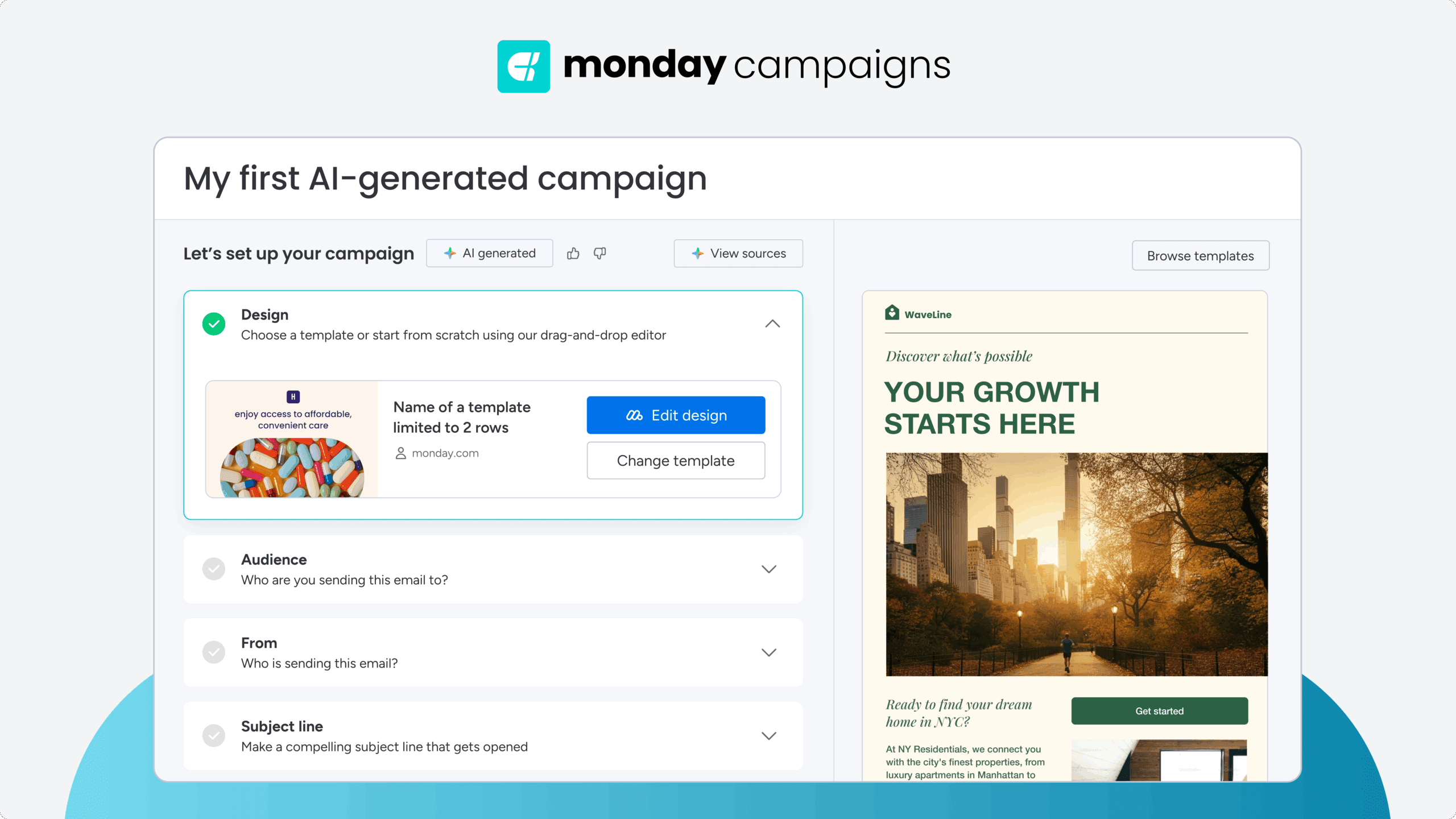
Only certain AI email marketing platforms connect campaign performance to actual revenue. Closing that gap saves your team hours and ensures every campaign drives pipeline. The features that actually matter are the ones that hold up when leadership asks about ROI.
Plenty of platforms promise the world, yet only some deliver value quickly. Before committing to a new tool, you need to know exactly what separates a revenue-driving engine from a basic email sender.
1. AI content generation and brand voice consistency
AI content generation should do more than fill a blank page. It needs to produce copy that sounds exactly like your brand from the very first draft. Platforms that embed your specific tone and messaging guidelines directly into their models eliminate endless editing cycles. Your team can finally spend their time refining marketing strategy rather than rewriting robotic output.
2. Predictive segmentation and dynamic audiences
Static lists become outdated the moment you export them. A contact who was cold last week but just visited your pricing page should move into a high-intent segment automatically.
- Real-time updates: Your team can rely on the platform to automatically rebuild that list every time a lead takes action.
- CRM synchronization: When your email platform connects natively to your CRM, segment membership updates in real time to match exactly where buyers are in their journey.
3. Send-time optimization
True send-time optimization works at the individual contact level, not the campaign level. One person receives their email at 9:00 a.m. because that’s when they consistently engage, while another gets the exact same campaign at 6:00 p.m. This level of precision requires deep historical engagement data tied to individual profiles. Platforms with native CRM integrations deliver far more accurate delivery recommendations than standalone senders working from incomplete data.
4. Native CRM integration
A native CRM integration is a direct, built-in connection that syncs in real time, unlike fragile third-party connectors. This structural difference matters when a deal closes and you need to immediately pause promotional emails.
Real-time updates ensure that a contact’s campaign eligibility changes instantly based on sales activity, while both marketing and sales teams share one continuous view of the customer journey, ensuring seamless communication at every touchpoint.
5. Campaign performance tracking and analytics
Open rates and click rates are just table stakes. What marketing directors actually need is the ability to connect email engagement directly to lead conversion and closed-won deals.
A campaign with a 40% open rate that generates zero pipeline is far less valuable than one with a 20% open rate that closes 3 deals. With monday campaigns, you connect campaign analytics directly to CRM data to track actual revenue influence in real time.
6. Ease of setup and team adoption
A platform with 50 advanced features only delivers value if your team can adopt it within weeks of purchase. Ease of setup means intuitive campaign building without relying on developers.
- Seamless workflows: Your platforms should fit into the processes your team already uses every day, aligning with familiar workflows.
- Zero overhead: By using monday campaigns, marketers can build audiences and launch emails on monday.com with minimal administrative effort.
7. Pricing and scalability
Entry-level pricing rarely tells the full story. Teams that stitch together a standalone email platform, a separate CRM, and an external AI writer often pay significantly more in aggregate.
- Hidden costs: Maintaining those connections carries ongoing overhead that often surfaces well after the original invoice.
- Predictable scaling: Because monday campaigns is built directly into the monday CRM suite, your costs scale predictably with actual usage rather than arbitrary tier limits.
- Total cost of ownership: Factor in integration maintenance, training time, and the hidden expense of context-switching between disconnected tools when evaluating true platform costs.
The right platform does much more than just send emails. It connects every single campaign to the tangible revenue outcomes your leadership team measures. Evaluate platforms based on what your team will actually use 6 months from now, and choose a solution that drives real business impact.
Learn more: AI for email marketing
How AI email marketing connects to revenue and sales alignment
Open rates and click-throughs only tell a fraction of the story. Are your campaigns actually driving closed-won deals? Connecting marketing efforts directly to revenue ensures those top-of-funnel metrics retain their value.
Why marketing and sales data belong together
When campaign data and CRM data live in separate systems, both teams work from an incomplete picture. Sales reps may reach out cold while a prospect has just read 3 emails. Marketers tend to optimize for clicks instead of revenue when they lack the ability to trace which campaigns generated closed deals.
This gap is a structural problem, not a reporting issue. Platforms that embed campaign execution inside the CRM solve this disconnect at the source. You need a single workspace where marketing and sales share one continuous view of the customer journey.
Designing emails for AI-powered inboxes
Inbox AI evaluates your emails before a human ever sees them. Gmail and Outlook use algorithms to filter incoming messages, meaning relevance directly dictates whether you land in the primary inbox or the promotions tab. How confident are you in your current deliverability strategy?
- Engagement signals: Inbox AI rewards engagement signals like opens and replies while penalizing bulk, generic sending.
- Lifecycle relevance: Emails referencing a recipient’s specific lifecycle stage signal relevance and consistently earn primary inbox placement.
- Reputation protection: Targeted, relevant sending strengthens your sender reputation and supports stronger future campaign performance.
Driving high-relevance campaigns with monday campaigns
Sending more emails only drives impact when they consistently reach the primary inbox. The shift to high-relevance campaigns requires accurate segmentation, personalized content, and optimal timing working in perfect sync. Aligning these elements ensures you achieve meaningful pipeline impact rather than just incremental gains.
Native CRM integration is where this alignment becomes a structural advantage rather than a nice-to-have. By pulling real-time contact data directly from monday CRM, monday campaigns ensures your segmentation stays accurate and personalization stays relevant. A unified platform directly connects campaign performance to revenue outcomes in real time, with native CRM data flowing throughout.
When marketing and sales operate from the same data, every message has the power to move the needle. Teams making this structural shift stop measuring success in simple sends and start measuring it in actual pipeline growth.
Launch your first AI-powered email campaign with monday campaigns
Most email platforms just give you a place to hit send. You need a platform that connects your messaging directly to CRM data, your sales pipeline, and real-time customer intelligence. When marketing and sales teams finally share the same system, every email becomes more relevant and impactful.
Step 1: Build and optimize with embedded AI
True efficiency comes from intelligence embedded at every decision point to help you create, send, and refine messaging instantly. Here’s how monday campaigns natively integrates these capabilities into your workflow so you can drive higher engagement.
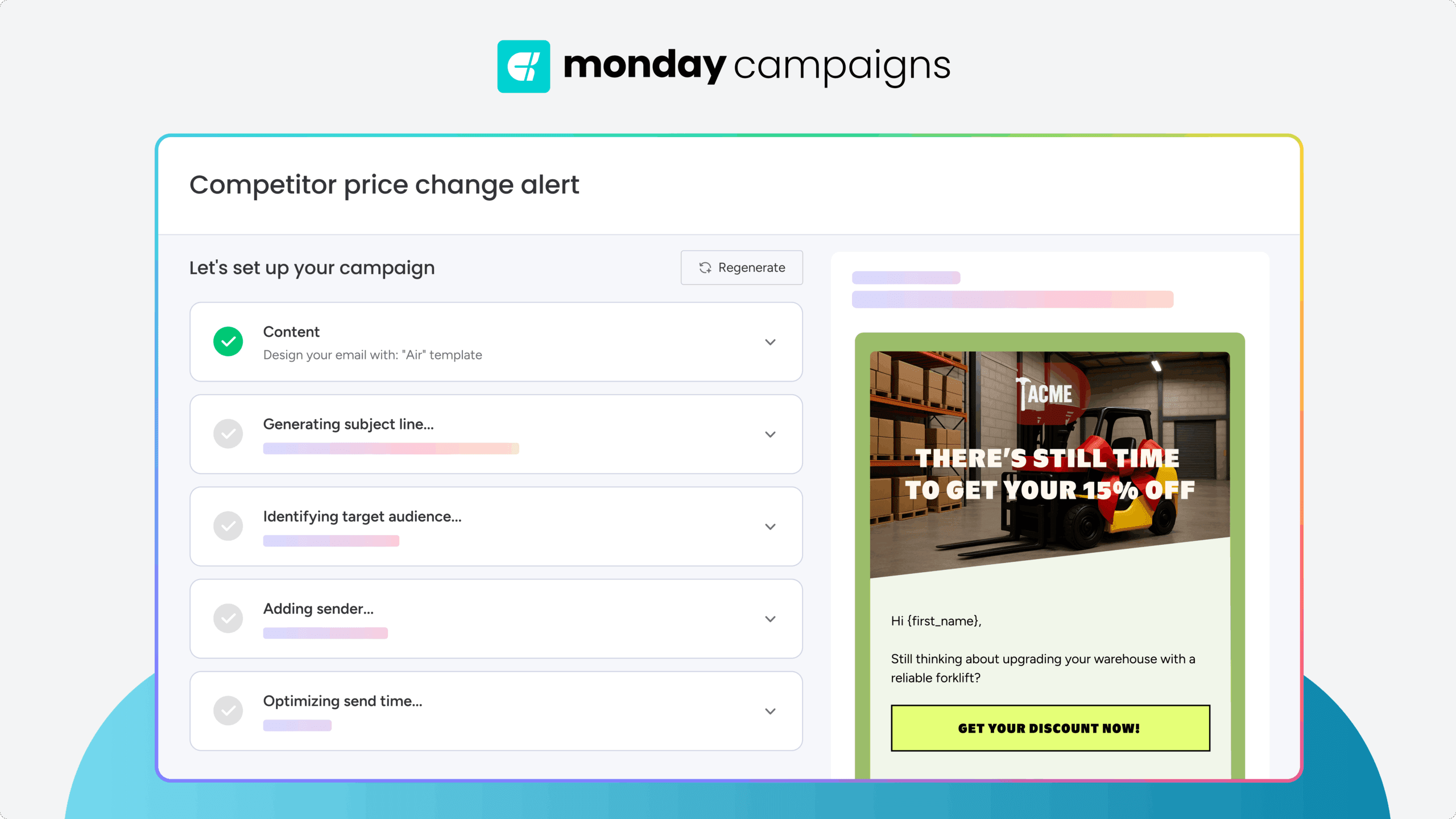
- Build: Let AI generate email copy and suggest audience segments directly from your CRM data. It draws on your brand kit automatically, ensuring your tone and style stay perfectly aligned.
- Launch: Trigger campaigns automatically based on specific CRM activity, like a deal moving stages or a lead hitting an engagement score. The platform then recommends optimal send times based on individual contact habits.
- Optimize: Feed real-time insights from sales calls and CRM activity straight into your campaign messaging. You can instantly refine your approach based on what actually resonates in the field.
Step 2: Connect natively with your CRM and work management
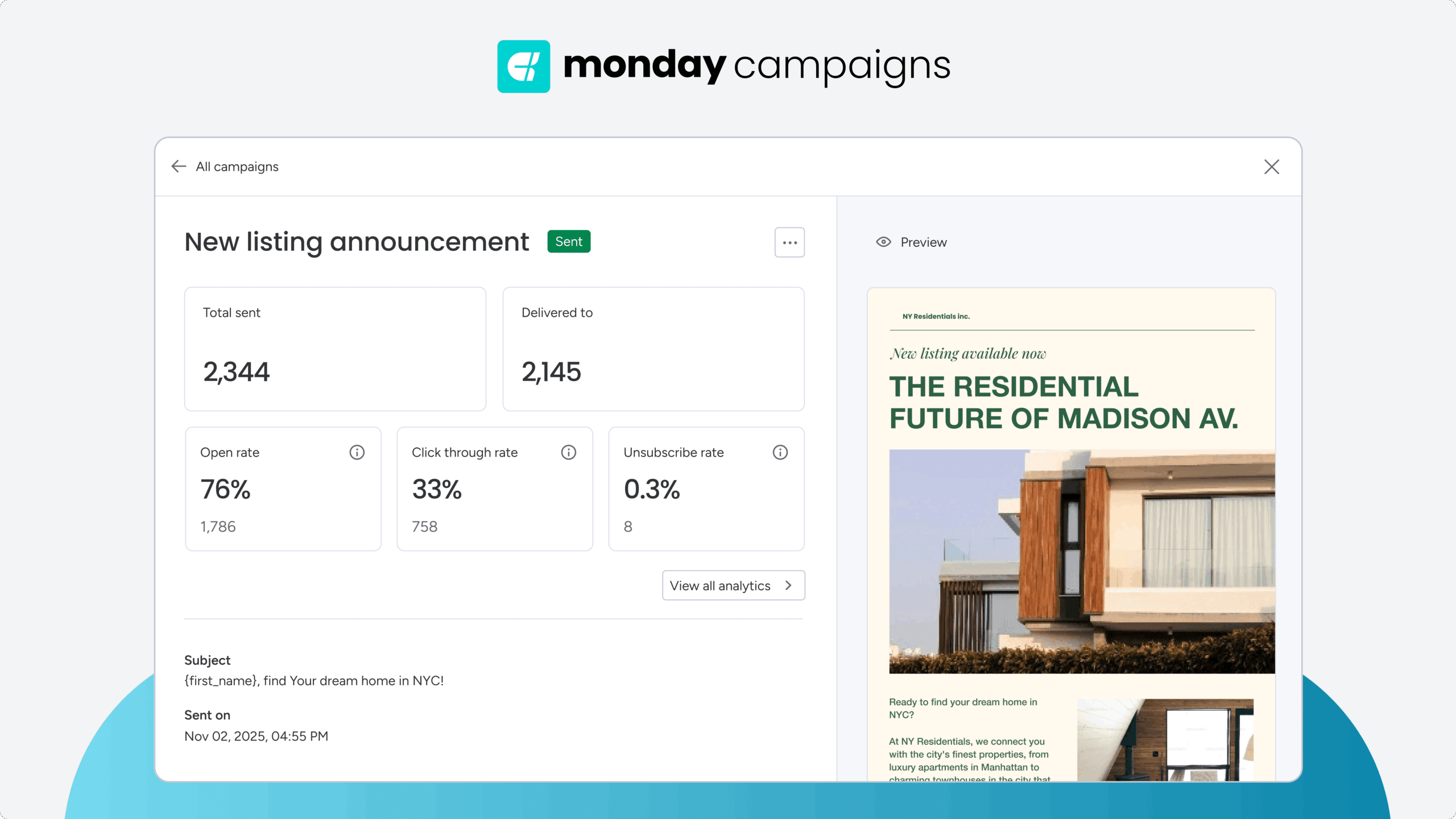
Standalone email platforms show you who opened a message, while connected platforms reveal which sends actually influenced closed-won deals. Because monday campaigns brings your performance and pipeline data into the exact same workspace, you track revenue impact instantly. Sales teams see exactly which contacts engaged and follow up with complete context.
Adding monday AI Workspace connects your creative execution directly to broader business objectives. A campaign tied to a major product launch stays completely synchronized with sales enablement and customer success timelines. Your marketing execution stays aligned with your top business priorities.
Step 3: Go from setup to send in minutes
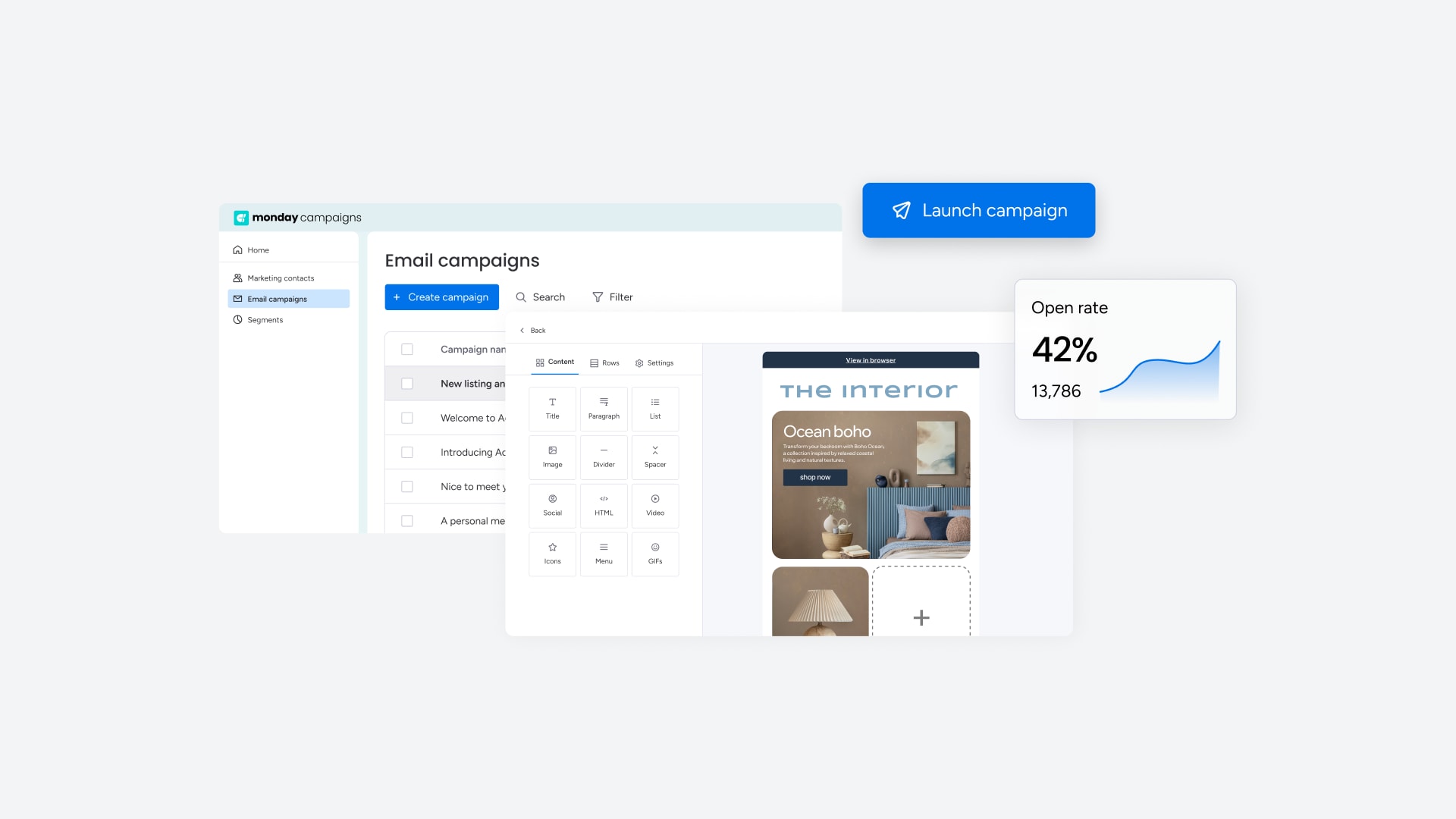
Marketers can move from idea to inbox on their own, with no technical support required. You can design an email using the intuitive drag-and-drop editor, select a dynamic CRM segment, and schedule your send in just a few clicks. Performance tracking lives right inside your campaign dashboard, giving you an immediate feedback loop on open rates and unsubscribes.
Available on Pro and Enterprise plans, monday campaigns removes the operational friction that typically slows your execution. The time between a strategic insight and a launched campaign is now measured in minutes rather than weeks.
Turn AI email campaigns into revenue drivers
Marketing teams gain confidence in which campaigns actually move the needle. By bringing your email execution and CRM data into a single workspace, you give marketing and sales complete visibility into the customer journey. Every message you send becomes a measurable step toward a closed-won deal.
Embedding AI across the entire campaign lifecycle means your team can refocus time away from manual list building and generic copywriting. High-level strategy becomes the focus while the platform handles the heavy lifting of segmentation, personalization, and send-time optimization. The result is a highly relevant inbox experience for your prospects and a clear path to revenue for your business.
The smartest move you can make is to start treating email as a connected revenue channel. Evaluate your current workflows, identify where data silos are slowing your team, and transition to a platform that connects your marketing efforts directly to your sales pipeline.
Try monday campaignsFAQs
Is there a free AI email marketing platform?
Whether there's a free AI email marketing platform depends on the provider, as several platforms offer free tiers with heavily restricted capabilities. If you want to test complete functionality, monday campaigns offers a 14-day free trial with full access to all AI-powered campaign features.
Can AI write email campaign copy that sounds on-brand?
AI can write email campaign copy that sounds on-brand as long as the platform incorporates your specific brand kit data directly into the workflow. With monday campaigns, you generate copy that automatically aligns with your tone and messaging guidelines, with manual prompts no longer required.
How does AI improve email deliverability in email campaigns?
AI improves email deliverability in email campaigns by enabling precise segmentation and send-time optimization to increase your overall subscriber engagement. These higher engagement rates signal relevance to inbox providers, which protects your domain reputation and secures optimal inbox placement.
Do AI email marketing platforms require a separate CRM?
AI email marketing platforms do not always require a separate CRM, though many standalone platforms need one to track revenue and build accurate segments. To keep your marketing and sales data completely unified, monday campaigns natively connects to your CRM, delivering a clean integration experience.
How long does it take to launch an AI-powered email campaign?
How long it takes to launch an AI-powered email campaign depends on complexity, but you can typically go from setup to send in just minutes. Using the drag-and-drop editor and AI-generated copy suggestions on monday campaigns, your team can execute targeted sends almost instantly.
What is the best AI email marketing platform for small marketing teams?
The best AI email marketing platform for small marketing teams depends on whether you need a standalone platform or CRM-connected campaign execution. For teams wanting AI-powered campaigns linked directly to their customer data with no operations specialist required, monday campaigns provides a perfectly unified workspace.

 Get started