


Your sales rep just closed a deal, but the contract, pricing notes, and account history are scattered everywhere. A client management system changes that by putting every conversation, deal, and data point in one place, giving your team the context they need to make faster decisions and hit revenue targets consistently.
This guide breaks down what client management systems actually do, who benefits most, and the features that drive real adoption. You’ll discover 15 platforms teams rely on daily and learn how to evaluate the right fit for your sales process.
What is a client management system?
A client management system is your single source of truth for every customer relationship. It centralizes contact information, communication history, deal status, and account activity in one place so your team stops hunting across emails, spreadsheets, and notebooks for critical details.
Instead of scattered data, you get complete visibility into every customer interaction. Your team makes faster, smarter decisions because the full context is right there when they need it.No more asking “what happened on that call?” or “where did we land on pricing?” — the answers live in the system. This complete view becomes especially powerful when you’re identifying cross-selling and upselling opportunities or managing strategic account relationships.
Client management software vs. CRM platforms
The terms get used interchangeably, but there’s a meaningful difference. A traditional CRM focuses on managing your sales pipeline and closing deals. A client management system takes it further, supporting the entire customer lifecycle from first contact through ongoing retention and growth.
Here’s how they compare:
| Aspect | Traditional CRM | Client Management System |
|---|---|---|
| Primary focus | Sales pipeline and deal closure | Full customer lifecycle management |
| Key users | Sales teams | Sales, support, success, and account management |
| Post-sale tracking | Limited or requires add-ons | Built-in onboarding, renewals, and support workflows |
| Handoff management | Often manual between departments | Seamless transitions with full context transfer |
| Customer view | Deal-centric | Relationship-centric across entire journey |
The best platforms bridge this gap entirely. Modern systems like monday CRM handle both sales execution and post-sale relationship management, so you don’t have to choose between closing deals and keeping customers happy.
15 best client management systems teams love using
The market is flooded with platforms that promise everything and deliver, well, more work. What separates a platform teams stick with from one that collects digital dust? Simple: The right system makes your team’s job easier, not harder.
Each of these platforms has its strengths. The goal isn’t to find the one with the most features, but the one that fits how your team works. Here’s a quick comparison table followed by a deep dive into each offering:
| Platform | Use case | Free trial | Notable feature | Starting price |
|---|---|---|---|---|
| monday CRM | Teams building a client management system with full context across deals, contacts, and activities | 14 days | Emails & Activities timeline | $12/seat/month |
| Salesforce CRM | Enterprise teams connecting sales, service, and marketing across complex organizations | 30 days | Customer 360 platform | $25/user/month |
| HubSpot CRM | End-to-end client lifecycle management through Smart CRM foundation | Free plan available | Association labels for relationship mapping | $20/user/month |
| Microsoft Dynamics 365 | Microsoft-centric enterprises needing comprehensive CRM with native Office 365 integration | 30 days | AI-powered Copilot assistance | $50/user/month |
| Pipedrive | Sales-focused teams needing visual deal tracking and activity-based workflows | 14 days | Visual pipeline management | $14/user/month |
| Zoho CRM | Mid-market teams handling the entire client lifecycle from lead capture to ongoing support | 15 days | Blueprint workflow automation | $14/user/month |
| Zendesk | Organizations prioritizing customer service operations with robust ticketing and multi-channel support | 14 days | Unified Agent Workspace | $19/agent/month |
| Clustdoc | Document-heavy client onboarding in regulated industries with compliance requirements | 7 days | KYC/KYB identity verification | $190/month |
| Airtable | Teams building flexible client databases that connect to existing CRMs | 14 days | Spreadsheet-database hybrid | $20/user/month |
| Wrike | Agencies and professional services teams needing governed external collaboration | 14 days | Guest reviews and approvals | $10/user/month |
| Capsule CRM | SMBs managing client relationships from first contact through project delivery | 14 days | Native project management | $18/user/month |
| Clio | Law firms seeking to eliminate data silos between intake, case management, and billing | 7 days | Dual secure portals | $89/user/month |
| TaxDome | Accounting professionals managing complex client relationships and sensitive financial documents | 14 days | Unlimited document storage | $700/year per seat |
| PlanStreet | Nonprofits and public agencies managing client intake, case notes, and program tracking | Contact sales | Real-time referral network | Custom pricing |
| SharpLaunch | Commercial real estate teams managing property marketing campaigns and prospect tracking | Contact sales | Secure Member Area | Custom pricing |
1. monday CRM
monday CRM delivers on the adoption promise that legacy CRMs love to make but rarely keep: a system teams actually want to use daily. You get visual pipeline management, no-code customization, and built-in AI capabilities that support the work your team already does, like logging activities, sending emails, and keeping a clean client record.
Instead of forcing a one-size-fits-all process, monday CRM gives revenue teams the freedom to match their pipeline stages, fields, and handoffs to how they sell. That’s a big deal when you’re building a client management system that sales, RevOps, and post-sales teams will actually maintain.
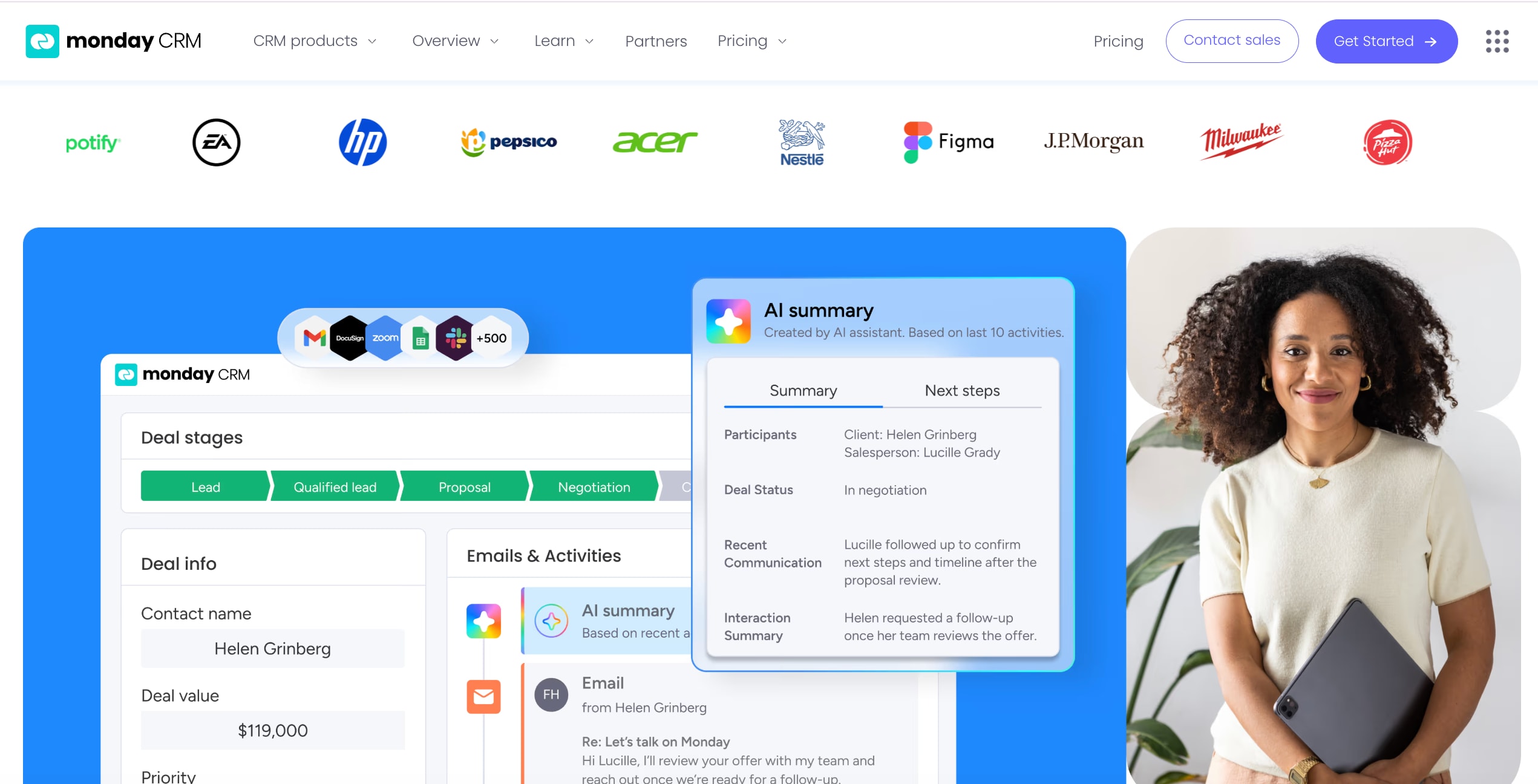
Use case: Teams building a client management system where every account has one living record, including connected deals, contacts, and a full Emails & Activities timeline
Key features
- Visual pipeline management: Use a visual pipeline to see where deals stand, and customize deal stages with drag-and-drop so your team works in their own language.
- Account and contact management (built for context): Open an account in an expanded item view to see relevant account and contact info, plus connected deals, accounts, contacts, and projects in one place.
- Emails & Activities timeline: Log and track every interaction, including emails, meetings, and notes, in one timeline so the full customer story stays attached to the record.
Pricing
- Basic: $12/seat/month (billed annually)
- Standard: $17/seat/month (billed annually)
- Pro: $28/seat/month (billed annually)
- Ultimate: Contact sales for quote-based pricing
- Plans start from 3 users minimum
- 14-day free trial available
- Nonprofit discounts available
Why it stands out
- Built for fast adoption: The visual workflow makes it easy for reps to keep data updated because it feels natural to use.
- Flexible without the technical overhead: RevOps can adjust fields, stages, and dashboards as the sales cycle evolves.
- It supports the full customer journey: monday CRM covers lead management, deal management, account management, and even post-sales tracking like onboarding, renewals, and collections.
2. Salesforce CRM
Salesforce CRM delivers enterprise-grade client management with deep customization capabilities and AI-powered insights. The platform dominates the enterprise market with its unified Customer 360 approach, connecting sales, service, and marketing data across complex organizational structures.

Use case: Enterprise teams that need to connect sales, service, and marketing across complex organizations
Key features
- Unified Customer 360 platform: Connects sales, service, marketing, and commerce data with AI-powered insights.
- Extensive customization capabilities: Supports complex business processes and industry-specific workflows.
- Large AppExchange marketplace: Offers over 9,000 partner apps and expert solutions.
Pricing
Pricing varies widely by edition and features. The following are examples of list prices.
- Free CRM: $0/month for up to 2 users with basic sales, service, and email marketing
- Enterprise: $175/user/month (billed annually)
- Unlimited: $350/user/month (billed annually)
- Agentforce 1: $550/user/month (billed annually) with expanded AI and automation features
- Additional costs for add-ons like Web Services API, Digital Engagement, Service Cloud Voice, and premium support tiers
Considerations
- Complex setup and steep learning curve require dedicated administrators and extensive training investments.
- Total cost of ownership often exceeds initial license fees due to add-ons, customization requirements, and implementation services that can overwhelm smaller teams.
3. HubSpot CRM
HubSpot CRM delivers a unified customer platform that connects marketing, sales, and service data in one place. The platform specializes in ease-of-use with embedded AI capabilities, making it ideal for growing businesses that want comprehensive client management without the technical headache.

Use case: HubSpot CRM excels at providing end-to-end client lifecycle management through its Smart CRM foundation, enabling teams to track every interaction from first contact to ongoing service relationships.
Key features
- Smart CRM with unified records: Automatically capture emails, calls, and meeting data across contacts, companies, and deals in a single timeline.
- Association labels for relationship mapping: Define and automate client relationships across contacts, companies, and deals for precise tracking.
- Built-in productivity suite: Access task queues, meeting scheduling, email templates, integrated calling, and mobile CRM functionality.
Pricing
- Free plan: Core CRM functionality with contact management and deal tracking
- Starter: $20/user/month for basic CRM features
- Professional: $50/seat/month for advanced automation and reporting
- Enterprise: $75/seat/month with custom objects and advanced customization
- Note: Prices reflect Smart CRM standalone seats. Bundled Hubs (like Sales or Service) have different pricing.
Considerations
- Advanced customization features like custom objects are restricted to Enterprise tiers, limiting flexibility for mid-market teams with complex processes.
- Support varies significantly by tier, with free and Starter plans lacking phone support, which can frustrate teams needing immediate assistance.
4. Microsoft Dynamics 365
Microsoft Dynamics 365 delivers enterprise-grade client management through deep Microsoft ecosystem integration and AI-powered insights. The platform targets organizations already invested in Microsoft 365, offering seamless connectivity with Outlook, Teams, and Azure services for unified business operations.

Use case: Microsoft-centric enterprises needing comprehensive CRM functionality with native Office 365 integration
Key features
- Deep Microsoft 365 integration: Connect seamlessly with Outlook, Teams, and SharePoint for unified workflow management across your entire tech stack.
- AI-powered Copilot assistance: Get predictive analytics and conversation intelligence across your sales processes to close deals faster.
- Omnichannel contact center capabilities: Access real-time transcription, sentiment analysis, and unified routing to deliver exceptional customer experiences.
Pricing
- Sales Professional: $65/user/month (annual billing)
- Sales Enterprise: $105/user/month (annual billing)
- Customer Service Professional: $50/user/month (annual billing)
- Customer Service Enterprise: $105/user/month (annual billing)
- Contact Center: $110/user/month with 40% promotional discount through June 2026
- Customer Insights: $1,700/tenant/month (includes 100k Unified People profiles)
Considerations
- Complex implementation requires significant technical expertise and time investment for full deployment.
- Higher total cost of ownership due to additional Azure services, voice channel fees, and capacity-based licensing limitations.
5. Pipedrive
Pipedrive delivers visual pipeline management built specifically for sales teams who need to see their deals move forward. The platform centers on activity-based selling with drag-and-drop simplicity, making it a go-to choice for small businesses that want quick wins without a complex setup.

Use case: Sales-focused teams that need visual deal tracking and want to maintain momentum through activity-based workflows
Key features
- Visual pipeline management: Track deals through every stage with an intuitive drag-and-drop interface that makes progress visible at a glance.
- Activity-based selling approach: Keep teams focused on next actions and prevent deals from stagnating with structured follow-up workflows.
- Mobile app functionality: Let field sales teams update deals, log calls, and manage leads on the go from any device.
Pricing
- Lite: $14/user/month (billed annually)
- Growth: $39/user/month (billed annually)
- Premium: $59/user/month (billed annually)
- Ultimate: $79/user/month (billed annually)
- Add-ons available for lead generation, project management, and email marketing
- 14-day free trial available, but no forever-free plan
Considerations
- Limited customization options compared to more flexible platforms restrict the ability to adapt to unique processes.
- Basic automation capabilities may not support the complex workflows that growing teams need.
6. Zoho CRM
Zoho CRM delivers comprehensive client management capabilities at transparent pricing that won’t break your budget. The platform combines sales, marketing, and support functionality with robust automation features, making it a solid choice for teams who need extensive features without the enterprise price tag.

Use case: Mid-market teams seeking a feature-rich platform that handles the entire client lifecycle from lead capture to ongoing support
Key features
- Omnichannel communication: Support email, phone, social media, and chat with real-time alerts that keep follow-ups timely.
- Process automation through Blueprint: Use the visual workflow builder to set up SLAs, validations, and guided transitions that keep deals moving.
- AI-powered insights: Get win probability predictions, churn detection, and best time to contact recommendations that help you prioritize the right actions.
Pricing
- Standard: $14/user/month (annual billing)
- Professional: $23/user/month (annual billing)
- Enterprise: $40/user/month (annual billing)
- Ultimate: Higher tier with advanced AI and customization features
- Free edition available for up to 3 users
- Annual billing saves up to 34% compared to monthly plans
Considerations
- The interface feels dated compared to newer platforms, which can impact user adoption and team enthusiasm.
- The learning curve for advanced features requires significant training investment, particularly for Blueprint workflows and CommandCenter journey orchestration.
7. Zendesk
Zendesk delivers customer service excellence through its unified ticketing system and omnichannel support platform. The platform specializes in service-first client management with AI-powered agent tools, making it ideal for support teams managing high-volume customer interactions across multiple channels.

Use case: Organizations prioritizing customer service operations with robust ticketing, knowledge base functionality, and multi-channel support capabilities
Key features
- Unified Agent Workspace: Get a customer context panel that displays interaction history, device info, and third-party profile data in one view.
- AI Copilot: Accelerate agent productivity with suggested replies, ticket summaries, and intelligent triage predictions.
- Omnichannel support: Connect with customers across email, chat, phone, and social media with optional enterprise-grade contact center capabilities.
Pricing
- Suite Team: $49/agent/month (billed annually)
- Suite Growth: $79/agent/month (billed annually)
- Suite Professional: $99/agent/month (billed annually)
- Suite Enterprise: $150/agent/month (billed annually)
- Support-only plans: Starting at $19/agent/month for email-centric teams
- Add-ons: AI Copilot ($50), Quality Assurance ($35), Workforce Management ($25), Contact Center ($50) per agent/month
Considerations
- Primarily support-focused rather than sales-oriented, with limited pipeline management capabilities for revenue teams.
- Zendesk Sell (their sales CRM) is being retired in August 2027, requiring organizations to migrate to alternative sales platforms.
8. Clustdoc
Clustdoc transforms document-heavy client onboarding into a single, automated workflow. The platform is built for compliance-focused processes in regulated industries like financial services and legal, making it a strong choice for teams drowning in KYC requirements and audit trails.

Use case: Teams managing document-heavy client onboarding in regulated industries like financial services, legal, and healthcare where compliance and audit trails are critical
Key features
- Document collection automation: Branded client portals and multi-step workflows streamline the entire intake process.
- Built-in compliance tools: KYC/KYB identity verification and comprehensive audit trails keep you regulation-ready.
- E-signature integration: Approval sequences and conditional display logic make contract execution seamless.
Pricing
- Pro: $190/month for 3 users, 1 standard process, 50 new applications/month
- Expert: Quote-based pricing for 5+ users, up to 10 processes, 150 applications/month
- Ultimate: Custom pricing for 10+ users with flexible limits and terms
- Professional services available at separate hourly/daily rates
- 7-day free trial with no credit card required
Considerations
- Limited CRM functionality beyond document management requires additional platforms for relationship management.
- Usage caps on the Pro plan (50 applications/month, limited e-signatures) may push growing teams toward higher-priced tiers quickly.
9. Airtable
Airtable transforms spreadsheets into powerful databases that teams can actually use for client management. The platform combines familiar spreadsheet interfaces with database functionality, making it accessible for teams who need flexible client tracking without the complexity of traditional CRMs. Built for organizations that want to customize their client workflows rather than adapt to rigid systems.
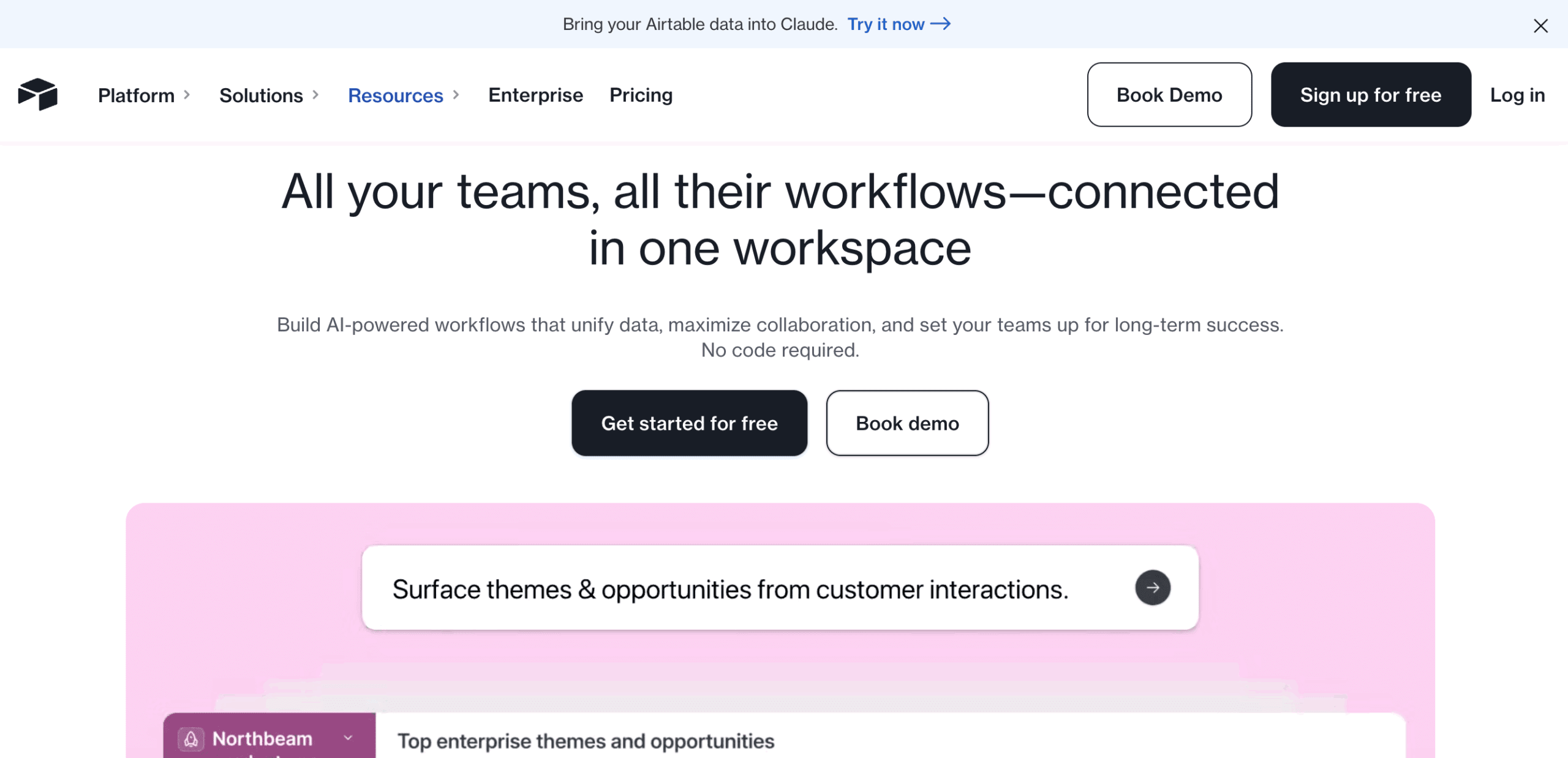
Use case: Teams building flexible client databases that connect to existing CRMs, using Airtable as a customizable layer for account planning, deal coordination, and cross-functional project tracking
Key features
- Spreadsheet-database hybrid: Multiple views (Grid, Kanban, Timeline, Calendar) give different team perspectives on the same client data.
- Custom interfaces without coding: Create role-specific dashboards and client summary layouts that match how each team member works.
- AI-powered automation: Automate client communication, meeting summaries, and next-step recommendations to keep relationships moving forward.
Pricing
- Free: $0/month with 1,000 records per base and basic features
- Team: $20/month per user (annual) with 50,000 records and enhanced collaboration
- Business: $45/month per user (annual) with 125,000 records and 2-way sync capabilities
- Enterprise Scale: Custom pricing with advanced governance and 100M+ record support
Annual billing provides discounts compared to monthly rates, and read-only collaborators don’t count toward seat limits on Team and Business plans.
Considerations
- Requires significant setup and customization to function as a dedicated client management system since it’s not purpose-built for CRM workflows.
- Advanced integrations like native Salesforce sync are limited to Enterprise tiers, potentially increasing costs for teams needing robust CRM connectivity.
10. Wrike
Wrike delivers end-to-end client service delivery workflows inside a unified work management platform. The platform specializes in enterprise-grade security and deep configurability, making it ideal for agencies and professional services firms managing complex client projects.

Use case: Agencies and professional services teams that need governed external collaboration without separate client portal software
Key features
- Dynamic request forms: Public links auto-create projects and route work to appropriate teams.
- Guest reviews and approvals: External clients provide feedback without needing platform accounts.
- Native budgeting: Real-time visibility, timesheets, and ERP integrations enable seamless billing workflows.
Pricing
- Free: $0/user/month
- Team: $10/user/month (2-15 users, billed annually)
- Business: $25/user/month (5-200 users, billed annually)
- Pinnacle and Apex: Contact sales for pricing
- Add-ons like Wrike Integrate, 2-Way Sync, and Datahub require custom pricing
Considerations
- Not a dedicated CRM or white-label client portal — relies on public forms and dashboards rather than branded client experiences.
- Advanced client-delivery capabilities and integrations are limited to higher-tier plans, with several key features requiring paid add-ons that can complicate budgeting.
11. Capsule CRM
Capsule CRM delivers straightforward client management with native project delivery built right into the platform. The Manchester-based company targets small and midsize businesses who need more than basic contact storage but don’t want enterprise complexity, making it perfect for teams managing both sales and post-sale client work.
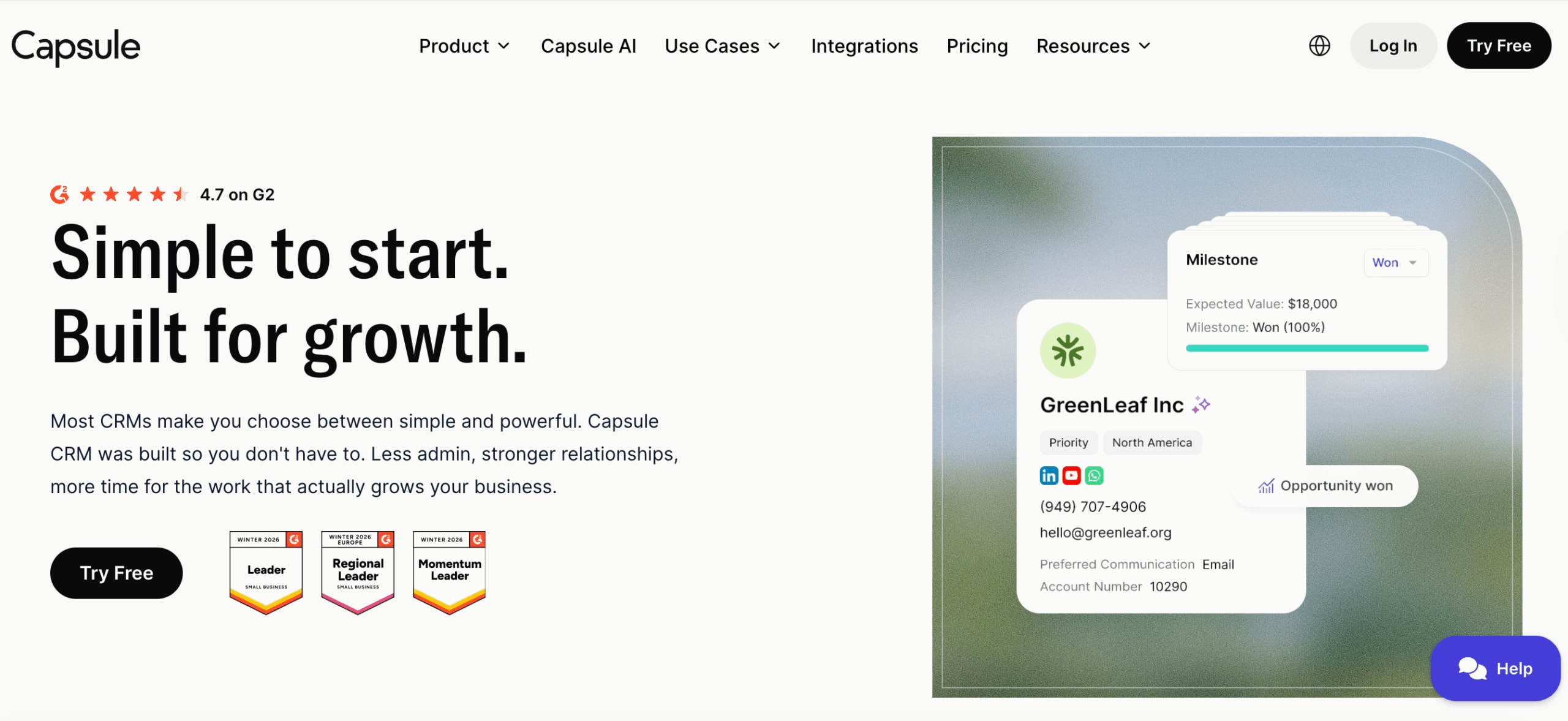
Use case: SMBs that need to manage client relationships from first contact through project delivery, all in one unified platform
Key features
- Native project management: Client delivery stays connected to contact history and deal context in one unified view.
- AI-powered email assistance: Contact enrichment and smart suggestions reduce manual data entry across your workflow.
- Drop Box email capture: Communications log automatically and trigger follow-up workflows without lifting a finger.
Pricing
- Free: $0/month for up to 2 users and 250 contacts
- Starter: $18/user/month (annual billing)
- Growth: $36/user/month (annual billing)
- Advanced: $54/user/month (annual billing)
- Ultimate: $72/user/month (annual billing)
- Up to 15% discount for annual billing
- Marketing add-on starts at $11/month
Considerations
- Advanced workflow automation capabilities are more limited compared to enterprise platforms.
- Some integrations require third-party connectors like Zapier, which can add complexity and cost.
12. Clio
Clio delivers a unified legal operating system that connects client intake to final billing in one platform. Built specifically for law firms of all sizes, it combines practice management with client portals, payments, and AI-powered features. With endorsements from 100+ bar associations including all 50 U.S. state bars, Clio has earned trust across 400,000+ legal professionals worldwide.

Use case: Law firms seeking to eliminate data silos between client intake, case management, billing, and client communication through a single, security-compliant platform
Key features
- Unified client lifecycle management: Track every client from intake through billing with conflict checking across all systems, so nothing slips through the cracks.
- Dual secure portals: Give clients and co-counsel passwordless login and mobile document scanning for seamless collaboration.
- AI-powered automation: Automate client updates, task prioritization, and billing to cut down on manual administrative work.
Pricing
All plans are priced per user, per month.
- EasyStart: $89/user/month (annual) or $99/user/month (monthly)
- Essentials: $119/user/month (annual) or $139/user/month (monthly)
- Advanced: $149/user/month (annual) or $169/user/month (monthly)
- Clio Grow (as a bundle add-on): $49/user/month (annual) or $59/user/month (monthly)
- Clio Grow (standalone add-on): $59/user/month (annual) or $69/user/month (monthly), plus a $399 one-time setup fee
- AI features and document automation: Contact sales for pricing
Considerations
- Feature restrictions on entry-level plans exclude client portal, custom fields, and texting capabilities
- Transaction fees apply to payment processing despite included Clio Payments, which can impact high-volume practices
13. TaxDome
TaxDome delivers comprehensive practice management software built specifically for tax and accounting firms. The platform combines client management, document storage, and workflow automation in one unified system, making it perfect for firms tired of juggling multiple point solutions.

Use case: Accounting professionals who need to manage complex client relationships and sensitive financial documents
Key features
- Omnichannel client communication: Connect through email, SMS, and secure portal messaging with a shared team inbox that keeps everyone in sync.
- Unlimited document storage: Organize tax-specific files, execute IRS-compliant e-signatures, and let clients exchange documents through mobile apps.
- Automated workflow pipelines: Build conditional logic, create custom organizers for data collection, and integrate with QuickBooks Online to streamline your process.
Pricing
- Essentials: $700-$800/year per seat (solo users only, varies by commitment length)
- Pro: $900-$1,000/year per seat (teams, varies by commitment length)
- Business: $1,100-$1,200/year per seat (advanced features, varies by commitment length)
- Custom quotes available for organizations with 25+ seats
- Additional costs for SMS setup (~$30.15), monthly SMS (~$11.15), and per-message charges ($0.04 US/CA)
- KBA for IRS-compliant e-signatures typically costs $1 per signer per attempt
Considerations
- Learning curve to fully leverage workflow automations and adapt existing processes into TaxDome’s pipeline structure.
- SMS functionality has limitations including no group messaging, no MMS support, and daily send caps of 6,000 messages.
14. PlanStreet
PlanStreet is case management software designed specifically for human and social services. It’s built to handle the real-world needs of nonprofits and public agencies, from client data and HMIS reporting to Medicaid billing. Forget juggling tools — this platform puts everything in one secure, configurable place.

Use case: Nonprofits and public agencies managing client intake, case notes, and program tracking across multiple services and funding sources
Key features
- Real-time referral network: Track referrals across agencies and send secure messages that keep everyone aligned without the back-and-forth.
- Built-in compliance reporting: Generate HMIS reports (APR, CAPER, CoC CSV) and process Medicaid/Medicare billing directly in the platform.
- Custom form builder: Design intake forms with conditional logic, e-signatures, and offline access using a flexible JSON-based builder.
Pricing
- Custom pricing: Plans are quote-based and tailored to your organization.
- Implementation and configuration services are available if you need extra help getting started.
- Every plan comes with 24/7 support, HIPAA compliance, and all future updates.
Considerations
- You’ll have to talk to sales for pricing — no public rates are listed.
- It’s built exclusively for human services, so it won’t be a fit for teams in other sectors.
15. SharpLaunch
SharpLaunch delivers a marketing-first client management system built specifically for commercial real estate professionals. The platform combines property websites, lead capture, and secure document workflows in one place, making it perfect for brokerages and asset managers who need to track prospects through complex CRE deals.

Use case: Commercial real estate teams managing property marketing campaigns, prospect tracking, and secure document sharing through the entire deal lifecycle
Key features
- Marketing-led lead management: Capture prospects with structured fields for broker roles, titles, and firm segmentation that keep your pipeline organized.
- Secure Member Area: Gate document access behind confidentiality agreements and track exactly who’s viewing what.
- Activity tracking: Log every client interaction from initial sign-ups to file views and email engagement in one timeline.
Pricing
- Custom pricing based on portfolio size and requirements
- Quote-based sales process — contact for demo and pricing details
- Preferred terms available through network partnerships like TCN Worldwide
Considerations
- Limited full-pipeline CRM functionality compared to dedicated sales platforms, requiring integrations for advanced deal management.
- Smaller review footprint and evolving feature set may require careful evaluation of specific workflow requirements before enterprise rollout.
7 key benefits your team will actually feel
These aren’t theoretical advantages. They’re practical, daily improvements that fix how work gets done. Teams with the right system see immediate changes: stronger customer relationships, better efficiency, and more revenue.
- Get the full customer story in one place. Stop hunting across inboxes and spreadsheets. When every interaction lives in one spot, your team gets instant context before they even say “hello.”
- Automate follow-ups so nothing gets missed. Set up workflows to follow up when a proposal sits unopened. Your reps focus on selling, not remembering who to nudge and when.
- See your pipeline’s health in real time. A visual pipeline gives you an instant look at your revenue health. Spot bottlenecks before they derail your quarter and forecast based on data, not optimism.
- Make cross-department handoffs seamless. A unified system ensures all context—promises, goals, and concerns—transfers with the customer. Everyone works from the same playbook.
- Let your field sales team sell from anywhere. Mobile access puts the full power of your CRM in your team’s pocket. Reps update deal status the moment they walk out of a meeting.
- Forecast revenue with data, not guesswork. Track deal progression, conversion rates, and sales cycle length to build revenue predictions you can actually stand behind.
- Use scalable processes that grow with you. A flexible system adapts to your needs without requiring a team of developers, ensuring your CRM is a competitive advantage, not a constraint.
9 must-have features for high adoption rates
User adoption is what separates a great CRM from an expensive digital paperweight. If your team is finding creative ways to avoid the system, it’s not them — it’s the tool. The right features make daily work easier, not harder, and get everyone on board without a fight.
1. Drag-and-drop pipeline customization
Your sales process is unique. Your CRM pipeline should be too. A rigid, one-size-fits-all setup forces your team to work around the system, killing adoption from day one. Let your team build the pipeline stages that matches how they actually sell. Dragging, dropping, and renaming stages to reflect their real-world workflow makes the tool feel like an extension of their strategy, not a roadblock.
2. No-code automation workflows
Want to see a good idea die? Tell your sales ops lead they need to file a ticket with IT and wait 2 weeks. Automation is pointless if the people who need it can’t build it themselves. Visual, no-code builders let your revenue team create workflows that trigger emails, update deals, and assign tasks automatically. Fix what’s broken and test new ideas in minutes, not months.
3. Native email integration and tracking
Toggling between your inbox and your CRM is a massive time-waster. It guarantees that deal information will get lost and your customer records will be incomplete. Bringing email directly into your CRM solves this instantly. Teams send, receive, and track correspondence right from the customer record. All the context, none of the copy-pasting.
4. Flexible custom fields without IT help
Your business doesn’t stand still, so why should your CRM’s data fields be set in stone? Growth means tracking new information — from industry specifics to competitive intel. Give your team the power to add the fields they need, when they need them. This small freedom keeps the CRM relevant and stops your team from reverting to rogue spreadsheets.
5. Real-time analytics dashboards
If your team has to export data to a spreadsheet to figure out what’s going on, your dashboards have failed. People need instant answers, not another project. Sales analytics dashboards should give every role the exact view they need, in real time. Sales reps see their pipeline, leaders see the forecast, and everyone knows where things stand without digging for data.
6. Full mobile app functionality
A mobile app that’s “view-only” is just a tease. Field sales reps and traveling managers need to do real work from their phones: create deals, log calls, and move things forward. Anything less just creates a to-do list for when they’re back at their desk. A full-featured mobile app means work happens now, not later.
7. Built-in team collaboration features
Deal conversations belong with the deal, not lost in a sea of emails or chat threads. Hunting for context across 3 different apps stalls momentum and causes missed details. Collaboration features inside the CRM keep everyone on the same page. Tag a teammate for legal review or share an update right on the deal card, and the entire history stays in one place.
8. Open API for easy integrations
Your CRM shouldn’t be a data island. It needs to connect to the other tools you rely on, from marketing automation to finance software. Without easy CRM integrations, you’re just creating more manual work. An open API makes your CRM the central digital workspace for all customer data. Information flows automatically between systems, giving you a complete picture of the customer without the busywork.
9. AI-powered intelligence that works for you
Manual data entry and guesswork don’t scale. AI features should do the heavy lifting — drafting emails based on deal context, scoring leads to surface real opportunities, and auto-populating fields from conversations. The best systems learn from your wins and losses, getting smarter with every closed deal. This isn’t about replacing your team; it’s about giving them superpowers to focus on relationships instead of admin work.
Features only matter if they actually get used. Prioritize the capabilities that remove friction and keep your team moving forward.
Choosing your client management platform wisely
The wrong CRM is more than a wasted budget. It’s a momentum-killer that ties your team in knots when they should be closing deals. Smart leaders look past the flashy demos and ask the hard questions before they sign.
Step 1: Match platform complexity to team size
Don’t buy a CRM built for a 500-person company if you have a team of 5. They don’t need enterprise governance; they need to get to work, now. The wrong fit creates expensive problems.
A mismatch works both ways. Small teams get buried in features they never use and give up, while large teams hit a wall and build messy workarounds. Think about where you’ll be in 2 years, because picking a platform that can’t scale is just scheduling a future headache.
Step 2: Calculate total ownership costs upfront
That monthly license fee is just the start. The real cost of a CRM hides in pricey consultants, endless training, and dedicated admins needed just to keep the lights on. Before you buy, map out the total cost over 3 years to see the real number.
A platform’s true price includes:
- Implementation: Does it take your team a few days, or an army of consultants billing $200 an hour?
- Training: Is it intuitive, or will you lose weeks of selling time to boring onboarding sessions?
- Maintenance: Can your team manage it, or do you need a full-time admin to handle updates and fixes?
Step 3: Verify integration compatibility before committing
A CRM that doesn’t talk to your other tools isn’t a central hub. It’s just another data silo. A disconnected platform creates the exact manual work you’re trying to eliminate.
Your marketing automation, accounting software, and support platforms must connect without dropped data or clunky workarounds. Broken integrations mean stalled workflows. Make sure everything plays nice before you commit.
Step 4: Plan for realistic implementation timelines
Forget the “instant deployment” promises. A proper CRM rollout takes time, and cutting corners here will cost you dearly later. Plan for a few months from start to finish.
You need time for data cleanup, workflow customization, and phased training. Rushing this part is a recipe for duplicate records and frustrated reps. Full adoption happens when your team has room to transition, find the edge cases, and make the platform their own.
Taking the time to evaluate these factors ensures you choose a platform that drives growth instead of creating roadblocks. A smart choice today prevents expensive migrations tomorrow.
Why monday CRM delivers on the adoption promise
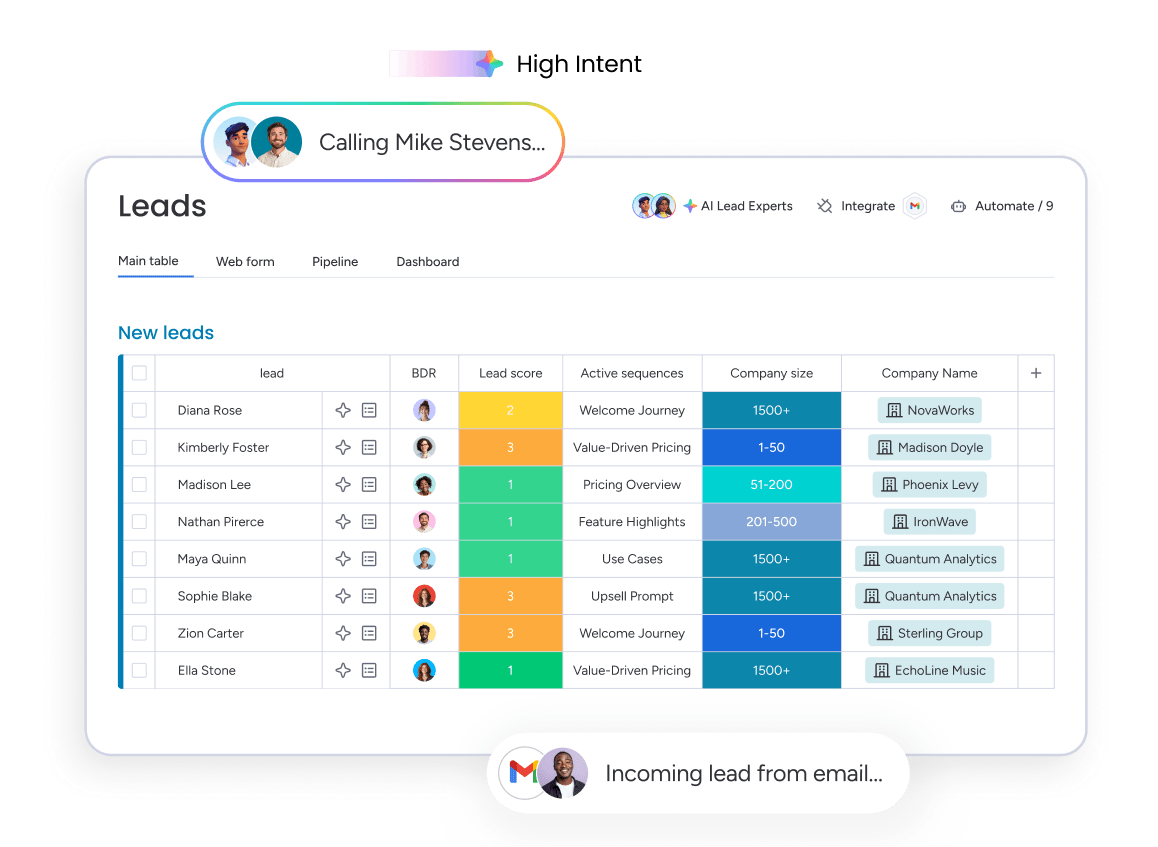
Most CRMs fail for one simple reason: Teams won’t use them. You’ve seen it. The expensive platform collects dust while your reps stick to spreadsheets and sticky notes. We get it. Revenue teams find success using monday CRM because it’s built for how people actually work, not how software thinks they should.
Intuitive interface teams master in days
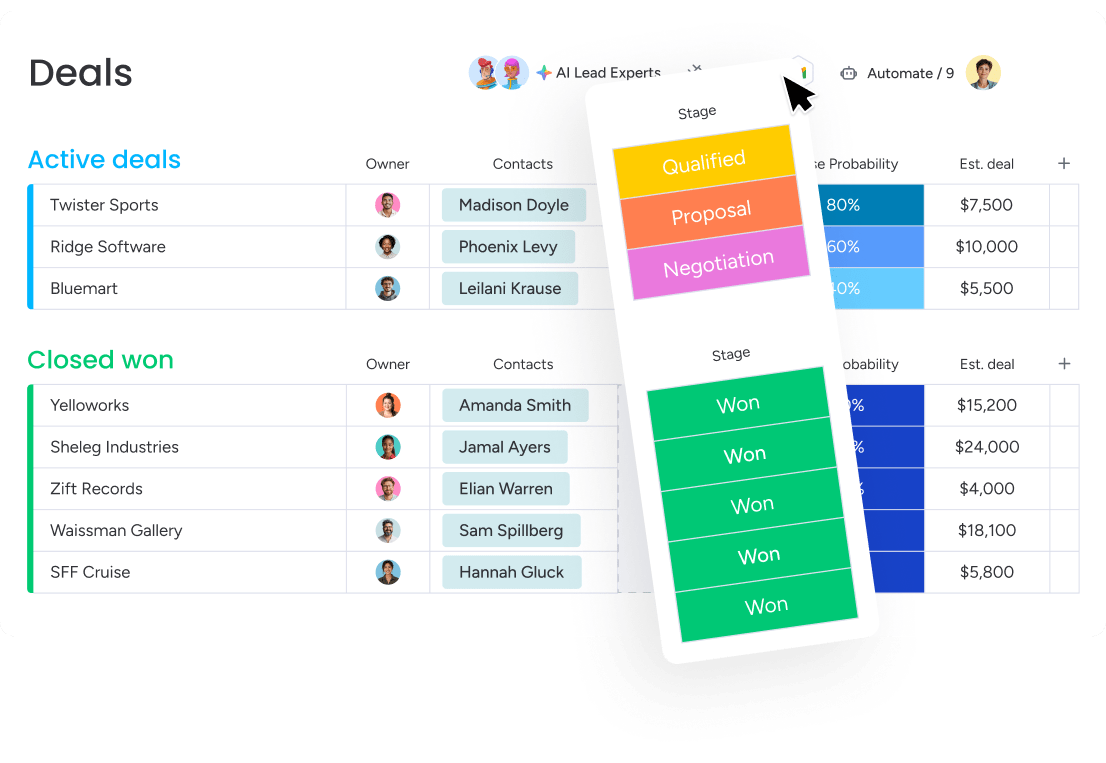
Our visual, drag-and-drop interface feels familiar from day one. Teams see the grid and just get it, moving deals between stages without needing a training manual. Sales, simplified.
Update information right where you see it with inline editing; no more clicking through endless forms. A tiny tweak that saves your team hours and keeps your data fresh. This intuitive design means new users are productive in days, not weeks.
AI-powered features that save real time
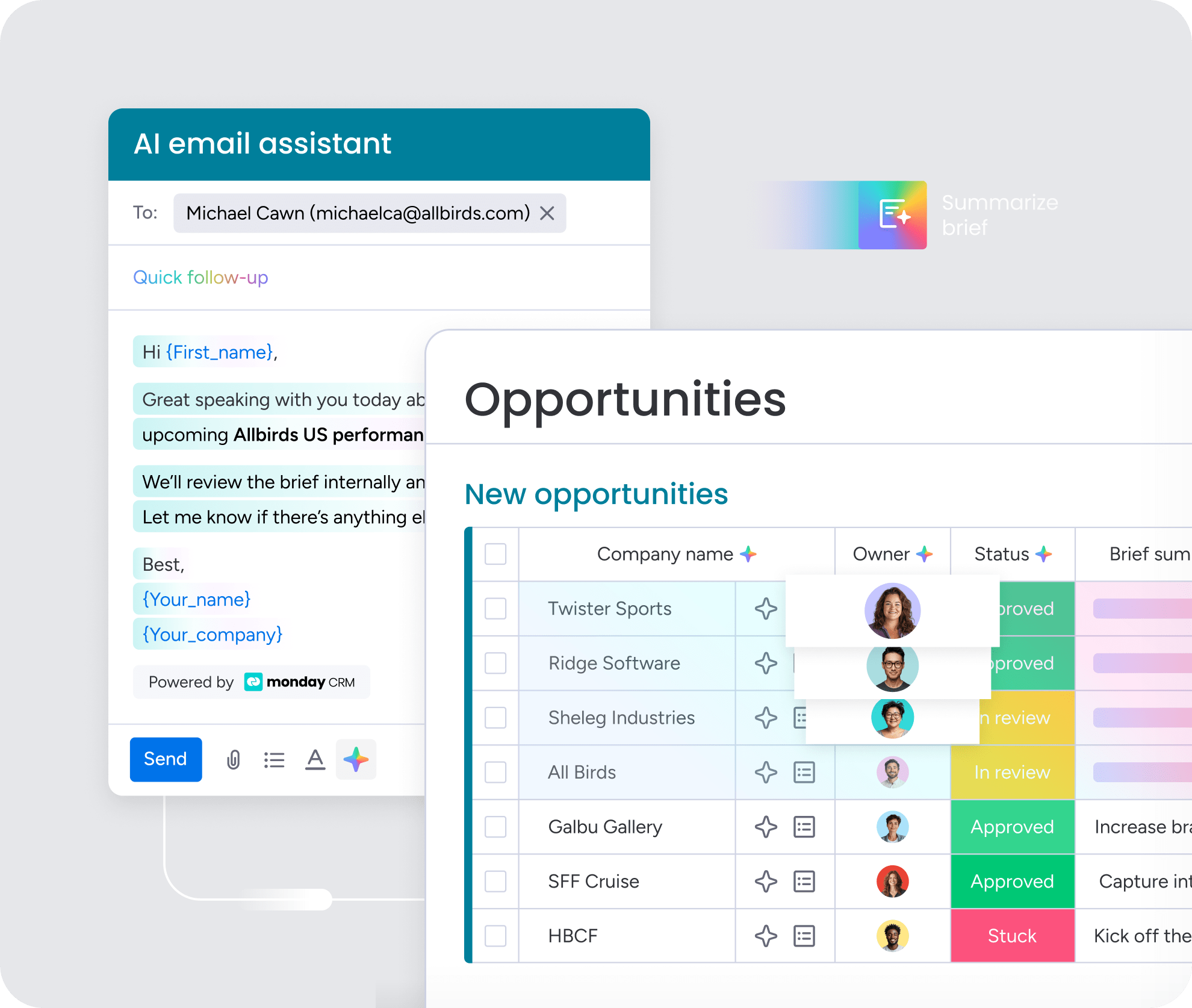
What if your reps could prep for a client call in seconds, not minutes? Our AI summarizes every email, note, and interaction into a clean timeline. No more digging through history, just instant context.
Stop agonizing over the perfect follow-up email. The AI assistant drafts professional, context-aware messages based on your customer’s history. Your team just reviews and hits send, turning a 20-minute task into a 2-minute one.
No-code flexibility that adapts to your process
Your sales process is unique. Why should your CRM force you into a box? Our no-code platform lets you build the exact workflow you need with simple drag-and-drop tools. Your process, your rules.
Track what actually matters to your business. Create custom fields for any data point, from industry specifics to competitive intel. Finally, you can report on the metrics that drive your growth, not just the ones your CRM allows.
Building a predictable revenue engine with the right CRM
The right client management system gives you complete visibility into every customer relationship, eliminates scattered data, and keeps your team focused on what actually drives revenue. When you centralize communication, automate follow-ups, and build workflows that match how your team sells, you stop losing deals to disorganization and start closing with confidence.
monday CRM delivers the adoption promise other platforms break: Teams actually use it daily because it’s visual, flexible, and built for how people work. See how fast your revenue engine runs when your CRM removes friction instead of creating it.
Try monday CRMFAQs
What is the difference between client management software and CRM?
The difference between client management software and a CRM is that client management software typically covers the entire relationship post-sale, while a traditional CRM focuses primarily on managing the sales pipeline. Revenue teams find success using monday CRM to handle both in one place, so you don't have to choose.
How much time does implementing a client management system really take?
A full rollout typically takes 2-3 months, but your team can be up and running with core features in just a few days. The exact timeline depends on your team's size and the complexity of your data.
Can simple client management software handle complex sales processes?
Yes, simple client management software can handle complex sales processes if it uses flexible, no-code tools. You can manage multi-stage approvals and custom reporting without writing any code.
What's the actual cost of client tracking software for a 10-person team?
Expect around $1,500–$3,000 annually for a mid-tier platform. The real question is ROI, as most teams recover their investment within a few months from efficiency gains alone.
Which client management tools work best for remote teams?
Cloud-based platforms that sync instantly across every device work best for remote teams. Everyone has access to the same real-time information, no matter where they're working from.
How do client management platforms ensure data security?
Client management platforms ensure data security with data encryption, strict access controls, and compliance with standards like SOC 2 and GDPR. Always verify a platform's security certifications before you commit.
