


Sales reps lose a large chunk of their time to admin work when they could be busy closing deals. AI for revenue operations eliminates this friction automatically, freeing your team to focus on the conversations and decisions that actually drive revenue.
This guide shows you exactly what AI does at each stage of the revenue cycle, which workflows to automate first for maximum impact, how AI agents execute multi-step processes autonomously, and how to implement it all without heavy IT work. You’ll see practical examples and get a clear path forward, whether you’re solving one bottleneck or building a fully connected revenue operation.
Key takeaways
- AI revenue operations automation removes data entry, lead routing, and CRM updates that drain sales rep productivity, freeing teams to focus on closing deals.
- RevOps leaders should automate high-friction workflows first by targeting the biggest bottlenecks: lead capture to sales, deal close to customer success, and renewal tracking to finance.
- AI agents handle multi-step revenue workflows independently, scoring leads, flagging at-risk deals, and coordinating team handoffs without constant human oversight.
- Mid-market teams can implement AI for revenue operations without extensive technical work by starting with a single workflow like lead routing or call summaries and expanding from there.
- AI-powered platforms like monday CRM provide real-time alerts that tell RevOps leaders which deals are slipping, why forecasts are off, and what specific actions to take.
What is AI for revenue operations?
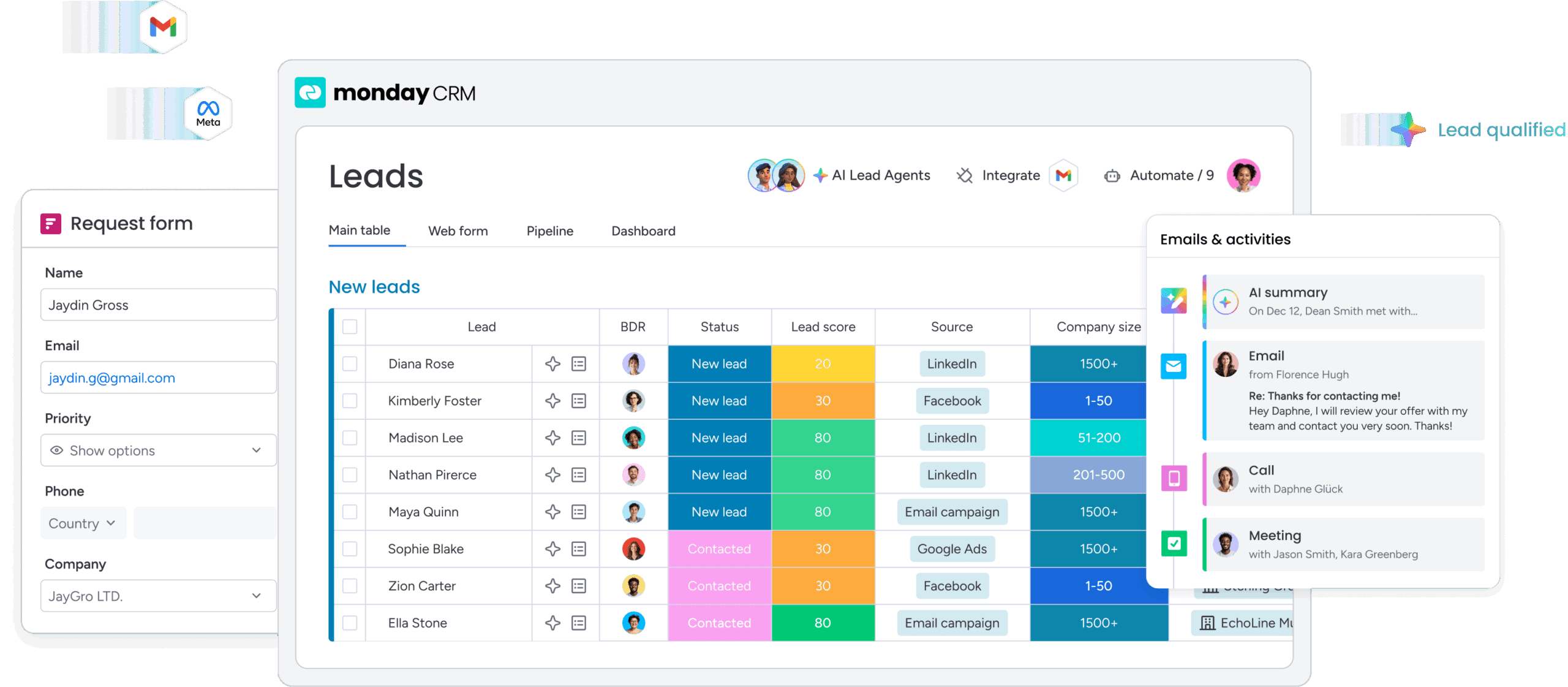
AI for revenue operations automates the entire revenue cycle — from lead capture to renewal — using machine learning and predictive analytics. Instead of following rigid rules, AI adapts to changing patterns, predicts outcomes, and executes workflows automatically.
RevOps teams need predictable results while coordinating marketing, sales, and customer success. Manual work like lead routing, CRM updates, and forecast building wastes time that should go toward strategy. AI handles the repetitive tasks, surfaces real-time insights, and keeps revenue data accurate.
AI for revenue operations delivers 3 core capabilities: AI revenue operations automation, RevOps AI, and AI revenue intelligence. Let’s look at each in greater depth.
1. AI revenue operations automation
AI revenue operations automation executes revenue workflows without manual work. Traditional automation follows fixed “if/then” rules. AI automation adapts based on data patterns, learns from outcomes, and handles complex, multi-step processes that simple triggers can’t manage.
Take lead routing as an example. Traditional automation might route all leads from a specific form to a single sales rep. AI automation evaluates each lead’s fit score, intent signals, and the rep’s current capacity and win rate for that industry, then routes accordingly. The difference is intelligence, not just following rules.
Here’s where AI revenue automation makes a difference:
- Lead routing: AI scores inbound leads by firmographic fit and behavioral intent, then assigns them to the rep with the best win rate for that segment while factoring in territory rules and current workload.
- Deal progression: AI detects when deals stall and triggers follow-up tasks, alerts sales managers, or enrolls prospects in re-engagement sequences.
- Renewal management: AI identifies at-risk accounts based on declining product usage and unresolved support tickets, then prompts CS teams to intervene before renewal dates.
2. RevOps AI
RevOps AI refers to AI platforms built for revenue operations teams to unify data, automate workflows, and give marketing, sales, and customer success visibility into the same information. RevOps AI is different because it connects the entire revenue cycle in one system, not just sales or marketing.
Sales AI optimizes outreach sequences. Marketing AI personalizes campaigns. RevOps AI connects marketing lead capture, sales deal progression, and customer success renewal tracking so nothing gets dropped and everyone works from the same data.
RevOps AI platforms do the following:
- Unified data layer: All revenue data lives in one place, accessible across teams.
- Cross-team workflows: AI orchestrates handoffs automatically, with no manual coordination required.
- Real-time visibility: Dashboards and alerts surface pipeline health instantly, so nothing slips through unnoticed.
3. AI revenue intelligence
AI revenue intelligence uses AI-powered analytics to surface insights from revenue data so RevOps leaders can decide faster. Instead of waiting for end-of-quarter reviews, AI analyzes activity data in real time to predict outcomes, flag risks, and recommend actions.
AI revenue intelligence tells you which deals are at risk right now and why, not just that your win rate dropped last month. Here’s what that looks like in practice:
- Risk identification: The platform flags deals likely to slip based on low engagement, missing stakeholders, or stalled activity, then alerts sales managers with specific recommendations.
- Dynamic forecasting: AI compares historical win/loss patterns to current pipeline data, adjusting forecasts as deals progress.
- Revenue trend analysis: Surfaces patterns that inform strategy — for example, that deals from healthcare close faster, or that enterprise accounts with technical champions convert at stronger rates.
How AI automates revenue cycle management end-to-end
AI automates the entire revenue cycle from first touch to renewal. Each stage has repetitive workflows that waste time and cause errors when done manually. Knowing where AI fits at each stage helps RevOps leaders decide where to start and what to expect.
Marketing campaign execution and lead capture
AI automates marketing campaign execution and lead capture by launching campaigns, personalizing messaging for different audience segments, and capturing leads from forms, emails, and web activity. Then it routes leads to the right team instantly.
Here’s what happens:
- Campaign personalization: Tailor email content, subject lines, and send times based on recipient behavior and engagement history.
- Lead capture: Extract data from form submissions, enrich it with firmographic details, and log it in the CRM automatically.
- Lead routing: Assign inbound leads to the right sales rep based on territory rules, current capacity, and fit score — within seconds of form submission.
Lead scoring and qualification to prioritize the right prospects
AI automates lead scoring and qualification by analyzing firmographic data, behavioral signals, and engagement patterns, then assigns scores that predict conversion likelihood.
| Scoring type | Data sources | Output | Action triggered |
|---|---|---|---|
| Fit scoring | Company size, industry, tech stack, funding stage | ICP match score (1–100) | Route to sales if >70, nurture if <70 |
| Intent scoring | Page visits, content downloads, email engagement | Buying intent score (low/medium/high) | High intent triggers immediate rep notification |
| Engagement scoring | Email opens, meeting attendance, response time | Engagement level (cold/warm/hot) | Hot leads prioritized in rep queue |
| Disqualification | Industry, company size, budget indicators | Qualified/Disqualified flag | Disqualified leads routed to nurture sequence |
Sales outreach and follow-ups so no deal goes quiet
Outreach sales automation drafts personalized emails, schedules follow-up workflows, and sends reminders when deals go quiet. The administrative work that used to consume hours of a rep’s day now happens automatically.
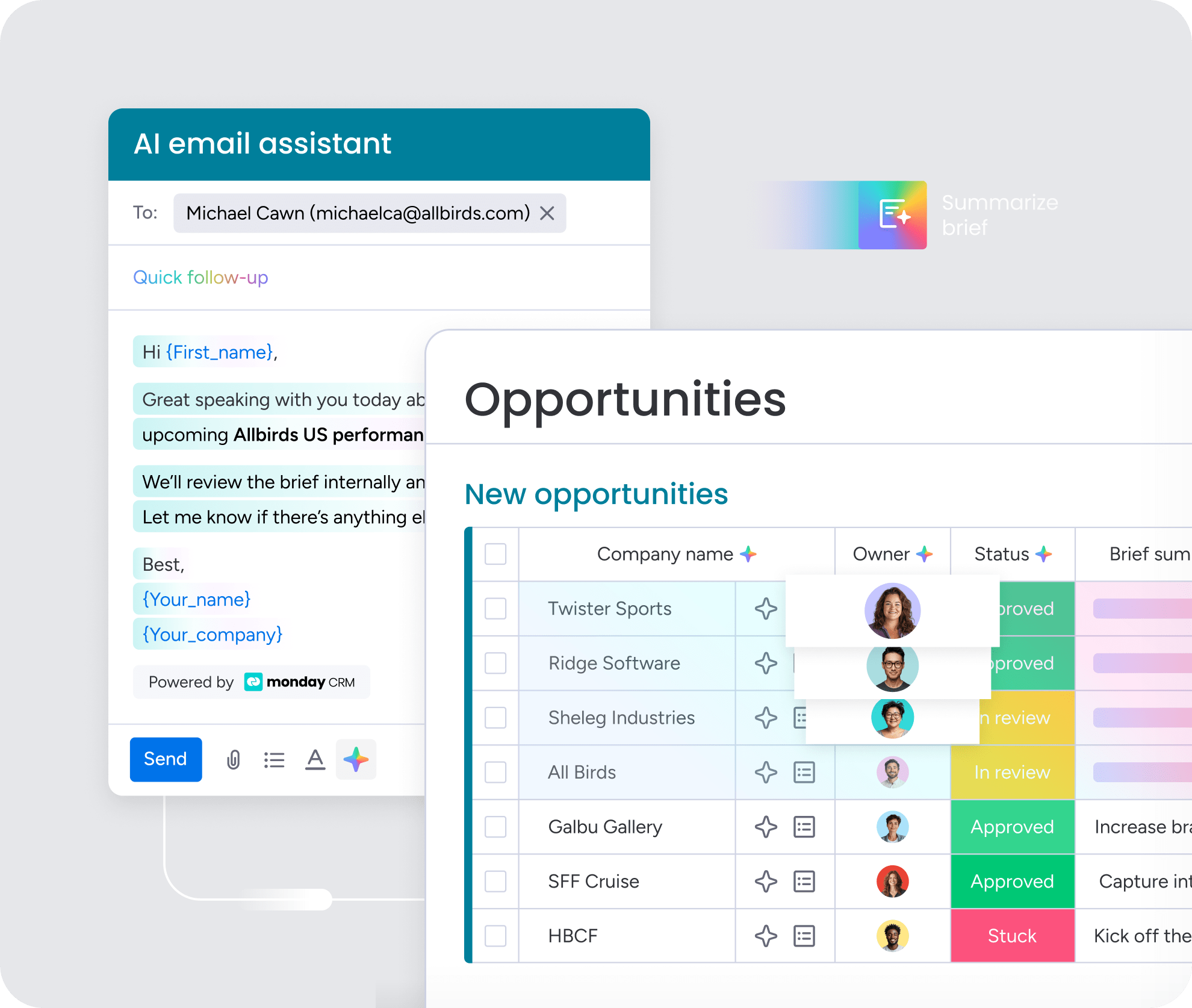
Revenue teams using monday CRM can compose emails faster with AI-generated drafts in Emails & Activities, then track individual and mass emails including open rates and link clicks. When deals go quiet, an AI sales assistant drafts check-in emails automatically, adjusting tone and messaging based on engagement history.
Pipeline management to catch deal risks
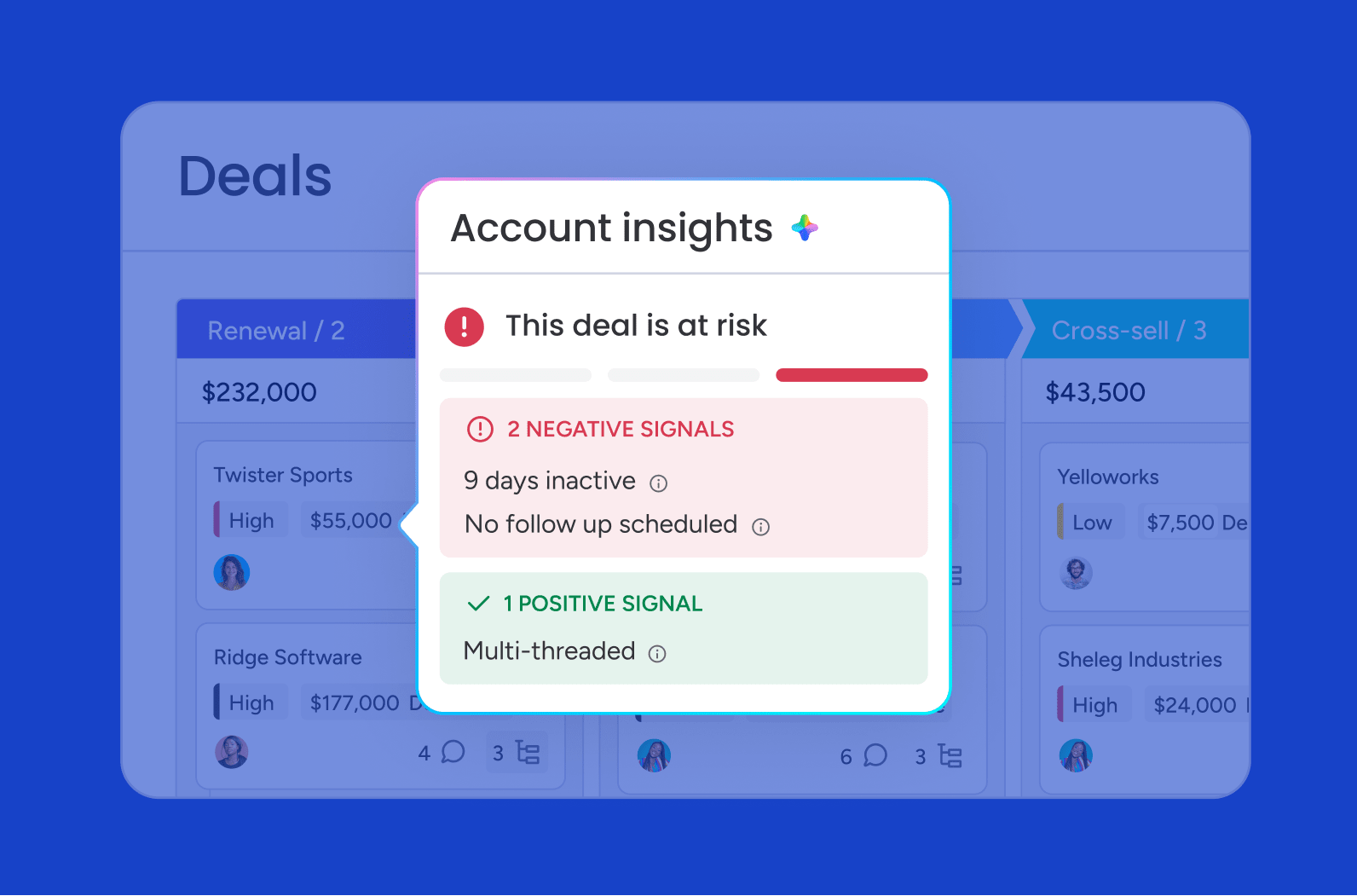
AI sales pipeline management tracks deal activity, updates deal stages automatically, and flags risks so sales managers can intervene early. These things make this work:
- Deal stage updates: Move deals to the next stage when key milestones are met, without requiring reps to manually update the CRM.
- Risk detection: Identify deals likely to slip based on low engagement or missing decision-makers.
- Next-step recommendations: Suggest the next action for each deal based on historical win patterns.
Teams leveraging monday CRM gain real-time forecast visibility and drill-downs by month, rep, or custom criteria. The platform tracks forecast versus actual sales, providing predictability with accurate projections that update as deals move through the pipeline.
Try monday CRMCustomer success and renewal workflows to reduce churn
AI automates customer success and renewal workflows by monitoring account health, spotting at-risk customers, and triggering outreach to prevent churn. The workflows that do the work include:
- Churn prediction: Flag accounts with declining usage or unresolved support tickets, prompting CS teams to intervene before renewal.
- Renewal reminders: Send automated notifications to customers 60, 30, and 15 days before contract expiration with personalized messaging.
- Upsell identification: Detect accounts using features near their plan limits and recommends opportunities to the CS team.
What AI agents mean for RevOps teams
Agentic AI in sales uses autonomous systems to execute multi-step workflows on behalf of RevOps teams without manual intervention. Unlike simple automation that follows fixed rules, AI agents adapt as data changes and learn from what works.
AI agents help RevOps teams by cutting the manual coordination work that slows down revenue. Manually routing leads, chasing deal updates, tracking renewals, and coordinating handoffs between teams consumes hours that could go toward strategy and analysis.
Lead scoring and routing
An AI agent evaluates inbound leads by analyzing firmographic fit, behavioral signals, and engagement history. The agent assigns scores and routes high-priority leads to the right sales rep instantly with no queue and no delay.
Teams using monday CRM can leverage the AI “Assign person” action to define teammates’ roles and skills so the system routes work more intelligently. An AI agent detects a high-intent lead and assigns it to the rep with the best win rate for that industry within seconds of form submission.
Meeting summaries and follow-ups

An AI agent listens to sales calls, pulls out key takeaways like customer pain points and objections, and logs them in the CRM automatically. The agent also creates follow-up workflows and sends recap emails to prospects without manual work after the call ends.
The AI Timeline Summary on monday CRM creates a short summary of all communication events such as emails, calls, meetings, and notes. This helps sales and support teams save valuable time by gaining a complete understanding of their team’s history with a client without manual note-taking.
Pipeline risk and next steps
An AI agent monitors deal activity, flags deals that are stalling or at risk, and suggests actions to keep them moving. Sales managers get alerts before problems show up in weekly pipeline reviews.
The agent tracks engagement patterns, spots missing stakeholders, and recommends specific interventions based on what’s worked before.
Revenue reporting and team handoffs
AI sales report automation generates weekly or monthly revenue reports and sends them to stakeholders automatically. The agent coordinates handoffs between marketing, sales, and customer success by:
- Detecting when a handoff is needed
- Creating workflows and assigning owners
- Notifying the next team automatically
- Creating a customer success onboarding workflow the moment a deal closes
8 revenue operations workflows to automate with AI
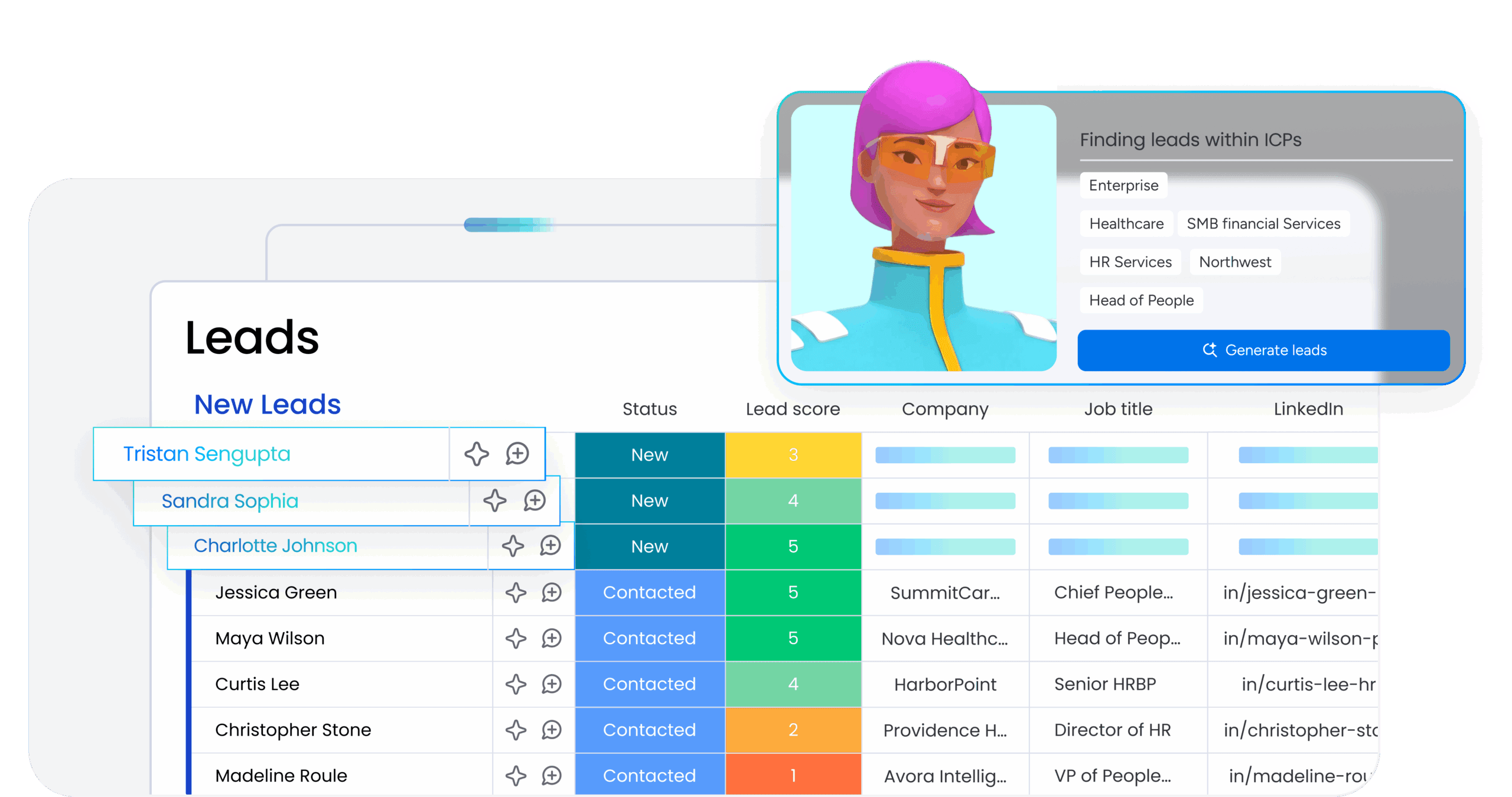
RevOps teams manage dozens of workflows across marketing, sales, and customer success. Generative AI for sales growth automates the most time-consuming, repetitive tasks so RevOps professionals can focus on strategy, analysis, and aligning teams.
- Capture and route leads faster from forms, emails, and chat. It enriches data with firmographic details, scores it for fit and intent, and routes it to the right rep instantly. High-priority leads land with a rep within seconds, cutting response time from hours to minutes.
- Score and prioritize sales opportunities by analyzing firmographic data, behavioral signals, and engagement patterns, then assigns scores that predict conversion likelihood. Reps focus on opportunities most likely to close, which improves win rates and cuts wasted effort on poor-fit prospects.
- Draft personalized outreach and follow-ups based on lead data and recent activity. When deals go quiet, AI drafts check-in emails automatically. It adjusts messaging based on industry, role, and previous interactions to stay relevant.
- Summarize calls and update CRM records automatically. AI listens to sales calls, transcribes them in real time, pulls out key takeaways, and updates the CRM on its own. monday CRM’s Autofill with AI can auto-populate Text, Date, Number, Dropdown, People, and Status columns, eliminating manual data entry after every customer interaction.
- Spot pipeline movement and deal signals early and, when deals haven’t moved in 2 weeks or when key stakeholders haven’t engaged, alert sales. AI also spots positive signals like increased email engagement and recommends next steps.
- Create forecasts and dashboard reports without manual compilation that update in real time. Customizable dashboards on monday CRM provide immediate insights into sales pipeline status, forecasting, team performance, and activity status — without manual report compilation.
- Coordinate handoffs across revenue teams, so when marketing qualifies a lead, AI routes it to sales. When a deal closes, AI creates a customer success onboarding workflow. This coordination keeps leads and customers fully engaged during transitions.
- Track renewals, payments, and revenue signals using usage patterns and support tickets. It sends automated renewal reminders and tracks payment status. Collection tracking on monday CRM helps teams monitor client collection status, get an overview of expected collection, and easily spot where to focus attention.
Benefits of AI revenue operations automation
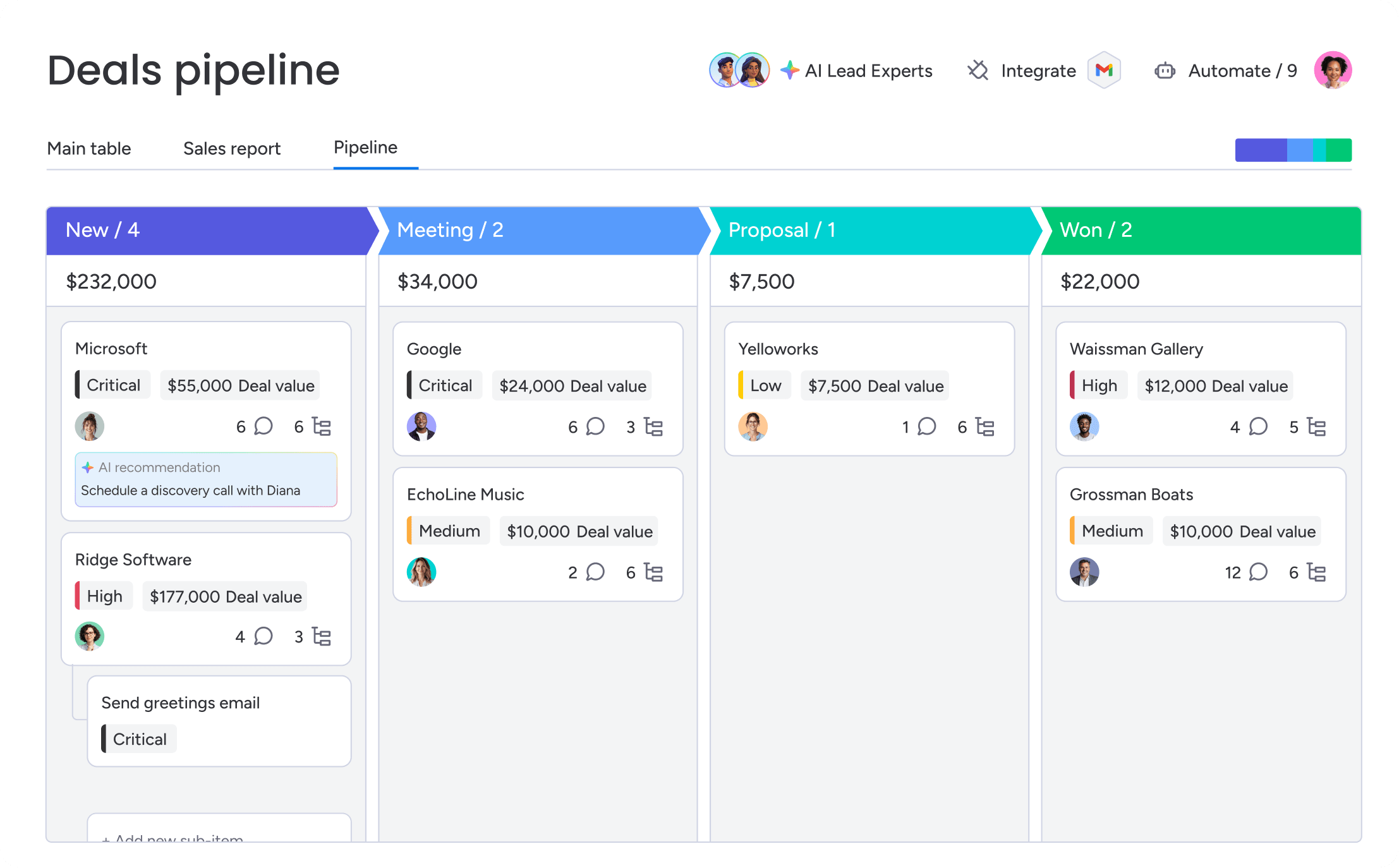
AI revenue operations automation creates measurable results across the entire revenue cycle. These outcomes matter most to RevOps leaders and CROs who need to demonstrate impact.
- More predictable pipeline: AI helps RevOps teams build more predictable pipelines by improving lead quality, cutting deal slippage, and making forecasts more accurate. Dynamic forecasts adjust as deals progress, so RevOps leaders get a more accurate view of future revenue.
- Less manual CRM work: With CRM automation AI, emails, calls, and meetings are logged in the CRM automatically. The system updates deal stages based on activity and enriches lead data with firmographic details.
- Stronger cross-team alignment: AI coordinates handoffs between teams automatically. Shared dashboards give all teams visibility into pipeline health, deal status, and customer health.
5 steps to implement RevOps AI without heavy IT work
Implementing AI for revenue operations doesn’t require a massive IT project or months of setup. RevOps leaders can start small, focus on high-impact workflows, and expand from there.
Step 1: Identify high-friction workflows first
The best place to start is where manual work creates the most friction. Look for workflows where teams spend excessive time on repetitive tasks or where handoffs frequently fail.
| Workflow | Friction indicators | AI solution |
|---|---|---|
| Lead routing | Leads sit in queue for hours, reps complain about lead quality | AI scoring and instant routing |
| CRM updates | Reps spend 15+ minutes after each call updating records | AI call summaries and auto-logging |
| Pipeline reviews | Managers manually check deals for red flags weekly | AI risk detection and alerts |
| Forecast compilation | RevOps spends hours building spreadsheets each week | AI dynamic forecasting |
| Team handoffs | Leads or customers get dropped during transitions | AI automated handoff workflows |
Step 2: Choose a platform that connects your revenue stack
AI for RevOps works best when it connects to the systems your team already uses. With native integrations across 500+ platforms including Outlook, Gmail, Slack, Zoom, and DocuSign, monday CRM enables AI to automate workflows across the entire revenue cycle without switching between platforms.
Step 3: Start with a single automation and measure results
Resist the temptation to automate everything at once. Start with one workflow, measure the results, and use that data to justify expanding. Track these metrics from day one:
- Time saved per rep on administrative work
- Speed improvement in lead response time
- Accuracy improvement in data entry
- Outcome improvement in conversion rates
Step 4: Expand to cross-team workflows
Once the initial automation proves value, expand to workflows that span multiple teams. Focus on:
- Marketing-to-sales handoffs
- Sales-to-customer success transitions
- Renewal tracking across CS and finance
Step 5: Build AI into your RevOps operating rhythm
AI automation works best when integrated into how your team operates day-to-day, not treated as a separate system. Here are ways to make it stick:
- Use AI-generated risk alerts as the starting point for pipeline discussions.
- Replace manual forecast compilation with AI-generated forecasts that update dynamically.
- Make AI insights part of your regular review cadence rather than an add-on.
How monday CRM automates revenue operations with AI
With monday CRM, RevOps teams get the AI capabilities, integrations, and real-time visibility needed to automate the entire revenue cycle without heavy IT work. The platform connects marketing, sales, and customer success in one system so leads never get dropped, deals move faster, and forecasts stay accurate.
- AI-powered lead routing and scoring: Automatically capture, enrich, and route leads to the right rep based on fit, intent, and capacity — cutting response time from hours to minutes.
- Automated CRM updates and call summaries: AI Timeline Summary creates concise summaries of all communication events, while Autofill with AI auto-populates fields across Text, Date, Number, Dropdown, People, and Status columns, eliminating manual data entry.
- Real-time pipeline visibility and risk detection: Customizable dashboards provide immediate insights into sales pipeline status, forecasting, and team performance, with AI alerts that flag at-risk deals before they slip.
- Native integrations across 500+ platforms: Connect Outlook, Gmail, Slack, Zoom, DocuSign, and more so AI can automate workflows across your entire revenue stack without switching between tools.
- Cross-team workflow automation: Coordinate handoffs between marketing, sales, and customer success automatically, ensuring nothing gets dropped during transitions from lead to customer to renewal.
Teams using monday CRM can start with a single high-impact workflow like lead routing or call summaries, measure the results, and expand from there. The platform makes it easy to implement AI for revenue operations without a massive IT project, giving RevOps leaders the tools to demonstrate measurable impact quickly.

“With monday CRM, we’re finally able to adapt the platform to our needs — not the other way around. It gives us the flexibility to work smarter, cut costs, save time, and scale with confidence.”
Samuel Lobao | Contract Administrator & Special Projects, Strategix
“Now we have a lot less data, but it’s quality data. That change allows us to use AI confidently, without second-guessing the outputs.”
Elizabeth Gerbel | CEO
“Without monday CRM, we’d be chasing updates and fixing errors. Now we’re focused on growing the program — not just keeping up with it."
Quentin Williams | Head of Dropship, Freedom Furniture
“There’s probably about a 70% increase in efficiency in regards to the admin tasks that were removed and automated, which is a huge win for us.“
Kyle Dorman | Department Manager - Operations, Ray White
"monday CRM helps us make sure the right people have immediate visibility into the information they need so we're not wasting time."
Luca Pope | Global Client Solutions Manager at Black Mountain
“In a couple of weeks, all of the team members were using monday CRM fully. The automations and the many integrations, make monday CRM the best CRM in the market right now.”
Nuno Godinho | CIO at Velv
“monday.com provides developmental flexibility, operational efficiency, and data transparency — all in one place. We became a company that moved from chasing data to leading with it.”
Hyunghan Lee | Team Lead, Sandbox Network
"monday.com brought every part of our business into one connected space. The harmony between work management and CRM has become our operating system — giving us the clarity and confidence to scale.”
Jennifer Chinburg | Executive Vice President of Corporate Development & Brand, Chinburg Properties
“We just weren’t getting value from our old CRM. With monday.com, it's a thousand times better. Our sales teams are more informed, more consistent, and far more connected."
James Arnold | Chief Operating Officer, CenversaTransform your revenue operations with AI
AI revenue operations automation is a present-day advantage — it’s what separates teams that hit targets consistently from those that scramble at quarter-end. The workflows covered in this article represent the highest-friction points in the revenue cycle, and each one is automatable today without a heavy IT lift. Much of this works best inside broader AI operations management software that connects revenue workflows to every other department, not just the CRM.
The smartest starting point is a single workflow. Pick the one causing the most friction, measure the results, and build from there. Teams that take this approach find that momentum builds quickly — one automated workflow creates the proof of concept that justifies the next.
With monday CRM, revenue teams get the AI capabilities, integrations, and pipeline visibility to make this happen in one place. From lead capture to renewal tracking, the platform connects every stage of the revenue cycle so your team spends less time on admin and more time on the work that actually closes deals.
Try monday CRMFAQs
What is AI for revenue operations?
AI for revenue operations uses machine learning, predictive analytics, and automation to manage the entire revenue cycle from lead capture through renewal with minimal manual intervention. This includes lead scoring and routing, deal progression tracking, forecast generation, renewal management, and cross-team handoffs.
How does AI improve revenue forecasting accuracy?
AI improves revenue forecasting accuracy by analyzing historical win/loss patterns, current pipeline health, and deal velocity to generate forecasts that update dynamically as deals progress. AI identifies deals likely to slip based on engagement patterns and adjusts their forecast contribution accordingly.
What's the difference between AI automation and traditional automation for RevOps?
Traditional automation follows fixed "if/then" rules while AI automation adapts based on data patterns and learns from outcomes. AI handles complex, multi-step processes that simple triggers can't manage, like detecting when a deal is at risk based on multiple signals and recommending specific actions.
Which RevOps workflows should I automate with AI first?
Start with workflows that involve the most manual work and create the most friction. High-impact starting points include lead routing, CRM updates, pipeline risk detection, and team handoffs. Choose one workflow, measure the results, and use that data to justify expanding.
How do AI agents differ from regular AI automation?
AI agents are autonomous systems that execute multi-step workflows without manual intervention, not just single tasks. An AI agent continuously monitors engagement, detects when deals stall, alerts the sales manager, recommends next steps, and creates follow-up tasks without human prompting.
Can I implement AI for RevOps without heavy IT involvement?
Yes. RevOps AI platforms integrate with existing tech stacks without requiring custom development. RevOps leaders can start with a single workflow, configure the automation through the platform interface, and expand from there. With monday CRM, teams can take this approach by unifying revenue data and workflows in one platform with native AI capabilities.
