


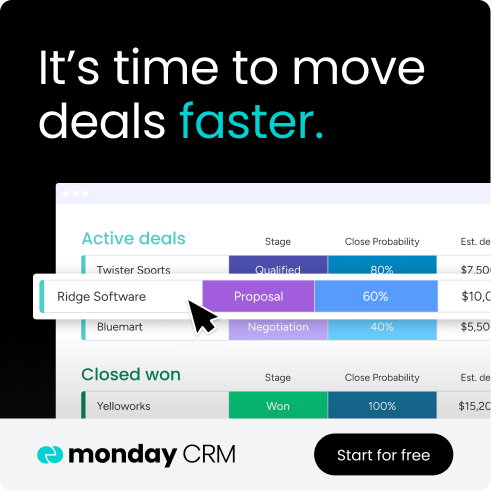
AI revenue cycle management transforms how revenue teams operate, connecting lead qualification, deal progression, and payment collection into one real-time system. Instead of reacting to stalled deals or delayed payments, teams gain the visibility to spot friction early and keep revenue flowing at a consistent pace.
If you’re searching for AI revenue cycle management, you’ve probably encountered healthcare-focused content. This guide focuses instead on B2B revenue teams, where AI improves everything from lead qualification to payment collection. This guide breaks down what AI revenue cycle management actually is, how it differs from healthcare RCM, and the specific ways it accelerates your lead-to-cash process.
Key takeaways
- AI automates lead scoring, follow-ups, and activity logging so reps spend less time on admin work and more time closing deals.
- Revenue teams get early warnings on stalled deals and overdue payments, allowing them to act proactively instead of reacting to problems after they escalate.
- AI analyzes historical deal patterns to predict close probability with greater accuracy, making pipeline reviews more realistic and reliable.
- Sales, finance, and customer success teams work from shared data in a unified system that eliminates silos and improves cross-functional alignment.
- Teams can start with one high-friction area like lead qualification or payment visibility and expand AI capabilities over time using platforms like monday CRM.
What is AI revenue cycle management?
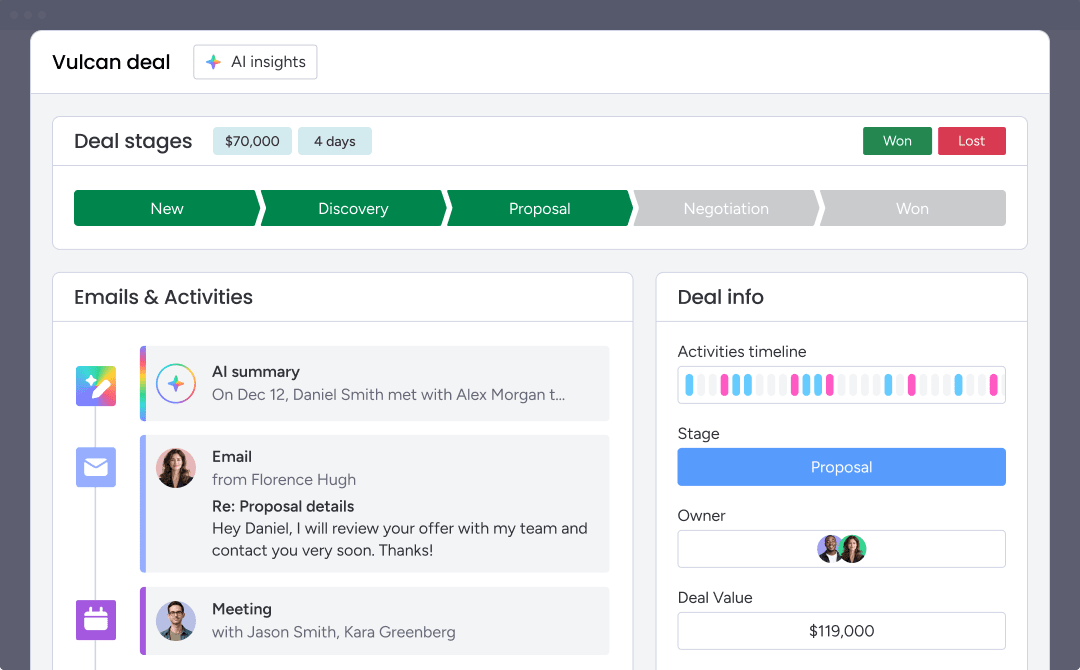
AI revenue cycle management uses machine learning to automate the entire revenue process, from the moment a lead comes in to the moment payment hits your account, so deals close faster and cash flow becomes predictable.
Instead of manual data entry and constant firefighting, AI handles the routine work, spots patterns in your data, and flags risks before they hurt revenue. It learns from your past deals to spot what’s working, predict what will close, and recommends the next best action.
Here’s how it works in real life:
- Lead qualification: AI scores and routes leads based on firmographic fit and intent signals, ensuring reps focus on opportunities most likely to close.
- Deal tracking: AI monitors pipeline health, flags at-risk opportunities, and suggests specific next steps to keep deals moving forward.
- Payment monitoring: AI tracks invoice status, predicts when payments are likely to arrive, and alerts teams to overdue payments before they become collection problems.
AI revenue cycle management vs. healthcare RCM
“Revenue cycle management” has roots in healthcare, but the term means something very different for B2B sales teams. Understanding the difference helps you apply the right approach to your own revenue operations.
Healthcare RCM is all about getting paid by insurance companies, avoiding claim denials, and staying compliant with regulations. B2B revenue cycle management tracks a different path: from first contact with a lead all the way through closed deal, payment, and account management. B2B deals aren’t quick transactions. They take weeks or months, involve multiple decision-makers, and require custom pricing and approvals.
| Aspect | Healthcare RCM | B2B revenue cycle management |
|---|---|---|
| Primary focus | Patient billing and insurance claims | Lead-to-cash workflows |
| Key activities | Medical coding, claims submission, denial management | Lead qualification, deal progression, forecasting |
| Main stakeholders | Providers, insurers, patients | Sales, marketing, finance, customer success |
| Regulatory environment | HIPAA, Medicare/Medicaid rules | GDPR, SOX, industry-specific compliance |
| Technology needs | Claims processing systems | CRM, automation, AI-powered insights |
| Success metrics | Reimbursement rates, days in AR | Win rates, sales velocity, cash flow |
But both approaches share the same 4 goals:
- Reduce revenue leakage from missed opportunities or errors
- Accelerate cash flow by shortening the time from engagement to payment
- Improve forecasting accuracy for smarter resource allocation
- Increase operational efficiency so teams focus on high-value activities
Why AI revenue cycle management matters for revenue teams
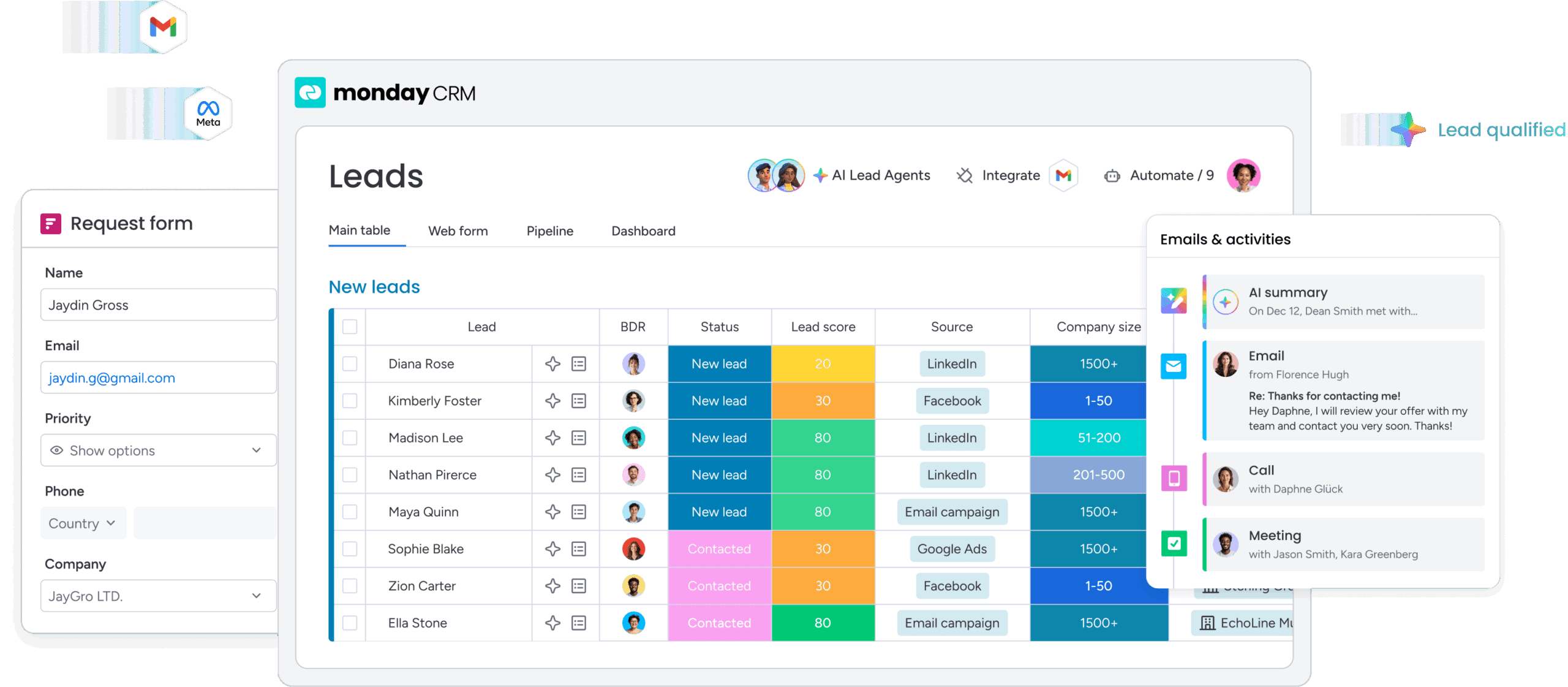
Manual revenue cycle management creates friction at every stage, and that friction compounds fast. Reps spend hours logging activities. Managers piece together pipeline reports from 5 different sources. Finance chases overdue invoices with zero context on the deal.
AI shifts your approach from reactive to proactive. It analyzes thousands of deals, spots risks as they happen, and tells you exactly what to do to keep revenue on track. You don’t find out a deal’s stalled during your weekly pipeline review. AI catches it instantly and tells you how to get it moving again.
Here’s what AI revenue cycle management does for each role:
| Role | Key benefits |
|---|---|
| CROs and VPs of sales | Real-time visibility into pipeline health, accurate forecasts, early warning on at-risk deals |
| RevOps teams | Automated data hygiene, intelligent lead routing, simplified reporting workflows |
| Sales reps | AI-driven next-best-action recommendations, automated follow-ups, reduced admin work |
| Finance teams | Improved cash flow predictability, connected payment tracking, faster collections |
Teams using AI respond to leads faster, forecast more accurately, and close deals quicker. It handles the busywork and surfaces insights that help teams make more informed decisions, faster.
How AI improves every stage of the lead-to-cash process
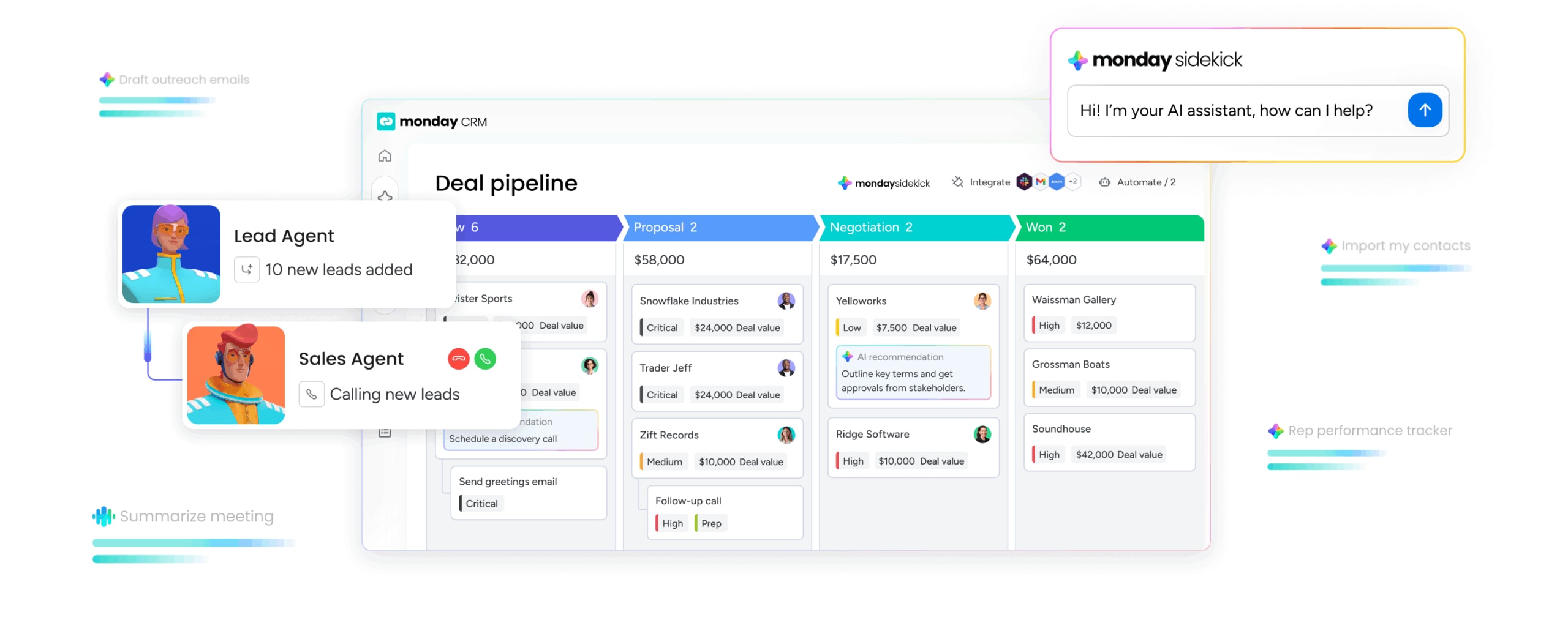
Lead-to-cash is the full journey from the moment a lead comes in to the moment payment lands in your account. This workflow spans multiple teams, systems, and handoffs. Every transition is a chance for delays, errors, and lost revenue.
Traditional workflows rely on manual data entry at every stage. Systems don’t talk to each other. Handoffs live in email threads and spreadsheets. AI transforms these workflows through CRM automation with AI predictive analytics, surfacing insights at each stage and ensuring handoffs between teams stay on track. Here’s what that looks like in practice:
Stage 1: Lead qualification and routing
Manual lead scoring is inconsistent at best, and it’s usually based on incomplete data. A rep might chase a bad-fit lead for days while high-intent prospects sit waiting for a response.
AI improves lead management through:
- Automated scoring evaluates firmographic data and engagement signals instantly.
- Intelligent routing assigns leads based on territory rules, expertise, and capacity.
- Real-time prioritization surfaces high-intent leads immediately for faster response.
Stage 2: Deal progression and follow-ups
Reps manage dozens of active deals simultaneously, and without AI deal flow management, it becomes difficult to track follow-up tasks and maintain momentum across every opportunity. AI keeps deals moving through:
- Automated reminders based on deal stage and last activity date.
- Next-best-action recommendations that suggest specific actions based on deal context.
- Email drafting capabilities that generate personalized follow-up messages.
Stage 3: Sales to finance handoffs
Manual handoffs between sales and finance create delays, errors, and miscommunication every time a deal moves from closed-won to invoicing. Finance gets incomplete deal info, which means incorrect invoices and delayed billing.
AI automates handoffs through:
- Deal summaries capture key terms and pricing automatically.
- Triggered workflows initiate invoicing when deals close.
- Cross-functional visibility ensures finance and customer success teams have access to deal context.
Stage 4: Payment tracking and collections
Finance teams manually track invoices across spreadsheets and accounting systems instead of using AI invoice management, leading to delayed collections and unpredictable cash flow. AI improves payment tracking by:
- Maintaining a real-time view of receivables
- Flagging overdue invoices proactively
- Forecasting when payments will arrive based on historical patterns
7 ways AI helps revenue teams close deals faster
AI revenue cycle management creates real, measurable improvements across your entire sales process. Each capability builds on the others to create a system that keeps revenue flowing and gives teams the insight to act before problems show up.
1. Prioritize high-fit leads before reps waste time on the wrong ones
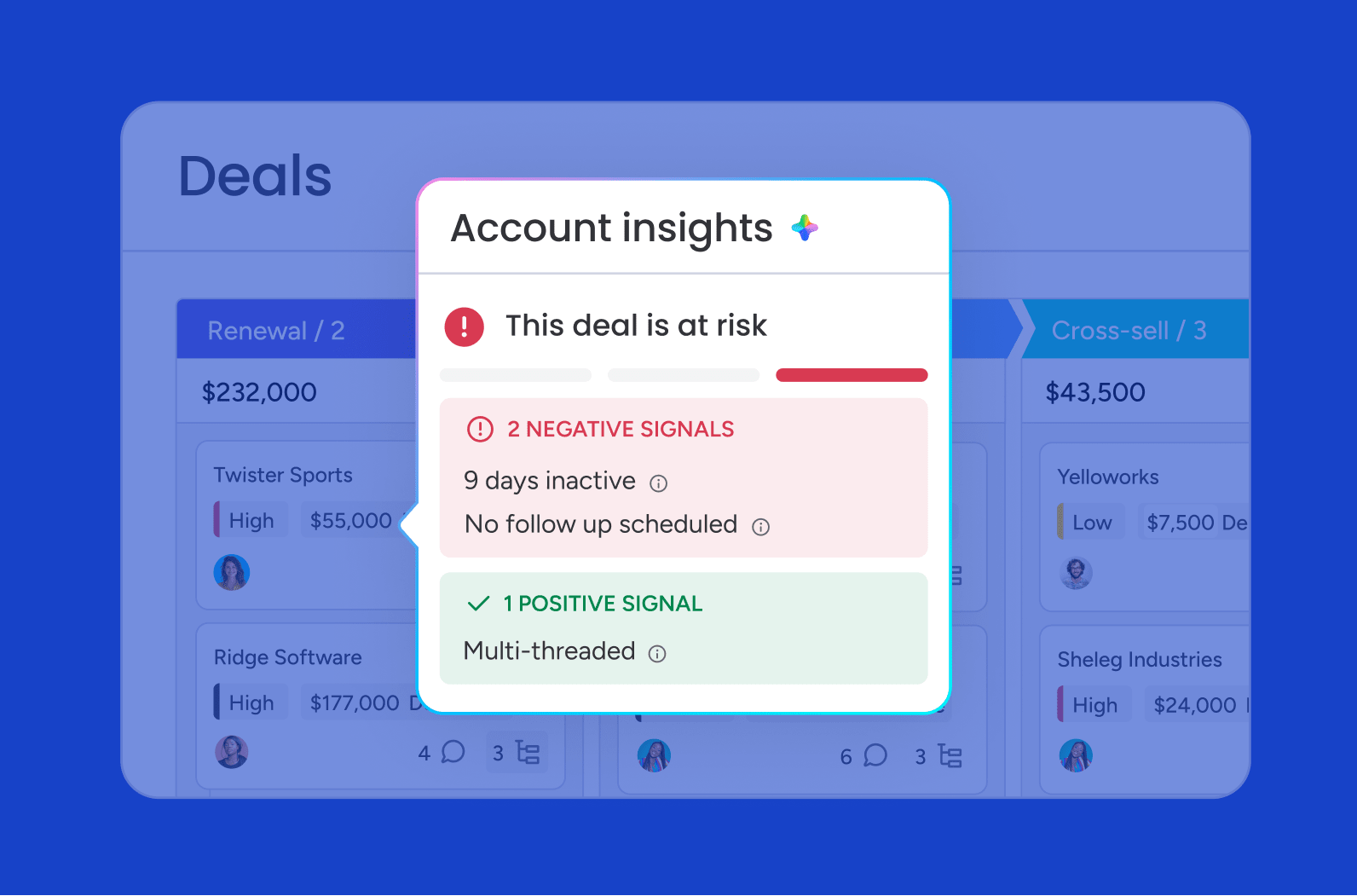
When reps focus on bad-fit leads, productivity drops and win rates suffer. Here’s how AI prioritizes leads:
- Fit scoring to evaluate firmographic data against your ideal customer profile
- Intent analysis that examines engagement behavior patterns
- Real-time ranking that continuously updates lead scores as new data becomes available
2. Capture deal details automatically so nothing falls through the cracks
Manual data entry consumes hours of rep time every week. AI automates data capture through:
- Email parsing that extracts key details from conversations
- Meeting transcription to capture action items and customer requirements
- Form autofill that populates CRM fields based on data from connected sources
3. Draft follow-up emails faster without sacrificing personalization
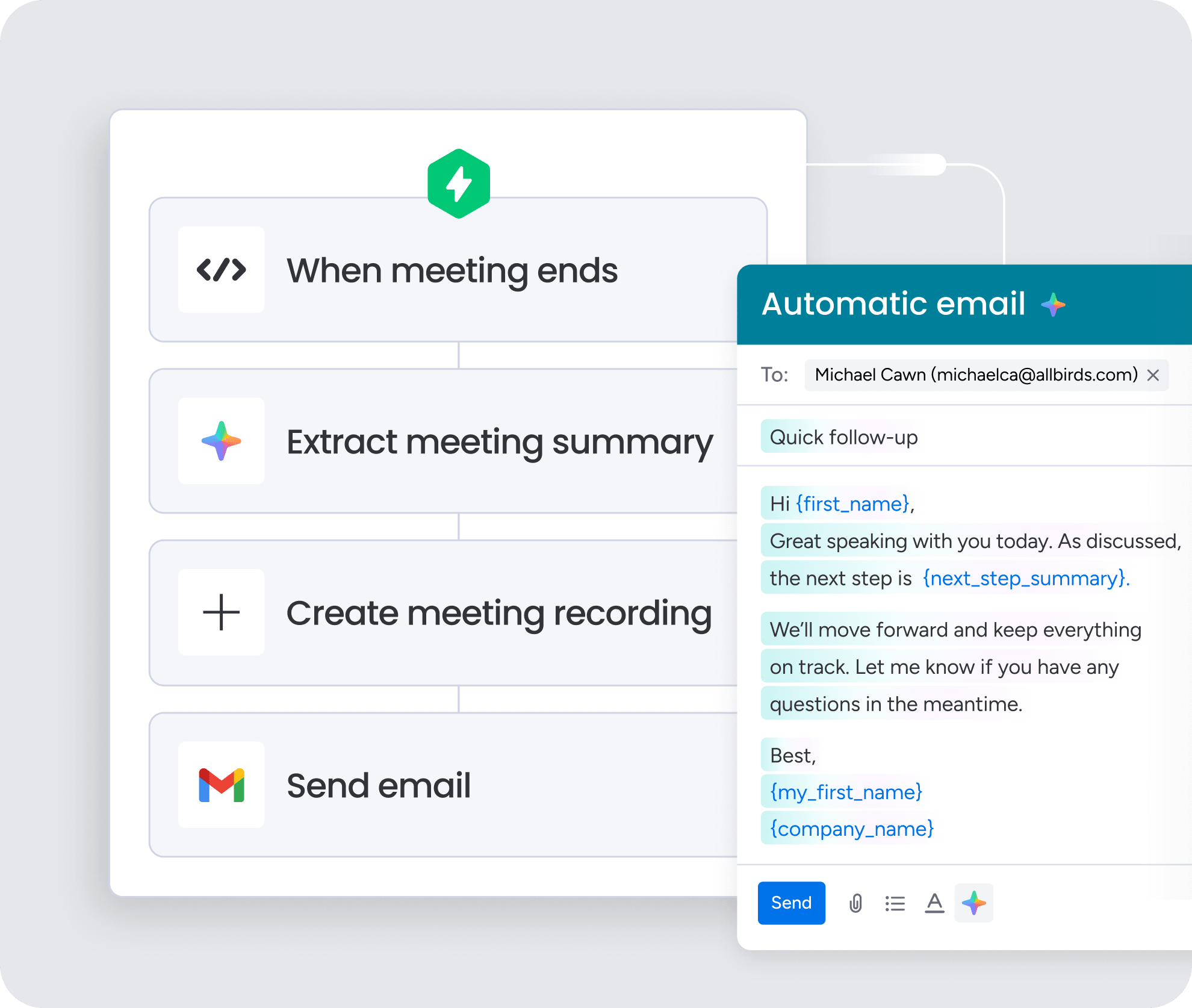
Without generative AI for sales growth, writing personalized follow-up emails slows down response times and creates inconsistency across the team. AI accelerates follow-up drafting through:
- Contextual email generation based on deal stage and recent interactions
- Tone customization that adapts to rep preferences and customer communication styles
- Quick editing capabilities to allow reps to review and refine AI-generated drafts
4. Summarize calls and customer history before every conversation
Reps handle dozens of customer conversations each week, and AI helps surface the key context so they walk into every call prepared. AI provides comprehensive summaries through:
- Call transcription to extract key discussion points
- Customer history overviews that provide context at a glance
- Pre-call briefs to prepare reps for upcoming conversations
5. Flag deal movement signals before stalled opportunities go cold
Revenue leaders need real-time visibility into the AI sales pipeline to know which deals are progressing, stalling, or at risk — without waiting for a weekly pipeline review. AI detects deal movement through:
- Activity monitoring that tracks email exchanges and meeting frequency
- Stalled deal alerts to flag opportunities with no recent activity
- Positive momentum signals that identify deals with increasing engagement
6. Improve forecasting accuracy with data, not gut instinct
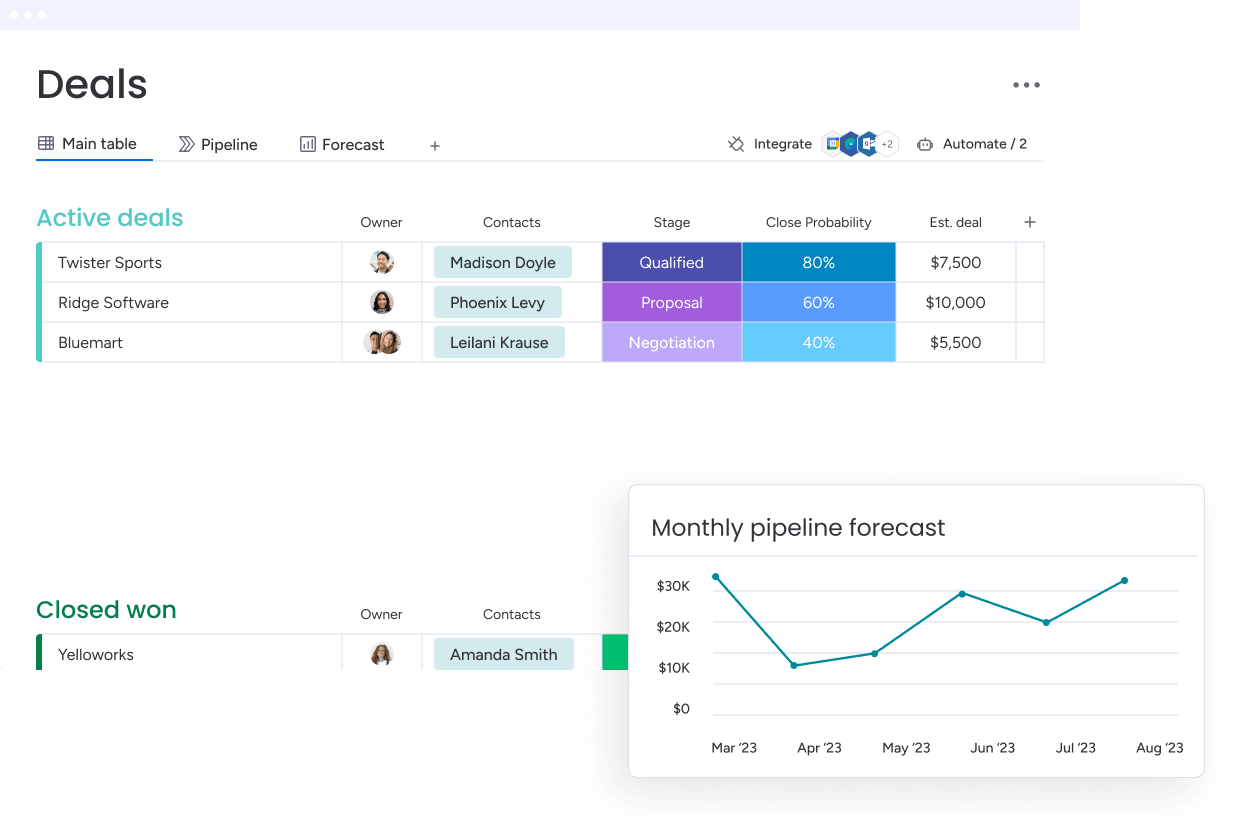
Traditional forecasts rely on what reps think will close. That often results in overly optimistic projections and unmet targets — leaving revenue leaders without reliable data to plan against. AI delivers more reliable forecasts through:
- Predictive modeling that calculates close probability for each opportunity
- Dynamic updates to adjust forecasts as deal activity changes
- Scenario planning that models different outcomes based on pipeline changes
7. Connect payment tracking to deals for full revenue visibility
Payment data typically lives in separate finance systems, creating transparency gaps that the right revenue management software can close between sales and finance. AI connects payment tracking through:
- Invoice monitoring within the CRM
- Proactive alerts for overdue payments
- Cash flow visibility that links pipeline forecasts to actual revenue collection
AI automation vs. AI agents: Which approach fits your revenue cycle?
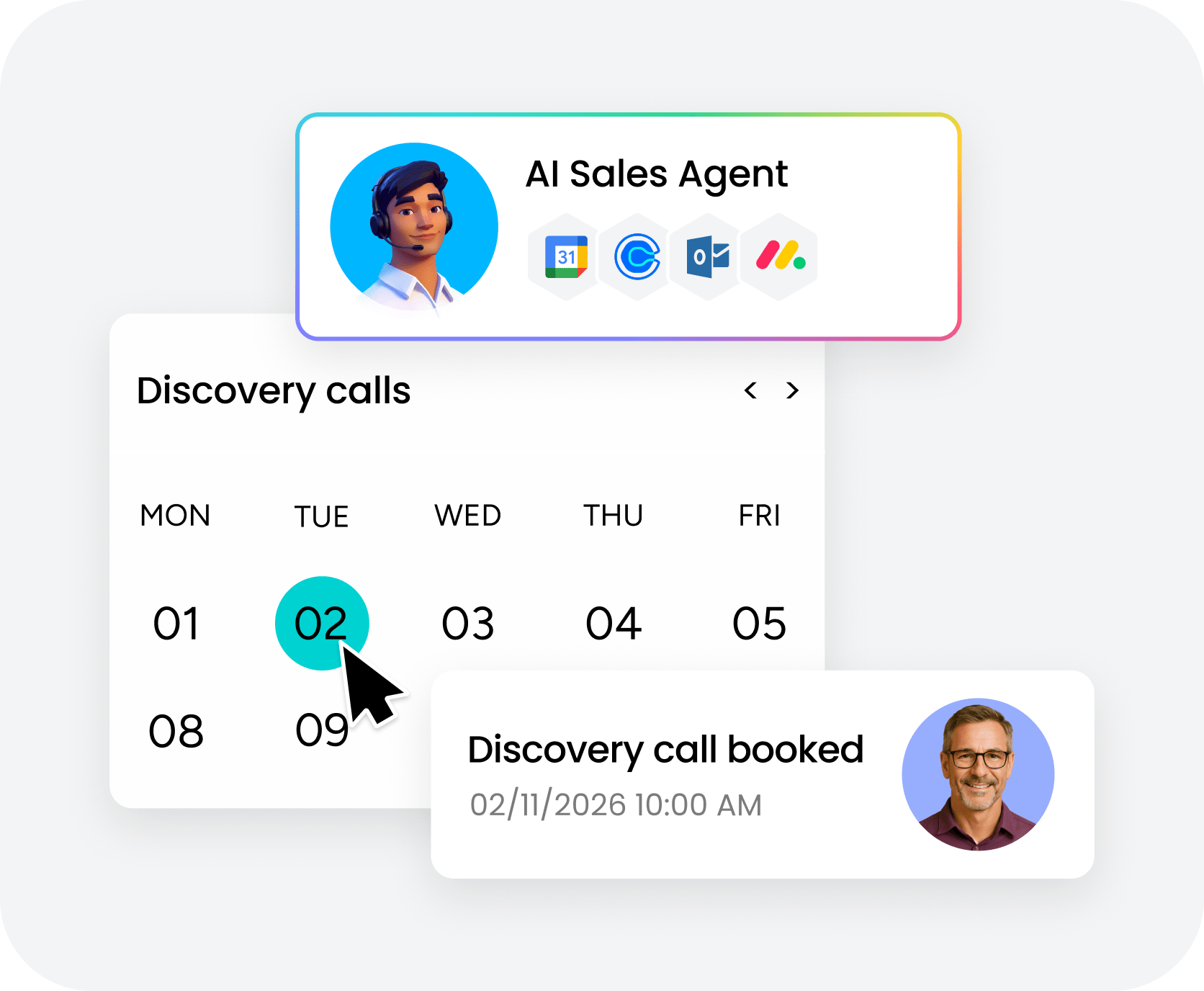
AI revenue cycle management operates through 2 distinct approaches: automation and agents. Each serves different purposes, and understanding when to use which one helps teams solve the right problems without overcomplicating workflows.
| Capability | AI automation | AI agents |
|---|---|---|
| How it works | Follows predefined rules and triggers | Analyzes data, reasons through context, and acts autonomously |
| Decision-making | Rule-based and deterministic | Context-aware and adaptive |
| Best for | Predictable, repeatable workflows | Complex, context-dependent decisions |
| Human involvement | Minimal after initial configuration | Collaborative — surfaces suggestions or takes actions with human oversight as needed |
| Setup complexity | Straightforward, one-time configuration | Requires training, testing, and ongoing refinement |
| Examples | Lead assignment, email sequences, activity logging | Deal monitoring, re-engagement drafting, sentiment analysis, next-best-action recommendations |
AI automation: Rule-based execution for predictable workflows
AI automation follows predefined rules to execute repetitive tasks. Set it up once, and it runs consistently every time.
Common automation examples include lead assignment, email sequences, activity logging, and deal summaries.
AI agents: Autonomous decision-making for complex scenarios
AI agents analyze data, make decisions, and act autonomously as conditions change.They work alongside revenue teams, handling routine tasks so people can focus on strategy and relationships.
AI agents excel at lead qualification, deal facilitation, meeting coordination, and sentiment analysis.
Most revenue teams benefit from both approaches. Use automation for high-volume, predictable tasks. Deploy agents for nuanced decisions that require context and judgment. The right mix depends on your team’s workflows and where you need the most leverage.
What to look for in an AI revenue cycle management platform
Not every AI revenue cycle management platform delivers the same value. Choosing the right one helps your team see results within weeks rather than months. Knowing what to look for in advance saves time and helps your team ramp faster.
Key evaluation criteria include:
- Embedded AI capabilities: AI should be built into the platform, not bolted on as a separate tool.
- No-code customization: Revenue teams should be able to adapt workflows without IT involvement.
- Cross-functional visibility: Sales, RevOps, finance, and post-sales teams need to work from the same data.
- Integration depth: The platform must connect with your existing tech stack seamlessly.
- Fast implementation: Teams should see value quickly without lengthy rollouts.
Don’t overlook security and compliance. AI processes large volumes of sensitive revenue data. Look for enterprise-grade security, encryption, and compliance features. The best platforms let you start small and scale over time. Start with something high-impact like lead scoring or deal tracking, then expand as your team gets comfortable.
How to put strengthen your revenue cycle with AI
AI revenue cycle management gives teams visibility, speed, and consistency. You move from lead to cash through automated workflows that keep revenue operations moving efficiently. The teams that adopt it early do more than save time — they build a real advantage in forecast accuracy, deal velocity, and cross-functional alignment.
Going from reactive to proactive revenue management doesn’t mean ripping out your entire system. Start with the biggest pain points in your current workflow (lead qualification, deal tracking, payment visibility) and build from there. Small wins compound quickly when you have the right AI in place.
monday CRM brings these capabilities directly into your revenue workflows on monday.com. Sales, marketing, finance, and customer success all work from the same data. With no-code customization and embedded AI, teams get up and running fast — then scale as needs change.
Try monday CRMFAQs
What is AI revenue cycle management?
AI revenue cycle management applies artificial intelligence to automate and optimize the entire revenue process from lead capture through payment collection. It enables revenue teams to close deals faster and improve cash flow predictability through automated workflows and intelligent insights.
How does AI revenue cycle management differ from healthcare RCM?
Healthcare RCM focuses on patient billing, insurance claims, and reimbursement workflows. B2B AI revenue cycle management centers on lead-to-cash workflows spanning marketing, sales, and finance departments, addressing entirely different processes and stakeholders.
What workflows can AI revenue cycle management automate?
AI can automate lead scoring and routing, email sequences, activity logging, deal summaries, forecasting, payment tracking, and customer handoffs between teams. These automations reduce manual work and accelerate revenue processes.
How does AI improve revenue forecasting accuracy?
AI analyzes historical deal data, win rates, and deal characteristics to calculate close probability. It dynamically updates forecasts as deal activity changes, providing more reliable predictions than subjective rep estimates.
Can AI revenue cycle management work with existing CRM systems?
Yes, AI revenue cycle management integrates with existing CRM systems through APIs and integrations. This connects payment data, marketing automation, and finance tools to provide complete revenue cycle visibility.
What should you look for in an AI revenue cycle management platform?
Look for embedded AI capabilities, no-code customization, cross-functional visibility across sales and finance, integration depth with existing tools, and fast implementation without heavy IT involvement.
Can small businesses use AI revenue cycle management?
Yes, small businesses can benefit from AI revenue cycle management without enterprise-level budgets or technical resources. Modern platforms offer scalable pricing and no-code setup that lets small teams start with high-impact use cases like lead scoring or automated follow-ups, then expand capabilities as they grow.
