


AI is already making decisions inside your business. It’s scoring leads, routing support tickets, drafting content, and updating pipeline stages, often without anyone stopping to ask: who’s responsible when something goes wrong? That question is at the heart of responsible AI, and it’s one more organizations are taking seriously as AI takes on a larger share of day-to-day work. Responsible AI isn’t a compliance checkbox or a values statement on a website. It’s the actual practices, governance structures, and technical controls that determine whether your AI systems are fair, accountable, and safe to scale. The difference between organizations that deploy AI confidently and those that run into costly, reputational, or regulatory problems often comes down to whether these practices are built into their workflows from the start.
This guide breaks down what responsible AI actually means, the six core principles behind it, how it differs from AI ethics, and what it looks like in practice across sales, marketing, and customer service. We also walk through how to implement responsible AI step by step, what post-deployment monitoring requires, and how teams can build governance controls into their existing workflows to make responsible AI practical at scale with platforms like monday agents.
Key takeaways
- Responsible AI is about action, not just values: Ethical principles don’t mean much without policies, audit trails, and governance structures that actually put them to work every day.
- Governance protects your business as AI scales: A biased lead-scoring model or an AI agent with overly broad data access creates organization-wide risk, not just a one-off mistake.
- Six principles form the foundation of responsible AI: Fairness, transparency, accountability, privacy, reliability, and human oversight work together as a system.
- Human oversight is non-negotiable for high-stakes decisions: Define which AI actions need human approval, set confidence thresholds, and make sure every AI action can be reversed.
- monday agents embeds responsible AI into your existing workflows: With granular permissions, full audit trails, simulation mode, and enterprise certifications like SOC 2 Type II and HIPAA, governance is built in.
What is responsible AI?
Responsible AI is the practice of designing, developing, deploying, and governing AI systems in ways that are ethical, transparent, fair, and accountable. AI-driven decisions respect human rights, avoid harm, and stay under meaningful human oversight from start to finish.
Responsible AI isn’t a single technology, product, or feature. It’s a set of guiding principles, governance practices, and organizational commitments that shape how AI is built and used. These practices apply to every type of AI, from simple automation rules to autonomous AI agents that score leads, route support tickets, and generate marketing content.
AI ethics is the broader philosophical framework that examines questions like “Should we build this?” and “What values should guide AI development?” Responsible AI is the operational practice of translating those ethical principles into concrete policies, governance structures, technical controls, and organizational behaviors.
Think of AI ethics as a company’s values statement. Responsible AI is the policies, training programs, compliance checks, and monitoring systems that bring those values to life in daily operations.
For teams evaluating AI-powered platforms, responsible AI separates confident deployment from guesswork. It helps organizations use AI to deliver real business outcomes while protecting customers, employees, and the business from unintended consequences.
Why responsible AI matters for your business
AI is embedded in everyday workflows—scoring leads, routing tickets, generating copy, and updating pipelines. As AI takes on more work, the consequences of irresponsible AI scale with it. A biased lead-scoring model shapes your entire pipeline, not just one deal. An AI agent with overly broad data access creates systemic vulnerability. Responsible AI lets you scale AI’s benefits while keeping risks in check.
Builds trust with customers and stakeholders
When customers interact with AI-powered systems, they’re trusting your judgment. Transparent AI practices show you take their data and experience seriously. According to Gallup research, 60% of Americans distrust AI to make fair decisions, yet trust nearly doubles among regular AI users. This trust directly impacts revenue: customers who trust how you handle their data are more likely to stay, refer others, and provide feedback that makes your AI systems smarter.
Reduces compliance and reputational risk
AI regulations are expanding globally. Organizations already face the EU AI Act, U.S. state-level AI laws, and industry-specific regulations like HIPAA and GDPR. Deploying AI without governance structures means growing regulatory exposure with every new law.
The reputational cost is equally significant. When AI produces biased outputs—a lead-scoring model that deprioritizes certain demographics, a content generator that misleads, or a ticket-routing system that underserves segments—damage extends beyond a single incident. In a Gartner survey, 29% of organizations experienced an attack on GenAI infrastructure in 12 months, and 62% reported a deepfake attack. Responsible AI practices create the documentation, audit trails, and governance structures that protect your organization and demonstrate accountability.
Improves AI performance and reliability
Constraints improve AI. When teams build responsible AI practices into workflows, auditing training data, testing for bias, monitoring outputs, they catch issues earlier and improve accuracy faster. Gartner research confirms this: organizations that perform regular AI assessments are over three times more likely to achieve high GenAI business value. Responsible AI isn’t a tax on innovation, it’s quality assurance that makes AI systems more accurate, dependable, and valuable over time.
6 core principles of responsible AI
Six core principles consistently appear across major responsible AI guidelines, including the NIST AI Risk Management Framework, the OECD AI Principles, and the EU AI Act. These principles work as a system: fairness without transparency can’t be verified, and accountability without human oversight can’t be enforced.
1. Fairness and inclusiveness
Fairness means AI systems don’t systematically advantage or disadvantage particular groups. An AI lead-scoring model should evaluate prospects based on business signals like company size and engagement history, not demographic proxies that correlate with protected characteristics. Teams can build fairness by auditing training data for representation gaps, testing outputs across customer segments, and defining measurable fairness criteria for each AI application.
2. Transparency and explainability
Transparency makes AI processes visible to the people affected by them. When an AI agent prioritizes deals in a pipeline, reps need to see the factors behind each recommendation rather than receiving an opaque score. Teams can build transparency by documenting how models make decisions, providing explanations alongside AI outputs, and maintaining visible logs of AI actions.
3. Accountability
Accountability establishes ownership for AI outcomes. When an AI agent routes support tickets, someone must own the quality of that routing and answer for its performance. Teams establish accountability by designating AI owners for each workflow, creating escalation paths for unexpected results, and documenting decision-making authority between people and AI systems.
4. Privacy and security
Privacy protects personal and sensitive data throughout the AI lifecycle. A CRM system using customer interaction data to train AI models must ensure that data is encrypted, access-controlled, and used only within consented boundaries. Teams protect privacy by implementing data minimization, enforcing role-based access controls, and ensuring compliance with regulations like GDPR and HIPAA.
5. Reliability and safety
Reliability means AI systems perform consistently under expected conditions. An AI agent that updates deal stages in a sales pipeline must correctly interpret signals like signed proposals and completed demos. Safety means the agent doesn’t overwrite critical data or take irreversible actions without human checkpoints. Teams build reliability by testing systems under varied conditions, setting confidence thresholds for human review, and establishing rollback procedures.
6. Human oversight
Human oversight maintains meaningful human control over AI systems, especially for high-stakes decisions. A marketing team using AI to draft campaign content benefits from speed and scale, but publishing without human review introduces risks like inaccurate claims or off-brand messaging. Teams maintain oversight by implementing human-in-the-loop checkpoints, using simulation modes to validate behavior, and defining escalation triggers for automatic review.
AI ethics and responsible AI are related but distinct. AI ethics is the philosophical framework examining questions like “Should we build this?” Responsible AI is the operational practice of translating those principles into concrete policies and technical controls. The table below clarifies the difference:
| Dimension | AI ethics | Responsible AI |
|---|---|---|
| Primary question | "What should we do?" | "How do we do it?" |
| Focus | Moral principles, societal impact, philosophical questions | Governance frameworks, implementation practices, monitoring systems |
| Scope | Broad, normative, often aspirational | Specific, operational, enforceable |
| Output | Values statements, ethical guidelines, principles | Policies, audit trails, permissions, accountability structures |
| Ownership | Often distributed across society, academia, regulators | Specific teams and individuals within organizations |
An organization can have strong ethical principles and still deploy irresponsible AI if those principles aren’t embedded in workflows and systems. For teams evaluating AI platforms, look for platforms that operationalize responsible AI principles through audit trails, permissions, human-in-the-loop controls, and compliance certifications. Platforms like monday agents embed these governance capabilities directly into your workspace, making responsible AI practical rather than theoretical.
Try monday agentsResponsible AI examples in business
Responsible AI principles become tangible when applied to specific business functions. The following examples show what responsible AI looks like in practice across three common areas where teams deploy AI today. Each example illustrates how the principles from the previous section work together in real workflows.
Responsible AI in CRM and sales
An AI system that scores and prioritizes leads, routes deals to sales reps, or suggests next-best actions in a pipeline touches every stage of the revenue cycle. The responsible AI considerations are significant:
- Fairness: The scoring model must not be biased against certain industries or company sizes without valid business reasons.
- Transparency: Reps should understand why a lead received a particular score.
- Accountability: Someone owns the model’s performance and answers for its outcomes.
Responsible implementation looks like this: the team audits scoring criteria regularly to ensure they reflect current business priorities and do not encode historical biases. Reps can see the factors behind each score, including engagement recency, company fit signals, and stakeholder activity, rather than receiving an opaque number. A designated owner reviews model accuracy quarterly, comparing AI-predicted outcomes against actual conversion data and adjusting the model when performance drifts.
Platforms that enable permission-based access and visible AI action logs make this kind of oversight practical for sales teams. When every AI action is logged, including which leads were scored, how they were prioritized, and what actions the AI triggered, the team has the data it needs to verify fairness, explain decisions to prospects, and demonstrate accountability to leadership.
Responsible AI in customer service
An AI agent that triages incoming support tickets, classifies severity, matches knowledge base articles, and drafts responses handles a high volume of customer interactions with minimal human involvement. The responsible AI considerations center on three areas:
- Equity: Enterprise and SMB customers should receive comparable response quality.
- Privacy: Sensitive information shared in tickets, including account credentials, financial details, and personal data, must be protected.
- Appropriate escalation: The system must route to a human when confidence is low.
The responsible approach involves setting confidence thresholds for auto-responses. If the AI is less than a defined percentage confident in its classification or suggested response, the ticket routes to a human agent instead. The team maintains human review for sensitive or high-severity cases, regardless of AI confidence, and monitors whether resolution quality, response time, and customer satisfaction vary across customer types, flagging any patterns that suggest inequitable treatment.
Responsible AI in marketing and content
An AI system that generates campaign copy, personalizes email content, or analyzes audience sentiment operates at the intersection of creativity, data, and customer trust. The responsible AI considerations span three dimensions:
- Accuracy: Generated content must be non-misleading, with no fabricated statistics or unsupported claims.
- Privacy: Personalization must use only data customers have consented to share.
- Bias: Sentiment analysis must not reinforce stereotypes or mischaracterize customer segments.
The responsible approach involves implementing human approval workflows for AI-generated content: the AI drafts, a human reviews and approves before publication. Personalization is limited to consented data, with documentation of which data points drive which personalization decisions. Sentiment models are regularly reviewed for bias, with the team checking whether the model interprets language differently across demographics, regions, or communication styles.
Who is accountable for responsible AI in a company?
Accountability for responsible AI is cross-functional, not siloed. When AI agents operate across workflows, touching sales pipelines, support tickets, marketing campaigns, and HR processes, no single team can own responsible AI alone. Effective governance requires shared ownership with defined roles.
The following breakdown shows how accountability typically distributes across an organization:
- Executive leadership: Sets the strategic direction for AI adoption, approves responsible AI policies, and ensures adequate resources for governance. Ultimately accountable for organizational AI risk.
- IT and security: Implements technical controls, manages permissions and access, monitors for security vulnerabilities, and maintains compliance infrastructure.
- Legal and compliance: Interprets regulatory requirements, reviews AI applications for legal risk, and ensures documentation meets audit standards.
- Department owners (marketing, sales, operations, HR, etc.): Own the AI workflows within their function, define acceptable use boundaries, monitor performance, and escalate issues.
- Data teams: Ensure data quality, audit training data for bias, and maintain data governance standards that AI systems depend on.
Platform choice affects how accountability is enforced. When AI governance controls, including permissions, audit trails, and human-in-the-loop validation, are built into the workspace where teams already operate, accountability becomes practical. When governance requires separate systems or manual processes, it often becomes an afterthought.
6 steps to implement responsible AI practices
Implementing responsible AI is not a one-time project with a defined end date. It is an ongoing organizational commitment that evolves as AI capabilities expand, team needs change, and regulations develop. The following 6 steps provide a structured starting point for teams at any stage of AI adoption.
Step 1: Define your responsible AI principles and policy
The first step is articulating what responsible AI means for your specific organization. This is not about copying a generic framework or adopting another company’s policy verbatim. It is about defining principles that reflect your business context, customer base, risk tolerance, and the specific ways you use AI.
- Convene a cross-functional working group with representatives from sales, marketing, operations, IT, legal, and customer-facing teams.
- Document your principles in a living policy document that teams can reference when making decisions.
- Align principles with existing company values and compliance requirements.
- Make the policy accessible to every team member who interacts with AI.
Step 2: Assess and map AI risks across workflows
Teams should inventory every workflow where AI is involved and assess the risk level of each. This includes obvious AI applications like lead scoring and content generation, as well as less visible ones like automated data enrichment.
- Categorize AI applications by impact level (low, medium, high).
- Identify which workflows involve sensitive data or consequential decisions.
- Document potential failure modes for each AI application.
- Prioritize governance efforts based on risk level.
Step 3: Embed governance into the AI lifecycle
Governance should be built into every stage of the AI lifecycle: design, development, testing, deployment, and monitoring.
- Establish approval gates before AI systems go live.
- Require documentation of training data sources and model logic.
- Build testing protocols that check for bias and accuracy before deployment.
- Assign governance roles with defined authority.
Step 4: Train teams and raise organizational awareness
Every team member who uses or is affected by AI needs a baseline understanding of how AI systems work and how to raise concerns.
- Create role-specific training.
- Include responsible AI in onboarding for new team members.
- Establish channels for reporting AI concerns or unexpected behaviors.
- Share regular updates on AI governance decisions and outcomes.
Step 5: Establish human-in-the-loop controls
Human-in-the-loop means designing AI workflows so that people retain meaningful decision-making authority at critical points.
- Define which AI actions require human approval versus which can proceed autonomously.
- Implement simulation or preview modes that let teams validate AI behavior before activation.
- Create escalation triggers based on confidence scores or anomaly detection.
- Ensure people can override or reverse AI actions at any point.
Step 6: Monitor, measure, and iterate
AI systems operate in environments where data distributions shift and regulations evolve. Teams must continuously monitor AI systems.
- Establish key metrics for AI fairness, accuracy, and reliability.
- Schedule regular audits of AI outputs and decision patterns.
- Create feedback loops where end users can flag AI issues.
- Update policies and controls as AI capabilities and regulations evolve.
Responsible AI frameworks, standards, and legal requirements
Whether responsible AI is legally required depends on your jurisdiction, industry, and the specific AI applications you deploy. The answer is increasingly “yes” for many organizations. The EU AI Act creates binding legal obligations for organizations that deploy AI systems affecting people in the European Union. GDPR and HIPAA already apply to AI systems that process personal or health-related data. Enterprise procurement processes now routinely include questions about AI governance and data privacy.
Several established frameworks provide structured guidance for organizations implementing responsible AI:
NIST AI Risk Management Framework
The NIST AI RMF organizes AI risk management into four core functions:
- Govern
- Map
- Measure
- Manage
It’s particularly relevant for U.S.-based organizations seeking a structured, risk-based approach.
OECD AI Principles
The OECD AI Principles provide guidance for international AI governance, organized around five core values:
- Inclusive growth
- Human-centered values
- Transparency
- Robustness
- Accountability
These are relevant for organizations operating across multiple countries.
ISO/IEC 42001 AI management systems
ISO/IEC 42001 is the first international standard for AI management systems, providing a certifiable framework for establishing and improving AI governance. It offers organizations a structured approach to:
- Establish AI governance policies
- Implement risk management processes
- Demonstrate compliance through certification
EU AI Act risk categories
The EU AI Act categorizes AI systems into four risk levels, each with corresponding compliance requirements. Understanding where your AI applications fall within this framework helps determine which governance controls and documentation standards apply to your organization. The table below outlines each category, its requirements, and common business examples:
| Risk category | Requirements | Examples |
|---|---|---|
| Unacceptable risk | Banned entirely | Social scoring systems, real-time biometric surveillance |
| High risk | Strict requirements including conformity assessments and human oversight | AI in hiring decisions, credit scoring, critical infrastructure |
| Limited risk | Transparency obligations; users must be informed | Chatbots, AI-generated content |
| Minimal risk | No specific requirements beyond existing law | Spam filters, AI-powered search |
Responsible AI governance for AI agents
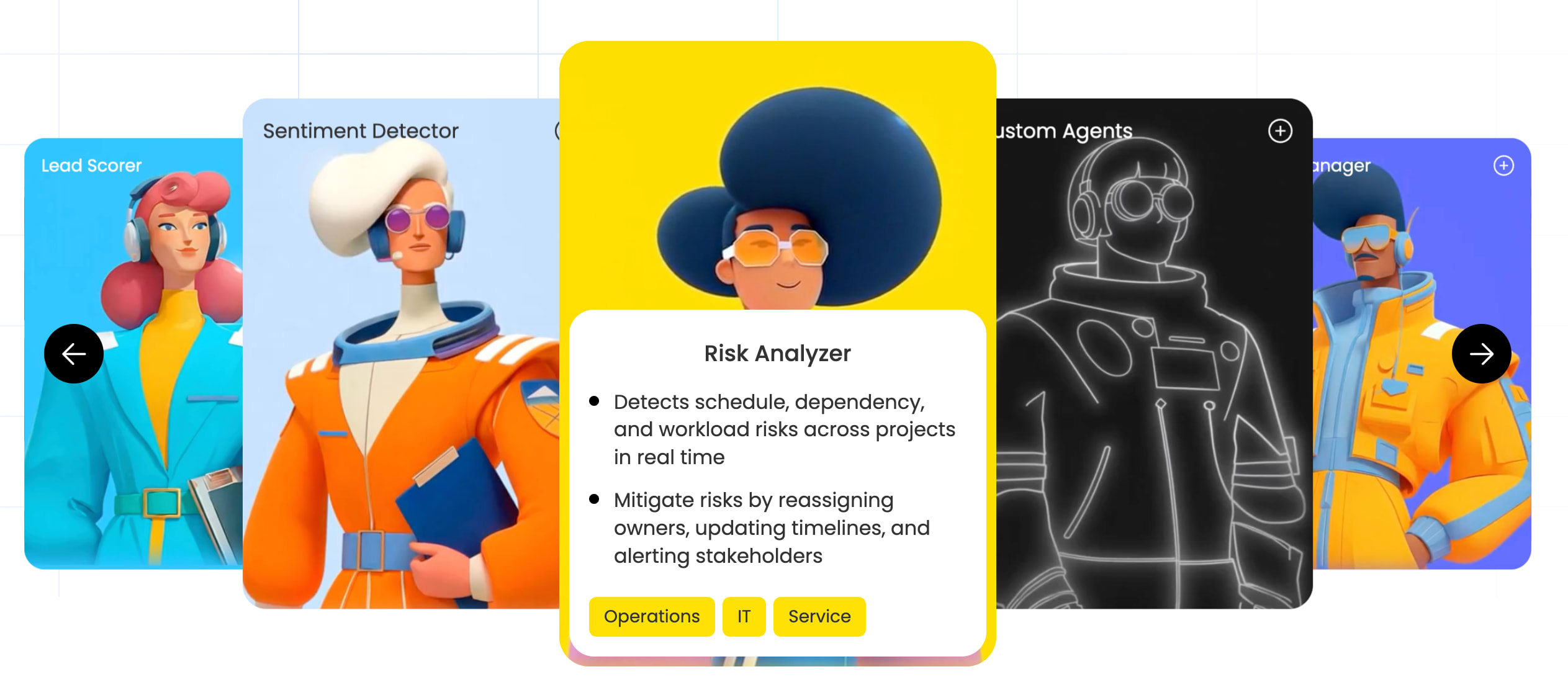
AI agents represent a distinct governance challenge because they operate with greater autonomy than traditional AI systems. An AI agent can independently execute multi-step workflows and make decisions on behalf of a team.
Why AI agents need specialized guardrails
- Autonomy: Agents act independently, which means errors can compound before a human notices.
- Scope: Agents often operate across multiple workflows and data sources, amplifying the impact of any single decision.
- Persistence: Agents run 24/7 so governance must be automated and embedded.
Permissions, audit trails, and simulation controls
Permissions define exactly what data each agent can access. Audit trails log every action an agent takes. Simulation controls allow teams to run an agent in a preview mode before activating it in a live environment.
How people and agents work together responsibly
The operating model follows a clear principle: people set direction, agents handle execution, and structured checkpoints ensure alignment. When an agent encounters a scenario outside its defined scope, it escalates to a human.
How monday agents supports responsible AI practices
monday agents brings responsible AI directly into the workspace where your teams already operate. Built on the monday.com AI Work Platform, it gives organizations the governance controls they need without requiring separate systems or manual oversight processes. AI agents work alongside your teams with the transparency, accountability, and security that responsible AI demands.
The platform makes it practical to deploy AI at scale while maintaining the oversight and control that protect your business, your customers, and your reputation. Every capability is designed to support the principles covered in this guide, from fairness and transparency to human oversight and compliance.
Granular permissions and role-based access control
Administrators define exactly which data each AI agent can access and what actions it can perform. Role-based permissions ensure agents operate only within their designated scope, preventing unauthorized data access or unintended actions. This level of control protects sensitive information and ensures AI agents respect the same access boundaries your team members follow.
Comprehensive audit trails for full AI transparency
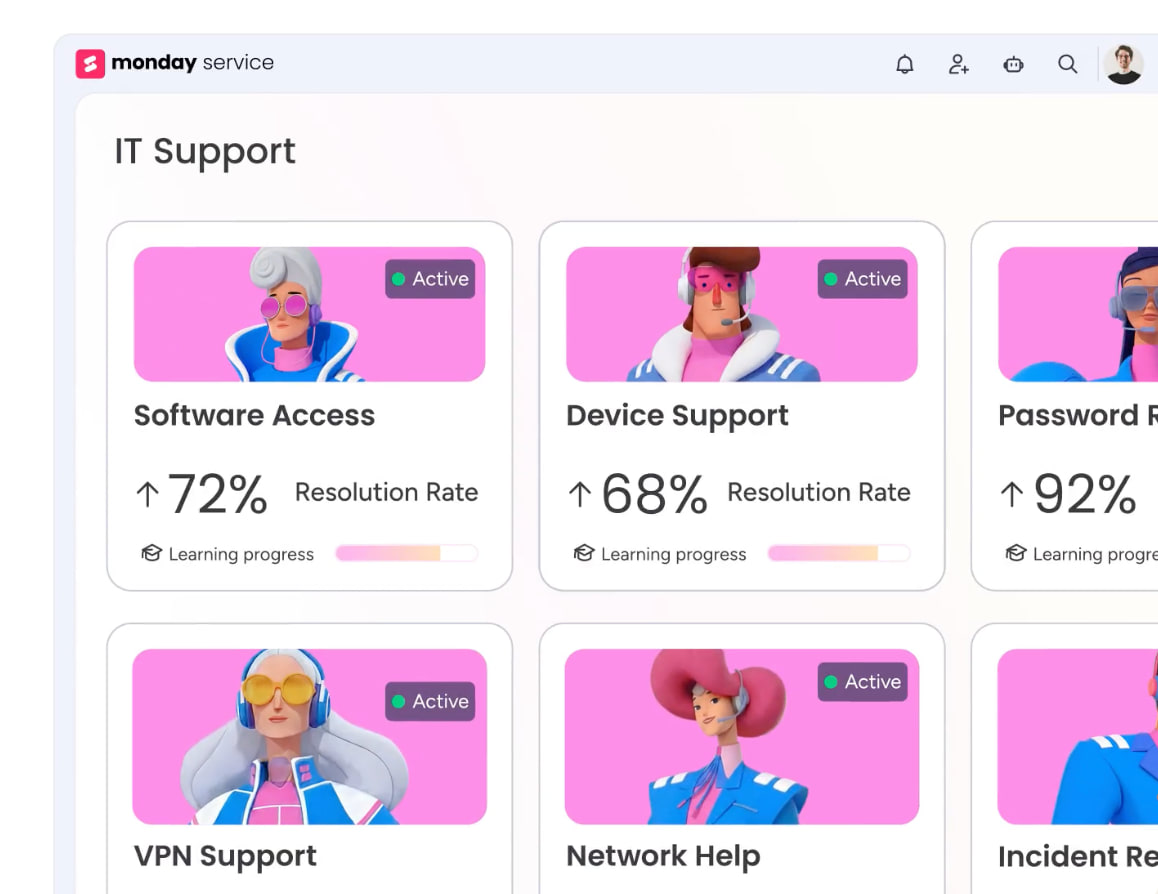
Every action an AI agent takes is logged and visible. Teams can trace exactly what each agent did, when it acted, and what data it accessed. These audit trails provide the documentation needed for compliance reviews, internal audits, and accountability when questions arise about AI decisions.
Simulation mode and human-in-the-loop checkpoints
Teams can validate AI agent behavior in a preview environment before activating agents in live workflows. Simulation mode lets you test how an agent will respond to real scenarios without risk. Human-in-the-loop checkpoints create approval gates for consequential actions, ensuring people retain meaningful control over high-stakes decisions. Confidence-based escalation automatically routes uncertain decisions to human reviewers.
Enterprise-grade compliance and data ownership
monday agents operates within an enterprise security infrastructure that includes SOC 2 Type II, ISO/IEC 27001, ISO/IEC 27701, and HIPAA certifications. Organizations retain full ownership of their data, and content is never used to train third-party models. This compliance foundation supports responsible AI deployment across regulated industries and global markets.
Making responsible AI practical for your organization
Responsible AI is not a distant aspiration or a compliance burden. It is the set of practices that lets organizations deploy AI confidently, knowing their systems are fair, transparent, and accountable. The principles covered in this guide work together as a system: fairness without transparency cannot be verified, accountability without human oversight cannot be enforced, and privacy without technical controls cannot be protected. When these principles are embedded into workflows from the start, AI becomes a reliable tool that scales safely alongside your business.
The difference between organizations that succeed with AI and those that face costly setbacks often comes down to governance. Teams that build audit trails, set clear permissions, maintain human checkpoints, and monitor AI performance continuously are the ones that turn AI into a competitive advantage rather than a risk. Platforms like monday agents make this practical by embedding responsible AI controls directly into the workspace where teams already operate, so governance becomes part of daily work rather than an afterthought.
Try monday agentsFAQs
What are the 4 pillars of responsible AI?
The four most commonly cited pillars are fairness, transparency, accountability, and privacy. Together, these ensure AI systems treat people equitably and protect sensitive data. Some frameworks add reliability and human oversight as additional pillars, but these four form the foundation most organizations build from.
How is responsible AI different from trustworthy AI?
Responsible AI focuses on the organizational practices and governance structures, while trustworthy AI describes the resulting quality of an AI system. Responsible AI is the process; trustworthy AI is the outcome. When you implement responsible AI practices consistently, trustworthy AI is what your customers and stakeholders experience.
What is a responsible AI policy?
A responsible AI policy is a formal organizational document that defines the principles, rules, and accountability structures governing how AI systems are designed and deployed. It translates ethical principles into concrete operational requirements that teams can follow in their daily work.
Do small businesses need responsible AI practices?
Yes. Any organization using AI to interact with customers or automate decisions faces the same risks of bias and privacy violations, regardless of team size. The reputational and regulatory consequences of irresponsible AI can be proportionally more damaging for smaller organizations with fewer resources to recover.
What responsible AI certifications exist?
Recognized certifications include ISO/IEC 42001 for AI management systems, SOC 2 Type II for security controls, and compliance certifications like HIPAA and GDPR. These certifications demonstrate to customers and partners that your organization has implemented verifiable governance controls around AI systems.
How does monday agents support responsible AI governance?
The platform supports governance through granular permissions, comprehensive audit trails, simulation mode, and human-in-the-loop controls within an enterprise-grade security infrastructure. These capabilities are built directly into the workspace where teams operate, making responsible AI practical without requiring separate governance systems.

 Get started