


Your sales team is generating more leads than ever, but are those prospects actually becoming customers? The difference between revenue growth and missed opportunities comes down to one thing: how systematically you capture, track, qualify, and nurture leads from first contact to closed deal.
This guide shows you what effective lead management actually looks like, the 5-stage process that keeps leads from disappearing, and how to build systems that turn prospect interactions into revenue. You’ll discover proven strategies for faster response times, automated workflows that work without you, and the metrics that predict which leads will close.
Key takeaways
- Contacting leads within 5 minutes dramatically increases conversion rates, while waiting even an hour can mean losing them to faster competitors.
- Create automated workflows and scoring systems so every lead gets consistent attention, regardless of rep workload or availability.
- Agree on what makes a lead “sales-ready” to eliminate finger-pointing and ensure quality prospects reach the right people fast.
- Monitor lead response time, conversion rates by source, and cost per acquisition to identify what’s working and optimize your investment.
- Centralize all customer information, interaction history, and deal progress with monday CRM so teams stop wasting time searching across systems and missing opportunities.
What is lead management?
Lead management is how you capture, track, qualify, and nurture prospects from first contact to closed deal. It connects what marketing does (generate interest) with what sales does (close deals).
Lead management turns data into action. Every prospect moves through defined stages with clear ownership, automated workflows, and measurable outcomes. This isn’t just about organizing contacts in a spreadsheet; it’s about creating a repeatable system that prevents revenue from slipping through the cracks between “someone showed interest” and “someone became a customer.”
Today’s buyers do most of their research before they’ll talk to sales. They expect near-instant responses when they reach out. Waiting even an hour can mean losing them to competitors who replied in minutes. This shift makes lead management essential, not optional.
What is lead management in a CRM?
Lead management in CRM is the systematic process of tracking and managing prospects within your customer relationship management platform. Your CRM becomes the central hub where every lead interaction, qualification decision, and progression step gets recorded and acted upon.
A CRM transforms lead management from scattered spreadsheets and email threads into a unified system. It captures lead information automatically, assigns ownership based on your rules, tracks every touchpoint, and triggers follow-up actions at the right time. This centralization means your team always knows which leads need attention, what stage they’re in, and what actions to take next.
Lead management vs. lead generation
Lead generation creates interest — think webinars, content downloads, social campaigns. Lead management ensures those leads get fast follow-up, scoring based on engagement, routing to the right rep, and nurturing until they’re ready to buy. Without lead management, those 500 leads from your latest campaign sit there while competitors grab them.
| Aspect | Lead generation | Lead management |
|---|---|---|
| Purpose | Attract potential customers and capture their information | Track, qualify, nurture, and convert captured leads |
| Primary ownership | Marketing teams | Shared between marketing and sales |
| Timeline | Point-in-time activities (campaigns, events, content) | Ongoing process throughout buyer journey |
| Outcome | New leads entering pipeline | Qualified opportunities and closed deals |
Types of leads you need to know
Different leads need different approaches. A hot lead ready to buy needs immediate sales attention. A cold lead needs nurturing before any sales conversation makes sense.
Understanding these categories helps you build the right workflows:
- Marketing qualified leads (MQLs): Prospects who’ve shown interest through content downloads, webinar attendance, or repeated website visits but haven’t expressed direct buying intent.
- Sales qualified leads (SQLs): Leads vetted by sales who meet your ideal customer profile with budget authority, defined timeline, and acknowledged need.
- Product qualified leads (PQLs): Users who’ve experienced value through free trials or freemium accounts, like someone who created multiple workflows and invited team members.
- Cold leads: Contacts with minimal recent engagement or outdated information who may have interacted months ago without responding to recent outreach.
- Hot leads: High-intent prospects showing immediate buying signals through demo requests, pricing inquiries, or competitor comparisons.
Your lead management process needs to identify these types automatically and route them to the right place. MQLs enter nurturing sequences. SQLs go directly to sales. Hot leads trigger immediate alerts. This segmentation gets every lead the treatment they need, when they need it.
Why lead management drives revenue growth
Lead management drives revenue in 3 specific ways that change how revenue teams work. Together, they create predictable growth by building a structured process that protects every opportunity.
Higher conversion rates through systematic follow-up
Speed matters more than most teams realize. According to a landmark study by Lead Response Management, leads contacted within 5 minutes are 21 times more likely to be qualified than those contacted after thirty minutes. Yet most sales teams measure response times in hours, not minutes.
Systematic follow-up removes the human mistakes that lose leads. Instead of relying on reps to remember follow-ups or track stages manually, automated systems keep engagement consistent:
- Automated follow-up sequences: Pre-built email and task sequences ensure every lead receives consistent touchpoints regardless of rep workload.
- Lead scoring for prioritization: Scoring surfaces high-intent prospects for immediate attention rather than treating all leads equally.
- Complete activity tracking: Every email, call, and meeting gets logged automatically so reps always know the full context.
- Follow-up gap visibility: Dashboards reveal which leads haven’t been contacted and which reps are falling behind.
Increased sales productivity and efficiency
Sales reps waste huge amounts of time on work that doesn’t generate revenue. They search for lead information across systems, enter data manually, coordinate handoffs, and sit through status meetings. Lead management systems eliminate this waste.
Centralized lead information means all data, interaction history, and context in one place. Reps stop searching through email threads and spreadsheets to understand prospect status. Automated lead routing assigns new leads instantly based on territory or expertise, eliminating assignment delays.

Alignment between sales and marketing
The classic conflict: marketing generates leads that sales calls unqualified, while sales ignores leads marketing worked hard to generate. Both teams blame each other while revenue suffers. Lead management creates the shared system that aligns both teams.
Agreed-upon qualification criteria mean both teams use identical scoring models and standards. Marketing knows exactly what makes a lead “sales-ready.” Sales trusts that leads meeting those criteria deserve pursuit.
Try monday CRMThe 5 steps of an effective lead management process
Effective lead management follows a clear progression where each stage builds on the last. Skip stages or do them poorly, and leads disappear. This framework turns chaotic lead handling into predictable revenue.
Stage 1: Capture leads across all channels
Lead capture means collecting prospect information from every place they interact with your business. Modern buyers use multiple channels before they convert. They might discover you through LinkedIn, visit your website, download content, then reach out via email.
Effective capture means connecting all your channels to one central system:
- Website forms that automatically create lead records
- Social media interactions tracked and logged
- Live chat conversations captured with full context
- Email inquiries routed to the right team member
- Event registrations integrated into your lead flow
Stage 2: Qualify and score leads systematically
Lead qualification determines which prospects are worth sales time based on fit and intent. Not every lead deserves immediate outreach. Some lack budget, some aren’t ready to buy, and some will never match your solution.
Lead scoring assigns numerical values based on key dimensions that predict conversion likelihood:
| Qualification criteria | What it measures | Example signals |
|---|---|---|
| Demographic fit | Match to ideal customer profile | Company size, industry, job title, location |
| Behavioral signals | Engagement and interest level | Page visits, content downloads, email opens |
| Timing indicators | Readiness to buy | Project timelines, budget cycles, contract renewals |
| BANT criteria | Sales readiness | Budget confirmed, authority identified, need defined, timeline established |
Stage 3: Route leads to the right team members
Lead distribution assigns qualified leads to the right sales rep or team instantly. Good routing gets leads to the right person fast. Every minute of delay reduces conversion probability.
Effective routing looks at multiple factors:
- Geographic routing: Assigns leads based on territory or region.
- Round-robin distribution: Ensures fair workload balance across reps.
- Skill-based routing: Matches leads with reps who have relevant expertise.
- Capacity-based routing: Directs leads to reps with bandwidth for immediate response.
Learn more: Lead distribution software
Stage 4: Nurture leads through targeted campaigns
Lead nurturing builds relationships with prospects who aren’t ready to buy yet. Most leads need education, trust-building, and proof of value before they’ll talk to sales. Nurturing keeps your solution front and center while they evaluate options.
Effective nurturing uses multiple strategies:
- Email sequences that deliver educational content based on interests
- Personalized messaging that addresses industry-specific challenges
- Multi-channel touchpoints combining email with social engagement
- Behavioral triggers that send relevant content when leads take specific actions

Stage 5: Optimize conversion through continuous improvement
Conversion optimization keeps improving your lead management through data and testing. This isn’t something you set up once and forget. It requires constant refinement based on what works in your market.
Key optimization activities:
- Funnel analysis: Identify where leads drop off between stages.
- A/B testing: Experiment with different messaging and timing.
- Source analysis: Determine which channels produce highest-quality leads.
- Win/loss analysis: Understand why deals close or fall through.
Small improvements add up fast. A 10% improvement at each of 5 stages doesn’t just add up; it multiplies through the sales funnel to create exponential revenue growth.

7 lead management best practices
These practices separate high-performing revenue teams from those with unpredictable results. Each addresses a common failure point with specific solutions you can use now.
1. Respond to every lead within 5 minutes
Response speed has huge impact on conversion, yet most teams still measure response time in hours. Leads are actively researching when they reach out. They’re comparing options and ready to engage.
Five-minute response requires technology and process:
- Automated alerts ensure reps know immediately when leads arrive through push notifications or Slack messages.
- AI-powered chatbots engage leads outside business hours, qualifying them and scheduling meetings for the next morning.
- Instant routing assigns leads to available reps without manual intervention.
2. Use AI-powered lead scoring

Manual scoring based on simple rules misses the nuanced patterns that predict conversion. AI analyzes hundreds of data points to identify correlations humans can’t see, continuously learning from your actual conversion data.
AI-powered scoring gives you 3 advantages:
- Pattern recognition identifies characteristics your best customers share.
- Behavioral analysis tracks engagement across all touchpoints.
- Predictive modeling forecasts conversion probability based on historical patterns.
3. Build automated nurturing workflows
Manual follow-up doesn’t scale when reps juggle hundreds of leads, active deals, and existing customers. Automated workflows deliver relevant messages based on lead behavior and stage.
Good workflows feel personal even when automated:
- Dynamic fields insert the lead’s name, company, and industry.
- Segmentation ensures healthcare leads receive healthcare examples.
- Behavioral triggers send relevant content based on specific actions.
The goal: Make every lead feel personally attended to, even at scale.
4. Create a unified lead database
Lead information scattered across spreadsheets, email, and notes creates chaos. Reps waste time searching for information. Duplicate records proliferate. Leads fall through cracks because nobody has complete visibility.
Centralization solves these problems by putting everything in one place:
- Connected data shows deals, accounts, contacts, and projects in one place.
- Interaction history prevents redundant outreach.
- Shared visibility enables campaign optimization.
monday CRM brings all customer information together with connected deals, accounts, contacts, and projects visible in one place. Reps see that colleagues already spoke with a lead last week, avoiding redundant outreach.
5. Enable self-serve buyer experiences
Modern buyers prefer researching on their own before talking to sales. They want information on their timeline. Self-serve experiences let prospects see the value before committing to conversations.
Good self-serve options include:
- Knowledge bases with comprehensive product information
- Interactive demos that showcase key features
- Pricing transparency that eliminates guesswork
- Free trials that demonstrate actual value
Leads who complete self-guided demos arrive at sales calls with informed questions rather than basic inquiries about what your product does.
6. Track lead sources and attribution
Understanding which channels and campaigns generate high-quality leads optimizes marketing spend and sales focus. Without attribution, you’re guessing about what works.
Attribution tracking requires consistency:
- First-touch attribution credits the initial discovery channel.
- Last-touch attribution credits the final interaction before conversion.
- Multi-touch attribution distributes credit across the entire journey.

7. Continuously optimize your process
Lead management needs constant refinement as buyer behavior and markets change. What worked last quarter might not work today. Optimization means measure, identify problems, test improvements, refine based on results.
Regular optimization activities include:
- Performance reviews that reveal trends and gaps
- Sales and marketing alignment meetings that ensure shared understanding
- A/B testing that uncovers what resonates with your audience
- Process audits that identify inefficiencies
This improvement mindset, supported by monday CRM’s real-time dashboards, keeps your lead management competitive.
Try monday CRMHow AI and automation transform lead management
AI and automation have changed what’s possible in lead management. Tasks that once required hours happen instantly. Responses that waited for business hours happen at 2 AM. These technologies don’t just speed up existing processes; they enable entirely new approaches to engaging and converting prospects.
AI agents for 24/7 lead qualification
AI agents engage leads continuously, qualifying them through natural conversations and routing high-priority prospects immediately. They learn from every interaction, improving qualification accuracy over time.
AI-powered qualification provides several capabilities:
- Conversational qualification means AI asks discovery questions to understand needs, budget, and timeline.
- Instant response ensures leads get engaged the moment they reach out.
- Intelligent routing identifies high-intent leads for immediate sales attention.
Learn more: AI agent lead generation: How sales teams automate pipeline building
Predictive analytics for lead prioritization
Predictive analytics uses historical data and machine learning to forecast which leads are most likely to convert. Instead of treating all leads equally or using simple rules, predictive models analyze hundreds of variables. They generate conversion probability scores.
This intelligence helps you allocate resources smarter through:
- Conversion likelihood scoring that ranks leads by closing probability
- Churn risk identification that flags leads likely to disengage without intervention
- Optimal contact timing that predicts when leads are most receptive based on past patterns
Automated lead enrichment and research
Manual lead research eats hours you could spend selling. Automated enrichment gathers comprehensive information from public sources and databases, populating it directly into lead records.
monday CRM’s AI “Extract information” capability automatically pulls key details from files like invoices, resumes, or contracts. Information extraction works with PDFs, images, and text columns. Specific details appear directly in board columns, eliminating manual data entry and ensuring complete lead profiles.
Key metrics to track lead management success
Measuring lead management performance shows what’s working, spots problems early, and proves ROI. These metrics show your revenue engine’s health and guide what to optimize.

Lead response time
Lead response time measures the gap between when a lead arrives and when you respond. It’s one of the best predictors of conversion. Faster response dramatically increases the chance they’ll engage and eventually buy.
Track both the timestamp of lead capture and first response to calculate the difference:
- Report averages, medians, and distribution patterns to understand performance consistency
- During business hours, aim for single-digit minute responses
- Outside hours, automated responses should engage immediately with human follow-up first thing next morning
Lead-to-customer conversion rate
This metric measures the percentage of leads that become paying customers. It’s the best measure of lead management effectiveness.
Calculate it as:
(Number of leads that became customers ÷ Total number of leads) × 100
Breaking this down by source, campaign, or rep reveals optimization opportunities. If webinar leads convert at 5% while social media leads convert at 0.5%, that intelligence guides resource allocation.
Cost per acquisition (CPA)
CPA measures total cost of acquiring new customers, including all marketing and sales expenses. It answers the key question: what does it cost to acquire a customer?
Calculate it as:
Total marketing and sales costs ÷ Number of new customers acquired
CPA should remain significantly below customer lifetime value. Trend direction and channel comparison matter more than absolute numbers — they show you the most cost-effective sources.
Building a lead management system that drives results with monday CRM
Lead management isn’t about organizing contacts or following up faster. It’s about creating a systematic approach that turns every prospect interaction into a potential revenue opportunity.

monday CRM provides the foundation for this systematic approach by centralizing every aspect of lead management in one platform, giving your team a single source of truth where every lead interaction, qualification decision, and progression step is visible and actionable.
Connect all the pieces of effective lead management into one cohesive system in monday CRM:
- Automated lead capture and routing: Forms, emails, and integrations feed leads directly into your CRM where they’re instantly assigned to the right rep based on your routing rules.
- AI-powered qualification and scoring: Built-in AI capabilities analyze lead data to categorize prospects, detect urgency from communications, and surface high-priority opportunities.
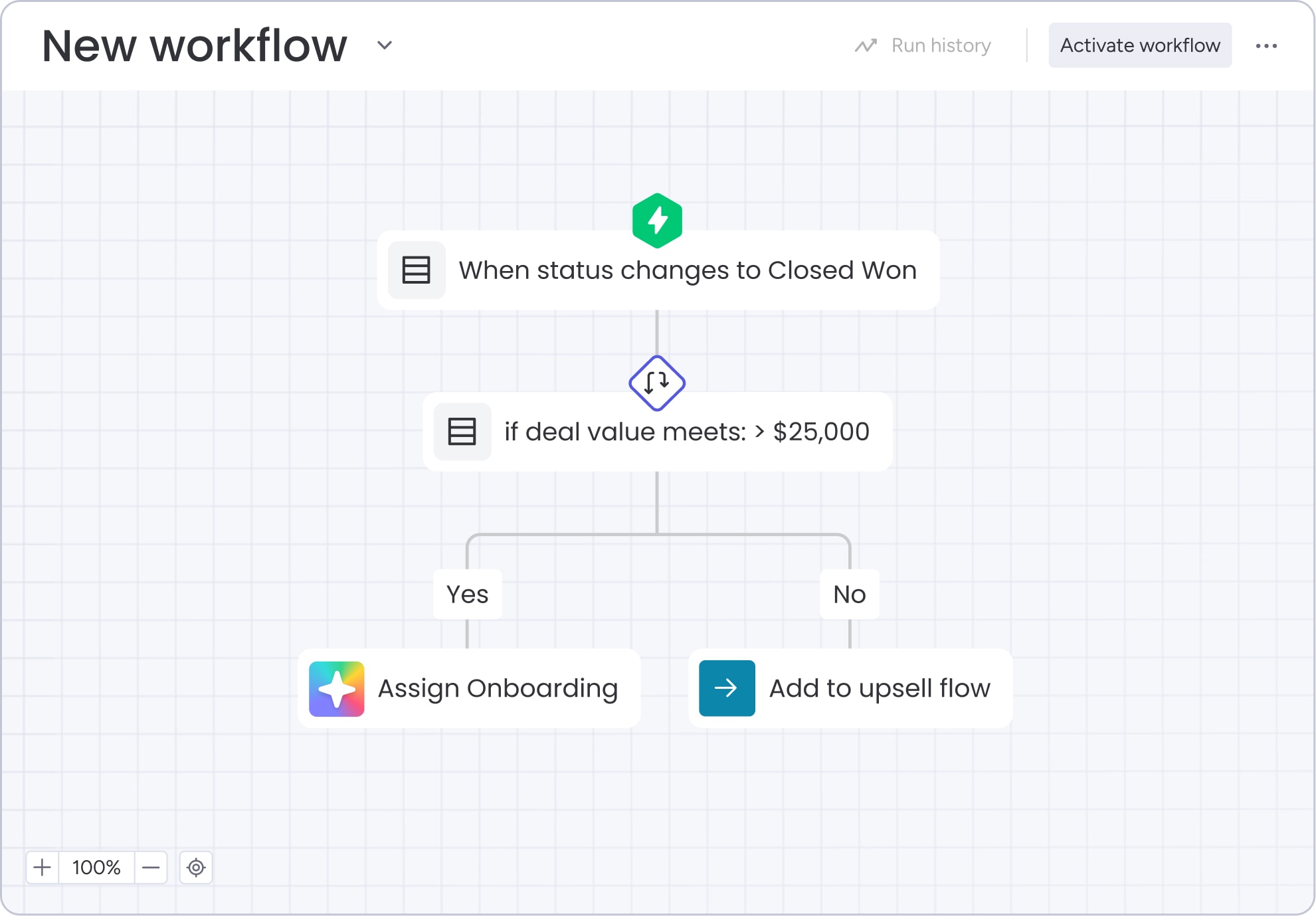
- Customizable pipelines and workflows: Visual boards let you design lead stages that match your actual sales process, with automations that trigger follow-ups and notifications at exactly the right time.
- Unified customer view: See all deals, accounts, contacts, and interaction history in one place so reps always have complete context without switching between systems.
- Real-time dashboards and reporting: Track response times, conversion rates, and pipeline health with customizable dashboards that reveal what’s working and what needs attention.
- Seamless team collaboration: Marketing and sales work from the same platform with shared visibility into lead quality, campaign performance, and conversion metrics.
When you implement the practices and processes outlined here on monday CRM, you’re not just improving lead conversion rates. You’re building the foundation for scalable, predictable revenue growth that compounds over time.

Turn leads into revenue with monday CRM
Effective lead management isn’t optional in today’s competitive landscape — it’s the difference between predictable revenue growth and missed opportunities. By implementing systematic capture, qualification, routing, nurturing, and optimization processes, you create a repeatable engine that converts prospects into customers while maximizing your team’s productivity and alignment.
monday CRM gives you everything you need to build this systematic approach in one centralized platform. From AI-powered lead scoring and automated workflows to real-time dashboards and unified customer views, you’ll have the tools to respond faster, convert more leads, and scale your revenue operations with confidence.
Try monday CRMFAQs
What is the difference between lead management and pipeline management?
The difference between lead management and pipeline management is their focus. Lead management covers the journey from initial contact through qualification, while pipeline management tracks qualified opportunities through the sales process to close. Lead management feeds the pipeline with qualified prospects, and pipeline management converts those qualified opportunities into customers.
How long should a lead stay in the nurturing stage?
The nurturing stage length depends on your sales cycle and buyer readiness. B2B leads with complex purchases may need weeks or months of nurturing, while simpler decisions may require only days. Monitor engagement signals like content consumption and email opens to determine when leads are ready for sales conversations.
How do you define a sales-ready lead?
A sales-ready lead demonstrates both fit and intent. They match your ideal customer profile in terms of company size, industry, and role while showing buying behavior like requesting demos, asking about pricing, or engaging with bottom-of-funnel content. Most teams define specific criteria that must be met before marketing hands leads to sales.
How do you prevent leads from falling through the cracks?
Preventing lost leads requires automated routing, follow-up reminders, and centralized tracking. Set up alerts for leads that haven't been contacted within your SLA window. Use dashboards to identify coverage gaps. Automated workflows ensure every lead receives appropriate follow-up regardless of rep availability.
What's the ideal number of follow-up attempts before marking a lead as unresponsive?
Most successful sales teams make between 5 and 8 follow-up attempts across multiple channels before marking leads unresponsive. Vary your approach with different times, channels, and messaging rather than repeating identical outreach. Space attempts appropriately to avoid overwhelming prospects while maintaining presence.
How do you measure lead quality versus lead quantity?
Lead quality is measured by conversion rates, sales cycle length, and deal size. High-quality leads convert more often, close faster, and generate more revenue. Track these metrics by lead source to identify which channels produce quality versus just volume. Quality indicators include engagement depth, fit score, and buying signals rather than simple lead counts.
