


For technology providers, customer support is no longer just a cost center for fixing broken things. It has become a core part of the product experience, directly influencing revenue, retention, and brand reputation. When service quality determines whether a customer renews or churns, the stakes are fundamentally different from traditional IT help desks. This shift requires a specialized approach: service management for technology providers (TPSM). It’s a strategic framework designed for companies that sell and support technology for external customers.
This guide covers the essential components of TPSM, from managing multi-product requests and incidents at scale to building self-service portals that customers actually use. You’ll learn how to move beyond simple SLAs to measure the customer experience and connect service performance directly to revenue. Building a successful service operation is about creating unified workflows that connect support, engineering, and customer success teams. By gaining visibility across the entire customer journey, you can resolve issues faster, deliver more consistent experiences, and scale your operations efficiently with platforms like monday service.
Key takeaways
- Revenue protection: TPSM turns service delivery into a revenue driver by managing customer support across products and tiers.
- Cost reduction: Unified operations cut costs by 40% through automation while connecting support, engineering, and customer success in one workflow.
- Automation efficiency: Self-service portals and AI handle routine requests, freeing your team for complex issues requiring human expertise.
- Rapid deployment: monday service launches in days with no-code customization and scales through AI-powered automation.
- Experience metrics: Track how service actually feels to customers, predict churn, and protect revenue before renewals.
What is technology provider service management?
Technology Provider Service Management (TPSM) is a strategic solution that integrates customer care and operations teams. It’s the practice of managing service delivery for companies that sell technology products or services to external customers, such as SaaS companies, managed service providers, and software vendors who need to support their customers at scale.
Unlike internal IT support that helps employees reset passwords, TPSM operates across customer accounts, product lines, and contractual commitments.
When a customer’s API integration fails or their billing sync breaks, that’s where TPSM comes in. The stakes are higher because service quality directly affects revenue, retention, and your brand reputation.
Understanding TPSM fundamentals
Service delivery is the end-to-end process of providing support, uptime, and issue resolution to customers. In TPSM, this includes both fixing technical problems and managing the customer experience around those fixes.
Multi-tenant support means serving many customers on shared platforms while keeping their data and configurations separate. When one customer reports a bug, you need to know if it affects just them, a segment of customers, or everyone using your platform.
Cross-product integration connects multiple services that customers use together. If a customer uses your CRM integration, analytics add-on, and billing connector, your support team needs to understand how they work as a system, not isolated products.
How TPSM differs from traditional service management
Traditional ITSM assumes everyone works for the same company and understands internal processes. TPSM doesn’t have that luxury. Your customers expect fast, accurate support without learning your organizational structure.
The economics change too. A slow internal password reset frustrates employees. But a delayed response to a customer’s API outage can block their transactions, trigger service credits, and risk losing their renewal. Here’s what makes TPSM fundamentally different:
| Dimension | Traditional ITSM | TPSM |
|---|---|---|
| Audience | Internal employees | External customers and partners |
| Complexity | One IT environment | Multiple products, deployment models, and service tiers |
| Accountability | Internal targets | Contractual SLAs and renewal risk |
| Communication | Informal internal updates | Every update needs to be accurate, timely, and professional |
Core ITSM principles adapted for technology providers
ITSM principles still apply, but they expand to handle external customers:
- Incident management includes customer communication, impact analysis across accounts, and coordinated escalations between support and engineering teams.
- Problem management shifts from fixing internal issues to preventing customer-wide problems. When you spot a recurring sync error affecting hundreds of accounts, you need to link it to product defects and track the business impact.
- Change management can’t rely on monthly approval meetings when you deploy updates daily. You need risk-based approvals that let low-risk changes flow through while carefully reviewing anything that could affect customer operations.
Why technology providers need specialized service management
Generic service management treats support as a cost center. But for technology providers, service quality determines whether customers renew, expand, or churn. You’re not just fixing problems, you’re protecting recurring revenue.
Customer expectations have shifted dramatically. They want the same seamless experience from B2B software that they get from consumer apps. When an integration fails, they expect personalized support with full context, not a generic ticket number.
Hidden costs of fragmented support systems
Without unified service management, costs multiply in ways that aren’t always obvious. Here’s where fragmentation hurts most:
- Duplicate work: Teams re-enter the same customer details across ticketing, CRM, and engineering systems
- Inconsistent experiences: Customers get different answers depending on which channel or team they reach
- Slow resolution: Agents waste time hunting for context across disconnected systems
- Blind spots: Leadership can’t see the full picture of service performance or customer health
These problems compound as you grow. As each new product or customer segment adds complexity, how can you prevent your support model from becoming unsustainable?
Competitive advantages through unified service operations
Unified service operations create measurable business value. When every interaction draws from the same customer history and product context, your team can respond with precision. Issues that used to require multiple back-and-forth exchanges get resolved in one interaction.
monday service connects these dots by linking service operations with the rest of your business. Support tickets connect to engineering work, customer success initiatives, and account data in one platform. That visibility helps you deliver consistent service while scaling efficiently.
5 essential components of Technology Provider Service Management
These components address the unique challenges technology providers face when supporting external customers across complex product ecosystems.
1. Multi-product service request management
Customers don’t think in product silos. A single request might include SSO setup, API access, reporting permissions, and billing changes. Effective multi-product management requires unified workflows that capture the full request once and route components to the right teams while maintaining one customer-facing thread.
2. Incident and problem management at scale
When paying customers are affected, you need to restore service fast while keeping them informed with clear updates. Scale introduces pattern-recognition challenges—ten separate tickets might point to the same backend issue. Linking incidents across products and accounts helps you spot systemic problems early and communicate through one coordinated response.
3. Continuous deployment change management
Technology providers deploy changes constantly, sometimes multiple times per day. Modern change management separates updates by risk level: automated approvals for low-risk changes, streamlined review for standard updates, and full assessment for changes affecting customer operations. Customer communication becomes part of the process through timely notifications for maintenance windows, API updates, and feature changes.
4. Self-service knowledge management
Self-service empowers customers to solve problems on their terms. B2B customers often prefer immediate answers over waiting for support. Effective self-service combines searchable documentation, guided troubleshooting flows, and community knowledge. monday service connects knowledge management with service workflows, surfacing relevant articles automatically or escalating intelligently when needed.
5. Cross-product IT asset management
Technology providers manage complex asset relationships: cloud resources, customer instances, integrations, and product dependencies. Asset visibility improves troubleshooting speed. When you can see that a reporting issue only affects customers using a specific connector version in certain regions, you can target your response precisely.
The business benefits that drive TPSM ROI
TPSM investment delivers measurable returns through cost reduction, revenue protection, and operational efficiency. Here’s what technology providers gain from unified service management.
Cut operational costs with intelligent automation
Intelligent automation can reduce operational costs by eliminating repetitive work that consumes expensive support hours. Ticket classification, routing, status updates, and standard responses run automatically based on rules or AI models. This means your agents spend less time on administrative tasks and more time solving real customer problems.
The savings scale with growth. With intelligent workflows, you absorb more volume through systems rather than headcount.
Higher customer lifetime value through consistent experiences
Service consistency directly impacts recurring revenue. When every touchpoint feels connected and professional, customers trust you with their business-critical operations.
Inconsistent service creates early warning signs of churn. If enterprise support is excellent but SMB support is fragmented, customers question your ability to scale with them.
Faster cross-product issue resolution
Complex issues often span multiple systems. A login failure might involve identity settings, API behavior, and third-party integrations all at once.
Unified service management keeps everything in one workflow. Teams can link related issues, share notes, and update customers through a single thread instead of bouncing between systems.
Complete visibility into service performance metrics
Comprehensive metrics reveal what’s really happening in your service operations. You need to track:
- Response and resolution times: How quickly you acknowledge and solve issues
- Customer satisfaction: Whether customers are happy with the outcome
- Reopen rates: How often “resolved” issues come back
- Product-linked patterns: Which features generate the most support burden
This visibility drives accountability and improvement. If one integration causes excessive escalations, you know where to invest engineering effort.
Linear scaling without exponential cost growth
TPSM enables sustainable growth by standardizing common processes and automating routine decisions. As volume increases, your cost per ticket decreases because systems handle coordination that would otherwise require more staff.
This doesn’t mean replacing human support. It means reserving human expertise for complex, high-value interactions while systems handle the routine work efficiently.
Proactive service delivery through predictive analytics
Predictive analytics help you prevent problems instead of just responding faster. By analyzing usage patterns and incident history, you can identify accounts at risk and intervene early.
Common scenarios include spotting integrations that fail under specific conditions, identifying customers approaching performance limits, and flagging components with rising incident rates before they cause outages.
TPSM vs traditional ITSM for technology companies
Traditional ITSM works well for internal support, but technology companies need more. TPSM treats service operations as part of the product experience, not a separate function. Here’s how they compare:
| Dimension | Traditional ITSM | TPSM |
|---|---|---|
| Scope | Known user base with shared context and internal processes | Complex environment with different configurations, entitlements, and expectations per account |
| Communication standards | Informal internal updates | Professional polish required—poor updates damage your brand |
| Accountability | Internal targets and flexible timelines | Contractual obligations with stronger prioritization and audit trails |
| Impact assessment | Single organization scope | Multi-tenancy requires precise analysis—is this affecting one customer or thousands? |
| Cross-functional collaboration | Limited to IT department workflows | Requires support, engineering, DevOps, and customer success working from shared context |
| Integration complexity | Single IT environment with standard tools | Diverse technology stacks: cloud services, mobile apps, APIs, billing systems, and monitoring platforms |
| Scaling approach | Linear growth with predictable needs | Rapid complexity from new products, premium tiers, and global expansion requiring flexible processes and automation |
Effective collaboration in TPSM requires visible workflows tied to the same customer record. monday service enables this through shared boards where teams see the same timeline, updates, and next steps without switching contexts, creating an orchestration layer that brings together monitoring alerts, development systems, CRM data, and service workflows in one place.
Building self-service as your primary support channel
Self-service delivers value for both customers and support teams. Customers get immediate answers without waiting in queues. Support teams focus on complex issues that truly need human expertise.
Designing B2B self-service portals that customers actually use
B2B portals succeed when they match how business users actually work. Design your portal with these principles:
- Role-based content: Admins need different information than end users or developers
- Intuitive navigation: Organize by common tasks like onboarding, troubleshooting, and configuration
- Seamless escalation: Let customers move from self-service to human support without starting over
- Account awareness: Show relevant content based on the customer’s products and configuration
Common mistakes include burying important content behind poor search, mixing beginner and advanced topics without clear labels, and making it hard to reach human support when needed.
AI-powered resolution workflows for complex technical issues
AI guides customers through structured troubleshooting for issues too complex for static articles. Effective workflows ask targeted questions, recognize patterns, and narrow down causes before escalating if needed.
Strong AI workflows handle specific scenarios like:
- Authentication problems: Checking SSO config, MFA settings, or provisioning issues
- Integration failures: Reviewing error patterns and routing to specialists
- Performance complaints: Correlating symptoms with known issues or incidents
Measuring self-service adoption and success rates
Track metrics that show real impact, not just activity. With the analytics dashboards on monday service, you can monitor key indicators like adoption rates, resolution rates for issues solved without agent help, and search success to see if customers find useful content.
Use these metrics to improve content continuously. Update popular articles regularly, refine confusing workflows, and add new content based on common ticket themes.
Moving beyond SLAs to experience-based metrics
SLAs measure operational compliance, but they miss how service actually feels to customers. You can meet every SLA and still deliver a frustrating experience.
Experience Level Agreements (XLAs) measure service from the customer’s perspective, tracking effort required to get help, communication clarity, and confidence in the resolution. While SLAs might track “first response within 1 hour,” XLAs measure whether that response was actually helpful.
Here are a few critical experience metrics to track:
- Customer effort score: How hard customers work to get issues resolved
- Resolution satisfaction: Whether the outcome met expectations
- Communication effectiveness: Clarity and timeliness of updates
- Time to confidence: How quickly customers feel their issue is understood
- Channel containment: Whether customers can complete journeys without escalating
Service metrics become strategic when linked to business outcomes. High-effort interactions often predict churn before it shows in renewal discussions. Show how service quality affects net revenue retention, support cost per account, and customer lifetime value. This transforms service from a cost center to a revenue protector.
7 steps to implement TPSM in your organization
Successful TPSM implementation requires thoughtful planning and staged execution. Here’s how to transform your service operations without disrupting current support.
Step 1: Assess your current service management maturity
Review your processes, tools, data quality, and team capabilities. Most providers find pockets of excellence alongside areas needing improvement. Ask whether teams can quickly identify which customers are affected by issues, if support and engineering share the same view of incidents, and whether leadership trusts service data for decisions.
Step 2: Define your cross-functional service strategy
Align service operations with business priorities. Clarify which services you offer, who owns them, and what success looks like. Get agreement from support, engineering, product, and customer success teams. Your strategy should reflect your business model. For example, a SaaS company targeting enterprise might prioritize premium support and incident transparency.
Step 3: Select the right ITSM software platform
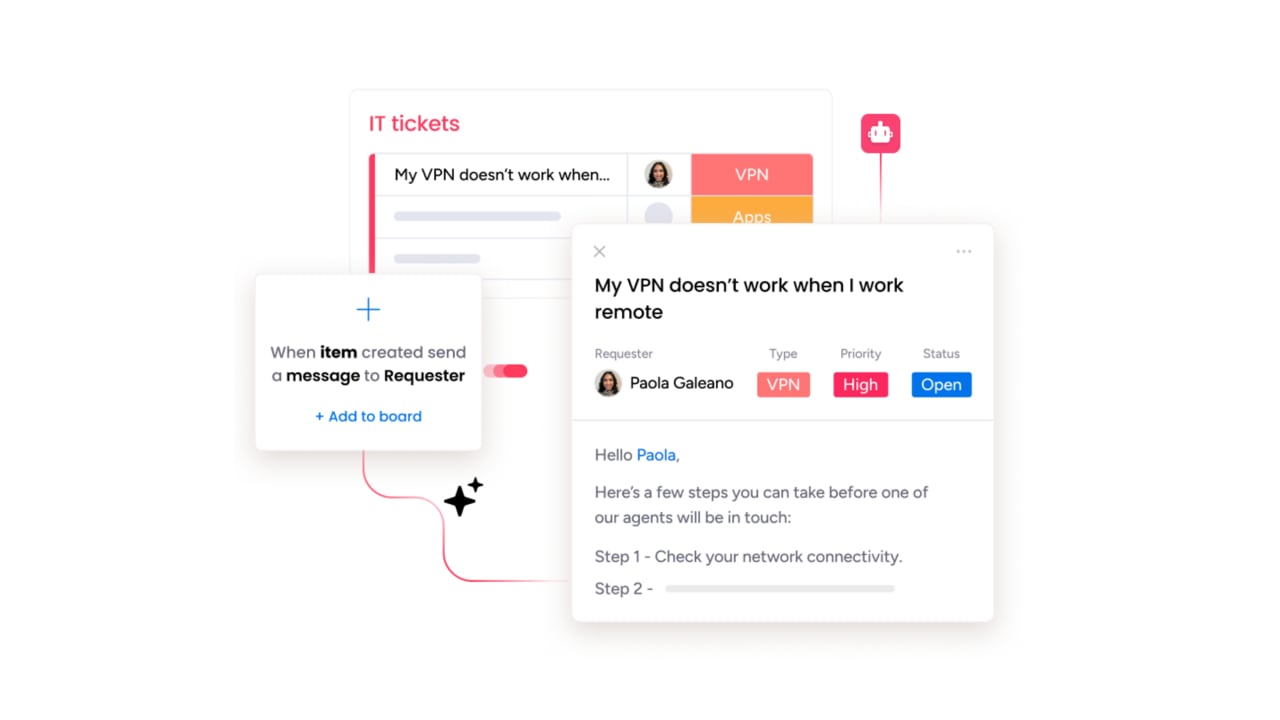
Choose ITSM software that supports external service delivery and cross-team coordination. Look for multi-tenancy support, workflow flexibility, customer portals, automation capabilities, and deep integrations. monday service excels here with fast deployment, no-code customization, and connections across your entire business. You can start with basic workflows and expand as you grow.
Step 4: Design unified workflows across departments
Define how issues move between teams. Focus on high-impact journeys like major incidents, customer escalations, and product defects. Good workflows include clear ownership, escalation triggers, and customer communication points. They connect teams without creating bureaucracy.
Step 5: Launch self-service capabilities
Roll out self-service in phases. Start with a knowledge base for common issues, add portal intake forms to capture requests properly, then build guided workflows for complex troubleshooting. Position self-service as the fastest path to answers, not a barrier to support. Train agents to guide customers to helpful resources.
Step 6: Deploy AI and automation strategically
Automate ticket categorization, routing, status updates, and standard responses. Choose processes with clear patterns and measurable impact. monday service provides AI-powered ITSM automation that augments your team rather than replacing them. Start small and expand based on results.
Step 7: Establish continuous improvement processes
TPSM requires ongoing refinement. Schedule regular reviews of incident trends, customer feedback, and workflow performance. Make service improvement part of your operating rhythm, not a one-time project. Treat it as product development for your service organization.
Try monday serviceChoosing the best IT service management platform for tech providers
Your ITSM platform becomes the operational backbone of customer service delivery. Choose one that grows with your business and connects all aspects of service management.
Must-have features for technology service delivery
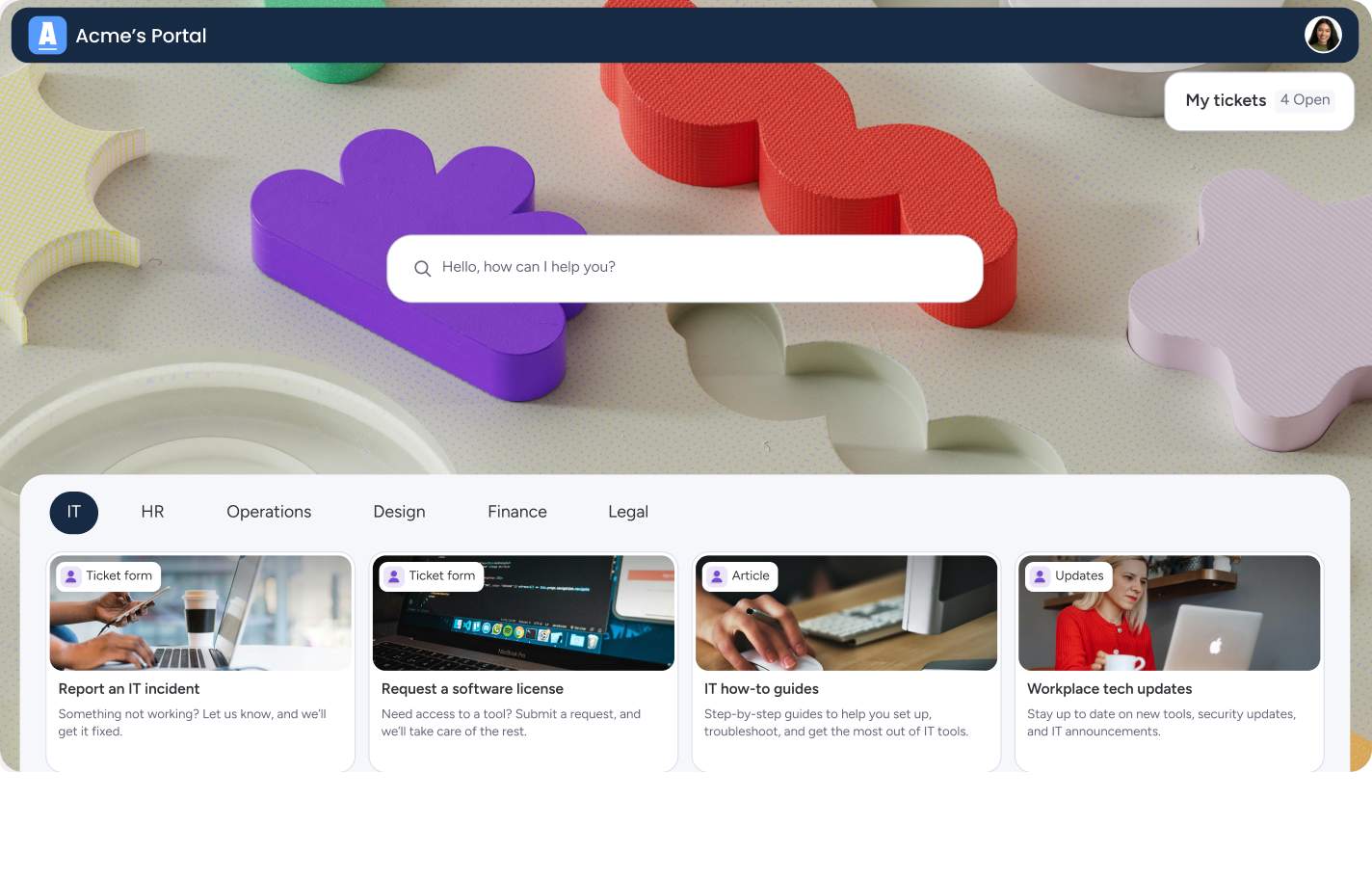
Technology providers need specific capabilities beyond basic ticketing. Essential features include:
- Multi-tenant data separation: Keep customer data and configurations secure and isolated
- Customer self-service portals: Let customers find answers and submit requests on their own
- Flexible workflow automation: Adapt processes without heavy development work
- Robust APIs and integrations: Connect with your existing DevOps, CRM, and monitoring tools
- Structured incident and change management: Handle issues systematically with clear accountability
- Knowledge management: Build and maintain searchable documentation that customers actually use
- Real-time reporting and analytics: Track performance and spot trends as they happen
- Scalability without heavy customization: Grow your service operations without constant platform overhauls
ITSM platform evaluation criteria
Evaluate platforms based on how well they fit technology provider needs:
- Customer-facing capabilities: Portal quality, multi-tenancy, communication workflows
- Integration depth: Connections to DevOps, CRM, monitoring, and billing systems
- Workflow flexibility: No-code customization and cross-team routing
- Analytics: Real-time dashboards and custom reporting
- Implementation speed: How quickly you can launch and iterate
Test with real scenarios. Can the platform handle a cross-product incident? Does it connect support with engineering smoothly? How easy is it for agents to learn?
Calculating total cost of ownership
Look beyond license costs. Consider implementation effort, integration development, training requirements, ongoing administration, and opportunity costs from delayed deployment. Platforms like monday service with no-code flexibility often have lower long-term costs despite higher license fees.
Implementing AI-powered service management while keeping it human
AI improves service most when it enhances human capabilities rather than replacing them. Use automation for repetitive tasks while preserving human judgment for complex issues. The best results come from choosing AI-powered IT management software that automates repetitive tasks while preserving human judgment for complex issues.
Here’s how to balance automation with personalized support:
- Automate the routine: Handle high-volume tasks like ticket routing, status updates, and standard responses automatically
- Reserve human expertise: Keep people focused on high-value escalations, complex technical issues, and sensitive customer situations
- Put AI in a supporting role: Let AI draft responses while agents make final decisions, gather context before escalating, and flag quality issues for coaching
- Train for collaboration: Help teams know when to trust AI suggestions and when to override them based on context
- Keep it personal: Maintain your brand voice in automated messages, provide clear paths to human support, and preserve context between interactions
Good automation feels like efficient service. Bad automation feels like being bounced between robots. Customers welcome automation that saves time but resist it when it blocks access to help or forces them through irrelevant workflows.
How monday service transforms Technology Provider Service Management
monday service addresses the unique challenges technology providers face by connecting service operations with every part of your business. It’s built for teams that need flexibility, speed, and visibility across complex service environments.
Connect service operations with every moving part of your business
Service issues rarely exist in isolation. monday service links support tickets with engineering work, customer success initiatives, and account data in one platform. When a product defect affects multiple customers, everyone sees the same picture and works from shared context. This connected approach reduces the time agents spend hunting for information and improves the accuracy of every response.
Deploy in days with no-code customization

Traditional ITSM platforms require months of implementation. monday service launches fast with pre-built templates and drag-and-drop workflows. You can start with basic ticket management and expand into complex multi-team processes without waiting for IT projects. No-code customization means your service team can adapt workflows themselves as needs change.
Scale confidently with AI-powered automation

monday service uses AI to handle routine work intelligently. Automatic ticket categorization, smart routing, and suggested responses help teams manage growing volume without proportional headcount increases. Agents get suggestions and automation handles repetitive tasks, but people still make the important decisions.
Deliver exceptional experiences through real-time insights
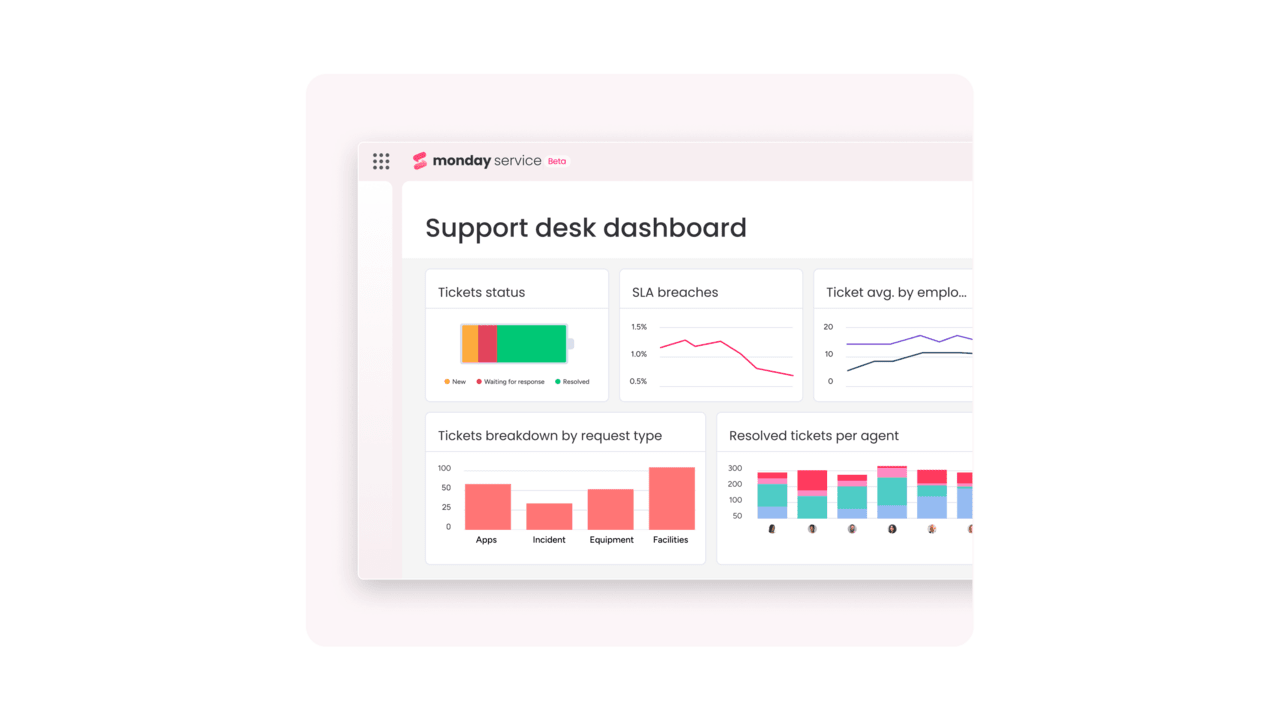
Real-time dashboards show what’s happening across your service operation right now. Track SLA performance, identify bottlenecks, and spot trends before they become problems. This visibility helps you make proactive improvements instead of reacting to complaints. You can see which products generate the most tickets, where processes slow down, and how changes affect service quality.

"Our team LOVES the monday service platform and we’re already exploring how we could incorporate it for other departments, too. It has streamlined our workflow in a way that both our team and customers appreciate."
Andrew Marshall | VP Operations
״monday service provides clear insights into requests volume and types, response times, and trends - helping us continuously improve operations"
Grant De Waal-Dubla | CIO
"The biggest value for us is speed and flexibility. You can get up and running in days, change anything instantly, and see everything in real time. And you don’t need a dedicated admin to do it."
Clive Camilleri | Head of People Tech & OperationsAccelerate your service excellence with the right software
Technology Provider Service Management has evolved from a support function to a strategic differentiator. The companies that excel at service delivery retain more customers, expand accounts faster, and build stronger competitive moats.
monday service gives you the foundation to build world-class service operations. With flexible workflows, AI-powered automation, and connections across your business, you can deliver the seamless experience customers expect while maintaining operational efficiency.
Try monday serviceFAQs
What's the difference between ITSM and ESM?
The difference between ITSM and ESM is scope. ITSM focuses specifically on managing IT services like help desk support and infrastructure management. ITSM focuses specifically on managing IT services like help desk support and infrastructure management. ESM extends those same service management principles to other departments like HR, facilities, and finance. Technology providers often need both — ITSM for internal IT support and ESM principles for managing customer-facing services across all departments.
How long does TPSM implementation typically take?
TPSM implementation typically takes 3 to 6 months for a full rollout, though you can launch core workflows within weeks. The timeline depends on your current maturity, integration complexity, and how many teams need to adopt new processes. Starting with high-impact workflows and expanding gradually usually works better than trying to transform everything at once.
Can small technology providers benefit from formal service management?
Small technology providers benefit significantly from formal service management because it establishes scalable processes early. Starting with basic workflows and consistent practices prevents the chaos that comes with rapid growth. Even simple improvements like standardized ticket routing and basic automation can dramatically improve service quality and team efficiency.
Which IT service management services should we prioritize first?
Technology providers should prioritize incident management and self-service first. Incident management ensures you can handle critical issues professionally when they arise. Self-service reduces ticket volume while giving customers faster answers. After establishing these foundations, add request management, knowledge management, and change management based on your specific pain points.
How do consumption-based pricing models affect service delivery?
Consumption-based pricing affects service delivery by requiring tighter integration between support and billing systems. You need to track usage accurately, communicate limits clearly, and help customers optimize their consumption. Service teams often become advisors who help customers get more value while managing costs, which requires different skills than traditional break-fix support.
What compliance requirements apply to technology provider service management?
Compliance requirements for technology provider service management vary by industry and geography. Common frameworks include SOC 2 for security controls, ISO 27001 for information security, GDPR for data protection, and HIPAA for healthcare data. These require documented processes, audit trails, access controls, and incident response procedures built into your service management platform.

 Get started