


Many service teams feel stuck in a reactive loop, constantly putting out fires instead of preventing them. This approach creates operational drag and keeps your team from contributing to larger business goals. The key is to shift from a simple help desk to a strategic digital workspace, and the right ITIL service desk software provides the framework to make that happen. Modern platforms make this proven methodology intuitive and accessible for any team.
This guide walks through everything you need to know to make that transition. It explores the essential features of a great service desk, compares the top platforms, and shares best practices for a smooth implementation. The goal is to provide you with a clear playbook for transforming your service delivery into a driver of business growth.
Try monday serviceKey takeaways
- ITIL turns reactive support into proactive service operations by standardizing how teams handle incidents, changes, and requests.
- The right platform should be easy to adopt, automate routine work, and integrate with your existing stack without months of configuration.
- AI-powered automation now handles ticket classification, routing, and initial response, freeing agents for complex problem-solving and strategic work.
- Compare platforms on usability, time-to-value, and total cost of ownership, then pilot with real tickets before committing.
- A phased implementation approach, starting with incident management, delivers the fastest and most visible results.
What is ITIL service desk software?
An ITIL service desk provides a standardized framework for managing the full lifecycle of IT services, from incident handling to driving continuous improvement. It helps teams transition from reactive troubleshooting to predictable, repeatable processes that improve service quality and reliability across the organization.
ITIL 4 introduced a service value system that replaced the rigid process chains of earlier versions with flexible, outcome-driven practices. ITIL 5, released in February 2026, extends the vision further. It integrates AI governance through its 6C Capability Model, formally adopting Experience Level Agreements (XLAs), and expanding beyond IT into digital product and service management. These frameworks give organizations a shared language and structure for delivering value. But what does that look like when your team is handling 500 tickets a week? It starts with ticketing software that can scale from a handful of requests to thousands without losing structure.
Modern ITIL service management software translates those practices into:
- automated workflows
- AI-driven triage
- real-time analytics
Instead of requiring teams to manually follow process maps, today’s ITSM software platforms embed ITIL principles directly into the way work flows. The result is a service organization that operates with greater control and transparency, where teams can identify recurring issues, reduce downtime, and scale service delivery without losing visibility.
5 best ITIL service desk software platforms
Selecting the right ITIL service desk platform means evaluating more than feature checklists. The platforms below were chosen based on their ITIL alignment, ease of adoption, AI capabilities, integration ecosystems, and total cost of ownership. Each one takes a different approach to service management, and the right fit depends on your team’s size, technical maturity, and operational priorities.
1. monday service
Best for: Organizations that want enterprise-grade ITSM capabilities with fast adoption and flexibility across departments.
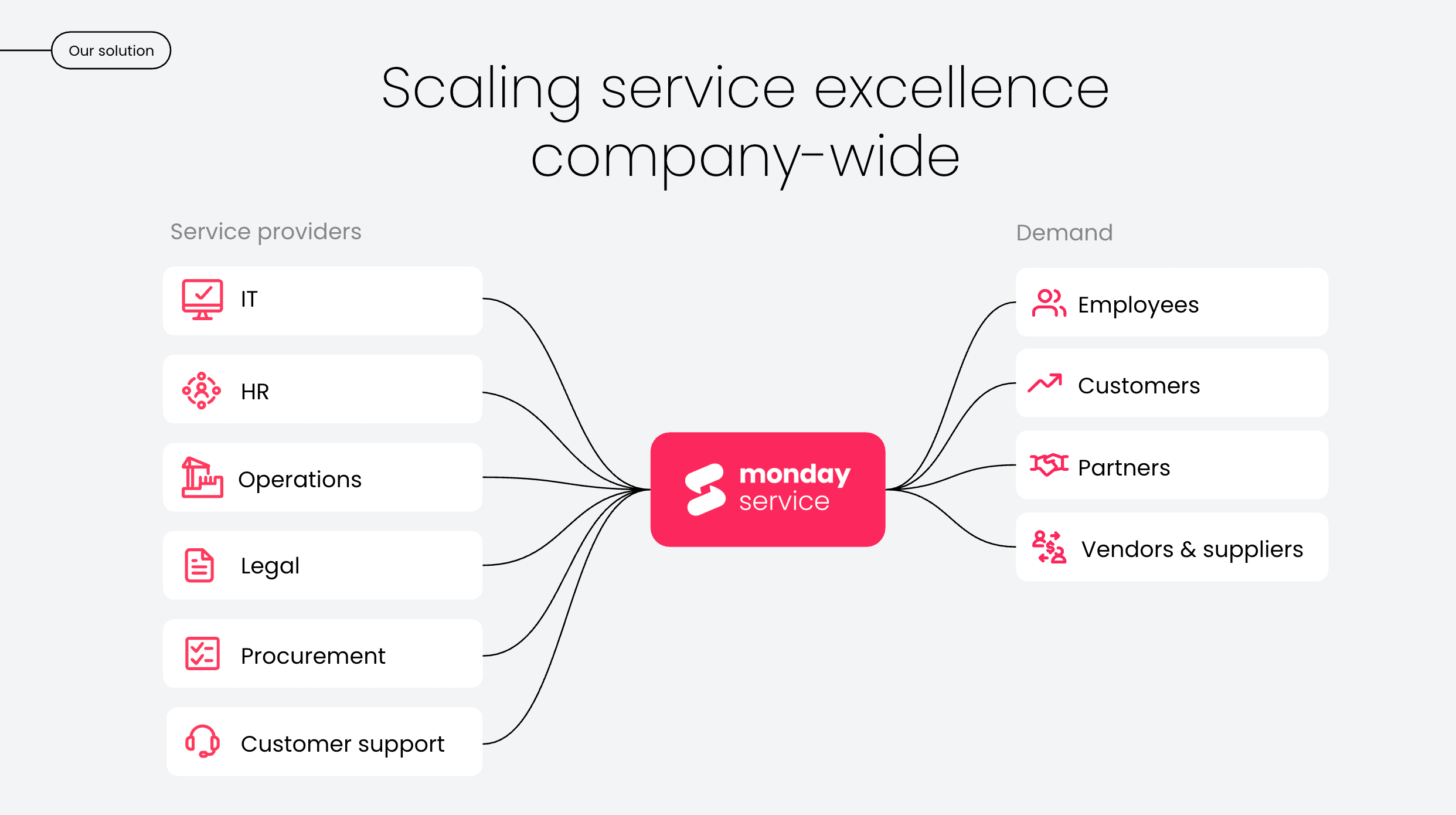
monday service helps organizations translate ITIL principles into visual, no-code workflows that scale across departments. SItting on top of monday.com’s AI Work Platform, it connects IT, HR, facilities, and other service teams in 1 unified workspace, making it straightforward to manage requests, track SLAs, and improve performance across the business.
Key features
- AI workforce with specialized agents: IT Help Agent, Device Agent, and Access Agent autonomously resolve repetitive requests, while the Service AI Supervisor intelligently routes each ticket to the right agent.
- monday sidekick: A context-aware assistant embedded in tickets that summarizes context, recommends next steps, drafts replies, and finds similar resolved tickets for faster resolution.
- AI-powered columns: Automate ticket triage by summarizing, categorizing, detecting sentiment, and assigning tickets to the right owner automatically.
- Incident management: Dedicated Incidents board linked to the Tickets board with built-in postmortem reports for root cause analysis.
- SLA column: Live timer tracking time to resolution with auto-pause outside working hours so metrics reflect actual service time.
- Customer portal: Self-service portal where employees submit requests and track progress in real time.
- Multi-channel intake: Email, WorkForms, monday Inbox, and Outlook shared mailbox integration.
- No-code automations: Pre-built recipes for status updates, ticket routing, and SLA monitoring, plus a workflow builder for complex multi-step processes.
- 72+ integrations, open API, and MCP connectivity: Connect with your existing stack and external AI platforms.
Pricing
- Standard: $31/seat/month (billed annually) — unlimited tickets, core service desk features, automations, SLA management, AI-powered columns
- Pro: $45/seat/month (billed annually) — everything in Standard plus advanced automations, workflow builder, enhanced AI capabilities
- Enterprise: Contact sales — full feature set including advanced security, governance, and custom configurations
All plans include a free trial and unlimited tickets.
Why it stands out
- Go live in days, not months: No-code configuration and pre-built templates mean teams launch ITIL workflows without developer support or lengthy implementation projects.
- Cross-departmental service delivery: A single workspace connects IT, HR, facilities, and legal service operations so requests flow across teams without context switching.
- Enterprise-grade trust: SOC 2 Type II, ISO 27001, and HIPAA compliance meet the security and governance requirements of regulated industries.
Automation
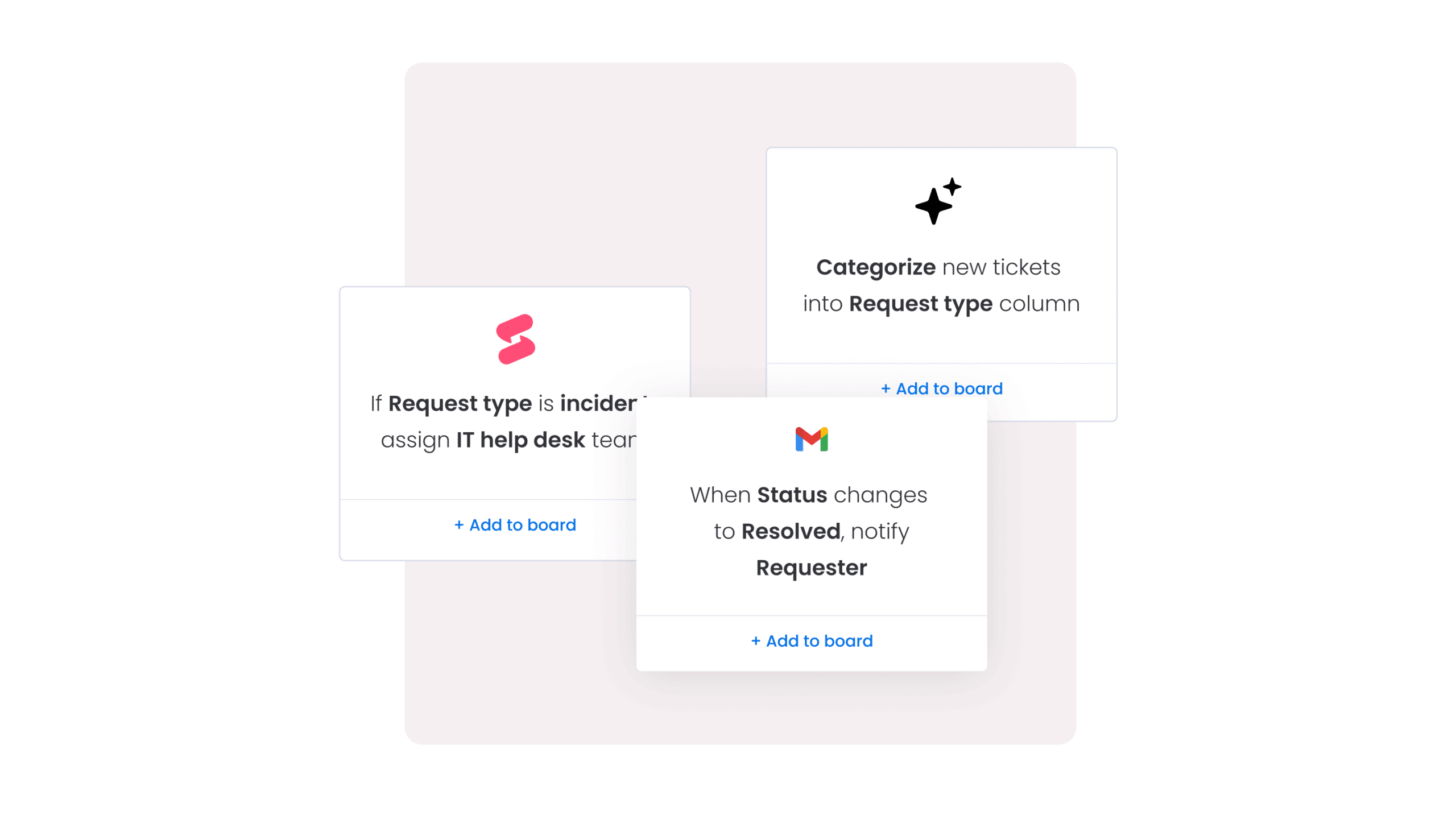
- Pre-built automation recipes: Out-of-the-box workflows handle status updates, ticket routing, SLA monitoring, and follow-up notifications without manual configuration.
- Enterprise workflow builder: Visual, no-code workflow builder supports complex multi-step processes across departments, including conditional logic, approvals, and cross-board actions.
- Email Automation app: Trigger dynamic, customizable responses at any stage of the support process based on ticket creation, status changes, or date-based events.
Integration
- 72+ native integrations: Connect with Slack, Microsoft Teams, Jira, Salesforce, and other enterprise platforms to keep communication and context consistent across your stack.
- Open API and MCP connectivity: Build custom integrations with existing enterprise systems and connect external AI platforms through Model Context Protocol for expanded automation capabilities.
- Bi-directional sync: Data flows automatically between monday service and connected platforms, ensuring records stay current without manual updates.
ITIL service desk software features
- Dedicated Incidents board: Escalate complex tickets to a structured Incidents board with linked tickets, categorization, and built-in postmortem report templates for root cause analysis.
- SLA column with live tracking: Real-time timer monitors time to resolution with automatic pause outside working hours, clear breach indicators, and configurable targets per service level.
- Customer portal for self-service: A centralized portal where employees browse knowledge articles, submit requests through guided forms, and track ticket progress independently.
2. ServiceNow
Best for: Global enterprises standardizing complex IT operations
For large organizations aiming to standardize complex IT operations at scale, ServiceNow provides an enterprise-grade ITIL service desk solution. The platform is a leader in comprehensive workflow automation and AI-powered service management, establishing it as the preferred choice for Fortune 500 companies.

Key features:
- AI-powered automation to summarize incidents, generate email responses, and provide intelligent recommendations for faster resolution
- Comprehensive CMDB integration for visibility into IT assets and relationships to support proactive problem management and informed decisions
- Enterprise workflow orchestration with low-code allows teams to automate complex approval processes and cross-departmental handoffs without heavy development resources
Pricing:
ServiceNow pricing is custom based on organization size and modules, with enterprise packages that include workflow automation, CMDB capabilities, and AI-powered insights. Prospective customers can request a tailored quote through the ServiceNow sales team.
Considerations:
- High implementation complexity: Initial setup and customization often require significant professional services and can take months to deploy fully
- Steep learning curve: Both administrators and end-users frequently report challenges mastering the platform’s extensive feature set and customization options
3. Jira Service Management
Best for: Dev-centric teams working in the Atlassian ecosystem

Key features:
- DevOps integration connects service requests with development workflows, allowing easy escalation between IT support and development teams for faster issue resolution
- Multi-channel support consolidates requests from Slack, Microsoft Teams, email, and customer portals into unified request queues with conversational ticketing capabilities
- ITIL 4 compliance provides PinkVERIFY-certified processes for incident management, problem management, change enablement, and service request management out of the box
Pricing:
Jira Service Management pricing starts at $7.53 per user per month for standard ITSM features and up to 100,000 users per site. Premium and Enterprise tiers add unlimited storage, uptime SLAs, and advanced automation. A free plan is available for small teams.
Considerations:
- Steep learning curve for non-technical users, with the platform’s extensive features potentially overwhelming teams that only need basic help desk functionality
- Limited customer portal customization options and many advanced features, like AI capabilities, are locked behind higher-priced Premium and Enterprise plans
4. Zendesk
Best for: Support teams prioritizing omnichannel experience
Zendesk offers a flexible ITIL service desk solution that prioritizes an intuitive user experience over rigid process adherence. Its specialization in omnichannel support and clean design makes it an excellent fit for organizations seeking an agile approach to IT service management. Instead of enforcing strict ITIL compliance, Zendesk adapts to a team’s specific needs and maturity level.

Key features:
- Unified omnichannel workspace that consolidates email, chat, phone, and social media interactions into a single agent interface
- AI-powered automation with intelligent ticket routing, pattern recognition, and generative AI for content creation and response optimization
- Comprehensive knowledge management system with searchable FAQs, troubleshooting guides, and self-service portals enhanced by AI
Pricing:
Zendesk pricing starts at $19 per agent per month for basic support features, with higher tiers including AI-powered automation, omnichannel routing, and analytics. A free trial is available across all plans.
Considerations:
- Requires significant configuration time and effort to achieve strict ITIL compliance, as it’s not a dedicated out-of-the-box ITIL solution
- Lacks a native Configuration Management Database (CMDB) and some advanced ITSM capabilities found in specialized platforms, potentially requiring third-party integrations
5. Freshservice
Best for: Mid-market teams adopting ITIL quickly

Freshservice provides an ITIL-aligned service desk designed for rapid deployment and ease of use, making it a strong choice for mid-market organizations. The platform excels at translating complex IT processes into intuitive, user-friendly workflows, bridging the gap between powerful functionality and accessible design. Its PinkVERIFY™ certification across multiple ITIL processes ensures a solid foundation for ITSM best practices.
Key features:
- Complete ITIL process coverage, including incident, problem, change, and release management, with out-of-the-box workflows
- AI-powered automation through “Freddy AI” that handles ticket routing, classification, and resolution suggestions
- Integrated asset management and CMDB capabilities that provide full visibility into IT infrastructure and dependencies
Pricing:
Freshservice pricing starts at $19 per agent per month for essential ITSM workflows. Growth and Pro plans add advanced automation, analytics, and asset management, while the Enterprise tier includes full ITIL coverage. A 14-day free trial is available without a credit card.
Considerations:
- Advanced reporting and analytics capabilities are limited compared to enterprise-focused competitors, which may restrict deeper performance insights
- Mobile app functionality doesn’t match the full desktop experience, potentially limiting field agent productivity
What to look for in ITIL service desk software
So what separates a platform that checks the ITIL box from one that transforms how your team delivers service? The difference usually comes down to how well the platform translates ITIL theory into daily workflows. The capabilities below represent the foundation of effective ITIL service desk operations, and each one directly impacts how quickly your team resolves issues and how consistently they deliver results.
Incident and problem management
Incident management is about restoring service as quickly as possible. Problem management goes a step further, identifying root causes so the same issues do not keep recurring. An effective ITIL ticketing system combines both in 1 centralized workspace.
The most important capabilities here include:
- Automated escalation paths: Assign ownership instantly and prevent tickets from stalling in queues.
- Root cause analysis workflows: Link related incidents to underlying problems and document findings for future prevention.
- Postmortem reporting: Capture what happened, why, and what changed after every major incident.
Change and release management
Every change to your IT environment carries risk. Structured change management reduces that risk by requiring approvals, documenting decisions, and creating audit trails that support compliance. Release management adds deployment gating so updates reach production only after proper review.
Prioritize platforms that offer:
- Configurable approval workflows: Route change requests through the right stakeholders based on risk level and category.
- Audit trails: Maintain a complete record of who approved what, when, and why.
- Risk assessment scoring: Flag high-risk changes before they reach production environments.
Knowledge management
A shared knowledge base turns resolved tickets into reusable insights. When agents can find proven solutions in seconds, resolution times drop. When employees can find answers through a self-service portal, ticket volume drops. Knowledge management is 1 of the highest-impact capabilities in any ITSM platform.
Effective knowledge management includes:
- Searchable article repositories: Indexed content that agents and employees can find through natural language queries.
- Self-service portals: Deflect tickets before they are created by surfacing relevant articles at the point of request.
- AI-suggested solutions: Automatically recommend articles based on ticket content and context.
SLA tracking and reporting
Clear SLA tracking keeps your team accountable and gives leadership visibility into service performance. Real-time dashboards transform raw data into actionable insights that connect daily operations to broader business outcomes.
Key metrics to track include:
- Mean time to resolution (MTTR): How quickly your team resolves incidents from first contact to closure.
- First-contact resolution rate: The percentage of tickets resolved without escalation or follow-up.
- SLA adherence: Breach alerts and performance trends that highlight where processes need attention.
AI-powered automation
AI has moved from a differentiator to a baseline expectation. According to ITSM.tools’ 2026 State of AI in IT report, 98% of IT organizations now use AI in some form. Gartner predicts that by 2029, agentic AI will autonomously resolve 80% of common service issues without human intervention.
The AI capabilities that deliver the most immediate value include:
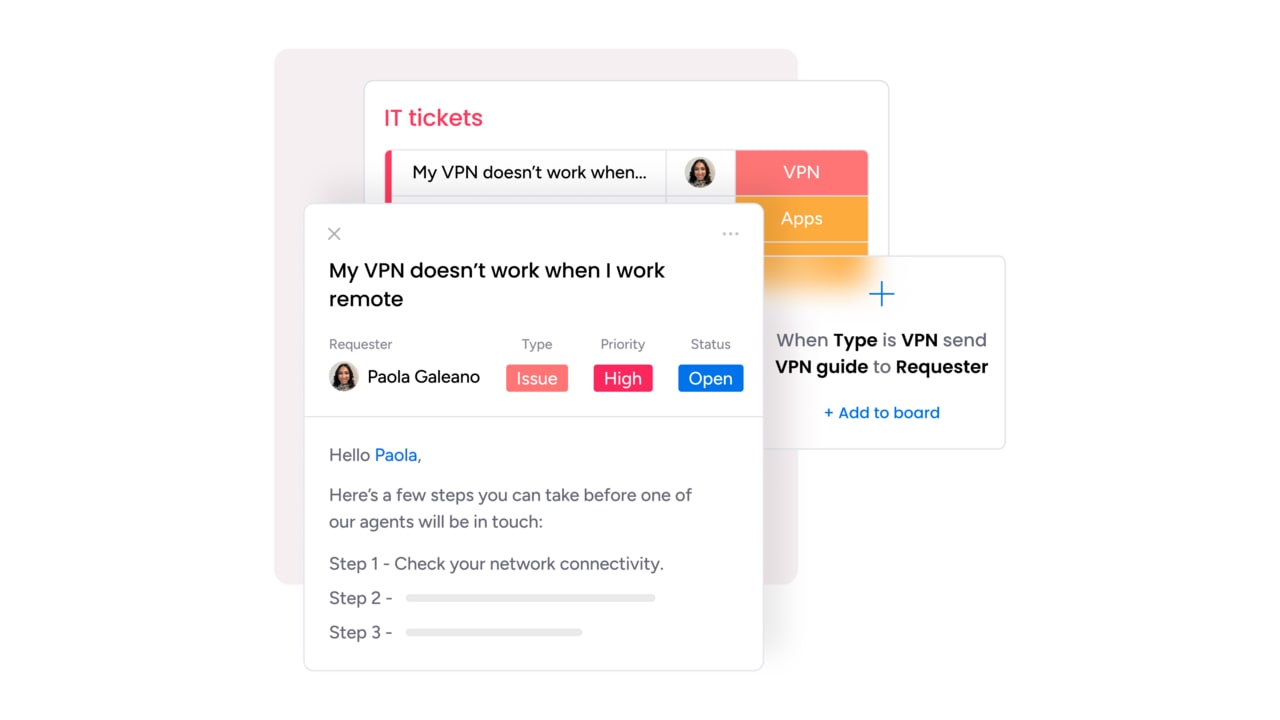
- Automatic ticket classification and routing: Categorize incoming requests by urgency, type, and sentiment, then assign them to the right agent or team.
- AI-generated response suggestions: Pull from your knowledge base to draft replies that agents can review and send in seconds.
- Conversational AI for self-service: Handle common requests through natural language chat interfaces without human involvement.
- Predictive analytics: Identify recurring issues and emerging trends before they become widespread incidents.
Learn more: AI for IT service desk
Multi-channel intake and integrations
Your team receives requests from email, chat, portals, Slack, Microsoft Teams, and sometimes phone. A connected service desk eliminates the context-switching that slows agents down and creates blind spots in reporting.
Look for platforms that support:
- Unified request queues: Consolidate every channel into a single view so no request falls through the cracks.
- Native integrations: Pre-built connections to the collaboration and productivity platforms your team already uses.
- Open API access: Custom integrations with existing enterprise systems and databases when native connectors are not available.
How to evaluate and implement your ITIL service desk
The organizations that get the most value from ITIL service desk software follow a phased approach, starting small and expanding as processes mature. Rushing to deploy every ITIL process at once is the most common reason implementations stall. The roadmap below keeps your team focused on measurable progress at each stage.
Phase 1: Audit your current state
Map your existing workflows before evaluating any platform. Identify which processes already align with ITIL best practices and document where manual handoffs, visibility gaps, and recurring bottlenecks exist. Frameworks like the NIST Cybersecurity Framework can help benchmark your security and risk management posture alongside ITIL processes. Involve end users early in this process — they experience the friction points that leadership often cannot see from dashboards alone.
Phase 2: Define evaluation criteria
Prioritize ease of adoption, time-to-value, integration with your existing stack, AI capabilities, and total cost of ownership. License fees are only part of the equation — implementation time, training requirements, and ongoing administration costs often exceed the sticker price. When evaluating an ITIL help desk, focus on how quickly your team can go from sign-up to handling real tickets. An ITIL compliant service desk should simplify your operations, not add months of configuration overhead.
Phase 3: Pilot with real tickets
Start with incident management. It offers the quickest, most visible wins and gives your team immediate proof that the new platform works. Run a 2-4 week pilot with a subset of your team handling real production tickets. Measure first-contact resolution rate and agent satisfaction during the pilot — these 2 metrics reveal whether the platform actually improves daily work.
Phase 4: Roll out and expand
Once incident management is stable, extend to problem management, change management, and additional departments. Activate automations incrementally rather than all at once. Build your knowledge base from resolved tickets during this phase — every solution your team documents becomes a deflection opportunity for future requests.
Phase 5: Measure and iterate
Track the KPIs that connect service desk performance to business outcomes: MTTR, first-contact resolution rate, SLA adherence, customer satisfaction (CSAT), and ticket deflection rate. Use analytics to identify recurring issues and automate resolution paths. As AI handles more routine work, your team’s role shifts from executing repetitive processes to designing smarter workflows and overseeing the systems that run them.
How monday service supports ITIL service delivery
While many platforms require extensive configuration to achieve ITIL compliance, monday service provides a purpose-built ITIL service desk that teams can launch in days, not months. The platform is designed for organizations that want enterprise-grade capabilities without the steep learning curve or extended deployment timelines that come with legacy ITSM software.
- Automate incident resolution at scale without expanding headcount — Specialized AI agents (IT Help Agent, Device Agent, and Access Agent) autonomously resolve repetitive requests like password resets, access provisioning, and device troubleshooting from start to finish, while the Service AI Supervisor intelligently routes each ticket to the most relevant agent.
- Turn every resolved incident into a learning opportunity — A dedicated Incidents board links directly to the Tickets board with built-in postmortem reports for root cause analysis, supporting ITIL problem management by documenting what happened, why, and what changed.
- Track SLA performance with metrics that reflect actual service time — The SLA column monitors resolution time with a live timer that auto-pauses outside working hours, ensuring your ITIL service level commitments align with real operational capacity.
- Deflect tickets before they reach your queue — A customer portal gives employees self-service access to submit requests, browse knowledge articles, and track progress independently, reducing volume and freeing agents for complex problem-solving.
- Connect your entire service ecosystem without custom development — With 72+ integrations, open API, and MCP connectivity, monday service fits into your existing stack and supports the cross-functional collaboration ITIL workflows require.
Choose the right ITIL service desk for your organization
The right ITIL service desk software balances process rigor with ease of adoption, AI-powered automation with oversight, and enterprise-grade security with a fast path to value. Every platform in this guide takes a different approach to those trade-offs, and the right choice depends on where your team is today and where you want to be in 12 months.
For teams looking for a platform that makes ITIL accessible from day 1, with no-code workflows, specialized AI agents, and cross-departmental service management on a single workspace, monday service offers a free trial to get started. The fastest way to know if a platform fits your team is to run real tickets through it.
Try monday serviceFAQs
How is ITIL different from ITSM?
ITSM defines the overall approach for delivering IT services to the business. ITIL provides a structured framework of best practices to carry out that strategy. In other words, ITSM is what you manage, and ITIL helps guide how you manage it.
How long does ITIL service desk implementation take?
Implementation timelines vary by scope. Teams introducing ITIL workflows for the first time often go live within a few months. Large organizations adopting full ITIL practices across multiple departments may need 6 months to a year, depending on data migration and change management.
Is ITIL service desk software suitable for small or growing teams?
Yes. Many platforms now offer scalable pricing and modular features, enabling smaller teams to begin with incident management and expand as their processes mature. This flexibility makes ITIL achievable even with limited enterprise-level resources.
What certifications indicate quality ITIL software?
Look for ITIL 4 alignment from accredited partners such as AXELOS. ISO 20000 certification and PinkVERIFY accreditation are also strong indicators that a platform meets global service management standards.
What should you consider before migrating to an ITIL platform?
Audit your current workflows and data sources first. Identify which processes already align with ITIL and where automation or visibility is missing. Involve end users early so the new platform supports how teams actually work, not just how processes look on paper.
What measurable impact can ITIL software have?
Organizations often report faster resolution times, higher customer satisfaction, and fewer escalations after adopting ITIL-aligned processes. The biggest gains come from improved visibility, automation, and knowledge sharing, which are factors that drive lasting operational efficiency.
Whatrole does AI play in ITIL?
AI plays a central role in modern ITIL service desks by automating ticket classification, routing, and initial response. Conversational AI handles self-service requests without human involvement, and predictive analytics identifies recurring issues before they escalate. According to ITSM.tools’ 2026 State of AI in IT report, 98% of IT organizations now use AI in some form. monday service deploys specialized AI agents that autonomously resolve repetitive requests across IT, HR, and operations.
What are common ITIL service desk challenges?
Common ITIL service desk challenges include resistance to process change, over-engineering workflows before proving value, and choosing platforms that require months of implementation before delivering results. The most effective approach starts with incident management, demonstrates quick wins, and expands incrementally as your team builds confidence with each new process.
How does monday service handle ITIL workflows?
monday service translates ITIL practices into visual, no-code workflows that teams can configure without technical expertise. The platform includes dedicated incident management with postmortem reports, SLA tracking with live timers, a customer portal for self-service, and AI-powered ticket triage that automatically classifies and routes incoming requests. It supports cross-departmental service delivery across IT, HR, and operations on a single workspace.

 Get started