


What if your service teams could solve problems before employees even knew they existed? This isn’t a far-off future. It’s the new reality of enterprise service management, powered by AI. Instead of being a bottleneck, support is becoming a business accelerator, transforming how work gets done across every department.
The shift to proactive service delivery is now possible with AI for enterprise service management. Instead of just managing tickets faster, AI helps you prevent issues, automate routine work, and connect operations across every department. This guide walks through a practical framework for making this shift, covering the essential AI capabilities, a phased roadmap for getting started, and how to scale these benefits beyond IT to HR, finance, and facilities—all achievable with platforms like monday service.
Key takeaways
- Shift from reactive to proactive: AI automatically routes requests and resolves issues before they disrupt productivity.
- Start small, scale strategically: Begin with self-service automation and smart routing, then expand to complex workflows across HR, finance, and operations.
- Deploy without technical expertise: Pre-built AI templates and visual workflow builders let business teams launch intelligent automation in days using platforms like monday service.
- Build your business case: Measure success through faster resolution times, higher first-contact resolution rates, and reduced cost per ticket.
- Unite all departments: Connect teams on one AI-powered platform to eliminate silos and give leaders real-time visibility across service operations.
What is AI-powered enterprise service management
AI-powered enterprise service management is the use of artificial intelligence to automate routine work, predict issues before they happen, and optimize how support gets delivered across your organization. This means your service teams can handle requests faster, spot problems earlier, and deliver more consistent experiences without adding headcount.
Think of enterprise service management as upgrading from reactive firefighting to proactive service delivery. Instead of waiting for employees to report problems, AI detects patterns and routes requests automatically.
Common issues resolve themselves through self-service, while leaders see what’s happening across all service areas in real time.
The evolution from traditional to intelligent service operations
Traditional service management follows a predictable pattern. Someone submits a request, an agent reads it, the team routes it manually, and work starts after the problem has already disrupted someone’s day.
AI changes this completely. The system understands requests instantly, routes them to the right team, and often resolves them without human involvement. Here’s what shifts when you add AI to service operations:
- Manual sorting becomes automatic: AI reads every request and sends it to the right team based on content, urgency, and past patterns
- Reactive becomes proactive: The system spots warning signs before users notice problems
- Silos become connected: IT, HR, finance, and facilities work from one shared system instead of separate platforms
Key components of modern AI service platforms
Modern AI platforms combine several technologies to make service delivery smarter and more predictive. Understanding these core components is key to evaluating which platform will deliver the most value. Here are the key technologies that power intelligent service operations:
- Natural language processing: Lets the system understand requests written in everyday language
- Machine learning: Improves routing and resolution over time by learning from past tickets
- Predictive analytics: Spots trends before they become visible in reports
- Workflow automation: Turns AI decisions into action by creating work items, sending notifications, and updating records without manual steps
- Knowledge management: Keeps your documentation current and surfaces the right answers when agents or users need them
How AI revolutionizes service delivery across your organization
AI fundamentally changes service delivery by replacing slow handoffs with instant routing, isolated queues with connected workflows, and reactive support with systems that learn and adapt. Here’s how traditional reactive systems compare to AI-powered proactive platforms:
| Service area | Reactive systems | AI-powered proactive systems |
|---|---|---|
| Problem detection | Wait for employees to report issues after disruption occurs | Detect server warning signs and alert teams before anyone loses access |
| Pattern recognition | Identify trends only after hundreds of similar tickets accumulate | Catch software update issues immediately after just a few reports |
| Request handling | Manually read requests, assign owners, copy data between systems, and follow up on status | Verify identity, trigger resets, update users, and close tickets automatically |
| Complex case support | Agents spend time gathering basic information and searching for solutions | Gather device details, suggest solutions, and escalate with full context so agents focus on problems that need human judgment |
| Department coordination | Separate systems for each department with manual handoffs and disconnected data | Trigger IT provisioning, HR documentation, facilities setup, and procurement in one coordinated process through platforms like monday service |
5 essential AI capabilities for enterprise service excellence
Not every AI feature delivers immediate value. These five capabilities create the strongest impact because they address the highest-volume activities and build a foundation for more advanced automation later.
1. Smart ticket classification and routing
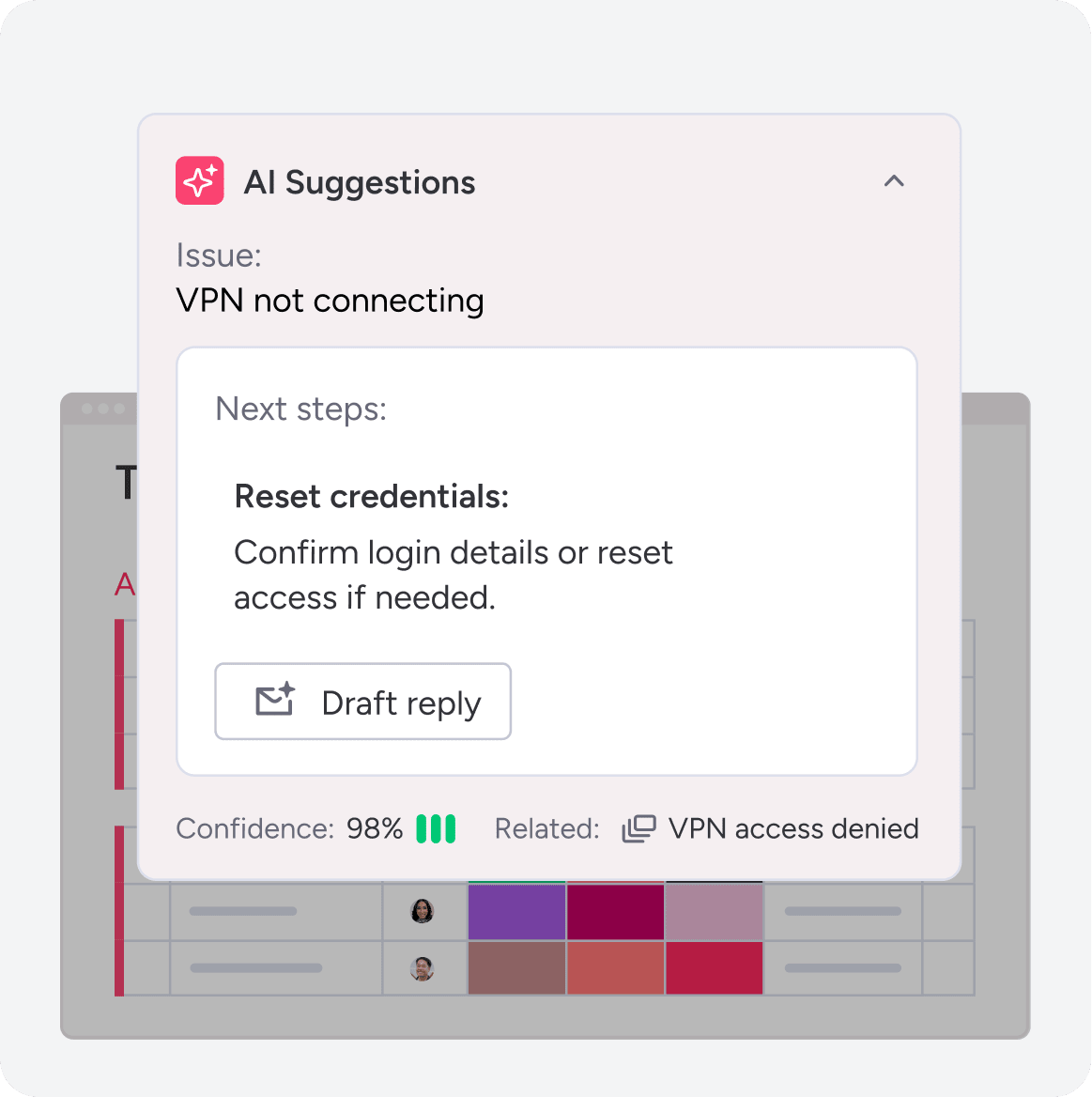
Smart classification reads incoming requests and assigns them to the right team automatically. It handles variations in how people describe problems, whether someone writes “laptop won’t connect,” “VPN issue,” or “can’t get online from home.”
The system learns which routing decisions lead to faster resolution and fewer reassignments. Platforms like monday service automate this entire flow with AI that reads ticket content, applies labels, and routes based on type, urgency, and team capacity. When combined with a robust enterprise service desk, this intelligent routing ensures requests reach the right specialists without manual intervention.
2. Natural language self-service
Employees want to ask for help the way they naturally speak. Natural language self-service lets them type questions in plain language and get immediate answers or actions. This works especially well for common needs:
- Password resets: Automated verification and reset without waiting
- Policy questions: Instant answers from your knowledge base
- Access requests: Guided workflows that complete automatically
A well-designed customer portal enhances this experience by providing employees with a centralized location to access self-service tools and track their requests.
3. Predictive analytics and trend detection
Historical service data reveals patterns that help you plan ahead. Predictive analytics identifies recurring incidents, seasonal peaks, and areas heading toward failure. Teams can anticipate demand spikes during onboarding seasons, spot issues tied to specific software versions, and focus improvements where they’ll have the most impact using tools like monday service.
4. Automated knowledge management

Knowledge bases often become outdated because no one has time to maintain them. AI keeps content current by detecting which articles need updates, suggesting new content based on resolved tickets, and surfacing relevant answers when agents need them.
As tickets close, the system can draft new articles from successful resolutions. Agents see suggested knowledge directly in their workflow without searching, while users find accurate, current information through self-service portals.
5. Agentic process automation
Agentic automation goes beyond simple if-then rules. These AI systems evaluate context, make decisions within set boundaries, and complete multi-step processes independently.
An agentic workflow might provision a new employee by checking their role, selecting the right access package, getting approvals, updating all connected systems, and confirming completion. Platforms like monday service enable this through flexible automation blocks that combine AI decision-making with visual workflow design.
The measurable business impact of AI service management
AI earns executive support when it delivers clear business value. The impact shows up in faster resolution, lower costs, smarter decisions, and happier employees, all at the same time.
Achieve faster resolution times
AI cuts resolution time by eliminating delays at every stage. Intelligent routing removes triage queues, automated diagnostics gather context instantly, and knowledge suggestions help agents find answers without searching. Employees get back to work faster, business services restore quicker, and downtime costs drop because issues move through the pipeline with minimal waiting.
Boost agent productivity
AI boosts agent productivity by handling repetitive tasks like ticket triage and data gathering, freeing agents to focus on complex problems and high-value support where human judgment matters most. With platforms like monday service, agents work from one unified workspace where AI suggestions, knowledge, and collaboration come together, letting them resolve issues faster without working harder. Organizations implementing IT service management best practices see even greater productivity gains as AI handles routine IT requests automatically.
Enable data-driven service decisions
AI transforms raw service data into actionable intelligence. Instead of guessing based on queue size, you see which request types are trending up, which automations save the most time, and where service risks are building. Real-time dashboards show service health and workload distribution, trend analysis highlights recurring pain points, and predictive models support better staffing and budget decisions. This visibility becomes even more valuable when integrated with enterprise resource management systems to optimize allocation across all departments.
Deliver personalized employee experiences at scale
AI makes enterprise service feel personal without building custom support for every employee. The platform recognizes each user’s role, department, location, and history, then tailors recommendations and responses accordingly. Employees expect workplace support to match their consumer experiences, and faster, more relevant service builds trust in internal teams while reducing the friction that makes routine requests frustrating.
Your 3-step roadmap to AI service transformation
Successful AI transformation happens in focused phases, not giant leaps. Each phase delivers value while building the foundation for what comes next. How do you know where to start?
Step 1: Launch self-service automation
Start where you’ll see quick wins with low risk. Conversational self-service, smart knowledge search, and automation for simple requests reduce ticket volume while making support easier to access.
This phase typically includes chat-based help, guided request forms, and automated fulfillment for repetitive tasks. You’ll see value quickly through lower service volume and more consistent experiences. Platforms like monday service accelerate this phase with pre-built templates, customizable portals, and AI-powered knowledge that works immediately.
Step 2: Deploy intelligent routing systems
Next, apply AI to how work flows through your organization. Requests get classified automatically, prioritized by impact, enriched with context, and routed without manual sorting.
This improves existing processes without replacing them entirely. Agents work more efficiently, reassignments drop, SLAs improve, and your data gets cleaner for better reporting. Using monday service, you can configure intelligent routing through visual workflows that combine AI classification with your team’s assignment rules. Organizations evaluating best help desk software options should prioritize platforms with these intelligent routing capabilities built in.
Step 3: Activate agentic workflows
The final phase introduces AI agents that manage complex, multi-step processes within controlled boundaries. These workflows make decisions, coordinate across systems, request approvals, and complete tasks that would otherwise require multiple teams.
This delivers the biggest impact but requires solid foundations. You need reliable knowledge, clean processes, good data, and clear governance. Platforms like monday service support this evolution through automation blocks and integrations that connect service workflows across your organization.
Try monday serviceScaling AI service management beyond IT
AI service management often starts in IT because of high ticket volumes and structured processes. The real value comes when you expand the same approach to HR, facilities, legal, finance, and other departments’ employees depend on daily. Organizations implementing enterprise IT service management can use those same AI capabilities to transform service delivery across every department.
| Department | Common processes | AI capabilities | Business outcomes |
|---|---|---|---|
| HR | Onboarding, benefits, policy questions | Automated responses, role-based onboarding, self-service answers | Strategic focus for HR teams, consistent new hire experiences, faster responses |
| Facilities & operations | Maintenance, space requests, vendor management | Smart routing, impact-based prioritization, predictive maintenance | Better planning, prevented failures, unified visibility |
| Legal & compliance | Document review, contracts, compliance tracking | Faster review, gap detection, risk flagging, standardized intake | Less repetitive work, earlier compliance checks, faster processing |
| Finance & procurement | Invoices, purchase requests, approvals | Automated processing, intelligent routing, spending analysis | Faster responses, spending visibility, strategic sourcing focus |
Platforms like monday service enable this cross-departmental transformation through customizable workflows, automated notifications, approval tracking, and real-time reporting, all on one unified platform. For facilities teams specifically, facilities service management capabilities ensure maintenance requests, space planning, and vendor coordination benefit from the same AI-powered automation.
Proving ROI and measuring AI success
ROI becomes clear when you connect service improvements to real business outcomes. Track both operational gains and strategic value since AI typically improves multiple areas simultaneously.
Essential KPIs for AI service performance
The right metrics show whether AI is actually improving service quality and reducing effort. Track these essential KPIs:
- First-contact resolution rate: Measures how often issues get solved immediately through self-service or agent support—higher rates mean less rework and happier users
- Average resolution time: Tracks how long requests take from start to finish—faster resolution means less employee downtime and smoother operations
- User satisfaction scores: Captures the actual employee experience, not just whether you met an SLA
- Agent productivity metrics: Monitors cases per agent, time on value-added work, and manual touches per request—the goal is finding the right balance between routine handling and complex support
- Cost per ticket: Shows your actual spend to resolve each interaction, which should drop as AI reduces manual work and prevents repeat issues
Building your business case framework
A strong business case starts with your current state. Document request volumes, handling times, staffing costs, and employee satisfaction, then model AI value through clear categories:
- Hard savings: Reduced manual effort, lower cost per ticket, and less downtime
- Capacity gains: Handling more requests without adding headcount
- Experience benefits: Improved satisfaction, reduced friction, and increased trust in support teams
- Strategic impact: Better visibility for leadership and more scalable operations
Link these metrics to business outcomes that executives care about. Faster resolution drives productivity, smart routing protects SLAs, and self-service reduces support costs.
7 best practices for successful AI implementation
Success with AI depends on operational discipline, not technical complexity. These practices help you avoid common pitfalls and build systems that actually work.
1. Establish high-quality knowledge foundations
AI needs accurate, organized information to work properly. Clean documentation, consistent terminology, and current policies give your AI systems a reliable source of truth. Weak knowledge creates problems fast through outdated answers, conflicting guidance, and lost user trust.
2. Choose no-code platforms for rapid customization
No-code platforms let business users configure workflows, forms, and routing without waiting for developers. This matters when priorities shift and processes need quick adjustments. Visual builders and pre-built templates reduce implementation friction while giving you control over how work flows.
3. Design for cross-platform integration
AI delivers more value when it connects to your existing systems. Service platforms need to exchange data with identity management, HR systems, collaboration platforms, and monitoring tools. APIs and pre-built connectors enable the data flow that lets AI understand context and take appropriate actions.
4. Implement strong governance controls
AI needs practical governance built into daily operations. This includes:
- Data access controls: Who can see and modify what information
- Audit trails: Complete records of AI decisions and actions
- Escalation rules: Clear paths for handling exceptions
5. Prepare for digital employee management
Digital employees are AI agents that handle specific functions like triage, scheduling, or policy guidance. Manage them like human roles with clear responsibilities, performance monitoring, and improvement processes.
6. Focus on change management and adoption
AI only delivers value if people actually use it. Clear communication, practical training, and visible quick wins help teams understand how AI supports their work. Adoption improves when you introduce AI as a helper, not a replacement.
7. Start small and scale strategically
Begin with focused use cases that solve real problems quickly. This reduces risk, builds confidence, and creates the foundation for expansion. Once initial workflows run smoothly, expand to more complex scenarios and additional departments.
Accelerate your AI service transformation with monday service
Combining workflow flexibility, cross-functional visibility, and embedded intelligence in a platform that business teams can actually use, monday service supports practical ESM priorities: fast deployment, no-code customization, connected operations, and scalable automation.
AI-powered ticket classification and smart routing
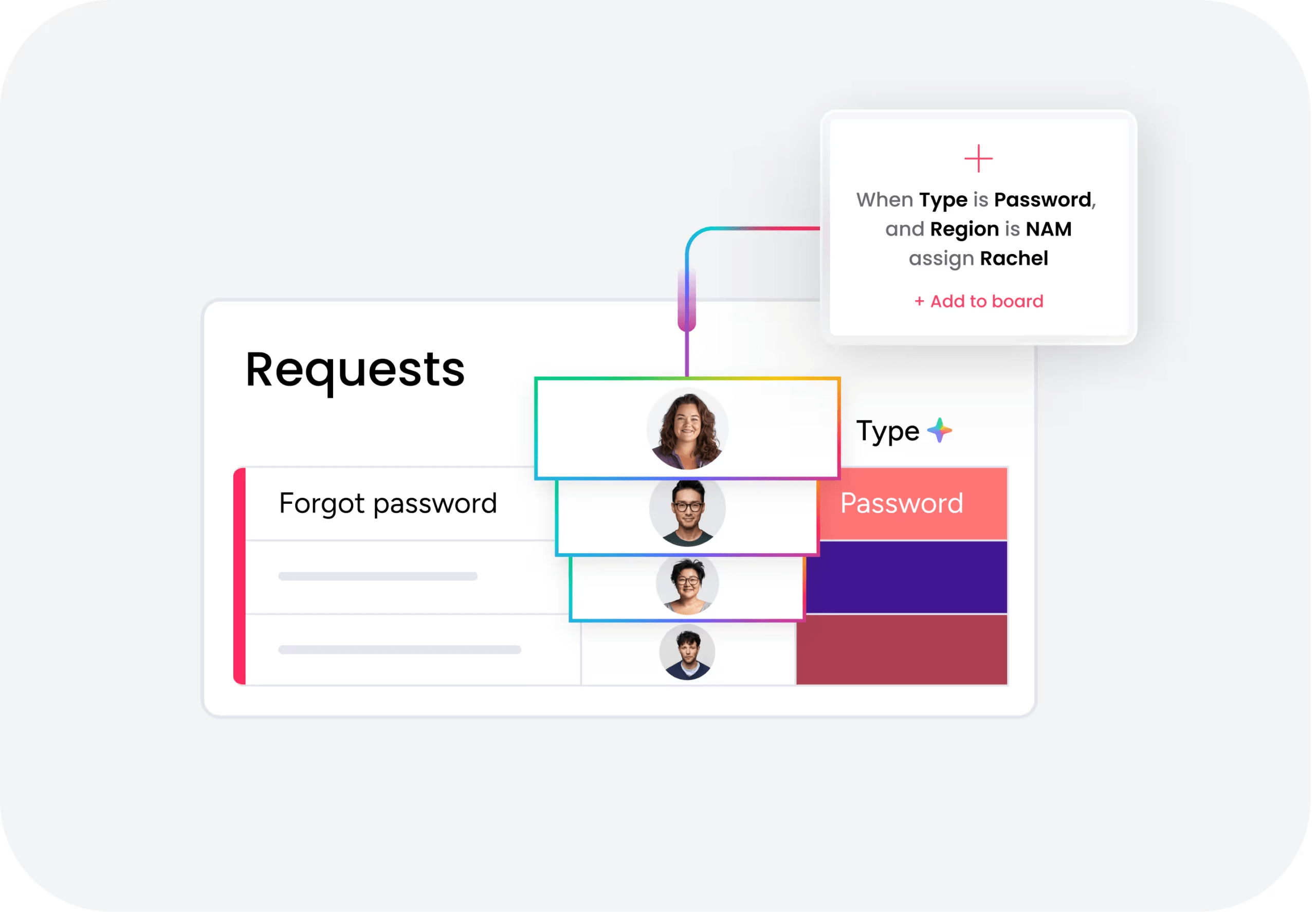
Natural language processing automatically reads, categorizes, and routes incoming requests to the right team without manual intervention. The AI analyzes ticket content, urgency indicators, and historical patterns to assign priority and ownership instantly. Teams see fewer reassignments and faster first responses as the system learns from every interaction. Pre-built automation templates get you started immediately, while the visual builder in monday service lets you refine logic as needs evolve.
Intelligent self-service with conversational AI

An AI-powered knowledge base and conversational interface let employees find answers and complete requests in natural language without opening tickets. The platform automatically suggests relevant articles based on what users type and triggers automated fulfillment for routine tasks like password resets. AI identifies content gaps from unresolved queries and recommends new articles, keeping your self-service portal current without constant manual updates in monday service.
Predictive analytics and proactive issue detection
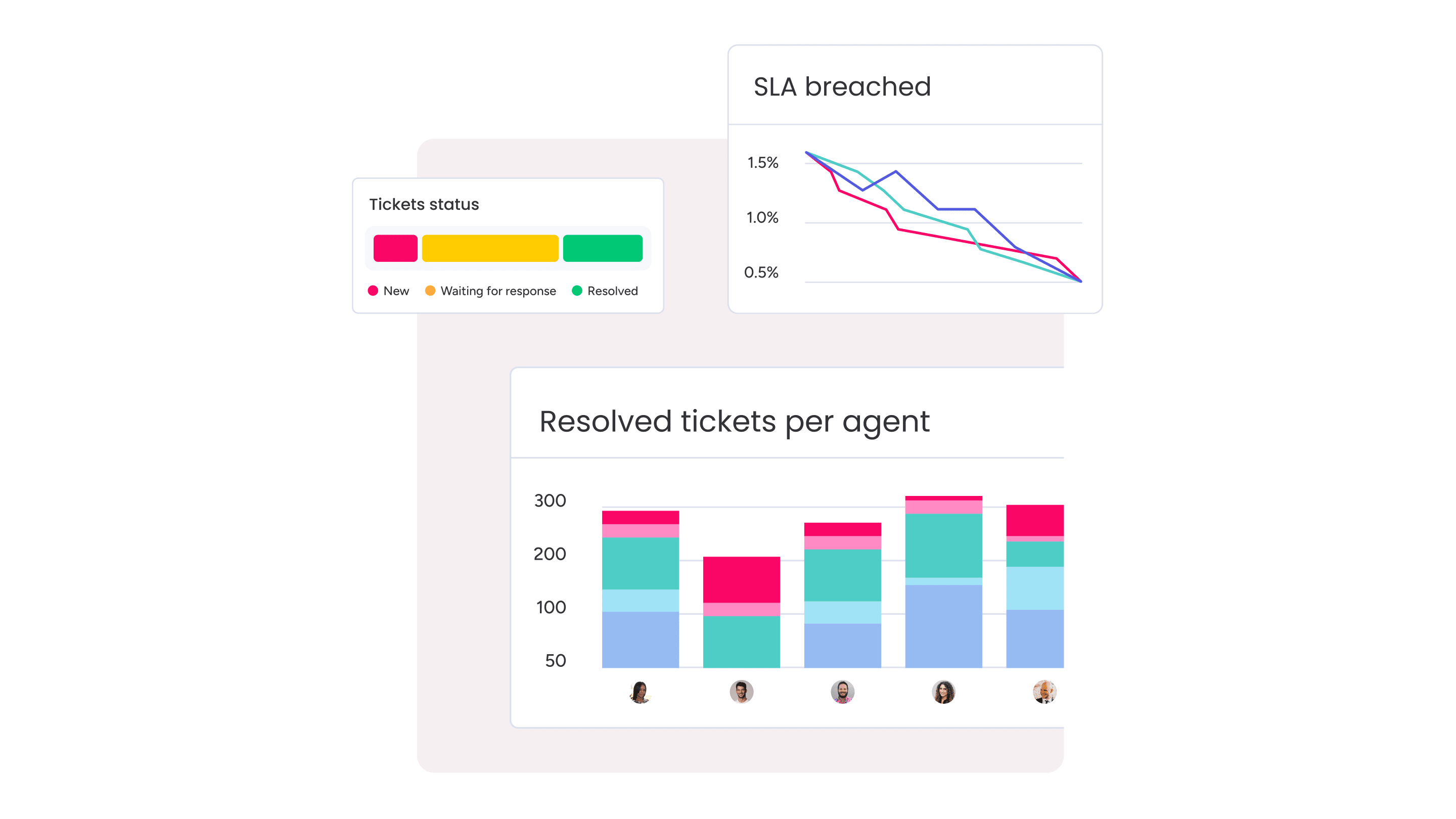
Built-in AI analytics surface patterns and trends before they become visible problems. The platform monitors ticket volume by category, identifies recurring issues, and flags anomalies that signal emerging incidents. Real-time dashboards give leaders visibility into service health across all departments, while predictive models help you anticipate demand spikes. This intelligence transforms reactive support into proactive service delivery with monday service.
Unified cross-departmental workflows with AI coordination

IT, HR, finance, facilities, and operations work on one platform where AI orchestrates complex, multi-step processes across teams. When an employee onboarding request comes in, AI triggers coordinated workflows that provision accounts, assign equipment, and update all relevant systems simultaneously. Leaders get unified visibility across all service functions, teams collaborate using shared data, and employees experience one consistent support system through monday service.
Transform service delivery with AI
AI-powered enterprise service management shifts organizations from reactive ticket handling to proactive problem prevention. Start with focused use cases like self-service automation and intelligent routing, then expand strategically as you prove value. Platforms like monday service make this transformation accessible through no-code workflows, embedded AI capabilities, and unified visibility across IT, HR, finance, and operations—delivering enterprise-grade service without enterprise-level complexity.
Try monday serviceFrequently asked questions
How quickly can organizations see ROI from AI service management?
Most organizations typically see initial returns within 3 to 6 months from AI service management. This is driven by reduced ticket volume and faster resolution times, with full returns appearing in 12 to 18 months as automation scales.
What's the difference between AI-powered ESM and traditional ITSM?
Traditional ITSM focuses on managing IT tickets and workflows using predefined processes. AI-powered ESM adds predictive capabilities, natural language understanding, and autonomous decision-making across all service functions including IT, HR, finance, and operations, enabling teams to prevent problems rather than just react to them.
Do organizations need technical expertise to customize AI workflows?
Most modern AI service platforms use no-code visual builders that let service managers customize workflows without programming knowledge. Technical expertise is mainly needed for complex integrations with legacy systems or highly specialized automation requirements that go beyond standard templates.
How does consumption-based pricing work for AI service management?
Consumption-based pricing charges organizations based on actual AI usage like the number of automated interactions, processes run, or data analyzed. This model reduces upfront costs and aligns spending directly with the value received, making it easier to start small and scale as you see results.
Can AI service management platforms integrate with existing enterprise tools?
Yes, modern AI service platforms provide APIs, pre-built connectors, and integration frameworks for common enterprise systems including ERP, CRM, HR platforms, collaboration tools, and IT monitoring solutions. This connectivity is essential for AI to access context and coordinate actions across departments.
What security measures should organizations consider for AI in service management?
Organizations should evaluate data encryption standards, access control mechanisms, audit logging capabilities, compliance certifications, and vendor security practices. Key considerations include how AI decisions are logged, who can modify AI behaviors, and how sensitive data is protected during processing and storage.

 Get started