


Just a few years ago, the concept of an AI assistant was still a far-fetched idea, only something you’d see in a sci-fi movie. And while our perceived vision of what an AI assistant looks like may have morphed a bit from the scary-looking metal figure living in our home, the concept of an AI assistant is unquestionably rooted in our reality.
Today, many businesses rely on advanced AI assistants in the form of what’s known as an AI copilot to simplify their work and boost productivity. Service teams specifically have embraced AI copilot technology to work smarter, quicker, and more efficiently.
This article breaks down what AI copilots are, the different types available, how they compare to AI agents, and the specific benefits they bring to service teams. We will also explore how purpose-built service platforms like monday service with AI copilot capabilities embedded directly in workflows are helping organizations streamline delivery and free their teams for higher-value work.
Key takeaways
- AI copilots work alongside humans: AI copilots handle routine work so teams can focus on complex, strategic decisions.
- Copilots differ from AI agents: AI copilots augment human judgment, while agents operate autonomously on predefined workflows.
- Service management is a prime application for AI copilots: Copilots assist with automated ticket triage, smart routing, self-service support, and SLA monitoring.
- Enterprise trust matters: Responsible AI copilot deployments require transparent data handling, permission controls, and human oversight.
- Platform-embedded AI copilots are leading the charge: Deliver contextual assistance directly within service workflows, giving teams intelligent support without switching between applications.
What is an AI copilot?
An AI copilot is an artificial intelligence-powered assistant that works alongside humans to increase productivity and streamline everyday work.
Built on large language models (LLMs), AI copilots analyze data, detect patterns, and generate human-like responses, all within the context of the workflows people already use.
Think of the term literally: a copilot sits beside the pilot, handling navigation, monitoring instruments, and managing routine operations so the pilot can focus on the bigger picture. Copilot AI works the same way in a business setting. It handles repetitive processes, surfaces relevant information, and suggests next steps, while the human stays in control of strategy and final decisions.
Several widely adopted AI copilots illustrate how this technology works across industries. Microsoft 365 Copilot assists with document drafting, email summarization, and meeting recaps inside the Microsoft ecosystem. GitHub Copilot generates code suggestions in real time as developers write. And domain-specific copilots, like AI assistants embedded in service management platforms, help agents resolve tickets faster by surfacing relevant knowledge and recommending responses. Essentially, copilots are used for any workflow where humans benefit from intelligent, context-aware assistance.
Types of AI copilots
Not all AI copilots are built the same way. Understanding the different categories helps organizations choose the right approach for their specific needs. Here are the four primary types shaping the market today.
| Type | What it does | Example |
|---|---|---|
| Conversational copilots | Chat-based assistants that answer questions, draft content, and handle general knowledge queries across topics | ChatGPT, Microsoft Copilot |
| Workflow-specific copilots | Embedded in a single workflow to accelerate one focused activity, like writing code or designing visuals | GitHub Copilot |
| Domain-specific copilots | Purpose-built for a vertical like customer service, HR, or IT, with deep context about that domain's processes | Service management AI assistants |
| Platform-embedded copilots | Integrated natively into a work platform, operating across modules with full organizational context | Service management AI platforms |
Conversational copilots are the most familiar, but domain-specific and platform-embedded copilots tend to deliver the highest impact for service teams because they understand the specific data, workflows, and priorities that matter in day-to-day operations.
So how do these AI copilots compare to the chatbots and virtual assistants that came before them?
How are AI copilots different from traditional chatbots or virtual assistants?
The distinction between an AI copilot and a traditional chatbot comes down to depth of integration, learning ability, and proactive capability. Traditional chatbots follow scripted decision trees. Virtual assistants like Siri or Alexa handle simple commands. AI copilots, by contrast, understand context, learn from interactions, and actively improve workflows without waiting to be asked.
| Dimension | Traditional chatbot | Virtual assistant | AI copilot |
|---|---|---|---|
| Context awareness | Limited to current conversation | Basic user preferences | Full workflow, history, and organizational context |
| Learning ability | Static rules | Minimal personalization | Continuous learning from interactions and outcomes |
| Integration depth | Standalone widget | Surface-level app commands | Embedded within workflows and data systems |
| Proactive capability | Reactive only | Reactive with basic triggers | Predicts needs and suggests actions before being asked |
The key shift is from reactive to proactive. AI copilots monitor activity proactively, recognize patterns, and surface recommendations in real time, becoming a natural extension of how people already work.
AI copilot vs AI agent: What's the difference?
As AI copilots become more capable, a related concept is gaining traction: the AI agent. While both use similar underlying technologies, they play fundamentally different roles in a workflow. Understanding the distinction matters because modern platforms increasingly use both.
| Dimension | AI copilot | AI agent |
|---|---|---|
| Autonomy | Assists and recommends; human makes the final decision | Acts independently within defined guardrails |
| Human involvement | Human-in-the-loop at every step | Human oversight for exceptions and escalations |
| Primary use | Augmenting human judgment on complex or nuanced work | Handling repetitive, high-volume processes end to end |
| Risk profile | Lower risk, since a person validates every action | Higher potential impact, requiring strong guardrails and monitoring |
Here is a practical way to think about it: an AI copilot helps a service agent draft a response to a complex customer issue, surfacing relevant past tickets and suggesting a resolution. An AI agent, on the other hand, handles a routine password reset request entirely on its own, from receiving the request to resolving it, only escalating if something unexpected occurs.
According to Gartner’s 2026 Technology Trends report, 40% of enterprise applications are projected to include embedded AI agents by the end of 2026. The most effective platforms combine both approaches, using copilots for work that benefits from human judgment and AI agents for service desks where speed and consistency matter most.
Understanding the underlying processes behind AI copilots clarifies when each approach fits.
How do AI copilots work
AI copilots work by combining a mixture of three AI technologies:
- Generative AI enables AI copilots to create content, suggest solutions, and automate workflows based on user input.
- Large language models (LLMs) allow AI copilots to understand complex queries, generate human-like text, and improve responses over time through deep learning.
- Natural Language Processing (NLP) helps AI copilots interpret, process, and respond to text or voice inputs in a way that feels intuitive and context-aware.
Breaking down the process of an AI copilot
The process of an AI copilot varies among different technologies, but the way it works generally looks like this:
Step 1: User input
Somebody interacts with the copilot, asking it to do something through a text or voice command.
Step 2: Analysis
The copilot analyzes the response, considering past interactions, user history, and workflow context.
Step 3: Response generation
The copilot leverages its LLM technology to retrieve relevant information from internal knowledge bases and databases. It also leverages Machine Learning (ML) technology that analyzes historical data to detect trends, identify potential bottlenecks, and recommend solutions. The AI copilot then crafts a personalized response based on data-driven recommendations.
Step 4: Execution and automation
Depending on the command, the copilot may automatically trigger actions for the copilot to carry out, such as categorizing requests, assigning tasks, generating reports, or sending notifications.
Step 5: Learning
The copilot uses self-learning algorithms, observing how people interact with its responses to adapt to user preferences and improve results over time.
Looking to bring AI into your existing workflows? Explore practical tips on integrating AI into everyday operations.
Benefits of using an AI Copilot
Beyond the convenience of having an always-available assistant, AI copilots bring measurable benefits that can transform how teams operate. Here are five areas where Copilot AI delivers the most impact.
1. Increased productivity and efficiency
By automating repetitive processes, providing instant access to information, and streamlining workflows, AI copilots free up time for employees to focus on complex and creative work that requires genuine human input. According to Microsoft’s 2026 Work Trend Index, organizations with active copilot deployments report that employees reclaim an average of 11 hours per week previously spent on routine information gathering and document preparation.
2. Cost savings
When teams spend less time on manual, repetitive processes, operational costs naturally decrease. AI copilots reduce the need for additional headcount to handle growing request volumes, and they minimize costly errors that come from manual data entry and routing. For service teams handling thousands of requests monthly, even small efficiency gains compound into significant savings.
3. Smart decision-making
AI copilots analyze large volumes of data, from datasets and patterns to past interactions, to surface reliable insights in real time. With predictive analysis, copilots help humans make proactive decisions based on emerging trends rather than reacting after problems escalate. This ensures decision-makers are considering all relevant information before choosing a course of action.
4. Enhanced customer experience
AI copilots empower teams to provide faster, context-aware, and personalized support. When an agent opens a ticket, the copilot can instantly summarize the customer’s history, suggest a resolution based on similar past issues, and even draft a response. Customers receive quicker answers, and agents spend less time searching for information and more time solving problems.
5. Real-time contextual assistance
What separates modern AI copilots from earlier automation is their ability to understand context. Rather than requiring explicit queries, a platform-embedded copilot monitors what a team member is working on, whether it is a specific ticket, a dashboard, or a service request, and proactively surfaces relevant suggestions. For example, monday sidekick, acting as an AI Copilot in monday service, might flag an SLA at risk, recommend a knowledge base article that matches the current issue, or alert a manager to an emerging pattern in incoming requests.
How AI copilots are transforming service management
The rise of the AI copilot is transforming the entire service management landscape. When used correctly, it can help various service teams, from IT, help desk, HR, and finance, deliver faster, smarter, and more seamless support experiences. Here’s how:
Automate ticket management
An AI copilot has the power to automatically categorize, prioritize, and assign service requests based on urgency and context.
A copilot can be programmed to categorize HR tickets according to priority. This ensures critical issues are instantly addressed by the right person while routine inquiries can be directed to a customer portal. This streamlines HR processes by creating a space that provides answers quickly without taking up extra HR resources.
Enable self-service solutions

An AI copilot can locate knowledge from a centralized knowledge base and use it to respond to employee or customer inquiries.
For example, instead of filing an IT request to be reviewed by an agent, someone with a simple issue can ask the AI service agent for help. The AI service agent will automatically retrieve and send a relevant answer based on the knowledge base. This speeds up IT processes and reduces the need for human intervention on common requests.
Build an AI-powered service workforce
The most forward-looking organizations are combining copilots with AI agents to create a complete AI-powered service workforce. In this model, AI agents handle high-volume, repeatable requests autonomously, such as password resets, onboarding checklists, or benefits inquiries. When a request requires judgment or nuance, the agent escalates to a human with full context and a suggested resolution already prepared.
According to Forrester’s 2025 Future of Customer Service report, AI-assisted resolution models will contribute to a 49% transformation of current customer service roles by 2030, shifting agents from transactional work to strategic problem-solving. Organizations exploring this approach can learn more about practical implementation in our guide to AI in service operations.
How monday service puts AI copilot capabilities to work
Understanding AI copilots in theory is one thing. Seeing how they work inside a purpose-built platform is another. With monday service, AI copilot capabilities are embedded directly into service workflows, giving teams contextual intelligence right where they already work.
Here is how monday service applies the copilot principles covered throughout this article.
AI-powered ticket triage and smart assignment
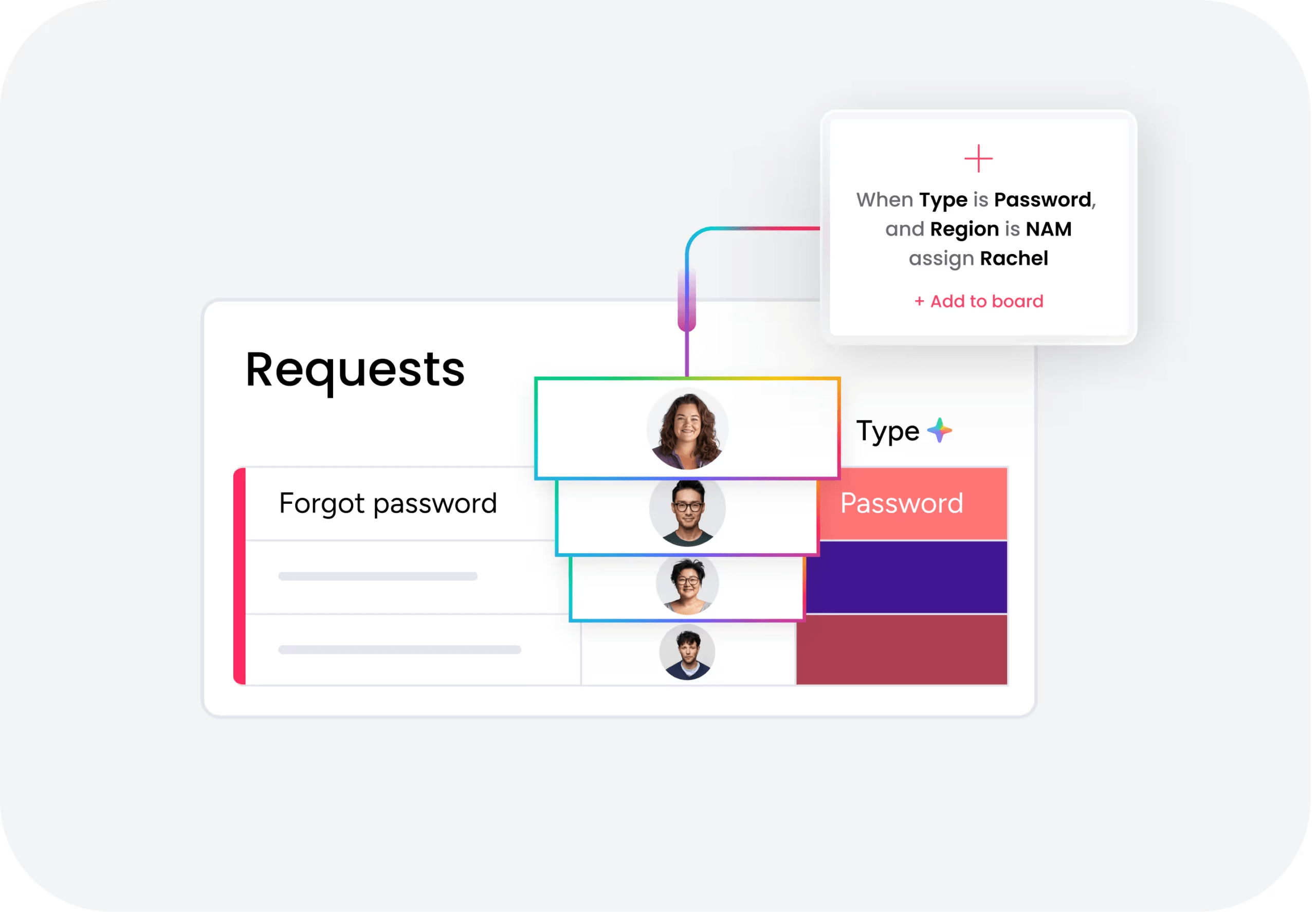
The platform uses AI-powered columns that automatically classify incoming requests by type (issue, question, or request), detect sentiment, and assign tickets to the right agent based on skills, priority, and context. The Summarize AI column generates concise ticket summaries so agents can understand the situation at a glance, without reading through lengthy email threads or chat transcripts. This connects directly to the automated ticket management benefit: fewer manual steps, faster routing, and consistent handling regardless of volume.
monday sidekick for contextual assistance
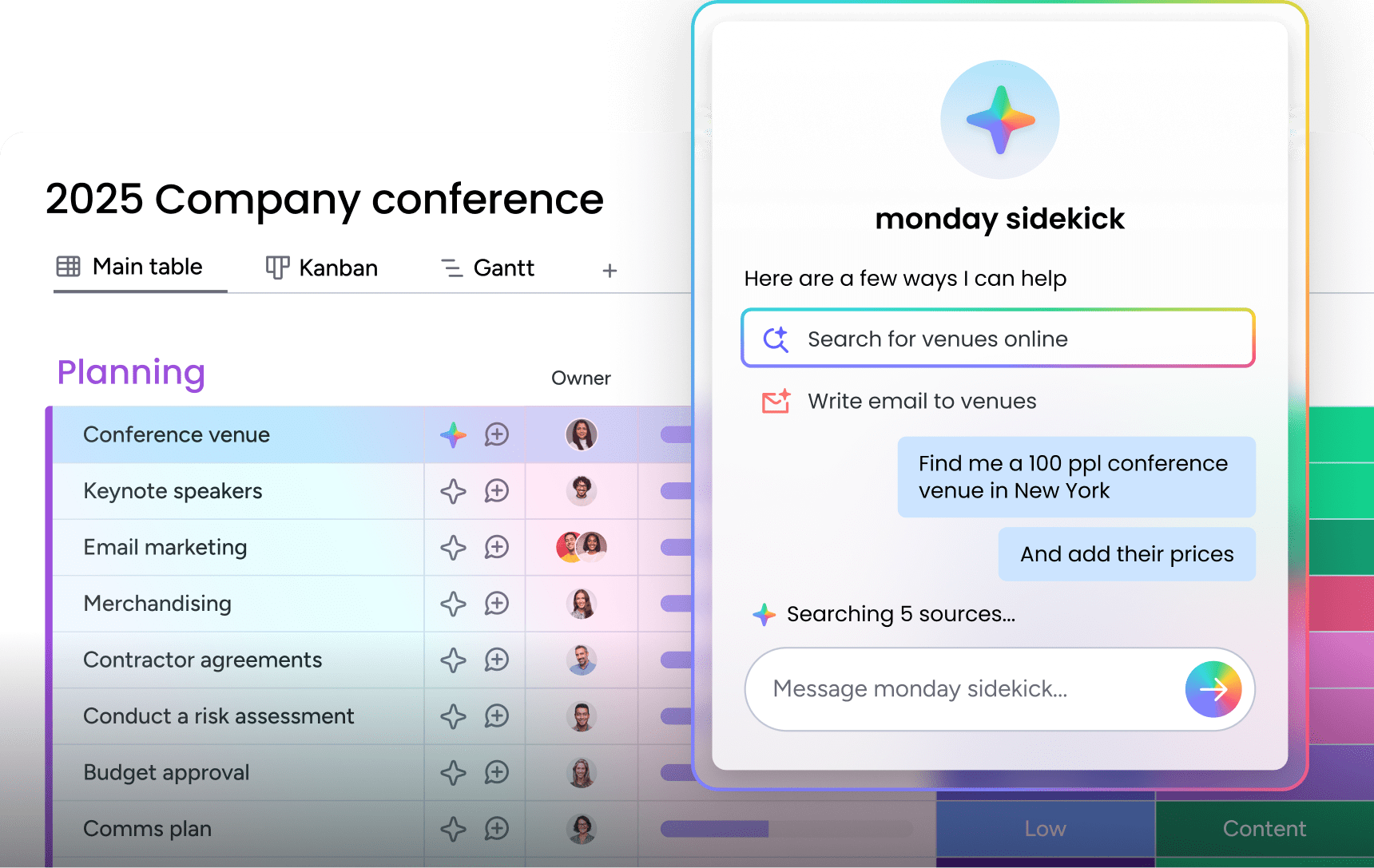
Built into the platform, monday sidekick serves as the embedded AI copilot, designed to work at both the board level and the individual ticket level. At the board level, Sidekick reviews workload distribution, surfaces urgent issues, analyzes ticket patterns, and flags SLA risks. At the ticket level, it summarizes context from previous interactions, recommends next steps, drafts replies, and finds similar resolved tickets to guide the current resolution.
This is the real-time contextual assistance benefit in action: relevant suggestions based on what the agent is actively working on, without requiring a separate search.
AI workforce and monday agents

The platform goes beyond copilot-style assistance with its AI Workforce: specialized AI agents built for specific teams and functions. A Service AI Supervisor routes incoming requests to the right agent, whether that is an IT Intake agent, an HR Benefits agent, or a custom-built agent for any department. These agents resolve requests autonomously using the organization’s knowledge base, past tickets, and explicit guardrails. When human input is needed, the agent escalates with full context and a suggested reply already prepared.
Ready-made agents are available for IT, HR, Sales, Marketing, and PMO, and teams can build custom agents using the agent builder. This is where the copilot-versus-agent distinction becomes practical: AI-powered service management on monday service uses both approaches together, matching the right level of autonomy to each type of request.
monday MCP for connected AI
The platform’s monday MCP (Model Context Protocol) is an open server that connects external AI applications, including ChatGPT, Claude, Copilot Studio, and Gemini CLI, to the monday.com workspace. This means teams can use their preferred AI interfaces while keeping all actions, data, and permissions grounded in their monday.com environment. It is available on all plans at no additional cost, reinforcing the platform-embedded copilot approach where interoperability extends the value of AI copilot capabilities across the entire organization.
Real-time dashboards and reporting
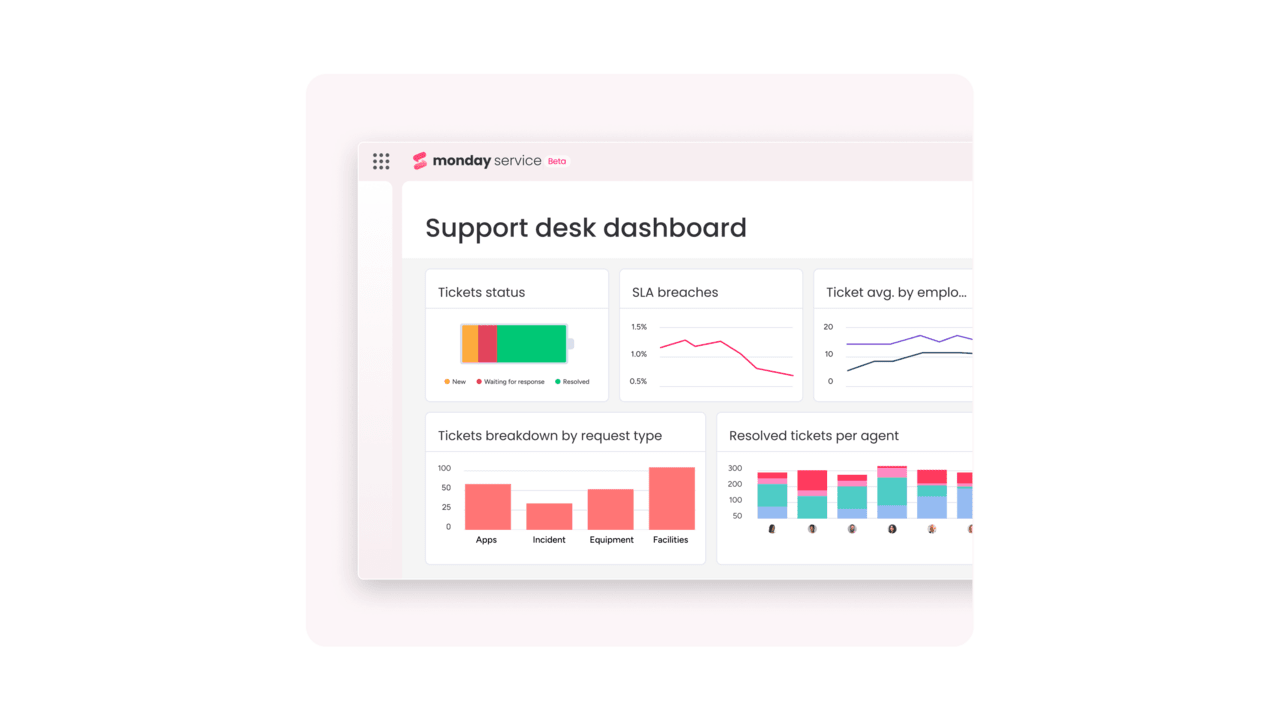
The platform provides customizable dashboards that track service performance and monitor trends in real time. Teams can generate interactive reports that analyze ticket handling patterns, SLA compliance, agent workload, and AI Workforce autonomy rates (the percentage of requests resolved without human involvement). These insights help managers make data-driven decisions about staffing, process improvements, and where to expand AI-assisted resolution.
Reliability and trust in copilots in 2026
While AI copilots are boosting efficiency and creating more productive work environments, they must be used responsibly. The first step in ensuring a responsibly used copilot is considering the copilot technology you’re using. It’s important to use an AI copilot that minimizes data security concerns and AI bias and requires human oversight for reliable AI responses.
monday service ensures ethical AI use by implementing layers of security and moderation to ensure safe and reliable AI experiences.
- Privacy first: Customer input and output data are never used to train machine-learning models.
- Enterprise-grade encryption: All information is encrypted both in transit (TLS 1.3) and at rest (AES-256), ensuring reliable protection against unauthorized access.
- Permission-based AI access: AI capabilities follow existing account permissions. If a team member does not have access to specific boards or columns, AI will not retrieve or display data from them.
- Bias prevention: Fairness, transparency, and accountability are embedded in AI design to safeguard against harmful or biased content
- Transparency: all AI features provide clear indications about how they operate and manage data.
Learn more about these commitments at the AI Trust Center.
The future of AI copilots and AI assistants
AI copilots are rapidly evolving from helpful assistants into essential infrastructure for how organizations deliver service. The line between copilots and agents is blurring, with modern platforms combining both to create complete AI-powered workforces that handle routine requests autonomously while keeping humans in control of complex decisions.
The organizations seeing the most impact are those using platforms where AI copilot capabilities are embedded directly in service workflows, built into a single, configurable platform. monday service brings together AI-powered ticket triage, contextual assistance through monday sidekick, autonomous AI agents, and connected AI through MCP, all within a single platform that teams can configure without writing code.
FAQs
What is Copilot AI?
Copilot AI refers to artificial intelligence-powered assistants that work alongside humans to increase productivity, automate repetitive processes, and surface relevant information within existing workflows. Unlike standalone chatbots, AI copilots integrate directly into work platforms and learn from interactions to provide increasingly accurate, context-aware assistance.
What is the difference between an AI copilot and an AI agent?
The difference between an AI copilot and an AI agent lies in autonomy and human involvement. An AI copilot augments human decisions by suggesting actions and surfacing relevant data, while the human retains final control. An AI agent operates autonomously within defined guardrails, handling repeatable processes end to end and escalating to a human only when an exception occurs.
What are some examples of AI copilots?
Some widely adopted examples of AI copilots include Microsoft 365 Copilot for productivity applications, GitHub Copilot for code generation, and monday sidekick for service management workflows. Each is embedded within a specific platform to provide contextual assistance tailored to that domain.
How does monday service use AI copilot capabilities?
AI copilot capabilities on monday service span the full service management workflow, including AI-powered ticket triage with automatic classification, sentiment detection, and smart assignment. monday sidekick provides board-level and ticket-level contextual assistance, and the AI Workforce deploys specialized agents that resolve routine requests autonomously.
Are AI copilots safe to use for enterprise data?
AI copilots are safe for enterprise data when the platform implements enterprise-grade security, including end-to-end encryption, permission-based data access, and policies against using customer data for model training. monday service details its AI safety commitments at the AI Trust Center.

 Get started