


Every team faces more requests than it can deliver in the time available. And when everything looks urgent, it can be tempting to promise to deliver all of it, even though you know there’s a strong risk you’ll miss the deadline. The MoSCoW method gives you a shared, honest way to decide what ships now and what waits.
This guide breaks down the 4 MoSCoW categories, where the framework came from, and how to run it step by step. You’ll also see a worked prioritization matrix, the effort-balancing rules that keep releases realistic, and how to manage the whole process on monday AI Workspace.
Key takeaways
- The MoSCoW method sorts work into 4 priority categories: must-have, should-have, could-have, and won’t-have (this time).
- It comes from the Agile DSDM framework and works best inside a fixed timebox or release cycle.
- The won’t-have category is the method’s key strength, because naming exclusions upfront prevents scope creep.
- DSDM recommends keeping must-have work to about 60% of effort and holding roughly 20% as could-have contingency.
- On monday AI Workspace, priority columns, dashboards, and AI agents keep every MoSCoW decision visible and current as work shifts.

What is the MoSCoW method?
MoSCoW prioritization is a tool for creating a hierarchy of priorities before and during a project. It stems from the Agile project management method, which aims to establish elements like product cost, quality, and project requirements as early as possible.
MoSCoW stands for must-have, should-have, could-have, and won’t-have (this time). Each item in the acronym denotes a category of prioritization. The idea is that items are sorted at the start of a project to clarify what is strictly necessary, what is desirable, and what the project can do without.
You’ll also see the approach called the MoSCoW framework or the MoSCoW model, but the mechanics are the same in every version. It’s a fast, low-jargon way to turn a long list of competing demands into an agreed order of delivery that your whole team can read at a glance.
Where does the MoSCoW method come from?
Software developer Dai Clegg created the MoSCoW method in 1994 for use in rapid application development (RAD). A 2024 requirements-prioritization survey attributes its introduction to Clegg while he was at Oracle UK. He designed it to help teams agree on priorities quickly during product releases.
The lowercase Os carry no meaning and exist only to make the acronym easier to pronounce. Practitioners then used it extensively within the Dynamic System Development Method (DSDM) from 2002 onward. The DSDM Consortium, now the Agile Business Consortium, adopted and documented the method, and it maintains the canonical definition today.
Clegg built MoSCoW for fast, timeboxed cycles where time and resources are fixed and scope has to flex. Understanding its origin helps you apply it where it performs best — release planning and sprint scoping.

What do the 4 MoSCoW categories mean?
The four MoSCoW categories are the heart of the method. Each one answers a single question: how badly does the project need this item to succeed? Here’s what each category means, using the standard definitions.
- Must-have: These items are essential for the success of the project. There can be no compromise on whether they are included, because without them, the entire project would be meaningless. In short, this is a top-priority MoSCoW requirement.
- Should-have: These items are those that are important but not absolutely essential like those in the “must-have” category. Elements in this category are considered a secondary priority; that is, they are important, but not crucial to success.
- Could-have: These items would be nice to have but are not essential. Still less important than the two preceding categories, these elements are considered a third-level priority. If including them will have negative consequences on cost or meeting deadlines, they should be omitted. It is only when they don’t negatively affect other project elements that they should be included.
- Won’t-have (this time): These items are those that are not essential and can be excluded from the project without jeopardizing its success. Being the lowest priority category, omitting them won’t hurt the project and they can be included when project conditions are more favorable. Note that most teams rush past won’t-have, but it does the heavy lifting. Naming what you won’t build this time, helps you make exclusions explicit and visible to stakeholders. That single act of writing it down is the strongest defense you have against scope creep later in the cycle.
When should you use the MoSCoW method?
MoSCoW works best in specific situations where time is fixed and you need to make fast, shared decisions about what ships. Use it when:
- You’re planning a timeboxed release or sprint: MoSCoW was built for fixed cycles where scope has to flex, so it’s ideal for Agile teams deciding what fits in the next iteration.
- Stakeholders disagree on what’s urgent: When everyone thinks their request is critical, MoSCoW forces a shared conversation about what the project actually needs to succeed.
- You’re facing more requests than capacity: If your backlog is longer than your timeline, MoSCoW helps you draw a clear line between what you’ll deliver now and what waits.
- Scope creep is threatening the deadline: The won’t-have category makes exclusions explicit and visible, so new requests don’t quietly expand the plan mid-cycle.
- You need a fast prioritization framework: MoSCoW doesn’t require scoring models or complex calculations, so you can sort a backlog in a single working session.
- You’re kicking off a project and priorities are unclear: Use MoSCoW as a discussion tool to align your team on what matters most before work begins.
But MoSCoW doesn’t handle everything. It doesn’t account for task dependencies, technical sequencing, or factors that might shift the order of delivery. Use it as one tool in a broader set of prioritization and task-management strategies, such as RICE or Eisenhower, not as a replacement for planning the how.
MoSCoW method: the pros and cons
MoSCoW is widely used in Agile projects with fixed timeboxes because it helps teams manage release requirements quickly. It’s proven effective, but it’s not perfect. The table below breaks down where the method delivers value and where it falls short.
| Pros | Cons |
|---|---|
| Easy to master: The method uses simple principles that require little background research to understand and apply. | Priority requirements can be subjective: Categorization relies on judgment rather than numerical data, which can lead to conflicting opinions about what qualifies as a must-have. |
| Helps prioritize: It creates a clear visual hierarchy of priorities, so teams always know which elements matter most. | Items require background context: Accurate categorization demands context for each item, which can be time-consuming and tedious to gather. |
| Useful for team discussions: MoSCoW serves as a conversation starter that gets team members aligned and sharing ideas openly. | Doesn't account for change: Fixed categories don't adapt when circumstances shift mid-project, so an item that's not necessary at the start may become critical later. |
| Helps achieve stakeholder consensus: When stakeholders participate in categorization, they gain a shared understanding of the project and agree on what takes priority. | |
| Can prevent scope creep: Setting clear, fixed priorities at the start makes it harder for unintentional changes to expand the project mid-cycle. |
How to use the MoSCoW method in 5 steps
Knowing the categories is one thing; running the method with a real team is another. The process below turns MoSCoW from a definition into a repeatable working session. Follow these 5 steps to move from a messy backlog to an agreed plan.
- Gather requirements and align stakeholders: List every task, feature, or requirement in one place, then bring the people who own delivery and the people who own outcomes into the same conversation.
- Agree the classification criteria first: Define what “must-have” actually means for this release before you sort anything. A shared definition prevents every stakeholder from labeling their own request a must.
- Sort each item into a category: Work through the list and place each item into must, should, could, or won’t-have. Challenge every must with the question, “what happens if we don’t deliver this?”
- Balance the effort: Check that must-haves don’t swallow the whole timebox. Keep must-have work to around 60% of effort and hold a pool of could-haves as contingency.
- Review and revisit each cycle: Priorities shift as you learn more, so revisit the classification at the start of each timebox and move items between categories as needed.
The hardest part is keeping the agreed list from gradually changing after the meeting ends. A shared board with a priority column keeps everyone working from the same classification, so a should-have doesn’t get promoted to a must-have without a visible decision.
MoSCoW prioritization example
Here’s how a team launching a new web app might use MoSCoW to sort features. The table below shows 4 features placed into categories, with a short rationale for each decision.
| Feature | Category | Rationale |
|---|---|---|
| Secure user login and checkout | Must-have | The launch is unsafe and can't transact without it |
| Password reset by email | Should-have | Important, but support can reset accounts manually at first |
| Dark mode theme | Could-have | A small uplift that's the first to drop if time runs short |
| Native mobile app | Won't-have (this time) | Deferred to a later release, not rejected |
MoSCoW best practices for balancing priorities
The method only works if the categories stay disciplined. When everything drifts into must-have, MoSCoW stops protecting the deadline. These best practices keep the balance realistic and the plan deliverable.
- Agree your criteria before sorting: Decide what qualifies as a must-have first, so the definition drives the decision rather than the loudest voice in the room.
- Balance effort, not item count: According to the Agile Business Consortium’s DSDM guidance, keep must-have work to no more than about 60% of the timebox’s effort and hold roughly 20% as could-have contingency.
- Prioritize within a category too: Not all must-haves are equal, so rank the order of delivery inside each category as well as across them.
- Revisit every timebox: Re-sort the list at the start of each cycle, because a could-have can become a must-have as circumstances change.
- Make won’t-have decisions visible: Record what you’re deferring and where everyone can see it, so exclusions are a shared decision rather than a surprise.

Manage MoSCoW prioritization with the AI Workspace
A MoSCoW list is only useful if it stays current and visible as work moves. Static spreadsheets fall out of date the moment priorities shift, and no one notices until the deadline is at risk.
monday AI Workspace keeps prioritization live, connected to the work, and shared across every team involved.
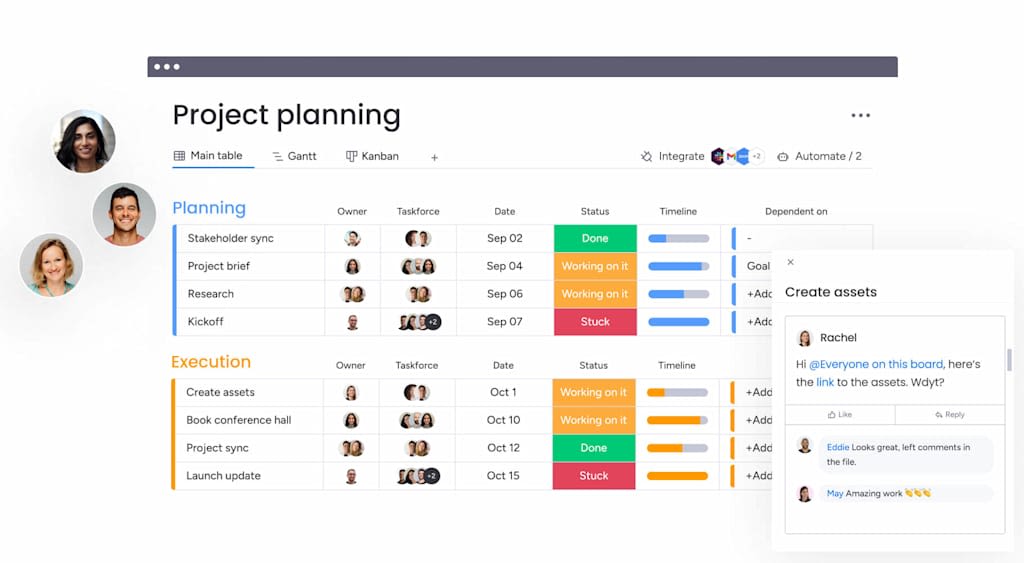
- Priority columns and board views: Start with a priority column and board views such as Kanban and table to sort each item into must, should, could, or won’t-have. Dashboards then roll those decisions up into a real-time picture of how effort is distributed across the 4 categories, so you can spot a bloated must-have list before it derails the timebox. You can also prioritize tasks using matrices and task prioritization templates to compare items side by side.
- Automations for routine upkeep: When an item’s priority changes, an automation can notify the owner, move the item to the right group, or flag it for review, so the classification doesn’t change. These same prioritization tools keep stakeholders aligned without another status meeting, and they connect to your broader task management process.
- monday sidekick for AI-assisted sorting: monday sidekick is a context-aware assistant that can recommend how to sort a backlog, draft the classification criteria, and answer questions about your boards in plain language. As you scale, Sidekick helps keep the effort balance in view rather than buried in a spreadsheet.
- monday agents for high-volume prioritization: For repeatable, high-volume prioritization, monday agents are task-specific AI workers that act inside your boards. The Sprint Planner organizes your backlog and drafts sprint goals around your team’s capacity, giving you a starting point for what fits in the timebox. The Dependency and Risk Mapper traces dependency chains and flags where a slip could cascade, covering the sequencing gap MoSCoW doesn’t handle on its own. Agents work alongside your team rather than replacing anyone, so people keep the final call on what’s a must-have. Every agent runs on mondayDB, one connected data layer spanning marketing, sales, ops, IT, HR, product, and legal, with 200+ integrations and MCP keeping the rest of your stack in sync.
Transform MoSCoW priorities into real progress
The real value of the MoSCoW method isn’t the four labels; it’s the clarity they force. When your team agrees what’s a must-have and what’s deferred, you protect the deadline and ship the work that actually matters. That shared honesty is what keeps scope creep from swallowing the release.
The next step is keeping those priorities alive as conditions change. Pairing the MoSCoW method with AI-assisted scoring and risk detection lets you re-sort the list the moment reality shifts, instead of once a quarter. On a connected work platform, your priorities move as fast as your work does.
MoSCoW method FAQs
What does MoSCoW stand for?
MoSCoW stands for must-have, should-have, could-have, and won't-have (this time). Each term is a priority category. The lowercase Os are filler letters added only to make the acronym easier to say, so they carry no meaning of their own.
Who created the MoSCoW method?
The MoSCoW method was created by software developer Dai Clegg in 1994. He designed it to help teams prioritize requirements during rapid, timeboxed development, and it was later documented in the Dynamic System Development Method (DSDM) handbook.
Is MoSCoW an Agile technique?
Yes, MoSCoW is an Agile technique closely tied to the DSDM framework maintained by the Agile Business Consortium. It suits timeboxed delivery because it fixes priorities before a cycle begins, helping Agile teams decide what to include in a sprint or release.
What are the disadvantages of the MoSCoW method?
The main disadvantages of the MoSCoW method are subjectivity and limited ranking. Categorization relies on judgment rather than numbers, so teams can disagree on what counts as a must-have. It also doesn't rank within categories on its own or account for task dependencies.
What percentage of tasks should be must-have?
DSDM guidance recommends keeping must-have requirements to no more than roughly 60% of a timebox's effort. The remaining effort covers should-haves and a contingency pool of about 20% could-haves, which gives the team room to absorb delays without missing the deadline.
How does monday AI Workspace support MoSCoW prioritization?
monday AI Workspace supports MoSCoW prioritization with priority columns, board views, and dashboards that keep every category visible in real time. Automations update priorities as work changes, while Sidekick and agents help sort backlogs and flag risks, so people keep the final decision.
