


Most to-do lists fail not because people don’t keep them, but because they lack the structure to turn tasks into meaningful progress. When you build a deliberate system around your list — one that captures, prioritizes, and connects daily work to larger goals — your to-do list becomes a productivity engine instead of a collection of good intentions.
This guide gives you a complete 7-step system for building a to-do list that actually drives results. You’ll learn proven prioritization methods, the psychology behind effective task management, and a practical framework for connecting your daily tasks to the goals that matter most.
Key takeaways
- Capture everything in one place: Capture every task in one trusted location before you start prioritizing, so nothing slips through the cracks
- Prioritize with 3 lenses: Prioritize by urgency, importance, and personal energy levels rather than just deadlines or due dates
- Make tasks actionable: Break large tasks into specific, actionable steps with assigned owners and realistic deadlines
- Review deliberately: Review your list daily and handle rolled-over tasks deliberately instead of letting them accumulate
- Scale with your team: monday AI Workspace connects individual to-do’s to team workflows and project boards, so personal task management scales with your organization
Step 1: Write everything down
Start with a complete brain dump. Every task, commitment, idea, and nagging thought occupying mental space needs to land in one place. This isn’t about organizing yet. It’s about clearing cognitive load so your brain can focus on doing work instead of remembering it.
There’s science behind this approach. Research on unfinished goals suggests they can remain cognitively active and interfere with other tasks. Creating a specific plan for completing them can reduce that mental interference, helping you focus on the work at hand.
The key is choosing one capture system and sticking with it. A physical notebook, a notes app, a platform like monday AI Workspace — the format matters less than consistency. If tasks live in 5 different places, you’ve created 5 different lists to check instead of one trusted source.
Modern capture methods have lowered the barrier significantly. Voice-to-task features let you dictate tasks during a commute. Email-to-task parsing converts messages into actionable items automatically. The point is removing every possible excuse for not capturing a task the moment it surfaces. When everything lives in one place, you can stop worrying about what you’re forgetting and start deciding what to do next.
Step 2: Prioritize your tasks
Not all tasks deserve equal attention, and treating them that way is one of the fastest paths to busy-but-unproductive days. Effective prioritization uses 3 lenses, not just one.
The first lens is urgency and importance. The Eisenhower Matrix remains one of the most practical frameworks here. It sorts tasks into 4 categories: urgent and important (do now), important but not urgent (schedule), urgent but not important (delegate), and neither (drop). Most people spend too much time in the “urgent but not important” quadrant, reacting to requests instead of advancing meaningful work.
The second lens is energy level. High-cognitive work like writing, strategic planning, or complex analysis belongs in your peak energy window. Administrative tasks, email processing, and routine updates fit naturally into lower-energy periods. This approach gets more done without requiring more hours.
The third lens is strategic value. Ask yourself: Which of these tasks actually moves the needle? Some tasks feel productive but don’t contribute to outcomes that matter. Before opening your list each day, identify your MIT (Most Important Task) and commit to completing it before anything else.
To prioritize your to-do list, start by identifying your single most important task for the day. Then sort remaining items using the Eisenhower Matrix (urgent vs. important), align task types with your energy levels throughout the day, and batch similar low-energy tasks together.
Watch out for the cherry-picking trap
Here’s something most productivity advice skips: Your brain is wired to sabotage your priorities. Completing quick, easy tasks can feel productive, which can create a bias toward low-value work. Knocking out 5 quick emails feels rewarding, even when the quarterly report sitting at the top of your list is the work that actually matters.
The fix is simple. Complete your MIT before you touch anything else. You can organize tasks by impact first and batch the quick wins for your afternoon energy dip.

Step 3: Break tasks into smaller steps
A task that’s too vague to act on will sit on your list indefinitely. “Prepare Q3 report” isn’t actionable. It’s a project disguised as a task. Breaking it down into specific steps transforms it from something you avoid into something you can start immediately.
Here’s what that looks like in practice:
- Vague: “Work on presentation” → Actionable: “Create 10 slides for Q1 budget presentation”
- Vague: “Follow up with client” → Actionable: “Email Sarah the revised contract terms by Friday”
- Vague: “Research competitors” → Actionable: “Analyze 3 competitor pricing models for strategy meeting”
Each actionable step starts with a verb, identifies a specific output, and makes the scope of the work immediately obvious. When tasks are this specific, there’s no mental overhead deciding what “work on presentation” actually means at 9 a.m. on a Tuesday.
Sub-tasks and checklists add another layer of structure for complex items. If a task has more than 3 or 4 steps, involves other people, or spans more than a few days, it may need its own breakdown. This is also a signal that your to-do item might actually be a project, which brings us to the next step.
Step 4: Know when a to-do becomes a project
There’s a practical distinction that most to-do list advice ignores: the difference between a task and a project. Understanding it prevents your list from becoming an unmanageable backlog of items that don’t belong there.
A task is a single, actionable item one person can complete in a defined time. “Send the meeting recap to the team” is a task. A project is a set of interconnected tasks with dependencies, multiple contributors, or a defined outcome that requires coordination. “Launch the Q3 marketing campaign” is a project, not a task, no matter how many times you write it on your to-do list.
Use a to-do list for individual tasks you can complete independently. Switch to project management when work involves more than 3 steps, requires coordination with other people, or needs progress tracking over multiple weeks.
Here are the signals that a to-do has outgrown your list:
- More than 3–4 steps: The item needs its own breakdown and tracking.
- Multiple people involved: Coordination requires shared visibility and accountability.
- External deadlines or dependencies: The work connects to deliverables others are waiting on.
- Progress tracking needed: You need to see how far along something is, not just whether it’s done.
For solo tasks, a to-do list is the right container. For multi-person, multi-week work, a project board gives you the structure to track progress, manage dependencies, and keep everyone aligned. The ideal setup lets you start with a simple to-do and escalate to a project board when the work demands it, without switching platforms. That’s exactly what task management software like monday AI Workspace is designed to handle.

Step 5: Set realistic deadlines
A to-do list without deadlines is a wish list. Deadlines add urgency and force you to make honest decisions about what you can accomplish in a given timeframe. But unrealistic deadlines create their own problems: missed targets, constant rescheduling, and the slow erosion of trust in your own system.
The most reliable approach is backward planning. Start with the final deadline and work backward, mapping out each step and the realistic time it requires. This surfaces dependencies and bottlenecks before they surprise you mid-project.
A few principles for setting deadlines that stick:
- Build in buffer time: Tasks almost always take longer than estimated, especially when they involve other people or external inputs.
- Distinguish hard deadlines from soft ones: Client deliverables and regulatory filings are non-negotiable. Internal targets can flex if needed.
- Use time blocking to enforce deadlines: Assign specific calendar blocks to high-priority tasks so they don’t get crowded out by reactive work.
- Set automated reminders: Deadline notifications keep tasks visible without requiring you to manually check your list every hour.
The goal isn’t perfection. It’s steady, sustainable progress. Base your time estimates on how long similar tasks have actually taken, not how long you wish they’d take.
Step 6: Handle unfinished tasks deliberately
Every to-do list accumulates tasks that don’t get done. Most people handle this by ignoring them, copying them forward to tomorrow’s list, or letting guilt quietly build. None of these approaches work. What does work is a deliberate system for processing your backlog.
What do you do with tasks you don’t complete? Review each unfinished item and ask 3 questions:
- Is this still relevant?
- Am I the right person to do it?
- Is now the right time?
Then either carry it forward with a new deadline, defer it to a specific future date, delegate it, or drop it entirely.
When a task rolls over more than twice, it’s a signal. Either the task isn’t as important as you thought, it’s too vague to act on (see Step 3), or it’s blocked by something you haven’t addressed. Rolled-over tasks that sit untouched for a week need a different decision, not another day on the list.
Build a weekly review ritual
Set aside 15–30 minutes at the end of each week to process your list. This isn’t about planning next week yet. It’s about honestly evaluating this week. Walk through every uncompleted item and make a deliberate choice:
- Carry forward: Still relevant and time-sensitive? Assign a specific day next week.
- Defer: Important but not urgent? Move to a future date and get it off this week’s list.
- Delegate: Someone else is better positioned to handle this? Hand it off with context.
- Drop: No longer relevant or valuable? Remove it without guilt.
This weekly review prevents list bloat, reduces decision fatigue, and keeps your system trustworthy. A list you trust is a list you actually use. A bloated list full of zombie tasks becomes background noise you learn to ignore.
Step 7: Stay consistent with a daily and weekly rhythm
The difference between a to-do list that works and one that collects dust is rhythm. A daily and weekly review cadence turns a static list into a living system that adapts as your work evolves.
- Daily rhythm: Spend 5 minutes each morning reviewing your list. Confirm your MIT for the day. Check for anything that’s changed since yesterday. Adjust deadlines or priorities based on new information. At the end of the day, spend 2 minutes updating progress and flagging anything that needs to roll forward.
- Weekly rhythm: Your weekly review (Step 6) handles the backlog. But also use this time to look ahead. What’s coming next week? Are there deadlines you need to prepare for? Are your tasks still aligned with your larger goals?
Consistency compounds. A list you review daily outperforms a perfect list reviewed occasionally. The habit doesn’t need to be elaborate. It needs to be reliable. Five minutes in the morning and 2 minutes at the end of the day is enough to keep your system working for you instead of against you.
Top methods for organizing your to-do list
Different work styles call for different organizational methods. These 3 proven approaches complement the 7-step system above. You can use them individually or combine elements from each to match your workflow.
Getting Things Done (GTD) for comprehensive capture
Getting Things Done, developed by David Allen, builds a complete system around 5 steps: capture everything, clarify what each item means, organize by context and priority, reflect through regular reviews, and engage with confidence. GTD works especially well for knowledge workers juggling multiple projects because it eliminates the mental overhead of deciding what to do next.
The core strength of GTD is its insistence on processing every input. Vague ideas become defined actions. Multi-step items become projects. Tasks get grouped by context (at the computer, on the phone, in a meeting) so you can batch similar work together.
Time blocking for focused execution
Time blocking assigns specific calendar slots to focused work. Instead of working from a list and hoping you get to everything, you decide in advance when each task happens. This creates a realistic picture of what your day can actually hold.
To make time blocking effective, base your time estimates on past experience rather than optimism. Group similar tasks to minimize context-switching. Build buffer time between blocks for transitions and unexpected interruptions. Treat your blocked time as committed appointments with yourself.
Learn more: AI daily briefer agent
Personal Kanban for visual workflow management
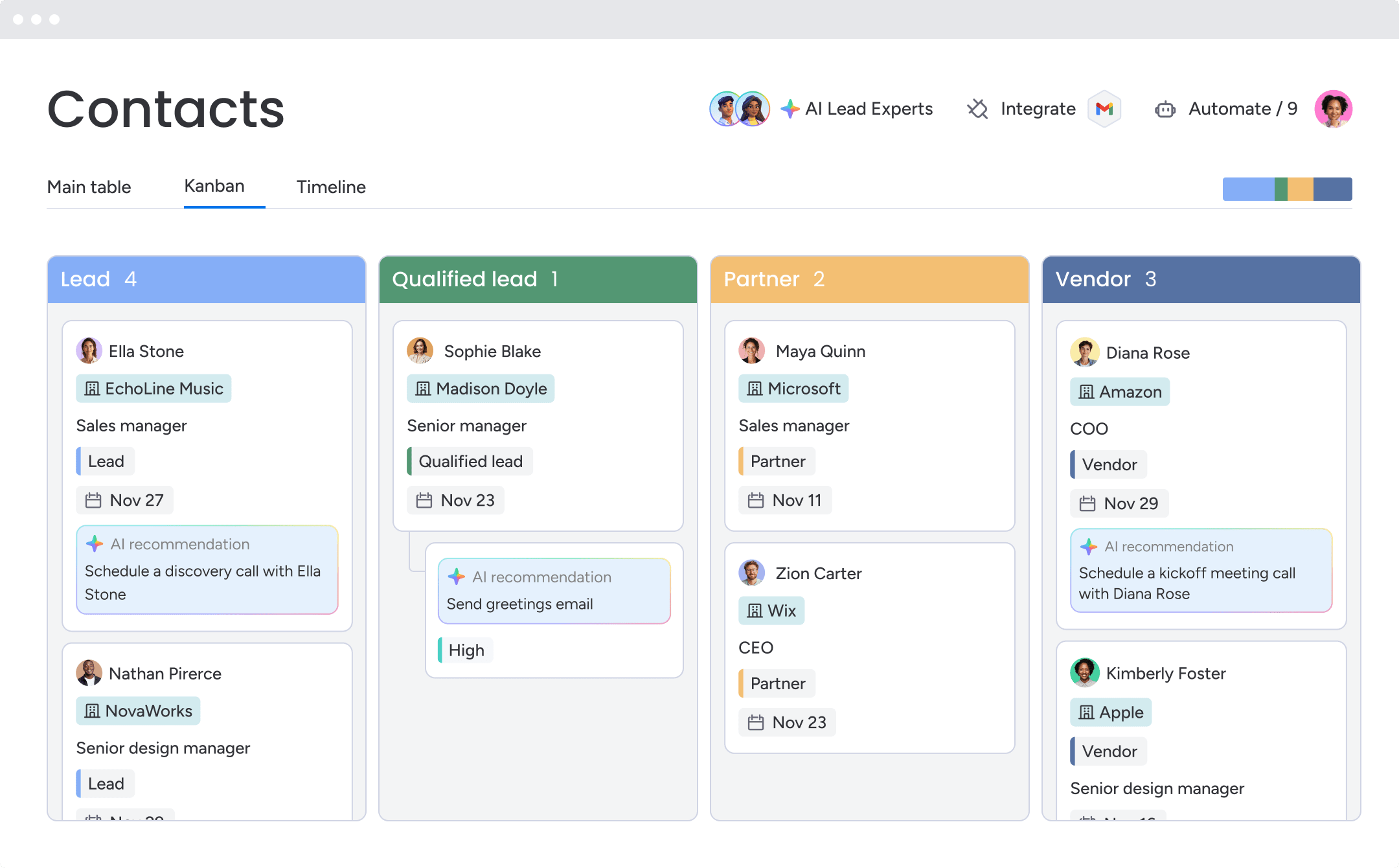
Personal Kanban uses a simple 3-column board: To Do, Doing, and Done. Moving tasks across columns provides instant visual feedback on your progress and prevents overcommitment. If your “Doing” column is always full, you’ve taken on too much work in progress.
Kanban is particularly effective for people who start many things but struggle to finish them. The visual constraint forces you to complete current work before pulling in new tasks, which consistently leads to higher completion rates and less context-switching.
Energy-based scheduling as a complement
Energy-based scheduling pairs task types with the times of day when you tend to have the most focus and mental energy. The concept is straightforward: Align task types with your natural energy levels throughout the day.
Cognitive-heavy work (writing, analysis, strategic planning) goes in your peak energy window. Administrative tasks, email, and routine updates fit into lower-energy periods. This approach doesn’t replace prioritization frameworks. It makes them more effective by ensuring your highest-priority work gets your best mental resources.
Align your to-do list with your bigger goals
A to-do list that isn’t connected to anything larger eventually becomes a list of busywork. The most productive people treat their daily tasks as the execution layer of larger objectives. Every task should trace back to a project, a quarterly goal, or a strategic priority. If it doesn’t, it’s worth asking why it’s on the list.
This doesn’t require a complicated framework. Start by identifying your top 3 goals for the quarter. Then ask yourself each morning: which of today’s tasks directly supports one of these goals? Tasks that don’t connect to any goal aren’t automatically worthless, but they shouldn’t crowd out the ones that do.
Use SMART goals (Specific, Measurable, Achievable, Relevant, Time-bound) to turn vague ambitions into concrete targets. Then break those targets into monthly milestones and weekly deliverables. Your daily to-do list becomes the last mile in a chain that runs from annual strategy to today’s work.
Where does a platform fit in? When your tasks live inside the projects and goals they support, the connection between daily work and strategic outcomes becomes structural, not aspirational. You can see at a glance whether your week’s effort actually advanced your priorities, or just kept you busy.
Build your to-do list on monday AI Workspace
The 7 steps above give you a complete system for personal task management. But individual productivity is only part of the picture. When your to-do list needs to connect to a team’s work, a project’s timeline, or an organization’s goals, you need a platform that bridges personal task management and collaborative workflows.
monday AI Workspace is built for exactly this transition. Here’s how it supports each phase of the system covered in this guide:
- To-do’s feature for personal task management: Keep track of your assigned tasks, deadlines, and priorities in one view. It’s your daily to-do list with the structure of a task management guide behind it.
- Multiple board views for flexible organization: Kanban boards for visual prioritization, Gantt charts for deadline tracking, Calendar views for time-based planning, and Timeline views for project sequencing. You pick the view that matches how you work.
- Automations that reduce manual follow-up: Deadline reminders, status update notifications, and task assignment workflows that route work to the right person automatically.
- Dashboards for visibility at every level: Connect individual task completion to team performance metrics and project status in one view, so managers see progress without chasing updates.
- AI capabilities for intelligent task management: AI Blocks draft task descriptions and categorize incoming work. monday agents help teams execute recurring workflows. monday vibe lets teams build custom apps without code.
- Integrations for connected workflows: Sync tasks with Slack, email, calendar apps, and the tools your team already uses, so nothing requires manual entry or tab-switching.
The core differentiator: monday AI Workspace isn’t just a task manager. It connects individual to-do’s to the projects, teams, and goals they support. Start with a personal task list, scale to a project board, and roll up to organizational dashboards, all on one platform.
Make your to-do list a system, not a habit
A to-do list only works when it’s part of a deliberate system. Daily capture, honest prioritization, consistent review, and connection to larger goals are what separate a list that drives results from one that collects dust.
The steps in this guide give you a complete framework for how to make a to-do list that actually works. Start with the brain dump. Build a prioritization rhythm. Process your backlog deliberately. And when your work outgrows a simple list, connect it to the teams and goals it supports.
monday AI Workspace brings this entire system together in one place. From personal to-do’s to team project boards to organizational dashboards, it’s a platform that grows with you.
FAQs
What is a to-do list?
A to-do list is a structured record of tasks you need to complete, organized by priority, deadline, or category. It serves as an external memory system that reduces cognitive load and keeps your work visible, actionable, and trackable.
What should be on a to-do list?
A to-do list should include specific, actionable tasks that start with a verb and define a clear outcome. Avoid vague entries like "work on project" and instead write "draft the executive summary for the Q3 report."
How long should a to-do list be?
Keep your daily to-do list manageable, with one item identified as your Most Important Task. Keep a separate master list for everything else and pull items into your daily list during your morning review.
What's the difference between a to-do list and a task list?
The terms are often used interchangeably, but a task list typically includes more structure: assigned owners, deadlines, status tracking, and integration with team workflows. A to-do list is usually personal and less formal, though both serve the same core purpose of capturing and organizing work.
How do I prioritize my to-do list?
Prioritize using 3 lenses: urgency and importance (the Eisenhower Matrix), energy alignment (high-cognitive work during peak hours), and strategic value (tasks that advance your most important goals). Identify your Most Important Task each morning and complete it first.
What makes a good to-do list?
A good to-do list has specific, verb-driven tasks with realistic deadlines, a defined prioritization method, and a regular review cadence. It lives in one trusted location, connects daily work to larger goals, and includes a system for handling unfinished items deliberately.
How do you make a to-do list when you feel overwhelmed?
Start with a brain dump to capture everything on your mind in one place. Then identify just your top 3 priorities for today and set everything else aside. Reducing your visible workload to a manageable number of items restores a sense of control and makes the next step obvious.
Should a to-do list be daily or weekly?
Use both: a weekly list captures everything you need to accomplish, while a daily list pulls 5–7 items from it each morning for focused execution. The weekly list provides context; the daily list drives action.
When should I use project management software instead of a to-do list?
Switch to project management software when your work involves more than 3–4 steps, requires coordination with other people, has dependencies or external deadlines, or needs progress tracking over multiple weeks. A platform like monday AI Workspace lets you start with a simple to-do and scale to project boards without switching tools.

 Get started