


Enterprise marketers face a crowded reality — too many tools, rising expectations for personalization, and growing pressure to prove that email drives pipeline and revenue.
AI email campaigns respond to that complexity. They coordinate data, messaging, timing, and performance in one system so execution keeps pace with strategy. Instead of adding another layer of tools, AI simplifies how teams plan, launch, and improve campaigns over time.
This guide focuses on how AI supports real-world email execution at scale. It covers campaign strategy, the tools shaping modern email programs, and practical ways to run cold outreach, lifecycle messaging, and CRM-connected campaigns more effectively.
Key takeaways
- AI email campaigns help teams move faster while keeping messaging relevant and on brand
- The strongest AI tools connect data, timing, personalization, and performance rather than focusing on copy alone
- AI-powered email campaigns perform best when customer insights live in a single system
- monday campaigns centralizes CRM data, AI insights, and execution so marketing and sales stay aligned
The dawn of AI-driven email and why automation is now the standard
Email remains one of the most measurable and scalable channels available to enterprise teams. As volumes grow and expectations rise, automation becomes essential for keeping campaigns relevant and efficient.
Replace static lists with adaptive campaigns
Traditional email workflows break down as scale increases. Static lists age quickly. Manual audience segmentation can’t keep up with changing customer behavior. One-off campaigns deliver short-term results but rarely produce learning that compounds over time.
Modern AI email campaigns replace these patterns with adaptive systems that improve continuously:
- Dynamic segmentation that updates as customer data changes
- Ongoing optimization based on engagement signals
- Coordinated workflows that support consistent improvement
AI also changes how marketers spend their time. Instead of managing every step by hand, teams focus on orchestration. Strategy, messaging direction, and performance analysis take priority while AI handles execution details at scale.
Email plays a central role in this shift. It offers immediate feedback, clear attribution, and a direct connection to CRM data. That combination makes email the most practical starting point for AI-driven campaigns and a foundation for broader marketing automation over time.
Use live customer signals to guide email decisions
AI email campaigns rely on real customer signals rather than assumptions. Instead of guessing what might resonate, AI evaluates behavior to guide delivery and content choices.
Key signals include CRM activity tied to accounts and contacts, engagement across emails and touchpoints, and each customer’s funnel or lifecycle stage.
These inputs move teams from gut-based decisions to insight-driven execution. Messaging, timing, and targeting shift as customers engage, keeping campaigns aligned with what is actually happening.
CRM context makes this possible. Lifecycle stage, engagement history, and sales activity ground AI in real customer journeys. Without that context, personalization quickly becomes shallow.
Essential AI tools for email campaign excellence in 2026
AI email campaigns depend on more than a single capability. High-performing programs combine writing assistance, timing intelligence, and personalization grounded in customer data. Together, these tools help teams execute consistently at scale.
AI email copywriting and how subject lines and content get smarter
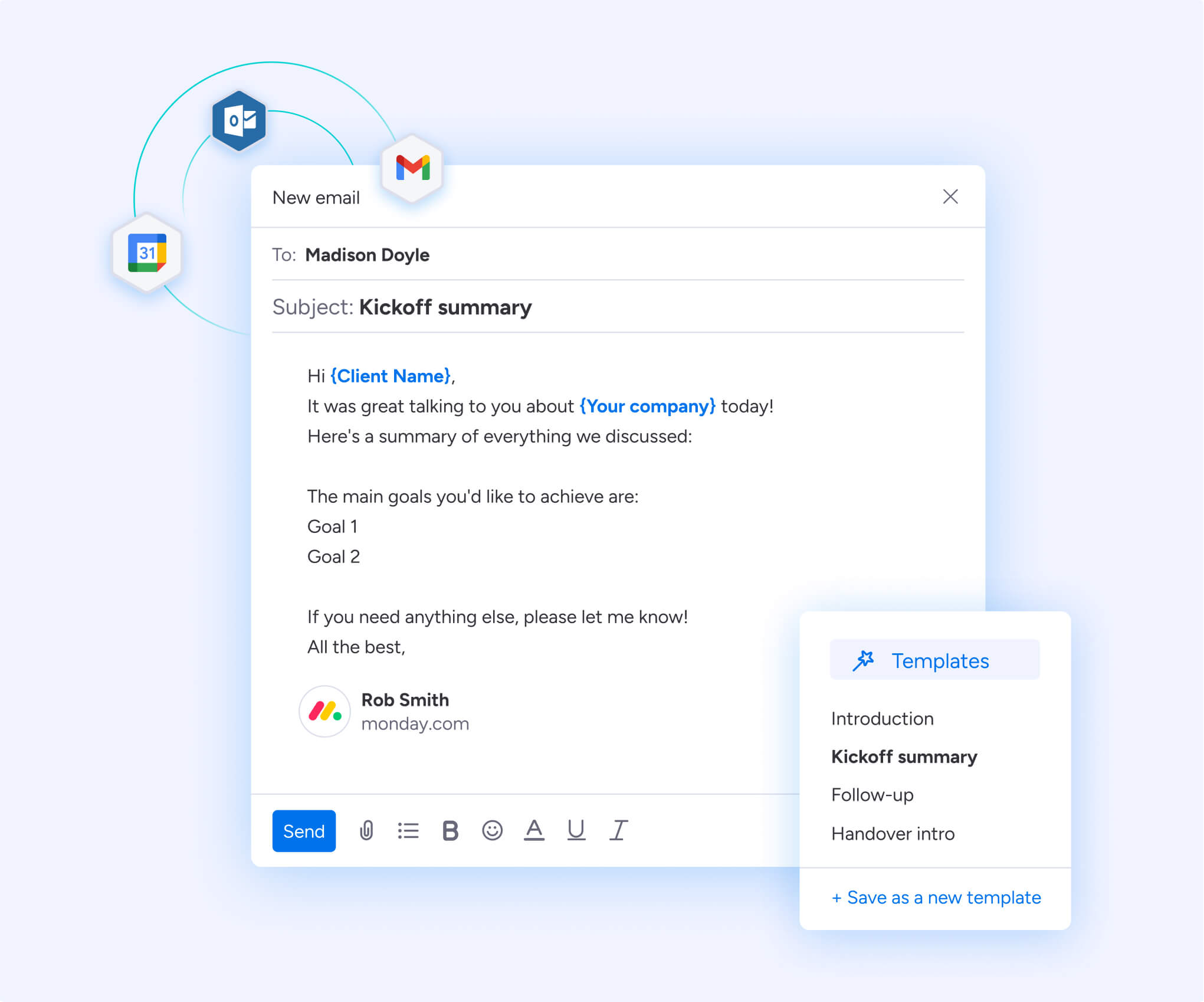
AI email writers handle many of the repetitive tasks that slow teams down. Today’s tools support:
- Drafting subject lines that align with campaign goals
- Adjusting tone and length for different audiences
- Applying brand guidelines consistently across messages
These capabilities speed up execution and reduce rework. They also help teams maintain consistency when multiple campaigns run in parallel.
Human input remains essential. Strategy, positioning, and voice guardrails still come from the team. AI supports those decisions rather than replacing them. When used well, AI accelerates production while preserving intent and brand integrity.
Predictive analytics and smarter timing decisions
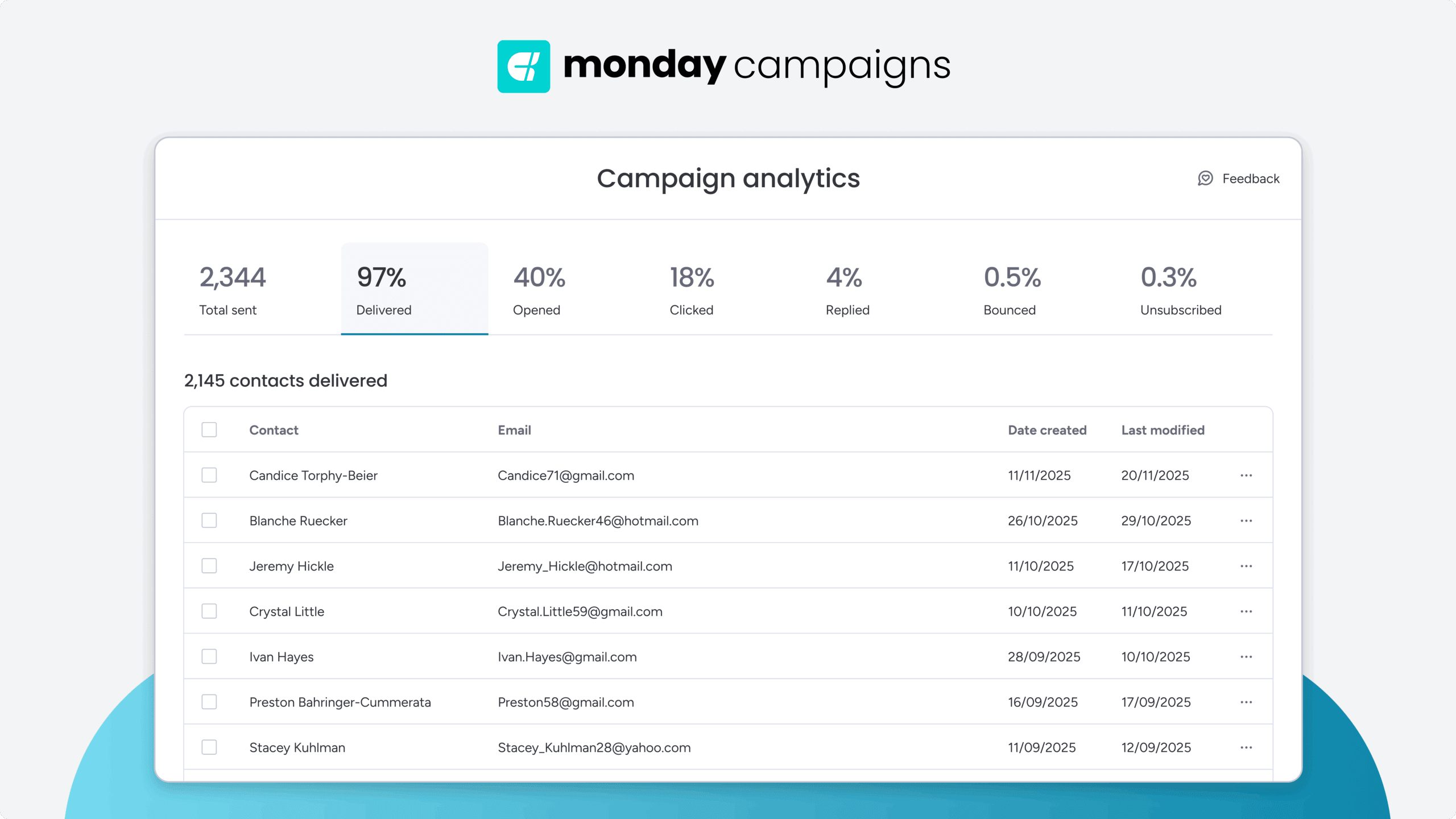
Timing plays a major role in campaign performance. AI tools for automating email campaigns analyze engagement patterns to refine:
- Send times based on recipient behavior
- Cadence across multi-step email sequences
- Follow-up timing tied to previous interactions
There is no universal best send time. Audiences differ by role, region, lifecycle stage, and behavior. Predictive analytics accounts for those differences and adjusts delivery accordingly.
Better timing improves engagement and supports deliverability. Emails that arrive when recipients are more likely to engage build healthier sender reputations over time.
Want to learn more about measuring the effectiveness of your email marketing campaigns? Check out Email marketing analytics: How to measure campaign success.
Personalize content across offers, messaging, and visuals
A personalization strategy extends beyond inserting a name into a subject line. AI supports relevance across multiple campaign elements:
- Offers aligned to account needs
- Messaging tailored to lifecycle stage
- Visuals that match the audience context
Accuracy depends on data quality. Personalization tools rely on CRM context to stay current as customer information changes. Without that foundation, messages quickly drift out of sync with reality.
Centralized customer data ensures reliable personalization and reduces manual maintenance as campaigns scale.
AI for sales email campaigns and cold outreach
Email campaigns increasingly span both marketing and sales teams. Lifecycle messaging, outbound outreach, and account-based programs often rely on the same customer data and timing signals, even when different owners handle execution.
AI supports this overlap by applying shared intelligence across marketing and sales email campaigns, helping teams stay coordinated as they operate at different funnel stages.
AI SDR platforms and AI email writers explained
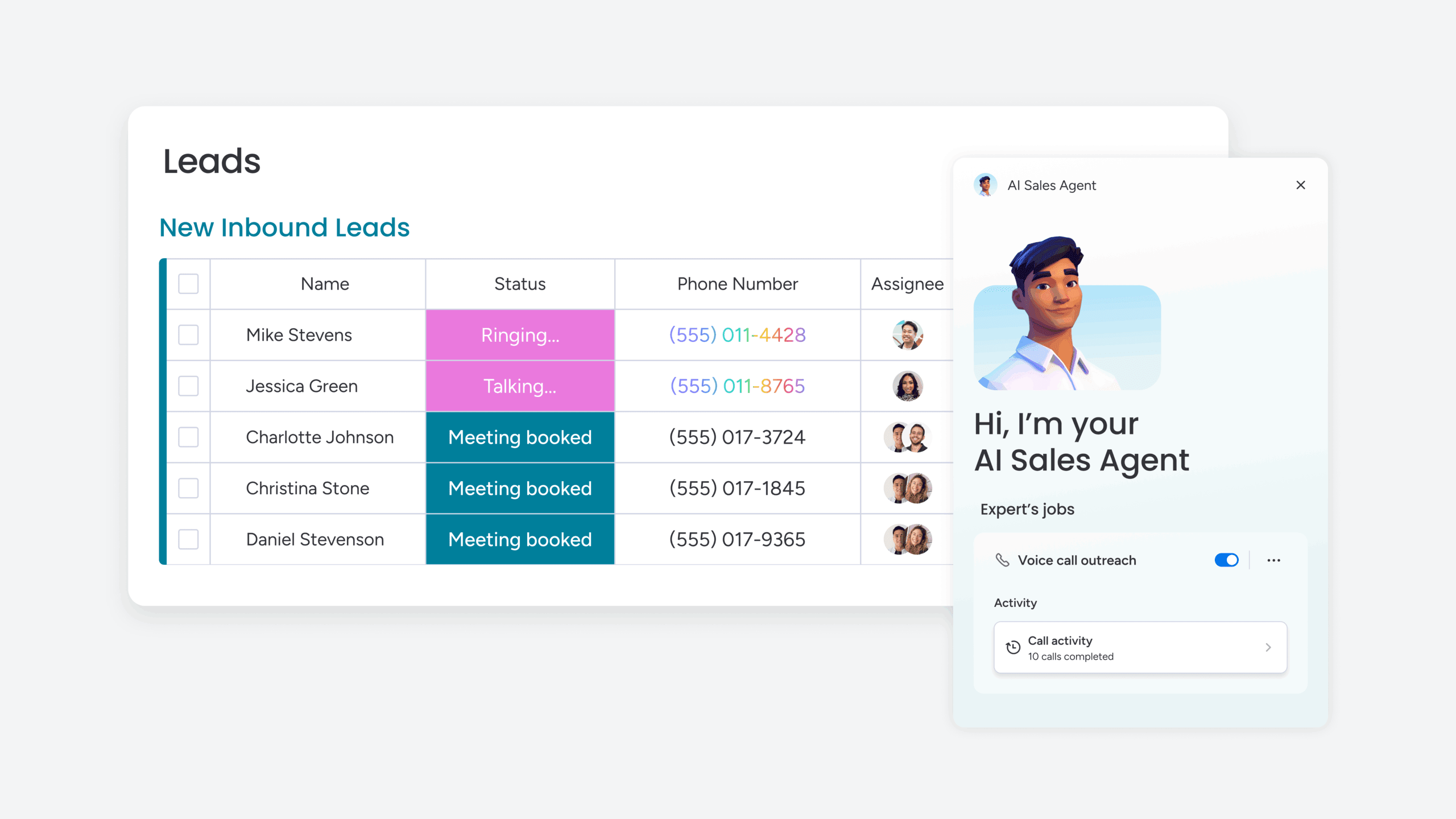
AI email writers and AI SDR tools solve different problems. Confusion often comes from overlapping terminology.
AI email writers focus on content creation. They assist with drafting messages and adjusting tone for outreach.
AI SDR platforms extend beyond writing. They support workflow automation, such as:
- Sequencing and follow-ups
- Lead routing and prioritization
- Performance tracking across outreach efforts
Choosing the right tool depends on sales motion and team size. Smaller teams may benefit from writing assistance. Larger teams running structured outbound programs often need automation that supports volume without sacrificing quality.
Hyper-personalization that earns replies
Effective cold outreach depends on relevance. AI-driven sales email campaigns personalize messages using signals that reflect real context rather than surface-level details.
Common inputs include:
- Industry and company profile
- Funnel stage or account status
- Recent activity across marketing and sales touchpoints
These signals help teams tailor outreach to what matters now. Relevance increases response rates and keeps outreach aligned with broader revenue goals. Volume alone does not drive results at enterprise scale.
Centralizing customer insights for AI-driven marketing with monday campaigns
Most enterprise teams already operate across a mix of CRM, marketing automation, and sales tools. Adoption often begins with lifecycle or outbound email, while other systems stay in place. Over time, centralized execution reduces fragmentation and simplifies how teams plan, launch, and measure campaigns.
As AI email campaigns mature, results depend on how closely the campaign tools integrate with customer data and daily workflows. monday campaigns is an AI-powered product within the monday CRM suite that lets teams create, launch, and optimize email campaigns in minutes using live CRM data, keeping planning, execution, and performance in one environment.
monday campaigns brings together:
- Contacts and account data from monday CRM
- Engagement and activity signals across the customer lifecycle
- Campaign performance tied back to CRM records
This shared context changes how campaigns operate. Segmentation stays current as customer data evolves, while timing and personalization adapt to real engagement patterns. Performance ties directly to pipeline activity, which helps teams show a clear impact on revenue.
When customer insights live in a single system, teams spend less time reconciling data and more time refining execution as outreach volume grows.
Teams typically start with two changes: replacing static lifecycle lists with CRM-driven segmentation and automating follow-ups based on real customer activity. These steps remove manual work early and create cleaner signals for future optimization.
How monday campaigns automations support email workflows
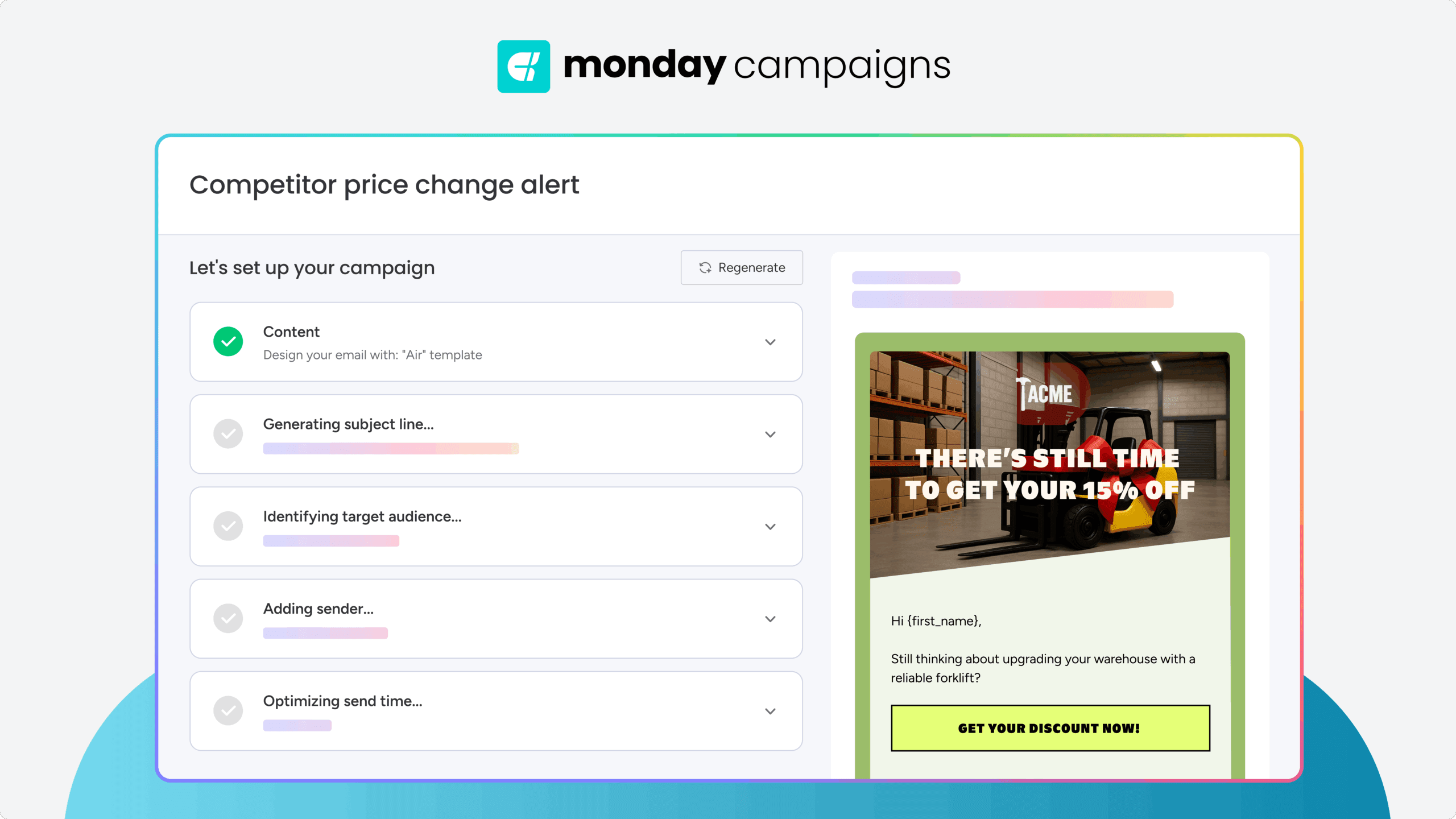
Automation in monday campaigns focuses on speed and clarity. Shared workflows reduce manual coordination while keeping teams aligned around the same data.
Common workflows include:
- Creating targeted CRM segments that update as contact data changes
- Triggering emails based on sales activity or lifecycle milestones
- Updating campaigns dynamically when engagement or account status shifts
These automations help campaigns respond to live signals rather than waiting for manual updates. Marketing and sales teams share context within the same system, reducing handoffs and shortening execution cycles.
Using monday’s AI features for campaign optimization
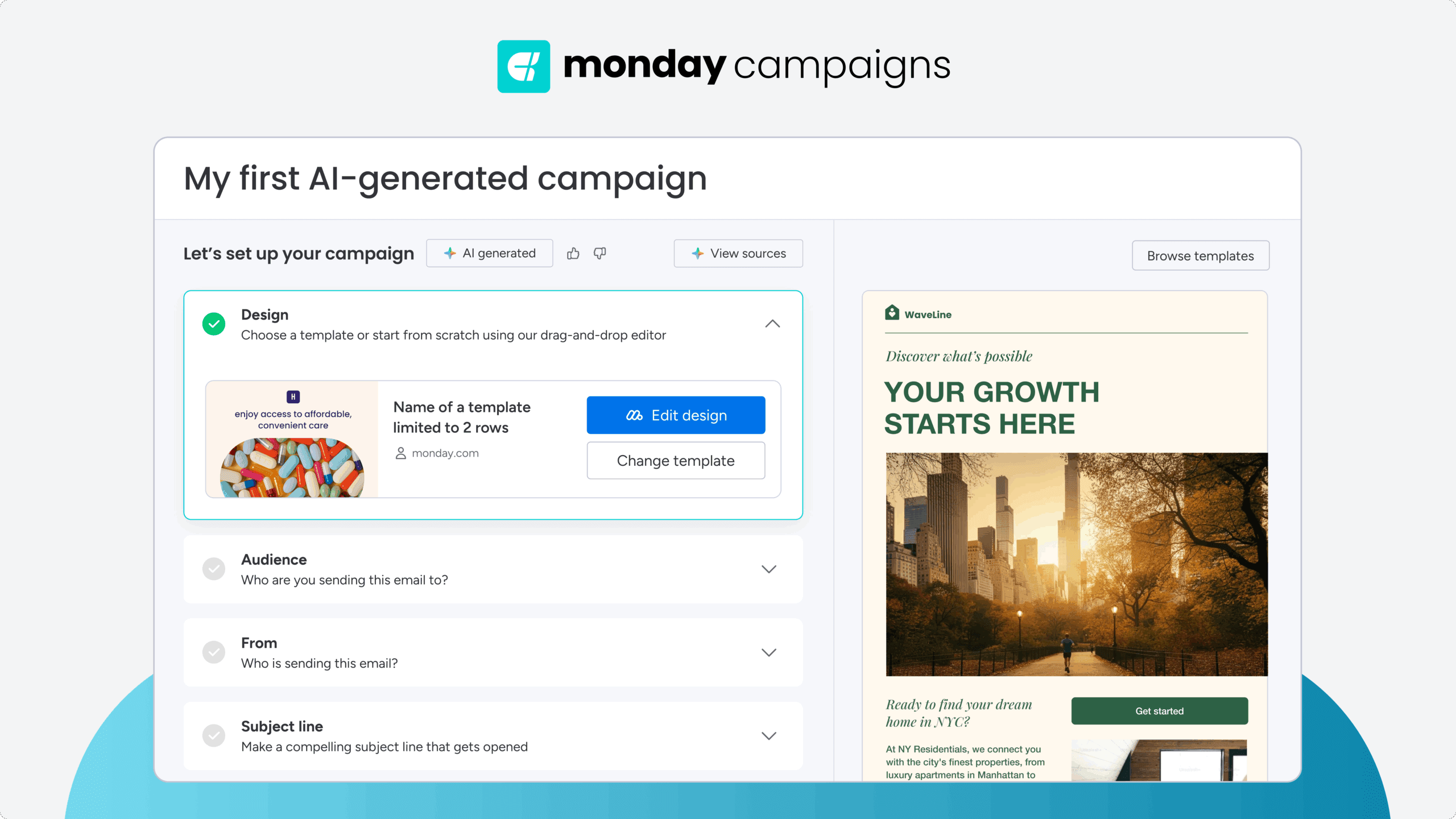
AI capabilities in monday campaigns support ongoing improvement across the campaign lifecycle and keep execution responsive as performance shifts. It’s embedded across the workflow, from verifying brand consistency to suggesting audiences, optimizing timing, and surfacing performance insights in real time.
Key capabilities include:
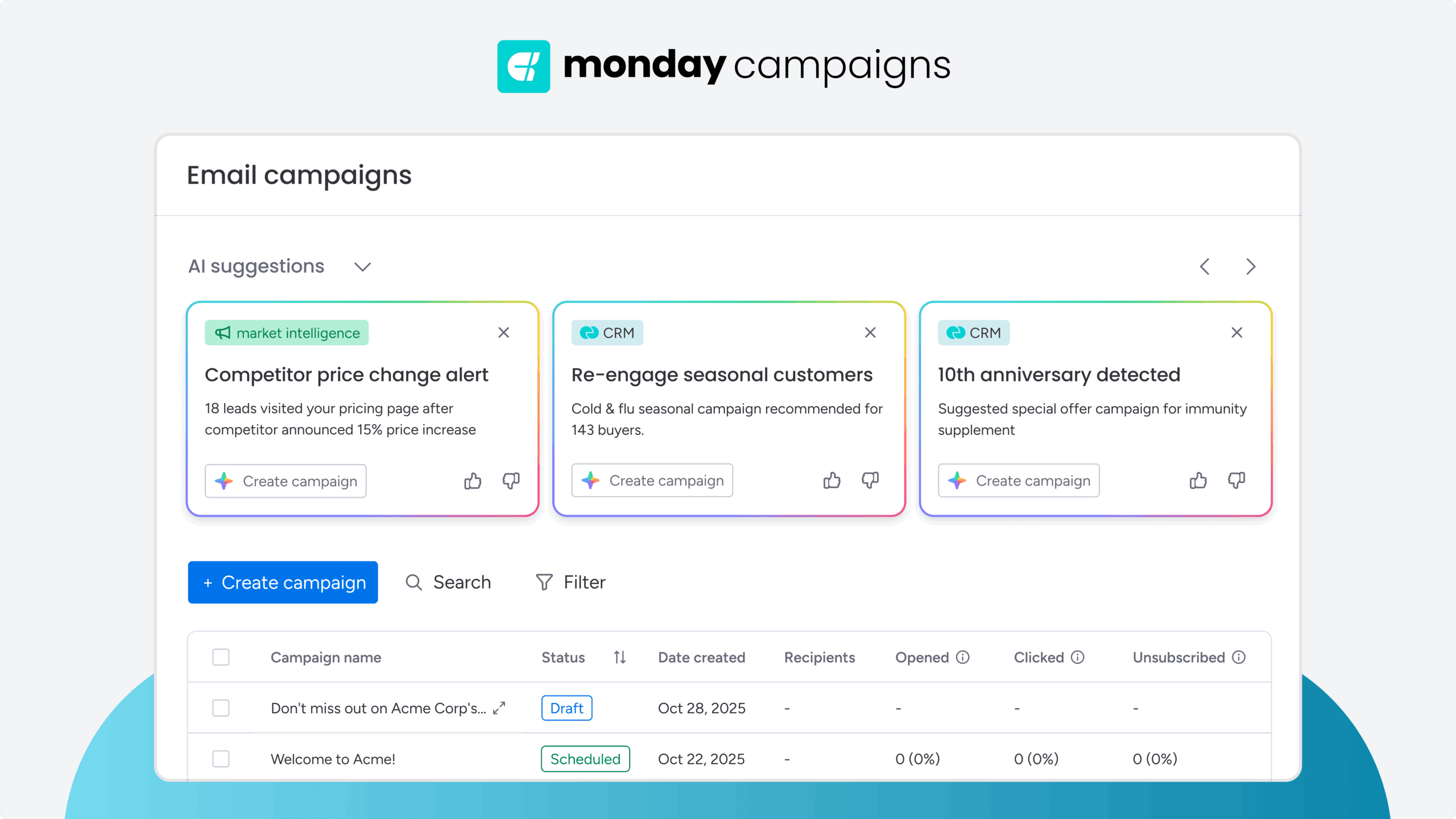
- Audience suggestions based on CRM data and engagement patterns
- Messaging recommendations aligned with campaign goals and brand guidelines
- Performance insights that surface what resonates and where adjustments are needed
These capabilities support workflows such as refining segments as new insights emerge, triggering follow-ups based on customer behavior, and adjusting messaging and timing while campaigns run.
Together, these workflows reduce lag between insight and action so teams can improve campaigns in real time.
AI keeps execution on brand while tying campaign decisions back to revenue goals rather than isolated engagement metrics. Teams remain responsible for configuration and direction. AI applies those inputs consistently and surfaces performance signals as campaigns evolve.
Next-level strategies for optimizing email campaigns with AI insights
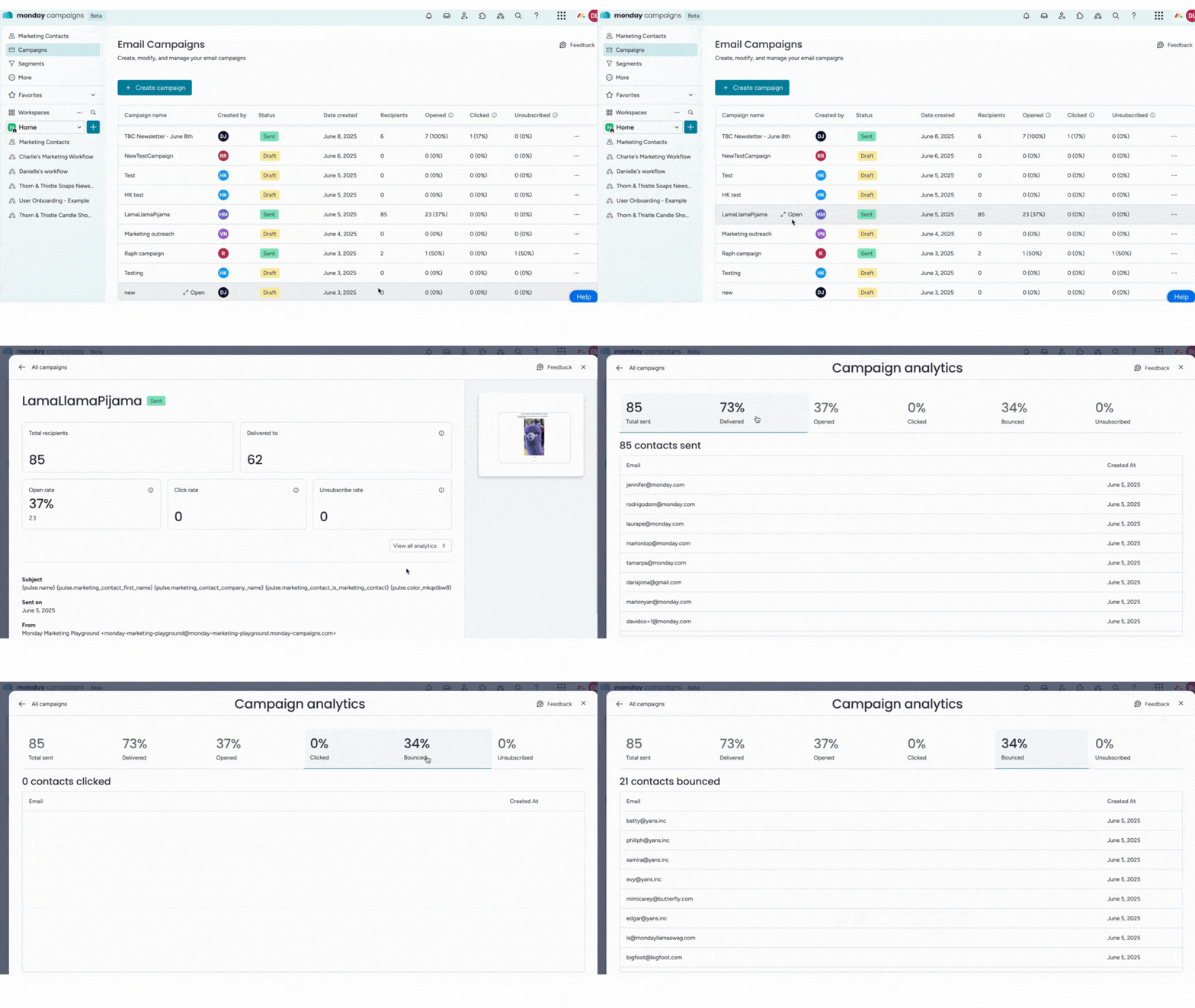
AI accelerates optimization, but it does not replace ownership. Teams still set goals, review results, and apply judgment where context matters. The value of AI shows up in speed, consistency, and faster access to insights that once took weeks to uncover.
As programs mature, teams shift attention from campaign metrics to account and pipeline outcomes. Email engagement becomes an input rather than the final measure of success.
Many teams track progress using metrics such as:
- Account movement across lifecycle stages
- Sales-accepted opportunities influenced by email activity
- Revenue tied back to CRM-connected campaigns
These signals keep optimization focused on business impact rather than surface engagement.
Deliverability as a strategic input
Deliverability grows more complex as AI-driven programs increase volume and cadence. Higher send frequency, broader audiences, and automated email campaigns all influence sender reputation.
AI email warm-up services help manage this risk through:
- New senders building credibility with inbox providers
- Higher-volume campaigns that need consistent engagement signals
- Long-term sender reputation across domains and audiences
Warm-up strategies guide pacing and volume to keep engagement healthy over time. Treating deliverability as a strategic input protects performance as outreach expands.
AI and multilingual email campaigns
Global teams often need to reach customers across languages without slowing execution. AI translation supports this effort through fast, consistent localization.
Automated translation works well when:
- Messaging follows a clear structure and shared terminology
- Teams localize high volumes of similar content across regions
Human review still plays a role for:
- Brand nuance and tone
- Regulatory or legal content
- High-impact customer communications
This balance allows teams to extend reach without turning localization into a bottleneck.
Run continuous testing without manual setup
AI tools for optimizing email marketing campaigns enable continuous testing across subject lines, content, timing, and sequencing.
These tools help teams:
- Test variations faster without manual setup
- Learn continuously from engagement data
- Reduce guesswork in optimization decisions
Learning loops replace one-off experiments. Campaigns improve incrementally as insights flow directly into future sends.
How teams govern AI email campaigns at scale
As AI-driven programs expand across teams and regions, governance becomes part of the execution process. Clear ownership, shared data standards, and review processes maintain quality and trust.
Effective governance typically includes:
- Defined roles for campaign ownership and approvals
- Shared data hygiene standards in CRM systems
- Guardrails for messaging, compliance, and brand voice
Strong governance keeps accountability clear while allowing AI to operate at full speed.
Who owns AI email campaigns in enterprise teams
Ownership typically sits with lifecycle or marketing operations teams, working closely with RevOps and sales leadership. This structure keeps campaigns aligned with revenue goals while maintaining consistency across regions and teams.
Turn AI email campaigns into a revenue system
AI email campaigns deliver the most value when planning, execution, and accountability live in one place. monday work management supports planning and operations, while monday campaigns is where teams execute CRM-connected email campaigns. Together, they connect strategy, delivery, and revenue impact under one roof.
Marketing teams coordinate briefs, approvals, and execution tasks in a single workspace. Work stays visible across regions and functions, which shortens cycles and reduces friction as outreach volume grows.
The real shift comes from integrating your email marketing strategy, data, and execution within a single system. When CRM context, AI insights, and campaign workflows work together, email moves beyond isolated sends and becomes a revenue system.
For teams building AI-driven programs today, email remains the fastest way to connect customer data, automation, and measurable business impact in a single environment.
FAQs
What is an AI-driven email campaign?
An AI-driven email campaign uses automation and customer intelligence to plan, execute, and optimize emails based on live data such as engagement behavior, lifecycle stage, and CRM activity rather than fixed rules or static lists.
How can AI improve email marketing campaign performance?
AI improves performance by helping teams send more relevant messages at the right time and continuously refine campaigns using engagement and behavioral insights, rather than relying on vanity metrics like opens alone.
Which AI marketing tools for email campaigns should teams expect in 2026?
Teams should expect AI tools that support content recommendations, predictive timing, dynamic segmentation, and performance insights that connect campaign activity directly to customer and revenue data.
What parts of an email campaign can AI automate?
AI can automate segmentation updates, content suggestions, send-time optimization, follow-up timing, and ongoing performance optimization while leaving strategy and oversight with the team.
Is an AI email writer the same as an AI SDR tool?
An AI email writer focuses on generating and refining message content, while an AI SDR tool manages outbound workflows, including sequencing, prioritization, and follow-ups across sales outreach programs.
How does AI use customer insights to personalize email content?
AI uses unified CRM data such as lifecycle stage, engagement history, and sales activity to adjust messaging, timing, and offers as customer context changes.
What are AI email warm-up services, and why do they matter?
AI email warm-up services help establish and protect sender reputation by gradually increasing send volume and monitoring engagement signals, which is especially important for new senders and high-volume campaigns.
Can AI accurately translate multilingual email campaigns?
AI translation supports rapid localization at scale, while human review remains important for brand tone, regulatory language, and high-impact customer communications.
What are the best practices for optimizing email campaigns with AI?
Best practices include maintaining clean CRM data, setting transparent governance for AI usage, and applying human oversight to strategic decisions and brand standards.
How does a CRM like monday support AI email campaigns?
A CRM supports AI email campaigns by providing a unified source of customer data that improves segmentation accuracy, personalization, and measurement across the full customer lifecycle.
Will monday campaigns support channels beyond email?
Email is the first channel because it provides clear attribution and fast feedback, with additional channels planned as part of a broader campaign execution strategy.
How does pricing work for AI email campaigns in monday campaigns?
Pricing follows a consumption-based model that scales with campaign volume and usage, and it is structured separately from monday CRM pricing.
How do teams typically roll out AI email campaigns in enterprise organizations?
Teams often begin with a focused use case, such as lifecycle email or outbound outreach, then expand as processes mature. Phased adoption allows teams to build confidence, align stakeholders, and scale execution without disrupting existing programs.

 Get started