


What if your sales team could spend more time actually selling? AI for sales management handles the repetitive work — data entry, follow-ups, call logging — automatically, freeing your reps to focus on conversations that close deals and surfacing the insights that move revenue forward.
This guide shows you how predictive, generative, and agentic AI each play a different role in your sales process, where the highest-impact applications are today, and how platforms that embed AI directly into your workflow make adoption simple. You’ll learn practical strategies for forecasting, rep coaching, and giving your team the tools to close deals faster with confidence.
Key takeaways
- AI automations take care of data entry, follow-ups, and call notes, freeing your team to focus on closing deals.
- AI analyzes real deal data so sales leaders can forecast with more confidence instead of relying on gut-feel estimates.
- AI pinpoints exactly where each rep struggles (e.g., objection handling or follow-up timing) so managers can coach with evidence, not guesswork.
- Features like Autofill with AI, AI Timeline Summary, and custom AI agents fit into your existing workflow without rebuilding anything.
- The human side of sales leadership — building trust, making strategic calls, and developing people — stays firmly in your hands.
What is AI for sales management?
AI for sales management is the application of artificial intelligence technologies to automate, optimize, and enhance sales processes, forecasting, coaching, and decision-making. This means AI handles the repetitive work that drains your team’s time while surfacing insights that help you make smarter decisions faster.
AI for sales management is multiple technologies working together. Machine learning gets smarter as it learns from your data. Natural language processing understands and generates human language. Behind the scenes, these capabilities analyze patterns, spot what matters, and handle tasks that used to take hours.

For sales leaders, the value of AI lies in how it appears in day-to-day operations to solve real problems. From prioritizing the right leads to predicting revenue, AI integrates directly into the sales workflow. Here are a few key examples:
- Lead scoring: Analyzes prospect behavior and firmographic data to prioritize which leads your reps should contact first
- Sales forecasting: Examines historical deal data, pipeline velocity, and external signals to predict quarterly revenue with greater accuracy than spreadsheet-based methods
- Conversation intelligence: Transcribes sales calls, identifies key moments like objection handling or competitor mentions, and surfaces coaching opportunities for managers
Sales teams are under pressure to hit targets with fewer resources. Buyers want personalized experiences at every step. Manual processes slow everything down and drain your reps’ time. AI cuts through that friction, so your team can compete without adding headcount.
How AI for sales works
AI for sales management works in a few different ways. Knowing the difference helps you pick the right solution for the job. Here’s how each type works and where it fits:
| AI type | Primary function | Sales application |
|---|---|---|
| Predictive AI | Forecasts outcomes and identifies patterns | Lead scoring, deal probability, churn prediction |
| Generative AI | Creates content and summaries | Email drafting, call summaries, proposal creation |
| Agentic AI | Takes autonomous action | CRM updates, lead routing, follow-up execution |
Predictive AI: Forecast outcomes before they happen
Predictive AI uses historical data and pattern recognition to forecast future outcomes and identify trends. This is the most mature form of AI in sales, focused on answering “what will happen?” questions before they unfold.
Here’s what predictive AI does in sales:
- Analyzing conversion likelihood: Identifies which prospects are most likely to convert based on engagement signals
- Predicting pipeline outcomes: Calculates deal close probability and expected revenue
- Detecting at-risk accounts: Spots usage drops or engagement declines before customers leave
For example: A predictive AI model analyzes 10,000 past deals and finds that prospects who attend 2 demos and check the pricing page within 14 days close 73% of the time. When a new prospect matches that pattern, AI flags them as high-priority so your team can move in when the time is right.
Generative AI: Create content and personalize outreach at scale

Generative AI creates new content based on prompts and context. In sales, this means an AI sales assistant can draft emails, generate call summaries, create proposals, and personalize outreach at scale, giving reps a powerful head start on every communication.
After a discovery call, generative AI writes a follow-up email that references the prospect’s pain points, suggests relevant case studies, and lays out next steps. What used to take 15 minutes now takes 2. Teams using monday CRM leverage AI email assistance directly within the Emails & Activities feature, allowing reps to compose personalized messages without leaving the platform.
Agentic AI: Execute tasks autonomously without waiting for prompts

Agentic AI is the next step. These systems perceive their environment, make decisions, and execute entire workflows with minimal human help.
An AI agent monitoring a pipeline might detect that a high-value deal hasn’t had activity in 10 days. An AI account outreach agent can automatically send a personalized check-in email to the prospect, log the action in the CRM, and notify the account executive. The rep wakes up to a completed action rather than a reminder to do it.
Try monday CRM6 benefits of AI for sales teams
AI for sales management improves productivity, accuracy, coaching, deal speed, collaboration, and scalability. That means more closed deals, higher win rates, and stronger teams. Here’s where the impact shows up most.
1. More selling time and less manual work
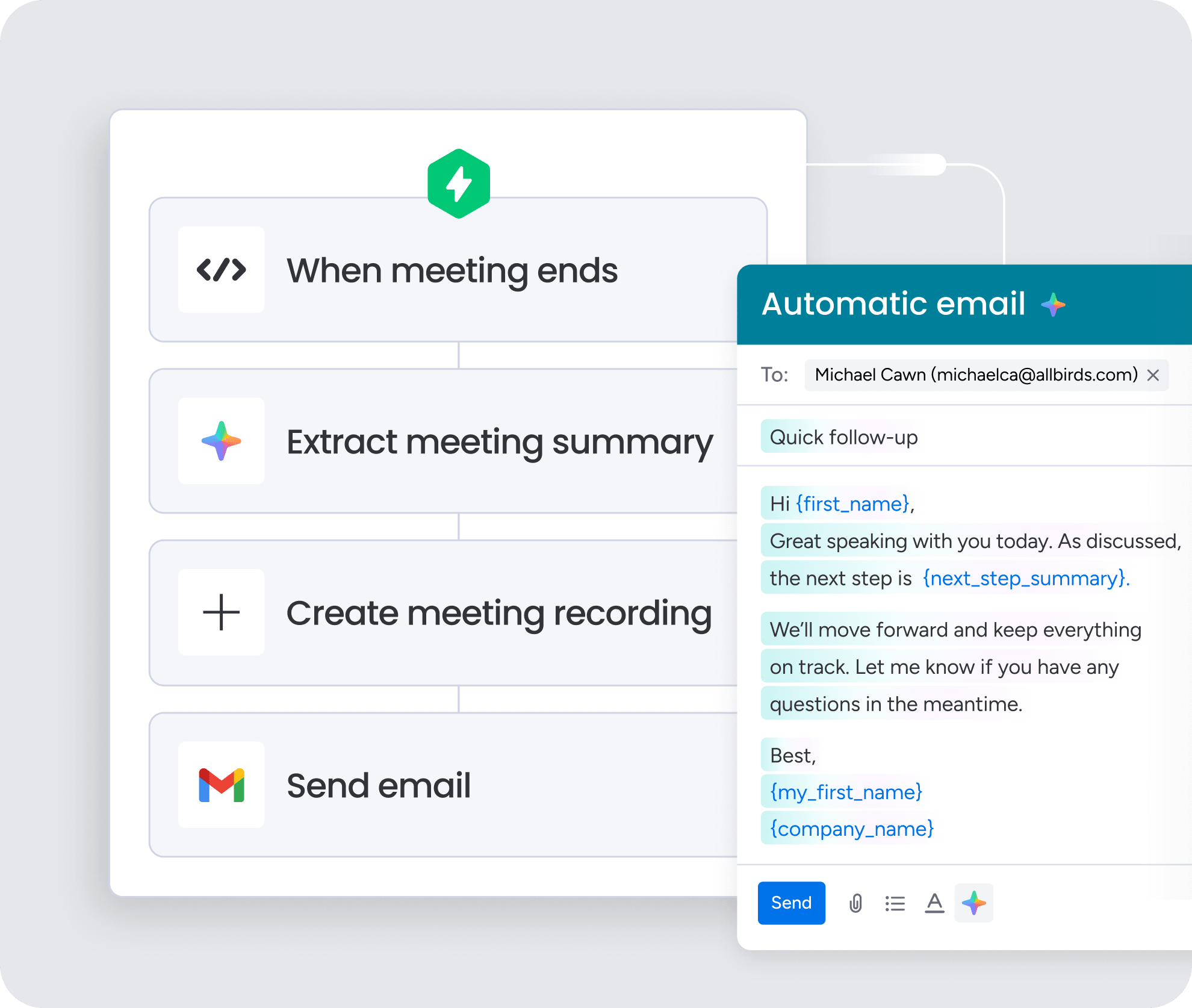
AI eliminates repetitive admin tasks that eat up your reps’ time: data entry, activity logging, meeting notes, follow-up scheduling, and CRM updates. Automate those, and reps can focus on what matters — talking to prospects and closing deals.
Here’s where you’ll save time every day:
- Automatic activity logging: Logging emails, calls, and meetings into the CRM without manual data entry
- Post-call documentation: Generating summaries and action items, eliminating note-taking during conversations
- Follow-up drafting: Drafting follow-up emails based on call context, reducing time spent on routine correspondence
Teams using monday CRM’s Autofill with AI automatically populate columns with extracted info, assigned labels, and sentiment detection — keeping records current without manual work.
2. Accurate forecasting and pipeline visibility
AI improves forecast accuracy by analyzing deal data, historical patterns, rep performance, and external signals to predict outcomes more precisely than manual methods. Sales leaders can report their numbers with confidence and make resource decisions that stick.
Here’s what improves:
- Deal-level probability: Calculating close probability based on stage progression, engagement levels, and historical win rates
- Early risk detection: Detecting pipeline risks early, including deals stalled too long or missing key activities
- Real-time visibility: Providing pipeline visibility across the entire team, surfacing trends manual reviews might miss
3. Personalized coaching at every level
AI helps sales managers deliver personalized, data-backed coaching to the whole team. It analyzes call recordings, email performance, deal progression, and rep activity to spot specific coaching opportunities for each person.
AI shows you which reps need coaching on specific skills. It analyzes call transcripts and flags moments where deals stall after pricing discussions — highlighting exactly who struggles with objection handling. Teams leveraging monday CRM’s AI Timeline Summary create short, readable overviews of all communication events, helping managers quickly understand account history before coaching conversations.
4. Faster deal cycles and higher win rates
AI speeds up deals by spotting bottlenecks, recommending next steps, and making sure reps reach out at the right time with the right message.
- Stall detection and re-engagement: Detecting when deals stall and suggesting specific actions to re-engage prospects
- Optimal timing: Identifying the best time to follow up based on prospect engagement signals
- Stakeholder mapping: Recommending which stakeholders to involve at each deal stage based on patterns from successfully closed deals
5. Cross-functional context across the customer journey

AI connects sales data with marketing, customer success, and support info — eliminating the gaps that slow deals or hurt customer experience.
Teams using monday CRM centralize all customer info in one place — deals, accounts, contacts, and projects visible together. AI-assisted updates and structured records make it easier to coordinate across sales, legal, finance, and post-sales teams.
6. Scalable best practices encoded into your workflow
AI captures what top performers do differently and makes those behaviors repeatable across the team. Instead of relying on gut feel, AI builds proven strategies right into your daily workflow.
- Messaging patterns: Analyzing emails from top-performing reps and suggesting similar messaging to other team members
- Activity sequences: Identifying the sequence of activities that correlate with closed deals and prompting reps to follow similar patterns
- Playbook automation: Codifying sales playbooks into automated workflows to support consistent execution
The irreplaceable human side of sales leadership
Here’s the reality: AI won’t replace sales managers. The core of sales management — human judgment, relationship building, strategic thinking, and leadership — can’t be automated. When you need to motivate a struggling rep, navigate a tough negotiation, or make a hard hiring call, you need emotional intelligence and context that only humans bring.
Here’s a breakdown:
| What AI handles | What managers still own |
|---|---|
| Analyzing pipeline data and flagging at-risk deals | Having difficult conversations with underperforming reps |
| Generating performance reports and identifying trends | Building trust and motivating the team |
| Surfacing coaching opportunities based on call analysis | Making strategic decisions about territory assignments and hiring |
| Automating CRM updates and activity tracking | Navigating complex deal dynamics and executive relationships |
AI will change what sales managers do day-to-day. Less time reviewing spreadsheets and chasing reps for updates. More time coaching, strategizing, and building relationships. The managers who thrive will be the ones who learn to work alongside AI and use it to do more.
8 proven AI examples in sales management
AI for sales management adds value across the entire sales process. Here are the highest-impact applications sales teams are using today. Each one fixes a specific bottleneck that costs you time, deals, or revenue.
1. Lead scoring and prioritization
AI lead scoring analyzes prospect data and assigns each lead a score based on how likely they are to convert. Sales reps focus on the highest-potential opportunities first instead of working leads in the order they came in.
- Multi-signal analysis: Scoring leads based on company size, industry, job title, email engagement, and website visits
- Intelligent routing: Routing high-scoring leads automatically to senior reps and lower-scoring leads to SDRs for further qualification
- Dynamic updates: Updating scores in real time as prospect behavior changes.
2. AI-powered email and outreach
AI generates personalized outreach emails, follow-ups, and sequences at scale. Teams using monday CRM’s AI email assistant compose emails directly within Emails & Activities, maintaining personalization while dramatically reducing drafting time.
3. Conversation intelligence and call summaries
Conversation intelligence uses AI to transcribe sales calls, analyze discussions, spot key moments, and create structured summaries. No more manual note-taking, and managers get visibility into every customer conversation.
4. Sales forecasting and pipeline analysis

AI sales forecasting analyzes historical deal data, current pipeline health, and rep performance trends to predict future revenue more accurately than manual methods. AI forecasting helps managers move beyond rep intuition by comparing each deal’s characteristics against historical patterns.
It can calculate deal-level probability, flag at-risk opportunities, surface strong buying signals, and support scenario modeling so leaders can see how pipeline changes may affect revenue targets. Teams using monday CRM’s forecast tracking, dashboards, and sales funnel views get live visibility into pipeline movement.
5. Deal risk detection and next-best actions

AI monitors deals in progress and spots risk signals. When it finds risks, AI recommends specific actions to get deals back on track. Deals go quiet for a week? AI detects when they haven’t moved and suggests specific ways to re-engage based on what worked before.
6. AI coaching and rep enablement
For managers, this makes coaching more specific and less dependent on memory. AI can analyze calls, emails, activity history, and deal progression to show where each rep needs support, whether that’s objection handling, follow-up timing, discovery quality, or next-step clarity.

Teams leveraging monday CRM’s AI Timeline Summary give managers instant context by summarizing Emails & Activities into short, readable overviews. This helps managers review account history faster and coach based on evidence rather than memory.
7. CRM data enrichment and autofill
AI automatically fills in missing CRM info and keeps records current without manual data entry. Teams using monday CRM’s Autofill with AI populate columns automatically — extracting info from files, assigning labels, detecting sentiment, and summarizing content.
8. Custom AI agents for sales workflows
Custom AI agents run specific sales workflows for reps and managers. They update records, route leads, schedule follow-ups, and send notifications based on set rules and real-time signals.
Try monday CRMThe rise of agentic AI in sales
AI in sales is evolving from tools that assist to agents that act on their own. Predictive AI tells teams what might happen. Generative AI helps teams create content. Agentic AI is the next step, with systems that can execute defined tasks for sales teams without waiting for a new prompt every time.
What is an AI sales agent?

AI sales agents are autonomous systems that perceive their environment, make decisions based on predefined rules and learned patterns, and execute tasks without requiring human intervention for every action. Understanding what makes them distinct helps teams deploy them where they’ll have the most impact.
Here’s what defines them:
- Autonomy: Operating independently, taking actions without waiting for human prompts
- Goal-oriented: Working toward specific objectives and take whatever actions move toward those goals
- Adaptive: Learning from outcomes and adjust their behavior over time
- Contextual: Understanding the broader sales process and make decisions based on multiple data sources
Where AI agents fit across the sales process
AI agents work at every stage of the sales process. Here’s how that works from start to finish.
- Lead generation and qualification: Monitoring inbound leads, score them, route them to appropriate reps, and initiate outreach within minutes
- Opportunity management: Tracking deal progression, update forecasts based on activity, and alert reps to risks before deals slip
- Sales execution: Generating proposals, draft emails, create call summaries, and log activities automatically
- Post-sale and expansion: Monitoring customer health scores, flag at-risk accounts, and create renewal tasks before contracts expire
Teams using monday CRM can build custom AI agents that fit their specific workflows. Instead of adapting processes to fit rigid automation, teams configure agents that match how they actually work.
Unlike standalone AI tools that require extra integrations and disconnected workflows, monday CRM brings AI capabilities directly into the sales process teams already use every day. From AI-powered email drafting and call summaries to forecasting visibility, workflow automation, and custom AI agents, teams can manage sales operations in one connected platform.
Put AI to work in your sales process with monday CRM

AI for sales management is already changing how revenue teams operate. The teams seeing the biggest gains are the ones that start with high-friction workflows, like lead scoring, follow-up drafting, CRM updates, or pipeline visibility, and build from there.
monday CRM gives teams a practical way to bring AI into existing sales workflows. With Autofill with AI, AI Timeline Summary, and custom AI agents, teams can reduce manual work, improve visibility, and give reps more time to focus on closing deals.
Try monday CRM AI sales managementFAQs
What is AI for sales management?
AI for sales management is the application of artificial intelligence technologies to automate, optimize, and enhance sales processes including forecasting, coaching, lead scoring, and decision-making across the entire sales workflow.
How can AI improve sales forecasting accuracy?
AI improves sales forecasting accuracy by analyzing deal data, historical patterns, rep performance, and engagement signals to calculate data-driven close probabilities rather than relying on rep intuition alone.
What's the difference between predictive, generative, and agentic AI?
Predictive AI forecasts outcomes and identifies patterns, generative AI creates content and summaries, and agentic AI takes autonomous action on behalf of sales teams within defined guardrails.
Can AI help sales managers coach their teams more effectively?
AI helps sales managers coach more effectively by analyzing call recordings, email performance, and deal progression to identify specific coaching opportunities for each rep and surface best practices from top performers.
Will AI replace sales managers?
AI will not replace sales managers because sales management requires human judgment, relationship building, strategic thinking, and leadership that AI cannot replicate.
How do I implement AI in sales management without adding technical complexity?
Implement AI in sales management without technical complexity by choosing platforms that embed AI directly into existing workflows, starting with one workflow to prove value, and expanding once the team sees results.
What are the best AI use cases for sales managers?
The best AI use cases for sales managers include lead scoring and prioritization, sales forecasting and pipeline analysis, conversation intelligence for coaching, deal risk detection, CRM data enrichment, and AI-powered email assistance that reduces manual work while improving accuracy.
