Some prospects are just gathering information. Others are already lining up budgets, looping in decision-makers, and comparing vendors. Knowing which is which determines whether your team spends its time chasing interest or closing real opportunities.
Hot leads sit at the point where curiosity turns into commitment. They ask concrete questions about pricing and implementation, move quickly between high-intent pages, share internal timelines, and bring stakeholders into the conversation because a decision is on the horizon. Teams that can spot those patterns early don’t just feel busy; they consistently hit their numbers.
This guide walks through what “hot lead” really means in 2026, the six signals that show a prospect is ready to buy, and practical ways to surface them inside your pipeline.
We will also cover how a visual, automated platform like monday CRM helps you respond at exactly the right moment so you can turn intent into closed revenue.
Key takeaways
- Hot leads signal near-term buying intent: prospects ready to purchase within 30–90 days show urgency through timelines, budget clarity, and evaluation behavior.
- Buying intent shows up as patterns, not one-off actions: rapid content consumption, pricing questions, stakeholder involvement, and competitive research typically appear together.
- Speed of response directly impacts conversion: responding within minutes helps control the conversation and significantly increases close rates.
- Decision-maker involvement marks a critical turning point: when executives, budget owners, or procurement teams engage, the account has moved into active evaluation.
- monday CRM helps teams act at the right moment: visual pipelines, AI-powered insights, and automated alerts surface hot leads instantly so high-intent opportunities never slip through.
What are hot leads?
Hot leads are sales leads showing strong purchase intent who are ready to make a buying decision within 30-90 days. They’ve moved past casual interest into serious evaluation mode, actively comparing solutions and asking specific questions about pricing, implementation, and timelines.
Four key characteristics set hot leads apart from other prospects:
- High engagement levels: hot leads actively consume content, respond quickly to outreach, and initiate conversations. They’re clicking through emails, downloading resources, and returning to your website multiple times within days.
- Specific inquiries: questions shift from general exploration to detailed evaluation. Hot leads ask about implementation timelines for their team size, payment terms, integration requirements, and contract specifics.
- Decision-maker involvement: key stakeholders with budget authority actively participate in conversations. When executives, department heads, or procurement teams join discussions, the organization is seriously evaluating your solution.
- Urgency indicators: hot leads express time-sensitive needs, mention specific deadlines, or reference external pressures driving their timeline. They need solutions now, not someday.
In B2B software, a hot lead might be a VP of Sales who attended your demo, downloaded your implementation guide, asked about API integrations, and requested a call with your customer success team within one week.
In professional services, it’s the CFO who reviewed your proposal, asked for client references in their industry, and inquired about your availability to start within 30 days.
Hot leads actively consume content, respond quickly to outreach, and initiate conversations. They’re clicking through emails, downloading resources, and returning to your website multiple times.
6 signs your prospect is ready to buy
Recognizing buying signals allows sales teams to prioritize efforts and allocate resources to prospects most likely to convert. Hot leads don’t show just one signal — they stack up multiple buying behaviors at once. These signals show you exactly when a prospect stops browsing and starts buying.
Sign 1: they ask specific questions about pricing and timeline
When prospects shift from “What does your solution do?” to “What’s the implementation timeline for a 50-person team?” or “Do you offer quarterly payment terms?”, they’ve entered serious evaluation mode.
Hot leads ask pricing questions that indicate genuine purchase consideration:
- Detailed proposal requests: “can you provide a quote that breaks down costs by department?”
- Contract term inquiries: “do you offer annual or multi-year agreements?”
- Volume discount questions: “what pricing applies for 100+ users?”
- Timeline-specific questions: “how quickly can we implement if we sign by month-end?”
These questions mean they’re building a business case and collecting data to make the call. They’re not asking hypothetically; they need specific information to move forward.
Sign 2: they engage with multiple content pieces rapidly
Hot leads consume content intensively, downloading whitepapers, attending webinars, and visiting multiple product pages within compressed timeframes. That speed separates serious buyers from people just poking around.
The progression across lead temperatures looks different:
- Cold leads: download one resource and disappear for weeks without further engagement.
- Warm leads: engage sporadically over several months at irregular intervals.
- Hot leads: consume multiple resources within days, demonstrating intensive research behavior.
Here’s what hot lead engagement looks like:
- Multi-stakeholder engagement: multiple team members from the same company download resources simultaneously.
- High-intent page visits: repeated visits to pricing pages and implementation documentation within short timeframes.
- Accelerated resource downloads: prospects grab ROI calculators, technical documentation, and case studies within days.
Sign 3: decision-makers join the conversation
Hot leads bring in the people who control the budget and make final decisions. When c-level executives, department heads, or procurement teams enter discussions, the organization has moved from exploration to serious evaluation.
Stakeholder involvement happens in three stages:
- Early stage: individual contributors gathering information without commitment or authority.
- Middle stage: managers and team leads understanding operational implications and resource requirements.
- Hot lead stage: decision-makers evaluating strategic fit, negotiating terms, and making final purchase decisions.
Decision-maker involvement manifests in specific ways:
- CFO participation: questions about ROI, budget requirements, and financial impact.
- IT director engagement: inquiries about security protocols, integration capabilities, and data migration.
- CEO involvement: participation in final presentations and contract negotiations.
- Procurement team requests: formal vendor information requests and compliance documentation.
When decision-makers join the conversation, shift from features to strategic value.
Sign 4: they share budget and implementation requirements
When prospects share their budget? That’s serious intent. Hot leads move beyond “What does it cost?” to “Here’s our budget range; how can we make this work?”
Hot leads share specific budget information including:
- Budget ranges: “we have $50K allocated for this project.”
- Timeline constraints: “we need to implement by Q2 for compliance reasons.”
- Resource availability: “our IT team can dedicate two developers for integration.”
- Success metrics: “we need to reduce processing time by 30%.”
Earlier-stage prospects dodge budget talk or give vague answers. Hot leads put numbers on the table. Budget conversations should be two-way exchanges where sales teams provide options that align with financial parameters while demonstrating value.
Sign 5: they request customer references or success stories
Reference requests indicate prospects moving from “Can this work?” to “Will this work for us?” They want validation from people who’ve already made the same choice.
Hot leads request specific types of references:
- Industry-specific case studies: “do you have healthcare customers who’ve solved similar challenges?”
- Size-comparable references: “can we speak with another 200-person company about their experience?”
- Use case validation: “has anyone used your solution for compliance reporting?”
- ROI verification: “what results have similar companies achieved?”
The more specific their reference requests, the more serious they are. Generic requests indicate early-stage interest, while specific requests signal hot lead status.
Sign 6: they research you against named competitors
Competitive research means they’re actively comparing options. Hot leads build comparison matrices, evaluate alternatives, and make informed decisions about which vendor best meets their needs.
Competitive research behaviors include:
- Direct competitor questions: “wow do you compare to [Specific Competitor]?”
- Feature comparisons: “does your solution include X feature like [Competitor] does?”
- Pricing benchmarking: “we’ve seen proposals from A, B, and C; where do you fit?”
- Implementation comparisons: “how long does your setup take versus [Competitor]?”
Answer competitive questions professionally and articulate your differentiators with confidence. Understanding the competitive landscape and preparing comparison materials ensures confident, credible responses.
Try monday CRM
“With monday CRM, we’re finally able to adapt the platform to our needs — not the other way around. It gives us the flexibility to work smarter, cut costs, save time, and scale with confidence.”
Samuel Lobao | Contract Administrator & Special Projects, Strategix
“Now we have a lot less data, but it’s quality data. That change allows us to use AI confidently, without second-guessing the outputs.”
Elizabeth Gerbel | CEO
“Without monday CRM, we’d be chasing updates and fixing errors. Now we’re focused on growing the program — not just keeping up with it."
Quentin Williams | Head of Dropship, Freedom Furniture
“There’s probably about a 70% increase in efficiency in regards to the admin tasks that were removed and automated, which is a huge win for us.“
Kyle Dorman | Department Manager - Operations, Ray White
"monday CRM helps us make sure the right people have immediate visibility into the information they need so we're not wasting time."
Luca Pope | Global Client Solutions Manager at Black Mountain
“In a couple of weeks, all of the team members were using monday CRM fully. The automations and the many integrations, make monday CRM the best CRM in the market right now.”
Nuno Godinho | CIO at Velv
“monday.com provides developmental flexibility, operational efficiency, and data transparency — all in one place. We became a company that moved from chasing data to leading with it.”
Hyunghan Lee | Team Lead, Sandbox Network
"monday.com brought every part of our business into one connected space. The harmony between work management and CRM has become our operating system — giving us the clarity and confidence to scale.”
Jennifer Chinburg | Executive Vice President of Corporate Development & Brand, Chinburg Properties
“We just weren’t getting value from our old CRM. With monday.com, it's a thousand times better. Our sales teams are more informed, more consistent, and far more connected."
James Arnold | Chief Operating Officer, CenversaHot leads vs warm leads and cold leads
Understanding lead temperature helps you prioritize the right prospects and use your time wisely. Each category requires different approaches and timelines. Know these differences, and you’ll tailor your approach and set real expectations.
| Characteristic | Cold leads | Warm leads | Hot leads |
|---|---|---|---|
| Engagement frequency | Minimal (once or never) | Regular (weekly/monthly) | Intensive (daily/multiple times per week) |
| Question types | General industry education | Mix of learning and evaluation | Specific implementation and pricing |
| Stakeholder involvement | Individual researchers | Team members participating | Decision-makers actively engaged |
| Timeline urgency | No timeline discussed | 3-6 months consideration | 30-90 days purchase readiness |
| Budget discussions | No budget awareness | Exploring budget options | Budget allocated and approved |
Understanding cold leads
Cold leads have minimal awareness of your solution and little demonstrated interest in purchasing. They may have provided contact information but haven’t engaged meaningfully with your content or sales team.
Cold lead characteristics include:
- Minimal interaction: content engagement beyond initial contact is rare.
- No timeline: no specific purchase timeline or expressed need.
- Educational focus: general inquiries about industry trends.
- Individual contributors: no decision authority.
- No budget: no budget allocated or considered.
Recognizing warm leads
Warm leads show moderate interest and engagement but aren’t ready for immediate purchase decisions. They’re actively learning and exploring options without commitment to specific timelines.
Warm lead characteristics include:
- Regular engagement: content consumption that’s consistent but not intensive
- Medium-term consideration: three to six months timeline without immediate urgency.
- Mixed inquiries: educational and evaluative questions.
- Team participation: team members beginning to participate.
- Budget exploration: exploring budget requirements though not yet allocated.
Identifying hot leads
Hot leads are your top priority — they need attention now. They demonstrate intensive engagement, specific purchase intent, and readiness to decide within 30-90 days.
Hot lead characteristics include:
- Intensive consumption: rapid content consumption across multiple channels.
- Short timeline: purchase readiness within 30-90 days with specific deadlines.
- Implementation focus: pricing and technical requirement inquiries.
- Decision-maker participation: active involvement from budget holders.
- Budget availability: budget allocated and available for purchase.
Leads can jump from cold to hot overnight when external factors hit. A cold lead can become hot overnight if their company faces a compliance deadline, experiences a security breach, or receives executive mandate to implement new solutions.
How to find hot leads in your sales pipeline
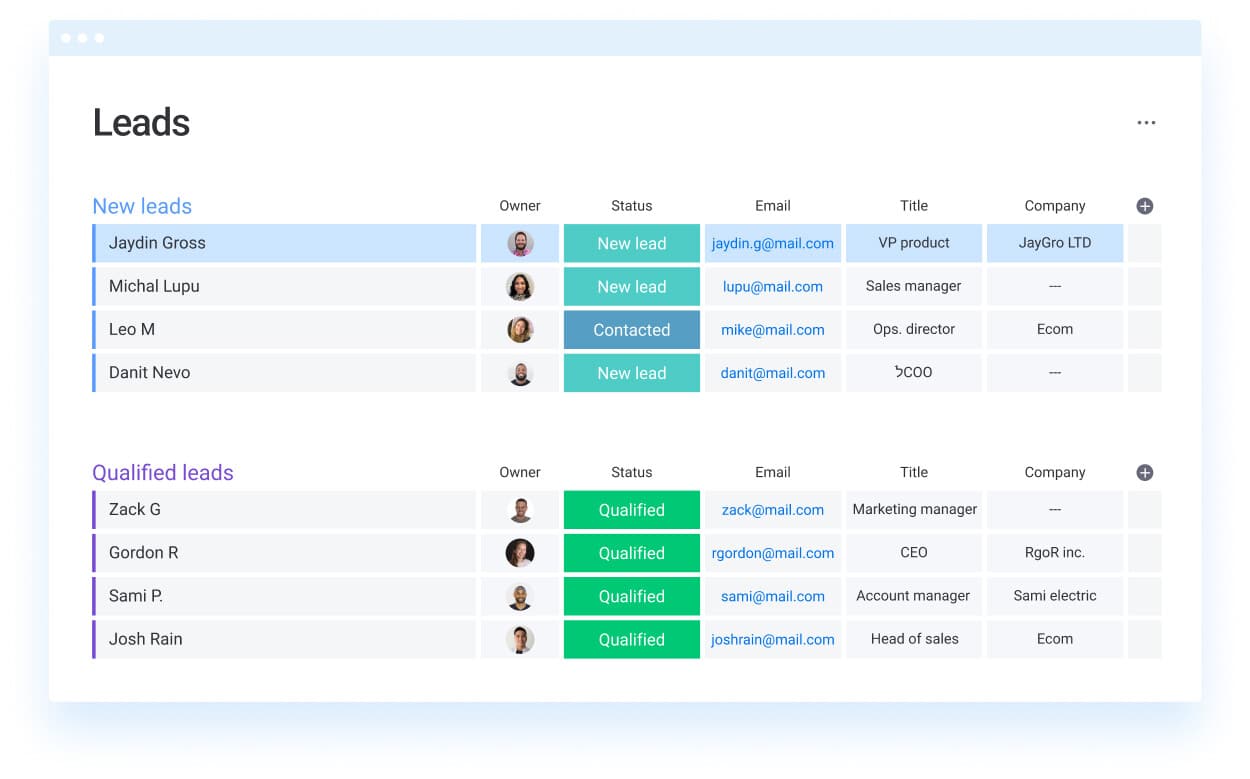
Many hot leads exist within current pipelines but go unrecognized due to lack of systematic lead management process. The following strategies help sales teams surface and prioritize these high-intent prospects through effective sales lead generation. Use these approaches, and you’ll turn gut feelings into data-backed decisions that close more deals.
Step 1: set up lead scoring based on engagement
Lead scoring assigns numerical values to prospect behaviors and characteristics, with higher scores indicating greater purchase intent. It turns gut feelings into hard data you can act on.
Effective lead scoring incorporates:
- Demographic scoring: company size, industry, role.
- Behavioral scoring: website visits, content downloads, email engagement.
- Engagement scoring: demo requests, pricing inquiries, reference requests.
- Temporal scoring: recent activity weighted more heavily than historical engagement.
Specific scoring examples include:
- Downloading a pricing guide: +15 points.
- Attending a product demo: +25 points.
- Decision-maker joining a call: +30 points.
- Requesting customer references: +40 points.
Step 2: track digital body language across channels
Digital body language is the online behavior that shows how interested a prospect really is. These signals show when someone’s ready to buy.
Digital signals to monitor include:
- Website behavior: page views, time spent, return frequency.
- Email engagement: open rates, click patterns, forward behavior.
- Content interaction: downloads, shares, time spent consuming.
- Social media activity: follows, likes, shares, engagement with company posts
Hot lead digital body language examples include multiple visits to pricing pages within a week, forwarding your content to colleagues, spending 10+ minutes on implementation documentation, or engaging with your company’s LinkedIn posts within hours of publication.
Step 3: monitor social selling signals
Social selling signals are public clues about what prospects need — visible on social media and LinkedIn. These signals show up before prospects even reach out.
Social signals indicating hot leads include:
- Job postings: roles suggesting need for your solution.
- Company announcements: funding or expansion news.
- Executive changes: new leadership bringing different priorities.
- Industry participation: revealing current challenges.
Step 4: use AI to predict purchase intent
AI spots patterns in prospect behavior that you’d never catch manually. AI processes engagement history and external signals to predict which prospects are most likely to purchase.
AI-powered intent prediction works through:
- Pattern recognition: identifying behaviors that historically precede purchases.
- Predictive modeling: scoring prospects based on similarity to previous conversions.
- External data integration: incorporating third-party intent data and market signals.
- Real-time analysis: continuously updating predictions as new data becomes available/
Hot lead digital body language examples include multiple visits to pricing pages within a week, forwarding your content to colleagues, spending 10+ minutes on implementation documentation, or engaging with your company’s LinkedIn posts within hours of publication.
5 ways to convert warm leads into hot leads
Warm leads represent significant untapped potential. They’re interested, but they need more nurturing before they’re ready to buy. Here’s how to move them from interested to ready-to-buy:
Strategy 1: send personalized content based on their industry
Generic content doesn’t work. Prospects need to see how you solve their industry’s specific problems. Industry-specific content proves you get their world — and that builds trust.
Effective personalization includes:
- Industry-specific case studies: examples from similar companies.
- Regulatory compliance content: addressing industry requirements.
- Vertical-focused ROI calculators: using industry benchmarks.
- Sector trend analysis: emerging challenges and opportunities.
Healthcare prospects receive HIPAA compliance guides and patient outcome case studies. Financial services prospects get regulatory change updates and risk management resources. Manufacturing prospects receive operational efficiency studies and supply chain optimization content.
Strategy 2: share social proof from similar companies
Prospects want proof your solution works for companies just like theirs. Social proof lowers risk and gives prospects validation from people they trust.
Types of social proof that convert warm leads include:
- Customer testimonials: specific quotes about results.
- Video case studies: customers explaining their evaluation process.
- Industry awards: recognition from analysts.
- User-generated content: organic customer satisfaction.
Make sure your social proof matches the prospect’s situation. A 50-person startup needs examples from similar-sized companies, not enterprise case studies.
Strategy 3: offer exclusive access or limited-time incentives
Exclusivity and urgency work — but only if they’re real, not manufactured pressure.
Effective incentive strategies include:
- Early access programs: beta testing new features.
- Executive briefings: sessions with company leadership.
- Custom pilot programs: addressing specific use cases.
- Limited-time pricing: tied to budget plans and cycles.
Strategy 4: connect them with current happy customers
Prospects trust other customers more than they trust you. References from satisfied customers give prospects the unbiased, real-world insights they’re looking for.
Effective customer connection strategies include:
- Structured reference calls: between prospects and existing customers.
- User community access: customer forums and discussion groups.
- Conference meetings: facilitated introductions at industry events.
- Advisory panel participation: exclusive customer insight sessions.
Strategy 5: demonstrate ROI with interactive calculators
Warm leads are usually building a business case to sell your solution internally. ROI calculators help prospects put numbers on the value and make their case to stakeholders.
Effective ROI demonstration includes:
- Industry-specific calculators: using relevant benchmarks.
- Customizable inputs: company-specific situations.
- Scenario modeling: comparing different implementation approaches.
- Shareable reports: for presenting to decision-makers.
7 best practices for managing hot leads
Finding hot leads is just the start. How you manage them determines whether they actually close. These practices help you close more deals without burning relationships.
Practice 1: respond within 5 minutes of engagement.
Analysis from the Journal of Medical Internet Research shows that faster response times directly correlate with higher satisfaction rates, with each 10-percentile increase in response time associated with 8% lower odds of achieving the highest satisfaction ratings.
Hot leads need solutions now, and they’re usually comparing you to competitors. Fast responses show you’re professional — and they often make or break the deal.
Speed matters because:
- First responders control conversations: early engagement sets the tone.
- Quick responses maintain momentum: delays can cool interest.
- Fast response signals efficiency: prospects judge your organization’s capabilities.
- Early conversations provide insights: valuable qualification information emerges.
Practice 2: assign hot leads to senior sales reps
Hot leads are your most valuable opportunities — they need experienced reps who can handle complex sales.
Senior reps excel because they:
- Recognize buying signals: experience helps identify subtle cues.
- Handle objections confidently: years of practice managing concerns.
- Build trust with executives: comfort level with C-level conversations.
- Understand complex processes: navigate organizational buying dynamics.
- Excel at closing: move prospects through final decision stages.
Practice 3: use multi-threading to engage all stakeholders
Hot leads almost always involve more than one decision-maker. Multi-threading means building relationships with everyone on the buying committee.
Multi-threading strategies include:
- Stakeholder mapping: identify all individuals involved.
- Role-specific messaging: tailored to each person’s priorities.
- Parallel relationship building: multiple team members engaged. simultaneously
- Consensus building: ensure all stakeholders support the solution.
Practice 4: create automated alerts for hot lead activity
Miss an opportunity, and hot leads cool off fast. Automated alerts make sure your team jumps on high-intent behavior right away.
Effective alert strategies include:
- Behavior-triggered notifications: high-intent actions trigger immediate alerts.
- Escalation procedures: when hot leads aren’t contacted promptly.
- Activity reminders: regular contact scheduling.
- Competitive intelligence alerts: when prospects research alternatives.
Practice 5: document every interaction in your CRM
Hot leads touch multiple people on your team at different points in the process. Good documentation keeps everyone on the same page and prevents wasted effort.
Documentation best practices include:
- Interaction summaries: key discussion points captured.
- Stakeholder preferences: decision-making processes noted.
- Competitive intelligence: alternative solutions being considered.
- Objection tracking: how concerns were addressed.
Practice 6: leverage video messages for personal touch
Hot leads want personalized attention that shows you actually care. Video messages build stronger connections than emails or texts.
Effective video messaging includes:
- Personalized introductions: addressing specific challenges.
- Demo highlights: showcasing relevant features.
- Follow-up summaries: recapping important conversations.
- Executive messages: for high-value prospects.
Practice 7: schedule next steps before ending each call
Hot leads need constant momentum — let them stall, and they cool off. Schedule next steps while you’re still on the call — it prevents delays and shows you’re organized.
Next step scheduling includes:
- Mutual commitment: specific actions and timelines agreed upon.
- Immediate calendar integration: while participants are available.
- Clear agendas: defined objectives for upcoming meetings.
- Stakeholder inclusion: appropriate decision-makers participating.
Turn more leads into customers with monday CRM
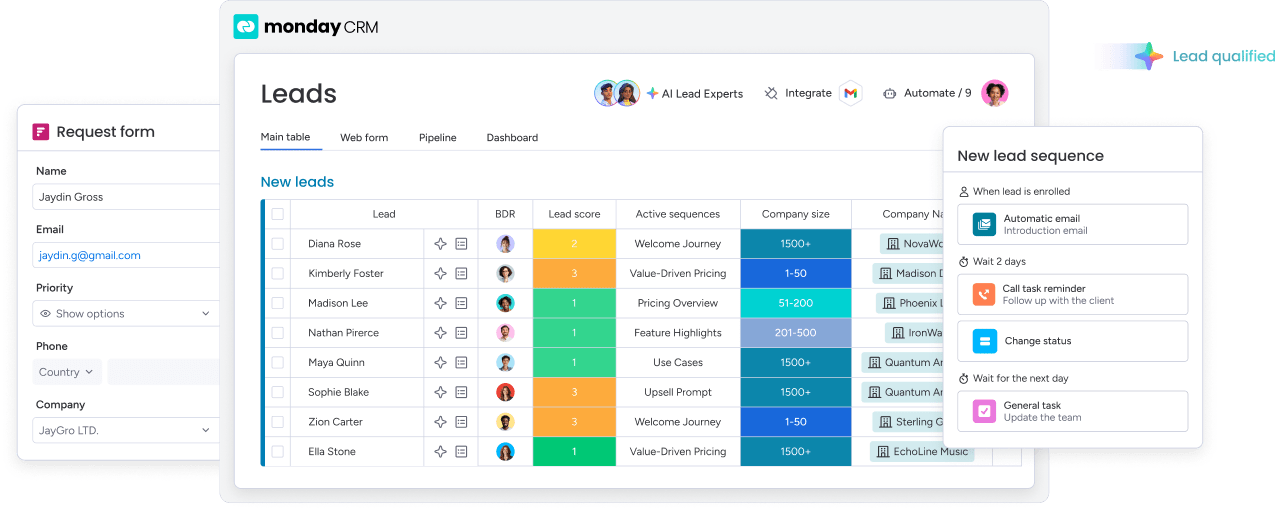
Managing hot leads well means having tech that supports your process and gives you real insights. Teams using monday CRM spot and close hot leads faster with visual pipelines and smart automation. It transforms messy lead management into organized, repeatable workflows, so your team focuses on what matters.
See hot leads at a glance with visual pipelines
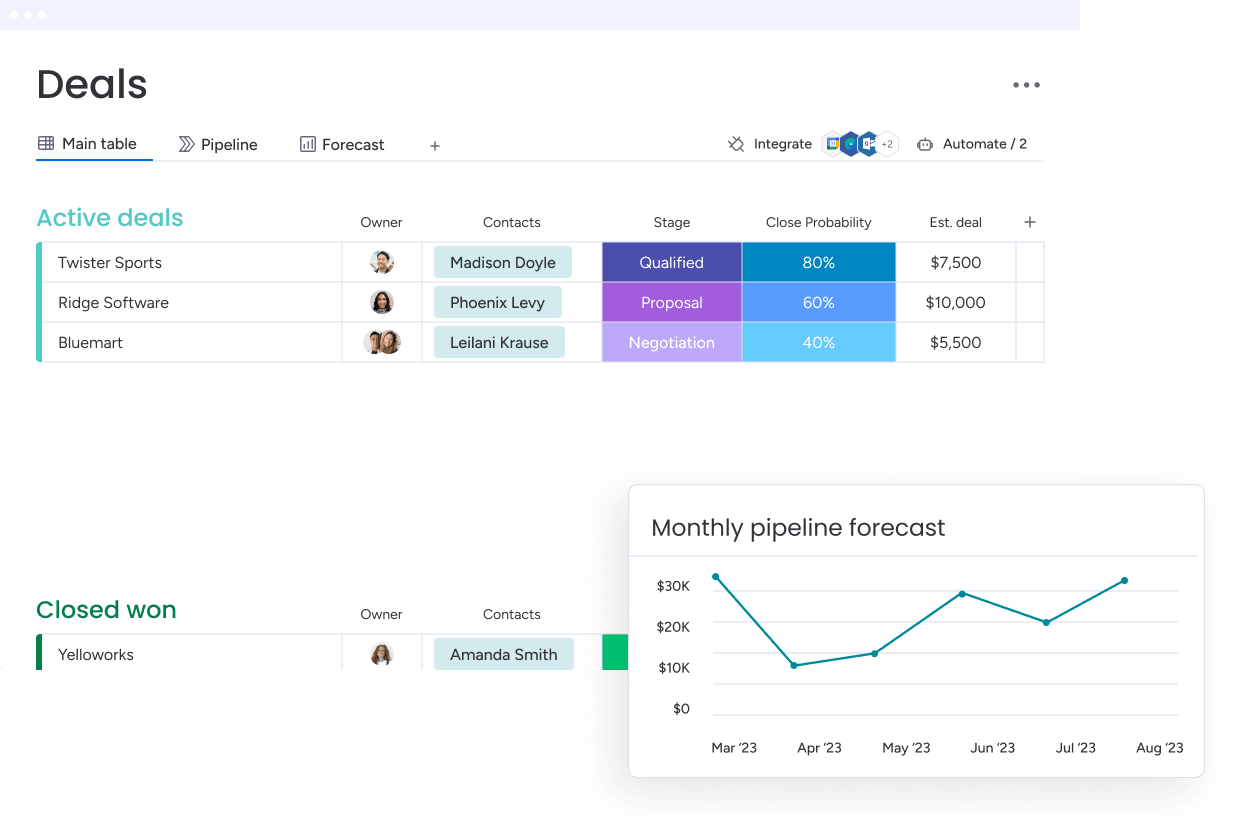
Visual pipelines show lead temperature at a glance with color-coding and custom views. Your team spots hot leads fast — no digging through reports.
Visual pipeline capabilities include:
- Color-coded lead temperatures: instant identification of prospect status.
- Customizable pipeline stages: matching your specific sales process.
- Drag-and-drop functionality: easy lead progression tracking.
- Multiple pipeline views: different perspectives for team members.
Get instant notifications when leads heat up
Smart notifications make sure you never miss a hot lead signal. The platform watches prospect behavior and alerts your team when someone’s getting serious about buying.
Notification capabilities include:
- Behavior-triggered alerts: high-intent actions generate immediate notifications.
- Customizable alert rules: based on your hot lead criteria.
- Multi-channel delivery: email and mobile app notifications
- Escalation workflows: automatic manager notifications when needed.
Automate lead assignment without code
No-code automation routes hot leads to the right rep instantly based on your rules. This ensures immediate action, efficient resource allocation, and a simple setup.
Automation capabilities include:
- Rule-based assignment routing: based on lead temperature or industry.
- Workload balancing: even distribution across team members.
- Escalation rules: automatic reassignment when needed.
- Custom workflows: matching your sales process.
Track lead temperature with AI-powered insights
AI analyzes behavior patterns and predicts when leads are heating up — before it’s obvious. The AI detects sentiment in emails, extracts key information from communications, and summarizes entire conversation timelines.
AI-powered capabilities include:
- Predictive lead scoring: machine learning algorithms identify patterns.
- Behavioral analysis: monitoring engagement across touchpoints.
- Sentiment detection: categorizing prospect communications.
- Timeline summaries: all communication events in context.
Maximize your hot lead conversion rates
Hot leads are your most valuable opportunities, but you need the right process and tech to manage them well. A 20% conversion rate versus 40%? It usually comes down to response speed, engagement quality, and keeping momentum alive.
The best teams combine behavior insights with automation so no hot lead slips away. They use visual pipelines to prioritize, AI to predict intent, and solid documentation to handle complex sales.
Try monday CRMFrequently asked questions
How long do hot leads typically stay hot?
Hot leads typically maintain their temperature for 30-90 days, though this varies based on industry, deal size, and external factors like budget cycles or regulatory deadlines. According to a 2024 McKinsey & Company global survey, 63% of executives expect increased profits in the next six months, making conditions particularly favorable for hot lead conversion.
What's the difference between a hot lead and a sales qualified lead?
A hot lead demonstrates high purchase intent through specific behaviors like pricing inquiries and decision-maker involvement, while a sales qualified lead meets predetermined criteria for sales engagement but may not yet show immediate buying signals.
Can a lead go from cold to hot without becoming warm first?
Yes, leads can skip the warm stage due to external triggers like regulatory changes, competitive pressure, or urgent business needs that create immediate solution requirements.
What's the average conversion rate for hot leads?
Hot leads typically convert at rates between 20-40%, significantly higher than warm leads (5-15%) or cold leads (1-3%), though rates vary by industry and sales process effectiveness.
How many touchpoints create a hot lead?
There's no magic number. Quality and type of engagement matter more than quantity. A prospect could become hot after 2-3 high-intent interactions or require 15+ touchpoints if they're in early research phases.
Should you use different sales tactics for different hot leads?
Yes, hot leads require tailored approaches based on their specific situation, industry, company size, and decision-making process. Enterprise hot leads typically need longer evaluation periods, while small business hot leads often move faster with fewer decision-makers.