


When a customer asks about a delayed order, your team shouldn’t need to check five different systems just to find an answer. The right e-commerce CRM keeps customer data, order history, sales activity, and fulfillment status in one place, so your team can respond with confidence instead of scrambling across tabs.
This guide breaks down what makes an e-commerce CRM different, the 7 features that actually matter, and 14 platforms built to unify your operations. You’ll see how integrations, AI, and automation connect your systems without adding manual work, so your team can focus on growing revenue instead of chasing information.
What is an e-commerce CRM?
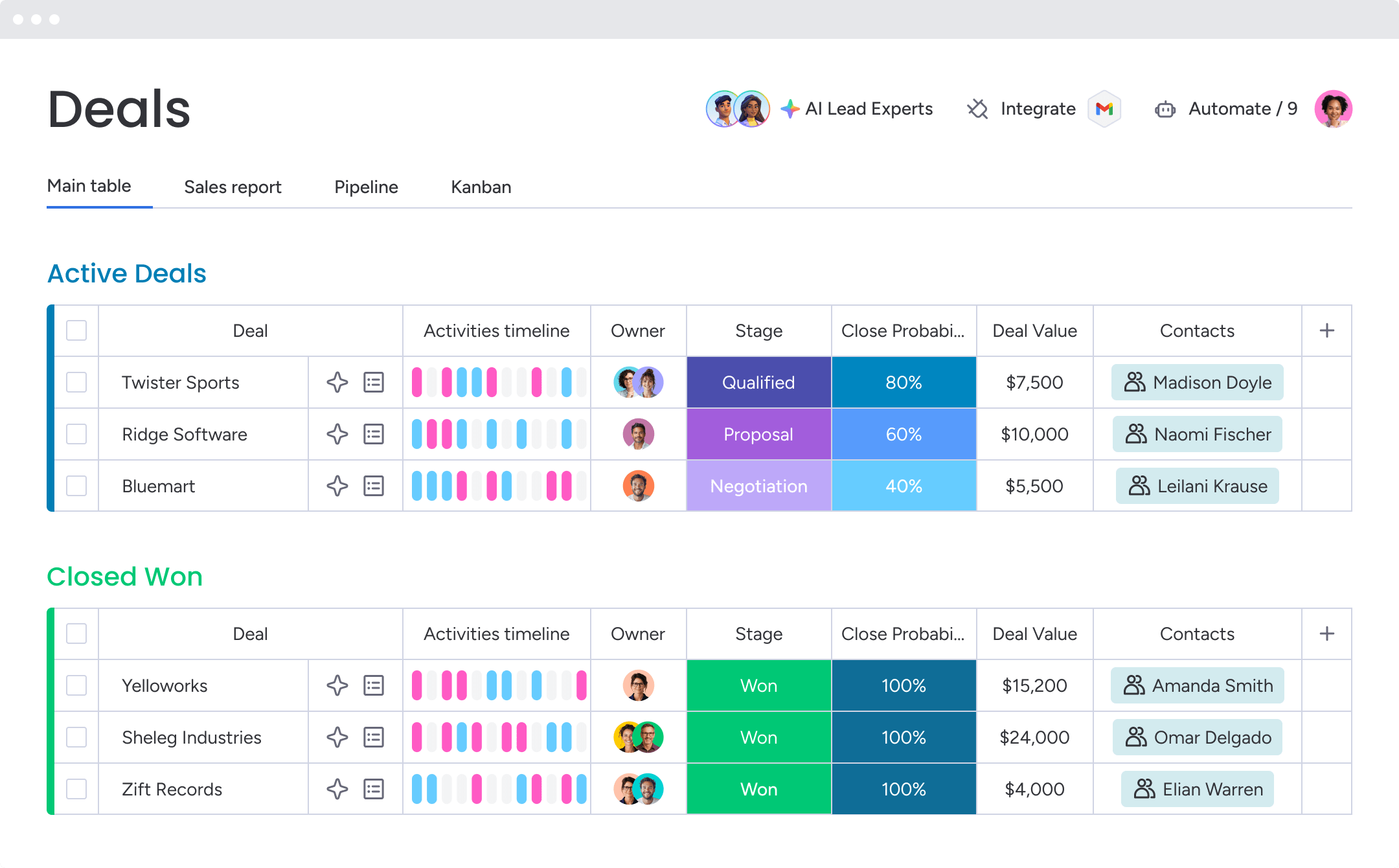
An e-commerce CRM is the control center for your online store. It gathers customer data, order history, and buying behavior from every channel and puts it in one place, so your team isn’t bouncing between five platforms just to figure out who purchased what.
What sets it apart from a traditional CRM is the model it’s built around. Standard CRMs are organized for deals and accounts. E-commerce CRMs are designed for orders and customers — often in the thousands. They’re made for the pace of online retail, not a long, relationship-led sales cycle, and they trigger actions based on what shoppers actually do.
And this isn’t a tool for a single team. It’s the kind of collaborative CRM that helps marketing, support, and sales stop operating in silos. Revenue teams see strong results with a collaborative CRM because it connects this data and cuts the manual work that slows everyone down.
Try monday CRM14 best e-commerce CRM platforms to unify sales and fulfillment data
No e-commerce CRM works for everyone — and that’s exactly why this category exists. Choose poorly, and you’re left with wasted budget plus a stack of tools that drags against your team instead of supporting it.
Each platform below is built with a different priority in mind, whether that’s marketing automation, sales pipeline management, customer support, or fulfillment visibility. Use the breakdown to match a tool to the problems your team actually needs to solve.
| Platform | Use case | Free trial* | Notable feature | Starting price* |
|---|---|---|---|---|
| monday CRM | Revenue teams wanting one configurable platform for leads, accounts, and post-sales work | 14 days | Sales and post-sales in one platform with cross-team visibility | $12/seat/month |
| HubSpot | Marketing automation, deal tracking, and Shopify data sync | No | Native Shopify bi-directional sync with Commerce Hub | $15/seat/month |
| Zoho CRM | Cost-conscious teams needing RFM segmentation and omnichannel tracking | No | RFM segmentation and CLV tracking built into CRM | $20/user/month |
| Salesforce | Large enterprises needing native CRM, commerce, and order management | No | Agentforce Commerce with AI-driven personalization at scale | Custom pricing |
| Pipedrive | B2B or wholesale account management with visual pipeline | 14 days | Visual Kanban pipeline with drag-and-drop deal management | $14/seat/month |
| Freshsales | Sales teams wanting built-in communication channels and AI lead scoring | 21 days | Freddy AI for lead scoring and deal insights | $9/user/month |
| Bitrix24 | Managing orders, customer communication, and sales without per-seat fees | No | Omnichannel contact center with unlimited users on free plan | $49/month |
| Creatio CRM | Midmarket and enterprise teams centralizing customer data and workflows | No | No-code workflow automation with visual designer | $25/user/month |
| Omnisend | DTC teams automating customer marketing across email, SMS, and push | No | RFM lifecycle segmentation based on purchase behavior | $16/month |
| Klaviyo | B2C brands focused on repeat purchases and maximizing CLV | No | Predictive analytics for churn risk and lifetime value | Custom pricing |
| Brevo | Small teams wanting email marketing and lightweight CRM together | No | AI-generated personalized product recommendations in emails | $9/month |
| ActiveCampaign | Abandoned cart recovery and lead scoring in one platform | No | Deep e-commerce data sync with predictive sending | $15/month |
| Metrilo | DTC brands tracking CLV and running behavior-based campaigns | No | Retention cohort analysis with 30+ segmentation filters | $199/month |
| ReadyCloud | Operations teams needing fulfillment and returns data in CRM | 14 days | Order, shipment, and return history unified in customer profiles | $24/user/month |
*Note: Pricing and trial availability as of publication date; contact vendors for current details.
1. monday CRM
monday CRM is built to flex around how revenue and operations teams actually run e-commerce work, without demanding a heavy technical lift. On the monday.com Work OS, you can shape pipelines, handoffs, and reporting so sales, support, ops, and finance all stay aligned around the same customer history.
Maybe you’re juggling wholesale accounts while trying to keep post-purchase follow-ups tight. Maybe your team is tired of guessing which conversations already happened and what needs to happen next. monday CRM keeps customer-facing work together in one system, giving every handoff the context it needs.

Use case: E-commerce revenue teams wanting one configurable platform for managing leads, accounts, and deals — then carrying that context into post-sales work like onboarding, renewals, and collections tracking
Key features
- Lead flow that doesn’t break at scale: Collect, enrich, qualify, and assign leads, then trigger the right follow-up automatically.
- Customer communication that stays trackable: Emails and Activities keep every conversation attached to the account, so support and sales aren’t working from partial info.
- Cross-functional visibility that keeps momentum: Keep sales, account management, legal, and finance working from the same records and timelines, especially when timelines tighten.
Pricing
- Basic: $12/seat/month (billed annually) — includes 1,000 active contacts and deals, 1 custom dashboard
- Standard: $17/seat/month (billed annually) — includes 2-way email integration, AI email generator, and up to 10,000 contacts and deals
- Pro: $28/seat/month (billed annually) — includes unlimited contacts and deals, sales forecasting, email sequences, mass emails, and 25,000 automation actions/month
- Ultimate (Enterprise): Custom pricing — includes lead scoring, advanced analytics, enterprise-scale automations (250K actions/month), and HIPAA compliance
- Annual billing discount: 18% off when billed annually
- Free trial: 14-day free trial available, no credit card required
- Plans start from 3 seats; teams with more than 40 seats can request a custom quote
Why it stands out
- Sales and post-sales in one platform: Teams manage leads and deals, then track onboarding, renewals, and collection status without jumping between systems.
- Built for cross-team work: Deal updates can move to legal and finance with the full timeline attached, so approvals and next steps stay accountable.
- Reporting that leadership can trust: Dashboards help CROs and sales leaders track pipeline health, forecasting, and quota attainment without waiting on a specialized admin.
2. HubSpot
HubSpot combines contact management, email marketing, and deal tracking in one platform, then lets teams layer in additional functionality through different Hubs as they grow. For SMBs and mid-market companies, that makes it a practical option. Storefront data can connect directly to CRM records, which helps e-commerce teams keep marketing and sales aligned around the same customer view. Commerce Hub adds native quote-to-cash functionality too, so invoicing, subscriptions, and payments can all happen inside the platform.

Use case: E-commerce teams that want marketing automation, deal tracking, and storefront data in one place — especially Shopify-based teams
Key features
- Shopify data sync: Bi-directional sync for contacts, products, and companies (Shopify Plus), with near-real-time updates. See key Shopify metrics on contact records and get auto-provisioned e-commerce dashboards for a big-picture view.
- Commerce objects: Dedicated Carts and Orders objects let teams segment, report on, and automate around e-commerce activity — including abandoned checkouts and order status — natively inside HubSpot.
- AI CPQ and billing: Quotes with integrated e-signature, approval workflows, subscription billing, and a hosted B2B checkout, all connected to the CRM record.
Pricing
- Free: $0 — limited CRM features
- Starter: From $15/seat/month
- Professional: From $1,450/month (includes 6 seats); one-time onboarding fee required
- Enterprise: From $4,700/month (includes 8 seats); one-time onboarding fee required
- Commerce Hub — Free: Invoices, payment links, and subscriptions included
- Commerce Hub — Professional: From $95/seat/month
- Commerce Hub — Enterprise: From $140/seat/month
- Additional cost drivers include: Marketing Hub contact-tier fees as your database grows, Commerce Hub platform fees (0.5% with HubSpot Payments; 0.75% with Stripe processing), and incremental add-ons for e-signatures and business units.
Considerations
- If your team needs advanced automation, custom reporting, or more tailored Shopify customization, you’ll outgrow the free tier quickly — and costs can rise fast as you add hubs and seats. HubSpot Payments is also currently available only to businesses based in the US, UK, and Canada, which limits its usefulness for international e-commerce operations.
- Shopify metafields aren’t supported, company sync requires Shopify Plus, and custom field mappings need at least Data Hub Starter — so more complex storefront setups may hit configuration constraints earlier than expected.
3. Zoho CRM
Zoho CRM delivers a lot of functionality without commanding an enterprise-size budget. For teams that need solid CRM fundamentals without excessive complexity, it covers the essentials well — from lead scoring to multichannel communication tracking. And if your business is already invested in the wider Zoho ecosystem, the native integrations add real value.

Use case: Cost-conscious e-commerce teams that want a scalable CRM with built-in RFM segmentation, omnichannel engagement tracking, and native ties to inventory, commerce, and marketing tools from the same vendor
Key features
- AI-powered lead scoring (Zia AI): Automatically prioritizes high-intent prospects so your team focuses on the deals most likely to close.
- RFM segmentation and CLV tracking: Segments customers by recency, frequency, and monetary value directly inside the CRM, giving revenue teams the data they need to run targeted retention and upsell campaigns.
- SalesSignals omnichannel tracking: Consolidates engagement signals from email, chat, social, campaigns, and support tickets into a single timeline, so your team always knows where a customer stands.
Pricing
- Free: Up to 3 users
- Standard: $20/user/month (billed monthly)
- Professional: $35/user/month (billed monthly)
- Enterprise: $50/user/month (billed monthly)
- Ultimate: $65/user/month (billed monthly)
- Annual billing saves up to 34% across paid plans
- Add-ons include additional file storage ($4.60 per 5 GB/month) and premium support tiers at extra cost
Curious how Zoho stacks up with monday CRM? Check out our monday CRM vs. Zoho write-up.
Considerations
- Non-technical users may find the interface dense, and teams without a dedicated admin should expect some extra setup time before workflows and integrations are fully dialed in.
- Native e-commerce integrations come with a few caveats — Shopify Basic accounts only sync sales orders rather than full PII, and abandoned cart data from Zoho Commerce does not sync directly into Zoho CRM, so workarounds through Zoho Campaigns or Marketing Automation may be necessary.
4. Salesforce
For organizations running large-scale commerce operations, Salesforce brings CRM, commerce, order management, and AI together on a single platform. It’s designed for enterprises with technical resources to match, and it offers unified customer profiles plus closed-loop analytics at serious scale. If your business operates across multiple channels and needs deep customization, this is the level Salesforce is built for.

Use case: Large e-commerce enterprises that want native CRM, commerce, and order management in one environment, along with AI-driven personalization and the technical bench to configure it properly
Key features
- Agentforce Commerce (formerly Commerce Cloud): Connects CRM data, order management, and AI agents to support guided shopping, merchandising, and post-purchase service in one platform.
- Einstein AI and Data Cloud: Delivers predictive analytics, customer segmentation, and personalized journeys using first-party data — without stitching together separate vendors.
- Composable storefronts: A React-based, API-first architecture gives enterprise development teams full flexibility to build fast, app-like shopping experiences.
Pricing
- Commerce Cloud (B2B and B2C): This is the core e-commerce product. Pricing is custom and typically based on a percentage of your gross merchandise value (GMV). You’ll need to contact sales for a quote.
- Salesforce CRM Suites: The per-user prices you often see online ($25-$350/user/month) are for the broader CRM suites (Starter, Pro, Enterprise, etc.). These have limited e-commerce functionality compared to the full-featured Commerce Cloud.
- Additional Costs: Plan for other line items. Success Plans are typically priced at 30% of net license fees, Data Cloud uses credit-based consumption pricing, and add-ons are quote-based.
Considerations
- Expect to need dedicated Salesforce admins, developers, and ongoing technical support — configuration alone can take substantial time and budget before the platform starts paying off.
- With GMV-based commerce pricing, add-on Success Plans, Data Cloud credits, and transaction fees, forecasting total spend can be difficult, especially for mid-market teams trying to weigh cost against return.
5. Pipedrive
Pipedrive centers the sales process around a visual, activity-driven CRM built to keep deals moving. It was created by salespeople who wanted software that matched the way they actually worked, and that shows. For e-commerce businesses with a B2B or wholesale arm, it offers pipeline visibility without much of the usual bloat.

Use case: E-commerce teams managing B2B or wholesale accounts and needs a structured, visual pipeline to keep follow-ups on track and deals moving toward close
Key features
- Visual Kanban pipeline: Drag-and-drop deal management with customizable stages so your team always knows where each account stands.
- Workflow automations and AI assistance: Automate repetitive follow-ups, status updates, and reporting, with an AI assistant that surfaces insights and drafts emails.
- Shopify and storefront integrations: Connect your storefront data via Marketplace apps and iPaaS connectors like Zapier or Make to sync orders and customer records directly into your pipeline.
Pricing
- Lite: $14/seat per month (billed annually)
- Growth: $39/seat per month (billed annually)
- Premium: $59/seat per month (billed annually)
- Ultimate: $79/seat per month (billed annually)
- Annual billing saves up to 42%; a 14-day free trial is available
- Key e-commerce features like lead capture (LeadBooster), email marketing (Campaigns), and website visitor identification (Web Visitors) are available as paid add-ons, starting from $32.50/month, $13.33/month, and $41/month respectively.
Considerations
- Native e-commerce marketing automation isn’t part of the package, so abandoned cart recovery and post-purchase flows will require a separate email marketing tool.
- Storefront connectivity depends on third-party connectors rather than native syncs, which adds setup overhead and introduces extra vendor dependencies for DTC-heavy teams.
6. Freshsales
Freshsales serves as the sales-focused CRM inside the Freshworks ecosystem, bringing phone, email, and chat together so your team can stop juggling tabs and stay focused on deals. On its own, it works well for SMBs and mid-market companies. For e-commerce, though, its strongest use case appears when it’s connected to the rest of the Freshworks suite — particularly for Shopify brands.

Use case: Sales teams that want built-in communication channels and AI-assisted lead prioritization
Key features
- Freddy AI for lead scoring and deal insights: Freddy AI surfaces next-best-action recommendations and deal forecasts, helping sales teams focus on the opportunities most likely to convert.
- E-commerce suite for Shopify: When combined with Freshmarketer, the platform unlocks pre-built automation for commerce events — abandoned carts, placed orders, first-time visitors — across email, SMS, WhatsApp, and live chat.
- Unified customer context (via the suite): By connecting Freshworks products, you can give agents a single view of customer conversations and purchase data, with out-of-the-box WISMO bots to handle order-status queries.
Pricing
- Free: Available for up to 3 users
- Growth: $9/user/month (billed annually)
- Pro: $39/user/month (billed annually)
- Enterprise: $59/user/month (billed annually)
- A 21-day free trial is available across paid plans
- Add-ons include Freddy AI Agent session packs, additional marketing contacts, and CPQ; telephony and SMS usage may incur separate provider fees
Considerations
- The most useful e-commerce capabilities — including playbooks and WISMO bots — don’t live inside core Freshsales. You’ll need other Freshworks products like Freshmarketer and Freshdesk, which makes the overall setup more complex and more expensive.
- Advanced segmentation, time-zone-based delivery, and some Freddy AI functionality are reserved for Pro and Enterprise tiers, so costs rise as usage matures.
7. Bitrix24
Bitrix24 takes a consolidation-first approach, bundling a CRM with project management, telephony, and even a built-in online store into one flat-fee platform. For SMBs and mid-market teams trying to reduce vendor sprawl, that makes it a practical option. Merchants can handle storefront, messaging, and CRM needs in one environment instead of stitching together separate subscriptions.

Use case: E-commerce teams that want to manage orders, customer communication, and sales pipelines in one place without paying on a per-seat basis
Key features
- CRM Store with payment links: Send checkout links directly from a deal via SMS or chat, with payment status updating automatically in the deal timeline — useful for conversational commerce.
- Omnichannel contact center: Connect WhatsApp, Instagram, Facebook, Telegram, and live chat through a single inbox, so customer conversations don’t fall through the cracks across channels.
- Inventory management: Track stock across multiple warehouses, manage receipts and transfers, and use mobile barcode scanning — all within the same platform as your CRM.
Pricing
- Free: Unlimited users; includes basic CRM, tasks, calendars, and chat with 5 GB storage
- Basic: $49/month (billed annually) for up to 5 users; adds sales pipelines, telephony, and website/webform builder
- Standard: $99/month (billed annually) for up to 50 users; adds sales automation, invoices, online payments, WhatsApp marketing, and e-commerce
- Professional: $199/month (billed annually) for up to 100 users; adds AI-powered sales features, advanced automation and analytics, e-signature, and HR tools
- Enterprise: Starts at $399/month (billed annually) for 250 users (plans scale up to 10,000); includes distributed servers, encryption at rest, 99.95% SLA, and priority support
- Annual billing saves up to 31% compared to monthly rates
- Telephony operates on pay-as-you-go credits; some messaging connectors (e.g., WhatsApp via third-party partners) carry additional fees
Considerations
- The broad feature set comes with a tradeoff: a steeper learning curve. Reviewers on G2 (4.1/5 from 610 reviews) and Capterra (4.2/5 from 979 reviews) frequently point to interface complexity and tool sprawl as the platform expands.
- Teams that need advanced segmentation or predictive analytics may find the CRM module less specialized than dedicated options, since Bitrix24’s strength is breadth and consolidation rather than depth.
8. Creatio CRM
Creatio CRM pairs no-code process automation with CRM capabilities in a single platform, giving teams significant control over how workflows are built and changed. It’s aimed at mid-market and enterprise organizations that need deep customization across sales, marketing, and service without relying on custom code. For e-commerce teams running complex operations across channels, Creatio’s composable structure lets the platform adapt to the business rather than the other way around.

Use case: Midmarket and enterprise retail teams that want to centralize customer data, order workflows, and omnichannel campaigns inside one CRM
Key features
- No-code workflow automation: Build and adapt custom business processes using Studio Creatio’s visual designer — no developer required.
- 360-degree customer view: Consolidate purchase history, loyalty data, wishlists, and service interactions into a single customer profile for more precise segmentation and outreach.
- Omnichannel retail workflows: Manage order processing, returns, delivery orchestration, and loyalty programs directly within the platform, reducing manual handoffs between systems.
Pricing
- Growth: Starting at $25/user/month
- Enterprise: Starting at $55/user/month
- Unlimited: Starting at $85/user/month
- CRM products (Sales, Marketing, Service) are priced as add-ons at approximately $15/user/month each
- Marketplace connectors (e.g., Shopify connector, InterWeave eCommerce Gateway at ~$300/month billed annually) are priced separately
- AI Action packages are billed annually and priced independently of the base platform plan
Considerations
- E-commerce functionality depends on marketplace connectors and third-party gateways rather than native storefront integrations, so teams that want a quick deployment should expect more configuration work and ongoing upkeep.
- Connector subscriptions, AI packages, and CRM product add-ons can raise total ownership costs meaningfully, making a detailed pricing review worthwhile before committing.
9. Omnisend
Omnisend is built to turn store data into automated marketing without requiring a full operations team to run it. Designed specifically for DTC brands on Shopify, WooCommerce, and BigCommerce, it combines email, SMS, and web push in one platform. For teams measured by campaign performance, that focus makes it particularly strong.

Use case: DTC e-commerce teams that want automated customer marketing across email, SMS, and push, with store data informing every decision
Key features
- RFM lifecycle segmentation: Automatically assigns contacts to lifecycle stages (Champions, At-Risk, Loyalists, etc.) based on real purchase behavior, so teams can target the right customers with the right message at the right time.
- Pre-built automation workflows: Abandoned cart, welcome series, and post-purchase sequences come ready to deploy, with AI-assisted segmentation that lets teams describe their audience in plain language and build the segment automatically.
- Omnichannel campaign management: Email, SMS, and web push run from a single dashboard, with audience sync to Google Customer Match and Facebook/Instagram ads for full-funnel reach.
Pricing
- Free: $0/month — all features included, up to 250 contacts and 500 emails/month
- Standard: From $16/month — scales with contact volume, 12× list email sends per month
- Pro: From $59/month — unlimited email sends (fair-use), monthly SMS credits equal to the plan price, advanced reporting, and priority support
- Discount: 30% off the first three months when paying three months upfront on an initial Standard or Pro subscription
- Note: SMS credits on Free and Standard plans require a separate subscription; per-message rates vary by country and volume.
Considerations
- Omnisend is a marketing automation platform rather than a full CRM. There’s no deal pipeline management, B2B account management, or cross-functional workflow layer, so teams with wholesale, B2B buyers, or subscription management needs will need another system.
- Customer lifetime value can be viewed on a per-contact basis, but CLV-based segmentation and aggregate CLV reporting are not yet available, which limits prioritization for revenue teams working at scale.
10. Klaviyo
Klaviyo brings email, SMS, and customer data together in a B2C CRM built specifically for e-commerce brands that depend on retention. Its native integrations with Shopify and WooCommerce are deep, and its predictive analytics help forecast churn risk and lifetime value so teams can act instead of simply reporting. From abandoned carts to win-back campaigns, its automated flows cover much of the lifecycle work DTC teams rely on.

Use case: B2C e-commerce brands focused on increasing repeat purchases and maximizing customer lifetime value through owned-channel marketing
Key features
- Behavioral segmentation: Builds real-time audience segments based on purchase history, browsing behavior, and engagement signals — with no look-back limits on historical data.
- Predictive analytics: Surfaces churn risk scores, predicted next order dates, and customer lifetime value estimates to help teams prioritize who to target and when.
- Automated flows: Pre-built and customizable automation sequences cover abandoned cart, browse abandonment, post-purchase, and win-back campaigns across email, SMS, WhatsApp, and push.
Pricing
- Free plan: Up to 250 profiles, 500 emails/month, and 150 mobile message credits/month
- Email and profiles: Scales by active profile count and monthly send volume
- Mobile messaging: Credit-based pricing across SMS/MMS, WhatsApp, and RCS; rates vary by country and channel
- Add-ons billed separately: Reviews, Advanced Klaviyo Data Platform, Marketing Analytics, Customer Hub (starts at $20/month for up to 10k active profiles), Helpdesk (starts at $10/month for up to 50 tickets), and Customer Agent (starts at $50/month for up to 75 AI-resolved conversations)
- Note: Costs scale with profile growth and message volume; teams should model seasonal peaks and overage scenarios before committing
Considerations
- Klaviyo is fundamentally a marketing and customer data platform, not a complete CRM. It won’t manage sales pipelines, wholesale accounts, or cross-functional deal workflows, so sales-led or B2B teams will need another CRM alongside it.
- As lists grow, pricing can climb sharply. G2 reviewers often mention cost as a concern at scale, and several capabilities require separate module purchases on top of the core email and SMS plan.
11. Brevo
Brevo blends email marketing with basic CRM functionality, giving smaller e-commerce teams one place to manage campaigns, contacts, and customer journeys. It started as a marketing automation platform and has expanded into multichannel communication, adding email, SMS, WhatsApp, and web push without reaching the price point of a dedicated sales CRM. For teams that want transactional messaging and automation under one roof, that simplicity is appealing.

Use case: Small e-commerce teams that want email marketing and lightweight CRM capabilities together instead of paying for two separate tools
Key features
- Multichannel automation: Build automated workflows across email, SMS, WhatsApp, and web push — with prebuilt templates for abandoned cart recovery, post-purchase follow-ups, and win-back campaigns.
- Dynamic product feeds: Drop AI-generated personalized product recommendations directly into emails, including bestsellers, recently viewed items, and custom static sets.
- E-commerce dashboard: Sync store data from Shopify, WooCommerce, Magento, BigCommerce, and more to get a centralized view of revenue, product performance, and customer retention.
Pricing
- Free: $0/month — 300 emails/day, up to 100,000 stored contacts, 1 user
- Starter: From $9/month — scales by email volume, with an optional add-on to remove Brevo branding
- Standard: From $18/month — adds full marketing automation, A/B testing, AI send-time optimization, landing pages, and web push
- Professional: From $499/month — adds AI product recommendations, back-in-stock alerts, Analytics Studio, contact scoring, and multi-user access
- Enterprise: Custom pricing — unlimited contacts, multi-account management, custom objects, SSO, and dedicated onboarding
- 10% discount available on annual billing across all paid plans
Considerations
- Only one connected store is supported per account in the e-commerce dashboard, which creates a limitation for teams operating multiple storefronts.
- Higher-end features like WhatsApp automations, Analytics Studio, and AI product recommendations sit behind the Professional tier ($499/month), a major jump from Standard pricing.
12. ActiveCampaign
ActiveCampaign sits at the intersection of marketing automation and CRM, giving e-commerce teams a way to act on purchase data without constantly switching systems. It connects natively with Shopify, WooCommerce, BigCommerce, and other platforms, making it especially useful for teams that want lifecycle marketing and pipeline management to work together.

Use case: E-commerce teams that want abandoned cart recovery, post-purchase sequences, and lead scoring in one platform instead of patching together separate marketing and CRM tools
Key features
- Deep e-commerce data sync: Orders, products, and cart data flow directly from Shopify, WooCommerce, and BigCommerce into contact records, powering automated abandoned cart and browse abandonment sequences.
- Cross-channel engagement: Email, SMS, and WhatsApp can be orchestrated within a single automation builder, with site tracking that triggers flows based on product or category views.
- AI-driven optimization: Predictive sending adjusts email delivery timing per contact, while Active Intelligence features help build and refine automations faster.
Pricing
- Starter: From $15/month (up to 1,000 contacts, billed annually)
- Plus, Pro, Enterprise: Pricing scales by contact count.
- CRM pipelines, lead scoring, SMS, WhatsApp, and custom reporting are available as paid add-ons and are not included in base plans
- For accounts created after November 3, 2025, all contacts (including unsubscribed and bounced) count toward the contact limit, which can accelerate tier increases for e-commerce lists with high churn.
Considerations
- The automation builder is powerful, but it asks more from users than simpler tools do. Teams should budget time for onboarding and setup.
- Once CRM pipelines, SMS, and custom reporting are added, total spend can rise quickly, so it’s worth modeling the full stack cost against your projected list size before committing.
13. Metrilo
Metrilo combines e-commerce CRM, analytics, and email marketing into a single platform designed specifically for DTC brands. It focuses on Shopify, WooCommerce, and Magento merchants that want to grow repeat revenue through retention rather than chasing acquisition alone. Customer profiles are built from first-party behavioral data, giving teams a detailed look at who buyers are and how they behave over time.

Use case: DTC brands that want CLV tracking, behavior-based email campaigns, and retention cohort analysis without wiring together several separate platforms
Key features
- Behavioral segmentation with 30+ filters: Slice your customer database by purchase patterns, product interactions, revenue thresholds, coupon usage, and more — then act on those segments directly within the platform.
- Retention cohort analysis: Track how customer groups perform over time, identify drop-off points, and measure the real impact of retention campaigns on repeat revenue.
- Integrated email automation: Trigger campaigns based on 20+ e-commerce events — abandoned cart, post-purchase, win-back, replenishment — without exporting data to a separate email platform.
Pricing
- Essential: $199/month (or $1,990/year)
- Pro: $379/month (or $3,790/year) — includes CRM and retention analysis
- Premium: From $599/month (or from $5,990/year) — adds full email marketing; final price scales with monthly new customers
- Annual billing saves approximately 16.7% across all tiers
- All plans include unlimited team members, one-click plugin installation, and live chat and email support
- CRM features require at least the Pro plan
Considerations
- Native communication channels are limited to email, so teams that also need SMS, push notifications, or WhatsApp will have to bring in additional tools.
- There’s no sales pipeline management or broader cross-functional workflow layer, which makes Metrilo a strong retention and analytics tool but not a complete CRM for teams with B2B sales or deal-tracking requirements.
14. ReadyCloud
ReadyCloud functions as a CRM with order management, making shipping and returns core parts of each customer record. It’s designed for e-commerce operations teams handling high-volume fulfillment across multiple sales channels, with native connectors for Shopify, Amazon, eBay, and more. If the biggest pain points in your business happen after checkout, ReadyCloud is built with that reality in mind.

Use case: E-commerce operations teams that need fulfillment, shipping, and returns data woven directly into their customer view — not bolted on as an afterthought
Key features
- Order and shipping data sync: pulls order, shipment, and return history from Shopify, Amazon, eBay, BigCommerce, and WooCommerce into unified customer profiles.
- Returns management: ReadyReturns offers a no-code self-service returns portal with configurable rules, multi-warehouse routing, and pay-on-use UPS/USPS labels.
- Post-purchase messaging: Action Alerts triggers targeted email and SMS communications based on order, delivery, and return milestones — with performance reporting tied back to customer profiles.
Pricing
- Base CRM: $24/user/month
- Add shipping (ReadyShipper X): $39/user/month (requires a CRM license per user)
- Add returns (ReadyReturns): $129/site/month
- Premium integrations (e.g., NetSuite, Shopify Plus, Magento 2): $99/integration/month
- Standard integrations (Amazon, eBay, Shopify, BigCommerce, WooCommerce, Mailchimp) are included at no extra cost
- A 14-day free trial is available.
Considerations
- Reporting is geared more toward sales by channel, shipping profitability, and delivery times. Teams looking for deep marketing attribution or advanced analytics will likely find the native reporting limited.
- Because pricing is modular, costs can stack up quickly once you add CRM, shipping, returns, and premium integrations — in some cases surpassing narrower point solutions depending on what your team actually needs.
How CRM and e-commerce integration unifies your customer data
Most e-commerce teams have customer information spread across the storefront, email platform, and support desk instead of in one CRM database. That fragmentation isn’t just inconvenient — it creates real operational problems. Marketing may send promotions to customers waiting on refunds, while sales misses opportunities because key context lives somewhere else.
Bringing those systems into a connected CRM changes that. When Shopify, Zendesk, and Klaviyo data sync in real time, your team can stop piecing together the story across browser tabs. Revenue teams get real traction with monday CRM because it gives them one place to see every order and interaction, turning guesswork into live visibility.
The payoff is bigger than convenience. Clean, unified data means automations trigger correctly, and AI features can actually spot churn risk or upsell opportunities because they’re working from accurate information.
7 features to look for in an e-commerce CRM
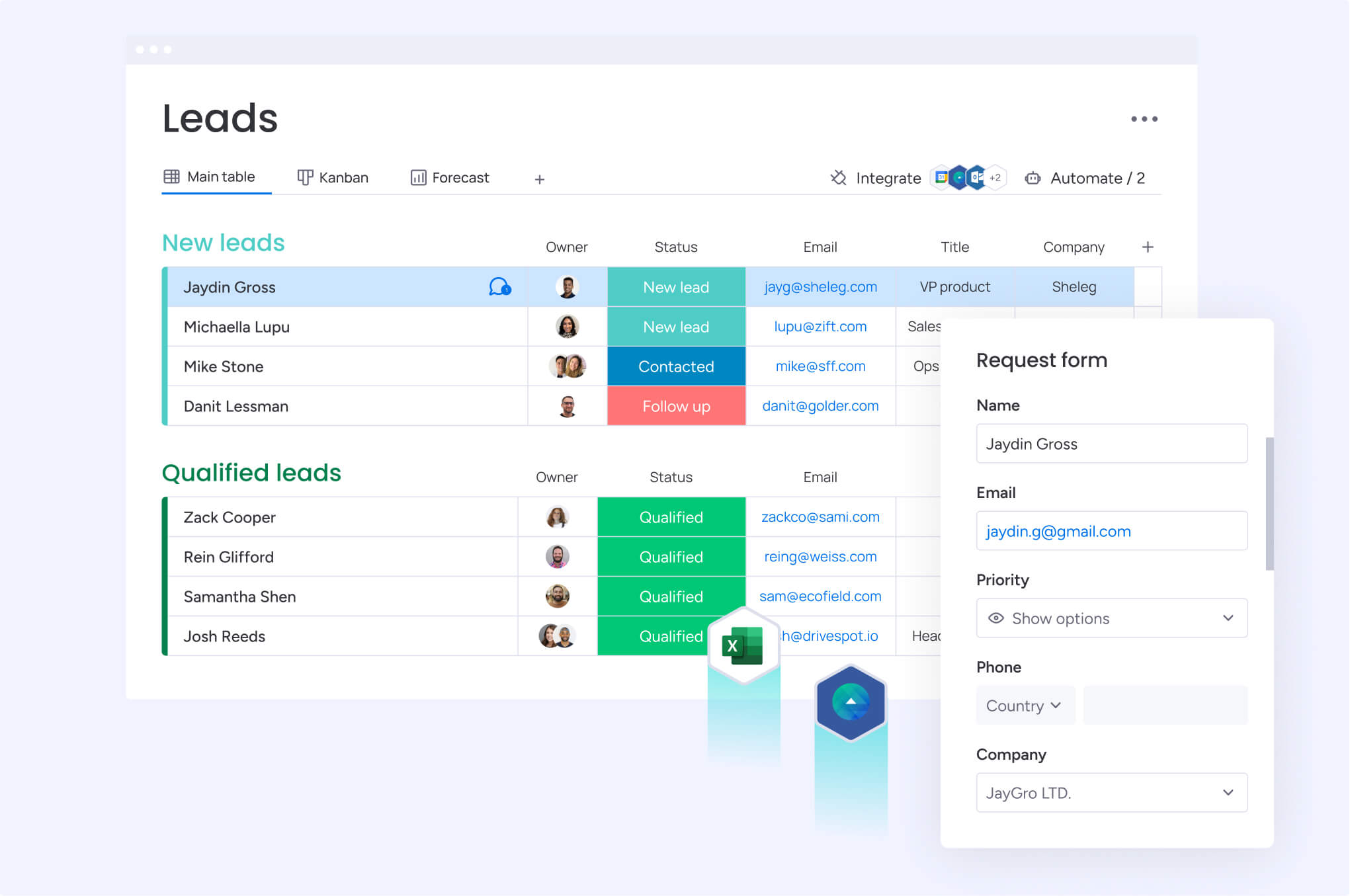
An e-commerce business can’t afford vague promises, and your CRM shouldn’t be built on them either. Choosing a platform with the right e-commerce capabilities allows your team to act on opportunities and build seamless workflows.
These features separate a true e-commerce CRM from a glorified contact list:
- Real-time order and customer data sync: Customer records should update instantly with every purchase, shipment, or return. Without that live connection, support loses context and marketing might send a promo to someone who just checked out.
- Deep e-commerce platform integrations: Connecting to Shopify, WooCommerce, or BigCommerce is table stakes. What matters is how deep that integration goes — capturing SKUs, discount codes, and return reasons, not just order totals.
- Marketing automation and cart recovery: Smart automation turns abandoned carts into sales and one-time buyers into repeat customers. Once configured, these workflows run themselves so your team can focus on strategy instead of manually sending emails.
- AI-powered personalization and segmentation: AI-driven segmentation highlights who might churn next and who could become especially valuable. With the right setup, AI can classify customers, detect sentiment, and route leads automatically — no technical specialization required.
- Inventory and fulfillment visibility: Put inventory and fulfillment data inside the CRM so anyone who needs it can see shipping status and expected delivery dates in real time. This visibility lets you flag delays and alert customers proactively before minor issues become major complaints.
- Unified customer support workflows: A unified timeline of every email, call, and chat means any team member can pick up a conversation with full context. The result: a smoother experience for the customer, even when conversations shift between sales and support.
- Analytics and customer lifetime value tracking: Customer lifetime value (CLV) shows exactly how much you can afford to spend getting and keeping a customer. Pulling a CLV report shouldn’t require a data analyst every time your team needs an answer.
Once your CRM software includes these core capabilities, the team stops spending all day reacting. Instead, it can focus on driving revenue with the visibility and control needed to grow. AI and automation take this even further by stripping out manual work, anticipating customer needs, and keeping workflows moving with far less effort.

Get ready to scale your e-commerce revenue
An online store that’s growing fast needs more than a simple contact database. It needs a platform that connects storefront data with sales, marketing, and support workflows. Once everyone is working from the same real-time information, a lot of the manual drag that slows growth starts to disappear.
The right e-commerce CRM gives your team the visibility and control to anticipate customer needs and automate routine work. Organizations achieve better results when they leverage monday CRM to centralize these operations and keep their teams aligned. Instead of fighting a disconnected tech stack, your team can focus on building stronger customer relationships.
Try monday CRM
“With monday CRM, we’re finally able to adapt the platform to our needs — not the other way around. It gives us the flexibility to work smarter, cut costs, save time, and scale with confidence.”
Samuel Lobao | Contract Administrator & Special Projects, Strategix
“Now we have a lot less data, but it’s quality data. That change allows us to use AI confidently, without second-guessing the outputs.”
Elizabeth Gerbel | CEO
“Without monday CRM, we’d be chasing updates and fixing errors. Now we’re focused on growing the program — not just keeping up with it."
Quentin Williams | Head of Dropship, Freedom Furniture
“There’s probably about a 70% increase in efficiency in regards to the admin tasks that were removed and automated, which is a huge win for us.“
Kyle Dorman | Department Manager - Operations, Ray White
"monday CRM helps us make sure the right people have immediate visibility into the information they need so we're not wasting time."
Luca Pope | Global Client Solutions Manager at Black Mountain
“In a couple of weeks, all of the team members were using monday CRM fully. The automations and the many integrations, make monday CRM the best CRM in the market right now.”
Nuno Godinho | CIO at Velv
“monday.com provides developmental flexibility, operational efficiency, and data transparency — all in one place. We became a company that moved from chasing data to leading with it.”
Hyunghan Lee | Team Lead, Sandbox Network
"monday.com brought every part of our business into one connected space. The harmony between work management and CRM has become our operating system — giving us the clarity and confidence to scale.”
Jennifer Chinburg | Executive Vice President of Corporate Development & Brand, Chinburg Properties
“We just weren’t getting value from our old CRM. With monday.com, it's a thousand times better. Our sales teams are more informed, more consistent, and far more connected."
James Arnold | Chief Operating Officer, CenversaFAQs
What is an e-commerce CRM?
An e-commerce CRM is a platform that centralizes customer data, order history, and purchase behavior from multiple channels. It helps online retailers manage thousands of transactional customers and automate workflows based on actual purchase events.
Why do e-commerce businesses need a CRM?
E-commerce businesses need a CRM to eliminate data silos between sales, marketing, and support teams. It provides real-time visibility into inventory, automates post-purchase communication, and helps track customer lifetime value accurately.
How does a CRM increase e-commerce sales?
A CRM increases e-commerce sales by using AI and automation to recover abandoned carts, personalize marketing campaigns, and identify high-value customers. This targeted approach ensures you send the right message at the right time, driving repeat purchases.
What is the difference between CRM and e-commerce platforms?
The difference between CRM and e-commerce platforms is their primary function. An e-commerce platform handles the storefront, checkout, and transaction processing, while a CRM manages the ongoing customer relationship, communication history, and sales pipeline.
Can you integrate a CRM with Shopify?
Yes, you can integrate a CRM with Shopify. Most modern e-commerce CRMs offer native integrations or API connections to sync order details, customer profiles, and inventory data directly from Shopify into your CRM dashboard.
