


Most organizations have a mission statement — an action-oriented declaration of what they believe in and what they want to achieve. But too often, these mission statements end up as wall art gathering dust while teams make decisions based on gut feeling, politics, or whoever speaks loudest in the meeting.
The problem isn’t the mission itself, but the disconnect between strategy and execution. When your mission lives in a slide deck instead of your workflows, teams can’t connect daily tasks to organizational purpose. To keep your vision aligned with your work, this guide explores how mission statement templates can turn purpose into action. We’ll cover the essential components every mission statement needs, a step-by-step process for creating one your team will use, and how monday work management will help you turn abstract purpose into measurable outcomes.
Try monday work managementKey takeaways
- Build your mission with input from every department: Include sales, operations, and customer service teams to create a statement that reflects real work, not just executive vision.
- Focus on outcomes, not features: Define the problems you solve and transformations you create rather than listing what your company does or makes.
- Use your mission as a daily decision filter: Every project proposal, budget request, and hiring choice should connect back to your core purpose and values.
- Transform mission alignment into measurable workflows: Embed mission components directly into project boards, tracking which initiatives support strategic priorities through real-time dashboards.
- Review and refine your mission every 3-5 years: Schedule regular check-ins to ensure your statement still guides decisions effectively as your organization grows and markets shift.
What is a mission statement and why your team needs one
A mission statement is your organization’s North Star — a concise declaration that defines your purpose, who you serve, and the unique value you deliver. It’s not a marketing slogan or motivational poster. Think of it as the filter that guides daily decisions, resource allocation, and strategic priorities.
Every project proposal, hiring decision, and budget allocation should trace back to this core statement. When teams understand not just what they do but why they do it, they align faster and execute with greater precision.
Mission statements give organizations 3 critical advantages:
- Strategic alignment: Teams across departments work toward the same objectives, reducing friction when priorities compete for resources
- Decision velocity: Leaders use the mission as a filter to evaluate opportunities, eliminating analysis paralysis
- Cultural cohesion: The mission attracts talent who share your values while naturally filtering out those who don’t
Without a clear mission, organizations drift. The warning signs show up fast: departments pulling in different directions, managers fumbling through onboarding explanations, and leadership pivoting strategies without explaining why. These symptoms indicate it’s time to define, or refine, your mission statement.

7 essential components every mission statement template must include
Building an effective mission statement requires 7 specific components that turn vague aspirations into real guidance. Each element plays a specific role in making your mission work in practice, not just sound good on paper. Master the following components, and you’ll create a mission that drives real decisions instead of decorating office walls.
| Component | Purpose | Common mistake |
|---|---|---|
| Core purpose | Defines why your organization exists | Confusing purpose with products or services |
| Target audience | Identifies who you serve | Trying to serve "everyone" |
| Value delivered | Specifies the outcomes you create | Listing features instead of solving problems |
| Unique approach | Outlines your methodology | Using buzzwords without substance |
| Differentiator | Articulates competitive advantage | Ignoring what makes you distinct |
| Measurable commitment | Includes specific standards | Using vague terms like "best" or "leading" |
| Shared values | States guiding principles | Choosing aspirational values that don't reflect reality |
Here’s how each component builds a mission that drives decisions.
Core purpose and target audience
Your core purpose goes beyond products or quarterly earnings. It’s the fundamental reason you exist and why your organization matters. It’s what keeps teams going through tough times and shapes long-term strategy.
Who you serve requires specificity. “Everyone” is not an audience. Define your primary audience so teams know whose needs matter most when making trade-offs.
Value delivery and unique approach
What value you deliver focuses on outcomes and transformations, not features. What problems do you solve? What opportunities do you create? This shows teams the impact they’re working toward.
How you create impact distinguishes your methodology or approach. This could be your business model, technology, or philosophy that sets you apart from competitors.
Differentiation and commitment
What makes you different isn’t about being “the best.” It’s about standing out in ways your audience geniunely cares about. Make sure this advantage is real and matters to customers.
Your measurable commitment includes quantifiable goals or standards that create accountability. This turns good intentions into concrete outcomes teams can track and support.
Your team’s shared values are behavioral principles that guide how work gets done and decisions are made. Base them on your current culture, not who you wish you were.
You can use dedicated digital boards to capture input on each component during strategic planning sessions. This ensures nothing gets overlooked while building consensus across departments.

5 steps to write a mission statement your team will champion
Creating a mission statement that influences daily decisions? You need a structured approach that involves your entire organization. The following process turns abstract concepts into guidance teams can use right away.
Step 1: Gather cross-functional input
Mission statements created by executives alone rarely stick. Building one that reflects how your organization works requires input from every level and department.
Start with structured data collection through stakeholder interviews to understand how different teams view the company’s value. Consider these perspectives:
- Sales teams: Offer ground-level insights about customer needs and competitive positioning
- Operations: Reveals what’s possible to deliver and current capability constraints
- Customer service: Knows where expectations meet reality and common friction points
Digital tools can accelerate this process. Teams can contribute asynchronously through shared workspaces, so remote employees and different time zones don’t block participation. Teams can contribute asynchronously through shared workspaces, so remote employees and different time zones don’t block participation. The goal is to capture diverse perspectives before you start synthesizing.
Step 2: Define your fundamental answers
Raw input needs structure. This step turns scattered feedback into clear statements about your organization’s purpose, audience, and value.
Look for patterns across departments. If sales describes customers as “growth-focused enterprises” while marketing says “ambitious mid-market companies,” you’re seeing the same audience through different lenses. Merge these perspectives into definitions everyone recognizes.
Nail down the non-negotiables about your organization. These become your mission’s foundation and the filter for future decisions.
Step 3: Draft multiple mission statement samples collaboratively
Never settle on your first draft. Creating 3-5 versions with different emphases reveals which language fits your organization. Each version might highlight different strengths:
- One emphasizes speed and agility
- Another focuses on partnership and trust
- A third leads with innovation and transformation
Compare them side-by-side to see which words resonate and which don’t. You can embed live project boards directly into collaborative documents, grounding abstract mission discussions in operational data and current project realities.
Step 4: Test with key stakeholders
Your favorite draft might confuse the people who need to live by it. Testing prevents rolling out a mission that sounds good in the boardroom but fails in practice. Evaluate each draft against 3 criteria:
- Memorability: Can team members recall it without reading?
- Distinctiveness: Does it sound uniquely like your organization?
- Actionability: Does it help make real decisions?
Gather feedback from employees, customers, and partners. Their reactions reveal whether your mission connects or needs refinement.
Step 5: Refine until crystal clear
Iteration transforms good drafts into powerful statements. Based on feedback, polish language to remove jargon, passive voice, and ambiguity.
Your mission is ready when new hires understand it immediately without lengthy explanation. Every word should earn its place. Every phrase should add precision. The final version becomes a decision-making tool, not just inspirational text.
Try monday work management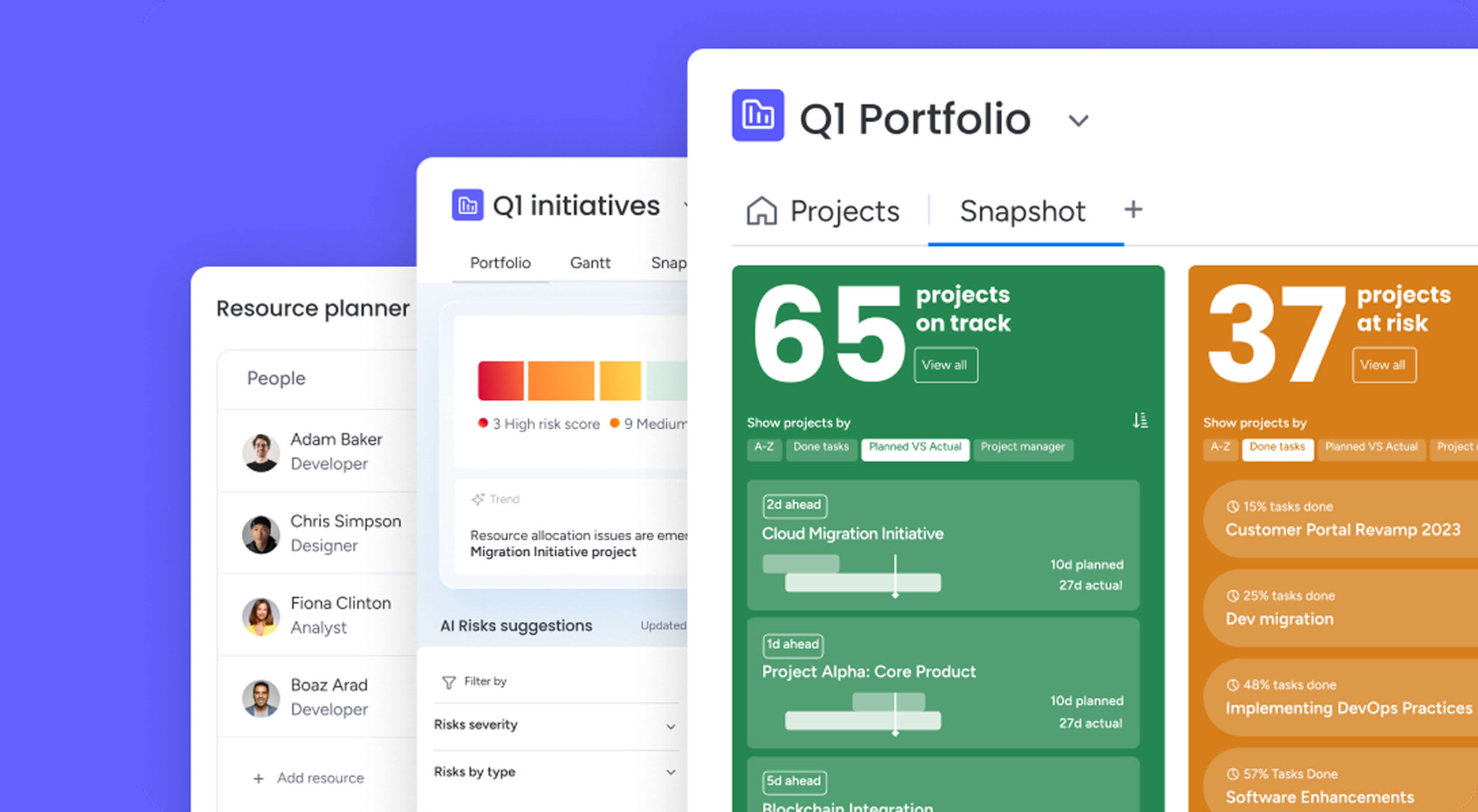
A mission statement format that drives real action
Choosing the right format determines whether your mission statement becomes a practical tool or forgotten text. Different organizational contexts require different approaches to balance comprehensiveness with memorability. The format you select should match your company’s complexity, culture, and communication style while empowering teams to use it to guide decisions.
The 1-sentence mission format
Maximum impact in minimum words. This mission format forces absolute clarity by limiting your mission to 20 words or less, typically following: “To [action] [beneficiary] by [method].”
This approach works best for organizations with singular focus and clear value propositions. Every word must pull its weight; there’s no room for corporate speak or padding.
The 3-part mission framework
When complexity requires more detail, this framework provides structure without sacrificing coherence. It breaks your mission into three connected segments:
- What we do: Core activities and primary functions
- How we do it: Methodology, approach, and unique processes
- Why it matters: Impact, purpose, and transformation created
This format allows you to address operational complexity while maintaining logical flow. Each part builds on the previous, creating a complete picture of your organization’s purpose.
The story-based template approach
Narrative structure creates emotional connection by positioning your organization as the solution to a critical challenge. This format typically includes:
- The problem or opportunity: What challenge exists in the world
- Your organization’s response: How you address this challenge uniquely
- The resulting transformation: What changes when you succeed
Story-based missions work particularly well for mission-driven organizations where the “why” involves overcoming significant challenges or creating meaningful change.
Choosing your ideal mission statement format
Different formats serve different organizational needs. Consider your context when selecting:
| Format | Length | Best for | Key advantage |
|---|---|---|---|
| One-sentence | 15–20 words | Focused startups, single-product companies | High recall and easy communication |
| Three-part | 30–50 words | Complex enterprises, multi-service providers | Comprehensive yet structured |
| Story-based | 50–75 words | Nonprofits, cause-driven organizations | Emotional connection and context |
Industry-specific mission statements inspire teams to excel
Mission statements look different depending on your industry. The commonality across sectors is that memorable mission statements balance specificity with inspiration. Here’s how each industry might approach crafting their mission statement.
Technology company mission statements
Technology companies face the challenge of making complex innovations feel human and accessible. Effective tech missions focus on the human outcomes their platforms enable, not the code that powers them.
Strong technology mission statements frame the product as a means to human connection, creativity, or empowerment. They avoid technical specifications in favor of transformation. The technology becomes invisible; the impact becomes everything.
Healthcare organization mission statements
Healthcare missions must balance clinical excellence with compassionate care. Leading healthcare organizations emphasize both the quality of outcomes (healing, prevention, wellness) and the quality of experience (dignity, comfort, accessibility).
Effective healthcare missions avoid medical jargon while maintaining professional credibility. They speak to patients, families, and communities in language that resonates emotionally while promising tangible health improvements.
Nonprofit mission statements
Nonprofits rely on mission statements to drive both funding and volunteer engagement. The strongest examples explicitly state who benefits and what specific change the organization creates in the world.
These missions use action-oriented language with verbs like “eliminate,” “empower,” or “restore.” They create urgency by defining what success looks like, making it easier for supporters to understand their role in achieving that vision.
Small business mission statements
Small businesses leverage personality and local connection in their missions. Effective missoin statement examples highlight commitment to specific communities or unique craftsmanship that larger competitors can’t match.
These statements build trust through authentic, grounded language that reflects the owner’s voice. They promise specific, personal service levels that resonate with customers seeking alternatives to corporate anonymity.
Mission statement vs vision statement vs values
Mission, vision, and values get thrown around interchangeably in strategy meetings, but they’re fundamentally different tools that serve distinct purposes. Mixing them up creates strategic confusion where teams don’t know whether they’re optimizing for today’s operations or tomorrow’s aspirations. Here’s how to keep them straight.
| Element | Focus | Timeframe | Purpose | Key question answered | Typical length |
|---|---|---|---|---|---|
| Mission | Current purpose — what you do today, who you serve, and how you deliver value | Present | Daily guidance and decisions — used when prioritizing work and evaluating opportunities | What should we focus on today? | 1–2 sentences |
| Vision | Future aspiration — what the world looks like if you succeed | 5–10 years | Strategic direction — used in planning, investor comms, and goal setting | Where are we heading? | 1 sentence |
| Values | Behavioral principles that guide how your team interacts and decides | Ongoing | Cultural foundation — defines how work gets done and decisions are made | How do we work together? | 3–7 principles |
A unified platform like monday work management keeps daily projects (mission) aligned with your long-term objectives (vision) while maintaining team standards (values).
Try monday work management3 ways to get team buy-in for your mission statement
Mission statements fail when they remain leadership abstractions rather than team realities. Getting genuine buy-in requires moving beyond announcement to engagement, addressing skepticism directly, and creating ongoing dialogue. The following approaches transform mission statements from corporate messaging into operational guidance that teams use and champion.
1. Run inclusive mission workshop sessions
Ownership comes from participation. When team members actively contribute to mission development, they champion the result because they helped create it.
Structure workshops with clear frameworks that maximize participation:
- Pre-work: Gather initial thoughts through surveys or brief interviews
- Facilitation techniques: Amplifies quiet voices through structured activities
- Follow-up: Show how specific feedback shaped the final statement
When employees see their input reflected in the mission, adoption becomes natural. They’re not following someone else’s words, but living by principles they defined.
2. Address common resistance points
Skepticism about mission statements often stems from past experiences with corporate fluff that never influenced real decisions. Address these concerns directly with concrete examples.
Common objections and responses:
- “This is too abstract”: Demonstrate how the mission guides budget allocation or project approval
- “It’s imposed from above”: Show how it codifies work they’re already doing successfully
- “It won’t change anything”: Connect the mission to recent wins and current challenges
Transform resistance into engagement by connecting the mission to existing successes and current operational realities.
3. Create continuous feedback loops
Mission statements need regular validation to stay relevant. Establish channels for ongoing input rather than treating the mission as fixed doctrine. Implementation strategies include:
- Quarterly check-ins: Schedule regular discussions about mission alignment
- Feedback channels: Create spaces for teams to flag disconnects between mission and decisions
- Collaborative platforms: Keep the conversation alive between formal reviews
This ongoing dialogue evolves your mission alongside your organization rather than becoming outdated text everyone ignores.
Turn your mission statement into measurable outcomes with monday work management
Most mission statements live in slide decks, disconnected from the realities of your work. monday work management changes that by embedding your mission directly into daily workflows. Here’s how the platform turns mission alignment from a quarterly conversation into an operational reality your teams engage with every day.
Connect the mission to your daily workflows with custom fields
Teams embed mission alignment directly into project boards through custom fields and status columns, translating abstract purpose into trackable project data.
Custom fields let you tag every task, project, and initiative to specific mission components. Add a “Mission Pillar” dropdown to your boards, and suddenly there’s a direct line of sight between individual contributions and organizational purpose. The mission becomes a living part of daily work, not a distant ideal.
Track mission alignment across projects
Custom dashboards display KPIs tied to specific mission outcomes rather than generic metrics. Teams monitor progress toward their unique purpose and values through visual widgets that update in real-time as work happens. When your mission lives in your dashboards, alignment becomes visible, measurable, and impossible to ignore.
With this birds-eye view, leaders can spot mission drift before it becomes cultural disconnect. When certain pillars consistently lack resources or focus, it’s a signal to either reallocate effort or revisit the mission itself.
Visualize progress with AI-powered dashboards
AI capabilities within monday work management accelerate mission analysis and turn abstract purpose into trackable outcomes. AI Blocks automatically categorize incoming projects by mission alignment, flagging which initiatives support strategic priorities without manual tagging. Summary features digest complex project updates into mission-focused insights, so leadership sees what matters without drowning in details.
monday sidekick, your AI work assistant, takes this further by answering simple questions about mission alignment across your entire workspace. Ask “Which projects support our customer experience pillar?” and get instant answers pulled from real project data. The agentic AI capabilities learn your mission framework and proactively spot misalignment, like when high-resource projects lack clear connection to stated purpose.
Automate mission-driven decisions
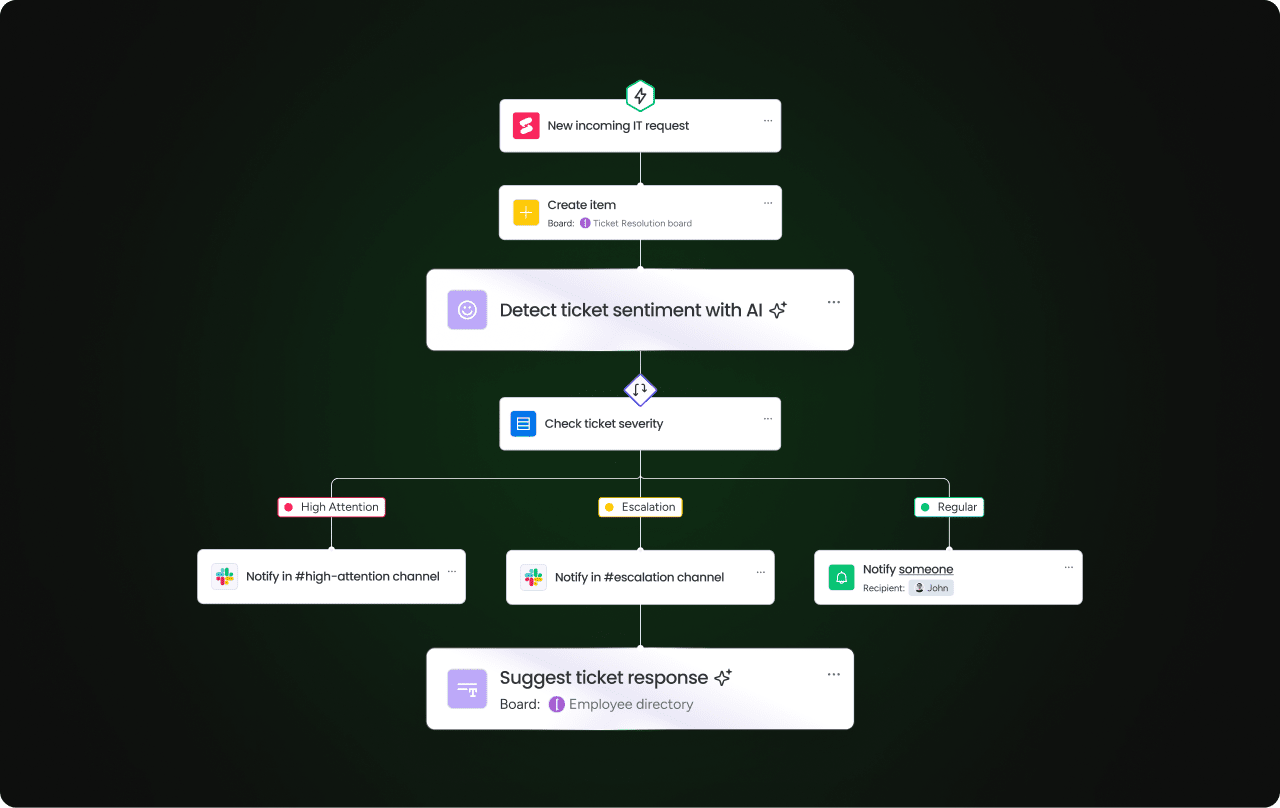
Automation builds mission considerations into approval workflows. Projects lacking clear mission alignment get flagged for review. Resource requests automatically route based on strategic priority.
The following comparison shows how monday work management operationalizes mission statements:
| Capability | monday work management | Traditional approaches |
|---|---|---|
| Mission integration | Embedded in daily workflows via custom fields | Separate documents or presentations |
| Progress tracking | Real-time dashboards and portfolios | Quarterly review meetings |
| Team collaboration | Centralized workspace for all roles | Fragmented email chains |
| AI assistance | Automated categorization and analysis | Manual assessment |
Build a mission that drives results, not just inspiration
The strongest mission statements balance specificity with memorability. They’re something your teams can recall and apply during real work situations. They make every project meaningful and every decision grounded in shared values.
Organizations that operationalize their missions through platforms like monday work management see faster alignment, well-defined priorities, and stronger team engagement. The mission stops being something you reference occasionally and becomes something you live daily through connected workflows and measurable outcomes.
Try monday work managementFrequently asked questions
What are the 5 parts of a mission statement?
The 5 essential parts of a mission statement are your core purpose (why you exist), target audience (who you serve), value proposition (what you deliver), unique approach (how you're different), and measurable commitment (what you promise to achieve). Each component transforms abstract purpose into concrete guidance for daily decisions.
How long should a mission statement be?
An effective mission statement should be between 15-75 words, depending on the format. One-sentence versions stay under 20 words for maximum memorability, while comprehensive versions shouldn't exceed 75 words to maintain focus.
Can a mission statement change over time?
Yes, a mission statement can and should change over time. Review your mission every 3-5 years or when major strategic changes occur to ensure it evolves as your organization grows and markets shift. Evolution should refine language while preserving core identity.
Who should be involved in creating a mission statement?
To create an effective mission statement, you should involve representatives from all organizational levels and departments. This includes leadership for strategic vision, middle management for operational reality, and frontline employees for ground-level insights. Cross-functional participation makes sure that the mission reflects actual work, rather than aspirations.
How do you measure mission statement effectiveness?
You can measure mission statement effectiveness through employee survey results about purpose, consistency in decision-making across teams, and alignment between daily activities and the stated mission. Track whether teams reference the mission during planning and if new initiatives clearly connect to mission components.
What's the difference between a company mission and team mission?
The difference between a company mission and a team mission is scope. A company mission defines the organization's overall purpose, while team missions specify how individual departments contribute to that broader purpose. Team missions specify how individual departments contribute to that broader purpose. While the company mission might focus on transforming an industry, a marketing team's mission would detail how they build awareness and engagement to support that transformation.

 Get started