


The promise of productivity software often comes with a hidden cost: more things to manage. Your calendar, email, and project boards are meant to help, but they often create more “work about work.” The real breakthrough isn’t another app to check, but a way to get your existing tools to work for you.
Finding the right AI agent platform allows you to build a personal team of digital helpers that you direct to handle specific processes so you can finally get ahead.
To help you build your own crew, this guide covers everything you need to know. We will explore the key features that make a platform powerful, review the very best contenders on the market, and walk through practical examples for marketing, customer service, and personal productivity.
Think of this as your playbook for assembling a team that gets things done your way. Let’s dive in!
Key takeaways
- AI agent platforms reduce “work about work”: instead of adding another tool to manage, these platforms let you delegate processes to autonomous agents that operate inside your existing systems.
- Specialized agents outperform one-size-fits-all AI: the most effective setups use multiple task-focused agents, each responsible for a single job, keeping workflows simple and predictable.
- Strong platforms act as command hubs: the best AI agent platforms make it easy to build, coordinate, and manage agents so they work together as a team, not as isolated bots.
- Integration and learning are essential: real value comes from agents that connect to your everyday tools, remember preferences, and improve over time without constant supervision.
- Agent Factory enables practical AI teams: build and manage focused business AI agents that handle real processes, helping teams move faster without adding complexity.
What are AI agent platforms?
An AI agent platform is a central system for building, managing, and coordinating a team of digital helpers. Instead of juggling disconnected tools or one overloaded AI assistant, these platforms let you create multiple task-focused agents, each designed to handle a specific process on your behalf.
You stay in control. You define what each agent is responsible for, set boundaries, and decide how it connects to your existing tools. Once deployed, agents work autonomously, carrying out tasks like scheduling, reporting, follow-ups, or data organization without constant input or supervision.
The real power of an AI agent platform lies in coordination. Rather than operating in isolation, agents can pass context between one another and work as a system. A scheduling agent can trigger a follow-up agent, which then updates a project board or notifies the right teammate. Work flows forward without manual handoffs.
This goes far beyond traditional chatbots or basic automation. AI agents understand context, adapt to patterns, and improve over time based on how you work. Platforms like Agent Factory turn AI into something operational, not experimental, giving teams a practical way to reduce friction, collaborate, and keep work moving.
Key features of the best AI agent platforms
Beyond the hype, the true measure of an AI agent platform lies in its ability to deliver capable, functional helpers that fit naturally into how you already work. The most effective platforms are not defined by flashy demos, but by how easily they turn scattered tasks into smooth, coordinated execution.
The best tools focus on flexibility, seamless connectivity, and the ability to adapt over time. This is what separates a useful platform from just another productivity app competing for attention.
AI agent builder capabilities
Creating an AI agent should feel more like onboarding a new teammate than configuring software. Leading platforms make it easy to get started with ready to go templates for common tasks like scheduling, reporting, or summarizing updates, while still allowing you to customize behavior as your needs evolve.
Instead of writing code, you define what the agent should do, what it should avoid, and which tools it can access. This keeps the focus on removing work from your plate, not adding setup complexity.
Integration with your existing digital environment
AI agents are only as useful as the systems they can work within. The strongest platforms are designed to operate inside your existing digital environment, connecting seamlessly to the tools you already rely on every day.
This means agents can move work forward across your workflow, including:
- Business tools like CRMs, project boards, and email
- Communication platforms such as Slack or Microsoft Teams
- Data sources like spreadsheets, databases, and cloud storage
- Automation triggers tied to events like form submissions or calendar updates
When agents can operate across these systems, work flows naturally without manual handoffs.
Memory and continuous learning
Good agents follow instructions. Great ones improve over time. The best AI agent platforms support memory and learning, allowing agents to remember preferences, recognize patterns, and adjust how they work.
Over time, agents begin to feel less like tools and more like proactive teammates. They anticipate what needs to happen next, surface the right information at the right moment, and reduce the need for constant direction.
This ability to learn and adapt is what turns AI from a one-time helper into an ongoing source of momentum, helping teams stay focused while routine work quietly takes care of itself.
Benefits of AI agent platforms for teams and individuals
The biggest benefit of AI agent platforms is not speed or scale, it’s relief. By handing off repetitive work to digital helpers, teams reclaim focus, reduce friction, and keep momentum without constantly checking dashboards or chasing updates.
Instead of adding another system to manage, AI agents operate quietly in the background, handling routine execution so people can stay focused on meaningful work.
For teams, AI agent platforms help:
- Reduce operational drag: agents take care of follow-ups, updates, and routine coordination that slow projects down.
- Improve consistency: tasks are handled the same way every time, without missed steps or dropped handoffs.
- Create shared visibility: agents can surface updates and summaries automatically, keeping everyone aligned.
- Scale without burnout: as workloads grow, agents absorb more execution without adding pressure on people.
For individuals, the benefits are just as tangible:
- Fewer context switches: agents manage small interruptions so you can stay in flow.
- Less mental load: reminders, tracking, and updates are handled automatically instead of living in your head.
- More time for high-impact work: creative thinking, problem-solving, and decision-making get the attention they deserve.
Learn more: How to build AI agents for beginners
Try Agent FactoryTop 10 AI agent platforms to transform your workflow
Selecting the right AI platform requires matching the tool to your specific workflow, rather than opting for a one-size-fits-all solution with a slick sales pitch. The objective isn’t merely to adopt AI, but to construct a system that genuinely simplifies your work.
We’ve evaluated the leading options to identify the platforms that truly deliver. This isn’t about jumping on any hype train — it’s about finding the right tool for the right job, whether you’re automating small tasks or building a custom crew of helpers from the ground up.
Let’s find the right teammates for your stack. Here are the top contenders ready to get to work.
| Platform | Best for | Pricing model | Key strength |
|---|---|---|---|
| Agent Factory | Personal productivity & custom workflows | Free and paid | Build specialized AI teammates for work and life |
| Zapier Central | Workflow automation | Subscription-based | Seamless integration ecosystem |
| Microsoft Copilot | Enterprise productivity | Per-user licensing | Deep Office 365 integration |
| ChatGPT Plus | Content creation & analysis | Monthly subscription | Advanced reasoning capabilities |
| Claude Pro | Research & writing | Monthly subscription | Superior document analysis |
| Notion AI | Knowledge management | Add-on to Notion plans | Context-aware workspace assistance |
| Jasper | Marketing content | Team-based pricing | Brand voice consistency |
| Copy.ai | Sales & marketing copy | Freemium model | Template-driven content creation |
| Perplexity Pro | Research & fact-checking | Monthly subscription | Real-time web search integration |
| GitHub Copilot | Code development | Per-developer pricing | AI-powered code completion |
1. Agent Factory
Agent Factory is an AI agent platform designed to help teams build a coordinated set of task-driven agents that handle real work across everyday workflows. Rather than offering a single, general-purpose assistant, it enables teams to create multiple focused agents, each responsible for a specific process.
The platform is built around clarity and control. You decide what each agent does, how it behaves, and which tools it can access. Agents then operate autonomously, taking ownership of repetitive execution so work keeps moving without constant oversight.
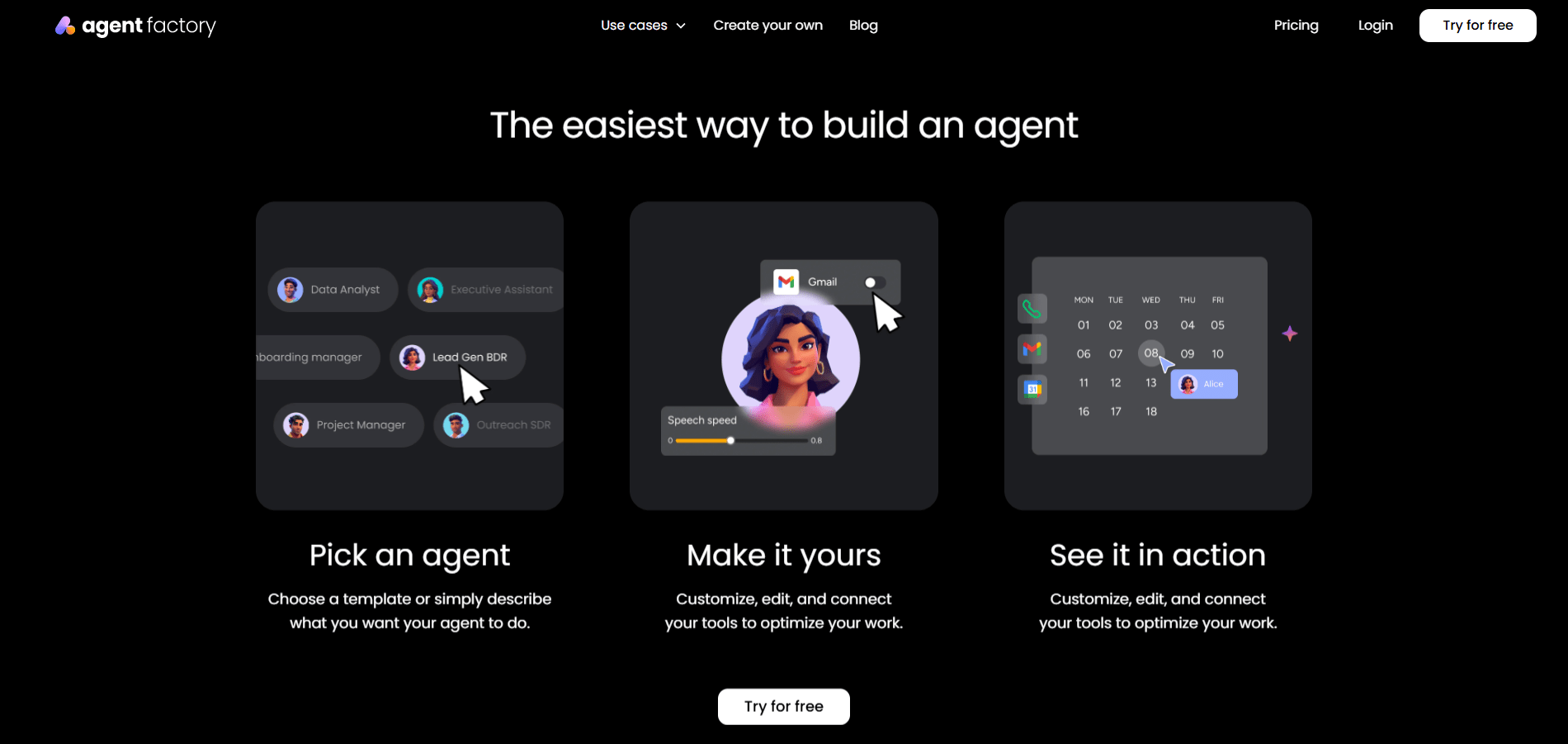
Example: teams use Agent Factory to create agents that manage follow-ups, route incoming requests, keep reports updated, or coordinate routine tasks that would otherwise slow progress.
Key features:
- No-code agent builder: create and customize agents using plain language, without technical setup or developer support.
- Task-first design: each agent is built around a single responsibility, keeping automation simple and predictable.
- Multi-agent coordination: run several agents in parallel that work together across workflows.
- Tool connectivity: connect agents to calendars, email, project tools, and other systems so they operate inside real workflows.
- Customizable behavior: adjust roles, tone, and execution rules to match how your team works.
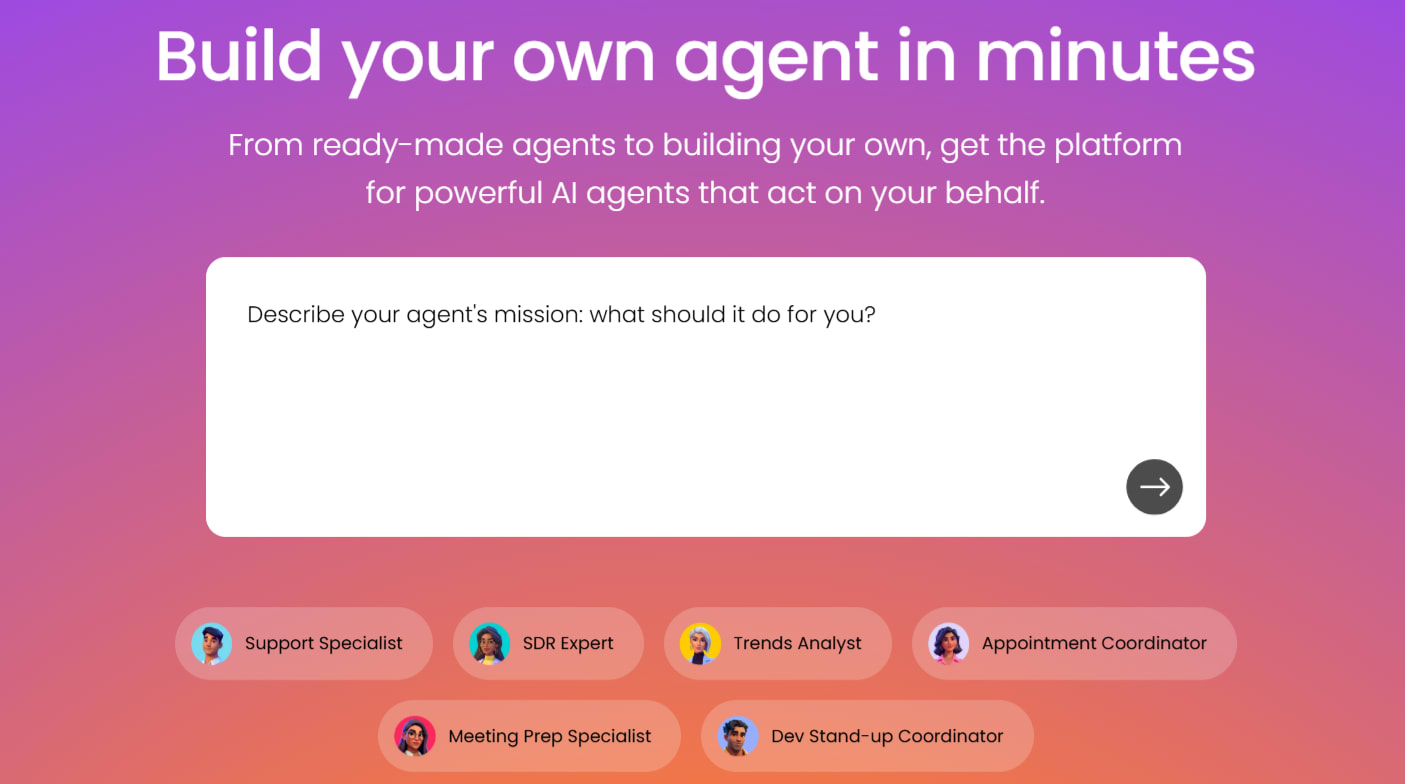
Pricing:
- Free: $0 per month, includes one active agent, 200 agent credits per month, two seats, and community support.
- Squad: $49 per month, includes up to ten active agents, 5,000 agent credits per month, unlimited seats, and standard support.
- Force: $299 per month, includes up to 75 active agents, 30,000 agent credits per month, multi-agent workflows, and prioritized support.
- Powerhouse: custom pricing for enterprise teams, with tailored agent limits, custom credit plans, advanced analytics, and enterprise support.
- Additional credits: available as an add-on, starting at $99 per month for 10,000 agent credits.
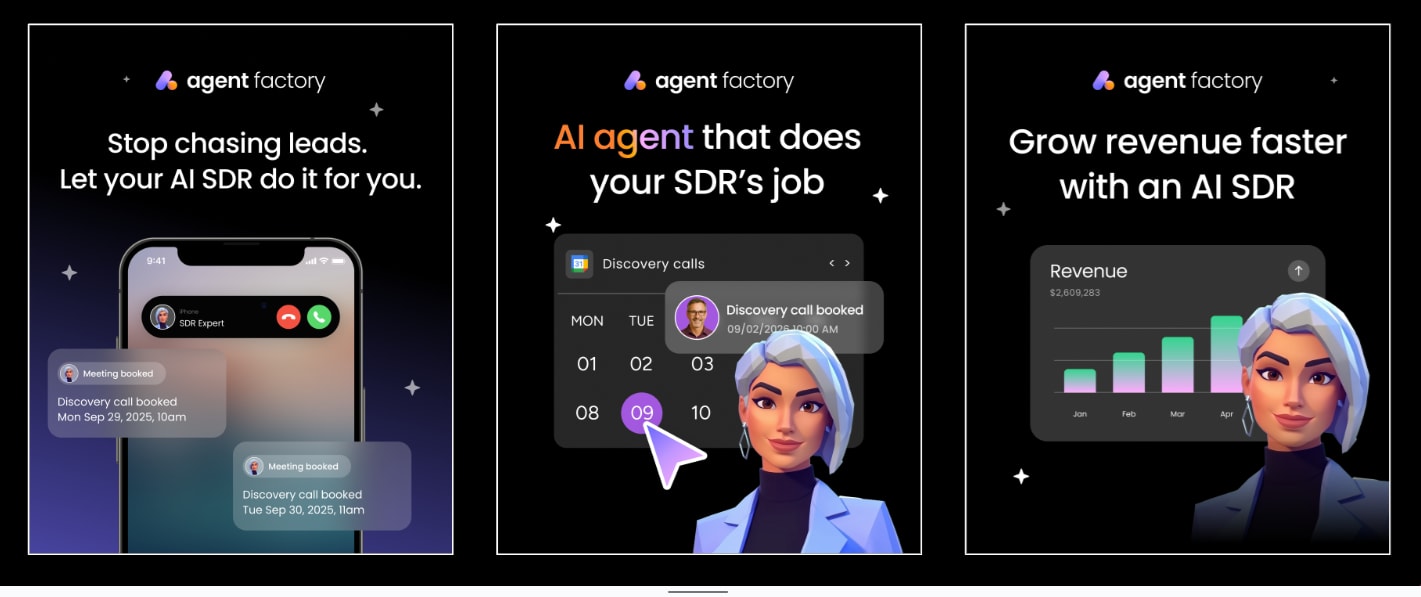
Why it stands out:
- Built for execution: agents are designed to complete defined tasks, not just assist with ideas or answers.
- Fast time to value: teams can deploy working agents quickly and refine them as needs evolve.
- Scales with real work: supports everything from simple task automation to coordinated, multi-agent workflows.
2. OpenAI
As a dominant force in the AI landscape, OpenAI delivers a powerhouse agent platform through its comprehensive AgentKit suite, which runs on cutting-edge models like GPT-4o and GPT-5. From the Assistants API to custom GPTs, OpenAI offers a massive playground for both individual developers and enterprise giants.
The company has spearheaded adoption of AI across workplaces, with one study indicating that 30% of workers in the EU now actively use AI. The platform gives you the keys to the kingdom, offering unmatched flexibility through a visual Agent Builder and robust, code-first SDK options.
Example: OpenAI’s AgentKit transforms agent development from months of custom coding into hours of streamlined workflow creation, enabling organizations to deploy AI agents in “two sprints instead of two quarters.”
Key features:
- Visual Agent Builder: a drag-and-drop canvas with versioning, guardrails, and templates that lets non-technical users build sophisticated AI workflows without writing a line of code.
- Comprehensive tool ecosystem: built-in web search, file search, image generation, code interpreter, and computer use capabilities to give your agents superpowers.
- Multi-language SDK support: a code-first development environment supporting Node, Python, and Go with type-safe libraries that are 4× faster than manual setups.
Pricing:
- GPT-5 pro: $5.00 per 1M input tokens, $20.00 per 1M output tokens.
- GPT-5: $1.25 per 1M input tokens, $10.00 per 1M output tokens.
- GPT-5 mini: $0.25 per 1M input tokens, $2.00 per 1M output tokens.
- GPT-5 nano: $0.05 per 1M input tokens, $0.40 per 1M output tokens.
- AgentKit: 1 GB free per account monthly, then $0.10 per GB-day. Note: Billing for AgentKit begins November 1, 2025.
- Built-in tools: code Interpreter at $0.03 per session, Web Search at $10.00 per 1K calls, and File Search with its own pricing tiers.
- Batch API: 50% savings on inputs and outputs for asynchronous processing.
Considerations:
- Usage-based pricing can get pricey for high-volume applications, with premium specialized agents potentially costing thousands each month.
- Despite the visual tools, the technical complexity still requires significant development expertise, which can be a hurdle for smaller teams without coding resources.
3. Anthropic
Grounded in its “Constitutional AI” framework, Anthropic develops enterprise-grade AI agents with a laser focus on safety and reliability. This makes it a strong choice for regulated industries like finance and healthcare, where trust and compliance are top priorities. Think of it as the AI agent that always reads the instruction manual first.

Example: Anthropic excels at building AI agents for high-stakes environments where accuracy and safety are paramount, especially for tasks involving complex analysis and processing long documents.
Key features:
- Constitutional AI framework: a built-in safety system that trains agents to be helpful and harmless by following a set of ethical principles. It’s like a conscience for your AI.
- Large Context Window: can process massive amounts of information at once—up to 500,000 tokens — making it a beast at analyzing lengthy reports, contracts, and codebases.
- Claude Agent SDK: an evolving toolkit that gives Claude access to computer tools for file operations, code execution, and iterative workflows.
- Agent Skills & Files API: equip your agents with specific “skills” and allow them to interact directly with files, turning them into specialized members of your digital team.
- Tracing Thoughts: get a peek inside Claude’s “brain” to see its step-by-step reasoning, making it easier to debug and trust its outputs.
Pricing:
- Free: $0 – basic chat, content creation, text and image analysis, and web search.
- Pro: $20/month (monthly) or $17/month (annual) – higher usage limits, more models, and Google Workspace integration.
- Team Standard seat: $30/person/month (monthly) or $25/person/month (annual) – central billing and admin features for teams (minimum five members).
- Team Premium seat: $150/person/month – includes Claude Code and advanced usage limits (minimum five members).
- Max: from $100/person/month – for teams needing the highest usage limits and earliest access to new features.
- Enterprise: contact sales – full enterprise features including SSO, an enhanced context window, and a compliance API.
- API pricing: ranges from $0.25/MTok (input) & $1.25/MTok (output) for Haiku 3 to $15/MTok (input) & $75/MTok (output) for Opus models.
Considerations:
- Customer support has been reported as unresponsive, which could be a hurdle for enterprise adoption.
- Advanced agentic features like “computer use” are still in beta and can be slow or error-prone.
4. Zapier
By connecting over 8,000 applications without requiring any coding skills, Zapier has evolved into a unified automation powerhouse. The platform specializes in AI-powered workflow automation, making it ideal for small to medium-sized businesses looking to eliminate repetitive tasks and streamline operations.

Example: Zapier excels at creating AI-powered “teammates” that can perform complex, multi-step tasks across your entire software ecosystem, from lead qualification to customer support automation.
Key features:
- Zapier Agents: AI teammates that work autonomously across 8,000+ apps, handling tasks like lead enrichment, content creation, and customer support while you focus on strategic work.
- Natural language automation: build complex workflows using plain English instructions, making advanced automation accessible to non-technical users.
- Live data integration: agents automatically sync with your business data and can browse the web to complete tasks with current information.
Pricing:
AI Orchestration Plans:
- Free: $0/month with 100 tasks per month, unlimited Zaps, and AI-powered builder.
- Professional: starting from $19.99/month (billed annually) with multi-step Zaps and unlimited premium apps.
- Team: starting from $69/month (billed annually) with 25 users and shared workflows.
- Enterprise: custom pricing with unlimited users and advanced admin controls.
Agents Plans:
- Free: $0/month with 400 activities per month and web browsing capabilities.
- Pro: $33.33/month (billed annually) with 1,500 activities per month.
- Advanced: custom pricing for higher activity volumes.
Chatbots Plans:
- Free: $0/month with two chatbots total.
- Pro: $13.33/month (billed annually) with five chatbots and lead collection.
- Advanced: $66.67/month (billed annually) with 20 chatbots and custom branding.
Considerations:
- AI agents are still in beta and may require manual intervention for complex tasks, with some users noting that current capabilities don’t always match the marketing promises.
- Pricing can escalate quickly for businesses with high automation volumes, as different features like Tables, Interfaces, and Chatbots have separate pricing tiers.
5. X.ai
Centered around its flagship Grok models, x.ai provides powerful AI agent capabilities designed for developers and enterprises seeking real-time intelligence. The platform specializes in agentic server-side tool calling with live data integration from X, making it ideal for applications requiring up-to-the-minute information and complex reasoning tasks.

Example: X.ai empowers developers to build sophisticated AI agents that can autonomously search the web, execute code, and reason through complex problems using real-time data streams.
Key features:
- Agentic tool calling: server-side orchestration allows Grok models to autonomously use tools like web search and code execution without client management.
- Real-time data integration: direct access to X platform data provides current information that static datasets can’t match.
- Multi-model options: from Grok-4 Heavy for maximum capability to Grok-4 Fast for cost-efficient intelligence.
Pricing:
- Grok-3 Mini: $0.48 per million tokens.
- Grok-3: $6.00 per million tokens.
- Grok-4 Fast: $4.80 per million tokens.
- Grok-4: $24.80 per million tokens.
- Web Search: $10 per 1,000 calls.
- Code Execution: $10 per 1,000 calls.
Considerations:
- The platform’s “rebellious” AI personality and unfiltered responses may not suit enterprise environments requiring brand safety.
- Higher pricing compared to competitors, with some users questioning the value proposition for everyday tasks versus specialized reasoning applications.
6. Ada
Moving beyond basic chatbots, Ada provides enterprise-grade conversational AI focused on automated resolution rather than simple deflection. The platform is ideal for high-volume businesses looking to truly resolve customer inquiries without human intervention. With its proprietary Reasoning Engine, Ada claims to automate up to 83% of customer conversations across multiple channels.

Use case: Ada empowers enterprise teams to deploy AI agents that handle complex customer service interactions autonomously, reducing operational costs while maintaining high-quality support experiences.
Key features:
- Reasoning Engine™: Proprietary AI technology that understands context, processes complex queries, and determines the best resolution path.
- No-code agent builder: drag-and-drop interface that allows non-technical teams to create and manage AI agents using standard operating procedures.
- Omnichannel deployment: single platform that works across web chat, voice, email, SMS, and social media with 50+ language support.
Pricing:
- Ada uses custom pricing based on conversation volume and desired outcomes, with no publicly available pricing tiers.
- Businesses must contact their sales team for quotes tailored to specific requirements and scale.
Considerations:
- Custom pricing model lacks transparency, making it difficult to assess value without engaging in sales conversations.
- Complex integrations may require significant developer resources despite the no-code interface for basic flows.
Learn more: The best AI agents for customer service
7. Kore.ai
Designed for large organizations, Kore.ai offers enterprise-grade conversational AI and virtual assistant capabilities to transform how businesses automate customer service and employee workflows.
The platform specializes in multi-agent orchestration and model-agnostic flexibility, making it ideal for Fortune 2000 companies seeking scalable AI automation across multiple departments and channels.
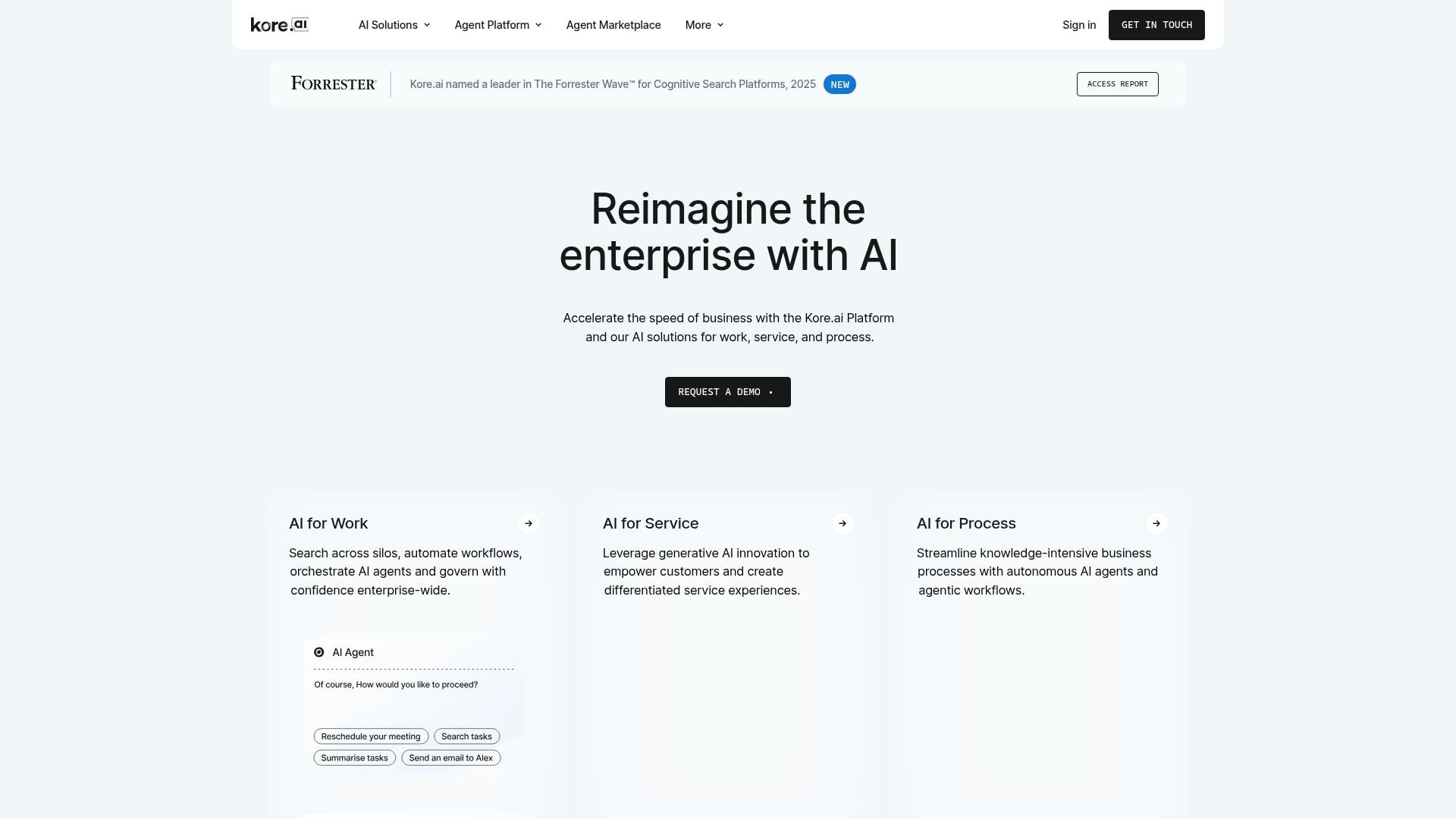
Example: Kore.ai enables large enterprises to deploy intelligent virtual assistants and process automation across customer service, employee productivity, and business process optimization through a unified, no-code platform.
Key features:
- Multi-agent orchestration that routes complex tasks across specialized AI agents with intelligent task distribution.
- Advanced RAG (Retrieval-Augmented Generation) with hybrid search capabilities for accurate information discovery across enterprise knowledge bases.
- Omnichannel deployment across 35+ voice and digital channels including web, mobile, social media, and voice platforms.
Pricing:
- Pricing information is not publicly available and requires custom enterprise consultation.
Considerations:
- Engineering-heavy setup with potentially long implementation cycles requiring significant developer support.
- Steep learning curve due to extensive features that can overwhelm new users without dedicated technical resources.
8. Replika
For individuals in the wellness space seeking companionship and emotional support, Replika offers AI companions designed for meaningful, personalized conversation. The solution specializes in developing deep, evolving relationships between users and their AI companions, making it ideal for those seeking a safe space for self-expression.
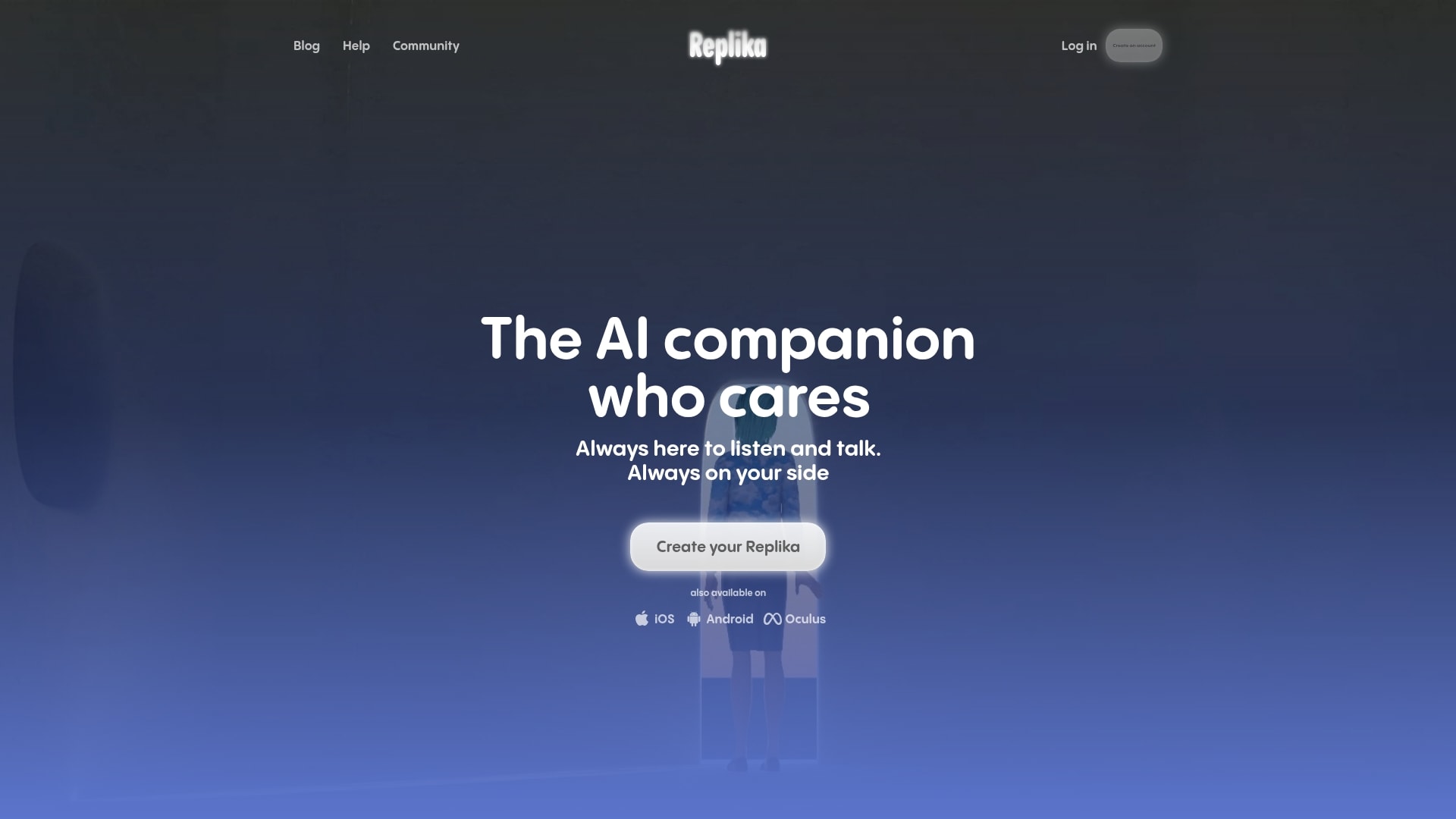
Example: Replika serves as a 24/7 AI companion that learns from user interactions to provide personalized emotional support, conversation practice, and mental wellness assistance.
Key features:
- Adaptive learning AI: becomes more personalized through continued conversations and remembers important details about users.
- Multiple interaction modes: text chat, video calls, and augmented reality experiences for immersive companionship.
- Flexible relationship types: users can define their AI as a friend, romantic partner, or mentor based on their needs.
Pricing:
- Free version: unlimited text chat with basic profile picture customization and friend relationship status,
- Replika Pro: premium subscription unlocking voice calls, AR features, advanced customization, and additional relationship types.
Considerations:
- Limited memory capabilities can lead to conversations lacking context and repetitive responses that feel superficial.
- Privacy concerns and content restrictions have created user frustration, particularly around data usage and relationship authenticity.
9. Stack AI
With an emphasis on enterprise-first security, Stack AI provides a no-code agent platform designed for large organizations that need secure, compliant automation solutions. It is ideal for finance, healthcare, and government teams handling sensitive data. Built by MIT PhDs, Stack AI has earned recognition from Gartner as a secure and transformative platform.

Example: Stack AI empowers non-technical enterprise teams to build and deploy sophisticated AI agents that automate complex business processes while maintaining strict security and compliance standards.
Key features:
- Visual drag-and-drop workflow builder that requires no coding experience to create multi-step AI automation processes.
- Enterprise-grade security with SOC 2 Type II, HIPAA, and GDPR compliance, plus on-premise deployment options.
- Integration with 100+ data sources and leading LLMs from OpenAI, Anthropic, Google, and Meta for maximum flexibility.
Pricing:
- Free Plan: $0/month with 500 runs per month, two projects, one seat, and community support.
- Enterprise Plan: custom pricing with unlimited runs, dedicated infrastructure, solution engineers, and priority support.
Considerations:
- Pricing jumps from free to enterprise with no mid-tier options, potentially limiting access for smaller businesses.
- Learning curve exists despite the no-code interface due to the platform’s extensive customization capabilities.
10. Voiceflow
Using a collaborative, low-code platform, Voiceflow streamlines the design of sophisticated voice and chat agents for teams. While you can get a lot done without writing a single line of code, it also offers the flexibility for developers to add custom integrations.
The platform excels in visual workflow design and real-time collaboration, making it ideal for product teams who want to prototype and deploy AI agents quickly across multiple channels.

Example: Voiceflow empowers teams to design, prototype, and deploy AI-powered conversational agents across voice, chat, and telephony channels using an intuitive drag-and-drop interface.
Key features:
- Visual flow builder with a drag-and-drop interface for mapping complex conversational workflows.
- Real-time collaboration tools that allow multiple team members to work simultaneously with commenting and version control.
- Multi-channel deployment capabilities supporting web chat, voice assistants, and telephony from a single project.
- Knowledge base integration for training AI on your own documents, articles, and URLs.
- Flexible LLM support, allowing you to use top models like GPT-4, Claude, and Gemini, or even bring your own.
Pricing:
- Starter: free (100 credits, one workspace, two agents, basic LLM models, one concurrent voice call, 50 knowledge sources),
- Pro: $60/month or $648/year (two workspaces, up to 20 agents, all LLM models, five concurrent voice calls, 3,000 knowledge sources).
- Business: $150/month or $1,620/year (five workspaces, unlimited agents, priority support, 15 concurrent voice calls, 10,000 knowledge sources, LLM fallback models, custom widget privacy).
- Enterprise: custom pricing (unlimited usage, dedicated training, SSO, Agent CMS, custom & private cloud, professional and migration services, custom LLM support, user management).
Considerations:
- Not built for backend task execution: Voiceflow excels at conversational experiences, but it’s less suited for agents that need to perform complex actions across multiple internal systems without additional integrations.
- Limited out-of-the-box analytics: while debugging and testing tools are strong, teams looking for deep performance analytics or long-term agent optimization may need external tooling.
- Can become complex at scale: as conversational flows grow larger and more dynamic, projects can become harder to manage without strong documentation and governance practices.
How to structure AI agents for real work
The most effective AI agent platforms don’t succeed because they offer more features. They succeed because they help teams design agents around how work actually gets done.
Instead of thinking in terms of one all-purpose assistant, high-performing teams break work into clear responsibilities and assign each one to a dedicated agent. This approach keeps automation simple, predictable, and easy to scale.
A practical structure usually starts with three types of agents:
- Execution agents: handle routine tasks like follow-ups, scheduling, updates, or data entry so work keeps moving without manual nudges.
- Coordination agents: pass information between tools and teammates, making sure nothing falls through the cracks during handoffs.
- Insight agents: summarize activity, surface trends, or flag issues so decisions are based on context, not guesswork.
Platforms like Agent Factory make this structure easy to implement. You can start with a single agent focused on one task, then layer in additional agents as workflows grow more complex. Each agent stays focused, while the platform handles coordination behind the scenes.
How to choose the right AI agent platform for your goals
Choosing the right AI platform starts with the work you want off your plate, not the features on a comparison chart. The best platforms are built to remove friction from everyday tasks, not add another system to manage.
Begin by identifying the repetitive work that slows your team down. Scheduling, reporting, routing requests, and follow-ups are strong signals that AI agents can help. A good platform makes it easy to turn those pain points into focused, task-specific agents that run quietly in the background.
Next, look at how well the platform fits into your existing setup. An AI platform should connect cleanly with the tools you already use so agents can operate inside real workflows instead of forcing new ones. If adoption requires major process changes, momentum tends to stall.
Ease of use matters, but so does room to grow. The right AI platform lets you start small with simple agents and expand into more coordinated workflows as needs evolve. Solutions like Agent Factory are designed with this progression in mind, balancing quick setup with long-term flexibility.
AI agent platform use cases that drive results
AI agent platforms deliver the most value when they are applied to real, repeatable work. The goal is not automation for its own sake, but creating relief for your team by removing the small tasks that interrupt focus and slow progress.
Marketing and growth teams
Marketing teams spend an outsized amount of time on coordination rather than creativity. AI agents can monitor campaigns, compile performance updates, route new leads, and flag issues early, without waiting for manual intervention.
By automating reporting and follow-ups, teams stay informed without constantly checking dashboards. This frees marketers to focus on planning, experimentation, and messaging instead of administration.
Customer service and support
AI agents are well suited to handling high-volume, repeatable customer requests. They can respond to common questions, triage tickets, and route complex issues to the right person automatically.
This creates faster response times for customers and meaningful relief for your team, allowing human agents to spend more time on nuanced problems where empathy and judgment matter most.
Operations and internal workflows
Internal work often suffers from bottlenecks caused by handoffs, reminders, and status checks. AI agents can track progress, nudge owners when action is needed, and keep systems up to date across tools.
When these background tasks are automated, teams gain visibility without extra meetings or manual updates, keeping work moving smoothly.
Personal productivity
AI agent platforms are just as powerful at the individual level. Agents can manage calendars, summarize updates, track recurring tasks, and keep small obligations from being forgotten.
When personal admin is handled automatically, workdays feel calmer and more intentional. This is where AI agents stop feeling like software and start feeling like support.
Platforms such as Agent Factory make it easier to apply these use cases by letting teams build focused agents that operate directly inside existing workflows. When used this way, AI becomes a practical advantage rather than another system to manage.
Build your personal AI team with Agent Factory
Productivity doesn’t come from adding more tools. It comes from giving work somewhere to go. Agent Factory helps you build a team of focused AI agents that take ownership of routine tasks, so you can stay focused on what actually moves things forward.
Instead of relying on a single, overloaded assistant, Agent Factory lets you design multiple agents, each with a clear responsibility. You decide what they handle, how they operate, and where they work.
With Agent Factory, you can:
- Create specialized agents for tasks like scheduling, reporting, follow-ups, and coordination
- Connect agents to your existing tools so they work inside real workflows, not alongside them
- Start small and scale naturally, adding agents as new needs appear
- Maintain visibility and control, with clear boundaries and predictable behavior
The result is a system that feels less like automation and more like support. Work keeps moving, small tasks stop piling up, and your team gains space to focus on higher-impact work.
If you’re ready to turn busywork into momentum, now’s the time to start building.
Try Agent Factory today and see what your own AI team can take off your plate.
The content in this article is provided for informational purposes only and, to the best of monday.com’s knowledge, the information provided in this article is accurate and up-to-date at the time of publication. That said, monday.com encourages readers to verify all information directly.
Try Agent FactoryFrequently asked questions
How are AI agents different from chatbots?
The main difference between AI agents and chatbots is that AI agents are autonomous teammates that can perform actions and complete tasks across your systems. Chatbots, on the other hand, are typically limited to answering questions from a pre-programmed script.
What technical skills do I need to build an AI agent?
None. Solutions like Agent Factory are no-code platforms, so you can build and launch your first AI helper in minutes using our intuitive tools.
Can I have multiple AI agents work together?
Yes. AI agent platforms are designed for coordination, not isolation. With Agent Factory, you can build multiple agents that each handle a specific responsibility and pass context between one another as part of a shared workflow. This makes it possible to automate entire processes, not just individual tasks, while keeping everything organized and predictable.
How do you protect my sensitive business data?
AI agent platforms are built to operate inside real workflows, which means security has to be foundational, not optional. Agent Factory uses enterprise-grade security measures, including data encryption, strict access controls, and adherence to strict compliance standards such as GDPR and SOC 2. These safeguards ensure agents only access what they need and operate within clearly defined boundaries, keeping sensitive business information protected at every step.
How long does it take to get started?
You can build and deploy your first simple agent in a few minutes. Integrating a full team of agents into complex enterprise systems may take a few weeks.
How much does an AI agent platform cost?
Pricing varies depending on usage and scale. Solutions like Agent Factory let you start building and testing agents without upfront commitment, then scale into paid plans as your needs grow. As teams add more agents, integrations, or advanced capabilities, pricing adjusts to match how much work your agents are actually doing.

 Get started