Retail customers are moving between stores, websites, and support channels faster than most systems can track, leaving sales and service teams working from half the picture. Bring every account, contact, and interaction into one place in monday CRM, with automations and AI that keep loyalty outreach, campaigns, and forecasts running around the clock.
.png)

.svg)

Retail data lives in dozens of places: POS exports, e-commerce platform, and loyalty systems, but none of them talk to each other. With monday CRM, retail teams can pull every purchase and profile into one account record so you always know who's buying what.
Build segmentation logic directly into your boards to tailor outreach by purchase behavior, geography, or store-level context.
.avif)
Native integrations pull customer and sales data from across your stack into one place without manual re-entry.
.avif)
Post-purchase moments matter as much as the sale, so monday CRM keeps returns, exchanges, and seasonal outreach connected to the same customer record.
.avif)
Monitor deals, wholesale opportunities, and location-level performance in real time, without exporting reports or waiting on end-of-month summaries.
.avif)
monday CRM combines no-code automations and AI agents to keep loyalty follow-ups, deal momentum, and admin work moving without manual effort.
.avif)
Retail chains, franchises, and wholesale partners each need their own account structure, with visibility rolling up to the right level.
.avif)
monday CRM's built-in AI works across every customer touchpoint, from first purchase to repeat business, so your team can focus on the shopper, not the admin.
.png)



.avif)


“We just weren't getting value from our old CRM. With monday.com, it's a thousand times better.”
.avif)
Integrate your tech stack to reduce admin time and boost velocity.





.png)
.png)
.png)
.png)
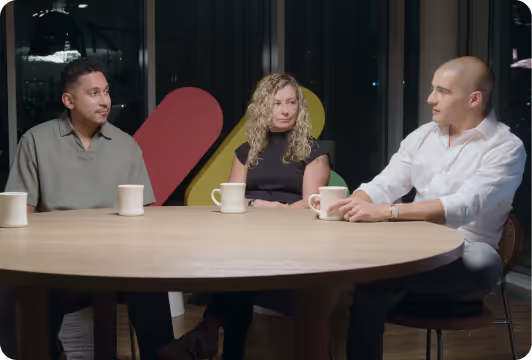
Get the unfiltered scoop from sales leaders about how to tackle major challenges with care.
Be the first to get the latest on the newest features and updates we’re rolling out on monday CRM.

Sharpen your monday CRM skills and master every stage of the customer journey.

Follow us on LinkedIn for pro sales tips, product updates, hilarious memes, and much more!
A retail CRM system is a connected set of boards for contacts, accounts, leads, and deals that keeps shopper and buyer relationships actionable across in-store, online, and multi-location workflows. In a retail CRM like monday CRM, teams can log and track every interaction in one timeline so customer context is never stuck in inboxes or spreadsheets. This makes it easier to run consistent follow-ups, manage wholesale or store-to-store opportunities, and report on revenue in real time.
Retail teams centralize customer records by linking accounts, contacts, and deals so every purchase-related conversation, quote, or reorder opportunity is visible in one place. Use the expanded item view to store key fields and connect related items. To keep profiles up to date, import customer lists or capture new leads via forms, use email and calendar integrations so activity is logged automatically, and standardize fields with dropdowns and status labels.
A strong CRM software for retail industry needs centralized records, repeatable follow-ups, and visibility into revenue. monday CRM includes key CRM capabilities like sales pipeline management with drag-and-drop deal stages, Emails and Activities timeline for logging emails, meetings, and notes, mass email and tracking, no-code automations for routing, reminders, and status updates, real-time dashboards for pipeline, funnel, activity, and forecasting, and AI agents for call notes, pipeline monitoring, and meeting prep.
Retail teams use no-code automations to trigger consistent outreach and tasks based on customer status, purchase cycles, or deal movement. For example, you can automatically create follow-up tasks when a deal moves to "Closed won" (to prompt a reorder check-in) or when a date arrives (to prompt a loyalty renewal outreach). Common repeat-revenue automations include notifying the owner and creating a task when status changes to "VIP", creating a follow-up and sending an internal reminder when a date arrives, and creating onboarding or first-30-days check-in tasks after a deal is won.
Yes, monday CRM is designed to fit your existing stack so customer and sales data can flow into one place instead of being manually re-entered. Teams commonly connect Gmail, Outlook, Google Calendar, and Outlook Calendar to capture communication automatically, use forms to collect online inquiries and create leads, and sync with Shopify, WooCommerce, Mailchimp, HubSpot, and other commerce and marketing platforms via integrations and APIs. To avoid duplicate records, combine integrations with lead qualification rules and duplicate-check processes in your lead intake flow.
monday CRM's AI reduces admin work by capturing context and prompting next steps automatically. Retail teams use AI Notetaker to transcribe calls and sync details to records, Pipeline Monitor Agent to flag stalled deals, Meeting Prep Agent to brief reps before calls, and Lead Sourcing Agent to find and score new leads. AI digital workers like Deal Facilitator support pipeline consistency across multiple locations.
Multi-location teams typically standardize one CRM structure and use fields to represent location context, then filter dashboards and views by store. In monday CRM, you can add a store or location dropdown to Contacts, Accounts, and Deals, use permissions to limit visibility when needed (e.g., region-based access), and build dashboards showing pipeline, activity, and forecasts per store. This approach keeps a single source of truth while still enabling location-level reporting.
monday CRM pricing depends on plan and seat count, and some capabilities vary by tier, with prices starting as low as $9/seat/month. AI usage is credit-based; every account gets 500 free AI credits per month, with additional credits available as needed. For the most accurate cost, compare plans based on the exact CRM features your retail team needs.
Start by creating or customizing boards for Leads, Deals, Contacts, and Accounts, then connect them so context flows automatically. Next, set up the automations that remove manual work and connect email and calendar so activity logs without extra effort. A simple rollout checklist includes importing existing customer data and standardizing key fields, configuring deal stages for your retail or wholesale sales cycle, adding mass email and tracking for consistent outreach, and building a dashboard for pipeline, funnel, and forecast visibility.



.avif)