

The gap between “good enough” and genuinely high performing is where competitive advantage lives — and the data proves it. Teams with high engagement are 18% more productive and 23% more profitable than their disengaged counterparts, yet building that level of performance demands more than hiring talented individuals or investing in collaboration tools.
This guide delivers research-backed frameworks, management tactics, and practical steps to improve team impact and transform how your team works together. You’ll learn what separates high-performing teams from average ones, how to build psychological safety and accountability, and how the right platform can help you implement these strategies at every level.
Key takeaways
- Characteristics matter: High-performing teams share specific, measurable characteristics: trust, accountability, psychological safety, and aligned goals.
- Leadership is the lever: Managers drive up to 70% of the variance in team engagement, making leadership the single highest-leverage factor in team performance.
- Three practices drive effectiveness: Feedback, recognition, and psychological safety can have a significant impact on team effectiveness.
- Distance demands structure: Remote and hybrid teams need intentional communication structures and shared visibility to maintain performance across distances and time zones.
- Infrastructure enables execution: monday AI Workspace provides dashboards, automations, and AI-powered insights that help managers track and improve team effectiveness in real time.
What is a high-performing team?
A high-performing team consistently delivers results that exceed expectations while maintaining member well-being and professional growth. It’s not a team that occasionally hits a deadline or ships a product on time. It’s a team that does so reliably, adapts when conditions change, and holds itself accountable without constant oversight.
The data makes the distinction concrete. Gallup’s meta-analysis of over 180,000 teams found that high-performing teams show 18% higher productivity, 23% greater profitability, and significantly lower turnover than average teams. Deloitte’s 2026 research adds an important nuance: The capabilities driving these results aren’t purely technical. Collaboration, judgment, and adaptability are the differentiators.
So what separates a “good” team from a high-performing one? Three things stand out across the research:
- Consistency: High-performing teams deliver results repeatedly, not just during crunch periods or under pressure.
- Self-correction: They identify problems early and adjust without waiting for a manager to intervene.
- Balanced output: They hit targets while keeping burnout low, retention high, and morale stable.
In practice, this looks like a product team shipping ahead of schedule while reducing overtime hours, or a sales team exceeding revenue targets while improving customer satisfaction scores. The defining trait isn’t heroic effort. It’s sustainable, repeatable excellence that translates into measurable team impact.
7 characteristics of high performing teams
Before you can build a high-performing team, you need to recognize what one looks like. These characteristics appear consistently across research from Gallup, Google, and McKinsey:
1. Shared purpose and aligned goals
Teams perform at their peak when every member understands how their individual work connects to the larger mission. Without that connection, work becomes a series of disconnected tasks rather than a coordinated effort toward a meaningful outcome. Shared purpose isn’t a poster on the wall. It’s a living understanding that shapes daily priorities and trade-off decisions.
2. Psychological safety
Google’s Project Aristotle studied 180 teams and concluded that psychological safety was the single most important factor in team effectiveness. When team members feel safe to take risks, admit mistakes, and ask questions without fear of punishment, innovation and performance both increase.
3. Defined roles and accountability
Each member knows what they own and what their teammates own. Overlap causes conflict. Gaps cause failure. Strong team management requires mapping responsibilities so every deliverable has a single owner and every team member has a defined scope.
4. Open and frequent communication
An Economist Intelligence Unit and Lucidchart study found that 86% of executives blame lack of collaboration and communication for workplace failures. High-performing teams don’t just communicate more; they communicate with greater intention and structure.
5. Trust and mutual respect
Trust is built through consistency, not team-building exercises. When team members follow through on commitments and treat each other’s time and expertise with respect, trust compounds over time. Deloitte’s 2026 research emphasizes that these human capabilities are foundational, not supplementary.
6. Adaptability and continuous improvement
High-performing teams treat setbacks as data, not failures. They run retrospectives, adjust processes, and iterate. A team that can’t adapt to changing conditions will eventually plateau, regardless of how talented its members are. The most effective teams build reflection into their rhythm, reviewing what worked and what didn’t after every major milestone.
7. Results orientation with balanced well-being
Performance without sustainability leads to burnout. The strongest teams track team impact through both outcomes (delivery speed, quality, goal attainment) and team health (engagement scores, retention rates, workload distribution). One without the other is incomplete.
Get Started
How to build a high-performing team

Knowing the characteristics is step one. Building a team that embodies them requires intentional management decisions, starting from how you hire and onboard.
1. Hire for complementary strengths, not uniformity
Diverse skill sets and perspectives outperform homogeneous teams. McKinsey’s “Diversity Wins” research found that companies in the top quartile for ethnic and cultural diversity are 36% more likely to outperform on profitability. When building your team, look for people whose strengths fill gaps rather than duplicate existing capabilities.
2. Set expectations and norms early
Establish communication cadences, decision-making protocols, and conflict resolution norms in the first 30 days. Ambiguity compounds over time and becomes exponentially harder to resolve.
Jason Miller puts it directly: Whenever someone new joins his team, he explains that his goal is to help them grow and improve. He openly acknowledges that he doesn’t expect anyone to stay on his team forever and, for that reason, he wants to make sure that by the time they leave, they are stronger than when they arrived.
Setting that expectation from the start gives team members confidence that feedback and challenges come with the ultimate goal of helping them reach their full potential. There are many ways to improve team performance, and building this foundation of trust early is one of the most effective.
3. Invest in the right infrastructure
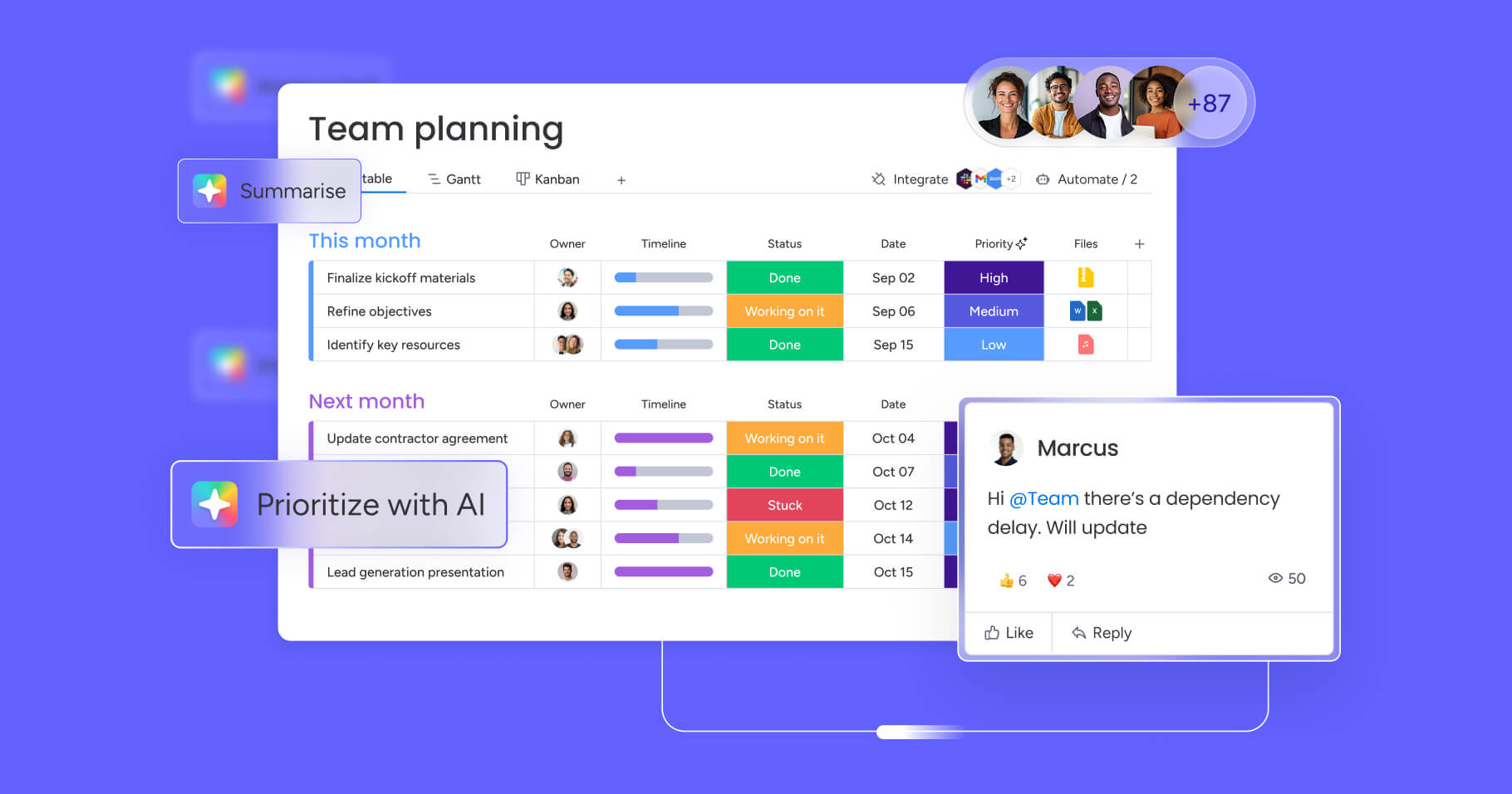
Teams need systems, not just motivation. Platforms that enable real-time visibility and automated workflows reduce friction between people and their work. Platforms like monday AI Workspace help by centralizing communication and automating routine handoffs, so team members spend their energy on high-impact work instead of status updates and manual follow-ups.
4. Create feedback loops from day one
Don’t wait for quarterly reviews. Build regular check-ins and feedback loops into the team rhythm from the start. The sooner you normalize giving and receiving feedback, the faster the team reaches high-performance territory. Weekly one-on-ones, biweekly retrospectives, and real-time project updates create multiple channels for course correction.
Teams that treat feedback as a continuous process rather than a scheduled event consistently outperform those that rely on annual review cycles.
Management strategies that drive team performance
Gallup’s research delivers a headline stat that every manager should internalize: Managers account for 70% of the variance in team engagement. That’s not a rounding error. That means the single most influential factor in whether a team performs at a high level is the person leading it.
1. Pay attention and give honest feedback
It can be hard for us, as people, to take a step back and identify our greatest weaknesses. That’s where you, as the manager, come in. Pay attention and take the time to understand each of your employees’ strengths and weaknesses. Then, help them grow and develop by giving them timely, honest, and authentic feedback.
Phrases like “good job” or “I think you could have handled that differently” don’t give your employees the direction or insights needed to get stronger. What does help is when you can spot specific elements that your employee is doing well and where they have room to improve. Be sure to create an open line of communication with your team members and to explicitly state your point. There’s a difference between giving critiques in a supportive way and sugarcoating so much that you fail to provide any tangible feedback.
When Jason Miller identifies an opportunity for a team member to improve, he’ll often start his feedback by asking, “Can I be very direct with you?” He also reiterates his goals in sharing the feedback to set the right tone for the conversation and establish an environment of openness and transparency.
The data supports this approach. Gallup finds that employees who receive daily feedback from their manager are 3x more likely to be engaged than those who receive feedback once a year. One practical framework for delivering effective feedback is the SBI model: Describe the Situation, the specific Behavior you observed, and the Impact it had.
This structure keeps feedback objective and actionable, which aligns with what performance management research consistently recommends.
2. Keep your team members challenged
When work becomes repetitive and mundane, employees start to feel like they’ve reached their ceiling and may begin to lose interest. As a leader, it’s important to identify opportunities for them to continue to grow and develop. As you come to understand their professional weaknesses, hand them opportunities in which they’ll be challenged to tackle those limitations head on and truly improve.
While it’s widely assumed that employees are constantly looking for promotions, research suggests that more often, they’re simply seeking new challenges and the chance to explore something different. According to the MIT Sloan Review, lateral career opportunities are 12x more predictive of employee retention than promotions. LinkedIn’s Workplace Learning Report reinforces this:
94% of employees would stay longer at a company that invested in their learning and development.
Challenging work requires trusting people with real ownership, not just delegating tasks, but handing over decisions and outcomes. When you assign a stretch project, resist the urge to micromanage the approach. Define the desired outcome, provide the resources, and step back. The growth happens in the space between the assignment and the result.
3. Provide thoughtful recognition
One of the secrets to being a great manager is simply caring. Knowing how to make your employees feel seen and celebrate successes can make all the difference. Frequency matters more than scale. A quick, specific acknowledgment outperforms a quarterly award ceremony, and spotlighting employees’ wins in a recurring newsletter feature or team channel keeps that recognition visible long after the moment passes.
Early in his career, he received a private message, out of the blue, from the CEO at his organization that was very meaningful and showed she recognized his contributions. That always stuck with him and is something he actively tries to do with his team members. As a manager of many people, he still goes out of his way to reach out to employees and let them know that he sees and appreciates the small things they do too. “Giving recognition for something outside of the norm can go a long way,” he adds.
4. Build psychological safety through vulnerability
Psychological safety isn’t something you declare; it’s something you model. When managers admit their own mistakes, ask for help, and respond to bad news without blame, they create conditions where the entire team feels safe to do the same. Google’s Project Aristotle research found this to be the number-one predictor of team effectiveness.
This connects directly to Miller’s philosophy of making intentions transparent. When you tell your team, “My goal is to help you grow, and I’ll be direct with you because of that,” you create a framework where honest conversation is expected, not feared. Leadership effectiveness depends on creating this kind of environment deliberately, not hoping it emerges on its own.

How remote and hybrid teams maintain high performance
With remote and hybrid work now standard for most knowledge workers, the principles of high-performing teams must be adapted for distributed environments. The fundamentals don’t change, but the execution does.
- Intentional communication cadences: Replace hallway conversations with structured async updates and synchronous check-ins. Define which decisions happen in meetings, which happen in shared documents, and which happen in direct messages. Without this structure, remote teams either over-communicate or under-communicate.
- Visibility into work progress: Distributed teams need shared dashboards and status tracking to replace the ambient awareness of a physical office. When everyone can see project status, blockers, and workload in real time, coordination improves without requiring more meetings.
- Building trust across time zones: Over-communicate intent and context. Document decisions and the reasoning behind them. Trust erodes fastest when people can’t see what’s happening or understand why choices were made.
- Avoiding proximity bias: Managers must ensure remote team members get equal access to high-visibility projects, stretch assignments, and recognition. Gartner’s 2026 HR priorities report highlights workforce redesign as a critical focus area, including ensuring equity across distributed teams in the age of human-AI collaboration.
The teams that thrive in distributed environments don’t just replicate office routines over video calls. They redesign their workflows for asynchronous-first collaboration, with synchronous touchpoints reserved for alignment, relationship-building, and decision-making. The goal isn’t to recreate the office experience remotely. It’s to build a distributed operating model that’s actually more effective than what came before.
Get Started
How monday AI Workspace helps teams perform at their best
The strategies discussed here work most effectively when they’re supported by the right infrastructure and managers have visibility into team impact. monday AI Workspace brings together AI, automation, and real-time visibility to help managers implement everything from goal alignment to workload management to feedback loops.
Here’s how the platform maps to the core challenges of building high-performing teams:
| Team performance challenge | monday AI Workspace solution |
|---|---|
| Aligning goals across the team | Dashboards with real-time OKR tracking and AI-powered status summaries |
| Keeping communication structured | monday sidekick summarizes updates, generates action items, and surfaces what matters |
| Tracking workload and preventing burnout | Workload widget and resource planner for capacity visibility and rebalancing |
| Automating repetitive handoffs | 200+ no-code automations for assignments, notifications, and status changes |
| Identifying risks before they escalate | monday agents (Risk Analyzer) flag schedule, dependency, and workload risks |
| Running effective meetings | Meeting Summarizer agent creates transcripts, summaries, and action items |
| Building custom workflows without code | monday vibe lets teams build apps from natural language descriptions |
The future of high-performing teams
High-performing teams share specific characteristics — psychological safety, aligned goals, trust, and adaptability — and managers drive up to 70% of the variance in team engagement through feedback, recognition, and intentional leadership.
As AI takes on routine work, the human capabilities that matter most (collaboration, judgment, adaptability) become even more critical, making the combination of human-centered practices and AI-powered infrastructure the defining advantage.
The managers who build these teams don’t leave performance to chance. They’re intentional about how they hire, communicate, challenge, and recognize their people—and they use platforms like monday AI Workspace to turn strategy into execution.
Get StartedFAQs
What are the key characteristics of a high-performing team?
High-performing teams share a common purpose, communicate openly, hold each other accountable, and adapt to change. Google's Project Aristotle research found that psychological safety is the single most important factor in team effectiveness.
How can managers improve team performance?
Focus on frequent feedback, meaningful recognition, and creating psychological safety. Gallup research shows managers account for 70% of the variance in team engagement, making leadership the highest-leverage factor.
How do you measure team effectiveness?
Measure team impact by tracking both output metrics (delivery speed, quality, goal attainment) and health metrics (engagement scores, retention rates, meeting effectiveness). Dashboards on monday AI Workspace can automate this tracking in real time.
What tools help build high-performing teams?
Look for platforms that centralize communication, automate workflows, and provide real-time visibility into work. monday AI Workspace combines AI-powered insights, workload management, and no-code automations to support team performance across distributed and in-office teams.
How do remote teams maintain high performance?
Establish intentional communication cadences, use shared dashboards for visibility, and ensure equal access to recognition and growth opportunities for all team members regardless of location.
What does team impact mean?
Team impact describes the measurable effect a team has on business outcomes, including productivity, quality, goal attainment, customer satisfaction, and organizational performance. Strong team impact also considers sustainable measures such as engagement, retention, and workload balance.
