


Product teams design what ships. Service teams fix what breaks. For too long, these functions have operated in separate worlds, creating a gap that frustrates customers and misses opportunities for improvement.
The integration of AI in product lifecycle management (PLM) has changed this dynamic, connecting product data directly to service operations. Now, support teams have the context they need to solve issues faster, and your product teams learn from real service outcomes to build more reliable, customer-centric products.
This guide describes how AI transforms each product lifecycle stage and introduces monday service as a platform that connects product teams with service operations.
Try monday serviceKey takeaways
- AI transforms product lifecycle management by connecting product data directly to service operations, helping teams resolve issues faster and prevent problems before they happen.
- The biggest gains come from breaking down data silos between PLM and service systems, creating a complete digital thread from design to support.
- To get started, focus on quick wins like automated ticket classification and knowledge suggestions to build momentum, then scale gradually across product lines.
- Data quality and team adoption should be your first priorities. Clean product identifiers and consistent processes matter more than advanced AI features when starting out.
- monday service bridges the gap between product teams and service operations with AI-powered workflows, real-time analytics, and no-code automation that keeps everything connected.
What is AI in product lifecycle management?
AI in product lifecycle management is the use of machine learning and automation to make PLM systems smarter. This means your PLM can:
- Predict outcomes like potential product failures, warranty claim patterns, or quality issues before they impact customers.
- Recommend decisions such as design changes or maintenance scheduling to help you resolve service tickets faster.
- Connect product data directly to teams like manufacturing, support, and field service.
Traditional vs AI in product lifecycle management
To understand how AI supports product lifecycle management, it’s useful to compare it to traditional PLM approaches.
| Aspect | Traditional PLM | AI-Enhanced PLM | |||||
|---|---|---|---|---|---|---|---|
| Data processing | Organizes structured product data (part numbers, BOMs, CAD files) | Processes both structured and unstructured data (service tickets, sensor logs, customer feedback) | |||||
| Decision-making | Manual searching and analysis across teams | Pattern recognition and predictive recommendations based on historical data | |||||
| Automation | Static workflows that require manual updates | Adaptive workflows that learn and improve from each interaction | |||||
| Issue detection | Reactive — problems identified after they occur | Proactive — forecasts potential failures and quality issues before customer impact | |||||
| Service integration | Product and service data exist in separate silos | Direct connection between product data and service operations for faster resolution | |||||
| Time-to-market | Standard development cycles with periodic reviews | Accelerated cycles driven by AI insights and real service outcome feedback | |||||
| Knowledge management | Static documentation that requires manual updates | Dynamic knowledge base that continuously learns from service interactions |
How AI revolutionizes each product lifecycle stage
AI transforms how teams work at each stage of the product lifecycle by connecting real-world signals directly to decision-making. Here’s how AI creates value from concept through ongoing support.
Requirements and ideation
Traditional requirements gathering relies on stakeholder interviews and limited customer feedback. AI changes this by analyzing real-world data, such as service tickets, warranty claims, and product usage patterns, to uncover recurring pain points you might otherwise miss.
For example, if AI flags that returns are spiking for products used in cold climates, requirements become more specific — “battery drains 40% faster below freezing” instead of “battery life is bad.”
Design and development acceleration
AI compresses design cycles by recommending options based on past performance. Generative design creates multiple component shapes under your constraints and AI-assisted testing predicts failure points from simulation data.
When products have dozens of variants, AI suggests the best combinations based on field performance. Overall, faster iteration means a faster time-to-market.
Smart manufacturing and quality control
AI monitors production in real time instead of periodic sampling. Computer vision detects defects faster than manual inspection and predictive models catch tool wear before it creates scrap.
Quality becomes a continuous signal. Today’s manufacturing anomalies often become next month’s warranty claims — AI helps you catch them early.
AI-powered service and maintenance
Traditional service reacts after failures have already happened. In contrast, AI predicts service needs by spotting warning signs like abnormal vibration or error sequences. When customers do reach out, AI suggests fixes based on their exact product version.
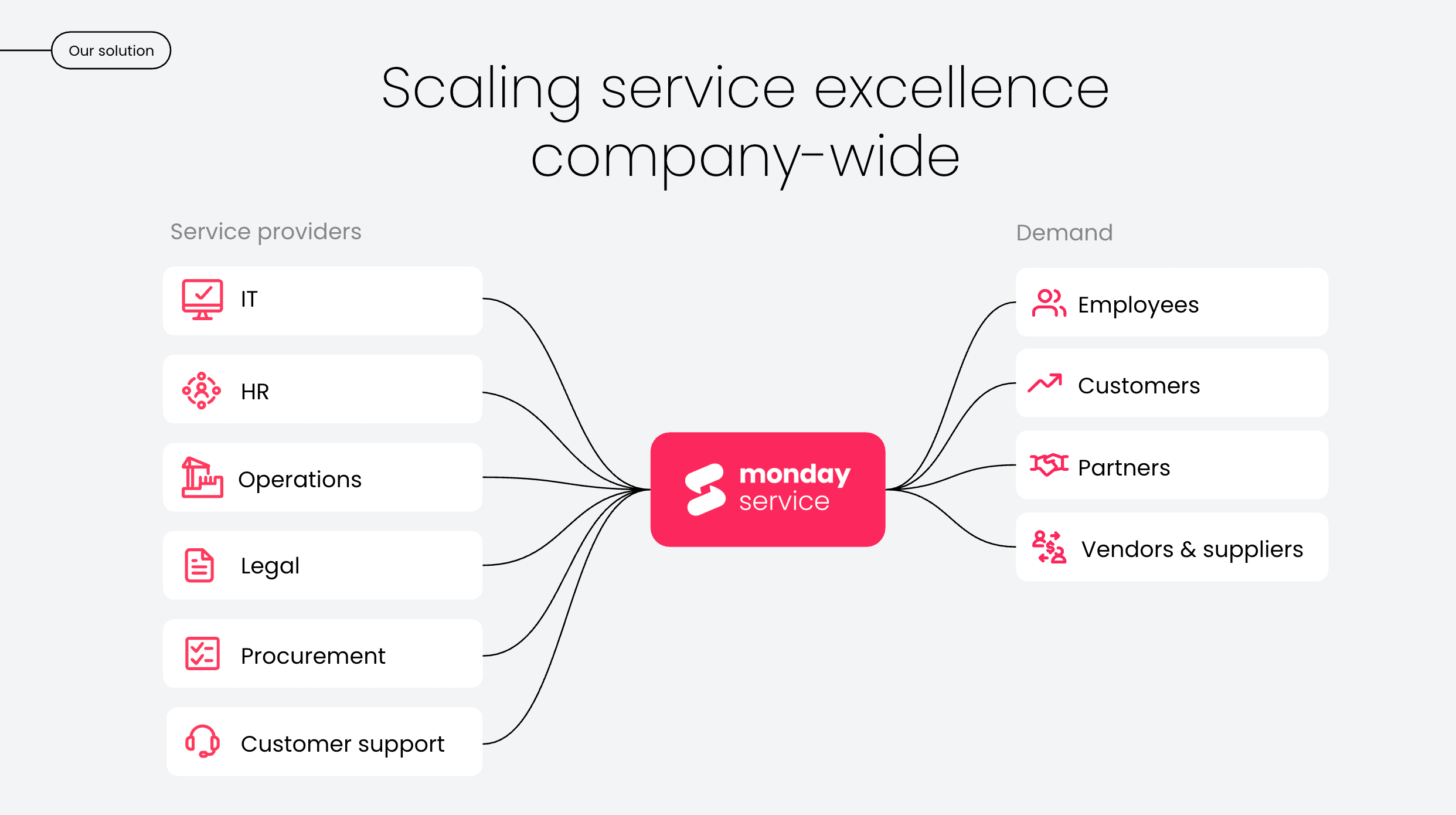
Service platforms like monday service become more effective when connected to PLM data. Agents see accurate product history and approved procedures without switching systems.
6 key applications of AI across product operations
The following applications turn product-service integration into daily reality. AI connects product data, workflows, and customer outcomes across your organization.
Predictive maintenance using product data
Predictive maintenance uses AI to analyze sensor data and predict when products need service. This replaces “fix after failure” with “fix before downtime.”
A pump manufacturer might predict bearing failure from vibration patterns weeks before breakdown. Service teams schedule maintenance during planned downtime and order parts early.
Automated knowledge management
AI organizes product information so teams find answers quickly. It creates searchable knowledge bases from manuals, change orders, and resolved cases.
Knowledge stays current as AI summarizes updates after each design change. New agents ramp faster because the system identifies relevant content by symptom and model.
Intelligent workflow orchestration
AI coordinates tasks across teams by routing work based on urgency, skill match, and parts availability. High-severity tickets trigger automatic escalation to engineering. Common requests get resolved with approved responses.
Real-time quality feedback loops
AI links manufacturing signals to service outcomes. If tickets spike for a serial range, for eaxmple, AI traces those units back to a supplier lot or assembly station.
This shortens containment time, as you identify impacted customers sooner and fix upstream issues before they spread.
Cross-team collaboration automation
AI reduces friction between departments by summarizing ticket themes for engineering and notifying teams when patterns indicate product-wide issues. The key capabilities that improve collaboration are:
- Automated alerts: System flags when “overheating” reports spike for one model
- Common language: “Screen flicker” in support maps to known defect categories
- Smart routing: Engineering gets reproduction steps while support gets customer messaging
Service ticket intelligence
AI analyzes ticket content to identify product issues and recommend actions. It classifies tickets, extracts key details, and predicts escalations.
AI detects that “Error 172 + reboot” matches a firmware issue and recommends the patch. monday service combines these AI capabilities with ticket workflows for fewer repeat issues.
Try monday serviceHow does AI connect product data to service excellence?
AI-powered PLM creates a two-way connection between product teams and service operations, offering the following benefits.
Eliminates product-service data silos
Silos form when product data sits in PLM while service data sits in separate systems. If your service team is still guessing which version customers run, AI unifies these views by:
- Linking tickets to configurations: Agents see warranty status and recent changes
- Facilitating cross-system search: Find answers across PLM docs and resolved cases
- Normalizing messy data: Extract error codes from free text for analytics
- Sharing ownership: Flag product defects and create engineering work items
Builds digital threads from design to support
A digital thread connects product information across its lifecycle. Every unit traces back to its configuration, build conditions, and known issues.
AI maintains these relationships even when data formats differ. Service agents see the exact variant, recent changes, known issues, and parts compatibility, turning generic troubleshooting into configuration-aware resolution.
Creates continuous improvement cycles
Service outcomes inform product decisions through AI. Engineering prioritizes work that reduces future tickets and quality teams correct process drift based on downstream failures.
Teams stop shipping fixes that look good on paper but fail in practice. Customers receive concrete guidance instead of vague updates.
What are the main benefits of AI in product lifecycle management?
When product and service data work in harmony, you’ll see measurable improvements across your operations, including:
- Accelerated time-to-market and issue resolution: AI predicts risk areas early and recommends proven configurations, helping you ship sooner with fewer redesign cycles. Root-cause identification that once took days now takes hours.
- Enhanced cross-departmental efficiency: AI attaches context to escalations, eliminating clarification loops. Engineering gets actionable cases, not vague complaints, while experts spend less time on repeat questions.
- Reduced operational costs: Predictive maintenance cuts emergency dispatch and overtime. AI catches quality drift early, reducing scrap and warranty costs while eliminating hours of manual categorization.
- Superior customer experience delivery: AI finds the right fix faster, so customers don’t repeat their story. Predictive maintenance triggers before failure, reducing downtime and ensuring consistent support quality.
Essential AI technologies driving modern PLM
Different AI technologies serve different roles in PLM. Here’s how the most impactful ones work together to transform product lifecycle management.
- Generative AI and industrial foundation models: Creates summaries, troubleshooting steps, and documentation from product context while translating complex technical data into plain language
- Machine learning for predictive analytics: Identifies patterns to predict failures, forecast service volume, and detect manufacturing drift before issues impact customers
- Natural language processing applications: Transforms unstructured ticket text into analyzable data, enabling semantic search and automatic extraction of error codes and symptoms
- AI copilots and service assistants: Delivers intelligent suggestions directly in your workflow, from troubleshooting steps to compatibility warnings, without switching systems
7 steps to implement AI in product service workflows
Implementing AI in your product service workflows doesn’t require a complete system overhaul. The key is starting with clear integration points between your PLM and service data, then building momentum through focused pilots.
The following steps guide you from assessment to scale, helping you connect product context to service operations in a way that improves both customer outcomes and team efficiency.
Step 1: Evaluate current PLM-service integration
Assess where product context gets lost between systems. Check if serial numbers appear reliably in tickets. Can agents access manuals without leaving their workflow? Do ticket outcomes flow back to product teams?
Measure baseline metrics like percent of tickets with verified product data and time spent searching for information.
Step 2: Identify quick-win use cases
Start with high-impact, low-complexity wins:
- Ticket auto-classification: Reduce triage time and misroutes
- Knowledge suggestions: Increase first-contact resolution
- Case summarization: Improve engineering handoffs
- Duplicate detection: Prevent fragmented investigation
- Predictive alerts: Reduce unplanned downtime
Step 3: Establish data governance standards
AI needs clean, consistent data. Set standards for product naming, required ticket fields, and symptom vocabularies. Focus first on identity fields and resolution outcomes, as these power linking and learning.
Step 4: Select an AI-ready platform
Choose a platform like monday service that supports integration, automation, and a business-friendly interface. The right platform becomes the foundation for connecting product data to service operations, so evaluate options carefully.
Look for these essential capabilities:
- Native integrations: Pre-built connectors to your PLM, ERP, and CRM systems that sync product data automatically
- Flexible APIs: Open architecture that lets you connect custom systems and build workflows that match your processes
- Adaptable data models: Ability to structure product hierarchies, configurations, and relationships without rigid schemas
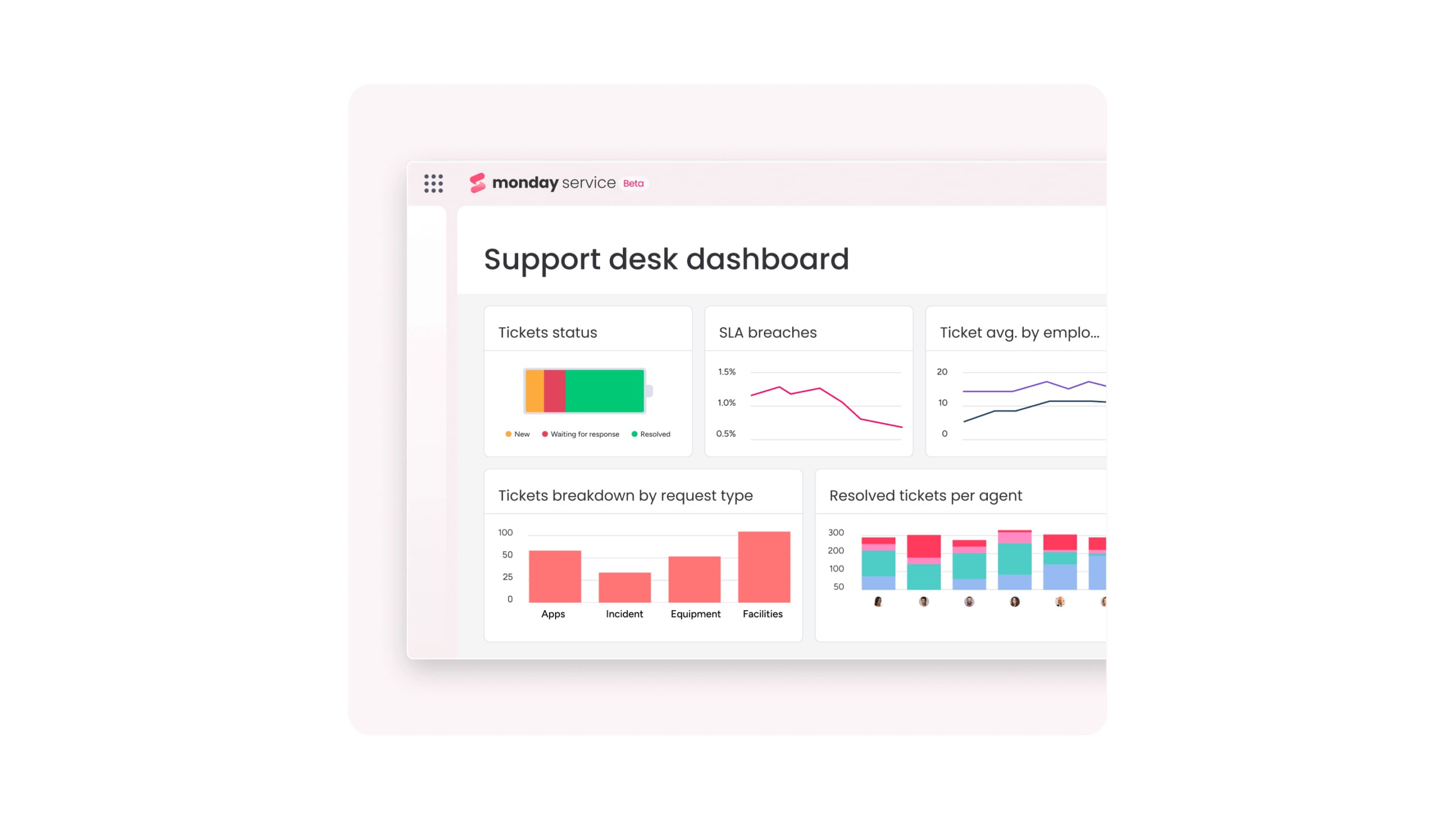
- Built-in analytics: Real-time dashboards that surface patterns across product lines and service outcomes
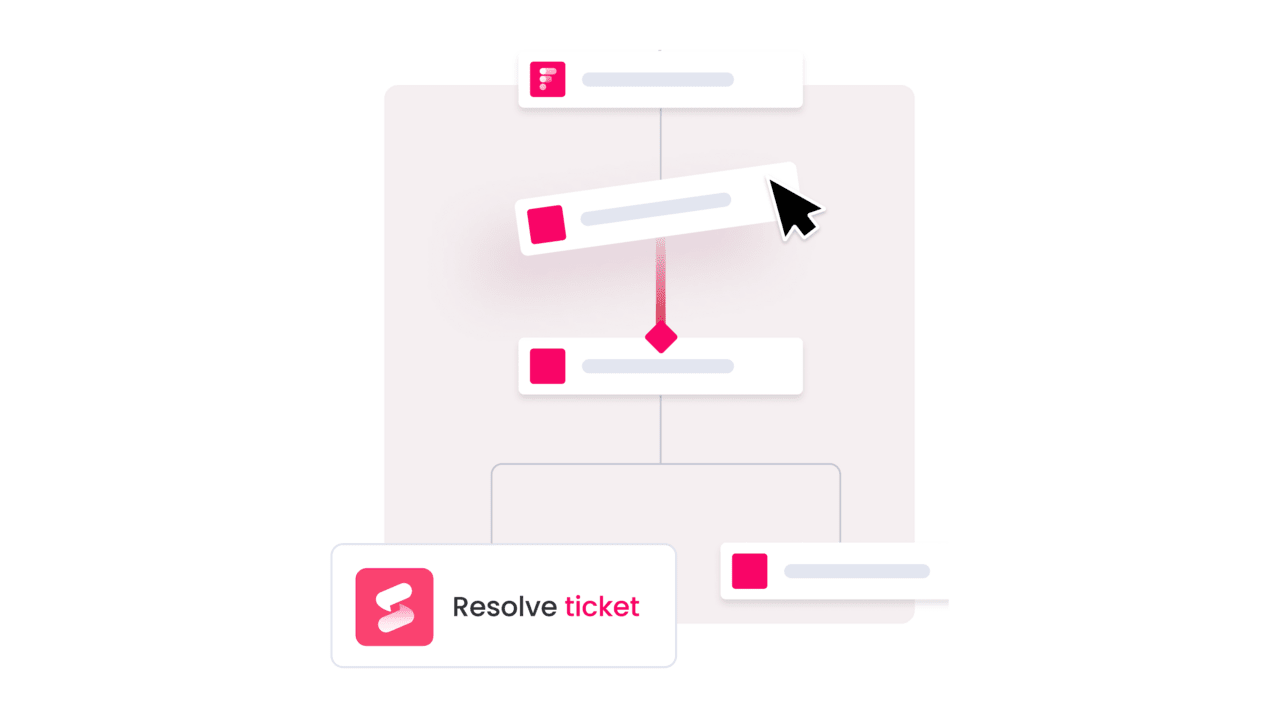
- No-code automation: Visual workflow builders that let service teams create automations without IT dependencies
- AI-ready infrastructure: Platform architecture designed to support AI agents, copilots, and machine learning models
Step 5: Launch focused pilot projects
Run pilots with narrow scope and clear metrics. Target one product line or ticket category with enough volume to learn quickly.
For example, you might start with warranty claims for a specific product model, aiming to reduce average resolution time from 48 hours to 24 hours within 90 days.
Track what works so you can replicate it when you move to other product lines.
Step 6: Scale across product and service teams
Once your pilot proves successful, expand gradually, either by product line or geographic region. As you scale, focus your training on practical application: teach teams how to use AI recommendations in their daily work rather than diving into theoretical concepts. It’s also important to establish clear feedback channels so frontline users can report what’s working and what needs refinement.
The most effective implementations happen when engineering and service teams share ownership of problem categories. This joint accountability lets AI insights flow in both directions.
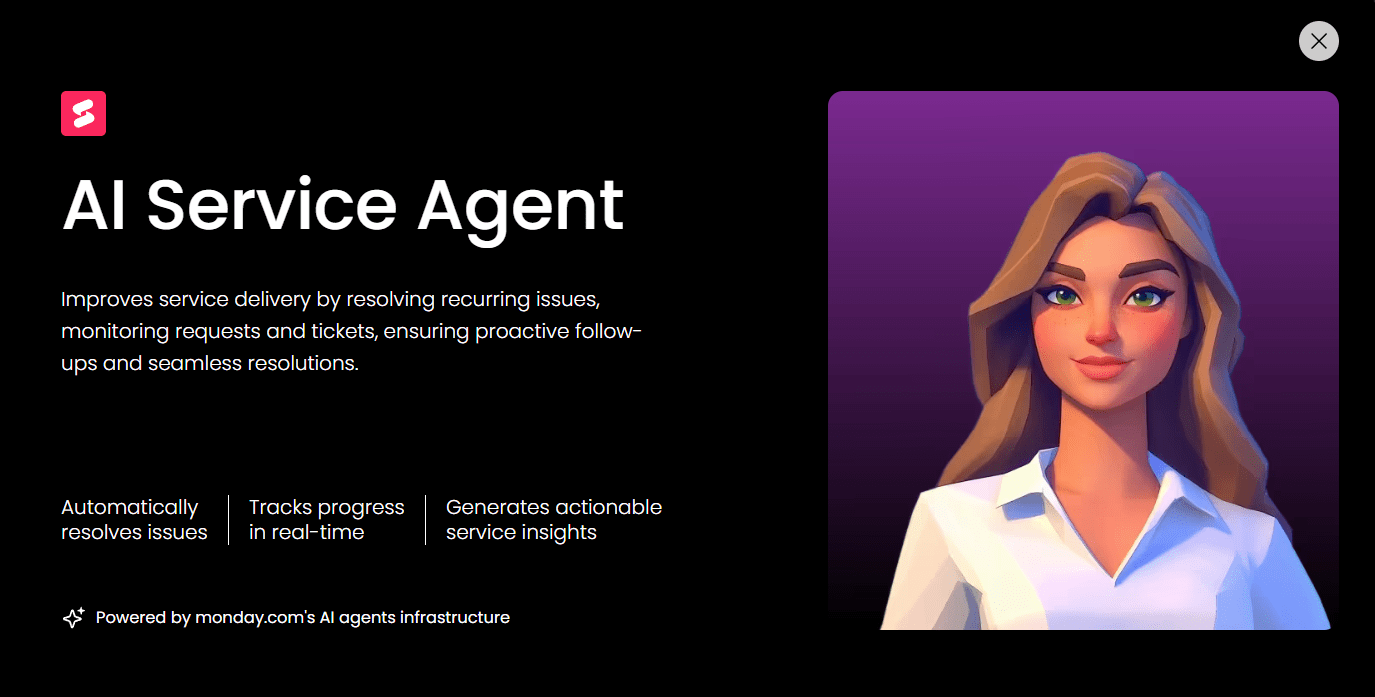
For example, AI agents for product management are autonomous systems that take action based on specific goals and real-time context. Unlike traditional automation that follows rigid scripts, agents adapt their approach as they gather information, adjusting their next steps based on what they discover along the way.
Step 7: Measure impact and optimize
Track metrics like resolution time, reopen rate, incidents per unit, and warranty costs that prove ROI and guide where you should optimize next.
Unlike traditional software that stays static after launch, your AI system gets smarter with every ticket it processes and every resolution it observes. Optimization becomes an ongoing process that continuously refines its recommendations based on what works in your environment.
How AI agents transform PLM service operations
AI agents are autonomous systems that take action based on specific goals and real-timecontext. Unlike traditional automation that follows rigid scripts, agents adapt their approach as they gather information, adjusting their next steps based on what they discover along the way. They work independently to complete tasks, but keep humans in control for critical decisions andapprovals.
Here’s how AI agents transform PLM service operations.
AI agents automate service workflows
Agents handle intake enrichment, resolution execution, and escalation packaging. An agent might extract error codes, look up warranty, and attach troubleshooting steps. Or it might detect severity, compile reproduction steps, and route to engineering.
Agents reduce coordination work while preserving human approval for sensitive actions.
AI agents build context-aware service assistants
Context-aware assistants use product data to tailor help. They combine symptoms with configuration and known issues to provide relevant troubleshooting, compatibility warnings, and faster issue identification.
The assistant works best when it sees the full digital thread, not just ticket text.
AI agents connect copilots to product knowledge
Copilots need approved product knowledge and current PLM data. They reference manuals, change history, known problems, and approved procedures.
This connection prevents hallucinated responses and keeps service aligned with engineering intent.
How to navigate AI implementation challenges
While AI delivers measurable value across product lifecycle management, successful implementation requires addressing several common obstacles. The good news is each challenge has practical solutions that keep your rollout on track.
Data quality and integration
The challenge: Inconsistent product identifiers across systems, like “Model-X-2024” in PLM but “ModelX2024” in service tickets, prevent AI from connecting design decisions to field issues.
The solution: Create mapping layers between naming conventions and make serial numbers required fields in service tickets. Use NLP to extract structured data from ticket notes, and build API-based integrations that keep product data current as your catalog evolves.
Organizational change
The challenge: Teams resist AI when they fear job displacement or added complexity. Without buy-in, even sophisticated AI systems go unused.
The solution: Frame AI as removing repetitive work like ticket categorization so teams can focus on complex problem-solving. Stage rollouts with feedback controls, share concrete metrics like faster resolution times, and use quick wins in triage speed to build momentum.
Security and compliance
The challenge: AI needs access to sensitive product data and customer information. In regulated industries, data breaches or compliance violations create significant risk.
The solution: Implement role-based access controls and encryption for data in transit and at rest. Establish audit trails for AI recommendations, assess vendor security practices, and consider hybrid approaches that keep sensitive data on-premises. Embed AI into your existing governance framework.
Trust in AI recommendations
The challenge: Black-box recommendations without clear reasoning create hesitation. Teams either ignore AI suggestions or follow them blindly.
The solution: Provide sources and confidence signals with every recommendation. Start with human review workflows before full automation, capture outcomes to improve the system, and let trust build through measurable improvements like fewer reopens and reduced misroutes.
Accelerate product service excellence with monday service
monday service is a service management platform that connects your support operations directly to product data, creating a unified workspace where service teams can resolve issues faster and product teams can learn from real-world outcomes. With the following features, your teams will have the product context they need without switching between disconnected tools.
AI agents that connect product intelligence to service resolution
monday service deploys AI agents that autonomously enrich tickets with product context from your PLM systems. When a ticket arrives, agents automatically extract serial numbers, match them to product configurations, retrieve warranty status, and surface known issues—all before a human touches the case.
Your service teams see complete product history, approved troubleshooting procedures, and compatibility warnings directly in their workflow, eliminating the context-switching that slows resolution and increases errors.
Agentic workflows that learn from every interaction
Unlike static automation, monday service uses agentic AI that adapts based on outcomes. AI agents analyze ticket patterns to automatically route complex cases to specialists, suggest resolutions based on similar past issues, and flag emerging product defects before they become widespread problems.
The system learns which troubleshooting steps work for specific product variants and continuously refines its recommendations, turning every resolved ticket into training data that makes future resolutions faster and more accurate.
Predictive analytics that close the product-service loop
monday service’s AI-powered analytics connect service outcomes directly back to product teams. The platform identifies which product configurations generate the most support volume, which design changes reduced ticket reopens, and which serial number ranges show early warning signs of failure.
Ready to connect your product data with service excellence? Try monday service today and see how AI-powered workflows transform support into a strategic advantage.
Try monday serviceFrequently asked questions
How is AI different from traditional PLM automation?
AI differs from traditional PLM automation because it learns and adapts over time. Traditional automation follows fixed rules, while AI handles unstructured inputs like ticket notes to generate intelligent recommendations.
What ROI can organizations expect from AI in PLM?
Organizations typically see ROI through reduced downtime, lower warranty costs, and faster service resolution. Results often appear within the first year, with predictive maintenance and faster triage driving early savings.
Can AI integrate with existing PLM and service platforms?
Yes, AI integrates with existing platforms through APIs, connectors, and middleware. Most AI solutions pull context from multiple systems rather than replacing them.
How much product data is needed to leverage AI effectively?
AI delivers value starting with basic data like product hierarchy and historical tickets. Quality and clean identifiers matter more than volume initially. Performance improves as you add outcomes and telemetry.
What skills do service teams need for AI-powered PLM?
Service teams need to interpret AI recommendations, validate suggestions, and provide feedback. Modern platforms are designed for business teams — deep technical skills aren't required.
How long does it take to implement AI in product lifecycle management?
Focused pilots typically take one to three months. Broader rollouts across products and regions take 6 to 18 months. Timeline depends on integration complexity and data readiness.

 Get started